Complex Crafting
I dedicated a paragraph to Nightingale’s crafting system in my initial Impressions post, but after spending some more time with it and going up the Tiers, it deserves its own article. In short, I haven’t seen a more (optionally!) complex, min-maxing crafting system anywhere else.
At the base level, all the resources that you collect – wood, ore, meat – have attributes. If you craft something using a resource, that item inherits the attributes. That’s… actually it. That’s the system. The key is that as you unlock higher Tier recipes, they call for more complex ingredients, which have intermediate crafting components. In most games, these intermediate items are just a resource sink. The trick Nightingale pulls off is that every crafting steps allows for more opportunity to stuff the end product with extra attributes.
Let’s use a real example. I recently unlocked the first part of Tier 3 items, and I want to upgrade my old gloves to Calcularian Gloves. The recipe is:
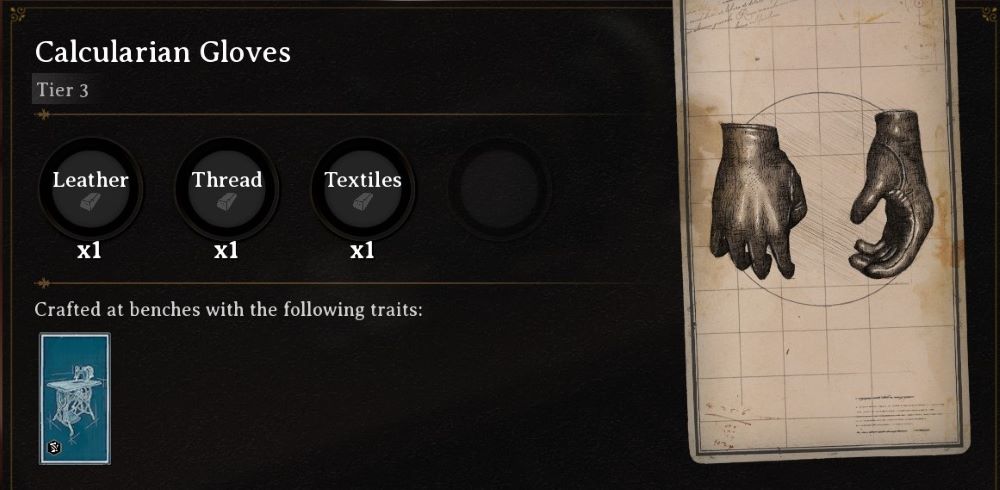
Fairly straight-forward, no? Let’s look at Leather. To make Leather, you need Hide, which comes from skinning creatures out in the world. Hide (Prey) grants +Stamina and Hide (Predator) grants +HP, which is fine, but there is also Fabled Hide that drops from bosses and special mobs that have an assortment of bonus stats. Pick one, craft the Leather, and move to the next ingredient.
…or maybe add a little more juice? As it turns out, Nightingale crafting has an additional unspoken feature in that higher-tier components can be substituted for their standard varieties. In this example, the recipe calls for Leather, but you can use Reinforced Leather for that slot. What’s that? It’s Leather x2 and a Fastener, the latter of which is crafted from Ingots. Now we can bring in some (m)ore stats. I’m a fan of Brass Ingots, as it has Melee Damage +4%, Ranged Damage +6%, and Durability +20. Craft the Fastener (Brass), combine with Leather, and we now have the first (!) ingredient ready for those gloves.
Next is Thread. What, you thought I was just going to “yada, yada, yada” this away? Thread requires Fiber x2. How complicated could that be? I’m glad you asked. There are a lot of sources of Fiber, starting with the grass you can punch in minute 1 of the game, to high-tier plant nodes, to drops from the Bound enemies. Something else that counts as Fiber is Animal Fibre (as spelled in-game). Animal Fibre comes from meat. Meat comes from skinning, but also from those Fabled beasts you slew for their Hide. So rather than cooking the meat for temporary buffs, you can instead craft it into Animal Fibre, and then into Thread for more permanent buffs. Neat.
Lastly, we have Textiles. Which is basically… most everything. I could use Reinforced Leather again for this component, but I wanted to look at other things. What I found on Tier 3 was Durable Cloth. This is made from Cloth + Lining. Cloth is Thread x2 and Lining is… Cloth + Thread x2. Talk about Threadception. Or maybe Fiberception is more accurate. To break this down, Durable Cloth is created using Cloth + Cloth + Thread, which are three opportunities to stuff in more stats. “Opportunity” is the key term here, because Lining by itself satisfies the Textile requirement, as does Cloth. The only reason to complicate it is precisely because it allows us to utilize more resources and multiply their attributes.
The best part is that, again, all of this is optional. If I wanted to fully min-max, I’d make sure that every Thread was crafted from Animal Fibre that came from Fabled Meat (e.g. bosses) that I farmed. Or I could walk outside my shack on tutorial island, skin the first deer I shot, punch some grass, and craft the Tier 3 gloves like that. The stat delta between the two would be incredibly vast, of course, but most reasonable players will probably just craft what they can using the best ingredients they happened to have squirrelled away at that moment. Or maybe they will be driven to go farming for more mats. Either way, that a win-win in the design department… provided you didn’t scare anyone away.
Anyway. Congratulations, you have just made a pair of gloves!
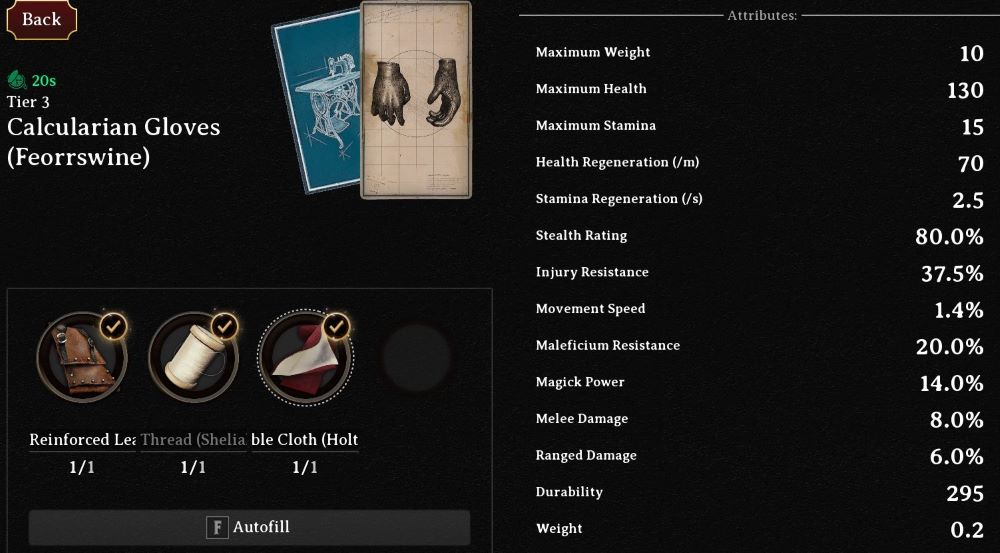
By the way… I hope you arranged the augmentation decorations to maximize your bonus attributes before crafting though. Oh, and be sure craft and apply an Infusion and appropriate Charm. Glad this was just an item of clothing and not a melee weapon, as you’d have all of that plus Enchantments.
Beginning Nightingale Tips
Here are some T1 beginning tips on playing Nightingale (post-Realms Rebuilt) that I wish I knew before.

Go Ahead and Build Your House Wherever
Nightingale is a game about portals and traveling to new places all the time. So… where is the best place to build your base? Near the Crossroads? Near a Portal? The actual answer is: wherever you want.
Fast travelling is easier than you think. Press M to bring up your map, and you’ll have two options: Travel to Respite, and Travel to Crossways. Clicking on Respite will take you to wherever you placed your Estate Carine, no matter the realm. That’s fairly straight-forward: porting home, dumping your inventory, and crafting some stuff. But how do you get back to where you were going? That’s where the Crossways comes in. There are portals in the Crossways. Specifically, these portals can only take you to the “Storied Realms” aka plot realms, but chances are that is where you are coming from anyways.
In any case, after you complete the 1st story realm you unlock the ability to craft your own portals wherever you want. So, again, don’t lose sleep over where you should build your base. Just do it.
Hold E to Collect All the Things
Did you just kill and skin a fae creature (you monster!) and see a bunch of Hide, Meat, Essence, and Bones pop out? Hold E to collect everything in one go. Chop down a tree on a slope and see the Wood Bundles start to roll away? Hold E. Mining Tin next to the water? Hold E occasionally. This method will not pick up sticks, rocks, and other interactable “nodes,” but it does work on basically anything that spawns in with the wispy glow around it.
Survivor Inventory is NOT Weight-Based
Early on, you can recruit an NPC to follow you around and fight and collect things for you. Unfortunately, they only have 15 slots of inventory, which means it’s easy to get clogged with all kinds of leaves, pieces of twine, and so on. The good news is that you can relieve them of those burdens, and instead load them down with 50kg stacks of Lumber and Ore, no problem. Extremely useful for when you strip-mining the fae realms for resources.
Don’t Let Survivors Bring a Knife to a Maul Fight
Speaking of survivors, ever wonder why your first survivor is dealing just 3 damage to those zombies trying to eat your face off? Because they’re equipped with 3-damage stone knife. Give them the Maul you aren’t using anyway, and suddenly they’ll be slaying mystical beasts while you sip tea and crumpets. Well, that’s a Tier 3 food, but you get the idea. Open the survivor’s inventory, put the new weapon inside, and then right-click it and choose equip. Don’t forget to give them your hand-me-down clothing after you upgrade as well.
Incidentally, you can also give the survivor a ranged weapon if that’s what you’re into. I recommend sticking to melee weapons though, to encourage them to take beatings on your behalf. If you do give them bows or guns, the good news is that they don’t need nor use up any ammunition.
Essence is of the Essence
When you are starting out, every spent Essence is a progression trade-off. Which crafting station do you unlock first? Is it worth unlocking (and crafting!) the Recovery spell? Once you get further into the game, the decisions become much easier, of course, but it’s also true that T1 Essence remains relevant forever as it is used to Repair even higher-tier gear.
So… pssst… interested in learning how to get some quick T1 Essence on the cheap? Check these out:
- Simple Saw Table – Paper x6 from Wood Bundle x2 [6 Essence]
- Simple Tanning Station – Straps x3 from Hide [3 Essence]
- Simple Workbench – Simple Wood Axe from Stone Block and Wood Bundle [10 Essence]
Once any of the products are created, right-click on them and choose Extract. Bam, enjoy the Essence. The Simple Wood Axe seems a clear winner, especially in the early-early game, but just note that these numbers are without any Augmentations from nearby decorations. And sometimes you just want to chop down a bunch of trees and/or clear all the Hides from your inventory, ya know?
Living the Charmed Life
There are a lot of little ways to enhance your gear in Nightingale, but one you don’t want to sleep on are Charms. These are unlocked under the Magick tab and represent conditional boons (and sometimes banes) that can be applied to tools and clothing. Key word there is apply, by the way – it does nothing in your inventory until you right-click and apply it to something. Ask me how I know.
One of the most useful ones in the early game is Charm of the Mule, which doubles your Carry Weight while reducing your Stealth by half. Seems like quite the tradeoff, but right now Stealth is pretty useless considering Bound always know where you are and using guns at all negates Stealth for several seconds afterwards. Once you get better backpacks you can drop it, if you want. Charm of the Wanderer is also great as it significantly decreases Stamina drain while gliding with the umbrella. Just note that Charms are only active when you have the item equipped. This means you are better off putting as many as possible on your clothing rather than on the items themselves.
Building from a Box
I was pleased to see that Nightingale allows you to use resources stored in chests to craft things at workstations. What struct me as odd at the time though, was how this did not extend to crafting walls, floors, or building the workstations themselves. Turns out, you can build using stored resources, but there’s a reason why you may not want to.
When you open any storage container, there is a gear-looking icon on the right called Container Permissions. It is here where you can toggle whether to allow for the resources inside that specific container to be used for building or not. The default is Not Allowed.
But… why? Well, resources are extremely important in Nightingale because they can imbue crafted items with their attributes. Buildings and Workstations, however, get zero benefit. So, ideally, you want your walls built with regular Wood Bundles from trees you chopped down on the tutorial island rather than the T3 Wood Bundle (Yew) that you could be using to grant tools +6% melee/ranged damage. The game otherwise doesn’t care which resource gets consumed, and it will consume your best resources on a whim if you’re not careful.
The good news is that you can decide on a system that works for you and just keep doing it. For example, I have several “Building: Allowed” containers where I put all the resources I don’t care about, and then everything else stays protected. Or you could do it the other way around.
Three Hots and a Cot
Food buffs are incredibly important for survival in Nightingale, as is the Comfort buff from sleeping. You can have up to three different food buffs at a time and there is never really a reason not to have them rolling. As a note, “different food buffs” is very generously defined in the game – you can get three Roasted Meat buffs as long as each was created with a different base Meat, e.g. Prey, Predator, Bug.
In the early game, I recommend finding and loading up on as many Blueberries as possible, as the Max Stamina bonus from them is significant when your gear isn’t providing a higher baseline. Also, do yourself a favor and unlock Mixed Plants immediately. The initial Roasted Berries recipe requires two berries, but Mixed Plants allows for two separate vegetables, both of which can be the same berry, doubling the attribute gain.
Semi-advanced tip: prioritize unlocking the Feast Minor Realm card if your base is in the Abeyance realm, aka tutorial island. The Feast card massively increases the duration of food buffs when eaten in that realm, and the increased duration persists when you leave. All of a sudden, your food buffs are lasting 40 minutes even while you progress the story in other realms. This is helpful no matter where your base is, but Storied Realms require you to finish them before you can apply Minor Realm cards.
Impressions: Nightingale
I had low expectations rolling into Nightingale – a Mixed review score on Steam and its own game directors professing disappointment will do it – but the game was surprisingly good. To be fair, I only started playing until after the Realms Rebuilt reengineering, so perhaps I would have been less surprised with the original rollout.
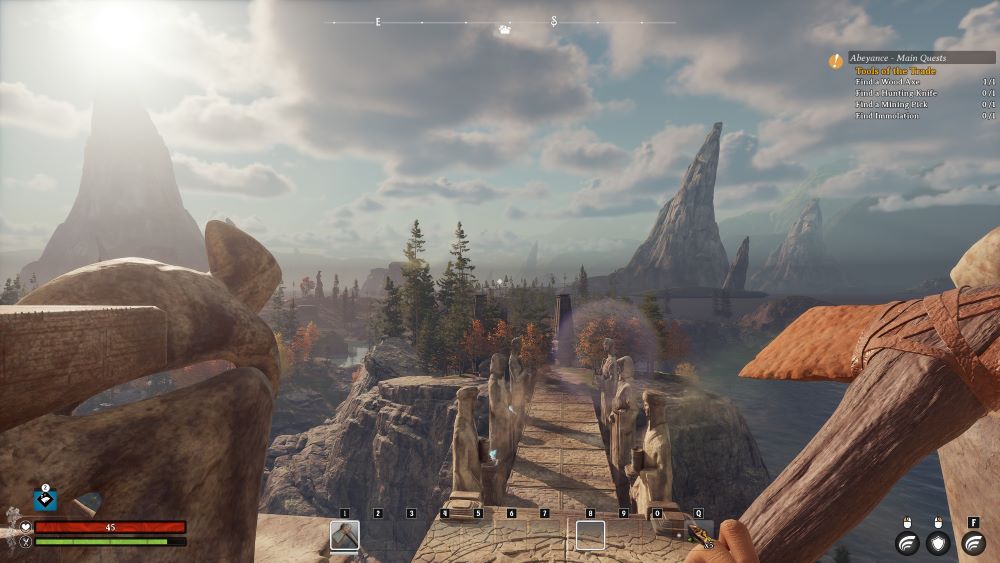
What I do want to note for posterity is my current giddiness and wonder surrounding the principle conceit of the game: portals to fae realms. I have played a lot of survival crafting games in my time, and it’s not particularly often that the world itself (or the potential thereof) excites me. But this initial Abeyance realm? Very excellent first impression. And as I was exploring the island, I kept thinking about how many problems realm-walking solves. Usually, carving up the world into disjointed instances is more of a programmer shortcut than artistic design, but it simply synergizes perfectly here. The only other games that achieved this level of environmental design brilliance for me was Starbound and No Man’s Sky. Getting that same feeling in a non-sci-fi setting is practically unheard of.
Now, it’s important to understand I haven’t actually made it off of this tutorial island yet. All this potentiality in my mind is exactly that: a superposition of imagination not yet intersected with reality. I have no doubt the waveform will eventually collapse and we’ll see, yet again, that the cat died in the box. But regardless of what ends up happening with Nightingale, I do want to see more things like this. I think having a more fae and/or eldritch angle on the genre is an otherwise untapped vein of novelty.
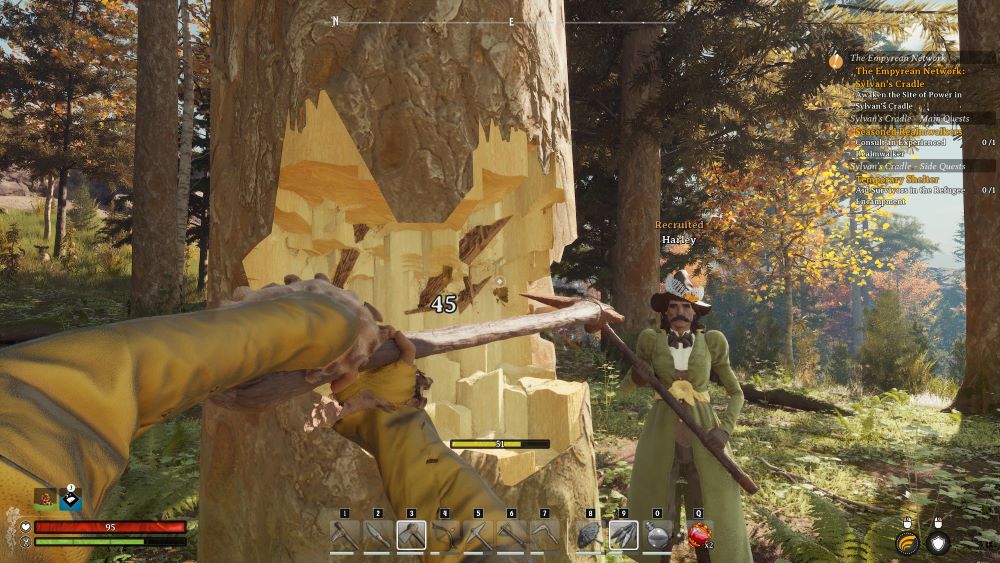
As far as general gameplay, Nightingale again surprised me in several ways. Chopping trees breaks off chunks, mining ore chips away rock where you hit it; little details like that go a long way with me. I remember reading people complaining about combat and the AI, but so far it appears serviceable, if not robust. The pseudo-zombie Bound mobs run, crawl, lurch towards you from multiple angles. Your character can block, get knocked around from attacks, and have a dedicated dodge button. Non-standard traversal is also supported, with a Mary Poppins-style umbrella glide and rock-climbing picks that you can also throw at surfaces to grappling hook yourself up. Again, all on the tutorial island.
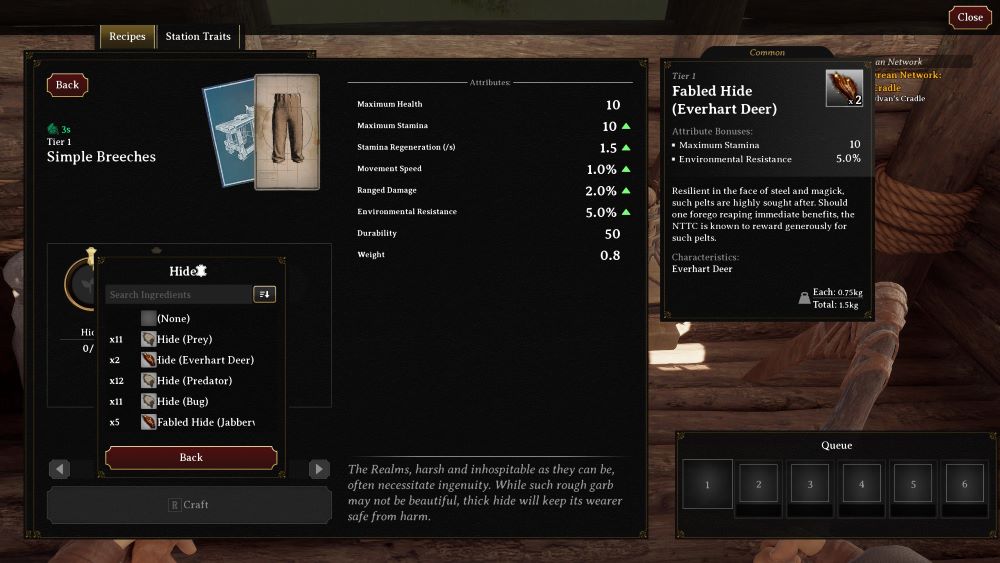
One huge innovation that I hardly ever see in any game is the fact that multiple different resources can be used in recipes. For example, one cooking recipe calls for two Raw Edible Plants – this can be satisfied with mushrooms, blueberries, barberries, etc, or mixed and matched. This may not seem like a big deal, but think about all the times you’ve had wolf meat in a game but couldn’t craft something because it required boar meat or whatever. Additionally, all these resources have specific bonuses associated with them. Gloves need Hide to craft? Okay, well, you can use Hide (Prey), Hide (Predator), or Hide (Bug), and they will confer +Stamina, +HP, or +StaminaRegen respectively.
Having said that, there are definitely some… let’s say opportunities for quality of life improvements.
I was able to recruit a follower NPC who helpfully assists me in combat and also picks up resources automatically. That’s great! Their inventory is not weight-based like mine though, it’s item-based. While this works out in my favor if I’m loading them down with heavy resources like wood or stone, they are just as likely to fill their pockets with leaves and twine, necessitating some awkward inventory management. Furthermore, while I greatly appreciate being able to craft from storage, could we craft from NPC inventory too?
Also, while I love the idea of “decorative” objects conferring a bonus to crafting stations and items created, it feels real dumb to have no control over which bonuses take precedent. Maybe this is a “problem” that gets solved later on with higher-tier crafting stations (that have more than two enhancement slots), but once I realized I had to move the Hunting Trophy across the house in order for the Training Dummy to grant my crafted Knife +Critical Damage, I wanted to throw the entire system in the trash. Like, what’s the design intention, folks? Am I supposed to have two separate Crafting Tables set up, one surrounded by objects that grant me 20% ammo per craft and +Damage on ranged weapons, and the other near objects with +Melee modifiers? Or is my “pick it up and place it in another room” workaround the design goal? Just… let us toggle which ones are active.
——
Having made it to the 2nd island, things are getting a bit more abrasive. The enemies are much harder, presumably tuned to be a challenge for players in Tier 2 equipment. But the only real way to get Tier 2 equipment is to gather Tier 2 essence to unlock the upgraded crafting stations. Meanwhile, surprise, the realm has a negative modifier that reduces your HP regeneration. The whole situation was a bit brutal. But now I’ve unlocked a bow that literally deals 100 more damage per arrow than I deal currently, using materials I can gather from my Abeyance realm. Which… is not the way that is typically supposed to work. Anyway, once that gets crafted, I’ll continue onwards to farm mobs for essence to unlock more crafting stations so I can craft the gear that will allow me to be actually successful in exploring the area.
Anyway, if I had to sum up the things I would like addressed over Early Access thus far, it would be:
- Toggle active Augmentations on crafting stations
- Craft from NPC inventory
- Sort by Weight option when viewing NPC inventory
- Remove or reengineer Hunger Meter (Food buffs mean you’re always full anyway)
- Reimagine the Magick/spells system entirely (it’s barely supported and boring to boot)
- Tighten up traversal mechanics, e.g. what can be climbed, grappled, etc
- Allow us to build bridges
Other than that, so far, I’m very impressed.
Me-Haul
Ever have a birthday, say, two weeks ago and then just ask yourself “what about second birthday?” That’s where I’m at right now. So, I bought some games and now I’m going to talk about them.
- Enshrouded – $23.99 (20% off)
- Nightingale – $17.99 (40% off)
- 1000xRESIST – $15.99 (20% off)
- killer7 – $4.99 (75% off)
The first two items there are survival crafting games I’ve had an eye on for months.
Nightingale in particular is interesting because the developers are pulling a full FF14 Realm Reborn angle called, er, Realms Rebuilt. It is not uncommon for Early Access games to have to completely retool after realizing they drove off a design cliff – Icarus will forever be my go-to example – but a total progression wipe and pivot towards non-procedural generation seems a bit weird when the central conceit of your game is ever-changing fae realms. Also, the CEO straight-up said: “We are not satisfied with where the game is at, we’re not satisfied with the overall sentiment, we’re not satisfied with our player numbers.” The Art Director then went on to say:
“Ultimately, what we realized about the procedural nature of the realms was that the procedural generation and procedural assembly of these things is really all in service of telling stories, and of letting players discover stories,” Nightingale studio director Aaryn Flynn told PC Gamer. “When you peel it back, when you recognize that that’s why we built all this tech and did all that is to tell stories, you can then ask yourself, ‘Well, are we doing that?’ Are we being successful in that?’ And we’re being only moderately successful with that.”
“We went through Enshrouded, Palworld, V Rising, we went through a lot of the bigger, quite successful survival crafting games, not just in terms of sales but in terms of player perception. And it was really the structure that stood out as something they offered that we were not offering,” Flynn said.
Gotta say, I appreciate the candor. At the same time… I can’t quite pin down why it all feels strangely off. Nightingale getting an offline mode two days after “release” was a hard pivot based on overwhelming player feedback. That’s good. Changing the narrative structure of your game based on the sales figures of other Early Access survival crafting competitors? That’s… certainly one way to do it. Hopefully it works out, considering I just bought the game, but I also hope it works out for the people who already enjoyed how the game was up to this point. Although it certainly seems like they’re saying there’s not enough of them to matter.
The second two titles are both truly random picks based on A) being on sale, and B) me hearing effusive praise for them on Reddit. Who says advertising doesn’t work? 1000xRESIST is not a game I could easily describe, and after reading the IGN 9/10 review for it, I somehow feel like I know even less than before what it’s going to be about. From what I’ve read about killer7, that one may be even more incomprehensible. But, well, I’m a simple man, and if you invoke Evangelion, Neir: Automata, Kojima, and/or Disco Elysium enough times, my wallet will appear. Provided it’s not MSRP.
This AI Ain’t It
Wilhelm wrote a post called “The Folly of Believing in AI” and is otherwise predicting an eventual market crash based on the insane capital spent chasing that dragon. The thesis is simple: AI is expensive, so… who is going to pay for it? Well, expensive and garbage, which is the worst possible combination. And I pretty much agree with him entirely – when the music stops, there will be many a child left without a chair but holding a lot of bags, to mix metaphors.
The one problematic angle I want to stress the most though, is the fundamental limitation of AI: it is dependent upon the data it intends to replace, and yet that data evolves all the time.
Duh, right? Just think about it a bit more though. The best use-case I have heard for AI has been from programmers stating that they can get code snippets from ChatGPT that either work out of the box, or otherwise get them 90% of the way there. Where did ChatGPT “learn” code though? From scraping GitHub and similar repositories for human-made code. Which sounds an awful like what a search engine could also do, but nevermind. Even in the extremely optimistic scenario in which no programmer loses their jobs to future Prompt Engineers, eventually GitHub is going to start (or continue?) to accumulate AI-derived code. Which will be scraped and reconsumed into the dataset, increasing the error rate, thereby lowering the value that the AI had in the first place.
Alternatively, let’s suppose there isn’t an issue with recycled datasets and error rates. There will be a lower need for programmers, which means less opportunity for novel code and/or new languages, as it would have to compete with much cheaper, “solved” solution. We then get locked into existing code at current levels of function unless some hobbyists stumble upon the next best thing.
The other use-cases for AI are bad in more obvious, albeit understandable ways. AI can write tailored cover letters for you, or if you’re feeling extra frisky, apply for hundreds of job postings a day on your behalf. Of course, HR departments around the world fired the first shots of that war when they started using algorithms to pre-screen applications, so this bit of turnabout feels like fair play. But what is the end result? AI talking to AI? No person can or will manually sort through 250 applications per job opening. Maybe the most “fair” solution will just be picking people randomly. Or consolidating all the power into recruitment agencies. Or, you know, just nepotism and networking per usual.
Then you get to the AI-written house listings, product descriptions, user reviews, or office emails. Just look at this recent Forbes article on how to use ChatGPT to save you time in an office scenario:
- Wrangle Your Inbox (Google how to use Outlook Rules/filters)
- Eliminate Redundant Communication (Ooo, Email Templates!)
- Automate Content Creation (spit out a 1st draft on a subject based on prompts)
- Get The Most Out Of Your Meetings (transcribe notes, summarize transcriptions, create agendas)
- Crunch Data And Offer Insights (get data analysis, assuming you don’t understand Excel formulas)
The article states email and meetings represent 15% and 23% of work time, respectively. Sounds accurate enough. And yet rather than address the glaring, systemic issue of unnecessary communication directly, we are to use AI to just… sort of brute force our way through it. Does it not occur to anyone that the emails you are getting AI to summarize are possibly created by AI prompts from the sender? Your supervisor is going to get AI to summarize the AI article you submitted, have AI create an agenda for a meeting they call you in for, AI is going to transcribe the meeting, which will then be emailed to their supervisor and summarized again by AI. You’ll probably still be in trouble, but no worries, just submit 5000 job applications over your lunch break.
In Cyberpunk 2077 lore, a virus infected and destroyed 78.2% of the internet. In the real world, 90% of the internet will be synthetically generated by 2026. How’s that for a bearish case for AI?
Now, I am not a total Luddite. There are a number of applications for which AI is very welcome. Detecting lung cancer from a blood test, rapidly sifting through thousands of CT scans looking for patterns, potentially using AI to create novel molecules and designer drugs while simulating their efficacy, and so on. Those are useful applications of technology to further science.
That’s not what is getting peddled on the street these days though. And maybe that is not even the point. There is a cynical part of me that questions why these programs were dropped on the public like a free hit from the local drug dealer. There is some money exchanging hands, sure, and it’s certainly been a boon for Nvidia and other companies selling shovels during a gold rush. But OpenAI is set to take a $5 billion loss this year alone, and they aren’t the only game in town. Why spend $700,000/day running ChatGPT like a loss leader, when there doesn’t appear to be anything profitable being led to?
[Fake Edit] Totally unrelated last week news: Microsoft, Apple, and Nvidia are apparently bailing out OpenAI in another round of fundraising to keep them solvent… for another year, or whatever.
I think maybe the Dead Internet endgame is the point. The collateral damage is win-win for these AI companies. Either they succeed with the AGI moonshot – the holy grail of AI that would change the game, just like working fusion power – or fill the open internet with enough AI garbage to permanently prevent any future competition. What could a brand new AI company even train off of these days? Assuming “clean” output isn’t now locked down with licensing contracts, their new model would be facing off with ChatGPT v8.5 or whatever. The only reasonable avenue for future AI companies would be to license the existing datasets themselves into perpetuity. Rent-seeking at its finest.
I could be wrong. Perhaps all these LLMs will suddenly solve all our problems, and not just be tools of harassment and disinformation. Considering the big phone players are making deepfake software on phones standard this year, I suppose we’ll all find out pretty damn quick.
My prediction: mo’ AI, mo’ problems.
Live Service
In “researching” my Concord post, I came across this IGN article in which analysts were asked why the game failed. One answer in particular was extremely interesting in a state-of-the-industry way:
“Live service games have a high failure rate,” Deane said. […] But while the risks are big, so are the rewards. It’s no secret that many of the highest-earning games in the market today are live service games. According to our data, only about 16% of the total revenue of the games market now comes from traditional full-game sales. Publishers are going to keep chasing that 84%.”
On the one hand, it shouldn’t be that shocking, right? Fortnite, Genshin Impact, GTA Online, Call of Duty, every MMO, and almost every mobile game are all live-service titles. Fortnite by itself generated an estimated $5.7 billion in revenue in 2023, for example. That’s per year. Genshin is another billion per year, GTA Online (aka GTA5) is approaching $9 billion lifetime revenue, and so on. Also, apparently Call of Duty mobile hit $3 billion total revenue in only four years and is now officially where the majority of CoD players are. Oh, and I guess Minecraft is also a live service game too? Another $300 million or so.
On the other hand: Jesus fucking Christ. 16%?! What the goddamn shit? Holy mother of god.

Ahem. Well, there you go. That’s the state of the industry right now. Or I suppose been the state of the industry longer than I’ve been paying attention. If you’re interested in just making like, a game, you’re competing over literal scraps. “Why are there so many live service games these days?” Right now I’m amazed there are still regular games. Of course, 16% of $350 billion is still $56 billion, but that’s much less than, say, $294 billion. And of that much smaller number, you are competing across all the available genres of regular games. Good thing development costs aren’t too prohibitive…
Cut the Concord
Statistically, you have never heard of it, but Sony is shutting down their new Overwatch-like hero shooter called Concord. After two whole weeks. On Steam, Concord apparently never broke 700 concurrent players at launch. The writing was probably on the wall from earlier when the open beta population was worse than closed beta – plus it launching as a $40 B2P in a sea of F2P competitors – but the sheer scale of the belly flop is shocking nonetheless. It is rumored to have cost $200 million, and for sure has been in development for eight (8!) years.
And now it’s gone.
You know, there are people out there that argue games should be more expensive. Not necessarily because of the traditional inflation reasons – although that factors in too – but because games costs more to make in general. Which really just translates into longer development times. And yet, as we can see with Concord along with many other examples, long development times do not necessarily translate back into better games. There is obviously some minimum, but longer isn’t better.
And yet, we have these industry leaders who suggest MSRP should be higher than the now-standard $70. To be “priced accordingly with its quality, breadth & depth,” as if any of that is really knowable from a consumer standpoint prior to purchase. We have reviews, sure, and Concord score a 70 from IGN. What does that tell you?
The overall way games are made is itself unsustainable, and an extra $10-$20 per copy isn’t going to fix anything. Indeed, there seems to be a blasé attitude in the industry that a rising MRSP will lift all the boats instead of, you know, causing the ones on the periphery to slide down the demand wave curve. Suppose GTA6 is released at $80. Is the argument that a consumer’s gaming budget will just indefinitely expand by an extra $10/year? Or will they, I dunno, just spend $10 less on other titles? Higher prices are certainly not going to expand the market, so… what?
As far as I can see it, the only reasonable knob to turn appears to be development time and nobody seems able to do it. I’m not trying to handwave away the effort and brute labor necessary to digitally animate mo-capped models in high fidelity. Or creating and debugging millions of lines of bespoke code. But I am asking how long it does take, how much of it is necessary, and how often these visually stunning games fall flat on their faces in the one function of their intended existence, e.g. being fun.
Throwing more money at the problem certainly doesn’t seem to be working.
Losing the W
Monday, through an unfortunate series of events, a small stack of wood smashed the tip of my middle finger on my left hand. Nothing was broken, no bleeding under the fingernail, just a puffy, painful bruise (thus far). After the initial pain went away, I expressed gladness that at least it wasn’t either of my index fingers or thumbs – those would be much worse to lose the use of for general computing.
…unless, as I quickly realized, you are a PC gamer. Turns out the W and S are pretty key components of the whole WASD control scheme. And, you know, WASD is prevalent in just about every survival game.
So, yeah, sucks for me for a while. Technically, I could use a controller, as long as the left trigger button isn’t too critical, but that’s definitely not what I would prefer using with first-person titles. Perhaps I should just use this opportunity to catch up on TV shows or play some Rimworld or something.
Hmm. Wonder how Neuralink is coming along…
The Forever Sigh
A few months ago, I was very interested in The Forever Winter, the post-apocalyptic extraction shooter.
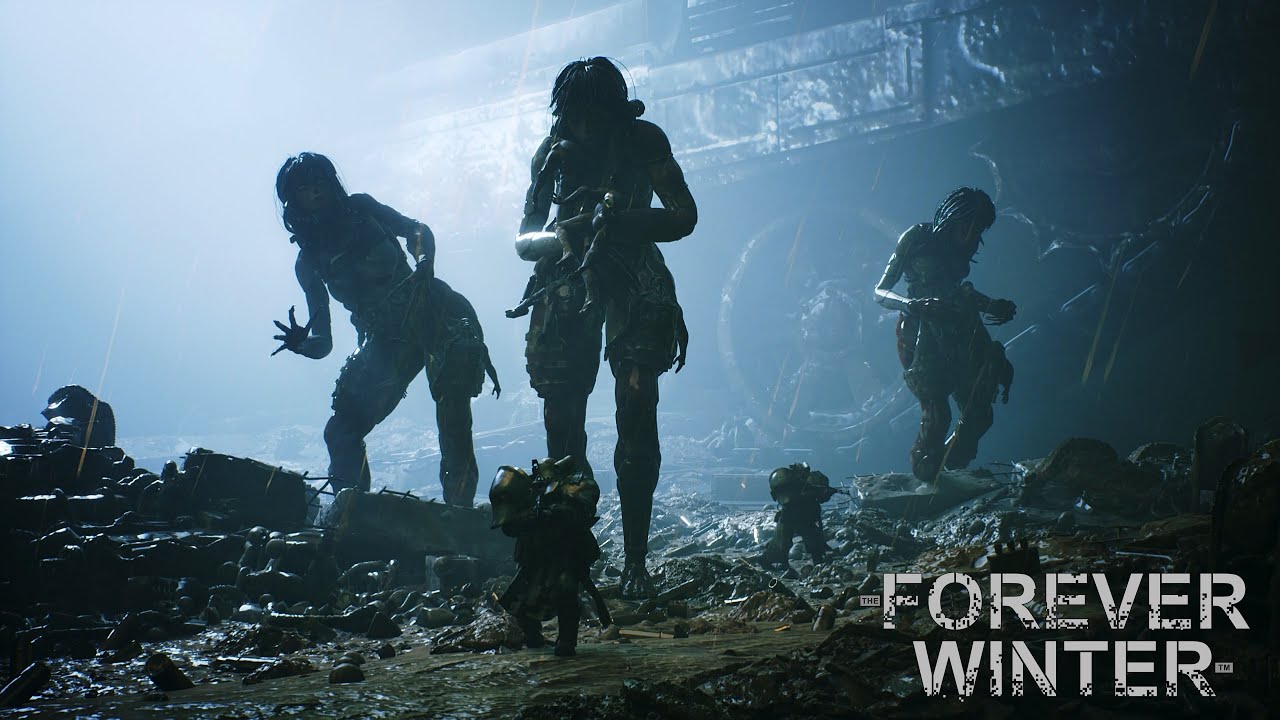
After reading this PC Gamer article though, my interest has dropped precipitously:
Then there’s the water situation. This is the most essential resource, and when my hub runs out completely the area is reset, costing all of the practical and cosmetic enhancements I’ve made, and my inventory will be gutted. Even before then, when it’s critically low, some services become unavailable. And this all happens in real-time.
“One of the things that actually came up in our beta, that we’re keeping, is that the water level has real-time degradation,” says Gregg. “If you and I log off with 10 days left and you come back three days from now, you’ll have seven days left, even if you haven’t played. It’s a hardcore game, you can build up a large surplus, but that is actually part of our co-op: to make sure people help each other.”
Good fucking luck, chief.
The great irony here is that I praised them before for basically being concept artists following through on their vision way outside the norm. Not many other devs would put spacesuit-wearing flame-thrower units using American flags as hoods into their games, nevermind the battle-tanks covered in corpses as camouflage. That’s cool! If you go grimdark, go all the way.
Having an expiration timer count down even when not playing though? That’s not “hardcore,” that’s just fucking stupid. I don’t even care how easy water is to get in-game, because that is irrelevant. What is the design attempting to accomplish? Because by default, what this tells players is that any break from the game may as well be permanent. Meanwhile, the people who are playing the game aren’t even affected by this “hardcore” feature. Ask the Icarus devs how that shit worked out for them.
I guess we’ll see how it plays out. The Forever War will be in Early Access at the end of September.
 In An Age
Running Out of (Fae) Road
Sep 27
Posted by Azuriel
I am done with Nightingale, (presumably) for now.
I stand by all of my prior reporting, including the original Impressions post. There is a lot of potential with the game and its central realm-walking conceit, the ability for it to introduce fantastical creatures, an absurdly complex crafting system, and how great it feels to move around and exist in these magic(k)al worlds. Overall there is a lot to like here, and Steam tells me I spent 39 hours playing Nightingale. That’s pretty good for any game, let alone an Early Access title.
That said… there is still a long way for Nightingale to go.
The first problem is the consistently uneven difficulty spikes. Right after completing the tutorial island, you are shuttled off to Sylvan’s Cradle, a realm suffering from corruption. This corruption impacts you as well, with a realm-wide massive debuff to passive healing. You are then confronted almost immediately with a new type of Bound enemy that is insanely aggressive and hard-hitting, along with all mobs in general being at “level” 20. Your own gear progression is dependent on collecting higher-tier Essence and spending it to unlock new recipes and crafting tables. And therein lies the rub: you must suffer through being wildly underpowered until you grind enough T2 Essence to spend to craft gear to get back you on par.
And, spoilers, you will smash into the same wall again two realms later with T3 Essence.
By itself, uneven difficulty isn’t that big an issue, although the devs have gotten themselves in a bit of a pickle with the hard T1/T2/T3 Essence delineations. To me, the more relevant problem is a lack of consistent vision when it comes to crafting more generally. There are stats like Injury Resistance that sound important (damage reduction?!), but end up being worthless (prevent sprained ankle). Under Alchemy, they have things like a potion that fills your hunger meter. Literally, why? Food is everywhere and the importance of food buffs means you must be eating all the time. There are other potions to reduce being hot, which is also easily solved by equipping an umbrella, nevermind the fact that heatstroke or whatever simply limits your Stamina regeneration.
One aspect that is also utterly bizarre is the very thing Nightingale cannot afford to fuck up: realm-walking. Specifically, the absolutely nonsense direction they are heading with the Minor Realm cards. Shortly after completing Sylvan’s Cradle, you get the recipe to start building your own portals. Opening a portal means crafting and consuming a Major Realm card to one of the three available biomes (Forest, Swamp, Desert). Minor Realm cards can be used at a Realmic Transmuter within that realm to tweak “the rules” and usually the weather in the process. At first glance, there appears to be a lot of Minor Realm cards, but the more you look at them, the more questions you end up having.
The first group of Minor Realm cards are environmentally cosmetic, which is fine. Cleansing makes the realm turn back to default settings, Foresworn Skies makes it look like a black hole is overhead, Tempest makes it rain all the time, and so on. Then you have some pure upside cards like Feast/Tavern that boost food buffs, Angler makes fishing easier, Treasury lets you farm Essence. Then come the tradeoff ones like Dragon’s Hoard, that boost treasure chest contents but increases damage taken. Fine.
But then you see Blunderbuss that literally says:
What? The devs included realm cards for pistols and rifles, by the way, so don’t feel left out. Additionally, there are realm cards that improve the yield of refined building materials, of wood, of ore, of crops, of meat/hide. All separate, of course, and occur only after the realm visibly shatters into a new form from the use of said card.
I’m honestly struggling to identify the design goal here. Is it intended for players to radically remake the realm in order to craft extra shotgun shells, and then revert it to another form to increase the yield on Wheat? Or should this encourage players to turn their primary residence into the City of Doors with portals to themed realms and otherwise endure the loading screens for marginal gains? Why are there output-related cards at all? Tempest makes it rain all the time, which means your crops will always be growing without needing to be manually watered. That sort of thing is what I consider good design – it’s subtle, intuitive (after a fashion), and atmospheric (literally). But then you have Greenhouse/Farm card which just straight-up increases plant growing speed and yield “for reasons.” Are these placeholders? Please tell me these are placeholders. Although placeholders for what I have no idea.
By the way, realms can only have one Minor Realm card at a time. Again, WTF mate? When I first heard about this portal system, I imagined being able to mix and match cards to craft bizarre realms like a very mountainous swamp or whatever. No Man’s Sky this ain’t. Instead, it’s just three procedurally-generated biomes with different skyboxes and min-max bonuses. Granted, there is a Trickster card that lowers gravity and shuffles up resources sources – chopping down trees give meat, skinning creatures gives ore, etc – but most everything else is rote. Safe. Sanitized. Much like with Starfield, you also end up seeing the same POIs and ruins over and over again.
Technically, there’s still time to right the ship before Nightingale runs out of road, to mix metaphors. Well, maybe. I doubt the realm generation code is flexible enough to accept blended biomes. Or maybe the original three will stay as-is and we’ll see others like Snow, Volcanic, and maybe some kind of Chaotic realm. Actually, I just found a quote:
Well, there you go. I do think that if they keep the bizarre Blunderbuss-esque Minor Realm cards around, they need to have it as an augmentation to an environmental-style Minor Realm card. That may lead to clearly-optimized combinations like Tempest + Farm, but they should either lean all the way into the nonsense or throw away half the cards immediately. When I think “Victorian gaslamp-fantasy adventure,” what does not come to mind is rewriting the rules of fae realms to make just my pistols better. Now, opening a realm to where all the Bound are wielding pistols and/or there are giant enchanted pistol enemies? That sort of thing is interesting.
Getting devs to gamble on “interesting” is not easy. Especially not when they’re already on their heels.
Posted in Commentary
2 Comments
Tags: Armchair Game Development, Early Access, Game Design, Nightingale, WTF mate?