Reviews: A Valley Without Wind 1 & 2
Game: A Valley Without Wind
Recommended price: Bundle
Metacritic Score: 54
Completion Time: ~13 hours
Buy If You Like: Metroidvania action platformers, infinitely long games
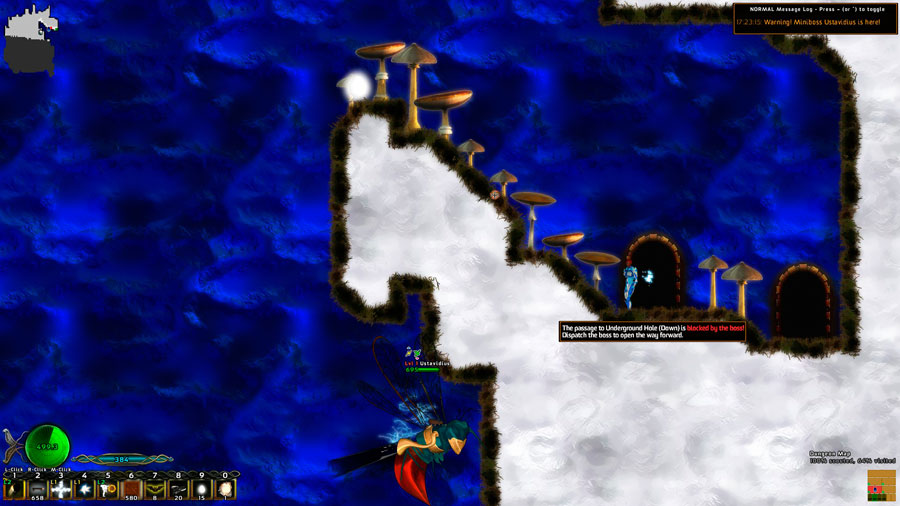
Art style reminds me of And Yet It Moves.
A Valley Without Wind (hereafter AVWW) is a procedurally-generated action-platformer in the Metroidvania style. The premise is that some unknown cataclysm has rent time and space, placing enemies like robotic mechs into Ice Age biomes. As a “glyph bearer,” your job is to scavenge materials from bombed out buildings, complete missions, and then take out the continent’s Overlord after killing off his/her/it’s lieutenants.
If all this sounds… strangely disjointed, that is because it is. The entire game comes across as more complicated (or simply arcane) than it has any reason to be. Basically, you jump around and kill enemies with ranged spells. The spells you have access to come from “spellgems” that you can either craft from materials you scavenge or earn via Missions. You also have several slots for enhancements, which are items you equip that have randomly-determined stats and abilities. For example, you might have a Foot enhancement that let’s you double-jump and have +20 mana, or Pants that eliminates all falling damage and gives +20 Haste.
Missions are one of the few things that give direction and meaning to AVWW, but after a while they too seem irrelevant. Essentially, Missions are a guaranteed way to acquire some particular thing, like a Spellgem. Missions themselves come in different types, such as Falling (character floats down long shaft avoiding enemies/spikes), Boss towers, Perfection (must restart if hit by any enemy), Rescue missions for additional survivors, and so on.
The problem is that not only is everything procedurally-generated, e.g. infinite in scale, there is not any real sense of progression. The “world” levels up after you kill an enemy lieutenant, but all that really means is that you need to re-craft all your Spellgems to the higher level to match the increase in monster HP. Finding stash rooms in buildings feels fun at first, but then you start to realize that the actual number of materials you need for any one thing is tiny. Alternatively, maybe you are missing just a single resource type and are forced to delve into dozens of buildings in order to find one inside.
But the biggest buzzkill for me was how absurdly limited the spell selection was. Once I found the most useful spell (and one backup of a different element type), every other spell was practically useless, which meant getting mats for them was useless, which meant pushing back the wind from new terrain squares (e.g. unlocking them) was useless, which meant farming the building to push back the wind from the lieutenants to access the Overlord and end the pain was useless tedious.
Don’t get me wrong, there are some interesting things going on in AVWW. The hybrid roguelike feature that is permadeath-but-you-keep-all-items made enemies feel threatening without punishing exploration, for example. Of course, the designers then made the decision that your avatar is a faceless nobody you have no attachment to, and the survivors are essentially reduced to extra lives with slightly (very slightly) different base stats. The granularity of the difficulty is extremely nuanced, allowing you to increase mob strength, platforming difficulty, or “citybuilding” complexity all independently.
At the end of the day though, I just did not feel particularly compelled by A Valley Without Wind. There is a vague sense of progression – defeating the lieutenants and then face the Overlord – but that never really trickled-down to the individual levels you were navigating. When the game comes right out and tells you to not bother exploring every nook and cranny for items (since the world is infinite), it makes you start wondering why you are looking for anything in the first place.
_____________
Game: A Valley Without Wind 2
Recommended price: none
Metacritic Score: 68
Completion Time: n/a
Buy If You Like: Throwing money away, poorly implemented games
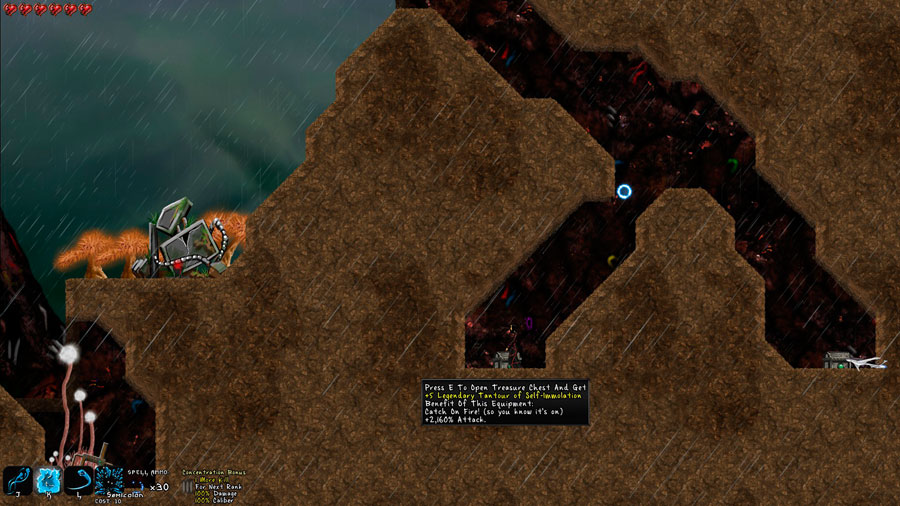
If only this was a meaningful choice.
There are very few games which I simply give up on. Of those games that I abandon, it is usually due to either frustrating game design or simple boredom. When it comes to A Valley Without Wind 2, it joins that sorry company with the distinction of having both qualities.
If you have played the original A Valley Without Wind, the first thing you should know is that the “sequel” has really nothing to do with its (much better) predecessor. The formula has changed. Radically. The premise is that after infiltrating the inner circle of the Overlord Demonaica and being gifted with an Oblivion Stone (aka the Glyphs of the first game), you reveal your true intentions to fight the Overlord’s power. You do so by… running away.
Basically, you order members of the resistance to move around the overland map in a turn-based manner, constructing farms and scavenging scrap to build other structures while you unlock more of the map by destroying rain machines (evil versions of the Windmills). Each resistance member can move once a turn, and they will not actually perform any actions until the end of the following turn. The turns themselves are advanced only when you enter into one of the rain machine maps and destroy it. Before doing so, you are free to explore any of the maps to look for Perks or… no, that’s it.
If this sounds nothing like the Metroidvania of the first game, that is because it isn’t. At all. In fact, the platforming aspects of AVWW2 has taken a thousand steps backwards. You cannot aim with the mouse any more, meaning that you are firing spells in just (usually) the cardinal directions. Instead of your own custom spells, you have to choose one of five “classes,” which have a total of four spells that do not necessarily even cover a wide range of situations. On top of that, spells have a sort of “priority” system where your projectiles are almost always destroyed by enemy projectiles, unless you have some specific spell with a high priority in your repertoire. This might sound tactical, but it’s really not. All it means is that you jerk clumsily around the screen, spamming your spells in a few directions while plowing into a screen full of enemy projectiles.
This is not even getting into the fact that the random loot and equipment strategy of the first game has been cut off at the knees neck. You have exactly one “equipment” slot, with no inventory; if you pick something else up, it replaces whatever you had equipped. The equipment also degrades as you take damage, so it will eventually break on its own. While the equipment you find is still random, there is no strategy or even thought required. “Is this better than what I have/an empty slot?” If yes, equip. If no, skip. The only customization you have is choosing which Perks to use, which basically amounts to 1 of 4 different Perks per level. Do you want +10% jumping height or +1 Heart (even the HP has been dumbed down)? Then again, considering that the platforming aspect is practically nonexistent, the Perks don’t really matter.
The funny thing (in a sad way) about all this was that the turn-based part of the game seemed sorta passably fun. Monsters would periodically come out of the Overlord’s tower, and you have to position your resistance members intelligently to intercept them without getting overwhelmed (each deals damage equal to their HP to one another), while also not leaving valuable structures open to destruction. Plus, around Turn 14, the Overlord himself was going to come out and destroy everything in his path. From there, you had a few things you could do while on the run, and the race against time angle was kinda compelling too. The problem was that the platforming aspects necessary to advance the turns and beat the overall game were so comically bad.
Ultimately, I am not even sure who A Valley Without Wind 2 was even made for. Metroidvania fans of the original will encounter perhaps the worst, most boring platformer ever made. Strategy gamers might have some fun, up until they are forced to play the worst, most boring platformer ever made to advance the turns. And… that’s it, the entire audience. The game simply fails at everything it was trying to do, when all they had to do was do what they did the first time around. I am not sure what the designers were thinking when they made this game, but whatever it was, it didn’t work.
Winter is… oh crap
The night after the prior post, I made it to my first Don’t Starve winter.
The snow birds should have been a sign I was getting close, but they were a warning left unheeded as I wasted several days gathering the materials to build a bee box (for harvesting honey, of course). Bees don’t come out in winter though, and my crops were thinning out. Moves needed made.
Having found and “killed” a lureplant, I decided that I needed to set it up in a more tactically advantageous way. A lureplant is essentially a fleshy bulb plant surrounded by a field of eyeball plants with teeth. Par for the course in a game where Nightmare Fuel is a literal item needed to craft magic items. The surrounding eyeball plants can’t grow on rocky terrain though, so you can build a safe walkway to the bulb and harvest the meat and other materials that the eyeballs “eat.” The problem is that this world randomly has an incredible lack of rocks.
But, dammit, winter is coming.
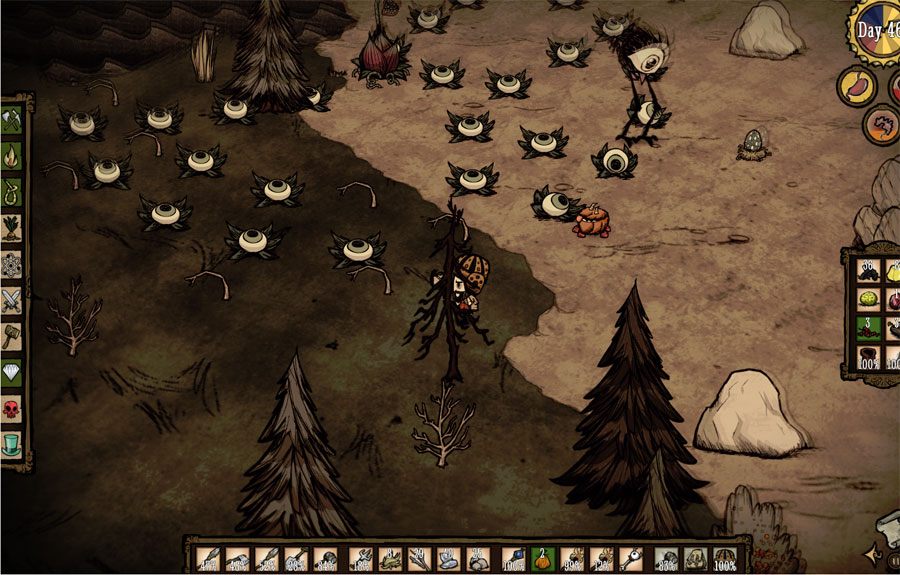
Artist’s rendition.
I made the ~1.5 day trek out to the one location I knew had rocks, while nervously glancing at the freezing ice starting to cover my screen. Torches do nothing to assuage my growing frostbite, so I periodically set fire to bushes and trees near the road. Once I get to the rocks, I realize that I can’t actually dig up the terrain here – the difference must be rock vs rocky. What does “rocky” look like? Oh, shit, that’s a Tallbird that is attacking my walking treasure chest! Oh… but it has left its nest undefended with its beautiful, succulent egg…
Pro tip #1: a Tallbird will one-shot you without armor.
Pro tip #2: resurrecting at a touchstone, practically naked in the dead of winter, with all your items in a pile around a Tallbird nest, is not actually all that useful. Especially when a pack of Hounds just happens to spawn not 20 seconds later.
Pro tip #3: Life is full of emptiness and disappointment and despair.
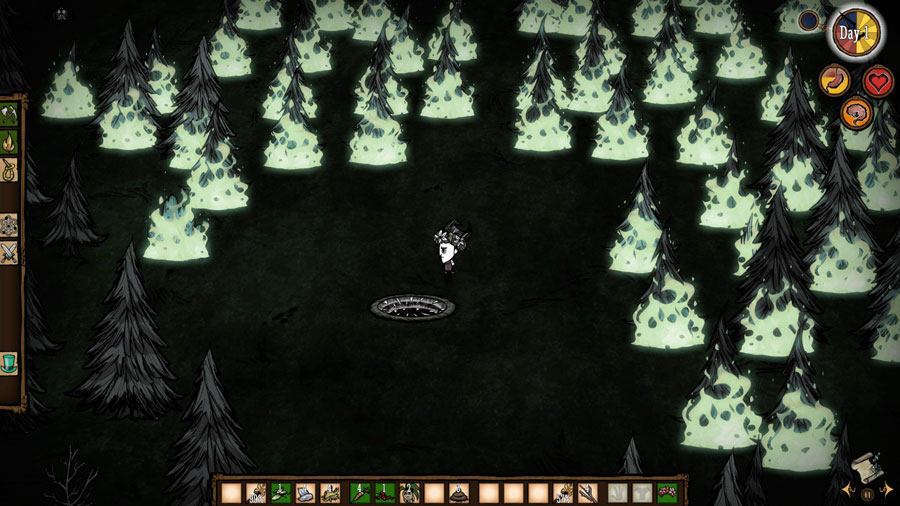
This random forest will feel my pain.
I started another two games after that, abandoning the first when my initial 10 minute search for gold was fruitless. The second game though… hey, I might be getting somewhere. Bees? Fuck bees. I got two smoking racks, a bird cage to transform monster meat into eggs, and have 8+ traps on top of the rabbit holes in a nearby field. I’ll look to survive this first winter, erm, first before upgrading my base with bees. Maybe dig up a few more berry bushes and plant them closer, although the fish in nearby ponds are more than enough to keep me sustained.
And that’s when I found it. Maxwell’s Door. Adventure Mode, aka Challenge Mode, aka a purpose greater than mere survival.
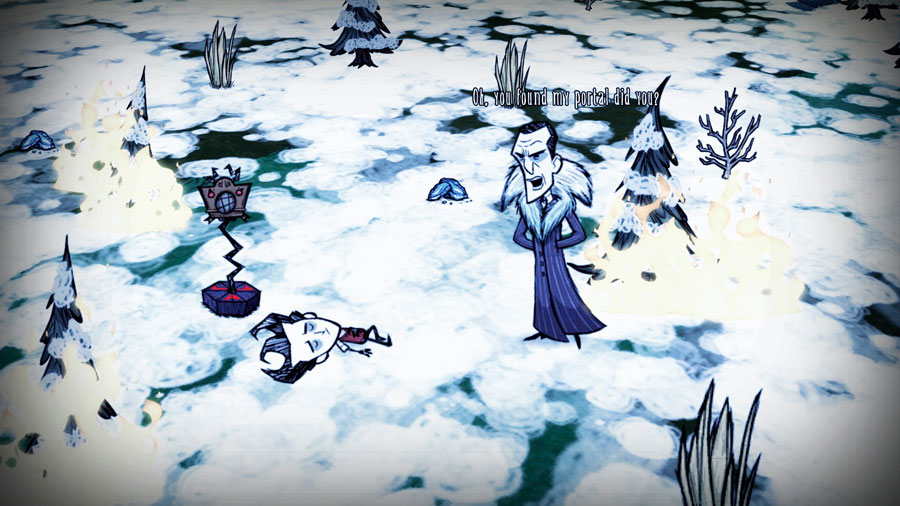
I have a very special set of skills…
I’m coming for you, Max. You thought you could leave me to die in your hellish wilderness realm? I got news for you, boy: it’s you who are trapped in here with me.
Not for long though. Not. For. Long.
My Current Obsession: Don’t Starve
As I mentioned back in my Card Hunter post, it is pretty rare that I get 100% engrossed in a given game. The all-in immersion in a game’s delicious logical systems is precisely what I desire, but gaming today is typically focused on front-loading the fun, followed by a tapering off of stimulation. So color me surprised when I found myself playing Don’t Starve until 6am again, trying (in vain) to get myself prepared for a winter I have never survived long enough to see.
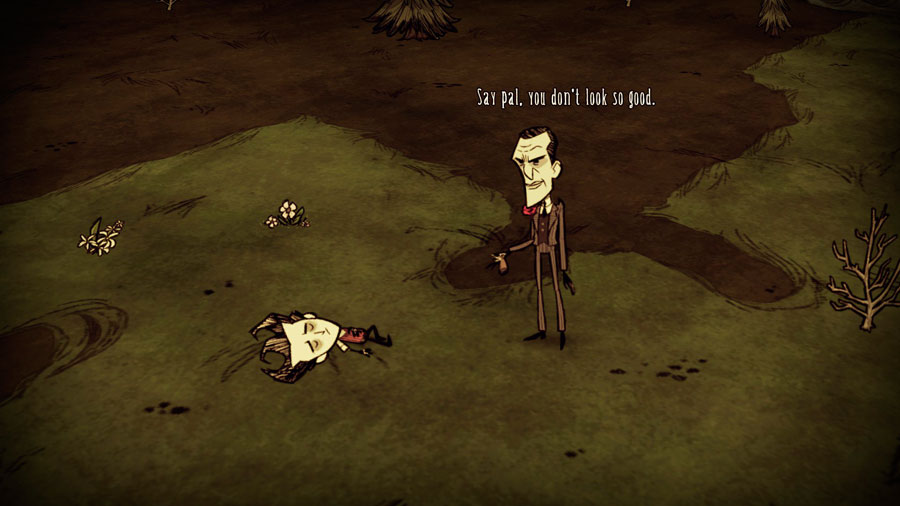
It’s all inevitably down-hill from here.
In a nutshell, Don’t Starve is an indie survival roguelike. You wake up, get taunted a bit by the above-pictured guy, and… that’s it. As the Steam store description states:
Uncompromising Survival & World Exploration:
No instructions. No help. No hand holding. Start with nothing and craft, hunt, research, farm and fight to survive.
They’re not kidding. Just when you think you’re getting the hang of a particular mechanic… BAM! You get stung to death by angry bees.
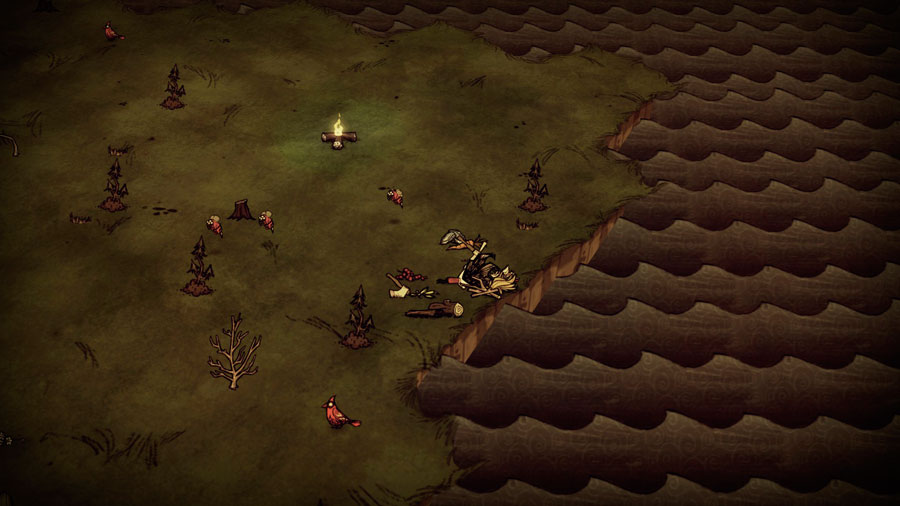
Not a good way to go.
If you die, that’s it, game over; your save file is erased. Occasionally there will be a sacrificial altar-looking thing, which acts as a one-time respawn mechanic. You can even construct your own Meat Effigy, which will also respawn you once… but you will have a lower maximum HP for as long as it exists. And keep in mind that you don’t resurrect with your gear – all of your shit is piled on the ground next to the giant spider nest or murloc Merm camp or swamp filled with giant tentacles or whatever nightmare area you died in.
And that’s another thing: there’s a sanity meter too.
But, seriously, Don’t Starve is one of the most brilliant games I have played in years. While I sort of feel like it’s still in beta (there’s a countdown until the next patch on the title screen), how all the game systems already interlock is astonishing. As you might imagine from the title, getting food is important. But actually getting enough food to survive is pretty easy. The problem is that actually foraging all that food will consume a large portion of your day, leaving you little time to explore before nightfall. You can’t just hoard food either, because it spoils. Even worse, no crops grow during the winter and the ponds freeze over and you can’t eat monster meat without going insane and… you get the idea.
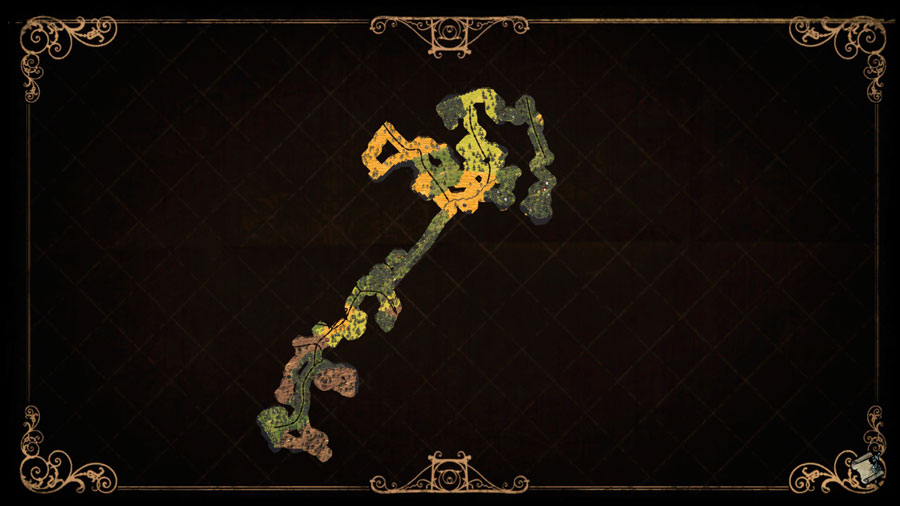
This is how far I walked looking for Flint, one time.
What I find so engaging is how I feel like I’m… juggling. You know in RTS games like Starcraft (etc) when you’re trying to micromanage some battles and having your base produce more units and sending scouts out to look for expansions? I actually dislike RTS games that are structured that way – I can do any one of them well, but not all simultaneously – but Don’t Starve somehow threads that needle. I would spend a few days making food supplies, then trek out into the wilderness looking for more of a certain resource I was lacking, foraging when I could, and trying not to get too far afield. Then come back, craft some new feature in my camp, and then get attacked by Hounds and die on Day 22.
And I’m not even mad.
Each world is procedurally-generated, which means next time I might be able to locate an even better starting location for my camp. Or maybe I’ll run across one of those random set-pieces and get a huge leg-up on survival with the ready-made supplies there. Or maybe I’ll actually find that goddamn Maxwell’s Door again and be able to play the game within a game. Oh, did I forget to mention that? The base game is a sandbox, but you can do Adventure Mode (a story-ish game mode) if you walk through Maxwell’s Door. If you die inside though, you get booted back outside into the “normal” world and it’s forever closed to you on this world. Collect four mysterious items though, and you can jump to a brand new world with another Maxwell’s Door located somewhere on it.
But let’s not get too far ahead of ourselves though, because none of us are likely to make it. As it says on the Steam page:
Randomly Generated New Worlds:
Want a new map? No problem! At any time you can generate a new living and breathing world that hates you and wants you to die.
One day, I will see the winter. And die horribly, no doubt. But seeing it will be enough. For now.
Optional Difficulty
I am finding myself with conflicting opinions on optional difficulty.
On the one hand, options are good. The distribution of peoples’ skill levels is a gradient, and not usually well-served by binary distinctions. We can easily imagine someone not being challenged at Normal difficulty, but perhaps overwhelmed when the switch is flipped to Hard – doubling monster HP and the like is overkill when all the person needed was +50%.
On the other hand… I might have become a bit corrupted by years of extrinsic MMO rewards.
You see, I just finished playing A Valley Without Wind, which I found to be fairly easy overall. The game actually features one of the most generously granular difficulty options I have ever seen though: it features 5+ different difficulty settings in three independent categories. At any time, you can boost the platforming difficulty up a few notches while lowering the actual fighting bits, or raising the “city-building” aspect to maximum while all but removing everything else.
Despite feeling like the game was a bit easy, I did not change the difficulty at all. “Why would I? It’s not like I get any better items or anything.” Oh. Oh my.
To be fair (to myself), this attitude changes depending on the game. I played on the highest difficulty in Magic 2013, for example, and couldn’t imagine playing on anything lower. X-COM was completed on Normal Ironman, as I imagined that at least Ironman was the “intended” difficulty. And actually, that is my usual metric: what did the designers intend to be the “real” difficulty? “Whatever is appropriate to you” is not a real answer to the question, as most times the difficulty is “Base +/- 100%.” I want to know what the Base is, and judge from there.
Now, it is also possible this is a specific game issue, e.g. I just don’t care all that much about AVWW. I had no problem with turning on Hardcore mode in my second playthrough of Fallout: New Vegas, for example, and actually felt like it made the game more interesting/fun when you couldn’t carry around 1000+ rounds of every ammunition type. Conversely, I did not see how mobs having more HP in AVWW was going to improve the gaming experience at all – left-clicking a few more times while you continue kiting isn’t really more fun.
In any event, this scenario has given me a somewhat greater appreciation for the “forced” difficulty games out there… at least the ones that fall within my natural ability, of course. While I still believe it is better overall to tune a game to cover a wide range of personal abilities, I hate having to arbitrarily decide what is an appropriate challenge to me. I don’t want easy games, but I don’t necessarily want a more tedious experience either (i.e. everything takes longer to kill + you’re more likely to die). Just give me a challenging game and let me figure out how to beat it on my own, without tempting me to cheese it with metagaming.
First Impression: Firefall (Beta)
Downloaded the Firefall open beta client yesterday because, you know, Press™.
For those not keeping track at home, Firefall is… well, hell if I actually know. Without looking it up, I’m assuming it’s a F2P MMO set in an open-world, over-the-shoulder Borderlands 2 with bugs taking the place of bandits. After looking it up, it seems the devs want to emphasize the fact that it is a skill-based action shooter with sandbox MMO elements. Apparently the world is a not level-restricted, but the highest-ranked “dungeons” will need full groups with crafted gear. Which sounds like roundabout levels to me, but let’s play along.
One of my biggest fears with new MMOs – or any game which expects me to be playing for 50+ hours – is losing on the character select screen. How am I supposed to know which class will be the most fun months from now? And even if I luck into the best class for me, how will I know it won’t radically change (or get nerfed) years later? So, right away, Firefall got some major brownie points with me once I understood that a “class” means a Battleframe, which you can swap out at pretty much any time. Need a healer? Jump into your healer suit and go play.
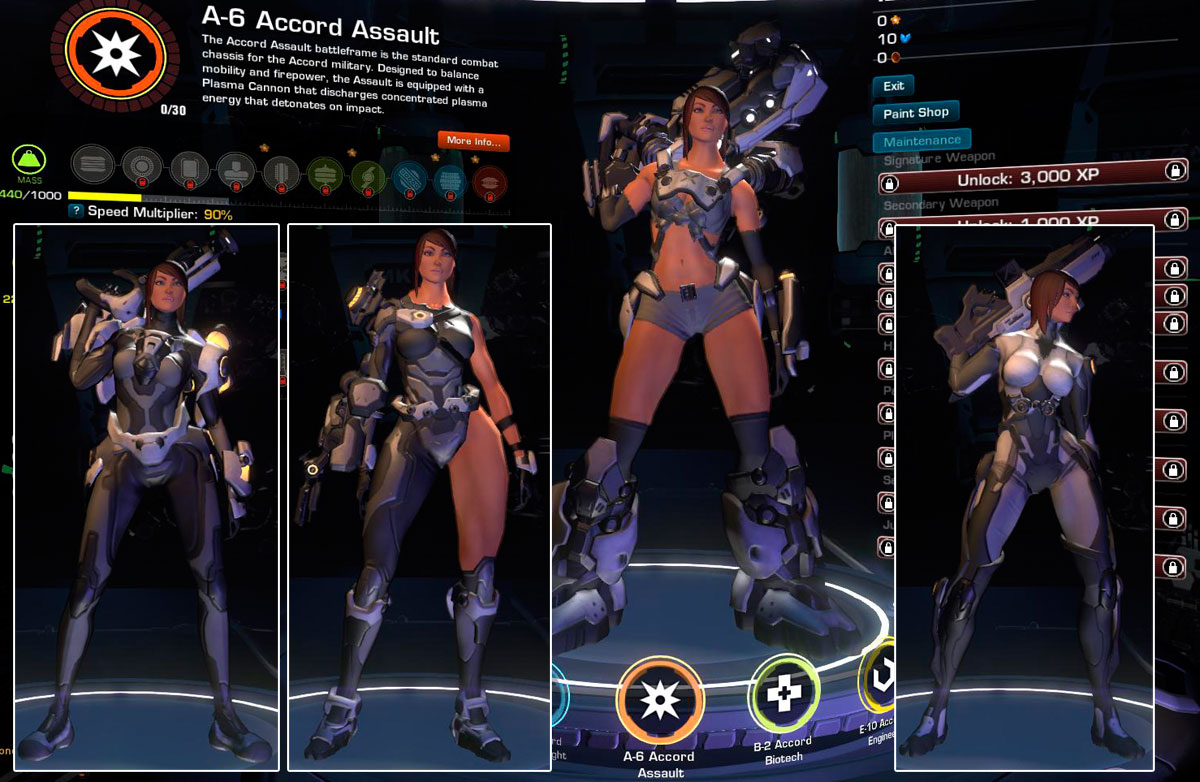
In a twist, the Assault and Engineer classes have less armor than the healer and rogue.
Loincloth starting armor tropes aside, I think the whole Battleframe direction is pretty clever. Not only are you allowing people to play whatever role is necessary at the time, having independent frames means a player has to “level-up” multiple times while still allowing for quick catch-up. In other words, it’s horizontal progression. PlanetSide 2 has this same sort of thing, where you might have to purchase various levels of Flak Armor for each class (which is expensive with Certs), or you can just focus on playing Light Assault or Medic and save your currency.
In any case, from the extremely limited amount of time I spent playing, things seem fun enough. They certainly looked good, at any rate.
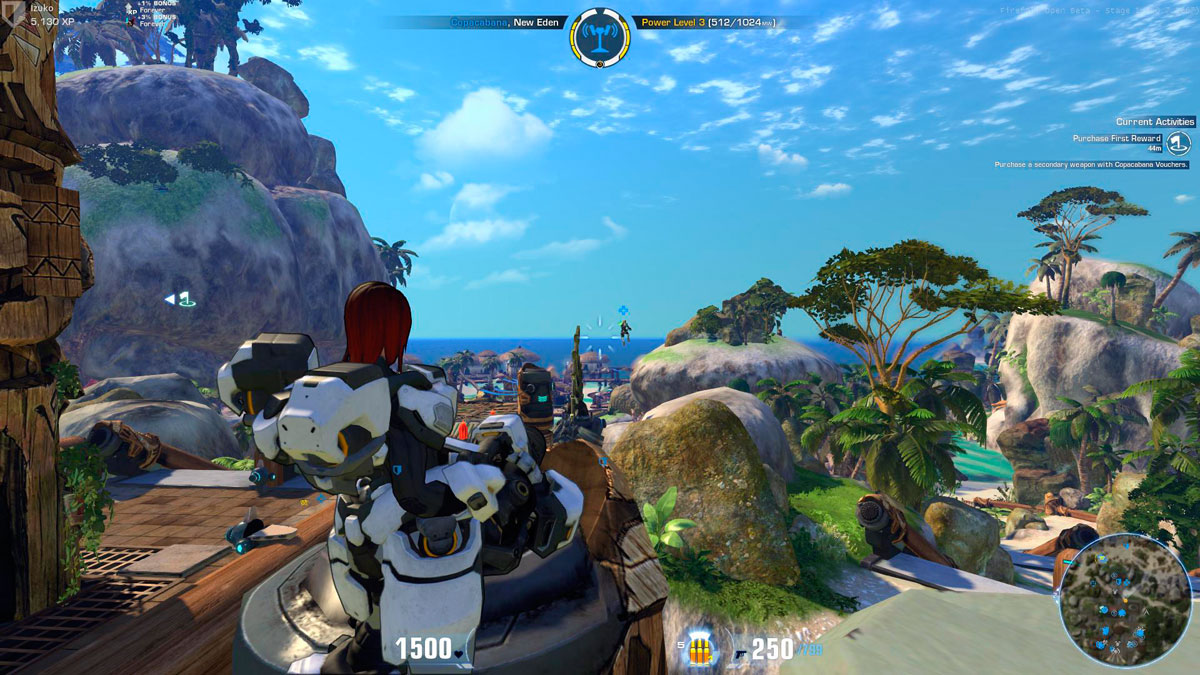
Borderlands 2 with an actual color palate.
Some people might not like the sort of cel-shaded motif here, but this sort of thing has never bothered me. If the game runs better and has more options for crazy effects, then I will “sacrifice” ultra-realistic graphics any day. Plus: everyone has jetpacks, right from the start.
I can’t give much more of an impression beyond the above, as I was unable to progress past the second “quest.” The first quest was to follow a waypoint, and the second was to kill some bugs and then return to purchase your sidearm from a vendor. Unfortunately, either I am completely oblivious (possible) or the the game was bugging out for me (likely) seeing as how no menu would appear after interacting with said vendor:
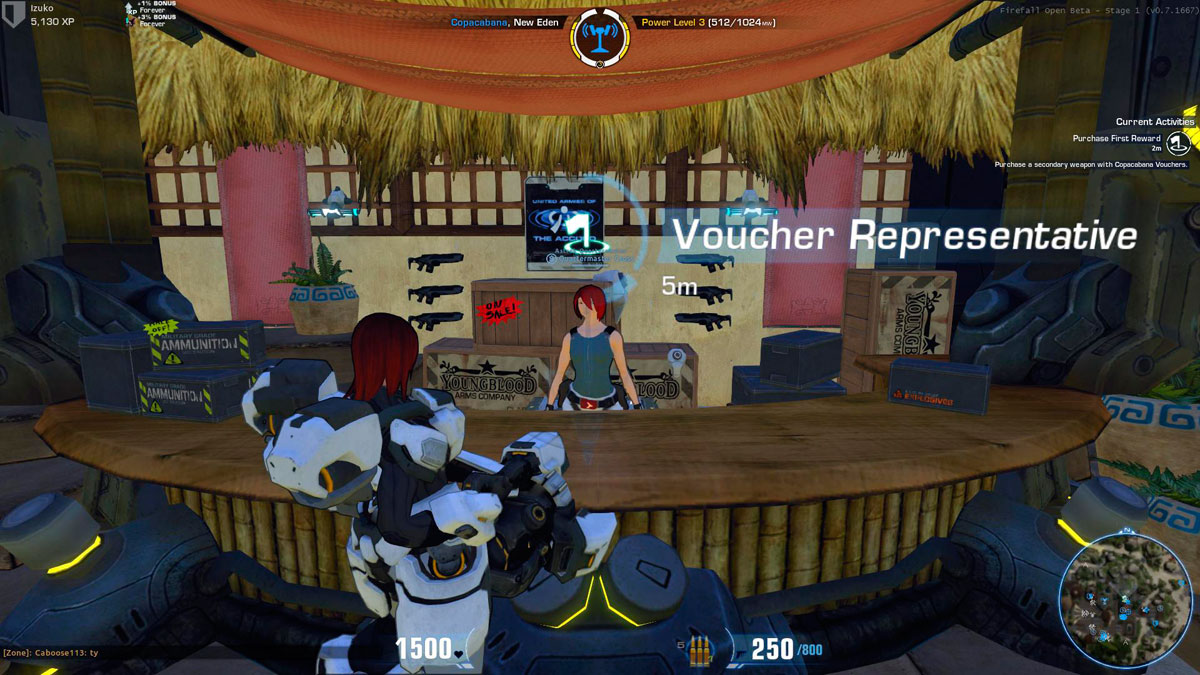
How about you give me a gun and I don’t shoot your face off?
Since the mouse controls your aim, I know that I successfully clicked ‘E’ on the vendor because the crosshair disappeared and an actual mouse pointer appeared. But no menu. I tried highlighting the guns in the background, clicking on every on-screen icon-looking thing, reloading the client, and finally restarting my computer. Open beta is open beta, but I was left feeling pretty disappointed all the same. Hell, I couldn’t even submit a ticket because that interface wasn’t showing up either. I could probably submit a bug report on the forums… or I could go play some other game that works instead.
While I was clicking around, I did notice something particularly interesting:
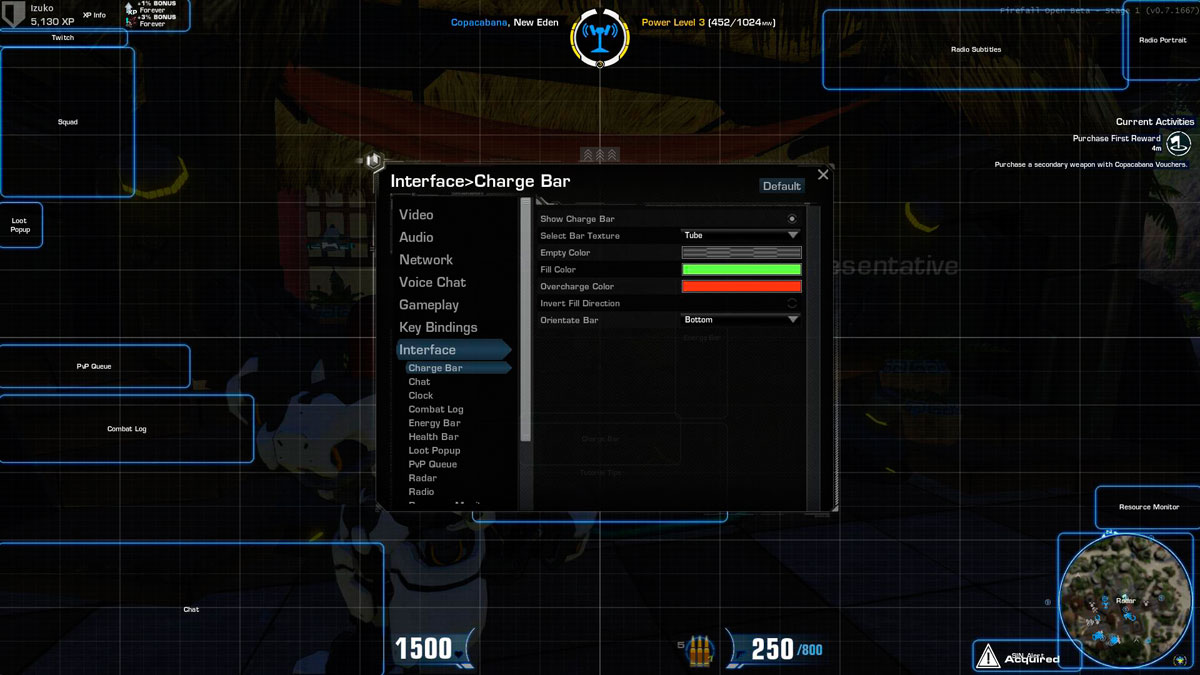
Customizable interface right out of the box?!
That’s right, you can move shit around your screen and I think resize elements right from the start. It might seem like a small thing, and it arguably is small, but it begs the question of why some MMOs *cough* require you to download 432 mods to do the same sort of things. Artistic restrictions? General laziness? More of this sort of thing, please.
I might check back in on Firefall later to see if the problem resolves itself, or I might simply wait until release. Until then, feel free to try it out yourself.
Comfort & Fashion
There is a saying that goes “Never let comfort interfere with fashion.” Perhaps it’s less of a saying and more an ironic reminder of how absurd human beings can get in the pursuit of arbitrary, ephemeral trends. Why anyone thinks high heels should be a thing, for example, I have no idea. Sure, some jiggly-bits are at a higher incline than normal, but my eyes are always drawn down to the barely-recognizable compressed foot nodules at the end of the legs. Can’t we have the fashion and the comfort? Let’s just make it fashionable to wear comfortable sneakers and call it a day already.
All these thoughts came to mind when I spied the following WoW PTR Patch 5.4 notes:
Warrior
- Shield Wall no longer requires a shield. If the Warrior does not have a shield equipped, it will show a visual of an equipped shield.
- Spell Reflection no longer requires a shield. If the Warrior does not have a shield equipped, it will show a visual of an equipped shield.
Way back in November of 2011, I mentioned the ridiculousness that is/was warrior gameplay. Obviously the ridiculousness extended all the way back to Day 1 of WoW’s release, but in 2011 there were a number of changes going on that made it feel like Blizzard was finally turning a corner. Most every warrior ability was tied to a specific Stance up to that point, but suddenly those restrictions were evaporating. “You can cast Spell Reflection in Arms stance!” And we cheered. And then realized you still needed a shield, and we sullenly took one line out of our macros before continuing browsing mice on Amazon with 12+ buttons on the side.
I am 100% convinced that, up to this point, Blizzard has required a shield for Spell Reflection (and Shield Wall for that matter) simply out of “fashion,” e.g. no legitimate gameplay reason. I mean, it’s one thing to include abilities/functionality that requires a high skill cap, or even an honest desire for certain skills to not be usable outside of certain scenarios. It is quite another when there is basically no possible way to utilize a button on your hotbar without having to support it with in-game scripts. No, seriously, just walk yourself through the steps necessary to cast Spell Reflection, and then compare that duration with the typical window in which the ability is useful… while keeping in mind that every PvP warrior is expressly balanced around judicious use of said ability.
I can understand their likely thought process here. “How are you reflecting the spell if not with a shield? And don’t even try to tell me you don’t need a shield for Shield Wall – it’s in the name!” Okay, yeah, it is. But the whole thing is one big, convoluted mess that creates an enormous gulf between even so-so warriors and their macro’d peers. You can make one button that handles the whole gear-swap/ability use process in a way that the default game never could. While “anyone” can copy/paste the macro, at some point you need to ask yourself why its necessary in the first place. Tradition? Fashion? Because it sure as hell isn’t for gameplay reasons.
Reviews: Hotline: Miami, Magic: 2013
Game: Hotline: Miami
Recommended price: $5
Metacritic Score: 85
Completion Time: ~5 hours
Buy If You Like: Violent twitch games, Retro style, puzzlers
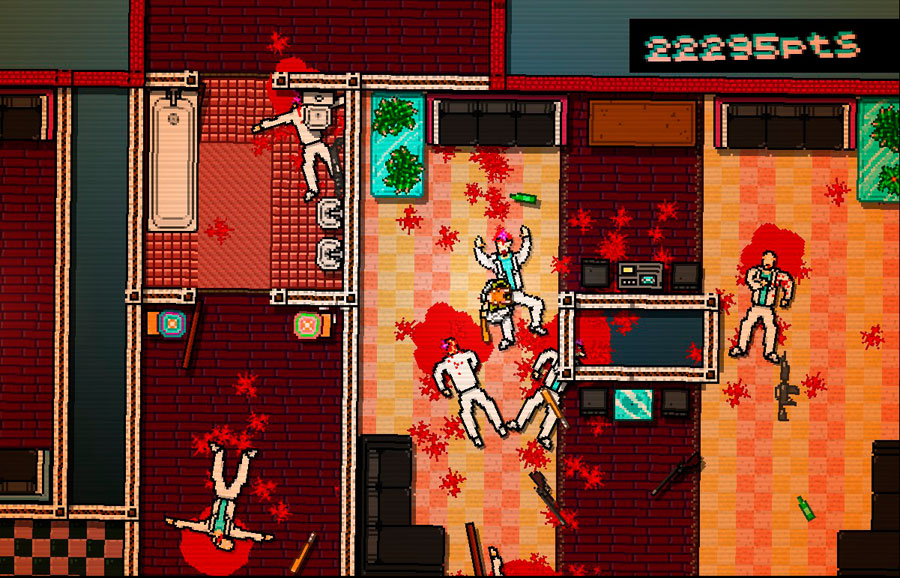
I FEEL HAPPY
Assuming you are not already familiar with another of the darling indie success stories, Hotline: Miami is an old-school top-down twitch puzzler game featuring a truly amazing soundtrack, a disturbing narrative, and pixelated ultraviolence. The “premise,” such as it is, involves the main characters receiving a voicemail listing an address under some other pretext (cleaning, going to a business meeting, etc). Once arriving in a DeLorean, the player can choose one of the unlockable animal masks to put on (which grants various buffs), and then gets busy brutally murdering every single person inside.
What is so engaging about the gameplay is precisely how manic, and yet deliberate it all feels. A single bullet or mistimed weapon swing will kill you instantly, leading to a reset of the entire floor. But while there is “stealth” in Hotline: Miami, it is not really a stealth game either. Some of the enemies follow scripted patrols, and yet others will simply stare exactly at the only means of egress into the rooms they occupy. This is why I called the game a “twitch puzzler,” as the best way to approach most levels is to simply barrel into each room, dispatch everyone inside, and speed onward… following a route and sequence of action derived from dying 10-20 times in a row. Think Super Meat Boy, not Tenchu.
Overall, Hotline: Miami is a pretty good game as long as you are not overly squeamish over pixelated blood and gore. While it is true that there may be a more philosophical undercurrent to the narrative that questions our delight in murdering virtual people, that really isn’t why you should play the game. You should play because it’s fun… provided you have the reflexes to keep up.
_____________
Game: Magic the Gathering: Duel of the Planeswalkers 2013
Recommended price: $10 (with DLC)
Metacritic Score: 77
Completion Time: 15+ hours
Buy If You Like: Magic, TCGs, Strategery
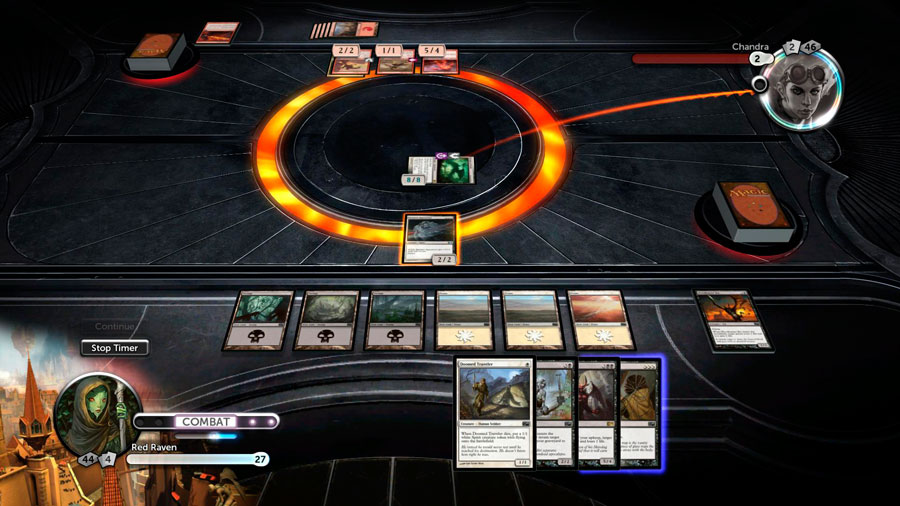
W/B siphon decks were one of my favorites IRL too.
Magic: Duel of the Planeswalkers 2013 is a self-contained simulation of Magic Online, featuring the ability to play a number of semi-customizable theme decks against AI or human opponents. As you win games using the same deck, you unlock up to 30 more cards which can swapped out for other cards, or simply added to the deck; while the unlocked cards are usually just duplicates, sometimes they are brand new cards that you did not have access to before. Beyond the duels, Magic 2013 also offers 10+ “Magic: the Puzzling” matches, where you are usually tasked with winning the game in the current turn (or next one) with a predefined board situation.
As an avid Magic fan that hasn’t had the opportunity to play in years, Magic 2013 was a very compelling substitute for the time I spent playing. There is a pretty wide variety in the theme decks presented, ensuring there is a deck for your playstyle regardless of whether that is Burn deck, Goblins, Milling, White Wheenie, Blue Flyer, and/or any of the multicolored decks. On the highest difficulty, the AI was pretty merciless; across my dozens of hours of gameplay, there were only a few convoluted situations in which I felt that a real human opponent might have played better.
There are really only two downsides to Magic 2013. The first is that customization is extremely limited. As mentioned, each deck can unlock only 30 additional cards. While most decks feature unlockable cards that can subtly shift its tactics in certain directions, on the whole you are stuck with what you have. It would have been nice to be able to create your own deck out of the entire pool of cards you have access to, perhaps by adding goblins to your Burn deck, for example. The second issue might be somewhat unfair, but… well, it was hard for me to maintain my interest in the game past a certain point since I knew the environment was self-contained. There was never going to be new cards in Magic 2013 (I purchased it after the DLC expansions was released). Now, Magic 2014 is just around the corner out now, of course, but that will have no interaction with 2013 at all. Magic fans or fans of TCGs in general will hopefully understand what I’m talking about.
Overall, Magic: Duel of the Planeswalkers 2013 is a pretty good Magic simulator for those looking for a pick-up-and-play TCG experience. Sometimes you will get mana screwed, sometimes the computer will top-deck some outrageous card, sometimes you will win because the computer never drew anything of consequence. That is pretty much par for the Magic course though. When it gets good, Magic 2013 feels like the real thing. Which is really all you can ask for from a game you can pick up for less than the price of three IRL booster packs.
Whale Crash
A while ago I was hanging out on a rocky ledge in PlanetSide 2, watching my team farm the NC warp-gate. Then I thought: “Hey, I can kinda recreate that last scene from Saving Private Ryan!”
Little did I know that…
 In An Age
Roguehate
Jul 22
Posted by Azuriel
Do you know the worst part about a roguelike? You can’t even rage-quit! “Oh, I just died? Well… fine! I’ll just delete my saves and… oh.”
Last known photo of my Adventure Mode hero.
The roguelike genre is one I had avoided for years, rebuffed by the mere word “permadeath.” Is that supposed to be an appealing characteristic? It’s like, I don’t need to know anything more about scrotum piercing to understand, at a fundamental level, that it’s just not for me. And so I happily carried on in my non-permadeath gaming, leaving behind the empty husks of my peers who had just lost their 60+ hour Diablo 2 Hardcore characters.
The Binding of Isaac changed all that for me. And then FTL cemented it. I don’t seek out roguelikes, but it is an exotic flavor I am willing to sample now and again.
The problem I am having though, is with all these roguelikes that choose to, well, bend the (unwritten) rules. For me, it started with Dungeons of Dredmor. After dying a few times getting a feel for the game, I went full optimize-the-fun-out-of-the-game mode. Explored every floor, room by room, while collecting and refining every resource. It was pretty clear that I had vaulted over the difficulty curve and would be coasting my way to the very end. That’s the point of permadeath though, right? To encourage conservative play?
Regardless of the answer to that question, the fact remains that I was on hour 22 of my roguelike save. To me, that is starting to border on obscene. I feel like the roguelike structure works perfectly for games that can conceivably be won within a few hours or a single (marathon) session. Anything longer is simply suspect – what useful purpose does permadeath serve then? I have 52 hours /played on FTL and 27 hours on Binding of Isaac, both of which can be finished within 2-3 hours. Permadeath in this scenario, and procedurally-generated encounters generally, thus increase the play-time of an otherwise short game. But if you are already spending 20+ hours on a single life only to die in some asinine way… well, what’s the point of trying again?
If you can’t tell, I’m writing this post because I’m pissed at dying in Don’t Starve. I made it all the way to the final world in Adventure Mode, which I could not even start until I found the doorway on Day 30+ in Survival Mode. You have no idea how close to the end I was. I had collected all four Things and was on my way to the Wooden Thing to assemble them. The last world is exceedingly harsh though, and my sanity was leaking out at a precipitous rate (it didn’t help that I was traversing a swamp). I stopped to pick a Blue Mushroom in the hopes of regaining just enough sanity to push me over the finish line.
Alas, a tentacle I couldn’t even see spawned and spanked me twice. Dead. I resurrected at my Meat Effigy in total darkness, and was one-shot a few seconds later. Dead again. Spawned back at the Adventure Door portal, and would have to go through everything all over again.
…except I don’t think I am. I have 35 hours into Don’t Starve, and was relishing the thought of being “done” with the game once Adventure Mode was beaten. “Done” in the sense of achieving sufficient mental satisfaction to allow me to move on to another game. Now? I just feel so goddamn empty. Dying to the last boss in Binding of Isaac feels terrible, but you are only really out an hour or so. Same with FTL. With Don’t Starve, I just saw 7-10 hours of my life evaporate into the ether. While that is technically how all leisurely pursuits end, I don’t usually end a gaming session feeling, well, like an empty husk.
It’s not really Don’t Starve’s fault – if the game were easier, even a tiny bit, it wouldn’t be the same game on a fundamental level. I like that a harsh game like this exists, as it pushes you into uncomfortable scenarios in which inaction is punished. I just don’t know if I want to be playing “long-form” roguelikes like this anymore. Permadeath is fine in the proper contexts, and said context is always in short games, IMO. Putting roguelike qualities into a game that simultaneously demands X amount of investment just strikes me as cruel and unusual. Some people like that sort of thing, sure. But I doubt that the end reward for our valiant efforts will be sweet enough to cover the acrid, bitter bile that is seeing so many hours go up in smoke.
Fake Edit: I tried again anyway. Died a few times, tried some more. Got the insanely difficult “forever winter” stage as my first level, but persisted anyway. Somehow made it even farther. Got to the 4th stage, and was feeling pretty good about myself. Run into a field of killer bees looking for a Thing, and died. Now at 48 hours /played. FML.
Posted in Commentary
4 Comments
Tags: Diablo, Don't Starve, Hardcore, Permadeath, Roguelike