Unfair Impressions: Darkfall, Final (?)
I was not sure there was going to be a Day 3 to this series. Hell, Day 2 came as a complete surprise for that matter. My default expression in life is “Impress me,” to which Darkfall just laughs. “Okay, show me what you have to offer.” “Show yourself.” There is an inherent nobility to that uncompromising sentiment, a sense that all the other games out there selling themselves are, indeed, engaging in prostitution. Darkfall instead has the purity of your back yard, with the creek your mother told you to stay away from. No one gave you a quest to turn over rocks to see what lied beneath them; you just did it because you were there, and hey look at that weird bug, I wonder what happens when I… eww.
Sorry, sometimes I get carried away with my own bullshit.

#MMOLogic
In truth, I continued playing Darkfall because I was interested in how onerous it would be to make arrows for my Skirmisher. The spiders never dropped any coin, the vendors were asking for 30+ crafting mats for 1g, and my initial try at crafting wooden planks left me with not enough gold to purchase a pick axe to mine the requisite stone for arrowheads. Considering my character was ostensibly an archer, would the game allow me to run out of arrows?
Of course it would.
I abandoned the spider spawns, and tried the other starter monster spawn location. It too was farmed out; in fact, I don’t even know what mobs spawn there as none lived long enough for me to point at them. From the map, I noticed some ruins off to the west. If there’s ruins, there’s monsters. Sure enough, it was zombie spawn city.
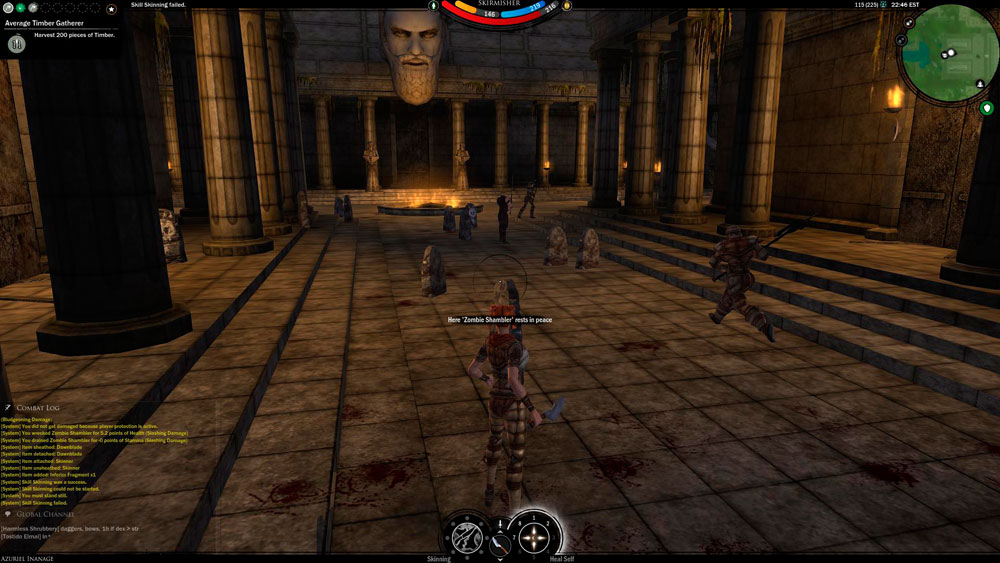
My potential future. Kill me now.
While I sat on the fringes watching characters in clearly superior gear farming through the zombies like butter, it occurred to me that there is a distinction between sandboxes that few ever make. There is the sandbox in which you perform repetitive actions in order to have fun later, and there are the ones in which you have fun doing fun things that leads to more fun later. Darkfall, to me, is the former; Minecraft would be the latter. And the funny thing is that the former doesn’t sound all that different from what I was required to do in WoW.
The zombies that trickled past the farmers did end up dropping hard currency – around 1-3g every 5-10 mobs. Examining the pleasure I felt when I walked away with 22g at the end of the farming excursion was a sobering experience. There were likely better spots for gold farming, even in the protected newbie zones, but it was a glimpse back into the churning abyss of a grind without end. Work hard today so you can have fun later, as opposed to having fun… having fun.
In any case, I remain pleased that I gave Darkfall the ole college try. Every time I read Syncaine’s latest post about ganking a dude and stealing all his stuff (and his boat), or about how he AFK farmed while writing the post, I can visualize what exactly all those shenanigans looked like. And then realize that game he and others are playing exists primarily in their own minds.
Which isn’t a bad thing, of course. It’s just not my thing.
Review: Spec Ops: The Line
Game: Spec Ops: The Line
Recommended price: $10
Metacritic Score: 76
Completion Time: 6 hours
Buy If You Like: Kane & Lynch-esque cover-based military shooters
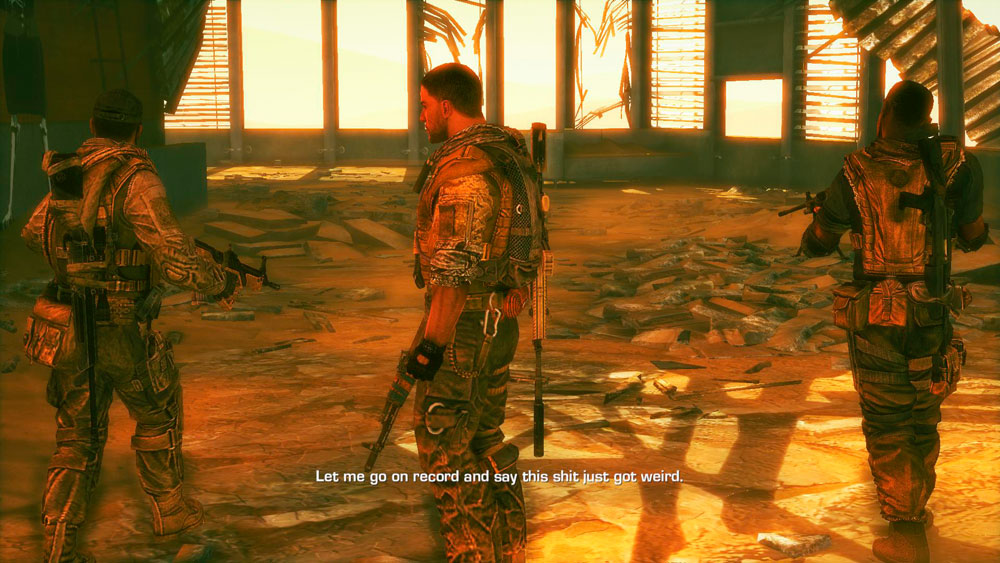
You said it, Lugo.
Spec Ops: The Line is an over-the-shoulder cover-based military shooter that seeks to subvert the tropes of its genre. You control Captain Adams, tasked with commanding your two Delta Force squad mates in search for what happened to Colonel Konrad and the rest of the 33rd Battalion. The search leads them into the ruined city of Dubai, which appears to have devolved into anarchy after a series of epic sandstorms cut it off from the rest of the world.
After killing some insurgents whom had taken members of the 33rd hostage, the mission starts to go pear-shaped when the very soldiers you are trying to save confuse your team for CIA operatives who have been riling up the insurgents. From there, things just keep getting darker and darker as you continue taking completely rational steps towards a line you did not realize you already crossed hours ago.
I was interested to play Spec Ops precisely because I heard about its subversive themes. What I discovered though, is that I have seen this all before in Far Cry 2 and Kane & Lynch 2: Dog Days. In fact, Kane & Lynch is the perfect analog here despite approaching from the opposite side of the legal spectrum: both games are over-the-shoulder cover-based shooters whose scenarios start off as reasonable before relentlessly veering into the absurd. What seems like a natural progression or escalation of violence suddenly sickens you once you realize what exactly you are doing. How did I go from killing insurgents to killing Americans? Why am I looking forward to the next cover-strewn environment so I can use my grenade launcher to kill even more soldiers?
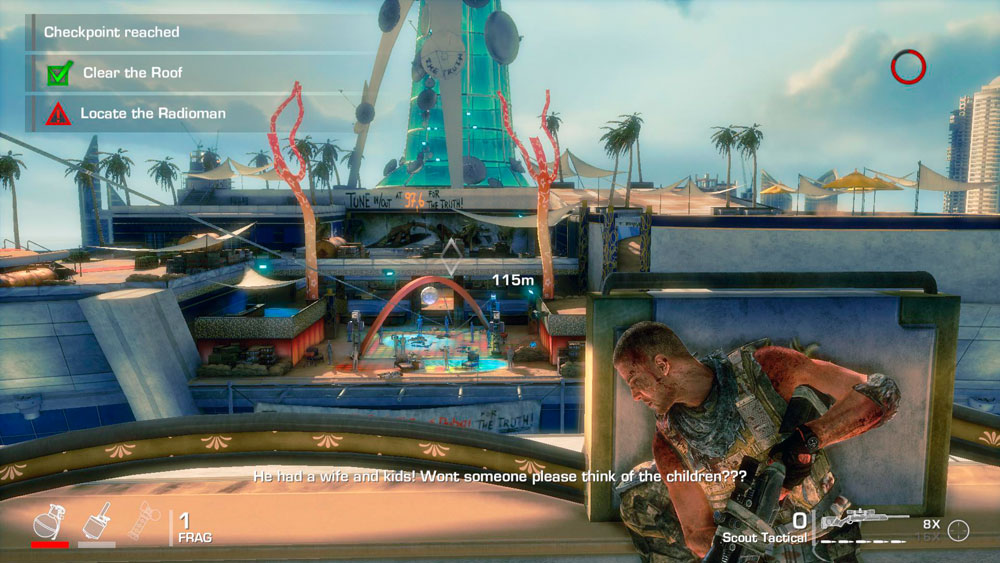
This joke never gets old.
The eponymous “Line” referred in the game title probably refers to one specific incident (that I won’t spoil), given how long it was dwelt upon, but I personally found it curiously ineffectual. At first, I didn’t even realize that my actions caused the incident in question, and even after I wasn’t particularly convinced player agency was involved. In spite of that, the game does a great job in fostering a sense of nihilistic fatalism. The situation becomes so FUBAR that it almost doesn’t matter what else you do at that point. And then you, the human player behind the screen, start to realize what that means for soldiers in real situations out in the world.
I am sympathetic to the argument that perhaps some reviewers give Spec Ops: the Line too much credit. While the gameplay doesn’t noticeably change, I absolutely felt fatigued by the end of the six hour story campaign. Construing that fatigue and feeling of pointlessness as being intentional artistic designs, might be a little too clever an excuse to take seriously; it sort of hand-waves away any possibility of bad game design, and feels a bit too convenient besides. If you are willing to give the designers the benefit of the doubt though, it is certainly an effective plot mechanism… just as it was in Far Cry 2 and Kane & Lynch.
Ultimately, I feel Spec Ops: the Line as an experience is worth a bit more than my usual limit for these shorter games. The visuals are amazing, the interaction with your squad is superb, and the setting is both unique and artistic. You might feel drained and depressed by the end, but at least you felt something – a feeling that might actually persist beyond turning the system off. Which is more than I can say for a lot of the games I have played.
Unfair Impressions: Darkfall, Day 2
I felt like the screenshots were not enough to fully immerse you in the world of Darkfall. So here is a video of me attacking some spiders. Don’t forget to switch to 1080p quality!
In terms of the tutorial, I finally realized why I was stuck on the “skinning” portion. While you can loot leather from the glowing gravestones, if you have a skinning knife you can also skin… the gravestones. Because that makes sense. The failure rate seems ridiculously high, but eventually I loot one.
The next step is to hearth to your bindstone, which I did exactly two minutes later. Literally, guys, it’s a 120-second cast. I started it up and left to make my lunch for the next day.
This actually reminds me of another curious thing: AFK-farming seems encouraged in Darkfall. Much like in Guild Wars 2, you must buy a logging axe or herbing sickle in order to gather materials, and these items have charges (durability in this case) that deplete on use. The difference here is that you can start up the animation in Darkfall and walk away from the keyboard – your character will merrily continue chopping timber until (presumably) the axe is worn down to the nub or the tree runs out of wood. It reminds me of what I have heard about mining space rocks in EVE, insofar as gathering only requires button presses once every half-hour. Is that supposed to discourage people from farming, or a concession that farming is so boring the game will do it for you while you Tab out and play something more engaging?
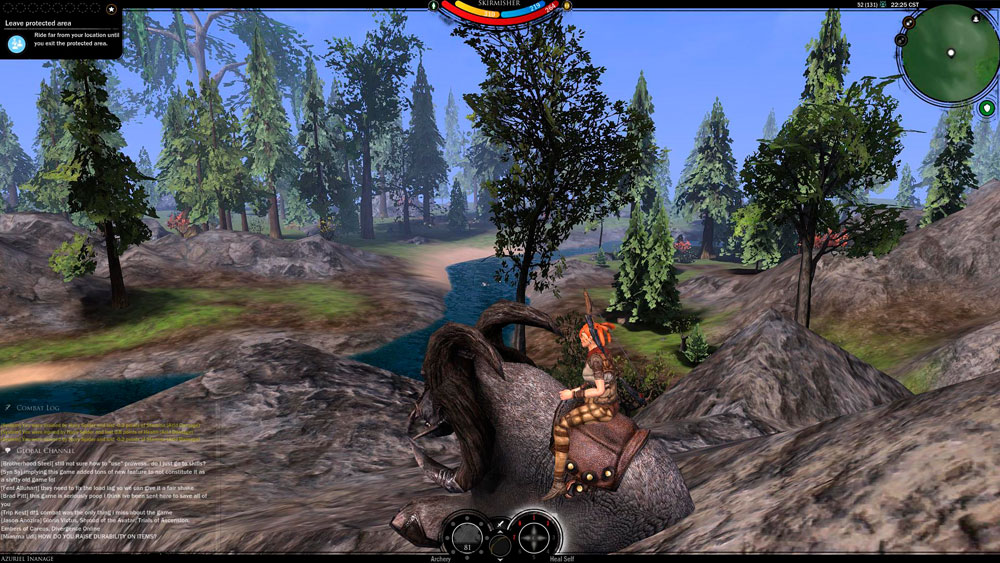
At the Southern FFA border.
In any event, the next stage of the tutorial was taking a 100kg (!) mount idol from the bank and summoning a mount. From there, you are tasked to running to the border of the protected area, sticking your toe over, and then coming back inside. Ah… so I was paranoid for no reason this entire time. Well, sorta. Apparently if you aren’t careful, people can actually steal your mount and ride away. After which I assume you are shit outta luck. Considering that unsummoning the mount takes a minimum of 2 seconds after dismounting, you’ll never want to actually be in town riding the thing.
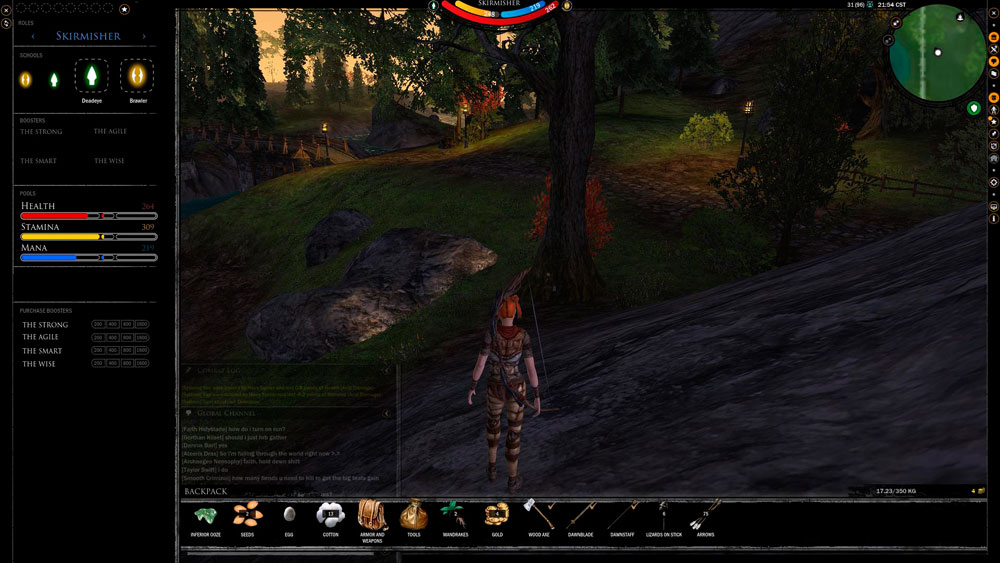
After much squinting at the abysmal UI, I finally found and dabbled with the Prowess system. Essentially, you earn Prowess doing things, doing a certain number of things (Feats), and presumably other ways too. Prowess essentially act as skill points you use to upgrade skills, increase your ability scores (Strength, Dexterity, etc), and so on. Most skills start a 1 and can be increased up to 100 with an increasingly harsh cost ratio (1:1 up to ~25, then 2:1, etc); each upgrade level typically improves cast speed plus some miscellaneous qualities by some percentage. As an example, putting points into Archery lets me fire faster and deal more damage per arrow, whereas Mining let’s me increase my AFK-yield.
That all makes sense, but I was taken aback a bit from the “Boosts”. At first, I was thinking they were F2P-esque boosts, but that does not appear to be the case.
Ha ha, we got you good.
Instead, they are… err. Well, you can buy the first rank of “the Agile” boost for 200 Prowess, and it increases Dexterity by +10 and the Stamina by +37. Considering that manually boosting Dexterity by +1 costs 30 Prowess, I don’t actually know the point of boosts in this context other than a designer “Gotcha!” moment. I mean, I suppose that it is a way to quickly achieve your class’s optimum stats while still offering a Prowess sink for long-term players (e.g. Warrior dumping extra Prowess into Intelligence once everything warrior-y is bought).
If there is a third day of playing Darkfall in my future, my goal is to figure out the crafting side of things. I understand the basics, but I’m a little uncertain about how one actually goes about getting hard currency; considering that crafting consumes gold as well as mats, you have to have a baseline of income from somewhere. None of the mobs I have killed dropped gold thus far. Does it all come from vendoring goods? There are no “quests” of course, and there doesn’t appear to be an AH either.
So… yeah. Darkfall.
Unfair Impressions: Darkfall: Unholy Alliance
That’s right, ladies and gentlemen. You know you are batting in the Big Leagues when you can bamboozle people into believing you are a member of the Press™ despite running a blog that is barely eking out Google pagerank from an Amazon book review and a bioterrorism article written in 2004 that happened to use the phrase “in an age” in the title. I suppose that this is sort of the gaming blogger dream though, wherein people send you free things and you write about them; instead of, you know, the standard procedure of having to purchase things to write about, like some kind of animal.
Whatever the case, Aventurine has inexplicably included me on their Press mailing list for Darkfall: Unholy Wars, and I am now entitled to the game itself along with 30 days of Press™ subscription for free. Rather than allow this inevitably comical misadventure go to waste, I downloaded and patched the game last Wednesday night.
It is worth noting why this post is labeled “Unfair Impressions”: basically, I have zero interest in Darkfall: UW. In fact, I would say less than zero interest. The sum total of what I know about Darkfall is that it is a full-loot FFA PvP game that some say is the most skillful MMO out there. They also say it’s terrible playing by yourself. Fantastic. Let me wander around, lost and confused, as I endeavor to stay as far away from other people as humanly possible.
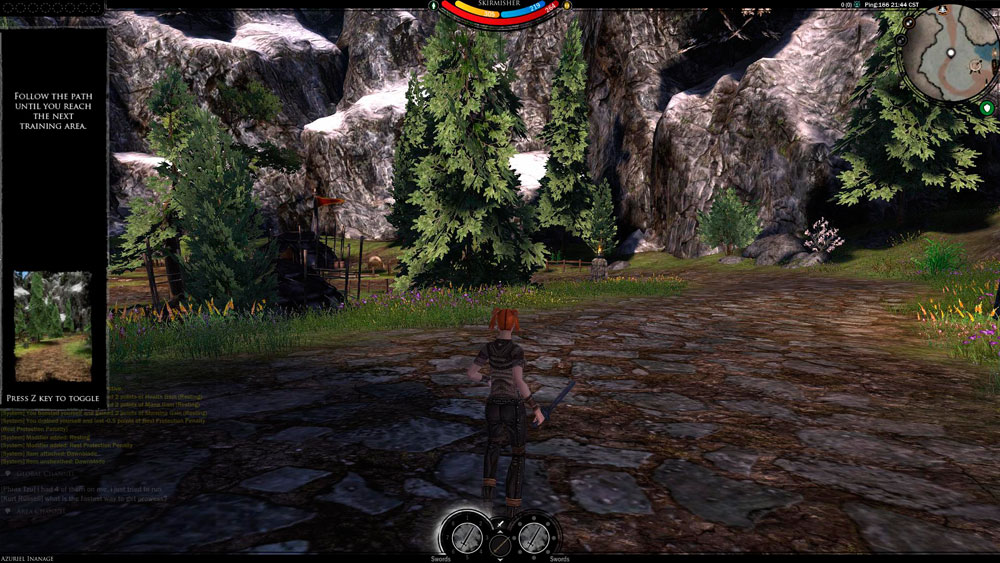
Well… they got the 2004 look down, at least.
Okay, I’m not going to mention how godawful ugly this game is. Not even once. The screenshots really speak or themselves. And as far as I’m aware, my settings are dialed to the max.
I am in the first town. I’m pretty sure this area is still a sanctuary, but I’m nervous about accidentally left-clicking someone. Okay, let’s follow the tutorial. “Buy an axe.” Alright, let’s see…

Way to maximize useless screen-space.
…good god, is this the vendor interface?
Alright, nevermind, let’s go out to a monster spawn.
Trust no one.
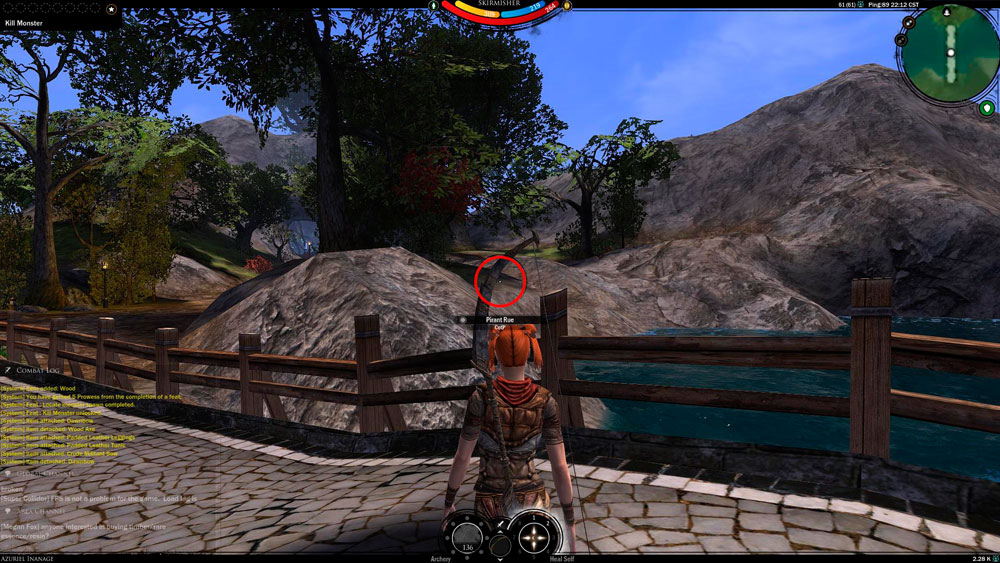
Halfway across the bridge, I notice a dude standing around. Is he a ganker, waiting for me to cross into no man’s land? Is he AFK? Can I gank him? It seems like a trap, so I shuffle away and swim into the river. My default strategy when I feel threatened is to make killing me as annoying as possible. Not that it ever stops anyone, but I derive the same satisfaction I imagine a puffer fish feels when swallowed by… whatever it is that chokes on a puffer fish before dying to its poisonous organs.

Don’t mind me. Please.
Monster spawn time. Cave spiders. I… think they shoot poison at me, but it is hard to tell. There are 4-5 people in the cave killing spiders already. Do they know each other? Is this zone still protected? I give everyone a wide berth and hang out in the cobwebs. I kill a spider and loot its tombstone. Leather. Spider… leather? But wait, my little achievement tutorial thing says I must skin the tombstone. But I already have… or have I? Okay, let’s kill another spider. Except another doesn’t spawn in my area, and now there are more people in the cave and it’s late and I want to play something else.
Alright… how do I log off? I binded myself to a stone in town, so maybe I can hearth back? After searching the painfully bad UI, I see the option. I click on the button and… wait. Still waiting. I get that it would be too easy to escape a ganking if it were quicker, but a full 120-second hearth timer?
Good lord, maybe this was a bad idea.
No Good Deed Goes Unpunished
In a game with morality choices, would you choose the Good options if the results were often worse?
Most of the games I can think of that had moral choices ended up rewarding you the most if you chose the Good options. In Bioshock, for example, you could either “harvest” the Little Sisters for extra upgrade currency, or you could Cleanse them for a smaller reward. As it turns out though, if you end up Cleansing the Little Sisters they would start dropping off care packages containing ammo and extra upgrade currency, such that you might even come out ahead by going the Good route. The choice also ends up reflecting the tone of the ending, but it luckily skews towards Evil Ending rather than Bad Ending per se.
In thinking back to Bioshock, I started wondering if I would have been more inclined to harvest the Little Sisters if they did not “sweeten the deal” with the gift baskets later. I would like to say “No,” but I also feel like the “Pick the Good option and get bigger reward later” is such a ingrained gaming trope that I am beginning to question which inclination came first. Would the promise of a “better” ending be incentive enough to make Good choices, even if the game proper was made more difficult thereby?
Or to go all the way: what if the only reward of a Good choice in a game was the personal satisfaction of having done the right thing? In other words, what if the player was punished in some way for choosing the moral thing to do? An example could be sparing a bad guy, only to have them return and kill an NPC teammate later. Would the average gamer behavior change? Would the moral players feel better about their choices, or worse?
Sometimes I feel like I want to be a game designer just to screw with people.
Got Ghostcrawler on Speed-dial
Right after yesterday’s complaints, the following notes go up:
- Experience needed to increase from level 85 to level 90 has been reduced by 33%.
- Reduced the number of Lesser Charms of Good Fortune needed for the Mogu Runes of Fate weekly quest to 50, down from 90.
- Players no longer need to have defeated Grand Empress Shek’zeer to enter the Terrace of Endless Spring in Normal difficulty.
- Shado-Pan and The August Celestials daily quests no longer have a faction prerequisite to be Revered with the Golden Lotus.
Technically, the last one has been in there a while, if you haven’t noticed before.
Anyway, nice try, Ghostcrawler, but it’s too little, too late for me. Maybe when the next expansion is 50% off, I’ll dip my toe in again like I did this last time. Then again, maybe not.
Unsubscribing, Take Two
I may have reached the end of my second run of WoW.
As was the case last time, there was no clear death knell, no final straw, no slap in the proverbial face. Forensic evidence would probably suggest that my decline in activity can be traced back to the 5.2 announcement. At that point, I stopped bothering with LFR, knowing that I could endure the same long queues for 20+ better ilevel gear in a few weeks. I was also pretty much geared in all 483s anyway, much to the chagrin of my less fortunate guild survivors.
5.2 reinvigorated several things for me, including reaching some of the reputation milestones on alts that I would have dismissed out of hand as ridiculous previously. There were some underlying truths about myself I started to realize however:
- A healthy variety of dailies is 100% meaningless. Blizzard seems to think that 15 dailies out of a pool of 90 is somehow more palatable than the same 15 over and over. But… dailies are dailies. Unless a certain daily quest is particularly odious, such as having to kill a hard elite solo (the Pyrestar Demolisher), all daily quests blur together into a gray slurry of virtual obligation.
- Between the lack of interesting Black Market Auction House wares (which has admittedly improved in 5.2) and the BoP-crafting material economy, it is difficult to maintain interest in even lucrative AH shenanigans. As I continued canceling and re-listing cut gems and other goods day in and day out, I asked myself what exactly I imagine myself doing with this almost 400k gold. Buy something… but buy what? The lack of 476+ BoE weapons particularly was annoying. Yes, I could run LFR a bunch of times or even Honor farm, but all this gold was supposed to save me time, at least theoretically. If time = money, then money = time, does it not?
- I continued playing long after I no longer experienced any fun because of the possibility that things might change in the future. Which is quite a bizarre feat of circular reasoning, if you think about it. I have 76 pieces of Imperial Silk, for example, because if I suddenly developed a resurgence in interest, my future self would have more fun with all these accumulated mats (which you cannot really get any other way). It reminded me of how I behaved in my Middle School history course: the teacher handed out a week’s worth of worksheets on Monday, and I always completed them that very evening so I could slack off the rest of the week.
- The Legendary quest backfired big time, at least for me. By the time 5.2 came out, I had 2 Sigils of Power and 14 Sigils of Wisdom. With an average ilevel of 491, I was faced with the prospect of slogging through half a dozen or more DPS queues for the starter LFR raids, getting 476 vendor trash… if I was lucky! And then what? 6000 Valor? The questline might not have been “required” for anything I was doing, but it certainly felt more in-your-face “you are falling behind” than I ever felt before about, say, a raid-only reputation or heroic valor gear, by the very virtue of its accessibility.
- Once I got over the initial trepidation of skipping a day’s worth of cooldowns and AH re-listings, it actually became more difficult to convince myself to log back on at all. I had already “lost a day” that I would never get back. So… why bother? I skipped logging in one Saturday, and suddenly half the week is gone with nary a fuck given.
As with the last time I unsubscribed, I do not begrudge Blizzard and crew anything in particular. Well, maybe for the shit-hole of a no-pop server that they continue to allow to exist, to the detriment of all the lost souls trapped in Auchindoun-US’s hellish purgatory. But beyond that, most everything else I see as an improvement over prior design. Heroic scenarios sound like a great feature, and would have been custom-made for the 2-3 of my friends that actually managed to log on these past few weeks. Similarly, I am/was looking forward to being able to choose which spec to gear up in LFR, regardless of current role.
But… well. I could quite literally be playing any one of a hundred other videogames right now; games already purchased and with no subscription fee. More than the money though, I am looking forward to having the mental space back. It’s… liberating, in a way that cannot be described to someone whom has not had that same sort of mental real estate spoken for and suddenly vacated.
Reviews: Recettear: An Item Shop’s Tale; Deadlight
Game: Recettear: An Item Shop’s Tale
Recommended price: $5
Metacritic Score: 82
Completion Time: ~16 hours
Buy If You Like: Japanese indie games with funny localizations
Seriously, even a Lost joke?!
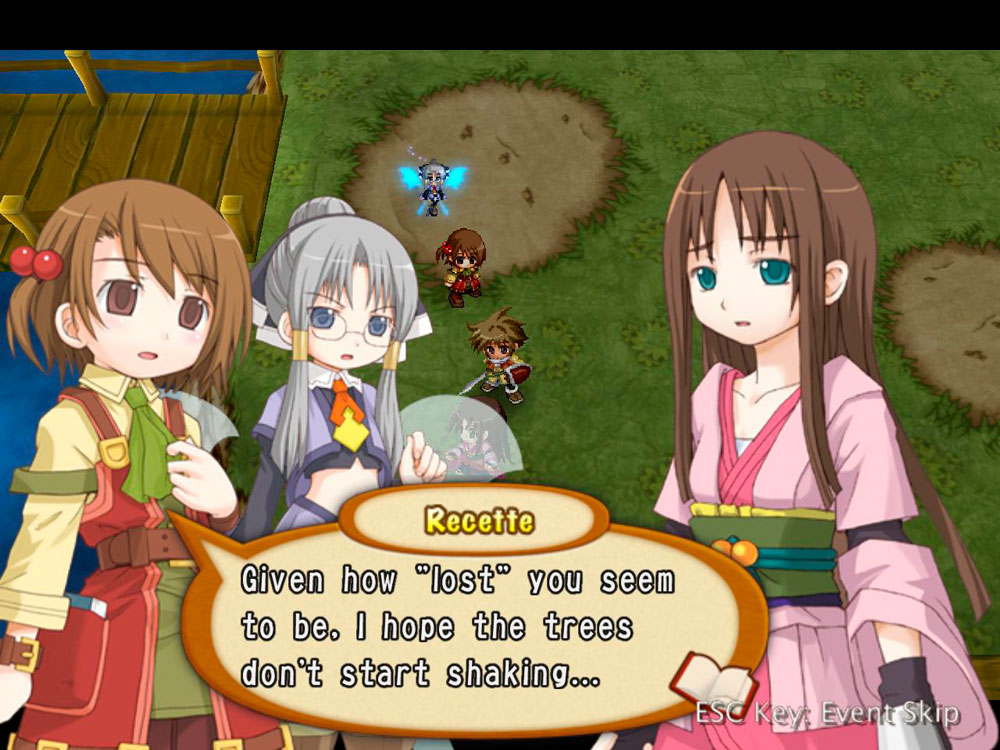
Recettear: An Item Shop’s Tale is a Japanese indie game localized in the Working Designs (RIP) tradition, wherein you take control of Recette as she turns her lonely house into an item shop to pay off her missing adventurer father’s defaulted debt. With the aid of the loan shark fairy Tear, you can either buy weapons, armor, and other goods at wholesale prices from the markets to sell at a premium, or hire out adventurers to go clear dungeons and sell those drops in your store. Time is limited however, and you must make each week’s increasingly crazy payment lest your home get repossessed.
I found the general gameplay and underlying mechanical tension surprisingly fun. Each day in Recettear is divided into four slices, which you can use to run your shop, spend going out shopping, or use two at a time to go through dungeons. I frequently found myself in interesting dilemmas: with the 80,000 payment due tomorrow, should I spend all four time slices to peddle my dwindling wares? Should I gamble that a dungeon run will net be some expensive “free” items, and that I still have time to sell them? Or should I actually spend money at the market in the hopes that I can recoup with profit before tomorrow?
These dilemmas even extend to the actual selling of items too, as you must decide what markup percent your customers are willing to accept. Shoot for the guaranteed 110%… or stretch to 130%? Finally, at random intervals the market for weapons/consumables/etc will either crash or spike, which can force you to sell at half price or lets you double your profits respectively.
Overall, I enjoyed the game while it lasted, or at least the first 8-10 hours. Defaulting on the loan actually leads to a Game Over screen, but you can start again at Week 1 with your full inventory, same adventurer levels/equipment, and same Merchant Level and other unlocks. While this makes beating the game an inevitability, you are likely to understand the underlying systems well enough to make beating the game a forgone conclusion before the end of Loop 2. For those who find themselves obsessed, Recettear does offer a quite a selection of post-game activities, including New Game+, Endless mode, and even Survival Hell mode where you have to keep making six-figure loan payments until you finally default.
If you want a unique, quirky indie game with an amusing localization, Recettear has you covered.
_____________
Game: Deadlight
Recommended price: Bundle
Metacritic Score: 78
Completion Time: ~3 hours
Buy If You Like: A less artistic LIMBO, or short side-scrolling puzzle games
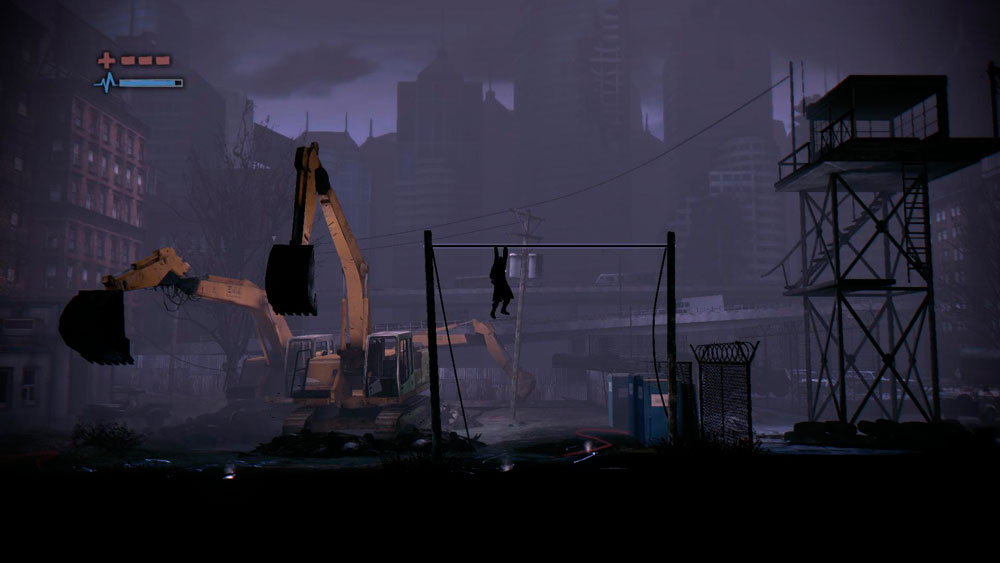
Dude… couldn’t you just walk 10ft into the background?
Deadlight is a side-scrolling puzzle platformer in the tradition of Out of This World or LIMBO, to use a more recent example. You control Randall Wayne has he navigates his way through a 1980s version of a Seattle zombie apocalypse on a mission to find his family. Amidst the frankly ridiculous jumping scenarios that Randall solves with Assassin’s Creed-levels of aplomb, you will frequently be harassed by zombies (or “Shadows” as they are termed here), which creates an extra level of tension and danger to the side-scrolling navigation.
It is worth noting that this game is stunningly beautiful; clocking in at 4.1 gigs, I suspect that the characters and environments are actually rendered in full 3D, with the camera merely forcing a 2D perspective. Aside from the graphics though, my comparison with LIMBO remains apt: Deadlight is an incredibly short game whose merits largely reside on the artistic side of the spectrum, rather than gameplay. Whereas LIMBO’s style accentuated the gameplay though, Deadlight’s more realistic bent strains credulity and breaks immersion in a few places. An example is in the screenshot above, where Randall had to leap from a building onto a series of cranes, then jump down to wire before launching himself over a barbwire fence. While platformers require a healthy degree of suspension of disbelief in general, I had a hard time getting over the fact that there is clearly a perfectly safe pathway not 10 feet in the background of that very screenshot.
Despite the immersion breaks, Deadlight isn’t a bad game – it is simply something I would not recommend picking up outside of a bundle. Even if you pick it up on a $5 sale as I did, the dollar-per-hour of entertainment is not particularly impressive.
 In An Age
The Cart and the Horse
May 8
Posted by Azuriel
Why would someone start playing a game that was only fun with the friends you made after playing the game?
One of the criticisms of my Darkfall series of posts was that I never even tried to join a clan. This is true, and I said up-front that I was not going to try; it is why I labeled the series “Unfair Impressions” in the first place. Part of the reason I made such a decision was that I am not particularly feeling sociable at the moment. Another part is that, ironically, it didn’t seem fair to whomever’s social fabric I would be using like a dish rag; I don’t fully subscribe to Gevlon’s worldview, but getting a social benefit without returning the favor does feel like leeching to me.
The biggest reason though, is that I fundamentally believe that games (even MMOs) should be fun in of themselves first.
Think about your first MMO experience. Did you start playing alone? I walked into Azeroth with nothing, and left six years later with a half-dozen friends from across the country who still ask me to join them at the next New England meet-up. That is the sort of MMO and “virtual world” dream scenario, right? But just like any relationship, it did not develop overnight. It took time. Time spent playing the game without said friends. And at any time, that window of opportunity to convert me to long-term guild player could have closed if I didn’t feel engaged or entertained enough compared to my gaming alternatives.
I am not against a game requiring investment to play, or even a game in which the most enriching experiences are to be found in grouping. I am against a game requiring a priori buy-in to justify itself. It is not reasonable, to me, to suggest clan play makes the sort of new player experience I wrote about irrelevant. Maybe Darkfall doesn’t care about catering to new players or “hand-holding,” and that’s fine. But I feel that it is a tiny bit ridiculous to then claim the game is good (or another game is bad) when you have already committed to that position before even downloading the client.
Any game is better with friends. Requiring friends in order to have fun playing a game at all is not a strength, it’s a weakness. A deficiency. There will be thousands of players playing your game for the first time, alone. Does the game then facilitate friendships? Good. Does the game present a whole bunch of impenetrable nonsense? Bad. All your 30-minute boat rides and clever grouping schemes won’t work if the players never even make it out of what passes for a tutorial.
The longer I play something like Planetside 2, the greater the opportunity for me to get hooked into somebody’s social fabric, even if I’m kicking and screaming against it the whole way. In fact, joining an Outfit would be a sort of natural evolution to someone’s daily gameplay. But that evolution is only possible because the underlying game is fun to play, e.g. I’m playing it a lot right now, solo. With Darkfall, the consensus seems to be that the opposite is true: you have fun playing a lot only after being integrated into a social fabric woven before you actually start playing.
To me, that just sounds like putting the cart before the horse.
Posted in Commentary, Philosophy
2 Comments
Tags: A Priori, Buy-In, Cart and Horse, Darkfall, Friends, MMO, Social Fabric, Unfair Impressions