Blog Archives
Unsustainability
Senua Saga: Hellblade 2 recently came out to glowing reviews and… well, not so glowing concurrent player counts on Steam. Specifically, it peaked at about 4000 players, compared to 5600 for the original game back in 2017, and compared to ~6000 for Hi-Fi Rush and Redfall. The Reddit post where I found this information has the typical excuses, e.g. it’s all Game Pass’s fault (it was a Day 1 release):
They really don’t get that gamepass is unsustainable. It works for Netflix because movies and tv shows can be made in a year or less so they can keep pumping out content each year. Games take years to make and they can’t keep the same stream of new content releasing the same way streaming services do.
Gamepass subs are already stagnating, they would make more money if they held off putting new exclusives on gamepass like movies do with putting them in theatres first before putting them on streaming. (source)
Now, it’s worth pointing out that concurrent player counts is not precisely the best way to measure the relative success of a single-player game. Unless, I suppose, you are Baldur’s Gate 3. Also, Hellblade 2 is a story-based sequel to an artistic game that, as established, only hit a peak of 5600 concurrent players. According to Wikipedia, the original game sold about 1,000,000 copies by June 2018. Thus, one would likely presume that the sequel would sell roughly the same amount or less.
The thing that piqued my interest though, was the reply that came next:
Yeah, even “small” games like Hellblade and Hi-Fi Rush, which are both under 10h to complete, took 5/6 years to develop. It’s impossible to justify developing games like these with gigantic budgets if you’re going to have them on your subscription service.
I mean… sure. But there’s an unspoken assumption here that these small games with gigantic, 5-6 year budgets would be justified even without being on a subscription service. See hot take:
Hellblade 2 really is the ultimate example of the flaw of Xbox’s “hands off” approach to game dev.
How has a studio been able to take 5 years making a tiny game that is basically identical to the first?
How did Rare get away with farting out trailers for Everwild despite the game literlaly not existing?
Reddit may constantly slag off strict management and studio control, but sometimes it’s needed to reign studios in and actually create games…
Gaming’s “sustainability problem” has long been forecast, but it does feel like things have more recently come to a head. It is easy to villainize Microsoft for closing down, say, the Hi-Fi Rush devs a year after soaking up their accolades… but good reviews don’t always equate to profit. Did the game even make back its production costs? Would it be fiduciarily responsible to make the bet in 2024, that Hi-Fi Rush 2 would outperform the original in 2030?
To be clear, I’m not in favor of Microsoft shutting down the studio. Nor do I want fewer of these kind of games. Games are commercial products, but that is not all they can be. Things like Journey can be transformative experiences, and we would all be worse off for them not existing.
Last post, I mentioned that Square Enix is shifting priorities of their entire company based on poor numbers for their mainline Final Fantasy PS5 timed-exclusive releases. But the fundamental problem is a bit deeper. At Square Enix, we’ve heard for years about how one of their games will sell millions of copies but still be considered “underperforming.” For example, the original Tomb Raider reboot sold 3.4 million copies in the first month, but the execs thought that made it a failure. Well, there was a recent Reddit thread about an ex-Square Enix executive explaining the thought process. In short:
There’s a misunderstanding that has been repeated for nearly a decade and a half that Square Enix sets arbitrarily high sales requirements then gets upset when its arbitrarily high sales requirements fail to be met. […]
If a game costs $100m to make, and takes 5 years, then you have to beat, as an example, what the business could have returned investing $100m into the stock market over that period.
For the 5 years prior to Feb 2024, the stock market averaged a rate of return of 14.5%. Investing that $100m in the stock market would net you a return of $201m, so this is our ROI baseline. Can the game net a return higher than this after marketing, platform fees, and discounts are factored in?
That… makes sense. One might even say it’s basic economics.
However, that heuristic also seems outrageously unsustainable in of itself. Almost by definition, very few companies beat “the market.” Especially when the market is, by weight, Microsoft (7.16%), Apple (6.12%), Nvidia (5.79%), Amazon (3.74%), and Meta (2.31%). And 495 other companies, of course. As an investor, sure, why pick a videogame stock over SPY if the latter has the better return? But how exactly does one run a company this way?
Out of curiosity, I found a site to compare some game stocks vs SPY over the last 10 years:

I’ll be goddamned. They do usually beat the market. In case something happens to the picture:
- Square Enix – 75.89%
- EA – 276.53%
- Ubisoft – 30.56%
- Take Two – 595.14%
- S&P 500 – 170.51%
And it’s worth pointing out that Square Enix was beating the market in August 2023 before a big decline, followed by the even worse decline that we talked about recently. Indeed, every game company in this comparison was beating SPY, before Ubisoft started declining in 2022. Probably why they finally got around to “breaking the glass” when it comes to Assassin’s Creed: Japan.
Huh. This was not the direction I thought this post was going as I was writing it.
Fundamentally, I suppose the question remains as to how sustainable the videogame market is. The ex-Square Enix executive Reddit post I linked earlier has a lot more things to say on the topic, actually, and I absolutely recommend reading through it. One of the biggest takeaways is that major studios are struggling to adjust to the new reality that F2P juggernauts like Fortnite and Genshin Impact (etc) exist. Before, they could throw some more production value and/or marketing into their games and be relatively certain to achieve a certain amount of sales as long as a competitor wasn’t also releasing a major game the same month. Now, they have to worry about that and the fact that Fortnite and Genshin are still siphoning up both money and gamer time.
Which… feels kind of obvious when you write it out loud. There was never a time when I played fewer other games than when I was the in the throes of WoW (or MMOs in general). And while MMOs are niche, things like Fortnite no longer are. So not only do they have to beat out similar titles, they have to beat out a F2P title that gets huge updates every 6 weeks and has been refined to a razor edge over almost a decade. Sorta like how Rift or Warhammer or other MMOs had to debut into WoW’s shadow.
So, is gaming – or even AAA specifically – really unsustainable? Possibly.
What I think is unsustainable are production times. I have thought about this for a while, but it’s wild hearing about some of the sausage-making reporting on game development. My go-to example is always Mass Effect: Andromeda. The game spent five years in development, but it was pretty much stitched together in 18 months, and not just because of crunch. Perhaps it is unreasonable to assume the “spaghetti against the wall” phase of development can be shortened or removed, or I am not appreciating the iteration necessary to get gameplay just right. But the Production Time lever is the only one these companies can realistically pull – raising prices just makes the F2P juggernaut comparisons worse, gamer ire notwithstanding. And are any of these games even worth $80, $90, $100 in the first place?
Perversely, even if Square Enix and others were able to achieve shorter production times, that means they will be pumping out more games (assuming they don’t fire thousands of devs). Which means more competition, more overlap, and still facing down the Fortnite gun. Pivoting to live service games to more directly counter Fortnite doesn’t seem to be working either; none of us seem to want that.
I suppose we will have to see how this plays out over time. The game industry at large is clearly profitable and growing besides. We will also probably have the AAA spectacles of Call of Duty and the like that can easily justify the production values. Similarly, the indie scene will likely always be popping, as small team/solo devs shoot their shot in a crowded market, while keeping their day jobs to get by.
But the artistic AA games? Those may be in trouble. The only path for viability I see there is, ironically, something like Game Pass. Microsoft is closing (now internal) studios, yes, but it’s clearly supporting a lot of smaller titles from independent teams and giving them visibility they may not otherwise have achieved. And Game Pass needs these sort of games to pad out the catalog in-between major releases. There are conflicting stories about whether the Faustian Game Pass Bargain is worth it, but I imagine most of that is based on a post-hoc analysis of popularity. Curation and signal-boosting is only going to become increasingly required to succeed for medium-sized studios.
[Cyberpunk 2077] Terrible Design
Cyberpunk 2077 has undergone a ton of changes since its disastrous launch. I was not keeping track of everything they fixed and tweaked, but suffice it to say, there was a lot. Some of which was immediately indicative of… well, idiot designers. That may sound harsh but let me give you an example: there is an early talent (Dagger Dealer) that allows you to throw your equipped knives. What was missing from the launch of the game until literally February of this year was any way to retrieve your thrown knives. Some designer thought this talent up and some programmer put it into a game where there are legendary knives, and no one thought that maybe losing them forever was a bad idea? Again, this was fixed in version 1.5 which I am currently playing. But the fact that it was even a thing outside of alpha is mind-boggling.
What I am coming to understand is that Dagger Dealer is a symptom of deeper issues.
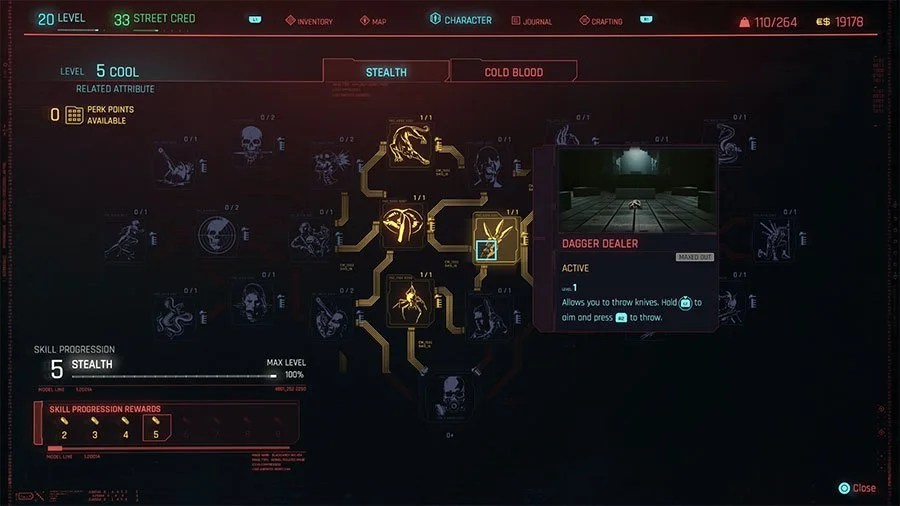
The overall leveling system is just a mess. You gain XP and gain character levels, which grant you Perk points and occasionally Attribute points. The latter are very important because they determine the maximum level of perk you can select within that Attribute. Additionally, each Attribute has multiple Skill Trees associated with it. So for example, the Reflexes Attribute contains the Assault, Blades, and Handguns trees, each of which contain 17-20 Perks that can have multiple tiers.
BUT WAIT, THERE’S MORE! Each Skill tree has its own XP meter that increases by utilizing that specific Skill in various ways. The more you use Handguns, the more Handgun XP you generate, and eventually you work your way down the reward track up to the limit of the Attribute. The rewards are usually little enhancements (Recoil reduction on Handguns, etc) but sometimes they are Perk points which you can actually assign anywhere. While that could lead to some interesting decisions wherein you start farming Blade XP to generate extra Perk points to put into Handguns or whatever, the emphasis should not deviate from the word “farm.” Because that is what it takes.
All of that may sound complicated, but none of it is particularly interesting.
I could live with all the overcomplicated shenanigans, but what I cannot stand is a Talent/Perk/Skill system with so few synergies. It is like the designers didn’t even try. I scoured the various trees and the closest thing to interesting that popped up was a Reflexes 8 Perk in the Blades tree called Stuck Pig that increases Bleed duration by 3/6/9 seconds. That is notable not because it’s actually any good, but because there is no “inflicted by a Blade” qualifier to it. Some things other than Blades inflict Bleed, so that would be an interesting choice and/or build to work towards if Bleeds were your thing. If instead you put any Perk points into Handguns, well, all of them turn off the moment you equip anything else.
And, Jesus Christ, don’t get me started on the crafting system. Because I’m going to anyway.
Crafting is governed by the Technical Ability Attribute and subsequent perks in the Crafting Skill tree. The most important ones are those Perks that unlock the crafting of Rare (5), Epic (12), and Legendary (18) items. In many games, there is always a tension between player crafting and found loot: A) if crafting is better, why search for loot, vs B) if loot is better, why engage with crafting at all. Cyberpunk kicks this up a notch with Iconic gear – these are weapons/armor with unique effects that you can continually upgrade… provided you dump a bunch of Attribute points into Technical Ability. If you don’t, those Iconic items might be good for a mission or two before trash drops start dealing more damage.

Aside from that, crafting largely sucks. You need to purchase weapon/armor “specs” from vendors to unlock the ability to craft that item in that specific tier. Just because you can craft a Rare sniper rifle does not mean you can craft the Epic version of the same sniper rifle, even if you unlocked Epic crafting via Perks. Also, the spec for that Sniper Rifle costs 75,000 credits which is just about what it costs to just purchase the Legendary version of that Sniper Rifle from the same vendor. At a certain point you can farm practically infinite amounts of credits via crafting anyway (purchase components, craft X gun, sell to vendor, cycle vendors), but the point is that the system as a whole makes no fucking sense. What was the harm with a more reasonable weapon spec cost? Woohoo, I get a “cheap” Epic Sniper Rifle by dumping Attribute and Perk Points into a tree that does not otherwise enhance my ability to deal damage with said Sniper Rifle. Christ, I bet that I would deal more damage with a trash-tier Sniper Rifle and those points spent in Reflexes instead.
By the way, Cyberpunk does feature a Respec button. The hilarious thing – in a comedy of errors sort of way – is that it only refunds Perk points, not Attribute points. Thus even though I am 40 hours deep into the game and realize how terrible Crafting has been for me, none of it matters because I can’t shuffle many of those points elsewhere because I’m limited based on Attributes, not Perks. I guess there is an argument that people would game the system by switching to a full Crafting build, upgrade all their shit, get infinite money, and then swap back to a weapon-specific build, but come on.
Know what else is disappointing? The cyberware parts of Cyberpunk. The game is predicated on body enhancements and everyone certainly looks the part. But the thing you find out after browsing a few Ripperdocs is that all the enhancements are… just random buffs locked behind Attribute gates. Sometimes you will find a common-tier upgrade not locked behind such a gate, but the vast majority are tied to your character’s Body or Reflexes Attribute, which means a Technical Ability/Intelligence character (cough) doesn’t have much to gain by cyberware. Which is really fucking bizarre, right? Compare that to how Deus Ex handles things – augments grant gameplay-changing abilities and are otherwise a big deal. In Cyberpunk, they are non-choices.
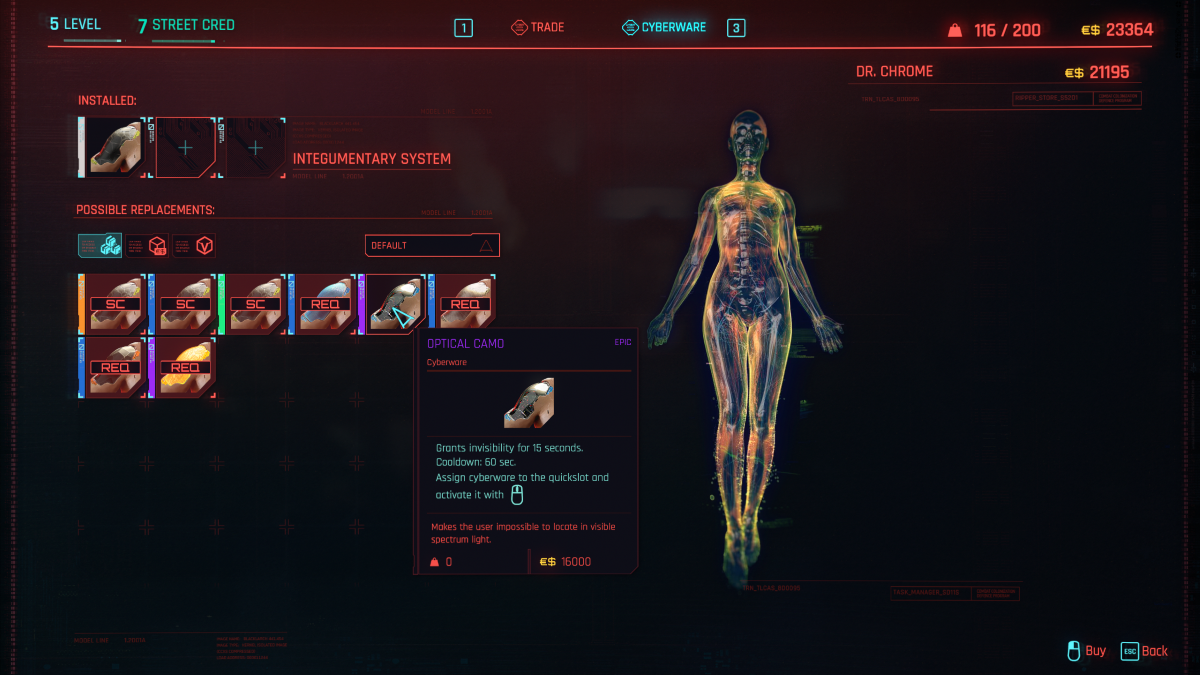
Ultimately, that is the biggest disappointment of all: everything in Cyberpunk (outside of dialog) feels like a non-choice. Can you “choose” to build your character around using Shotguns and Katanas for roleplaying purposes? Sure. Place your Attribute and Perk points in the corresponding slots. But none of that is interesting. And to me, there is no such thing as an uninteresting choice – there are choices and mere decisions. You decide to use Shotguns, and everything else follows. Notwithstanding the banality of having to decide on a specific weapon to use in the first place, there is no room for synergy choices within Skill trees or trying different strategies once Attribute points have been committed.
I am not certain this part of Cyberpunk 2077 is fixable. Being able to Respec Attribute points would help, or perhaps granting more Attribute points overall. Perks would have be radically reworked to introduce synergies though, and I’m not certain designers who had to wait a year and half to noodle on how to fix throwing knives is up to the task.
Are Gamers the Biggest Karens?
Browsing Reddit when I came across this post:
The comments are full of masturbatory glee and gamer “trolling,” as if none of those posters play games themselves and/or have had complaints about them. Taken on face value though, the comic is probably correct. With an asterisk. Because the thing about the term Karen is one near and dear to my heart: entitlement.
Karen is used as a pejorative because regular people do not ask to speak with a manager over a perceived slight. It’s an over-the-top escalation that presumes the individual is someone whom the manager needs to hear from. But… if you ordered a medium-rare steak and the server brings out one that’s well-done, nobody bats an eye when you have them send it back or ask for a refund. That is a reasonable escalation – if the manager comes out of their own volition to apologize, then that’s fine.
Here’s the thing though with games: anyone you can talk to is basically “the manager.”
And the other thing? The managers, e.g. the developers, want you to talk to them. Developers have fostered this transactional relationship industry-wide and monetized it. “Games as a Service” is the new “RPG-elements”: everybody has it. Which makes sense, as games are uniquely positioned to be interactive and adaptable. Books, music, and movies are created and finished. For all the millions of voices crying out to George R.R. Martin to change something about Game of Thrones – or to just finish his goddamn books for Christ’s sake – no one presumes that it is possible to actually accomplish anything. Meanwhile, an errant forum post can get a developer to shift the entire competitive metagame. Or more likely, a forum post that rouses enough rabble.
Keeping silent and voting with just your wallet is pointless – you need to vote with other peoples’ wallets if you hope to get a word past the whales. And that typically means getting vocal, getting specific, and I guess appearing entitled to have opinions of the transactional relationship taking place. Do the developers have to listen? No. They don’t have to have a forum, do any communication or outreach, and just build games. Presumably they looked at the numbers and (begrudgingly?) realized that the playerbase could be leveraged to push more product. And now they have the tiger by the tail.
Are some gamers over the top? Yes, of course. That went without saying… until I just did. But I am always leery of the predilection in these circlejerks to land on the thought-terminating cliche of entitlement. At its most pernicious root, using entitlement as a pejorative fosters an authoritarian environment in which you are made to feel lucky that you got any service at all, much less the wrong service, even if you paid for it. Meekness is not a virtue.
…okay, maybe it is.
However! Developers are not gods, they are just people building a collaborative, commercial product/service to sell to you. It’s okay to send back tacos when you ordered meatloaf. It’s okay to leave a bad review when your steak is cooked wrong. It’s okay to express passion in a hobby that you spend literal years of your life playing. Maybe don’t send death threats; send cupcakes instead. Advocate for yourself and your desires, especially if no one is making games you like anymore. No one has to listen, of course, or agree that its a good idea or implement what are clearly brilliant changes that will improve the franchise for decades to come. That’s going to be a on the devs and their conscience.
How some of them sleep at night, I’ll never know.


Cut the Concord
Sep 6
Posted by Azuriel
Statistically, you have never heard of it, but Sony is shutting down their new Overwatch-like hero shooter called Concord. After two whole weeks. On Steam, Concord apparently never broke 700 concurrent players at launch. The writing was probably on the wall from earlier when the open beta population was worse than closed beta – plus it launching as a $40 B2P in a sea of F2P competitors – but the sheer scale of the belly flop is shocking nonetheless. It is rumored to have cost $200 million, and for sure has been in development for eight (8!) years.
And now it’s gone.
You know, there are people out there that argue games should be more expensive. Not necessarily because of the traditional inflation reasons – although that factors in too – but because games costs more to make in general. Which really just translates into longer development times. And yet, as we can see with Concord along with many other examples, long development times do not necessarily translate back into better games. There is obviously some minimum, but longer isn’t better.
And yet, we have these industry leaders who suggest MSRP should be higher than the now-standard $70. To be “priced accordingly with its quality, breadth & depth,” as if any of that is really knowable from a consumer standpoint prior to purchase. We have reviews, sure, and Concord score a 70 from IGN. What does that tell you?
The overall way games are made is itself unsustainable, and an extra $10-$20 per copy isn’t going to fix anything. Indeed, there seems to be a blasé attitude in the industry that a rising MRSP will lift all the boats instead of, you know, causing the ones on the periphery to slide down the demand
wavecurve. Suppose GTA6 is released at $80. Is the argument that a consumer’s gaming budget will just indefinitely expand by an extra $10/year? Or will they, I dunno, just spend $10 less on other titles? Higher prices are certainly not going to expand the market, so… what?As far as I can see it, the only reasonable knob to turn appears to be development time and nobody seems able to do it. I’m not trying to handwave away the effort and brute labor necessary to digitally animate mo-capped models in high fidelity. Or creating and debugging millions of lines of bespoke code. But I am asking how long it does take, how much of it is necessary, and how often these visually stunning games fall flat on their faces in the one function of their intended existence, e.g. being fun.
Throwing more money at the problem certainly doesn’t seem to be working.
Posted in Commentary, Philosophy
Comments Off on Cut the Concord
Tags: Armchair Game Development, Concord, GTA 6, MSRP, Unsustainable