Blog Archives
Impressions: Blackrock Mountain
That was a fun 20 minutes. See you next week, I guess!

I think I actually cackled.
Yep, beat even all three bosses on Heroic. Or should I say “beat them on Gimmick?”
In the above screenshot, I went with Freeze mage against the 2nd heroic encounter and won on the back of a single card. Literally, the same card, as it got traded back and forth every turn by the AI’s Lorewalker Cho. The plan was to wait to kill the AI via Fatigue damage, but I got bored halfway through and decided I had enough removal plus Mirror Entity up. I clear the opponent’s board with some Explosive Sheep and watch it play Deathwing. Oh lordy. I get a copy of the 12/12 creature, the opposing Deathwing gets BGH’d, I drop another Mirror Entity in the off-chance of some top-deck shenanigans, then sail home to victory.
I enjoy this sort of content, but I feel there’s not really a good way to go about it in card games. The adventures in Hearthstone are one-and-done content, for example. Hex has at least part of its PvE content up and running, and yet that is more focused on grinding low drop-rate rewards, from what I hear. I suppose in the latter case there is at least a reason to continue reusing the AI content.
Hmm. Yeah, it’s a tough design to crack. Even if you faced a sort of “random enemy” opponent that didn’t have a gimmick to play around (e.g. just a bot), what’s stopping you from just playing your tournament netdeck every game and likely wiping the floor with them? Random decklists for players too could be fun – the Mage class challenge in Blackrock Mountain was amazing – although it might be tough to stay motivated if you keep losing because the deck you were assigned was garbage.
Lasting card game content may just be other players only.
Hearthstone Naxx Pricing
Can I make a post via bluetooth keyboard on the deck of a beach condo with my smartphone getting 2 bars of signal? Let’s find out!
Anyway, as you may or may not know by now, Blizzard released the official Naxx mini-expansion pricing scheme for Hearthstone. Needless to say, it’s a bit convoluted. As promised, the first wing is free to everyone… who logs in sometime during the first month. The other wings are 700g apiece, or $6.99 each. Unless of course you buy them at bundled prices, which knocks it down to roughly $5 per wing.
I honestly don’t know what to think about these prices. A daily quest will reward you with 50g on average (40g is the lowest + 3 wins is 10g) so it sorta makes sense to tie things to two weeks of dailies per wing. Since the wings are going to be gated to one per week already, this means you will have a slight pressure to either purchase the later wings or fall behind, but not by too much. And this sort of assumes there won’t be any gold rewards for actually beating any of the bosses (which could go either way).
But the thing I come back to is, of course, the opportunity cost. A booster pack is 100g. So, basically it costs 7 booster per wing to unlock, with the total being 28 boosters (2800g). The lowest RMT cost of packs is $2.99 for 2 boosters. The cost of unlocking all of Naxx assuming you log on post-patch is $19.99, which is the same price as 15 boosters.
So… yeah. Depending on whether or not you are morally opposed to spending any money on a F2P* title, it seems as though your choice is either spending $20 or grinding out the equivalent of $40 worth of boosters. I can’t check my Hearthstone account at the moment, but I have around 1400g saved up, I think. Even though I am halfway there, I am not entirely sure I want to commit to a month or more of dailies all to save money and end up getting $20 less boosters.
Perhaps this is exactly why the pricing is so convoluted in the first place; Blizzard accountants working their dark magic to get people on the fence to pony up the cash. But Jesus Christ, man, remember those days when you didn’t have to do differential calculus to figure out if something was worth buying? I suppose the good part is that I’ll be able to see if the rest of Naxx is worth getting based on the free wing first.
Then again, anyone who doesn’t end up getting all 5 wings is just going to be hosed in Constructed Ranked play. Unless, of course, Blizzard has made the expansion cards perfectly balanced and optional and not power-creep-y at all.
Yeah, about that.
Hearthstone, and the Infinite Dollar P2W Hypothesis
When it comes to Hearthstone, it seems you can’t win for losing.
The basic gist is that Trump, one of paragons of Hearthstone streaming, recently hit Legend rank (skip to 1:24 for the last game) with his F2P Warlock deck. This makes the 3rd class he has hit Legend with using the F2P deck concept; the prior two were Mage and Shaman. Back in February, Reynad piloted a F2P Warrior deck to Legend. Additionally, the #1 ranked player in both the NA and EU brackets, Kelento, uses a Hunter deck with six Rares. That’s right: zero Legendaries, zero Epics. With five out of the nine classes accounted for, forum-warriors and Bad Player Apologists alike continue with the narrative that Hearthstone is just another P2W cop-out. “Let’s see them hit Legend with Priest!” “Pfft, anyone can hit Legend after 180+ wins.”
Other than, you know, themselves.
As has been mentioned before though, they might not be wrong: everything hinges on how one defines Pay-2-Win. If one defines P2W as any game in which additional dollars confers any possible advantage, I suppose it could be said Hearthstone is P2W just like any given CCG. Then again, all of the F2P decks that hit Legendary rank were made using Dust and Gold given by quests and wins. In other words, zero actual dollars were utilized. Is such a broad measure of P2W even useful as a definition of anything? One can imagine a scenario in which someone paid a pro player to actually play his/her character for them, which would seemingly fit the definition of P2W even if the game itself was otherwise structured to be anti-P2W.
This sort of musing has led me to imagine something I’m calling the Infinite Dollar P2W Hypothesis. Namely, does having infinite money somehow confer infinite advantage? Under this rubric, there are a number of interesting conclusions. For example, we can safely state that games like Candy Crush Saga and even Dungeon Keeper are P2W; both games (seem to) have infinitely spammable features that make even the most difficult challenges irredeemably easy. For example, in Candy Crush Saga, you can buy extra attempts/turns on the same map along with Lollipop Hammers that break candy without taking up precious turns. Dungeon Keeper is a bit edgier of a case considering there is a hard time-limit of 3 minutes to assault a dungeon, but you can absolutely purchase infinite resources and instant build times with infinite gems.
In Hearthstone, a ~$600 purchase in booster packs guarantees you every card in the game. As mentioned above though, not only do you not need every card in the game to hit the highest of ranking, you often don’t even need anything other than cards any given player can acquire in less than a week of gameplay. But we’re talking about infinite dollars, right? In which case, all the instantly purchased/crafted Legendary cards in the world won’t save you from Kelento’s Hunter deck, by definition of he being #1 on two continents. Control-type decks seem to require a lot of Legendaries to be competitive, sure, but I think it’s difficult to argue that P2W equals “money improves poor performance” without that (indirectly at worst) applying to everything.
A P2W definition that restricts the advantage stemming from only cash purchases paints games like PlanetSide 2 as P2W (camouflage is SC only) whereas Hearthstone gets a free pass. And considering how “F2P” games like Candy Crush Saga and Dungeon Keeper are moving towards a random daily prize model (that either awards cash shop items directly or cash shop currency), suddenly we’re in a world in which the “obvious” P2W games aren’t actually P2W anymore.
Perhaps P2W is one of those nebulous concepts, like porn, relegated to the “I know it when I see it” category. Be that as it may, I think my own evolving opinion is settling on the Infinite Money Hypothesis. Because in a world where companies like Blizzard price things specifically to dissuade certain behavior (e.g. $25 server transfers), surely we can conclude that infinite money breaks whatever balance they believe they achieved through pricing. If everyone had infinite money, would the policy still work? If not, it is at best a blunt instrument. At worst, a cynical money grab.
All that being said, I’m willing to entertain counter-examples.
Hearthstone and other Game News
According to the Blues, Blizzard’s F2P “Free to download, optional in-game purchases” Hearthstone will be released for real in a matter of weeks:
How close to the end of the beta are we? Don’t need an exact date, because I know that would be horrendous, but is this a matter of days or weeks or months?
I can’t say exactly, but it is soon. Not months.
Although there are a number of annoying bugs still kicking around, I have largely considered the game to be ready for Prime Time since the closed beta. The level of polish when it comes to sound effects, the implied physicality of the game pieces, and everything else is pretty astounding considering the size of the development team. For a while there were rumors floating around that the game wouldn’t be released until the iPad version was up, but it seems like that might be referring to the planned single-player Adventure Mode.
Whatever the case, I am very much looking forward to the release and any potential card tweaks that might go along with it. To an extent, it’s easy to sit on the sidelines and call the release of new card sets/expansions as “greedy,” but goddamn does it get annoying after a while when you see the same dozen cards get played in game after game. The metagame is in a healthy state of flux, but the core staples of most every deck do not.
In news that I likely care about more than any possible reader, apparently there is a 4th (5th?) entry in the Deception series called Deception IV: Blood Ties and it’s being released this month. While it is obscure as hell, the Deception series was a set of rather groundbreaking PS1 games that were the precursor to games like Orcs Must Die. Essentially, you set up a number of nefarious traps in a mansion and then must lure trespassers to their doom by controlling an otherwise unarmed Gothic lady.
Here’s a video from Kagero: Deception 2, which is the sort of foundation of the series:
The graphics were pretty hideous even by the time the 3rd game was released, and the plot was Japanese nonsense, but the gameplay? Equal parts brilliant and hilarious. A large part of the game revolved around chaining trap combos, both because traps had cooldowns and because getting the bonus currency was required to unlock more traps/upgrade existing ones (and there was no farming). A fairly simple chain would go like this:
- Bear Trap at bottom of stairs.
- Giant Boulder crashes down stairs, knocks target into back wall.
- Push Wall knocks target back onto Bear Trap.
- Repeat.
Sounds quaint, right? Well, it should, considering Deception started doing it in 1996 and Kagero in 1998. Those were good years – FF7 was 1997, FFT was 1998 as was Xenogears.
…all of which happened almost 20 years ago. Sigh.
Hearthstone P2W?
Gevlon had a post up last Friday about Hearthstone that claimed the following:
My problem isn’t that you must pay to be anything but a punching bag. I’ve played 5 years of World of Warcraft, paying 720 euros in the process. My EVE accounts are over 1000 Euros, luckily they’ve been paid by bad EVE players. It’s obvious that you have to pay to use a product and can only get a sample for free. However – unlike in subscription games – there is no fixed cost. If I pay the subscription, I can play EVE or WoW fully. If I pay even $1000 on Heartstone, there is absolutely no guarantee that I’ll be competitive against someone who paid $2000. Even worse, there is no guarantee that my wins are mine, and I’m not just stomping on better players with smaller wallets.
So no thanks, I keep away from Heartstone and the rest of the pay-to-win games.
It is worth noting at the start here that the math is off: on average, you’ll have every Hearthstone card after opening 512 packs, or spending roughly $640. Or it could be as few as 215 packs, for $213. Or you could end up like me, who has just about every card I could conceivably want (not a full set) after having spent 3+ months and $50.
Gevlon countered that there will be more expansions and thus cards later on, but I don’t find that particularly relevant because a dude named Reynard took a 5-day old account and navigated a completely F2P warrior deck to the Legendary Rank, all on Twitch. This wasn’t a guy who spammed Arena games 20 hours a day for every card in the game – this is a guy put us all to shame with his brass balls, mad skillz, and a deck with six Rares (no Epics, no Legendaries). Granted, he is about a pro-CCG player as a person can get. “Results not typical” and all that. But how much money or cards it takes “to be competitive” is not quite as descriptive or damning a statement as it sounds. Is it possible to prop one’s lack of skill with more powerful cards? Sure, probably. Where exactly are those goalposts though?
The larger question of whether Hearthstone is P2W obviously depends on your definition of the term. Is having more/better cards an advantage you can purchase your way into? Yes. However, you can also earn your way to those same rewards using in-game currency. In fact, the whole Dust and Crafting mechanic is something about Hearthstone that has significantly moved my original opinion of its apparent P2W tendencies.
See, I do consider card games like Magic to be P2W for a few specific reasons. First, the power level of the cards heavily and unapologetically skews towards the higher rarities. While there are some very nice Legendaries in Hearthstone, the vast majority of even the top tier decks consist of Basic class cards and Commons/Rares. Second, and more importantly, you have zero control over acquiring any specific card in games like Magic. Yes, you can absolutely buy cards off of other players, but that’s exactly where the P2W part comes in. Or, actually, it comes in at the very beginning, wherein you have zero cards in your collection and have to purchase some to play at all.
Crafting in Hearthstone, along with your ability to complete daily quests and purchase packs with in-game currency, shifts the focus away from paying for advantage to paying for time. Given time, you will have all the cards you could ever want, with zero dollars spent. Is paying for XP boosts in other games considered P2W? Not likely.
But if accelerating the grinding process constitutes a win one pays for, that by definition should encompass most all MMOs, WoW and EVE included. Gevlon thinks dropping $1,000 on PLEX and walking away with a 100m Skill Point pilot inside a Titan as a Day 1 player “doesn’t count” because those were player-made, and thus there was no net increase in power in the EVE universe. But isn’t all power relative anyway? That new player in a Titan is at a significant advantage over all his/her Day 1 peers, not to mention anyone not flying around in a Titan-hunting band.
Besides, what actual difference is there between purchasing currency directly from CCP, and simply siphoning the currency generated from thin air by 1,000 players completing 1,000 missions? Or even completed ships built from ores from the ether? Rate of in-game inflation? If one is P2W, surely the other is as well.
In any case, my opinion right now is that Hearthstone is not P2W, even though it otherwise has most of the trappings of decidedly P2W CCGs. Your early games with the default card selection will suck. There are a number of strictly-better cards at the same mana cost, and they’re usually more rare. A Legendary card dropping at the other end of the table is liable to ruin your day.
That being said… it’s been proven that one can be competitive with a six-Rare deck. You will end up with all of the cards in the game if you keep playing (for free!) long enough. Hell, it’s not even one of those “you can technically get everything but it takes 10,000 hours” F2P payslopes. Other CCGs have allowed players to buy packs using in-game currency, but Blizzard’s willingness to allow Hearthstone players to craft the exact card they want should close the P2W debate once and for all.
At least, for now. We’ll see what the future brings with expansions.
No Better Time to Buy
If you happen to be in the Hearthstone beta, there is perhaps no better time to purchase packs for real money than right now. See, Blizzard changed the following cards in their most recent patch:
- Unleash the Hounds
- Sylvanas Windrunner
- Blood Imp
- Defender of Argus
- Pyroblast
- Dark Iron Dwarf
- Abusive Sergeant
- Warsong Commander
- Charge
- Novice Engineer
While most of the changes were nerfs (aside from Unleash the Hounds), the salient point is that Blizzard compensates those who might have spent Dust crafting these cards by making the disenchant Dust amount the same as the crafting cost. In other words, I could craft Sylvanas for 1600 Dust and disenchant her for 1600 Dust instead of the normal 400 Dust.
“Whatever,” right? Wrong.
What is not immediately obvious is that you have the ability to craft Golden versions of every card in the game, which are the digital equivalent of foil cards in paper CCGs. These Golden version of cards typically cost four times as much Dust to craft than normal. Do you know what this means?

Dust. Dust everywhere.
As far as I know, every person who signed up for the Hearthstone beta has gotten a key by this point, so technically anyone who cares about this game has the opportunity right now to take advantage of this scenario. Those two cards above gave me 1200 Dust by themselves, which is 400 Dust away from any Legendary I care to craft. I went ahead and disenchanted both my Pyroblasts as well for 400 Dust apiece, as I never really felt inclined to use them all that much in the first place. Given how this “bonus” Dust window only stays open for about two weeks total, you might want to make your decision sooner rather than later.
This scenario was about the only thing that would have gotten me to pay real money for Hearthstone. And I did. As I have mentioned previously, my prior lack of interest in paying is not an indication of some deficiency in the game, but rather the strength of being able to play for free with few impediments… provided Hearthstone isn’t your sole source of entertainment. If you’re capable of only playing once every 2-3 days to knock out dailies and then go into the Arenas, you can do quite well for yourself over time. But if you want to dip a toe into Constructed, you’ll do much better with the various Legendaries.
Just be warned that sometimes bullshit like this happens when opening packs:
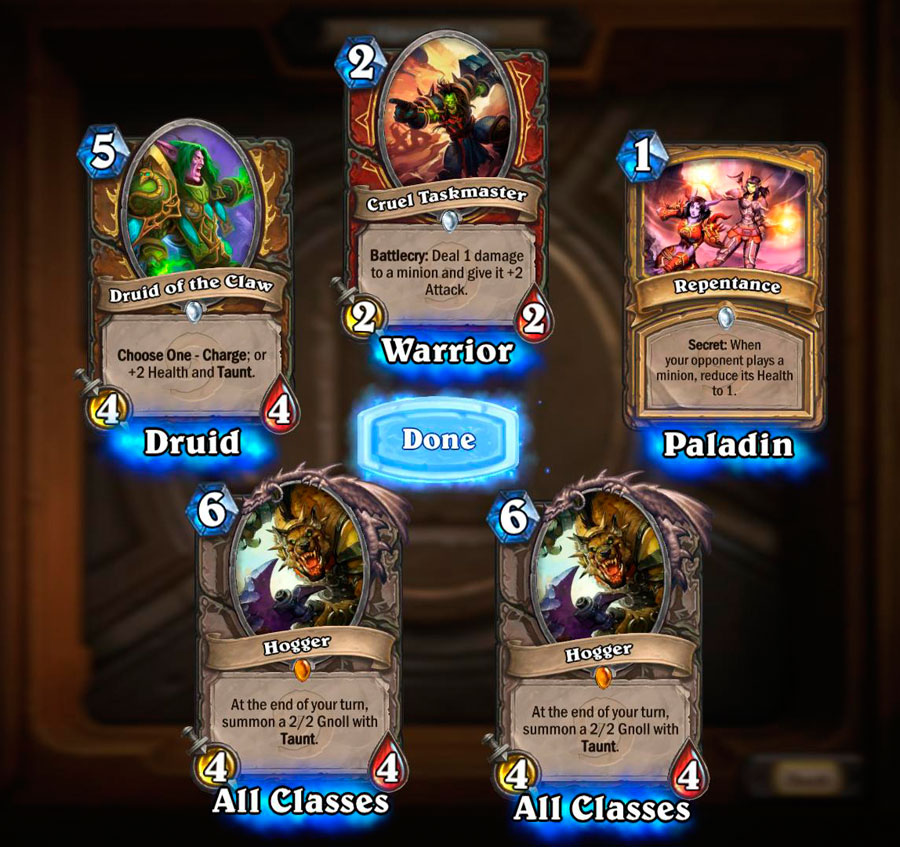
Really, Bliz? Really?
Hearthstone Arena Strategies
So, you’re a little hesitant to step into Hearthstone’s Arena mode, or perhaps you already have and the games did not quite go as planned. I’m going to level with you: I’m not some grandmaster Hearthstone Arena player, although I break even (6+ wins) more times than not. What I can offer you is a collated batch of Arena strategies collected from either personal experience, from streams, and/or random tidbits from players better than myself. So read on, absorb what’s useful, and critique the rest in the comments.
Make Peace with the RNG
You will be screwed right out of the gate on occasion. From a poor selection of Heroes at the beginning, to a drafting process that offers you zero removal cards, to being faced against opponents with 2-3 Legendaries and all the right answers. It happens. So make your peace with its inevitability, and endeavor to learn something useful as you struggle uphill both ways.
Understand Card Advantage
Card Advantage is a concept that came out of Magic: the Gathering theory more than a decade ago, and is a key component in virtually all CCGs since then. The Wikipedia page on the topic is pretty robust, and I recommend taking the time to read through it – the concept of card advantage underpins every other strategy that follows.
Know Your Enemy
There are nine classes in Hearthstone, each with very specific Hero abilities and class-specific cards. Just like in any PvP situation in WoW or other games, the more you know about your opponent’s repertoire, the better your chance of predicting his/her moves and playing around them.

My creature placement turned a 2:1 into a 1:1, saving two critical creatures.
For example: when facing a Rogue or Mage, the positioning of your creatures matters. Betrayal is a potentially devastating Rogue card whose power is entirely dependent on how you order the creatures on your board – if you have a high-attack power minion inbetween two other creatures, bam, that Rogue just got a 2-for-1 because you got careless. Cone of Cold is more difficult to play around, but you can do funny things by placing your strongest creatures on the outside (forcing the Mage to choose which to become Frozen) or even mucking up the math by playing a Faerie Dragon intelligently. For example, if I had been facing a Mage in the picture above, the Cone of Cold could only ever hit two creatures since the Faerie Dragon couldn’t itself be targeted.
If you haven’t taken the opportunity to look up all the class-specific cards already, go ahead and click My Collection and then Crafting Mode (and make sure All Sets is on at the bottom). This will show you all the non-Basic cards for every class. As far as I can tell, the only way to see all the Basic cards is to earn them by leveling each class up to 10 yourself… which is a good idea anyway.
Assume the Removal
This is a subset of the previous point. Know what kind of removal that your opponent may have access to, assume that they have it in hand, then force them to use it. It’s Turn 7, and the Mage will likely devastate your board with a Flamestrike. Can you do anything about it? Yes, actually: force them to use it. Worst case scenario is that they generate a lot of card advantage by crippling your offense. But they were going to do that anyway. Best case is that you had enough threats on the table to force them to use it when you were expecting them to, and not at their leisure.
If you play conservatively and they don’t use the Flamestrike, all you’ve done is given up damage in exchange for nothing.

Assume the worst, hope for the best.
Here is a rough guide:
- Hunter: Multi-Shot at Turn 4. If it’s a Secret, assume it’s a Fire Trap.
- Mage: Sheep on Turn 4, Blizzard on Turn 5, Flamestrike on Turn 7. If you are at 11 HP or 7 HP, assume you will die next turn from Pryoblast or Fireball.
- Paladin: Consecration on Turn 4. Blessing of Kings on Turn 4.
- Rogue: Betrayal any time you have 3 creatures. Assassinate on Turn 5.
- Shaman: Bloodlust whenever they have more than 3 creatures out. Lightning Storm at the worst possible moment.
- Warrior: Assume a 2 or 3-power weapon the next turn, and/or creatures with Charge. Any useful creature that has taken damage will die.
- Priest: You will likely lose after Turn 8. Win before then.
- Druid: Swipe starting on Turn 4. Starfall on Turn 5 (it’s a rare card though). Assume 8/8 or 5/10 Taunt creatures after Turn 8.
- Warlock: Assume Hellfire whenever they don’t have a creature out.
Draft Bombs
A Drafting environment is worlds different than Constructed. You might be able to play around one Mind Control, but can you play around three? Ever face a Warlock with four Hellfires before? This is not meant to discourage you from doing Arena, but to recognize that you will encounter all sorts of outlandish situations. The only real thing you can do is draft the strongest possible cards you can, play them intelligently, and hope for the best.

Pictured: an insanely tough first pick. Went with Knife Juggler.
What are the strongest possible cards? Good question. I suggest starting with Trump’s Arena Card Rankings as a jumping off point, as it covers all Basic/Common cards. The fundamental take-away though, is asking yourself how any given card you play stacks up with other cards for the same cost. Does it trade favorably? While a Kobold Geomancer can turn an Arcane Explosion into a Consecration, it will have its lunch eaten by a vanilla 2/3 River Crocolisk who will still be a hungry 2/1 creature after the trade. Chillwind Yeti is the least interesting creature ever that turns entire games around with his big, dumb 4/5 for 4 self (bonus points for immunity to most Priest removal).
Of course, given the choice, I would take Amani Berserker over the River Crocolisk every day of the week. Point is: don’t discount efficient creatures. Considering it is entirely possible to have no opportunity to draft any removal, you may have to make due with what you have on the board.
Know When to Race, and When to Coast
It’s your turn 4 and you have two 3/2 creatures compared to your opponent’s lone 1/1 creature. What do you do?
If you said “It depends on what class your opponent is,” you win.
The difference between dealing 6 damage this turn and a Paladin casting Blessing of Kings on his 1/1 and taking out one of your creatures (and likely forcing you to trade next turn) is huge. If you manage to keep that Paladin’s board clear each turn, the Blessing of Kings is a dead card until at least Turn 6, and by then you’ll either have this game wrapped up or have something to deal with a 5/5. There have been more than one game where I lost simply because Dark Iron Dwarf was stranded in my hand (unlike the Shattered Sun Cleric, the dwarf has to target a creature if one exists, even your opponent’s).
At the same time, a commitment to killing everything your opponent plays every turn means that every creature they cast gains the text “and gain X life, where X is the HP of this creature.” At the end of the day, you win by reducing your opponent’s HP to zero, not keeping his board empty. Sure, there are many times in which I was trying my best to Jedi Mind Trick my opponent into attacking my face rather than killing creatures I had plans for, but giving a Control deck room to breathe is exactly what they want you to do.
Get Ahead, Stay Ahead… But the Long Game is Good Too
I once lost a match where the only creature that survived more than one turn was my opponent’s Faerie Dragon, which he/she had coined out on Turn 1. Every turn thereafter consisted of us trading cards and creatures. Which might have been okay, if it were not for the fact that trading one-for-one favors the person who played first. In other words, the early game matters. A lot.
At the same time, what you don’t want to do when drafting is neglect your late game. The vast majority of the Arena games I play end long after Turn 10. Having a front-loaded mana curve is great for punishing slower decks, but what are all your 2/2 and 3/3 creatures going to do when faced with a 8/8 or 5/10 meatwall with defender? Or a Flamestrike? There is nothing more frustrating in Hearthstone than running out of steam and watching your shot at victory slowly erode under the tremors of Stormwind Champions.
When I drafted a Paladin Aggro deck (e.g. zerg with cheap creatures) I about conceded on Turn 1 when the Mage I was fighting dropped a Mirror Image. I had a fist full of creatures, but many of them were 2/1s which would have died to a ping by the Mage’s Hero power before they could even attack once. If you mostly stick with the highest-value cards you can, you’re likely to walk out with a mid-range deck that can handle most situations. Specifically trying to shoehorn in a “theme” in an Arena environment is just asking for trouble.
Play Smart… Play S-Mart
While the exact depth of Hearthstone strategy is up for debate, there is absolutely opportunity to miss game-changing plays and/or epically screw yourself over by poor decision-making. For example, I am still facepalming over this scenario:
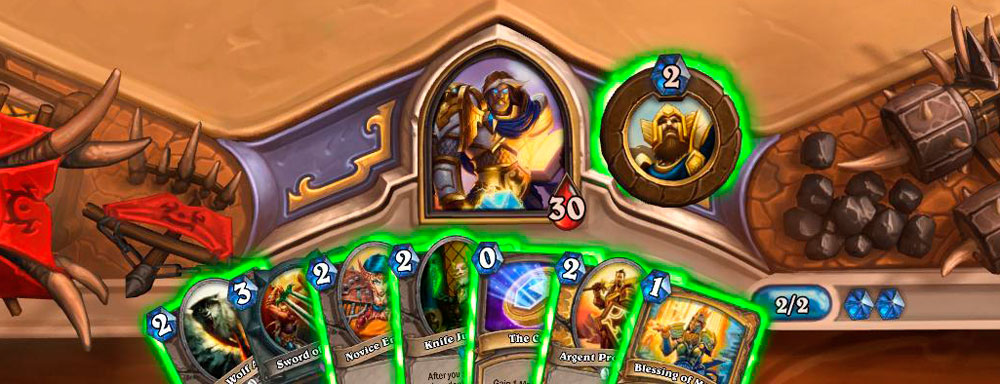
Don’t get greedy.
My Turn 2, opponent had played a Novice Engineer. Staring at a hand with a Sword of Justice and four cheap creatures, I got greedy by using the Coin to power out the SoJ and passed the turn. And that’s when this happened:
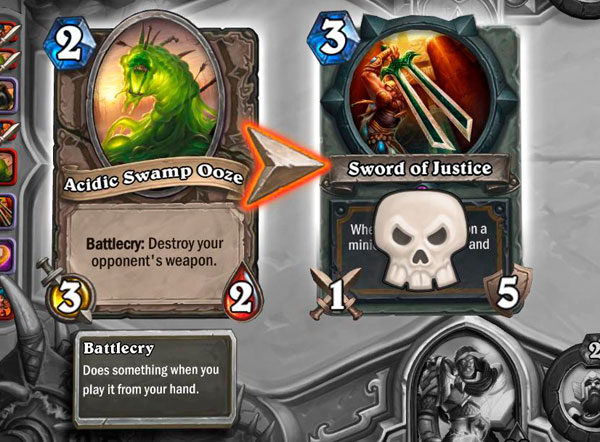
“What’s the worst that can happen? Oh.”
I pretty much lost the game right there. My opponent’s 3/2 and/or 1/2 would eat any creature I played or eat my face if I delayed long enough to cast the Knife Juggler + Argent Protector. Indeed, it did not really matter what I played, because my opponent got a 2-for-1 just by playing the Ooze, and arguably a 3-for-1 since I had to deal with the creature eventually. That was not a fun game.
There are times when you may need to go all-in to win. If my opponent didn’t have the Ooze, my card advantage would keep ticking higher each turn the Sword survived. A smarter play would have been to cast my own Novice Engineer and then see what kind of creature he played in response. Depending on what he/she played, I could have coined into a Knife Juggler + Argent Protector, or dropped a Dire Wolf Alpha and killed his Novice Engineer, or boosted my Engineer to take out a x/5 creature or whatever. Point being, playing Sword of Justice and passing the turn is the dumbest possible move you can make. Sometimes it’s the only move you can make, but it’s still dumb.
Beyond that scenario, there are all sorts of little things to keep in mind. Knowing how powerful Silence can be, for example, especially against opponents who spent their whole turn casting that 6/5 with Taunt creature only to see your full board go right for their face. Faerie Dragon placement, as mentioned earlier. Knowing that mass removal like Consecration and Hellfire will not trigger Cult Master’s card-drawing power as long as it dies at the same time as other creatures. Facing the tough choices like this one, and realizing that the obvious plays are not always the best ones:

Coining into a Flamestrike seems obvious… but it’s not always the best.
I don’t remember what sort of nonsense the Druid played after I killed the Cult Master with my Water Elemental, pinged the imp, and then played Ogre Magi. All I remember is that I was quite happy saving the Flamestrike for the following turn when he dumped his hand and then later using the Coin with Archmage Antonidas to jump-start the Fireball cascade.
_____________________________
Hopefully this guide has been of some use for you. The very bottom line when it comes to improving your Arena match outcomes is simple: learning from your mistakes. Did you really get screwed by the RNG, or was it the RNG + a bad early play on your part? Fix what you can and then try again.
Have fun… and maybe I’ll see you out there.
Hearthstone’s Future
SynCaine brought up an interesting point about the future of Hearthstone:
“situation in Hearthstone only ever improves”
Until the the first expansion is released, and what do you think is going to be the revenue driver for the game?
At least with MtG:O, it was understood you were stepping into a P2W arena, where you could pay X to compete with Y. What level you wanted to compete at was up to you and your wallet.
Here, I feel as though Blizzard is trying to hide the P2W aspect (especially in beta), but ultimately that’s what the model demands. Without new cards you don’t keep people interested, and for those new cards to be interesting, they have to be worthwhile (aka; stronger/better).
I think the heavy class-based gameplay is also a balance nightmare as we are already seeing, and I expect it to get worse as the better players create more gimmick decks. Woe is the free player if the FOTM gimmick requires an epic or ten.
While the game isn’t even in Open Beta at this point, I think it is reasonable to start thinking about where Hearthstone goes from here. At the moment, I am sort of worried about the “depth” of the game, although it’s possible that it’s current shallowness accessibility is a feature, not a bug. Then again, I’m not entirely sure.
There are several things working against Hearthstone’s future. The biggest is it’s class system. In a card game like Magic: the Gathering, you can have a robust metagame arising from even the “generic” Core Set (which come out once a year and forms a “base” upon which the near-quarterly expansion sets build upon) because you can conceivably play any card you want; the five colors of Magic have their own class-like themes and mechanics, but you can mix and match to your heart’s desire. Thus, a Black/White deck can play totally different from an all-Black or all-White deck. With Hearthstone, a Paladin’s cards are exclusive to Paladins. You can’t choose to play, say, Avenging Wrath in your Mage deck, for example. Or Divine Favor in your Shaman deck.
A related long-term problem is expandability. I am not talking about running out of mechanics or creatures to reference from WoW or Warcraft lore (although that’s sort of a concern, honestly), I am talking about how many new cards can actually be coherently added. In short, Blizzard is going to have to either create a ton of new cards each expansion, or barely any. For example, an expansion that adds just one common, rare, and epic card to each class will require 30 new cards (9 classes + neutral). While that may or may not sound like a lot of cards, unless these new cards are above the curve or enable entirely new strategies, it’s possible that an expansion could be a total dud for you and the class you enjoy playing despite increasing the total card pool by 10% or more.
Third, as I have mentioned before, the class balance is on a razor’s edge even in a perfect scenario. It is pretty much a given that we will see a Death Knight and Monk class added in an expansion, and they will need to have at least 15 additional, class-exclusive cards and unique Hero Powers. While that can certainly shake up the overall balance structure, it’s not as though your specific metagame will likely change all that much. Because, again, your Mage deck is limited to Mage cards plus Neutral cards; there is no DK “splash” to provide additional depth.
Fourth, it is worth considering how many different mechanics Blizzard is A) willing to implement in this game, and B) can implement in this game. One of the most basic creature abilities in Magic is Flying: a creature with Flying cannot be blocked except by other creatures with Flying, although it can choose to block non-Flying creatures. In the context of Hearthstone, this ability doesn’t make a whole lot of sense, as you have complete control (barring Taunt) to choose whether your creatures attack your opponent or a specific creature. Now, Blizzard could certainly shoehorn it in there – perhaps making the flying creature untargetable by other creatures – but that’s when the devs start to go against their (presumed) mandate towards simplicity.
And that’s just with Flying.
Lastly, SynCaine’s cynicism regarding Blizzard making overpowered cards to sell future expansions is not without merit, even if I would argue that it’s largely unavoidable and not inherently malicious. Power creep happens. Even when “the rules” about costs are nailed down, some options are more powerful/relevant than others. In Magic, a First Strike 2/2 is better than a Trample 2/2 even if they both cost the same amount of mana. A Flying 2/2 is arguably better than either. I have pointed this out before:
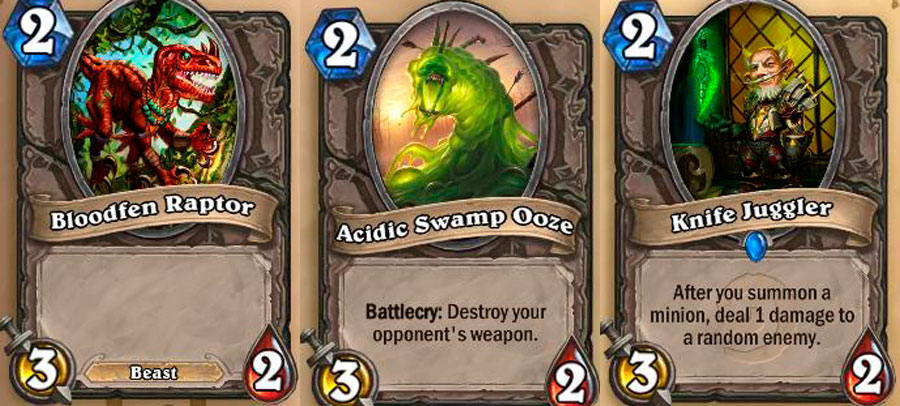
Balance!
Being a Beast is not as powerful as the other two cards, unless you are playing a Hunter Beast deck. But the more damning implication, IMO, is how the above cards sort of imply that a 1/4 for 2 would be balanced. Or a 2/4 for 2 mana, even. We already have 3/2s with an ability, 2/3s with an ability, 1/3s with a huge ability for 1 mana (Priests, seriously), so a 2/4 for 2 isn’t outlandish rules-wise. And yet it would be crazy OP, invalidating a huge swath of two-drops. The context of the environment is as important and possibly more so than the strict card power rules.
All that being the case, I don’t actually agree with SynCaine that the new player is screwed, as my prior declaration remains accurate: your situation in Hearthstone only ever improves. Six expansions later, assuming no structural changes, you will still be able to Disenchant the cards you don’t want to directly create the cards you do. That’s unbelievably huge in the CCG world. Even if you take the stance that your likelihood of opening one of the “ten or so required Epics” is necessarily diminished (assuming new cards are stuffed into the same virtual booster pack), your ability to guarantee a card is not – you will always get 40 Dust per pack, minimum. Ten packs is an Epic of your choice. You’ll get enough gold in two days of daily quests to buy a pack straight-up, or three if you want to go the Arena route. So, unless expansions are coming out every 1-2 months, you’ll have plenty of time to get whatever cards you need to be/stay competitive without spending a dime.
Spending dimes gets you there faster, of course. But in this context, I’m okay with it.
The Hearthstone Hole
Green Armadillo from Player vs Developer has a post up about the somewhat skewed incentives in Hearthstone. Essentially, Blizzard does not have too much of an incentive to do Matchmaking based on card rarity/quality, as not doing so allows the paying customers to get some easy wins against non-paying customers while hopefully encouraging the latter to spend some money to get out of the hole. Plus, queue times might go up if they segmented the audience too far.
I’m not really going to comment too much on the situation itself, because it is kinda true. Hearthstone is a CCG, and like all CCGs, it is Pay-To-Win until all the cards are obtained. Moreover, there appears to be a good chance that the Matchmaking algorithm is not even in place or functioning properly. And like I have mentioned in the past, Blizzard has stuck close to the CCG model of strictly-better cards being “balanced” around their rarity.
But let’s put all that aside for now, and start talking solutions.
1) Stick to Arenas
Hearthstone is basically the Arena for me; everything else is simply a means to more Arena games. The only real reason why I would care about opening more packs and whatnot is to get cards that will allow me to complete my daily quests faster. That might change at some later date – likely coinciding with me actually opening up something more than a Rare card – but for now it is more than enough.
If you are leery about the Arena, don’t be. It is the great equalizer. Sorta. It is still entirely possible to be screwed via RNG by facing opponents that got two Legendary cards whereas you barely have one Epic. Plus, sometimes you get little to no selection when it comes to removal or class-specific cards. I went 4-0 the other day as a Warlock, feeling good, and then got matched with a Mage that had four Fireballs. In a normal game, you can’t even have more than two of the same card. I ended up losing to that Mage, plus a 2nd mage that had a seemingly never-ending supply of Freezing cards (Blizzard, Ice Lance, etc), and some third guy that undoubtedly didn’t deserve to beat me somehow.
Hmm… I’m not exactly helping things, am I?
2) Basic decks can still be good.
Generally speaking, Basic Decks are not at too much of a disadvantage depending on the class you are playing. That means both your class and their class. So while the daily quest can basically dictate which class you end up having to play as to get rewarded, there are steps you can take to put the odds ever in your favor.
For example, this Mage deck is entirely Basic cards:

I don’t even have any non-Basic Mage cards yet.
By a complete coincidence, the two dailies I had sitting around were “Win 5 games” and both had Mage as one of the class options. I went 5-2 with the above deck in Unranked mode.
I am not suggesting that I am some pro player – my Arena matches usually keep me humble – but understanding the hidden depths to something simple like the above deck is key in turning games around. For example, Kobold Geomancer is not a particularly desirable card on it’s own, since it often (at best) trades with other 2-drops. And while you should absolutely play it early if you don’t have anything better, keep in mind its hidden power: turning Arcane Explosion into a Consecration on turn 4. Even if they play something with 3 HP, you can spend your 3rd turn sniping it down to 2 HP before likely wiping their Turn 1-4 board. Hell, it even works in the late-game considering you can Geomancer + Flamestrike to take out 5 HP dudes, or finish off a line of wounded guys with the 2-damage version.
If I had all the Mage cards, would I replace cards in the above deck? Of course. Mana Wyrm is a complete no-brainer, for example. Then again, most of the cards I would add would essentially morph the deck into something else entirely – Mana Wyrm, Blizzard, and Cone of Cold all have a much different feel to them than Arcane Missiles, Arcane Explosion, and Kobold Geomancer shenanigans. To say nothing about the non-Basic Neutral cards available.
There are absolutely certain classes that are much weaker than others when they do not have access to their powerful Rares/Epics – such as Warriors and Brawl – but the Mage really isn’t one of them. Even classes like the Shaman can win unexpectedly with just their Basic cards (i.e. via Bloodlust).
All that being said, yes, you can and will roll over and die to some Diamond+ League decks. One of the losses I had in my run was to a Priest, who only won because Blizzard knee-jerked buffed the hell out of them in the latest patch. Mind Control, in particular, is some major bullshit:

It’s 2:1 Card Advantage, minimum.
I had two big blockers Mind Controlled in that match, along with facing some Shadow Word: Pain slowing my early game. “Playing around” the Mind Control is possible, sure, but it cedes control of the board to the Priest unless they haven’t been playing anything else this whole time. Flamestrike is certainly powerful and has to be taken into consideration when facing a Mage, but let’s face it, the Mage is perhaps the best class to deal with Mind Control – everyone else is screwed.
Even though that game felt completely awful to me, it is worth mentioning that I was 1 damage away from stealing earning the game at the end.
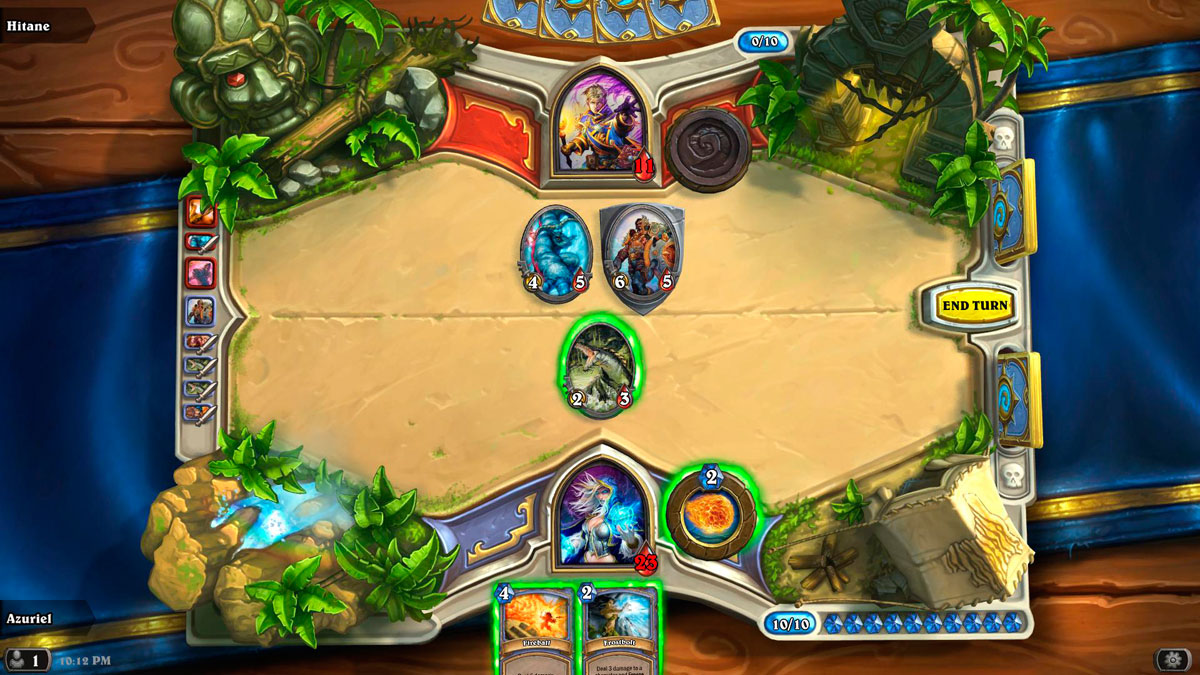
This would have felt SO GOOD, dammit.
Fireball for 6 damage, Frostbolt for 3 damage, Hero Power for 1 damage would have left the Priest at 1 HP and frozen. Now that I think about it… holy shit, guys. I’m so dumb. What I ended up doing was Fireball the Lord of the Arena (my own, by the way), Frostbolt the Yeti, Hero Power the Priest, and then attack for 2. My logic at the time was that if I could bluff him into worrying about a Pyroblast (10 damage), he might play more defensively while I continued digging a way out of the hole. It didn’t occur to me that being frozen by the Frostbolt might have prevented him from using his own Hero Power to heal… letting me ping him for 1 damage and the win next turn.
Even if that doesn’t work – I’m honestly not sure – the point is the same: I had him to within 1 damage with a Basic deck. A minor decision at the beginning of the match or an errant attack against a creature I didn’t have to might have made all the difference. So while some cards are horribly OP and possibly locked behind a rarity wall, just keep in mind that a better player might have been able to steer your same deck and same draws into a win.
So… strive to be that better player.
3) Your cards only ever improve
This likely won’t feel like a “solution,” but your card situation in Hearthstone only ever improves. But more importantly, keep in mind that if you are feeling particularly weak without a certain card, you can craft that card specifically. Each pack of cards can be disenchanted for 40 Dust, minimum (+5 for Common, +20 for Rare). That is enough for a 100% assured Common card of your choice, per pack. Three packs would equal a Rare of your choice plus 20 Dust leftover. Ten packs would give you any Epic of your choice. And if you were crazy enough to do so, 40 packs will guarantee any Legendary card of your choice.
Again, those are minimum numbers. If you (digitally) crack open a second Rare, or an Epic/Legendary/Gold version of any card, the Dust payout increases substantially. Plus, you know, you might actually open the card that you were looking for to begin with.
What I am basically trying to get across here is that Green Armadillo (and others) are correct: Hearthstone is a “F2P” CCG whose principal purpose is to extract the maximum amount of dollars from you in a completely typical F2P way. The important difference here, and reason I am likely to be playing Hearthstone for a long time to come, is that Blizzard isn’t being particularly nefarious about it. Try playing Magic Online or the upcoming Hex by investing zero dollars while still earning actual cards. Try playing any CCG and having a predictable and free (!) method of eventually acquiring any specific card you want. I mean, everyone pretty much agrees that the best way to play Card Hunter is to throw down $25 on their Basic Edition, and that’s also a F2P game. A similar “investment” early on could make your daily quests in Hearthstone that much easier.
Or save your money, like I’m doing. Losing streaks suck, but the Matchmaking software will fix it eventually if going Live doesn’t do so by virtue of deepening the pool of players. The minute you hit 150g, you can buy a ticket into a cloistered realm where, even if everyone doesn’t have the same quality cards, you are at least not shackled to playing around with just your Basic ones. Plus, 7 wins before 3 losses means you can get back in for free. And even if you go 0-3 like I have on a few occasions, the minimum you walk away with is something like this:
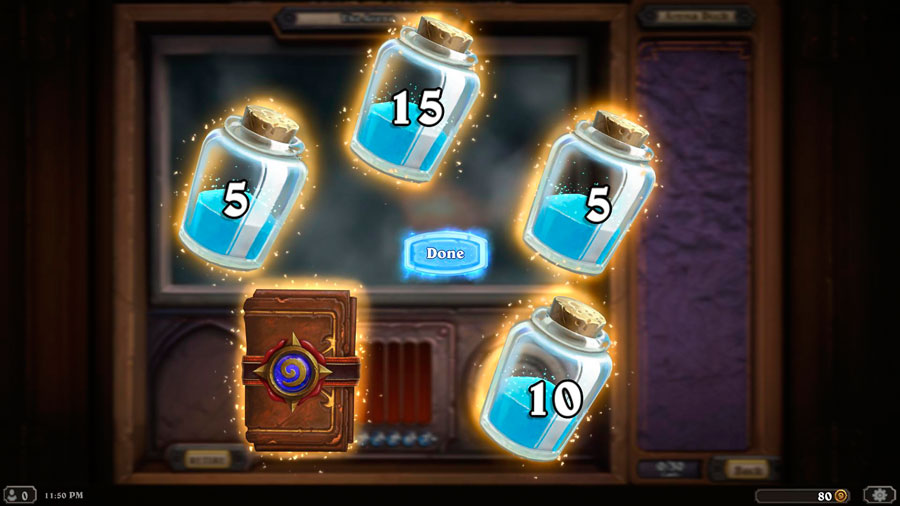
Just be aware of the ego-bruising that accompanies it.
What’s that? A booster pack plus almost as much Dust as you’d get disenchanting a 2nd pack.
Card balance isn’t exactly where it needs to be – beta is beta – but the one thing least deserving of criticism is Hearthstone’s business model. While being in the Hearthstone Hole is discouraging, it is not and will never be as bad as the same phenomenon in traditional CCGs nor even your everyday F2P app with a payslope. I mean, Jesus, I’m not sure how other CCGs can compete with this.
[Hearthstone] Remaining Concerns
My Press™ coverage of Hearthstone has been pretty glowing thus far, so I wanted to talk today about some lingering concerns about a few issues that cropped up in the last week. I do not believe these to be structural problems necessarily – I feel like they could be fixed within the Beta – but I also have no idea how Blizzard will address them, if at all.
1) Unbalanced Heroes
On paper, the nine Heroes you can pick between are balanced. Here is a rundown of their powers:
- Druid – Hero gains +1 Attack until end of turn, and +1 Armor
- Priest – Restore 2 health to target
- Warrior – Hero gains 2 Armor
- Paladin – Put a 1/1 creature into play
- Rogue – create a 1 attack/2 durability weapon, or +1 Attack to weapon this turn
- Warlock – Lose 2 Health and draw a card
- Hunter – Deal 2 damage to enemy Hero
- Shaman – Create a random totem (usually 0/2 creature w/ ability)
- Mage – Deal 1 damage to a target
By the way, all of the listed abilities cost the same amount of resources (2 crystals).
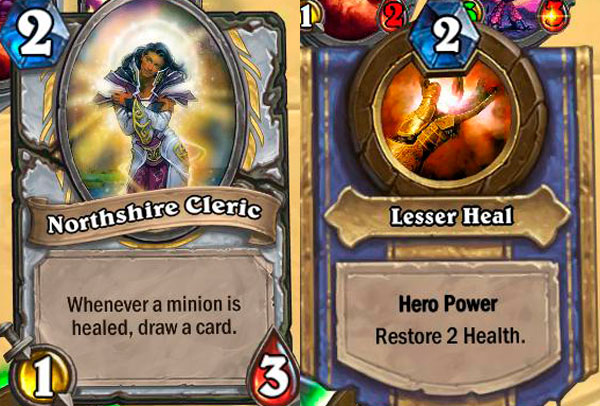
One of the more annoying classes to play against.
The problem in reality is two-fold. First, there is a huge difference in synergy between a Hero’s powers and the class-restricted cards. The Priest’s ability, for example, combos ridiculously well with one of the default Priest cards: Northshire Cleric, a 1/3 creature that let’s you draw a card when a creature is healed. In fact, entire mechanics revolve around and/or become enabled by the Priest’s ability. Enrage, for example, is an ability that triggers an effect when the creature is damaged. One of the most common cards that uses Enrage is the Gurubashi Berserker, a 2/5 creature that gets +3 Attack each time it’s damaged. Smashing into a 2/2 will beef the troll up to a 5/3, which is nice… but also puts it within range of a lot of counter-attacks. A simple heal from the Priest though, puts it back to 5/5, letting it snowball further. Then you have goofy cards like the Angry Chicken, which is a 1/1 with Enrage: +5 Attack. Obviously you need to combine that creature with some other effects to boost its Health, of which the Priest has many.
By means of comparison, nothing combos with the Hunter ability. In Magic: the Gathering, the devs eventually created the Bloodthirst mechanic that boosted a creature’s stats (or some bonus effect) if it was played the same turn as the opponent taking damage. No such thing exists in Hearthstone, at least for now. And while Rogue decks need no assistance, the Combo system on Rogue cards have nothing to do with the Rogue’s ability; at least the Druid, Warrior, and Warlock are thematically consistent with their class cards. Then again, perhaps we should look at the Priest as an outlier rather than the bar that other classes should reach.
The second problem is related to the first: what class cards are available by default radically changes the strength of your deck. Now, sure, technically everyone will be able to unlock all 20 basic class cards by simply playing against the computer (assuming they didn’t want to challenge players). But take my word for it: many of those early games suck. Hard.
Through either a combination of the first issue or the second, I can already tell that some Heroes are being left in the dust by the Beta population. I would say more than 95% of the Ranked games I have played have been against either the Mage, Rogue, or Priest. For a good reason: they’re strong.
There are a few clever things Blizzard is already doing to (presumably) combat this trend. One of the types of daily quests is to win 2 games as a specific class. When I logged on yesterday, for example, I had to win 2 games as a Druid and Warrior (two separate quests, as I had missed yesterday’s daily). Having played neither before, I created custom decks for both and then went for a spin against some human opponents. Those games played out very differently than my normal games, and were pretty fun to boot, although I doubt I will be spending much time with them until I luck into some of their non-basic class cards from booster packs.
The other clever move to improve class experimentation, if not promote diversity, is how Arena mode matches start by forcing you to pick between three random class Heroes before you start the actual Draft process. The other day, I had to pick between the Hunter, Druid, and Shaman, all of whom I had never played with before. While they let you mouse-over their Hero powers from that specific screen, the more critical aspect of the Heroes is ultimately their selection of class-specific cards. Spending some time in your collection looking at all of the class’ cards – which, by the way, Hearthstone allows you to do even if you don’t own them – is definitely recommended.
For the record, I chose the Hunter. And went 0-3.
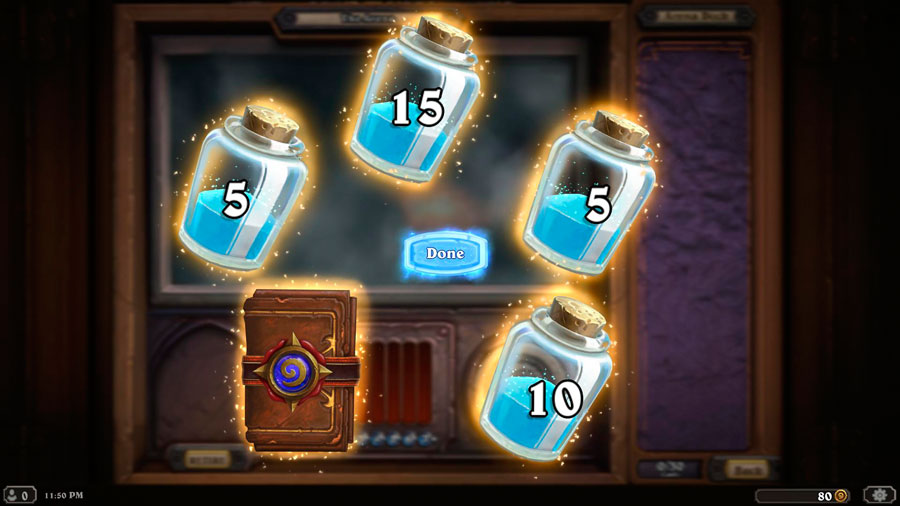
Worst possible Arena result, I think.
2) Unbalanced Cards
Beyond the Hero issue and the class-specific card issue, I have a problem with the card balance in a few locations. Basically, I don’t feel like strictly-better cards should exist in a CCG, especially not when it appears it’s being “balanced” around rareness. Take a look at the following:
Balance!
There is precisely one scenario in which you might choose the raptor over the gnome: if you were playing some kind of Beast deck (e.g. with the Hunter). And actually, you might put in the gnome even in your Beast deck; por que no los dos? At least with the Ooze, you can convince yourself that there are certain scenarios in which blowing up the opponent’s weapon is better than whittling down their blockers for free.
By the way, only the Paladin, Warrior, and Rogue are likely to ever have weapons equipped. That Ooze is pretty much a dead draw 90% of the time in my experience.
A few other cards are simply ridiculous. Pint-Sized Summoner, for example, pretty much single-handedly caused me to lose an Arena game (I had no targeted removal at the time). Bloodlust is probably balanced, but 100% of the games in which I lost to a Shaman have been due to that one card… and a bunch of suddenly bloodthirsty totems. And so on.
3) Over-reliance on Taunt
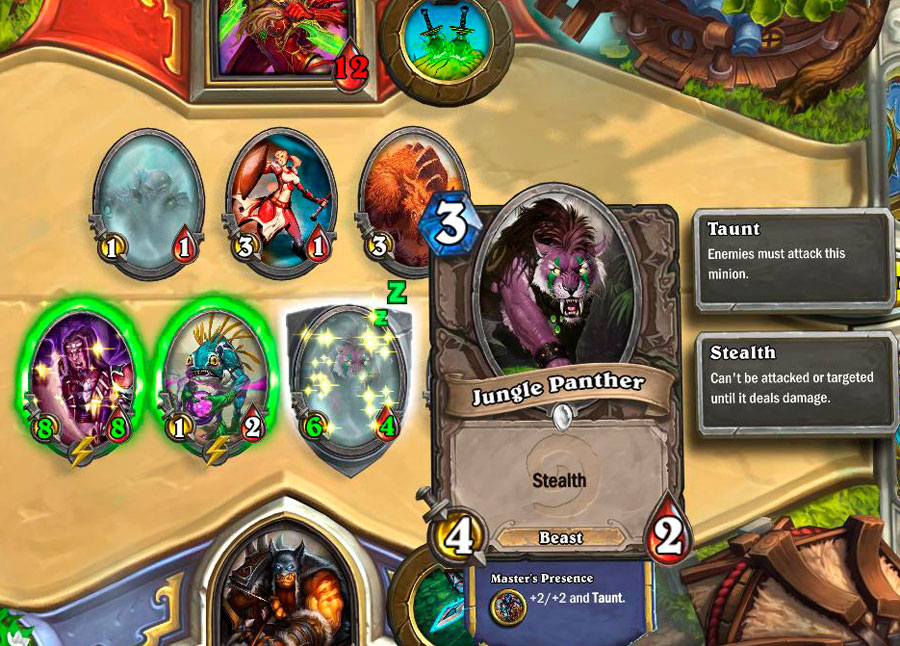
This section is going to be short, because the title sums it up: Taunt is both ubiquitous and pretty much the only means of combat shenanigans.
This should have been a combo, dammit!
In case you aren’t aware, Taunt is a creature ability that forces an opponent to only attack the creature with Taunt, as opposed to being able to attack any creature or just smash the opponent’s face in directly. Without Taunt, basically whoever drops creatures first is at a huge advantage since they can decide to attack any “special” creatures their opponents play with their own creature or ignore them. Pretty much the only rational strategy then becomes A) play special creature and then immediately drop a Taunt meatshield, or B) beef up a Taunt creature and control the board. An all-in-one package example of the latter is Ancient of War, which is an absolute bomb drop in Arena, by the way.
4) Playing first puts you at a huge disadvantage
Another shorty, but basically I never ever want to go first when playing Hearthstone.
Each player draws three cards before a game, and can choose to send any (or none) of the cards back and draw different ones. Whoever goes second draws a fourth card during this phase, and thus can fish for their deck combo cards or removal that much deeper. Plus, after the first player’s turn, they get a 0 crystal card called “The Coin” that will temporarily give you 1 crystal for a turn. So, basically, going second you can cast a 2 crystal card on your turn 1, or 3 crystal card on turn 2, and so on. What makes it even worse is that The Coin counts as playing a card/spell, which can trigger all sorts of nonsense, such as a Defias Ringleader suddenly giving the Rogue a 2/3 and 2/1 creature on turn 1.
Conclusion
Having said all that, I do feel like these are solvable problems. For the most part. Given the simplicity of the resource system and the mechanics in this first set, I am not quite sure how things will get balanced. The Knife-Juggler and Pint-Sized Summoner could be reduced to 2/1 and 1/1 respectively, and still be worth playing. But what about those Hero powers? The Hunter power can’t be reduced to 1 crystal or the damage increased to 3. Would they buff the Hunter class cards instead? What if a player doesn’t actually use those “balancing” cards?
Time will tell upon release exactly how broken some of these interactions are. Time will also tell how much we or Blizzard particular care. I probably have the most fun in Arenas (I went 8-3 and 9-2 this weekend, the latter of which resulted in 310g) where dropping game-changing cards is the norm, and Ranked matches sorta feel like 2v2 Arena in WoW somtimes. I would rather it be balanced of course, but this is also a CCG – there being only a few viable decks at the upper-end is pretty much par for the course. But if Blizzard wants to do some (more) groundbreaking things with their game design, they are going to have to fix the above four issues at a minimum.
 In An Age