Blog Archives
The City of Steam Alpha Preview for the Rest of Us
If your own blogroll is remotely similar to mine, you have probably heard quite enough about that City of Steam game. The alpha test was wrapping up this past weekend so the devs started handing out codes to just anyone… which would explain how I got one. The beta test will not start for another ~3 months give or take, and there isn’t even a target release date, so the question undoubtedly on your mind – as was on mine every time I read about the game elsewhere – is simple: why should I care about City of Steam?
Well, do you have a few minutes? If so, watch this:
Feel free to expand that into 1080p full-screen, which is the resolution I played at.
In case you were not aware, City of Steam is a browser-based F2P indie MMO. And the above was from its alpha state.
With the exception of Glitch and Kingdom of Loathing, I tend to stay away from browser-based games for… well, no particular reason. I suppose I never thought of them being “for me,” where that is defined by nebulous double-standards like a willingness to pay for a discrete product as long as I don’t have to use a cash shop or spam my friends. Then there is the soft-spot in my cold, black heart for games with character progression deep enough to optimize the fun out it, as one might squeeze whey from cheese. Except, in this disgusting analogy, I eat the whey.
What were we talking about again? Ah, City of Steam.
I have read some descriptions comparing it to Diablo, but the gameplay is more akin to, well, a typical MMO. All the dungeons are instanced, there are some dungeons within dungeons (Dunception!), you can form traditional MMO parties of up to 5-people, guilds exist, the hub areas act as lobbies of sorts, there are daily and story quests, extensive crafting/modding system that alter actual weapon/armor appearance on your avatar, and… let’s stop here. It’s alpha.
While I had an indie MMO developer’s attention though, I just had to ask some (perhaps impertinent) questions:
Me: This is kind of a Bigger question, but… why browser based instead of stand-alone game? Was it easier to go with browser, or more accessible?
Me: I know I can’t be the first one amazed with the graphics. They are very, very well done and came at a complete surprise. Which is kind of why I ask.
Gabriel V. Laforge: It made it more accessible; we wanted to go on the idea that it’s a lightweight game that almost anyone can just jump on and play
GL: hence the short loading times and no massive client downloads
GL: Unity 3D and loads of our own in-house tools really helped optimize that, without sacrificing all that much in terms of graphics or content
Me: Have the more high-profile MMO news – like 38 Studios collapse, SWTOR going F2P, Funcom stock crashes – affected how you build or design the game? Has it complicated the seeking of outside investors (assuming you need any)?
GL: Yes and no…. the game started out as being something we just really wanted to do. Our lead designer, David Lindsay, wrote a series of Roleplaying books, (The New Epoch), upon which the game is based
GL: as for competitors, well, those are large downloads to play, so we don’t necessarily consider ourselves in the same league
GL: we have nowhere near the team or budget they do ;)
GL: as for investment, we have had funding from an investor who helped us get this far, so we’re set on that end
GL: from here, we still have to decide whether we’ll publish independently, or sign on with a publisher (we’ll only go with one who can share the same vision of making this game with integrity…. we REALLY don’t want to go with a pay-to-win model or any crap like that)
Me: A lot of us in the blog world are speculating on whether the MMO genre in general is contracting. Some have suggested that its widespread popularity was just a “fad.” Is that something you worry about as an indie developer? Or are you simply happy to be able to do a job you love? :P
GL: personally, I’m just happy making games
GL: as a company, we’re trying to present something different, and if it works, all the better
GL: if not, we gave it our best
GL: so far though, we’ve been having very positive feedback and reviews, so we’re optimistic
Me: Are there multiple instances of the hub world? If so, how many people can there generally be?
GL: Instances are private for now, for solo and groups of up to 5
GL: we plan to have publick instances for a lot more players later on (we were limited by the endgine before, but now we can make it)
Me: I mean The Refuge [ed: the first main area].
Me: I see a bunch of people running around, but I imagine there is some kind of cap, right?
GL: We havent’ reached (broken) it yet, and have gone up to 600 PCU so far
Me: haha
Me: I’m pretty sure that’s more than I’ve seen in WoW ;)
GL: Really…? Lucky us! :D
Me: I noticed the Mount slot… this is a vague question, but how big of a world will CoS be at launch?
GL: Pretty darn big; Nexus, the City of Steam, it a massive metropolis
GL: there will be enough places to explore to keep people very busy ;)
GL: right now, Alpha has about 150 difference levels
GL: at launch, we plan to have more like something in the upper hundreds, maybe a thousand or so, with more added with future updates
GL: might not be open world, but it will have plenty of flavour
Me: have you settled on a max level yet?
GL: 30 for Alpha, 40 for Beta, and from there, beyond :) (once higher level content is added)
Me: For my audience (such as it is), I have to ask: will there be a Looking-For-Group feature to facilitate grouping for the 5-player content?
GL: We plan to, given engine limitations on whether we can pull it off, but yes, is planned :)
Assuming you are still with me at this point, you might be wondering why I am devoting all this space to a browser-based indie MMO in its alpha state. The answer is quite simple: this may be the future of the genre.
Perhaps not City of Steam specifically, but here is an indie developer doing its best to craft an MMO on a shoestring budget in a world of AAA companies getting 38 Studio’d. And what is impressing me here is that the “nightmare scenarios” we tell ourselves in the blog world might not actually be that bleak. I no longer feel that it has to be $50+ million budgets or bust. Whether it is City of Steam or another indie offering, I am now convinced the possibility exists.
Kickstarter, Cash Shops, and Ultimate Capitalism
The perfect capitalist scenario is full price discrimination. That is to say, the ability to charge each individual customer the maximum amount they are willing to pay (consumer surplus = $0). Under normal situations, this is exceedingly difficult in non-monopolistic markets. If my maximum for a game is $85 and yours is $250, the monopolist would have to have some way of preventing me – or, say, Gamestop – from (re)selling the game to you at a discount.
Enter F2P and cash shops.
Every customer pays the same entrance fee (be it literal F2P or some cover charge or $X+ for the “collector’s edition”), but now you have the ability to engage in some voluntary price discrimination. Want some costumes? $10. How about a shiny mount or horse armor? $25. Server transfers? Hats? Keys to unlock chests? Speed the game up? Unlock a dungeon? Cha-ching!
When Guild Wars 2 comes out, there will be some people out there that bought it for $60. Others will have bought it for $80. Still others will spend $150. And many more will spend $5, $10, $100 more over time via the cash shop. Nearly perfect voluntary price discrimination. Same game, same amount of development (those developers would have been creating said content regardless), different prices for different customers.
Enter Kickstarter.
A lot of bloggers have been covering Kickstarter here lately. Two of the “previewed” games caught my eye: The Dead Linger, and Faster Than Light (FTL). The latter game is a roguelike space exploration game that has successfully received 2,005% of its funding goal. After watching the video and reading about it, I am somewhat sad I missed the chance to “buy-in” with $10.
The Dead Linger is an opportunity to buy-in at $25 for a game that sounds like a cross between Left 4 Dead and Minecraft (25,000 km procedurally generated worlds, 16-person multiplayer, PvP modes if you want, etc). Then I looked at the $100 option, which included the game and goodies, plus your name or handle as part of a street sign or graffiti. “How cool would it be to see people posting their screenshots and then seeing ‘Azuriel was here’ in the background?'” I thought.
That’s when I remembered how cool $100 is, especially when compared to a game not even in playable alpha yet.
The interesting thing to me about Kickstarter in a cash shop world are the implications. In effect, it proves that there are people out there just looking for the opportunity to give their money away. If I was fanatically in love with Bioware and Mass Effect 3, how could I show my appreciation for what they do? Buy the Collector’s Edition? Buy the novels? In each case, what is taking place is a sale, a transaction, a transfer of goods for compensation. My “contribution” is not distinguishable as an act of charity or praise; Bioware simply gets the feedback that I deemed the product a good value for the money.
Kickstarter is different. Sure, a lot of people treat it as a extra-early preorder. But you can also contribute anonymously. If I sent Bioware a check for $1000 in a the mail, would they cash it? I have no idea. What Kickstarter has done is package up charity and enthusiasm into a “product” that can be sold.
Rationally, it is no different than sending a check in the mail, but it feels different. There is a meter that fills up, there are (limited!) time-sensitive bonuses, there is the satisfaction of needs going on (the game wouldn’t exist without this funding), there is a sensation of fellowship with other Kickstarters. In short, it is brilliant marketing. Utterly and completely brilliant.
As a skeptical consumer, however, I worry. The gamification of charity aside, I am concerned about how the industry marketeers must already be foaming at the mouth. How long is it until it is not just Day 1 DLC we see, but “Pay $100 for your name in graffiti on Station Omega?” It already appears as though pre-order “bonuses” (if you pay for it, it is not a bonus) in the form of DLC is here to stay. When is Kickstarter’s methodology entirely co-opted, and eventually devalued?
Oh, wait. Resident Evil 6’s Premium Edition, which includes a real-life replica of Leon’s leather jacket, costs over $1,000. The future is now.
File Under: Eyebrow Raised
The following two bits of random news caught my eye yesterday.
Breaking News: Cataclysm heroic dungeons were too hard, long
There is a new Cataclysm “post mortem” interview with Scott “Daelo” Mercer that just went up. It is a PR puff-piece so whitewashed they had to run over to San Bernardino to pick up more lime, but it did contain at least one visible kernel of truth in the pile of bullshit:
Q. What didn’t work out as planned or expected?
Initially, we started off the Heroic dungeons at too high of a difficulty. The difficulty level rather abruptly changed when compared to the Heroics players experienced at the end of Wrath of the Lich King. This major change caught many players off guard, and frustrated some of them. The difficulty also increased the effective amount of time required to complete a dungeon to a longer experience than we wanted. With the release of patch 4.3 we’re now in a much better place. We’ve always talked about being able to complete a dungeon over lunch, and the Hour of Twilight dungeons get us back to that goal. End Time, Well of Eternity, and Hour of Twilight all provide epic play experiences to our players, but at the real sweet spot of difficulty, complexity, and time commitment.
This is a drum that I have been beating for a week shy of a full year. It is not especially relevant these days – does anyone really care or disagree at this point? – especially given the Mists announcement back in October that heroics were going back to WotLK-style. But it is always nice to have some measure of extra closure on things.
Dust 514 is F2P, for real this time
Last month, I pooh-poohed David Reid’s speculation that EVE could become the biggest game in the world by the end of 2012 via the “tens of millions” of Dust players. While Reid is (one of) the most filthy, vile marketeer(s) in the history of videogames, the latest news via Eurogamer is that Dust is in fact F2P:
Eurogamer can megaphone that Dust 514, the exclusive PS3 MMOFPS that will exist within Eve Online, will now be free to download and free to play.
There was going to be a $10 to $20 cover charge for the game on PSN, but that has now been scrapped.
“It was a relatively confusing proposition,” executive producer Brandon Laurino explained to Eurogamer, “and we wanted to make it unambiguous that this is a free-to-play game.”
Laurino goes on to stress Dust won’t be Pay 2 Win – “There is no micro-transaction that you can do that gives you an unfair advantage over someone who hasn’t paid anything” – but a few paragraphs later this happens:
Items available include vanity goods to customise appearances with; boosters that save time, such as double skill point (SP) boosters; variants of weapons that aren’t necessarily more powerful – “side-grades” that look or play differently; services like character respecs; and lucky dip treasure boxes. “It’s what has emerged as best practice,” Laurino said.
Oh, I see.
I suppose there is room to say things like double-XP potions and the like don’t actually count as P2W. And maybe they will actually get the weapon side-grades balanced right. But… “lucky dip treasure boxes?” TF2 has those crates you unlock with keys or whatever, but I would never accuse TF2 of taking itself particularly seriously. I am always skeptical when someone feels the need to hardcode lottery tickets into their game… do they have no faith in the product itself to engender poor financial decision-making?
All that aside, it is pretty big news for Dust to be launching F2P out of the gate. I do not have a PS3 and I believe launching Dust as a PS3-exclusive (i.e. no PC version) was the worst idea in the history of ever, but this is something I am definitely keeping my eye on. As I said in an earlier article on the subject, Dust would have been the perfect vehicle to transition someone interested in the EVE concept from the fence to being podded in-game. We will have to see how the game actually plays, but being F2P gets a lot of feet in peoples’ doors.
Evil Genius of F2P
Saw this last week:
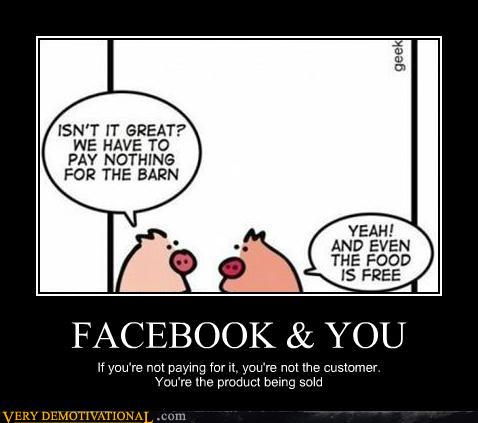
Unfortunately, Tobold actually already linked to this Demotivational poster before I could finish this post, thereby costing me street cred.
It is a fairly common statistic (if unofficial) that less than 10% of F2P gamers actually ever spend money in the cash shop. Most of the resulting commentary has focused on how this ~10% subsidizes the other 90%. This is not actually the case. The evil genius of F2P games is how the non-paying gamers subsidize the paying ones by simply being there. If you are playing LotRO “for free,” what you are actually doing is giving paying customers a reason to actually pay money.
Think about it. If 90% of F2P gamers don’t pay, then the game would presumably have only a tenth as many players if it were not F2P. Hell, the entire point of LotRO going F2P was how they would have shut down the servers otherwise. It did not matter that there were already paying customers; the problem was there was not enough paying customers. When the F2P switch is flipped, you suddenly get a huge influx of “freeloaders” who have a very compelling reason to buy items that make them stand out from each other. Meanwhile the already paying customers are happy because now they have the ability to keep paying for a game they enjoy, and a whole bunch of new people to do it with.
Facebook and Google aren’t doing you a favor by providing “free” social media services. As the Demotivational mentions, you are a product – in this case private demographic information, music tastes, favorite shows, etc, all freely updated by you on your own time – to be sold. You may “get” some bit of value out of these services (else you presumably would not use them) but Facebook/Google/F2P MMO developers are obviously getting a lot more from the bargain. F2P and social media is honestly the biggest marketing coup since fashion apparal designers realized that people would actually give them money for the privledge of wearing advertisements, e.g. shirts with the company logo on them.
900,001; Or How Tiny Tower Killed WoW
The frustrating thing about canceling your subscription is that you never end up doing it for the reasons you want to have done it for. All of us have those little wedge issues that crop up in the process of an evolving game design that we disagree with on fundamental levels. Cash shop antics with the Sparkle Pony/Disco Lion. Heroics being too easy or too hard. Justice point gear and the availability thereof. Premium subscriptions. Racials, class balance, paladins getting nerfed into the ground every patch/not getting nerfed enough.
I had a whole post titled “The Unapologetic Grind” ready to go, talking about how the malaise that seems to be spreading in the “community” has more to do with the transition of the badge system into an “empty bar filling” system that both encourages you to grind way past your normal limits (just… one… more… bar…) and injects feelings of inadequacy when you inevitably fail to fill them. Indeed, the first day that my guild failed to hit our maximum XP cap was the day I could point to as the beginning of the end.
But… when you get right down to it, the answer is always simple.
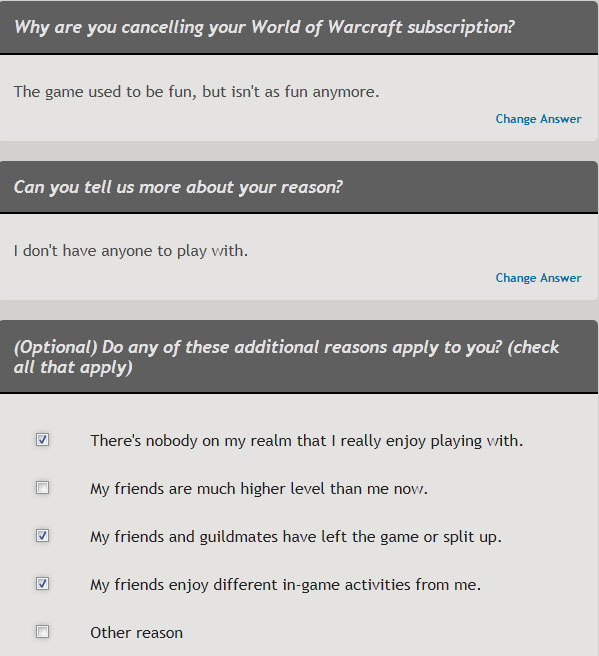
I first came across Tiny Tower a few weeks ago after hearing Scott Johnson and friends talk about it on The Instance and The Morning Stream, two rather hilarious podcasts I have listened to for months. If you have never heard of Tiny Tower, it is a “F2P” Apple app that is objectively a pointless waste of time. There is nothing skillful or strategic about any of the gameplay, and obviously there is no plot to speak of. It exists on my iPod only because it stimulates my nucleus accumbens in a completely vapid way: it tricks my physiological drive to multi-task into believing that the accumilated time spent playing has any meaning. And yet I have not deleted the app. It is still on there.
The philosophical question of whether anything we do has value or meaning aside, WoW engages in this same remote, psychological pleasure-center stimulation. And why wouldn’t it? It is an MMO with a monthly subscription. The difference between creating enough content to occupy people for a month versus creating content it takes a person a month to complete is the difference between bankruptcy and a sweet raise. Think about those Tol Barad trinkets you spent 30+ days “earning.” That they required 125 marks and Exalted reputation was entirely arbitrary. It was not about creating content, it was about creating a time wall that needed to be dismantled brick by brick by repetitive activity which creates an illusiary value to the end-product. Something you have worked towards accumilates value that simply getting it right away would lack.
In WoW’s defense, there is actually an end product there: a trinket that you might be using the rest of this expansion’s lifespan. Games like Tiny Tower have latched onto the notion that you do not even need the end-goal, do not need a pot of gold at the end of the rainbow. Worse than that though, these designers have realized that the individual actions do not have to be entertaining either. These are sandbox games without the sand; play replaced by going through the motions of play, yet triggering the same biochemicals as if you were having actual fun. And having thus deluded you into believing your participation has value, they tweak the “gameplay” to make even this seem reasonable*:
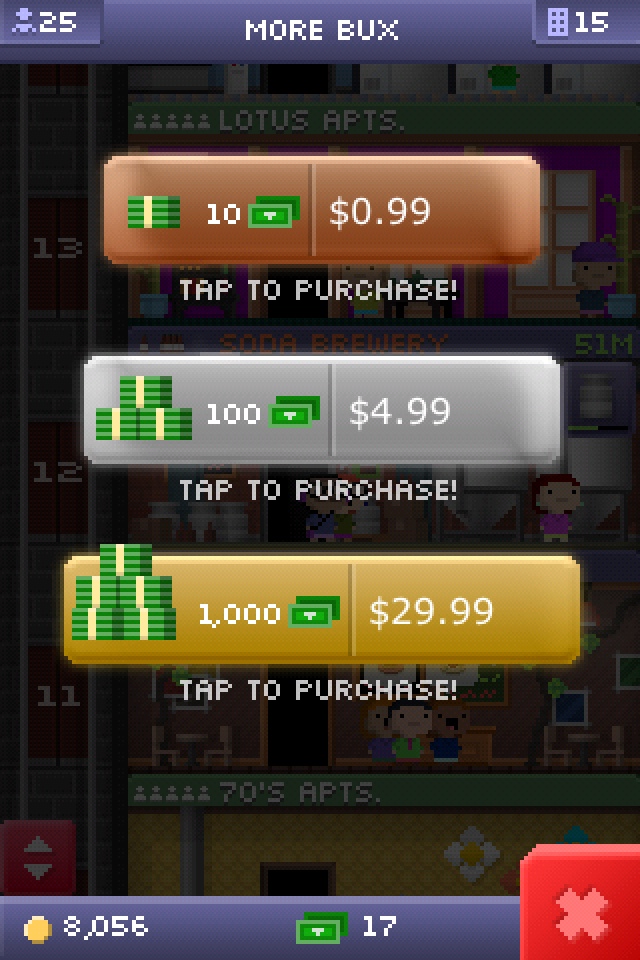
Seriously. I am waiting for a Steam deal on Limbo because $9.99 is a tad higher than I would prefer, and yet I was musing on how much could be accomplished with 1,000 Tower Bux… at the low, low price of $29.99. Philip Morris has nothing on these “F2P” assholes.
As my friends started logging into WoW less and less, the weakening social ties to the game gave me room to stand from my chair and really examine what I was doing. The taste of daily quests soured in my mouth. The AH was still fun… but it was the deals and strategy and the profit, not the tedium of listing, undercutting, emptying the mailbox. Sure, I could (further) automate those actions, but that is like automating chewing to speed tasteless digestion – it misses the point. The one activity I enjoyed for the sake of enjoyment was PvP. But when I became Honor capped on my warlock, BGs ceased to be amusing nearly instantly. “If I’m going lose 5 games for every 1 win during Twin Peaks holiday, I may as well do it on a toon that has use for Honor.” In other words, character advancement and fun had been so inexoriably linked in my mind that I questioned whether they could even exist independantly. Tiny Tower demonstrated that I would do something unfun for even the vaguest of rewards, and that was when I realized I was not actually having fun in those BGs. Or rather, it was no longer immediately clear that I was.
A lot of these sort of posts smack of “I quit WoW and so should you, for these reasons,” but that honestly is not my intention. I think there are some definite missteps that the designers made in Cataclysm, and I would be happy to debate those at length any day of the week regardless of whether subs are lost or gained. The fact of the matter though, is that if I was still having an engaging social experience in WoW I would probably still be paying $15/month. Without friends, WoW falls to the merits of its single-player experience. When that single-player experience is no longer fun, it falls finally onto its time soaking skills. And in the arena of time soaking, WoW cannot hold a candle to “games” like Tiny goddamn Tower.
God save us all.
*Obviously anyone who has played this “game” will go on about how they haven’t paid for anything. I haven’t paid for anything either. But any time you looked at that Bux screen and did not laugh at the designers’ overreach is a time you ceased to “beat the system” and became one with it. Nevermind all the stupid iTunes band previews or Youtube videos you watched because they gave you “free” Bux to do it.
Talk About Free Publicity (Diablo 3)
Diablo 3 will let you sell pixels for dollars, in-game, and vice versa.
My first thought, along similar lines to Alto, was: can you imagine the number of gold guides for Diablo 3? WoW alone supported one costing $47 for the majority of the game’s lifespan, and that is discounting the other, cheaper ones of the last few years. And you couldn’t even really cash your gold out! In a game where you could presumably spend $47 and make $100 in-game using the tips, it might be foolish to not do so. Unless you could get those same tips from anyone with a blog, of course.
My second thought was self-reflection on why I instinctually despised this news. If you never use a cash shop, and if you don’t care that other people do… then why hate it? There are two reasons why.
- Number 1: It removes, or diminishes the value of time.
When you drill it down, by “value” I really mean “advantage.” If I can play five hours a day and you can only play two, all other things being equal, I will have an advantage over you in an MMO. Especially in MMOs, where the design is to throttle content to ensure monthly subscriptions. I will reach the level-cap sooner, I will level more alts, I will have access to more professions, I will have more attempts on raid bosses, I will be geared to the teeth while you are still struggling for your two-piece bonus. Skill can overcome Time in many areas (Arenas, raiding, etc) and obviously a complete moron would be incapable of any number of activities no matter how much time they spent playing.
Most people, grudgingly, can accept when their Time was beaten by an opponent’s Skill. In RPGs, people are more forgiving of when Time beat Skill – the premise being that Time is something that acquires value in only one specific way (“earning” it) that is available to anyone*. Cash Shops, RMT, and so on radically change the calculus. Time, which hitherto was “priceless” in-game, now has a price. If we are equally skilled, I can win by either Time or Cash whereas you may be limited (literally or philosophically) to Time alone. If the game makes Time capable of beating Skill, and Cash = Time, then Cash > Skill becomes possible. This is where the whole “Pay-To-Win” (Golden Ammo, etc) pejorative comes from. As a gamer, you have to start asking yourself why you would “invest” in Time in a game where anyone with more Cash could stomp you at any moment. If Time is all you have, there are other games without Cash Shops which would give you a better return.
Blizzard has thus far avoided the Pay-To-Win scenario in WoW by keeping the Cash Shop limited to cosmetic items and preventing gold from being (legitimately) purchased. Meanwhile, Diablo 3 is balls-deep in Pay-To-Win by every available measure. From their FAQ:
Will players be at a disadvantage in the game if they do not purchase items in the auction house?
All of the items available in the auction house can be obtained in the game. The auction house system is designed to facilitate the exchange of items (items can also be exchanged through character-to-character trades). Diablo III is primarily a cooperative game; while the game will offer some highly entertaining player-vs.-player options, we don’t intend to balance items for player-vs.-player gameplay. We feel that a robust and powerful item-trading system will make the co-op experience more enjoyable.
The question after that is equally hilarious.
Can I just buy the most powerful items and breeze through the game?
Items will be level-restricted, meaning your character won’t be able to use an item until he or she is at the appropriate level for that item.
Read: you can purchase the most powerful items for your level to breeze through the game with, until you hit the level cap of 60 where uber-gear** will likely make or break your character just like in WoW. For the low, low player price of $100 per slot, if we are lucky. And we may actually see sales that high or higher, given that it would be “affordable” after the sale of a bunch of $5 auctions. Keep in mind that while Blizzard is providing a “cash out” advanced feature, it is actually pretty misleading:
How do I cash out from the currency-based auction house?
As an advanced feature, players will have the option of attaching an account with an approved third-party payment service to their Battle.net account. Once this has been completed, proceeds from the sale of items in the currency-based auction house can be deposited into their third-party payment service account. “Cashing out” would then be handled through the third-party payment service. Note that this process will be subject to applicable fees charged by Blizzard and the third-party payment service. Also, any proceeds from the sale of items in the currency-based auction house that have been deposited into the Battle.net account will not be transferrable to the third-party payment service account. Not all regions will support this advanced feature at launch. Region-specific details, as well as details regarding which third-party payment services will be supported and the fee that Blizzard will charge for the cash-out process, will all be provided at a later date.
In other words, any dollars that actually reach your Battle.net account essentially become carnival tickets – non-refundable currency that performs as pseudo-cash, buying you the big fuzzy bear, Disco Lion, or 30 days of WoW. The “cashing-out” only occurs if you tweak your Battle.net settings so that AH proceeds never actually touch your Battle.net account, but get directly deposited into your Paypal account or whatever. Considering you can’t actually buy anything with dollars until said dollars are loaded into your Battle.net account (thereby making them non-refundable), I have little doubt there will be quite a few surprised AH goblins out there who find that their $1000 nest egg will, at best, keep them subscribed to Titan or whatever for the next half-decade.
- Number 2: It threatens design integrity.
This is decidedly a gray area, especially in a post where I already said “[…] the design [of MMOs] is to throttle content to ensure monthly subscriptions.” What design integrity means to me is asking yourself whether what you are about to do is going to make for a better game (story, simulation, etc). I intentionally did not say “makes your game better” because typically gaining more subscriptions or selling more boxes makes a game with a multiplayer component better. Instead, design integrity is about making the game in of itself better at what it is. If a game can only be better if it had more people playing it, that is a job for the marketing department, not game designers.
One of the clearest, most easily recognizable breaches of design integrity to me would be the Firelands daily quests. There is nothing about this series of quests that gets better for them having been spread out over 30+ days. Nothing. Even if your argument is that the number of days serves to simulate the long struggle of a dangerous military campaign, I would counter that the same feeling could be accomplished by doubling the number of actual quests, and allowing a choice few to be repeatable once complete. An example could be, I dunno… the entire Hyjal zone itself?
Obviously the Firelands dailies were not the first incident of intentional content throttling (there were reputation grinds, etc, from Day 1), but it is particularly galling to me insofar as the way it was hyped and presented. Seriously, they came out and said…
Rather than these stages only becoming available after a certain period of time or at the end of a long quest series, players will instead get to use a new alternate currency called Marks of the World Tree to unlock them at their own pace.
…as if stages were not available until after a certain period of time (weeks) or at the end of a long (daily) quest series. Again, the Argent Tournament et tal did this years ago, but in that particular preview they merely state exactly what was going on: new dailies.
How this relates to Diablo 3 is simple. Does a currency-based AH make Diablo 3 a better game? I do not think it does. What it seems to be aimed at is what Blizzard mentions in the FAQ, along the lines of “since you guys are going to do crack anyway, we may as well supply it.” If getting the perfect item or set is the motivator for playing the game (after finishing the story), does the inclusion of an AH at all make Diablo 3 better than, say, some profession/item/etc that could randomly turn items into a different version of itself? Such a thing would perhaps be distracting from the Skinner Box lever that is grinding bosses for loot (e.g. spend more time randomizing one item than simply killing things for a random shot at another), but it is a question worth asking anyway.
The fear here is Cash Shops and RMT lead to F2P-esque games that sacrifice the fun of the game for monetization of the game. Tobold has talked about the World of Tanks model many times, but it is most succinctly described in the opening paragraphs of his Payslope post:
Even Free2Play games need to make money to be sustainable. Many have some sort of paywall, reserving certain content for people who pay. World of Tanks doesn’t have such a wall, everybody has access to all the maps and tech tree tanks in the game. Instead WoT has something I’d rather describe as a payslope: The high-level game becomes very tedious if you don’t pay.
The effect is first noticeable around level 7 (out of 10): Starting from this level regular tanks on regular accounts tend to spend more credits on ammo and repair than they get as credit reward at the end of the battle. There are some variables there, winning earns you more than losing, and dealing a lot of damage also earns you more. But with level 8+ tanks costing millions of credits, money definitely is getting tight at the higher levels.
I am not opposed to game designers being paid for their quality products. I am, however, opposed to intentionally hobbling the player’s game experience to “trick” them into paying to continue playing a game they found fun. If World of Tanks did not have a Cash Shop or RMT, do you think they would still have a point in the leveling curve where it became extremely tedious to play? Maybe. You would rightly call that bad game design however. Same deal with MMOs and systems designed to take weeks of repeated content to complete.
Blizzard stated that Diablo 3’s loot system was developed before they decided to add an AH with RMT options. I have no choice but to accept that statement on face value. But given the carnival ticket structure of money in Battle.net accounts, it is abundantly clear Blizzard stands to make an absolute killing by implementing RMT even without considering the Blizzard cut on both listing and successful auctions. Even if you are a pro AH goblin and amass $10,000 without yourself ever paying anything into the system, that is $10,000 (+X% of whatever Blizzard cut) sitting in a Blizzard escrow account earning interest, all of which would have been “left on the table” otherwise. They repeatedly said they will not be selling anything or setting prices, but it would be incredibly naive to believe that future Diablo 3 balance decisions (drop rate, etc) will not directly affect Blizzard RMT profits, and/or Blizzard would not ever make changes with such things in mind.
Bottom line: you can only really trust someone who makes you pay everything up front. Provided they actually deliver the product you bought, you will know that they had no incentive make an inconsistent experience. And inconsistent experiences make for the worst videogames.
*In reality, Time as an advantage is just as “unfair” as Cash could ever be. Just ask anyone who has typed the phrase “no-lifers” or “you just live in your mom’s basement.”
**Even more interesting to ponder is whether Blizzard intends to limit the gear from Nightmare and Hell difficulties to only being wearable by players of those difficulties. I mean, I can only assume gear dropped from Hell difficulty would be better than Normal mob drops. It is possible they intend the level cap of 60 to only be achievable on Hell difficulty, although I imagine it would be almost as tough a sell as the opposite – not everyone can/wants to play on that level, but do you simply not give the average player access to the coolest spells? Or are the gaming veterans stuck with merely upgraded spell stats instead of abilities?
The Problem With F2P and Microtransactions
Are you someone who almost never engages in microtransactions, has no real issue with people that do, but nevertheless feel like you are losing something whenever a game company starts to embrace them? Do you get the sensation that the purchasing power of your money is decreasing the longer a game goes on, seemingly for no real reason? Do you think cash shops are just plain wrong but have difficulty expressing it in words? The good news is I finally remembered the name of the economic concept behind the sensation: consumer surplus. The bad news is… so have game companies.
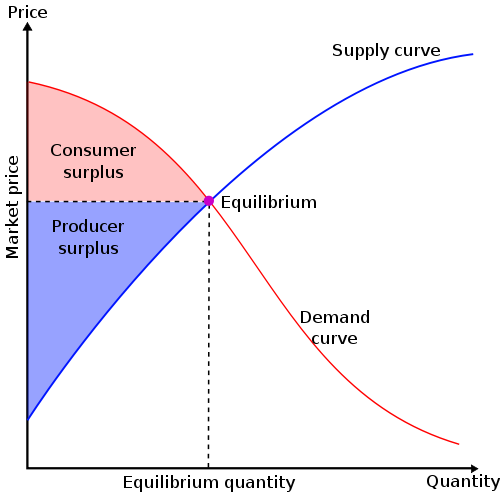
Consumer surplus is the difference between the maximum price a consumer is willing to pay and the actual price they do pay. If a consumer would be willing to pay more than the current asking price, then they are getting more benefit from the purchased product than they spent to buy it. An example of a good with generally high consumer surplus is drinking water. People would pay very high prices for drinking water, as they need it to survive. The difference in the price that they would pay, if they had to, and the amount that they pay now is their consumer surplus. Note that the utility of the first few liters of drinking water is very high (as it prevents death), so the first few liters would likely have more consumer surplus than subsequent liters.
The description is pretty self-explanatory, but I think the graph is a bit more useful.
And why not, here is a Greek college professor talking about it.
Do you want some videogame examples? Think back to multiplayer Diablo 2 and Warcraft 3. When I bought Diablo 2, it was because I wanted a quality dungeon-crawler experience similar to Diablo 1 – that there was an entire multiplayer experience attached was pure consumer surplus for me. Same with thing with Warcraft 3. Would I have paid an extra $5 for access to multiplayer? Probably. That $5 that I would have paid but did not have to amounted to Blizzard “leaving money on the table.”* Non-game examples includes Netflix Streaming, where you can access hundreds of movies at any time for $7.99. In spite of the “controversy” surrounding them raising prices of dual streaming/DVD plans, I think it is rather obvious that most Netflix customers would actually pay $10, $15, or even $20 a month for the service, especially since Movies On Demand-style services can cost upwards of $4.99 per movie.
The entire premise of microtransactions is dividing your content into smaller chunks to (re)capture and monetize every ounce of consumer surplus. While it is true that overall the game and it’s various monetized components are still worth buying – it falls within the bounds of the Demand Curve, which by definition means you value the game more than the money used to purchase it – it is equally true that literal value has been extracted from you. In other words, microtransactions remove value from games by reducing your consumer surplus.
Now, there may be the open question of whether the sort of microtransactions Blizzard is doing “counts” as consumer surplus mining. If Blizzard could/did not charge $25 for a mount, for example, would they have made the mounts at all? Would Blizzard have never made the Mobile Armory and/or the premium RealID grouping features if those did not tack on an extra subscription fee? I think they might not have developed those features and mounts, but that is more of an issue with the lack of credible competition** Blizzard faces than anything else. Indeed, competition generally engenders the greatest amount “value-added” consumer surplus since direct price wars are untenable. Then again, I might also bring up the Red Queen argument in that, much like raiding content, Blizzard has to continually be moving forward to maintain its present position. The artists that made and animated the Disco Lion would have been working on something either way, so if not adding that mount in as a PvE/PvP reward of some type, the effort might have been directed into a Titan or Diablo 3 model instead (increasing consumer surplus in those games).
In any case, I find the F2P and microtransaction model somewhat disturbing, yet inevitable. It obviously has the power to save games that would not exist otherwise (e.g. LotRO, APB, etc), and thereby opens the possibility of radical innovation in the types of games we play. Similarly, the rise of Steam and iTunes (and Facebook for that matter) as content delivery services makes indie games/music possible that could not exist in a typical retail box store. That said, the existence of that hitherto unexploited consumer surplus also leads to worse games, like Tiny Tower***. Meanwhile, instead of growing the industry, we have the major players pumping out sequals and squeezing the blood from what rocks are left instead of, well, mining for new rocks. This same phenominom is going on in the movie industry, with parallels like making movies 3D not because that adds value, but because A) they get to charge more, and B) it makes the movies nearly impossible to pirate.
The way I see it, the more game companies fall over themselves trying to monetize every corner of our consumer surplus, the less they fall over themselves giving us quality entertainment. Eventually, there will be some break-point beyond which lies an Era of Subsistence Gaming where we get exactly what we pay for and not one whit more. And those will be very bleak times indeed.
*Except Blizzard did not actually “leave any money on the table,” since that implies there was no value to Blizzard for giving consumer surplus. As we all know, it is the exact opposite: we as players give that value back to Blizzard in the form of brand loyalty and positive word-of-mouth recommendations. Part of that comes from the (historic) quality and polish of their games, but the feeling that we are getting more plays a non-zero part in the calculus.
**Blah, blah, Rift, LotRO, etc. Rift peaked at 600k subs and is now hovering around ~480k. LotRO peaked at 560k and is now at 360k. If you add both Rift and LotRO numbers at their peak, and then multiplied that by two, WoW would still have had more players than that in just North America… in 2008. Lost subs are lost subs, but I bet the Disco Lion made more money in the opening day it was released to cover a year’s worth of lost subs.
***Worse as in psychologically designed to exploit your nucleus accumbens, and essentially disprove the economic theory of rational consumers single-handedly.
 In An Age

Slow News Day
Aug 1
Posted by Azuriel
Man. If only there was, like, something interesting going on the world of gaming. You know, some tidbit of under-reported MMO news or some noteworthy announcement that happened in the last 24 hours or so. If it could demonstrate my somewhat embarrassing lack of forecasting abilities, that would be great too.
So, yeah, SWTOR going F2P.
Less than 1 million subs now, but totally “well over” 500k, aka the event horizon of the money hole. There is not much else to say that has not been said in a dozen other blogs in your RSS, although I am inclined to point to Green Armadillo’s analysis over at Player Vs Developer for one-stop shopping; I agree with basically everything the dasypodidae said. Especially the confusion as to how a F2P model is supposed to work when the stuff being pay-gated is probably what the vast majority of players don’t care about, e.g. endgame.
My contribution to the discussion, such as it is, will be the following:
A fine company with a long history of good decision-making.
In other news, I finished Dead Island over the weekend, and just completed Orcs Must Die 2 mere hours ago, having played the entire Story-mode in co-op. Official reviews of both and others will be forthcoming. Then again… maybe not. The recent Steam Summer Sale haul included the following:
I almost pre-purchased Borderlands 2 since it was $40 via Dealzon, before I realized that I am addicted to the thought of getting deals on videogames more than the actual playing thereof. At least, that is the only possible conclusion looking at my (digital) library. I was feeling kinda bummed out at letting the Borderlands 2 deal slip away though – while it was never supposed to be a sort of Day 1 purchase to me, I was definitely looking forward to it sooner rather than later – until my friend said “Steam Winter Sale.” God dammit.
I am looking forward to hitting up SWTOR once it goes F2P though, assuming GW2 plays out as I expect and I don’t do a full relapse with MoP. Throwing down $15 for the box a week or so from now is not asking much, but like I mentioned earlier, it is all about the dealz. And it is hard to argue with “free several months from now” when there is plenty to do in the midterm.
Posted in Commentary, SWTOR
2 Comments
Tags: Bioware, EA, F2P, Forecasting, Player Vs Developer, Steam Summer Sale, SWTOR