Blog Archives
Time Deletion
Guys… I’m up to 77 hours in Mewgenics. It hasn’t even been two full weeks yet.
That’s not even the worst/best part: Slay the Spire 2 is hitting Early Access on March 5th. It has one of the best trailers I’ve ever seen for a roguelike deckbuilder:
Granted, I don’t really know of many other roguelike deckbuilding trailers.
In any case, yeah, pour one out for my gaming backlog. And frontlog, for that matter. I certainly haven’t been spending any time thinking about Expedition 33 (etc) in the last two weeks. Too busy drinking from the firehose. Perhaps I can circle back in April… no, let’s say May. End of Q2, for sure.
(Heh, I didn’t say of which year)
The Hopes of the Game Industry
In short: they hope GTA 6 will cost $100 so they can raise their own prices.
As reported by VGC, Epyllion’s Matthew Ball just released a report focusing on the “State of Video Gaming in 2025”, which shares his thoughts on what might happen within the industry this year. Of course, a lot of that focus is out on GTA 6 which is primed to be one of the biggest game releases of all time, with some analysts predicting that it’ll make more than $1 billion in pre-orders alone.
Within the report, Ball claims that there is “hope” within the industry between publishers and developers that Take-Two will respond to all of the excitement and hype surrounding GTA 6 by raising the default price of the game to $100. Considering the fact that GTA 6 is going to sell well no matter how much it costs, the industry is reportedly hoping the price gets raised so that others can follow suit.
There is a ridiculous sort of myopia associated with seeing (and/or experiencing) high-profile commercial failures and escalating production costs, only to come to the conclusion everything would be better with higher unit prices. How about… *checks notes* … lower production costs? “But players demand AAAA-quality graphics!” Do they? I can appreciate the dilemma faced by developers, wherein the last game cost $400m and not wanting to gamble with a $350m (or lower) sequel. But if the acknowledgement is that the status quo of ever-increasing production costs is unsustainable, higher prices at best stems the bleed temporarily. At some point you need to address the root cause.
I was curious at this point as to what “the industry” actually thought about things, and if GTA 6 selling for $100 was all of it. So, the article I linked to above points to this VGC article, which then points to a 222-slide presentation by Matthew Ball, whom appears to be a “strategy advisor” to, presumably, the games industry (and others). If you have the time, I do very much encourage you to take a look yourself, as it is surprisingly straight-forward and facts-based. A summary:
- 2011-2021 saw the game industry grow at 150% annually
- However, in 2022 revenue fell -3.5% and remained flat in 2023-2024
- This mismatch in prior projections has dried up VC pipelines and investments
- The growth of the prior decade was due to multiple “innovations” that has since exhausted themselves
- Think microtransactions, mobile gaming, Battlepasses, etc
- Assumed new innovations are not bearing out (AR/VR, etc)
- Worse, rise of social video (TikTok) is actually eating into mobile leisure-time in a significant way
- PC and Steam growth appears to be bright spot… but all because of China
- Chinese game companies are exporting and directly (and successfully) competing with Western devs
- Game industry has unique struggles in variable pricing, and cannot easily pass on inflation
- Overall engagement is decreasing in gamers, including the hardcore ones
- Most of all gamers’ playtime is with existing titles – only 12% is spent on new games
- Network effects mean players stay playing the games their friends are playing
The final section of the presentation includes thoughts on potential new growth engines. And it does include GTA 6, but also several others.
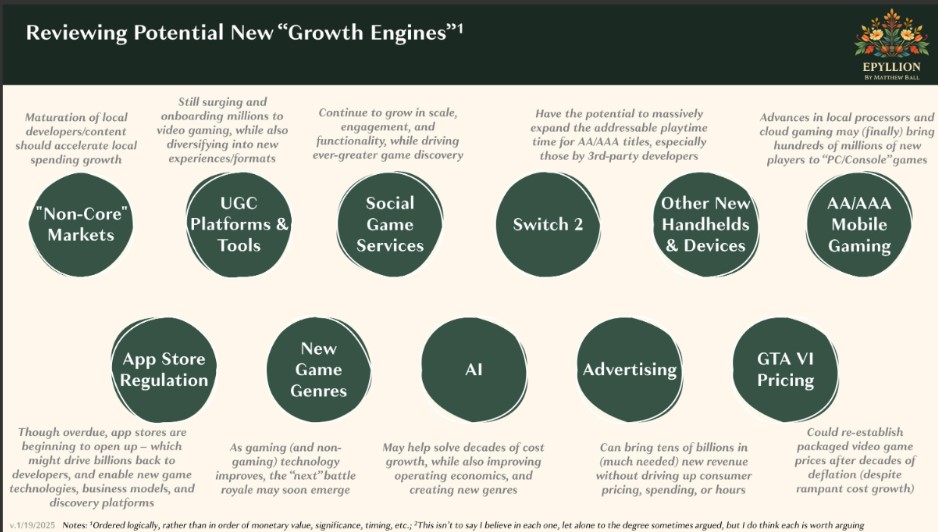
Again, I think it is worth looking at the presentation yourself, as each of the 11 bubbles there get multiple slides that introduce, justify, and even caution about the “solution.” Well, aside from GTA 6, which is noted would be the cheapest GTA ever (in real terms) if it comes out at $70. GTA 5 was released in 2013 at $60, which would be over $80 today, for example. Notwithstanding the billions of dollars GTA Online brought in, of course.
Overall, I did come away a bit more sympathetic to the plight of the games industry. Some of the headwinds I can personally attest to. For example, there have been multiple nights in which I found 2-3 hours of my “gaming time” consumed by Youtube Shorts scrolling. The network effect or “black hole” games are certainly a challenge as well, as anyone who has spent years playing MMOs can attest to. How do you compete against Fortnite, Minecraft, Roblox, and/or all the others?
“Raise prices,” of course!
Unfortunately, the actual solution is both pithy and hard to achieve: make fun games. Note how that solution did not include the words “spend 8 years painstakingly rendering every blade of grass.” Also note that I’m not saying that coming up with a fun game is easy either. But the industry seems stuck in this death loop of hiring more artists, programmers, marketers, and greenlighting enormously long development times… only for the game to fall flat because the fun wasn’t there. You can’t just hire more people to increase the fun quotient. And sometimes the fun that is achievable is only experienced by a narrow slice of the market, too small to be sustainable for the larger companies.
I don’t know the solution. If I did, I certainly wouldn’t be giving it out for free. But it might well be… decimation for the industry. I think a lot of publishers are just going to go bankrupt trying to spend their way out of the tailspin. AI could be a big disrupter, but disruption favors small indie shops, not the big guys. And while I do feel like longer development times is the obvious root issue for ballooning costs, I don’t see how the industry moves towards shorter development times and… then what? More releases? I mean, I wouldn’t be mad about a new Fallout every 2 years. If they keep the releases the same with a shorter development time though, that just means an implosion in the game jobs market. Not ideal.
…or maybe it is?
I dunno. I’m just a dude looking for fun games to play with my ever-decreasing amount of free time and eroding consumer surplus. When I look at my most-played games though, what I don’t see is full-priced titles with photo-realistic graphics and 8+ years in development. Well, I guess some Early Access titles were being worked on for that long, but it was like with three guys, not three hundred.
Anyway, Take Two can try and take $100 if they want and everyone raise prices as a result. Maybe it works, maybe it doesn’t. Nevertheless, my parsimony will abide.
GW2: Class Act
Close to 60% of my Guild Wars 2 gameplay is determining which class/spec I want to play at a given time. It’s a struggle because there are nine classes with three specs which have two broad categories of damage types (Power vs Condi) apiece. Nevermind the various Utility options and talent tweaks and, oh yeah, all the weapons that bring different skills too.
When looking at what to play though, my priority list is:
- Sustain, e.g. self-healing
- Pressing buttons feels satisfying
- Good open-world DPS
- Has option for ranged damage
- Condition cleanse
- Good open-world burst damage
- Class/spec is competitive (with tweaks) in fractals and/or PvP
- Rotation isn’t crazy
Might seem weird to have Sustain at the top, but in my nine years off and on playing GW2, I have discovered that the worst feeling I experience while playing is eating some big boss hit for 2/3rds of my HP and then frantically dancing around waiting for my self-heal to come off cooldown. Will other players help you up? Often, in fact! But I would rather be the guy helping other people off the floor than eating dirt myself.
Scourge [Necromancer elite spec]
My current main is a Scourge. While I have not played every single class/spec combination, I can say that Scourge is about as perfect as I can imagine. Phenomenal self-healing and barrier, great DPS, all ranged damage, baseline Condition cleansing, Boon stripping on a short cooldown, and even decent burst if you just unload all the cooldowns right away. While “class fantasy” isn’t listed as important above, it does count for something. And the Scourge has it, what with the sand necromancer schtick.
The “problem” is that… well, I’ve been playing that same spec for months. Not even months in a row (although it’s close), but like for a while, then taking a multi-year break, then playing it again. While the damage is good, the rotation is pretty straight-forward, so I end up pushing the same sort of buttons in the same sort of way, forever. It works, but it’s rote.
For the last several weeks, I did try to make Reaper work. Greatsword that turns into a giant scythe, the ability to burst down regular mobs in seconds, what’s not to love? Well, the sustain, or lack thereof. Bursting mobs depends on accumulating Life Force and popping a cooldown that burns Life Force naturally, in addition to said Life Force being your 2nd HP bar. So, get low on normal HP, pop the cooldown, and if the fight is still going on a few seconds later, you get to be right back on low HP.
Renegade [Revenant elite spec]
My up and coming new main, or at least secondary main.
I tried Revenant when it was first released and didn’t “get” it. Maybe it was undertuned at the time? All I know now is that the Condi Renegade pushes all the correct buttons for me: great sustain, good DPS, and bursting potential. Plus, it has great ranged damage, which is a huge plus. I plan on using my Renegade to go back through the various Living Story, er, stories in order to complete the Return Of… meta-achievements. If I have to play these again, may as well be on a different character.
Holosmith [Engineer elite spec]
I really want to like the Engineer, but it’s a struggle. Conceptually, the Holosmith is cool. The damage looks fun, there is some bursting potential, and so on. The problem I find is that the self-sustain isn’t there, even though I’m walking around with a shield. It is very possible that I’m simply not playing it correctly. Looking at some Scrapper videos, it’s also possible that I should be trying that spec out more, since it has a lot more sustain.
Really though, the main reason my Engineer is getting any attention is because of the upcoming Mechanist spec in the expansion. That is something I’m very interested in.
Mesmer [Any]
Another class that I should really like, but don’t in practice. I love the concept of an illusionist fighter dealing psychic damage, with a bunch of clones running around confusing people. Playing with it though, I find it extremely hard keeping up 3 clones for maximum DPS, let alone shattering them and then creating three more. I end up either not having three because one died or whatever, or wasting cooldowns trying to create three and doing nothing. Meanwhile, nothing is dying particularly quickly.
Maybe it’s my lack of gear on this character, but it’s hard to justify grinding Winterberries for the 10th time to get them enough gear to potentially be fun at a later date.
Thief [Any]
Again, I wanted to like them, but nope. One of the meta specs (Condi Daredevil) has a “rotation” of literally evade spam. Like, use an ability to makes you Dodge x3, use actual Dodge Roll x2, and then auto-attack a few times. Repeat. What’s not to love about that? I prefer simpler rotations myself, but damn guys.
Power Deadeye actually came closer to being good for me despite having an even simpler rotation of pressing Unload a bunch, because Unload is cool. Like you are just shooting with dual pistols a bunch over and over. The problem is that it has no cleave, so I had to press Unload a bunch on one guy, then swap, then swap again. Maybe Scourge has spoiled me, I dunno.
Elementalist [Any]
My character is named Azuriel Prime, as it was my original class when I started playing nine years ago.
Too bad Elementalists suck, and have pretty much forever. Is there something more brittle than a glass cannon? Sand castle cannon at high tide? Zero sustain, your elementals disappear when you mount, and everything kills you. Oh, and your rotation is cycling through 20 abilities compared to “just Dodge on cooldown and things die.”
[Fake Edit] Between when I originally wrote this and when the post was scheduled, I did spend a bit more time with the Elementalist. I went for Condi Tempest with full +Toughness, +HP, +Condi damage gear. And… it’s working, sorta. It’s not particularly fun and I couldn’t tell you what the Tempest brought to the table aside from being able to press your elemental attunement again (which is a DPS loss), but it’s not totally useless in of itself. It just can’t compete with other options, which have better sustain, higher damage, and easier rotations.
Guardian, Ranger, Warrior
Don’t have the character slots to have any of these.
Granted, I did before the Revenant, and actually had a few at level 80 back in the day. But back then, I wasn’t particularly impressed, and now it’ll cost me $10 to try them so… ¯\_(ツ)_/¯
Meaningful Experiences
I was browsing Kotaku the other day, and a paragraph struck me:
Nobody ever asks why anyone stopped playing Halo 2. No response would merit it. The game came out in 2004, and three years later, there was Halo 3. At some point, it got old. Another game came along. Friends moved on. It was just a thing you did, and then you went and did something else.
This is something I struggle with, internally. Not Halo 2, but with the general concept.
I used to play a lot of Counter-Strike back in the day. So much so that I was extremely bitter when version 1.6 came out and changed the way a lot of the guns fired (1.5 for life). I transitioned into Warcraft 3-modded Counter-Strike servers – Night Elves went invisible when they stopped moving, Undead had low-gravity and regain health when dealing damage, etc – before finally moving on entirely to Battlefield 2. I played that damn near daily for like four years. Then Magic Online for a while, then World of Warcraft for a decade.
Looking back, what can I even say about any of those decades of gaming?
“I had fun playing Counter-Strike.” Maybe someone else can say “me too,” and then commiserate about X or Y change in the intervening years. But that’s it. We can’t really share our experiences in any further detail – you had to be there in that moment, else it’s just a vague sentiment, if one tries to communicate the feeling at all. WoW is different in the sense that I eventually met my guildmates in the real world – and invited each other to our weddings – but I can’t imagine meaningfully talking with some random WoW player on the street.
Contrast that with, say, any of the Final Fantasy games. Or Silent Hill. Or really any single-player, narrative experience. If someone says their favorite game is Xenogears, I could meaningfully talk with them for hours. We could discuss our favorite team compositions, how shocked we were about X revelation, how funny the mistranlations were, and so on. That means something in a way that “This one time on de_dust…” does not. We played the same game, but had different experiences.
At the same time, I don’t want to denigrate other peoples’ experiences. I wouldn’t suggest that someone hiking in the woods or fishing is wasting their time, despite those discreet events being equally ephemeral and unrelatable. There are people who simply enjoy wandering around virtual worlds, like there are people wandering around the real world. If that’s what you like, keep doing it.
I worry about myself though. I started Hellblade: Senua’s Sacrifice the other day, and enjoyed the play session. After that, it’s been days and days of Slay the Spire (Ascension 12 with the Silent) and 7 Days to Die. The latter is especially egregious, considering it is in an unfinished Alpha state. Why not put it down and go back to Hellblade, which is – by all accounts – a much deeper experience? Because, in that moment, these other (potentially vapid) experiences are 5% more pleasurable.
“If you’re having fun, what does it matter?” Well… wirehead. Also, having fun, in of itself, is not relatable. Which, I suppose, belies an underlying desire of mine to be relatable or at least capable of conveying relatable experiences. Even if there were people who wanted to read “I had fun playing videogames today,” I wouldn’t want to write just that. There should be something more.
I dunno. It would be one thing if the dilemma was between playing videogames and completing some meaningful task IRL. It’s not. There is nothing more #firstworldproblems than angst surrounding which two leisure activities provides the most long-term utility. Nevertheless, the worry exists, alongside a deeper one as to whether wirehead experiences have increased my fun tolerance beyond the reach of narrative games altogether. Or perhaps I am simply playing the wrong narrative games.
From Whence Fun?
The other day I was playing Words with Friends (aka Scrabble app) with my SO. She is not much of a gamer – although she did play WoW back in vanilla – but she enjoys board games, and word games the most. I play along with the word games mainly because it’s something we can do together, but… I don’t really enjoy it. Word games are not my forte, and it does not help that she is way better at words than I am. I have actually legit won on occasion, primarily on the back of a few critical plays when the tiles line up just right. For the most part though, she kicks my ass on the daily.
For those who don’t know, there are an abundance of Words with Friends “cheat” apps out there. What those will do is analyze your seven tiles and the board, and then list out the best possible scoring combinations via brute-force analysis. I have never played with any such apps, but I find the idea amusing simply because that is exactly what I try to do a lot in-game.
See, Words with Friends will only allow valid plays. So, if you don’t know whether something is a word, you can drop tiles and get instant feedback. I have gotten a lot of points before basically dropping random tiles in key locations and making a word I had never heard of.
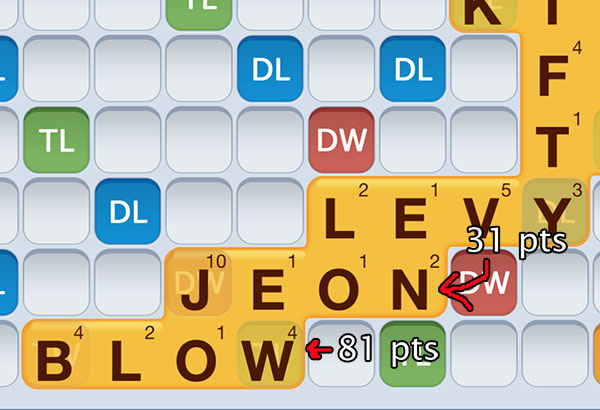
I don’t even know what “Jeon” is, but I regretted playing it immediately.
The difference between my method and using an app to do it for me is… something.
I suppose it becomes less of a contest between two players’ knowledge when automation is involved, cheapening the experience. On the other hand, my SO plays word games a lot – she runs several concurrent games at a time, in fact – so she has memorized all the different Q words that don’t need a U, and so on, which is a pretty big advantage. And like I mentioned, I can do everything the cheat apps would do, if I was patient enough to do it myself. So, at some point, her overwhelming knowledge versus my very basic brute-force tactics becomes analogous to one or both of us facing two different kinds of bots.
That thought led me to another: what if we both used cheat apps? At that point, the game would probably come down to the random nature of tile distribution, and perhaps a few scenarios in which we had to choose between two same-point plays. Regardless, it doesn’t sound particularly fun, right? If we have automated things that far, we may as well automate the selection of the answer, and just have two bots play against each other forever.
So… from whence did the fun originate?
I think it is safe to say that certainty reduces fun in games. While I do not necessarily mean that randomness needs to exist in order for fun to occur, I do mean that the outcome needs to be unknown, or at least in contention. If one person has the cheating app and the other does not, it’s not likely to be a fun game. Even if no cheating was involved, one player having an overwhelming advantage – either knowledge or skill – and the outcome is probably the same.
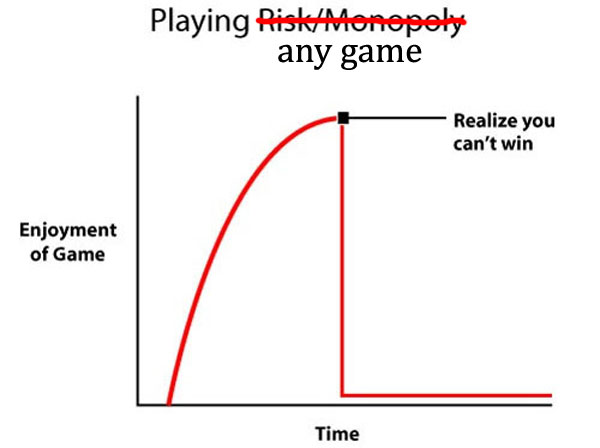
But what does that really say about our games, and the way we play them? The better we are at a game, the less fun we likely will have. Having a little advantage is nice, and the process by which we get better (experimenting, practice, etc) is a lot of fun too. At a certain level though, it tapers off. What’s fun after that? Direct competition? Maybe. Part of that fun is likely tied into the whole “unknown level of skill from opponent” thing though. Because if we knew he/she was using a cheat program, that fun would evaporate pretty quickly.
Now, there is a sort of exception here: it can be fun to totally dominate your opponent(s). Be it ganking in MMOs, or aimbots in FPS games, the reason a person would do such a thing is precisely to “collect tears” by specifically ruining other peoples’ experience. At that point though, the medium is kinda immaterial; the bully is just using whatever is convenient and less personally risky.
In any case, I went ahead and shared my thoughts above with my SO and her response was interesting. For her, the “game” within Words with Friends is actually just challenging herself in finding the highest-scoring move each turn – she does not necessarily care about the ultimate outcome of the game. Which, to me, sounds like she should be playing against bots, but nevermind. And I actually understand that sentiment: whenever I was playing BGs in WoW, my goal is not necessarily to win at all costs (e.g. sitting on a flag 100% of the time), but to amuse myself on a micro level, even if I was grinding Honor.
Still, I suspect my SO will eventually tire of the wordplay over time, once her skills plateau. Or… maybe she won’t. After all, I somehow find it infinitely interesting to collect resources in Survival games despite having achieved maximum efficiency usually by clicking the button once. Which leads me back to my original question: from whence fun?
Challenge is Overrated
Rohan posted the other day that the modern MMO tendency towards making leveling alts easier runs afoul of Raph Koster’s Theory of Fun¹. “Leveling alts should be harder, not easier!” Allow me to offer an alternative Theory of Fun: it’s about Novelty, not Challenge.
While I have forwarded this thesis almost three years ago, I am more convinced than ever that the Novelty theory better explains fun than Challenge. For one thing, when was the last time you were truly challenged in a videogame? When were your abilities pushed to their maximum? Okay, now think about the last time you had fun playing a videogame. Did you ever have fun without being challenged? QED.
Part of this debate is semantic – Challenge is Novel by definition, else it would not be challenging. But Challenge does not model the demonstrated ability of players to derive fun and entertainment from picking herbs, mining copper nodes, exploring the map, fishing, and so on. Neither Skyrim nor MineCraft are particularly challenging, and yet people can sink MMO-esque amounts of time into them.
What challenge is taking place in the imagination of a child at play?
The other problem with Challenge as Fun is how clearly there is a hard limit on it. Even if you avoid crossing the line into too challenging to complete, sustained challenge can be exhausting. Which makes sense, as challenge is an exertion of effort above the median. Sustained challenge also presupposes a sort of boundless limit for self-improvement. Even if I believed that everyone could do anything if they simply put their mind to it (I don’t), it’s undeniable that one’s effort hits diminishing returns rather quickly. Is it worth 15 hours of additional practice to realize 1% gains? Maybe someone thinks so. I raided with a Hunter back in ICC whose DPS improvement was literally squeezing in one, single additional Kill Shot into an eight-minute fight. But even he would be unlikely to spend 30, 60, 90 more hours to squeeze in a second one.
Plus, you know, he did end up quitting WoW despite there being plenty of challenge left.
The way I am describing Novelty is not necessarily as “a completely unique experience.” All it has to do is simply feel new to you. The subjectivity is an important facet, just as with Challenge, and it explains how someone can still have fun picking herbs when the action itself is fairly rote and well-defined. For myself, I consider Progression to be Novel; increasing in power and effectiveness is fresh and exciting to me. I start making plans for my ever-increasing hoard of Peacebloom (etc), or imagine what I could purchase after selling it. Others could see the act-in-time to be Novel – they have never picked Felweed at this particular time and place before, and who knows if a member of the opposite faction could be lurking around the corner. Of course, there is also the people-element that can make the most mundane of tasks into cherished memories.
In the end, I might almost say that the most universal quality in fun games is Engagement. Challenge can be engaging, Novelty can be engaging. However, it is not particularly useful to suggest a game be more Engaging any more than it is useful suggesting a game be more Fun. One can certainly suggest a game be more Challenging or Novel though. I would just suggest going with the latter.
¹ I have not actually read Koster’s book, so it’s entirely possible he isn’t arguing Challenge > everything. In fact, I seem to recall it being more about learning things, which puts it more in line with my Novelty argument. Nevertheless, I don’t feel like a game has to be Challenging to be fun, and I have no idea why challenge is so fetishized in game design.
Unfair Impressions: TSW, Days 3-4+
Day 3
As mentioned previously, my spirits were up quite a bit from the doldrums of the first two days in The Secret World. Knowing that it was expected that one unlock all the “inner wheel” abilities on the Ability Wheel lowered the existential pressure of permanent choices. And as soon as I confirmed with a commenter that, yes, TSW did have an in-game Search feature for abilities, the mental wheels started turning quite pleasurably. I finished a series of entirely pleasant and non-frustrating quests, got 7 more AP, and then starting picking things that maximized my synergy.
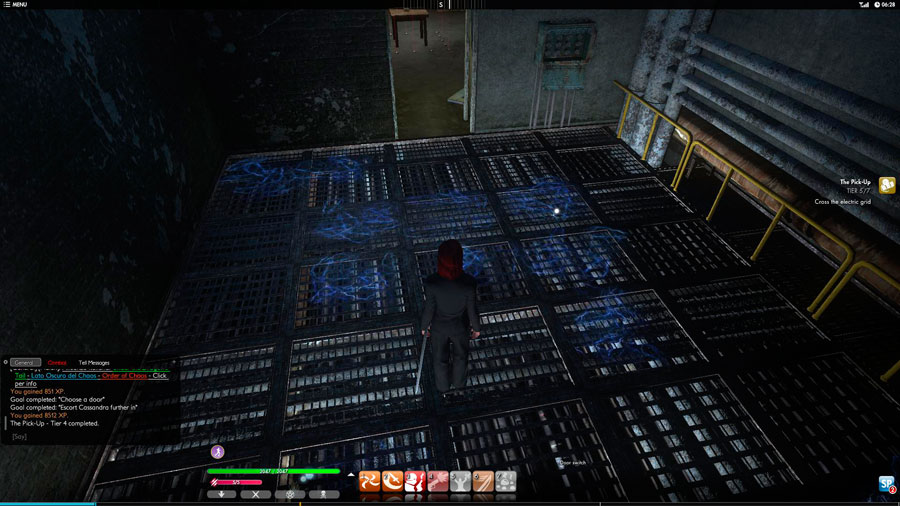
“Quests” like this were refreshingly novel.
My present loadout is something like follows:
- Delicate Strike – single-target blade builder (+10% Penetration chance)
- Blade Torrent – AoE blade builder (+Affliction DoT)
- Balanced Blade – AoE blade finisher
- The Business – single-target pistol builder (+Weakened Healing)
- Shootout – channel pistol finisher
- Above the Law – Targeted AoE cooldown damage field
The other relevant passives meanwhile are:
- Lick Your Wounds – Stacking HoT when you deal damage
- Immortal Spirit – HoT when you Penetrate
- Gnosis – Hitting Weakened targets = 33% chance for more damage
- Dark Potency – Hitting Afflicted targets = Stacking +Penetration buff
You don’t really have to know anything about TSW to sort of see what’s going on there. Blade Torrent hits everything and then gives them an Affliction DoT, which triggers a +Penetration buff for me, which increases my chance to trigger a self-HoT. Meanwhile, I get a baseline HoT for just hitting things. The Business deals damage, puts up a Weakened debuff, which makes further hits deal extra damage 33% of the time.
Actually, the synergy isn’t really all that there. The two weapons themselves don’t really have much synergy with one another. There doesn’t seem to much of a point to not simply spam Blade Torrent, even when I have enough combo points to use my AoE finisher. Using the single-target pistol attack to Weaken and deal bonus damage sounds cool, but I’m mostly facing small groups of weak enemies right now. Even I were facing a single target, the Aff –> +Pen +HoT deal sounds a whole lot better, especially since the Weaken ability I have is essentially the Mortal Strike debuff.
But like I said, the wheels are turning. “Hmm… well, the Shotgun features a baseline ability to hit things in a cone, and you can make that give everyone a Weakened debuff that results in 30% less damage done. That’s certainly better than a single-target attack that gives -Healing on mobs.” Then you run across a higher-tier Shotgun passive called 12 Gouge that causes enemies you Penetrate to become Weakened (-30% damage) that starts making your mind melt in interesting ways.
- Oh, so if I spam Blade Torrent, everything around me gets an Affliction DoT, I get a +Penetration buff, then if I Penetrate anything from spamming the attack they get Weakened (-30% damage), which then can trigger the 33% chance for them to take extra damage.
- And I get two different HoTs.
- What does a 12 Gouge katana even mean?
No doubt there are better, more efficient combos in the game that exploit synergies I don’t even know are possible; I have been limiting my scope to mostly inner-circle abilities, which the exception of 12 Gouge. But, again, this whole exercise has significantly increased my respect for the game… at least in this area.
I mean, this part is, as the kids say, “totes fun.” However, actual combat so far amounts to me spamming one attack over and over. Which is not all that different than spamming Wrath a thousand times in WoW, of course; I’m not even out of the equivalent of Goldshire yet. Nevertheless, I remain wary as to how engaging the combat is really going to be once I “finish” the ability-planning part. And I wonder how much of the fighting game design was sacrificed at the altar of ability synergy complexity.
WoW combat is fun, to me, even when I’m killing entirely trivial mobs. It’s visceral in a way I can’t entire describe. TSW combat is not… also in a way I can’t entirely describe.
Day 4
It is funny and sad, all at once, how much difference a little gear makes in an MMO.
After the fun of planning build synergies the other day, I was facing the reality of what amounted to a number of long slogs against single enemies with 30+ seconds TTK (time to kill). Worse, I was getting little-to-no sense of when/how you would ever use the Dodge button or circle-strafing in TSW. Sure, avoid the bad stuff/targeting reticule on the ground. But beyond that? All the enemies reminded me of the unquestionably lame zombies of Orr in GW2, with their 300% movement speed and amazing clipping powers.
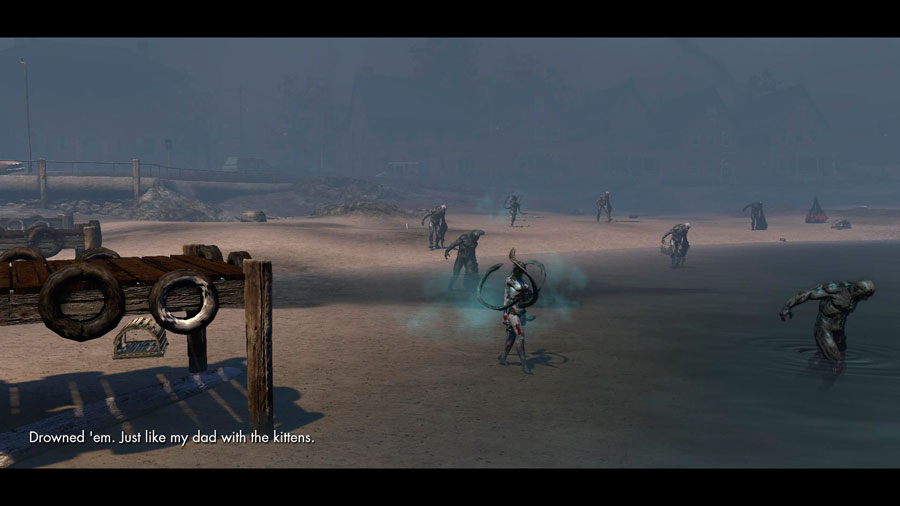
Know what’s fun? Not fighting these mobs.
I died a few times, as you can imagine, against single mobs. Specifically, I died to enemies who never seemed to target the ground with anything – they simply beat my face in, old-school. The worst part of new games is when you fail for reasons you don’t quite understand, or are unable to prevent. I knew I was probably dead within the first 5 seconds of the combat encounter, but it took another 15 before I officially gave up the ghost. I could have probably ran away, but I wanted to know specifically why I was dying, and to get a sense of what I could do to prevent/slow down the process. The auto-HoTs weren’t enough, for sure. But it seemed like only the Assault Rifle and Blood Magic “weapons” allowed for self-healing spamming. Which meant I was going to end up with seven of nine (har har) weapon skills halfway filled, likely putting me signifigantly behind the power curve that would have existed had I stuck with the same two weapons.
Then I got gear. Partly from the “subscriber rewards” I received for having purchased the game for $15 via Steam, and the rest from the AH. Mobs are just falling over now. The stronger ones still take a while, and I still derive no visceral thrill from killing them, but my HoTs essentially keep me above 80% HP at all times.
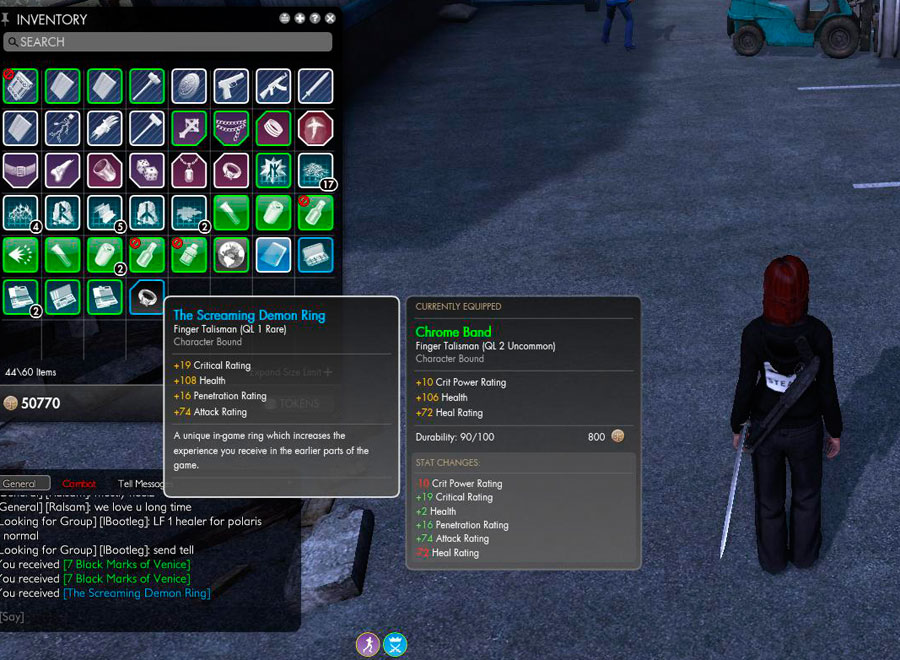
You’d be surprised how big a difference it makes. Or maybe you wouldn’t.
Maybe there will be fun combat later on, but it’s getting increasingly difficult IMO to use that as a proper excuse. With a few weapon exceptions, GW2 was fun right out of the gate, for example. And it all seems extra silly when hypothetical games like SavageSun somehow manage to feel fun to play even when you only have two abilities.
In any case, this will likely be my last Unfair Impressions for TSW. I don’t plan to stop playing necessarily, but I think these few articles have adequately served their purpose – namely, presenting my impressions of a game that I had no particular desire to play in the first place. While the chances that I play TSW in the long-term is less than zero, my opinion of it is certainly better than what it was when I started it. If I play it more, it will be in the context to experience the narrative and quests.
Which sounds great until you realize I said the same thing about SWTOR.
The Siren Call of Dynamism
Looks like we have the next Jesus game:
EverQuest Next Could Fix Everything Wrong With MMORPGs
I’ve played every major massively multiplayer role-playing game released since 1998, yet it feels like I’ve spent the past 15 years playing the same game over and over again. That’s a problem. EverQuest Next is the solution.
I probably should have stopped reading that Kotaku article right there, but I’m a masochist at heart.
Don’t get me wrong, some of the things I’m reading about EverQuest Next sound interesting. Voxel-based things, somehow without looking like Cube World. And… err… yeah. Classless/multi-class systems like The Secret World/FF11. Stylized graphics like WoW, Firefall, Wildstar. Red zones on the ground that you shouldn’t stand in, like most every game these days. Jumping and “parkour” (which means what, exactly, in this context?) like in Guild Wars 2. Reducing abilities down to eight, like Guild Wars 2 again. Dynamic events and “calls to arms” like Guild Wars 2 and Firefall and Warhammer. Hell, considering they brought over Jeremy Soule to do their soundtrack, they probably should have just called the game EverGuildQuestWars2Next.
Then there are the hype red flags. A StoryBricks-based AI that wanders around and sets up camp organically? Neat. But then I started reading this interview:
So, to better understand the Rallying Calls, I wasn’t clear on some things with David Georgeson’s example: say you’ve built a big city, and built these stone walls around it, and now an army has come for a siege. Is that something that happens over a couple hours, or a week?
McPherson: That army siege lasts until the players on the server have completed that stage.
[…]
With the “emergent AI,” though, how can you maintain something indefinitely? If the army comes to attack, and is defeated outright in an hour or the players just ignore it, what then? Do you keep spawning enemies?
Butler: Until the things that spawn them are destroyed.
[…]
So, if orcs are released into the world and wander around looking for areas they like, they’re not coming from some point and spreading outward, they’re spawning from camps they set up?
McPherson: Right, perfect example. So in phase four of this Rallying Call, four large orc warband camps spawn in the hills. Those camps are literally swarming with orcs.
Butler: And they’re unassailable.
McPherson: Until you meet the requirements to move on to that next area and eliminate those. Then you and your army push past them and assault them in their homeland.
Butler: You try to fireball the palisade walls in the orc camps, but the fireball doesn’t take down the walls because you need catapults, because that’s what unlocks the next phase and gives you the ability to assault the camps directly.
[…]
What happens if players don’t do any of this?
Butler: It’s simple, it doesn’t advance. So just like a chapter of a book, right? You’ve got your personal storyline, you’re playing through the game. Your personal contribution and the story that goes with it goes on at whatever pace you choose to pursue. The server has a storyline as well, expressed with these Rallying Calls. If players choose not to pursue them, the clock just doesn’t advance.
Oh. So… these things are completely indistinguishable from anything we’ve seen a thousand times before, all the way back to simple phased quests in WoW? Will there be a little “Catapults put into position: 0/2” blurb in the middle-right side of the screen too? How dynamic and revolutionary.
Getting back to the Kotaku article, the author presents his final conclusion like this:
Addressing the Real Problem
Boredom is the enemy of the MMORPG, plain and simple. Now matter how gorgeous the world, or how animated the player base or how compelling the game itself, eventually all of that content the developers spent years creating is going to grow stale.
That’s the real problem here. MMORPGs have traditionally been developed much like single-player games. There’s a beginning, a middle and an end. They can be padded with downloadable content, but they’re still single-player games with other people crammed in there to keep us from realizing that we’re playing the same thing over and over again.
Maintaining a strong community helps, but its not enough. To really solve the core problem, you’ve got to create what so many games before have promised — a living, breathing, ever-changing world.
EverQuest Next sounds like the solution to me.
Now, he says he has been playing MMOs for the last 15 years, but I get the distinct impression that he hasn’t. All long-term compelling MMO content is player-based. An ever-changing world is irrelevant in comparison to a completely static world populated with other people you like hanging around with. People are still playing the original EverQuest for god’s sake! This is besides the fact that there isn’t a “living, breathing, ever-changing world” in EQN or anywhere.
Even if EQN or some future game actually managed to pull it off, would you even want to play it? As I pointed out back in 2011, player impact on the game world is considerably less interesting than many people make it out to be. Imagine if xxArthasDKlolxx killed an NPC and now you can never interact with said NPC again. Is that what you want? Feature sets that include “destructible environments” always have to be followed up by explanations about how it isn’t permanent, lest new players be introduced to a cratered wasteland made by bored griefers.
EVE has been in the news lately with its dynamic player impact, but all of that has been confined to player social structures, and not the game-world itself; star systems have changed ownership, but it’s not as though there are less NPCs or ice rocks in the universe.
That’s how you do dynamic content: with people. Whether orcs spawn in the valley or on the hill is extremely trivial, considering you still have to remove them in pretty much the same manner as you did 15 resets ago. GW2 has committed itself to two-week content obsoletion cycles, which I guess is one way to avoid the tedium of redoing the same thing over and over. Then again, even if the set pieces change, you are still interacting with the world the same way, more or less, as you did at level 1. “Kill this, click that, jump here, fill up your meter, claim rewards.”
I’m not saying that dynamic/changing content can’t be fun, I’m saying that dynamic content is not some silver bullet for boredom. Things might change randomly or dynamically, but your understanding of their mechanics only increases over time. Nils has talked about this years ago, as I have, but I think Klepsacovic summed it up more poetically here:
That last part is the key: anything I could think of. Early on I did not imagine what else I could want to do in this world. I’d done only a tiny fraction of what I could. This had two effects. One was that I had not run into a limit yet. The other was that I could not imagine a limit. I did not imagine that the sky ended, that the quests ended, that the raids could all be done. These were all true, but since I did not know them and did not even imagine them, they were irrelevant. I was running the infinite distance of a circular path.
Since then I’ve learned and my behavior has changed. I do not run in circular paths. I run out, find the edge, map it out, and then fill it in. This means that very early on my mind has already filled the size of the world, so that all that can happen after are details, with nothing big to be revealed. In my mind it looks like two strategies for filling in a circle. Both start at the center. One draws a line out to the edge and now the radius is known. It then spirals inward, knowing exactly where it is headed. The other starts the spiral at the center. It will cover the same area, but it will do so not knowing where the edge is, what the limits are, until it reaches them.
Cynicism is easy, but it’s also an appropriate response to any claim that non-player dynamism is going to solve anything. You can still get bored playing a procedurally-generated game; if that fact is not the simplest indictment of the intellectual bankruptcy of Mike Fahey’s Kotaku argument, I don’t know what is. People are the only thing that will continue making a game interesting once you have mapped out the circle. The player-built structures and other such things might bridge the gap, but it won’t be enough if you aren’t making friends and setting down roots. Given how EQN is F2P though… well, I’m not holding out hope for a particularly stable, long-term community.
All that said, EQN is now on my radar. If it’s fun, I’ll play it. Hell, I’m kinda interested in the incredibly devious EQN Landmark “game” where you’ll likely pay SOE for the privilege of building content for them (Landmark is F2P, but that just means the costs are hidden). Imagine building your own house – as in, your IRL house – and placing that in game… or selling it to other people. I have never used Portal 2’s puzzle-making feature, but I am always a fan of developers giving players tools to build in-game stuff. Crowd-sourcing is great, but even better is the ability to sorta build your own game design portfolio.
Would I get bored with EQN eventually? No doubt. But I don’t see that inevitability as a negative – it is simply the natural consequence of learning and experiencing things. An MMO doesn’t have to last forever to be worth playing. People and relationships don’t last forever either, but I don’t see anyone saying those are a waste of time.
 In An Age
Dollar Per Hour of Entertainment
May 7
Posted by Azuriel
Today I want to talk about the classical “$1 Per Hour of Entertainment” measurement of value. This has been a staple of videogame value discussions for decades. There are multiple problems with the formula though, and I think we should collectively abandon its use even as general rule of thumb.
The first problem is foundational: what qualifies as “entertainment”? When people evoke the formula, they typically do so with the assumption that hours spent playing a game are hours spent entertained. But is that actually the case? There are dozens and dozens of examples of “grind” in games, where you must perform a repetitive, unfun task to achieve a desired result. If you actively hate the grinding part but still do it anyway because reward is worth it, does the entire process count as entertainment? Simply because you chose to engage with the game at all? That sounds like tautology to me. May as well add the time spent working a job to get the money used to buy the game in that case.
Which brings me to the second problem: the entertainment gradient. Regardless of where you landed with the previous paragraph, I believe we can all agree that some fun experiences are more fun than others. In which case, shouldn’t that higher tier of entertainment be more valuable than the other? If so, how does that translate into the formula? It doesn’t, basically. All of us have those examples of deeply personal, transformative gaming experiences that we still think about years (decades!) later. Are those experiences not more valuable than the routine sort of busywork we engage with, sometimes within the same game that held such highs? It is absolutely possible that a shorter, more intensely fun experience is “worth” more than a mundane, time-killing one that we do more out of habit.
Actually, this also brings up a third problem: the timekeeping. I would argue that a game’s entertainment value does not end when you stop playing. If you are still thinking about a game days/months/years after you stopped playing, why should that not also count towards its overall value? Xenogears is one of my favorite games of all time, and yet I played through it once for maybe 80 hours back in 1998. However, I’ve thought about the game many, many times over the intervening decades, constantly comparing sci-fi and/or anime RPGs to it, and otherwise keeping the flame of its transformative (to me) memory alive. Journey is another example wherein I played and completed it in a single ~3 hour session, and I still think about it on occasion all these years later. Indeed, can you even say that your favorite games are the same ones with the highest dollar per hour spent playing?
The fourth problem with the formula is that it breaks down entirely when it comes to free-to-play games. Although there are some interesting calculations you can do with cash shop purchases, the fact remains that there are dozens of high-quality games you can legitimately play for hundreds of hours at a cost of $0. By definition, these should be considered the pinnacle of entertainment value per dollar spent, and yet I doubt anyone would say Candy Crush is their favorite gaming experience of all time.
The final problem is a bit goofy, but… what about inflation? The metric has been $1 per hour of entertainment for at least 20 years, if not longer. If we look at 1997, $1 back then is as valuable as $2.01 today. Which… ouch. But suggesting that the metric should now be $2 per hour of entertainment just feels bad. And yet, $1 per two hours of entertainment also seems unreasonable. What games could hit that? This isn’t even bringing up the other aspect of the intervening decades: loss of free time. Regardless of which way inflation is taken into account, fundamentally I have less time for leisure activities than I did back in high school/college. Therefore the time I do have is more valuable to me.
At least, you’d think so. Lately I’ve been playing Hearthstone Battlegrounds (for free!) instead of any of the hundreds of quality, potentially transformative game experiences I have on tap. Oh well.
Now, I get it, nobody really uses the $1 per hour of entertainment metric to guide their gaming purchases – they would otherwise be too busy playing Fortnite. But, fundamentally, calculating the per hour rate is about the worst possible justification for a discretionary purchase, the very last salve to ease the burn of cognitive dissonance. “At least I played this otherwise unremarkable game for 60+ hours.” Naw, dawg, just put it down. Not every game is going to be a winner for us individually, and that’s OK. Just take the L and move on. Everything is about to start costing $80, and you sure as shit don’t have 20 more hours per game to pretend you didn’t get bamboozled at checkout.
But you know what? You do what you want. Which is hopefully doing what you want.
Posted in Commentary, Philosophy
3 Comments
Tags: Dollar Per Hour of Entertainment, Entertainment, F2P, Fun, Inflation