Blog Archives
Incentivizing Morality
In the comments of my last post, Kring had this to say:
In an RPG I don’t think there should be a game mechanic rewarding “the correct way” to play it. The question isn’t why aren’t we all murder-hoboing through a game where you can be everything. The question is, if you can be anything, why would you choose to be a murder-hobo?
In the vast majority of games, “the good path” is incentivized by default. This usually manifests in terms of a game’s ending, which sees the hero and his/her scrappy teammates surviving and defeating the antagonist when enough altruistic flags are raised. Conversely, being selfish and/or evil typically results in a bad ending where the hero possibly dies, or becomes just as corrupt as the original antagonist, and most of the party members have abandoned you (or been killed). It’s almost a tautology that way – the good path is good, the bad path is bad.
Game designers usually layer on addition incentives for moral play though. The classical trope is when the hero saves the poor village and then refuses to accept the reward… only to be given a greater reward later (or sometimes immediately). I have often imagined a hypothetical game in which the good path is not only unrewarding, but actively punished. How betrayed do you think players would feel if doing good deeds resulted in the bad guy winning and all your efforts come to naught? It would probably be as unsatisfying in such a game as it is IRL.
Incentives are powerful things that guide player behavior. And sometimes these incentives can go awry.
Bioshock is an example of almost archetypal game morality. As you progress through the game, you are given the choice of rescuing Little Sisters or harvesting them to consume their power. While that may seem like an active tradeoff, the reality is that you end up getting goodies after rescuing three Little Sisters, putting you about on par with where you would have been had you harvested them. By the end of the game, the difference in total power (ADAM resource) is literally about 8%. Meanwhile, if you harvest even one (or 2?) Little Sister, you are locked into the bad ending.
An example of contrary incentives comes from Deus Ex: Human Revolution. In this one, you are given the freedom of choosing several different ways to overcome challenges. For example, you can run in guns blazing, sneak through ventilation shafts, and/or hack computers. The problem is the “and/or.” When you perform a non-lethal takedown, for example, you get some XP. You also get XP for straight-up killing enemies. But what if you kill someone you already rendered unconscious with a non-lethal takedown? Believe it or not, extra XP. Even worse, the hacking minigame allows you to earn XP and resources whereas acquiring the password to unlock the device gives nothing. The end result is that the player is incentivized to knock out enemies, then kill them, search everywhere for loot but ignore passwords/keys so you can hack things instead, and otherwise be the most schizophrenic spy ever.
Does DE:HR force you to play that way? Not directly. Indeed, it has a Pacifist achievement as a reward for sticking just to non-lethal takedowns. But forgoing the extra XP means you have less gameplay options for infiltrating enemy bases for a longer amount of time, which can result in you pigeonholing yourself into a less fun experience. How else could you discover the joy that is throwing vending machines around with your bare augmented hands without having a few spare upgrades?
Speaking of less fun experiences, consider Dishonored. This is another freeform stealth game where you are given special powers and let loose to accomplish your objective as you choose. However, if you so happen to choose lethal takedowns too many times, the environment becomes infested with more hostile vermin and you end up with the bad ending. I don’t necessarily have an issue with the enforced morality system, but limiting oneself to non-lethal takedowns means the majority of weapons (and some abilities) in the game are straight-up useless. This leads you to tackle missions in the exact same way every time, with no hope of getting any more interesting abilities, tools, or even situations.
I bring all this up to answer Kring’s original question: why choose to be the murder hobo in Starfield? Because that’s what the game designers incentivized, unintentionally or not. Bethesda crafted a gameplay loop that:
- Makes stealth functionally impossible
- Makes non-lethal attacks functionally impossible
- Radically inflates the cost of ammo
- Severely limits inventory space
- Gates basic character functions behind the leveling system
- Has Persuasion system ran by hidden dice rolls
- Feature no lasting consequences of note
Does this mean you have to steal neutral NPCs’ spaceships right from under them and pawn it lightyears away? Or pickpocket every named NPC you encounter? No, you don’t. Indeed, some people would suggest that playing that way is “optimizing the fun out of the game.”
But here’s the thing: you will end up feeling punished for most of the game, because of the designer-based incentives not aligning with your playstyle. In every combat encounter – which will be the primary source of all credits and XP in the game regardless of how you play1 – you will be acutely aware of how little ammo you have left, switching to guns that you don’t like and also take longer to kill enemies with, being stuck with smaller spaceships that perform worse in the frequent space battles, and don’t offer quality of life features you will enjoy having. Sinking points into the Persuasion system will make those infrequent opportunities more successful, but those very same points mean you have less combat or economic bonuses which, again, will leave you miserable in the rest of the game.
Can you play any way you want in Starfield in spite of that? Sure. Well… not as a pacifist. Or someone who sneaks past enemies. Or talks their way out of every combat encounter. But yes, you can avoid being a total murder hobo. You can also turn down the graphical settings to their lowest level and change the resolution to 800×600 to roleplay someone with vision problems. Totally possible.
My point is that gameplay incentives matter. Game designers don’t need to create strict moral imperatives – in fact, I would prefer they didn’t considering how Dishonored felt to play – but they should take care to avoid unnecessary friction. Imagine if Deus Ex: Human Revolution did not award extra XP for killing unconscious NPCs, and using found passwords automatically gave you all the bonus XP/resources that the hacking game offers. Would the game get worse or more prescriptive? No! If anything, it expands the roleplaying opportunities because you are no longer fighting the dissonance the system inadvertently (or sloppily) creates.
In Starfield’s case, I’m a murder hobo because the game doesn’t feel good to play any other way. But at the root of that feeling, there lies a stupidly simple solution:
- Let players craft ammo.
That’s it. Problem solved – I’d hang up my bloody hobo hat tomorrow.
Right now the outpost system is a completely pointless, tacked-on feature. If you could craft your own ammo though, suddenly everyone wants a good outpost setup, which means players are flying around and exploring planets to find these resources. Once players have secured a source of ammo, credits become less critical. This removes the incentives for looting every single gun from every single dead pirate, which means less time spent fighting the awful inventory and UI. With that, being a murder hobo is more of a lifestyle choice rather than a dissonance you have to constantly struggle against.
That’s a lot of words to essentially land on leveraging the Invisible Hand to guide player behavior. And I know that there will be those that argue that incentives are irrelevant or unnecessary, because players always have the choice to play a certain way even if it is “suboptimal.” But I would say to you: why play that game? Unless you are specifically a masochist, there are much better games to roleplay as the good guys in than Starfield. You can do it, and there are good guy choices to make, but even Bethesda’s other games are infinitely better. And that’s sad. Let’s hope that they (or mods, as always) turn it around.
- I have read some blogs that suggest you can utilize the outpost system to essentially farm resources, turn them into goods to vendor, which nets both credits and crafting XP. So, yeah, technically you don’t have to rely on combat encounters for credits. However, you can’t progress through the story this way, and I’m not sure that using outposts in this fashion is all that functionally different from simply stealing everything. ↩︎
Impressions: Elden Ring
God damn.
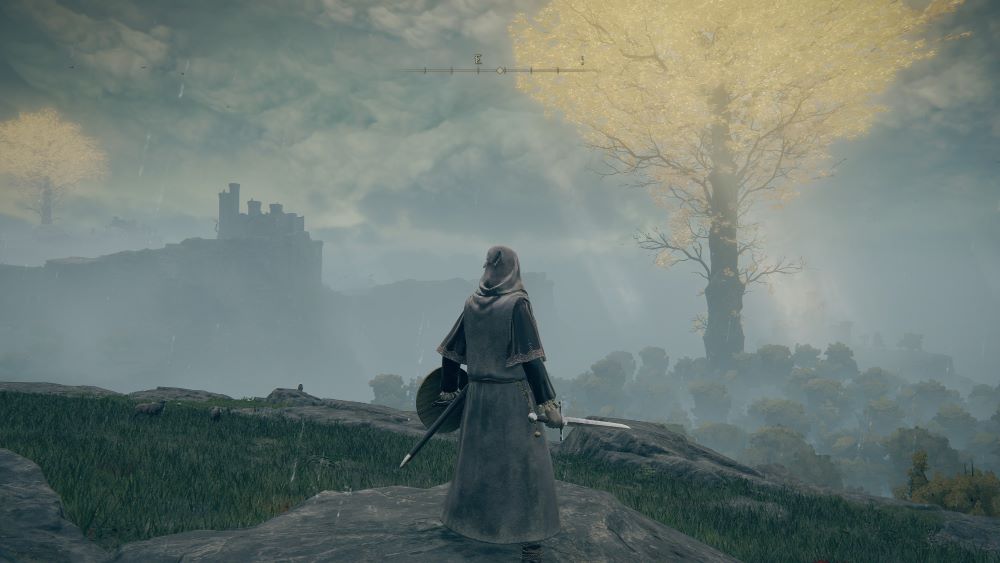
I do not necessarily want to rehash everything about Elden Ring, as you probably have already heard loads about it. As of May 2023, Elden Ring has sold over 20.5 million copies, which made it the second best-selling game in all of 2022 (with Call of Duty taking the top spot). This is truly a stupendous achievement considering the type of game FromSoftware makes and where the Dark Souls series has come from. Although, yeah, this isn’t a Dark Souls game per se.
The overall formula has been shaken up quite a bit. Yeah, combat is still super tough, requiring patience, precise reflexes, and usually trial-and-error. Death still results in all your souls runes dropping on the floor and you possibly losing them if you die before picking them back up. You still level up in a deeply unsatisfying way, raising stats one at a time and getting vague bonuses on even vaguer secondary stats you will probably never actually use at any point in the game.
At the same time, the game feels entirely different. Dark Souls offered freedom of a sort once you got to the first main area, but nothing like Elden Ring. After unlocking three bonfires Sites of Grace, you get a double-jumping magical horse that you can call at a whim and even engage enemies while mounted. As a spellcaster, there is essentially zero downside for me to not be mounted 100% of the time. Your foes can knock you off the horse, but the mounted shenanigans fundamentally change how I approach open-world combat. I never felt comfortable just running past everything in Dark Souls, but here? Anything you actually engage is on purpose.
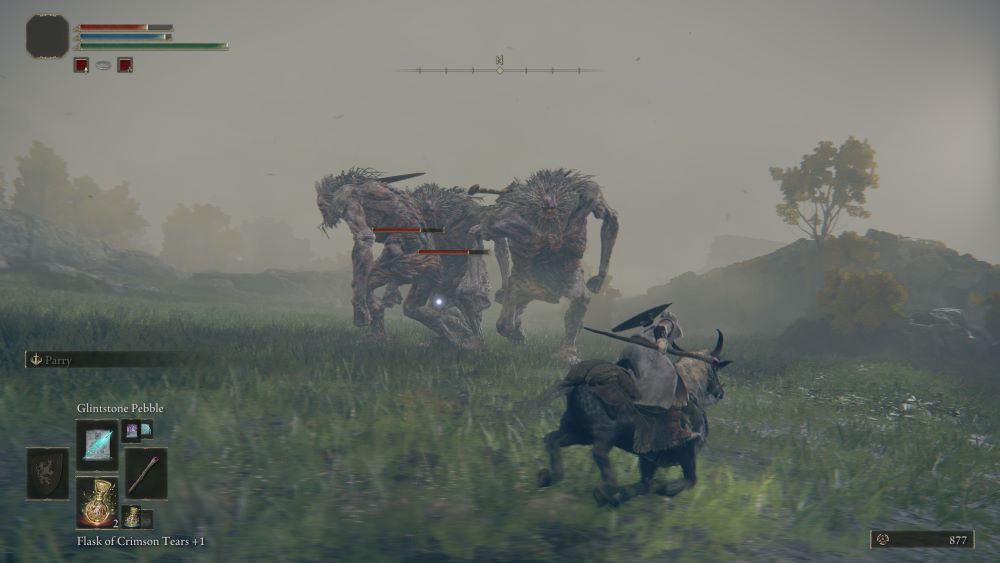
Amusingly, there are even pseudo-stealth mechanics at play. Clicking the left-stick (these games demand a controller IMO) will cause your character to crouch, and there’s even a tutorial screen about hiding in tall grass. Again, you could backstab mobs sometimes in Dark Souls, but it typically only occurred during combat after they missed an attack, or with certain mob pathing. Now, you can practically Solid Snake your way through many areas, up to and including firing arrows at walls to make enemies turn around and investigate the sound.
I also appreciate that combat feels a lot… tighter? And more gamey at the same time? Dodge rolling is super important as always, but unlike in Dark Souls, I actually saw several times where my character clearly was hit by a sword or whatever but I had i-frames and thus took no damage. Enemy attacks seem to be telegraphed a bit better, or at least it feels that way.
At the same time, some of the weaknesses of the Dark Souls series are amplified in Elden Ring.
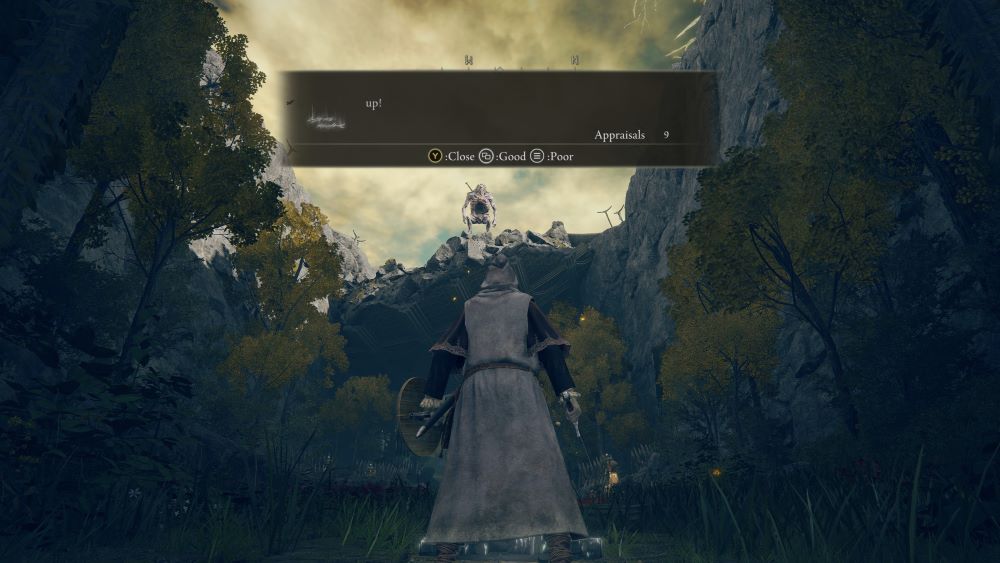
I already mentioned leveling feeling unrewarding, but exploration (thus far) feels both encouraged and kinda punished. Caves act as Skyrim-esque mini-dungeons, filled with enemies and traps, with a mini-boss at the end. If you are successful, you are accumulating runes that you will need to spend to level up or upgrade your gear, lest you lose them. But the freeform exploration means you can never really tell where anything is, or what you are building towards. Do you spend resources upgrading your starting gear, to help you in the encounters to come? What if the very next chest or body holds a vastly superior item? What are the Intelligence requirements for spells you find soon? Where the hell even is the Sorcerer trainer?
These known unknowns are part of the “mystique” of Dark Souls and certainly would sell a lot of game guides back in the 90s, but it’s all part of the sort of design bullshit I hate. I don’t need to be optimizing for the endgame from level 1, but I do need to feel confident that the devs aren’t being obtuse on purpose. Can you miss crucial game mechanics (Ashes of War) for not fully exploring one of the beginning camps? Yes. Could you technically get by without using them? Yes. Can you complete the entire game just using Glintstone Pebble? Yes.
Would this lead to a richer, more fulfilling gaming experience? No.
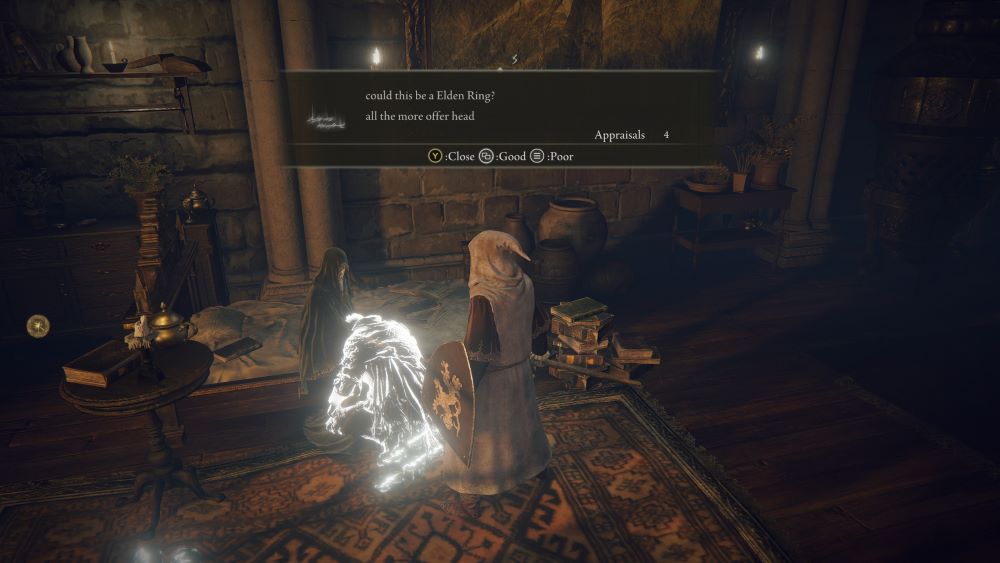
It’s a fine line to walk, I get it. It’s also useless to complain about degrees of hand-holding in a FromSoftware title… although they clearly do give way more hints with the “lines of grace” on the map (or having a map at all). But I bring all this up because the end result is that I hit up the Wiki or Youtube to get one minor frustration answered and end up seeing “How to become OP in the first 15 minutes without fighting a single enemy.” Which, cool, good job constructing your game in such a way that it rewards technique and mastery in learning routes. But also, WTF, mate? I’m over here playing Elden Ring like a standard videogame with progression when I clearly should have been running past every mob just yoinking all the upgrades off the ground from horseback.
I dunno, man. The problem is: when does that stop? When do you start “playing the game” and actually tackling bosses? I encountered one open-world mini-boss recently and got clobbered, even on horseback. The typical Souls solution is to Git Gud and/or farm some more levels. I did the latter, but also spent an hour riding around and getting two additional flasks plus one flask upgrade before coming back. Beat that mini-boss and was rewarded with… crap I’ll probably never use. Not quite as bad in some RPGs wherein you can out-level gear rewards entirely, but certainly not at all on par with how powerful I had become to beat the boss. That’s certainly a unique sort of freedom, but I don’t exactly want to praise the freedom to make the game experience worse for myself.
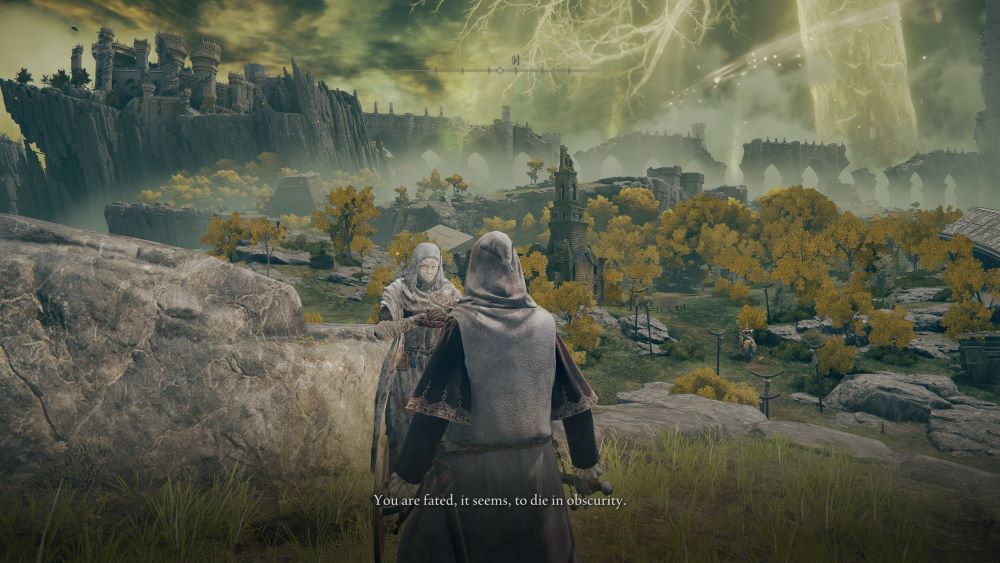
We’ll have to see where things go from here. I’m 15 hours in, zero major bosses down, still dithering in basically the first map of the game. Will things improve? Will it get worse in new ways? Who knows. If I’m casting the same two spells another 30 hours from now though, I’ll be very disappointed.
Meaningful Choices
In the comments to my last post, I got some pushback from stating Covenants in WoW “were choices in the same way stacking Crit vs Versatility is a choice: namely, choosing to be objectively correct or gimp your character in X or Y (or all) content.” Indeed, I believe that the proposed 9.1.5 patch changes that remove the Covenant-switching restrictions is something that should have existed from the beginning. Which, since some people forgot, it kinda did since you could freely change Covenants without friction outside of going back to one you previously “betrayed.” In that one scenario, you were limited to a once-a-week quest.
But let me go a bit further: I do not believe that “meaningful choices” can or ought to exist in MMOs.
What someone means by “meaningful choice” is critically important, of course. There is no one answer. For example, is a mutually exclusive choice always meaningful? Does a choice have to be permanent to be meaningful? Does a choice have to have lasting consequences (which is different than just being permanent) to be meaningful? Does a choice have to feel difficult to make to be meaningful?
I bring up these different dimensions of “meaning” because I sometimes feel that people fetishize Permanence in terms of choices. That if you can change something later, it must mean that the original choice itself didn’t matter. To them I say: Every Moment is a One-Time Event. Specs in WoW have been imminently changeable at the drop of a hat for many years. If you choose to not tank for a raid, that choice lasts only for as long as you want it to. But here’s the thing: the choice you made to not tank yesterday is permanent. You can’t go back in time and make a different choice for the Tuesday raid time. So… was the original decision a meaningful choice? If you were good at tanking, it certain was for everyone there.
Let’s bring this back specifically to WoW Covenants in Shadowlands. For those not playing along at home this expansion, there are four Covenants (i.e. factions) the player could choose to ally with at max level. During the leveling process, you got to do quests for each one and also play around with the unique Covenant abilities that each one offers – some are general abilities, and others are class-specific. Eventually, you have to choose a specific Covenant to champion and otherwise experience the rest of the expansion with.
Is picking a Covenant a meaningful choice?
As I wrote before, I would say No. Was it mutually exclusive? Yes, you can’t have more than one Covenant at a time. Were there consequences? Yes. Sort of. Covenants were swappable even before 9.1.5 but let’s not pretend there isn’t a significant time cost to essentially starting over with rebuilding a Sanctum, grinding Anima, and all the sort of nonsense daily quests one has to do. Plus, you lost access to any Transmog from the original Covenant. Was it permanent? Obviously not, but that would not have been the secret sauce if it was – instead of meaning, such a decision would have brought in frustration and betrayal.
Why? The Covenant abilities themselves are an extremely mixed bag. Sometimes they don’t matter, and other times they matter a whole hell of a lot. For example, if you are a PvP Priest, you want to be Venthyr for the Mindgames ability. Mindgames is one of the most unique CCs ever introduced to WoW, and I guarantee you that it will be brought forward into the next expansion as a Talent or even baseline ability. If you don’t PvP on your Priest character, then sure, your Covenant choice is more wide open. But if you ever thought you would, not picking Venthyr would be playing with a handicap.
On the PvE side, Night Fae is an attractive choice for Death Knights given it increases their mobility, which is otherwise the classical weakness of the class. However, Night Fae is extremely terrible for both Unholy DPS and Blood tanking. So your “choice” is between the optimal DPS/Tanking or improved quality of life. Explain to me again why it’s a good thing that we have to pick between the two.
Notice how none of the above considerations touch on the Covenants themselves: their theme, their plot, their aesthetics, their characters, or anything that actually makes them meaningful from a narrative standpoint. There are certainly players out there for whom Covenant theme is the number one consideration. Helistar said in the comments yesterday: “When I started Shadowlands it was obvious that my druid would be Night Fae, optimal choice or not.” That’s totally fine! Although… I have to ask the follow-up question: if it was so obvious from the start you were picking Night Fae, was the choice really meaningful to begin with?
If it seems as though I’m playing both side of the argument… I kinda am.
The real crux of my argument is this: the designers should not be going out of their way to “enforce” meaningful choices. In Diablo 2, you could not respec your character; in Diablo 3, you could swap your abilities around at almost any time. Was picking talents in Diablo 2 more meaningful? No! All it did was make me feel bad every time I leveled up, knowing I was always going to be 2-3 levels late to the actual good talents due to the dumb, blind decisions I made hours ago. That doesn’t feel meaningful.
Imagine if Blizzard designed Covenants such that Covenant abilities were interchangeable (and probably Soulbinds), but the Covenants themselves were not. Priests could have Mindgames but fight with the Kyrians. That sort of thing. Would that detract from the meaningfulness of the Covenant decision? Or would it… enhance it? I would unequivocally say the latter. Because WoW is an MMO where you could be spending 40 hours a week playing your character and not spend a second progressing whatever story exists. So for me, gameplay decisions and projected viability and optimization are my top priorities. And those things are largely math problems with clear, non-ambiguous answers.
In a hypothetical Shadowlands where Covenants had no particular gameplay impacts, suddenly that decision becomes meaningful. The choice more reflects who I choose to identify with, who I am as a person, who best reflects my values, and that’s a hell of a lot more meaningful than 2% DPS. It would certainly be closer to what I feel were the meaningful choices in, say, the Mass Effect series:
What the exchange highlighted to me though, was how squishy the venerable Sid Meier quote actually is.¹ To me, the choice between curing the Krogan genophage or deciding not to was interesting. In fact, I spent ten minutes or so agonizing over it when the dialog wheel was presented. Was it fair of us to cripple an entire species because we feared their hardiness and breeding speed? At first, I was worried about that hypothetical. Once the Reapers were gone, who is to say that the Krogans don’t simply out-breed and out-muscle the rest of us out of the universe? Then I thought: wait a minute, is this not the same sort of argument used against inter-racial marriages in the past, and even concerns about Islam today?
The genophage choice is definitely one that I felt was meaningful. It can say a lot about you as a person. Maybe the fact that Covenants primarily boil down to a numbers game to me still says something about my values, but I don’t think you can read much more into it other than sometimes 2% DPS actually matters. Rather, I would say that the meaningfulness of a choice in an MMO is directly disproportional to its gameplay effect. If you care about the numbers, then it really isn’t a choice; if you don’t care about the numbers, what are they doing there in the first place? Just remove the numbers.
Finally, for those still stubbornly sticking to their guns regarding “permanent choices are meaningful choices,” I say to you one word: alts. Nothing is permanent if you can have alts. So really it’s just a question of how many hours of hazing you want to require someone to go through to experience the other choice. Or just to potentially be viable in another subset of content.
Inflection Points
In Divinity: Original Sin, I have definitively hit an inflection point in terms of character power. And that is kind of a shame.
Basically, once you hit level 15 you can start learning “Master” level skills/spells. As one might expect, these can be extremely powerful. For example, one of them is Meteor Shower, which drops 30 little fireballs in a specific area, each of which can deal a few hundred points of damage apiece in addition to spread fire in the area. These powerful spells cost a lot of Action Points – generally meaning needing to wait around multiple turns to save up enough AP – and are limited to One-Per-Battle in terms of cooldowns.
The issue is that you can game the hell out of the system. The AP cost is entirely irrelevant if you happen to spot a group of enemies before engaging in combat, for example – AP only exists within combat, so go nuts for the alpha strike. Hell, I bring down the stars on even one dude, because why not? It’s always been powerful to initiate combat with a “free” spell, but up till now those spells didn’t necessarily gib your target.
Another of the Master level skills allows an Archer to fire 16 arrows in a 45-degree arc. Great for groups… or, you know, if you want to effectively one(16?)-shot bosses from point-blank range. Oh, and hey, there’s a low-level Ranged Power Shot skill that increases damage by 20% at the cost of accuracy. Which would normally be an issue if not for the fact that Arrow skills auto-hit as long as the target is in range.
MMO players will recognize this phenomenon as “Optimizing the fun out of the game.” As I have mentioned previously though, the optimizing process itself is what I find fun to begin with. And it has been pretty fun figuring this out. The problem is that the game is now “solved,” and I am in one of those positions at the end of a Civilization match where winning is a foregone conclusion, but for the long, tedious march to an official win condition.
I said this situation is a shame because I’m not so sure it was necessary. Up until this point, effective AoE in Divinity was actually decently limited. Yeah, there were combos and such that you could set up, e.g. dropping Oil in an area and then lighting it on fire. But none of it was enough to one-shot groups by itself. Hell, often those combos ended up being counter-productive. The Oil+Fire combo was good for setting people on fire, but the resulting smoke prevented targeted follow-up attacks until they moved out of the area.
This scenario sort of reminds me of Final Fantasy Tactics, when you are suddenly given an excessively OP party member (Orlandu) for basically no reason. The game was challenging up to that point, and considerably less so afterwards. Why? What was the designer reasoning?
Sometimes inflection points are inevitable. At the beginning of a game, your character’s options for skills and magic items are likely limited, so there might be less room for synergies. More options means more combos means more opportunities for OP results. Simply not giving anything new past a certain level isn’t a particularly good design, so the devs might actually be trapped in that regard.
And, hey, I’m not blind to the fact that it probably feels good, both as a player and as a designer, to reach the endgame and feel like a total badass. Every wizard dreams of the moment they go from shooting Magic Missiles into the darkness to altering the fabric of reality itself. This is why games like WoW end up giving you +5% upgrades each tier instead of a more measured 1% – anything less feels unrewarding.
The fundamental problem is that I found the Divinity combat system rewarding as-is. Even with good equipment, things felt dicey all the time. I’m sure that someone out there had a lot of fun going from dicey fights to forgone conclusion ones, but that person is not me. And I cannot help but wonder if it was necessary at all. If super-skills are necessary, do they need to be this particularly powerful? Why 30 meteors instead of, say, 10? That would still be a huge improvement over the standard Fireball spell.
In any case, I am continuing to play Divinity and hopefully wrap things up soon.
I Still Got It
I bought the Sky Golem I was talking about a few weeks ago, but my background plan hadn’t changed, e.g. creating my own. And yesterday, I finished:
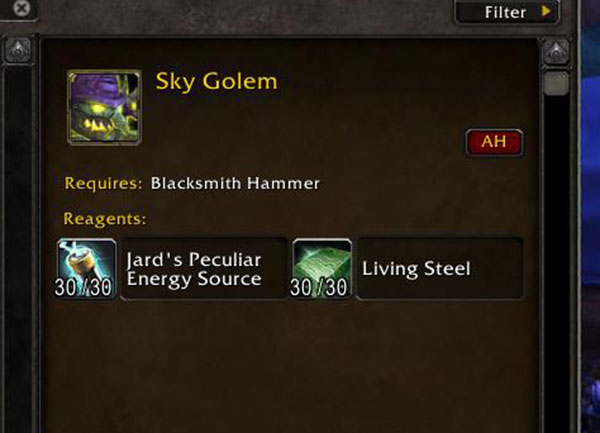
Success!
The current prices on Auch are in the 130k gold range, which would mean a significant recoupment on my original outlay of 85k.
There are, of course, some sunk costs in terms of materials: 300 bars of Ghost Iron on top of whatever 30 Living Steel cost to produce. However, 100% of my Living Steel came from shuffling Ghost Iron ore/bars by transmuting them into Trillium, then Trillium into Living Steel. Well, Trillium and a surprising secondary path: the no-cooldown Trillium + Spirit of Harmony transmute.
Throughout this side endeavor, I had been trying to liquidate some of my last-expansion mats and failing to do so. “This AH is dead.” Well… maybe not as much. After crafting and listing the Sky Golem, I threw the leftover Trillium I had for something like 550g a bar. The next day, I learned that they all sold. Huh. I checked the AH and now Trillium is sitting at 750g apiece. Someone is either trying to reset the market, or there is a spike in demand. Either way, it’s time for me to get in on this.
I check Ghost Iron Ore and note there are like 800+ on the AH for 15g apiece. That means 400 bars is 30g, or Trillium bars costing 300g apiece (not counting the extra Transmute Mastery procs). Even if they sell at 550g instead of the reset price, I’m in good shape.
So, I bought all the cheap ore. And then let out a heavy sigh on my smelter alt:

Yes, that’s 10 and a half minutes of AFK time.
After that completed, I checked the AH for Spirit of Harmony, in the off-chance I could profit off Living Steel. Incidentally, there were only four Living Steel on the AH, so I bought them all out and doubled the prices. Then I blankly stared at the screen for a moment:

For those of you who might not know, you can combine 10 Motes of Harmony into one Spirit of Harmony. And based on the number of people selling Motes, it seems many have forgot about this:
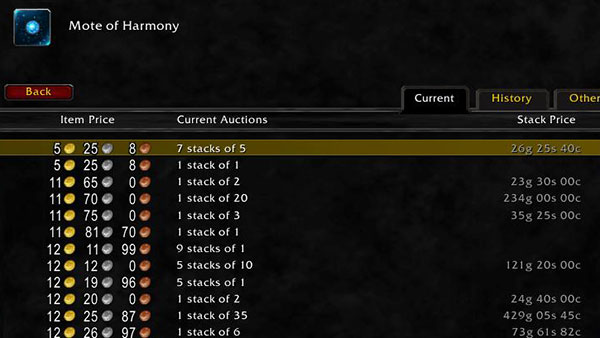
Like… I almost feel bad for that top seller. Did he or she not read the tooltip on the item before listing? I mean, okay, I’ll buy your 52g Spirits of Harmony, three of which take the place of three bars of Trillium in the Living Steel transmute.
Now, I fully recognize that not everything is going to sell here. It’s even possible nothing sells – I did pretty much dump 40 bars of Trillium on the AH. That said… this has been the most excited I have been about WoW in quite some time. Which isn’t to say that I have grown bored with the endgame just yet, but the machinations around trying to “optimize” the AH is a entirely novel experience to everything else. And I like it.
Things I’ve Learned About Myself via Fallout 4
I have been playing Fallout 4 pretty much non-stop since last Tuesday, and in that time I have started recognizing a few things about myself and how I play the game. These are not perhaps grand, personal epiphanies caused by Fallout 4 – I have certainly seen the seeds germinating in other games – but there is something about this game that is causing them to be more noticeable than normal.
Voice Acting Makes Characters a Character
Generally speaking, I do not role-play RPGs. By which I mean, I do not construct a character that looks like me, and I do not make decisions based on what I would personally do in that situation. If anything, I role-play the character I am playing as themselves, or whatever idealized form seems more narratively interesting. Which, I suppose, is still technically role-playing, but nevermind.
This predilection means I don’t actually like Fallout 3 or Fallout New Vegas all that much from a narrative standpoint. In Fallout 3, you are a blank slate, literally controlling your character from birth to presumably mold him/her into something resembling you IRL. Which, personally, just always seems like an easy way to skip writing a convincing narrative. “Let the reader fill in the details.”
The protagonist of New Vegas had a backstory, but the implementation was even more discordant, as I noted in my review:
I wasn’t protecting my home, my family, nor was I my own person. I was… the Courier, a stranger in familiar skin, following a past everyone knows about but me.
Fallout 4 reminds me of what I already implicitly knew from Mass Effect: voice acting makes all the difference. Even when you still have the difficult choices to make, a well-delivered line can leave you with an impression of a character, and that impression can serve as your guide to who they “really” are.
Is voice-acting appropriate in every game? No. Does its presence often lead to more railroaded plots (due to the costs of recording twice as many lines)? Yes. But as someone who would rather experience plot vicariously rather than directly, it makes Choose-Your-Own-Adventure style choices a lot more bearable. The characters will tell you who they are.
Even Implied Romance Options Forces Me into Guy-Mode
The first character I created in Fallout 4 was, of course, Azuriel. As in, the wife. Played through the tutorial and even got all the way into Concord before something occurred to me. Could you romance companions in this game? As it turns out, you can.
I immediately rerolled as a dude.
It is a completely ridiculous reaction, but it happens every time in every game where romance is possible. Well, with one exception that proved the rule: I played a lady dwarf in Dragon Age: Origins several years ago. And it was awkward as fuck. Not that romance in any videogame isn’t generally awkward, but there is just something… maybe not immersion-breaking per se, but something personally off-putting about it that I can’t get over. Which makes my reaction to Fallout 4’s version of romance even more ridiculous, since you can romance any gender as any gender. But there it is.
I do plan to play the wife on my next “only pistols, no Power Armor, Renegade” style run though.
Change (in Formula) is Good
For the longest time growing up, I never really understood why all the Final Fantasy games had to have such radically different battle systems each time. Wasn’t FF7 good enough? Innovation, refinement, and so on are all worthy goals, but when you hit a certain plateau of elegance, why not just keep doing that thing?
Well… because then you have Fallout 4’s systems.
I grokked the entirety of Fallout 4 within the first hour or so of playing. The same strategies I’ve committed to muscle memory after hundreds of hours of Fallout 3 and New Vegas were immediately successful. Loot guns, leave the armor. Peek around corner, VATS, hide until AP regenerates. Food > Stimpacks unless you’re pressed for time. If things get dicey, break out the Pip-Boy to stop time and organize your equipment. Shoot X enemies in the face, shoot Y enemies in the legs.
While the out-of-VATS gunplay is much, much improved compared to the prior titles, Fallout 4 is basically Fallout 3/New Vegas all over again. The same tricks work.
As someone who enjoys optimizing the fun out of games, this has left me in a weird spot. All the optimization is basically done. I spent a rather absurd amount of time looking over the Perk tree and trying to figure out the best way to navigate it, but it almost seems meaningless at this point; not only am I near level 30 (and thus am actually hunting for Perks to still take), most of the Perks aren’t actually that good. And even if they were, there is no level cap, so in a sense it doesn’t matter. If I’m going to optimize anything, it’ll have to be a much narrower field, like getting an OP character between levels 2-10 or something.
I feel like the Witcher series has steadily gotten worse from a mechanics standpoint with each iteration, but at least it was different each time. The changes gave me something to mull over and marinate in my mind. And it seems like being able to do that, even if the underlying mechanics end up being worse, is still better than not having to do it at all.
Legendary Items are a Bad Idea
To an extent, I am still conflicted on this point.
Legendary items are cool, generally, in any game they are in. Their rarity gives designers the chance to introduce abilities that might be too powerful to be added to random loot. Legendaries can also facilitate character builds, and thus encourage additional playthroughs. Legendaries are fun in Borderlands, Diablo 3, and Fallout 4.
Legendaries also remove entire categories of loot drops, replacing them with nothing.
In Fallout 4, I have been using the Overseer’s Guardian for the last 30 or so hours of gameplay. The only way I could replace this weapon is if I encounter an even more ridiculous weapon that trivializes the game more than the Overseer’s Guardian already does. Which is sad, because not only does this make all the weapon drops I’ve encountered vendor trash, but it actually discourages me from experimenting with anything new.
For example, I finally saw a Gauss Rifle on a vendor just yesterday. I always enjoy Gauss Rifles in Fallout – mainly due to how cool they were in the movie Eraser (holy shit, 1996?!) – but it “only” deals 125 damage baseline. Even if I could mod the rifle for more damage, it seems unlikely that it’ll beat 137 damage x2 from a semi-automatic sniper rifle. “Maybe I’ll see a Legendary Gauss Rifle drop.”
As soon as that thought formed in my mind, I began massaging my temples. After all, this is the same game that hands out weapons like this:
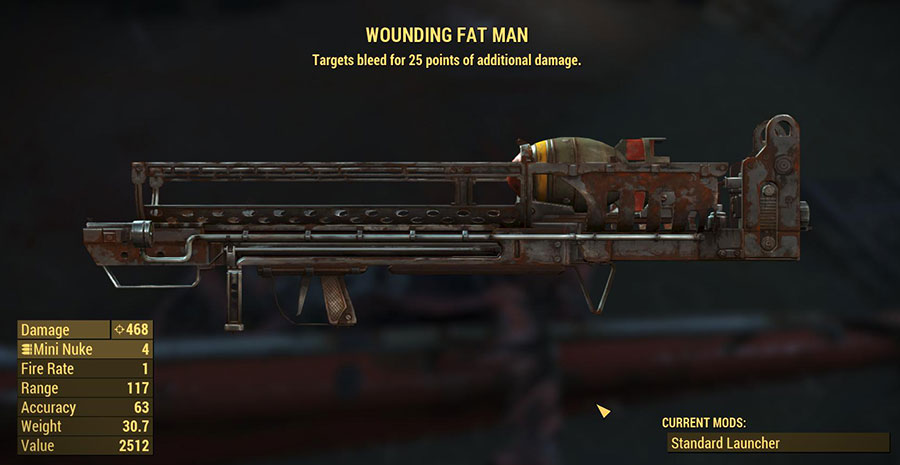
Guess it’s better than extra radiation damage.
Maybe I’m less conflicted than I thought. Legendaries are a bad idea, even if I enjoy the existence of Legendary mobs in Fallout 4. The latter fills holes in the gameplay, whereas the Legendaries they drop create them.
Cardboard Throne
Much as with the base game before it, I believe I’m done with Beyond Earth for now.
This is not to suggest that I believe Beyond Earth to be a bad Civ game. There are quite a few issues – some imbalances, some questionable design philosophies, etc – as pointed out in various Reddit threads dedicated to the game. However, it absolutely captures that whole addictive “I pressed End Turn for six hours in a row” part of the Civ experience. Even now, I’m getting the urge to boot it back up.
What is stopping me is the realization that what I like about the game and what the game actually does are two separate things.

It’s all downhill from here.
My favorite part of a Civ match is the beginning, when your strategy is largely formless, reactive, as you cast your eyes about an unknown and hostile world. “Okay, let’s scout out that island.” “Ooo, a city here would capture three strategic resources!” This feeling lasts maybe the first 100 turns, beyond which everything becomes a formality, a known, an inevitability. Yes, perhaps disaster strikes, perhaps you lose a city, perhaps an enemy Civ suddenly wins with a surprise victory condition. Nevertheless, you still know what you have to or should be doing at that point – it all just becomes the mechanical action of carrying it out.
All for what? The personal satisfaction of grinding the patience of a machine to dust? If Firaxis changed the Retire button to a No Longer Delay the Inevitable button, I would win the same amount of times with at least some in-game acknowledgment of the hours poured into the equivalent of a roguelike. Do I really need to conquer those last two capitals before the game is officially over? The game was arguably decided hours ago when I stopped exploring and building cities.
This sort of reminds me of when I used to be really into RTS games like Command & Conquer and Starcraft, up until I understood the concept of Actions Per Minute. Suddenly, the game I was hitherto playing was no longer. I could not unlearn how horribly inefficient my “build six Protoss Carriers” strategies were, nor how much better I could have been playing. The three aspects of gameplay were (still) entertaining – building bases, ordering units around, micromanaging one unit’s abilities specifically – but I both understood that I was incapable of engaging in more than one of them at a time, and not particularly motivated to try to get better. If you had time to turtle up to spam endgame units, you probably had time to win much earlier. Which means I was doing… what, exactly?
There is nothing necessarily wrong with enjoying a game outside of its intended purpose, but if the box brings more joy to the cat than the toy it contained, maybe you should just have bought a box instead. Or go find a better toy.
Like I said though, if Civ and Beyond Earth is your type of game, more power to you. I used to think it was mine. But now that I see myself sitting upon a virtual throne of cardboard boxes, I am not quite sure what to think. Other than maybe I should go play something else.
Worst of All Worlds
A few days ago Tobold made what seemed to be a reasonable argument that F2P games are just like cell phone plans – some plans work better than others depending on how much you use the phone. That seems fine, until you realize that phone carriers typically give you a choice between subscriptions and buying minutes, even for the same phone model. But more than that, what I want to talk about is how/why I feel that F2P is always bad for me as a player.
I’m one of those people that derive pleasure from “optimizing the fun out of games.” Of course, I don’t actually see it as fun reduction at all; if anything, I get the most entertainment possible when I can lever the whole of my mind in opposition to the game designer. It is not that I want to discover the ultimate ability/gear combo to make the game trivial (most games have cheat codes, Save file hacks, etc), it is that I want the game to be difficult or deep enough to drive me to discover it using the tools the designer gave me. The optimization part is simply the nominal destination of a thoroughly engaging and fun journey getting there.
This brings me (back) to the topic of F2P. One of the common defenses of F2P is that it evens the playing field between the time-rich and the people with limited time. Frankly, I feel that is bullshit right off the bat. One of the hallmarks of a fair game is everyone playing by consistent rules – if I have to kill 1000 boars, everyone has to kill 1000 boars. If killing that many boars takes 15 hours, then yes, someone who can spent 15 hours a day playing the game will have an “advantage” over someone who can only play two hours.¹ Then again, a particularly skillful player might be able to figure out how to kill the required number of boars in only 10 hours, perhaps by optimizing his/her equipment, farming strategy, and/or ability rotation. The “time-rich” player might still have the “advantage,” but their brute-force approach is inefficient.
The typical F2P experience is thus the worst of all possible worlds for players like myself. I am both time and money “rich” (i.e. I have disposable income), which already presents uncomfortable gaming decisions on a daily basis. If you have no money or no time, the solution to any F2P problem is pretty obvious: grind it out or pay to skip the grind. Conversely, those of us who can do both are stuck rationalizing every possible decision all the time. “Do I grind for another 2 hours, or do I just spend the $5?” Maybe the default should be pay-to-skip in that scenario, but what about all the other games you could be purchasing with that same $5? Is “saving” two hours in one game worth purchasing a different game that could last you 20 hours by itself?
The real kicker though is the fact that F2P more or less invalidates any real sense of optimization. All of us already know that the most efficient move in a F2P game is to load up on XP potions, convert cash into in-game currency to clean out the AH, and open lockboxes all day until we have everything of any value. There is no possible way to beat that. “Just figure out the most efficient path without spending money.” Playing with an artificial handicap is simply not as engaging to me. You can technically increase the difficulty of a FPS by decreasing your mouse sensitivity, but that will never feel as satisfying as having more intelligent opponents.
Where I agree with Tobold is that F2P is here to stay. Outside of the CoDs and Battlefields and Counter-Strikes of the world, I’m not sure many multiplayer games could exist on their own in sustainable numbers. Astute readers will also know that I have been playing PlanetSide 2 for 230+ hours now and that’s a F2P game. Then again, I also spent over $100 in Ps2 thus far, including being “subscribed” for the last six consecutive months (efficiency, yo). Not to mention how I bought helmets and camo for my characters almost entirely because of the extremely slight advantage that they bring (arguably P2W).
I am not against F2P games on principal, it’s just that they quite literally cannot be as fun to me as they could be. I play these games to submerge myself in their fiction. Being constantly reminded that for the low, low price of $4.99 I could have X, Y, and Z not only breaks the immersion and puts a price tag on my hitherto priceless time, it also serves as a reminder that the solution to every problem is just a credit card away.
¹ Advantage is in scare-quotes because I don’t recognize an advantage as being “playing the same game more.”
 In An Age
Autobivalence
Oct 14
Posted by Azuriel
I have a love/hate relationship with automation games, like Factorio, Dyson Sphere Program, Satisfactory, and others.
On the one hand, they mostly satisfy the survival-adjacent itch of accumulating resources, building a “base,” and otherwise growing stronger each play session. Any game where you can think about it offline and come back the next day and be better off for having pondered, is a huge win in my book. These games should be localized entirely within and up my alley.
I also hate them.
Long-term readers know that I very frequently engage in “optimizing the fun” out of the games I play. There are two corrections to make here. First, “optimizing the fun” is a strange way of rephrasing “leveraging my full mind towards achieving success.” By no means am I implying that I’m some genius or whatever, but I do enjoy not having to handicap myself in Perk/Skill/Talent/Strategy selection because the designers left in some obviously OP power. If a given move is powerful, I’m going to utilize it, even if the game is less fun as a result… because the game is already less fun if I have to ignore imbalanced shit. Looking at a list of available choices and finding the surprising synergies of given combinations is precisely the fun I’m looking for. Optimization is fun.
However, this is where the second correction comes in: I dislike trial-and-error, e.g. reinventing the wheel, e.g. the grunt work. This is where all the automation games lose me. While it is technically optimization, I do not find it at all fun or engaging to spend hours rearranging conveyer belts to increase production by 5% or whatever. That’s assuming I would even know how to make things better, which I honestly do not. Indeed, it irks me every time in these games’ tech trees when Blueprints are unlocked, as it confers the assumption any of my macaroni factory art is worth copy & pasting. But I also know that just copying the perfected blueprints of others would “rob” me of a lot of the gameplay of these titles. So… I usually just struggle, flail about, recognize I’m not having fun, and uninstall.
Having said that, I am playing Satisfactory in 4-hour increments every evening for the past few days.
I was playing Dyson Sphere Program (DSP) a few days before that, as I saw that it was leaving Game Pass and so I wanted to give it a whirl. While DSP was fun enough, it really reminded me a lot of Factorio which I had bounced off of. Conversely, Satisfactory improves (IMO) a lot on the general formula. For one thing, the “tech tree” unlocks by consuming regular items rather than abstracted science cubes. The actual tech unlocks are are immediately grokkable too, like a faster conveyer belt, new building, unlocked resource, or whatever. In DSP, I would research 5-6 things in a row without actually understanding what (if anything) they did or how it would impact my factory until later.
The main thing though is that I “cheated” in Satisfactory. More specifically, I watched a Youtube series on compact, scalable blueprints of various buildings. I’m assuming someone out there would consider that cheating. But here’s the thing: it actually unlocked the game for me. I have heard of things like “main bus” and “manifold” and similar jargon before, but all that did was make me feel as though there was a secret language that everyone was just supposed to know. After watching the series of Youtube videos and recreating them inside the game, I understood. Even better, the designs weren’t 100% efficient. Which meant I had a choice: sacrificing Efficiency for Quality of Life (i.e. simplicity).
That’s the secret about optimization: it’s always in relation to something else. Maximum widgets/min? Sure, there’s one answer to that. The most widgets/min while also maintaining your sanity and/or having fun? Something something Sid Meier interesting decisions!
Anyway, I’m at 30 hours in Satisfactory and counting. There are some elements I’m not too fond of – it’s hard to justify exploring the map before you spend dozens of hours setting up a factory to output stuff in your absence – but overall it has been surprisingly… satisfactory.
Posted in Commentary
Comments Off on Autobivalence
Tags: Automation, Blueprint, Dyson Sphere Project, Factorio, Optimization, Satisfactory