Blog Archives
The Early Starfield Reviews Are In
To be clear, I have not played Starfield – the Game Pass version is not out yet. However, there is a Reddit megathread with many of the top review sites linked. Verdict? Mostly good. Ish. A fewer big outlets like GameSpot, PC Gamer, and IGN have given it 7/10 scores though.
One common complaint about the game is the disjointedness of fast travel. There are 1,000 planets to land on in the game, but the actual landing bit is a cut-scene and/or menu prompt.
At first, this seemed like a silly complaint to me, especially when people compared it to No Man’s Sky. Yes, there is an element of fidelity to the simulation in NMS when you fly towards a planet, break through the atmosphere, and then choose to land literally wherever. But that is something they have to incorporate because the fundamental gameplay is so repetitive and shallow. If you could just instantly warp to a Point of Interest, you would “consume” everything it had to offer within 30 seconds and then be done with all the, e.g. language unlocks in an afternoon. Heading back out into space feels good, yes, but its function is padding.
The criticism harder to shake off is when the reviewers point out how segmented exploration gets vis-a-vis fast travel. You may have seen this Skyrim meme before:

That is absolutely something that happened to me while playing Skyrim. Or the times you are just wandering around and stumble across a faction fight, or bandit camp, or whatever else. There are bandit camps in Starfield, and (presumably) faction fights, and other similar events. But the nature of the game would appear to make these things less organic. They just appear on the planet menu. And so I can see how that could become an issue with some people, and possibly myself.
That said… we’ll see. I have always been a proponent of flying in MMOs despite that encouraging the exact behavior I was describing, e.g. drop in and drop out gameplay. I don’t necessarily feel the need for the NMS flying around if the destinations and Points of Interest are themselves are a worthy goal. And if planet exploration is just the equivalent of driving around with the Mako in Mass Effect, we can… just not do that.
Again, time will tell. I have been looking forward to Starfield for a long time and I love sci-fi as a setting and Bethesda games in general. I’m not quite sure why they felt the need to add 1000 planets though.
Impression: Kingdom Come: Deliverance
It has actually been a while since I first started playing Kingdom Come: Deliverance (KC:D), but in that time I have put in around 50 hours. I am not certain that I will put in any more time to complete the game, but figured I would go ahead and dedicate some virtual real estate to my experience.
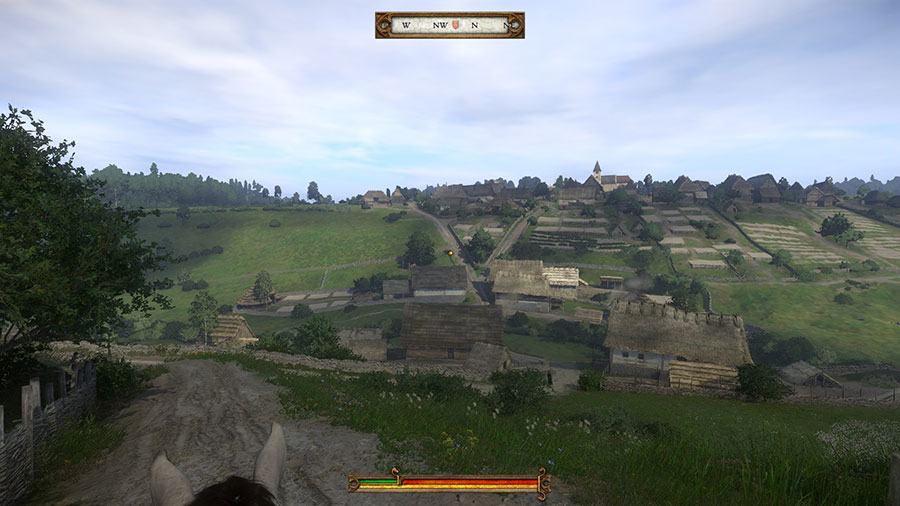
In short, KC:D is for a very specific type of player. And I’m not it.
There are a lot of things to like about the game. Visually stunning. Novel setting and premise, insofar as it’s a no-magic, no-hero medieval adventure. Immersive without needing quotes – first-person perspective in which you can see your feet, helmets getting in the way, walking (or riding) through the muck and rain. Arbitrarily hardcore, even at the expense of fun… which some people enjoy.
Again, I’m not one of them. Or maybe I can be, but not entirely this particular flavor.
The best example is with the combat. You have probably encountered dozens of variations of “you start out as an illiterate blacksmith’s son with no combat experience, OF COURSE combat is hard at first!” I mean, yes and no. Yes in that you start off as a level 1 character with literally no skills or points to put them in until you get XP. No in that the combat system is still trash at max level, as you typically just perform the same moves you have been doing the whole time, except this time you have enough skill points for shit to matter. That’s about as realistic as World of Warcraft or literally any RPG ever made. Except here you are still stuck stabbing faces (lest you be unbeatably countered) while waiting for your opponents to attack (so you can unbeatably counter them).
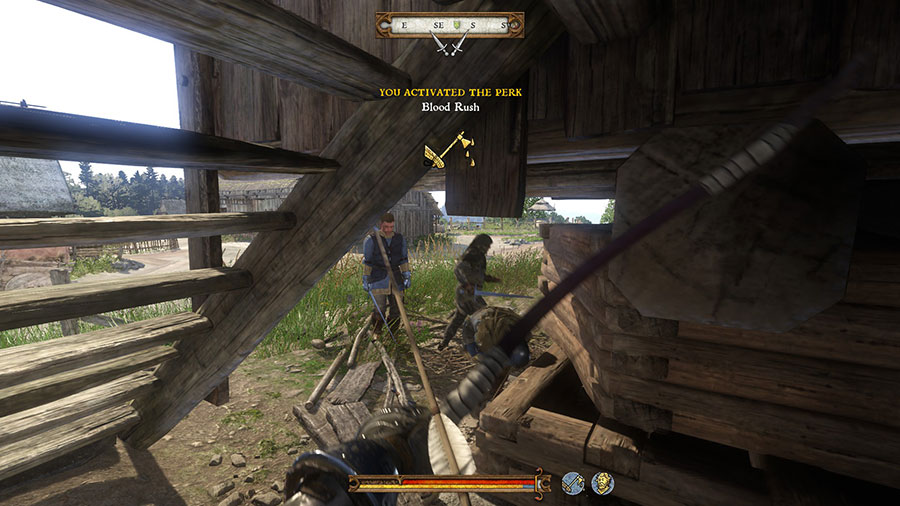
Oh, and occasionally you will be surrounded by peasants and murdered because lock-on targeting jank. Which is “realistic,” I guess. About as realistic as clipping through a bush or under some stairs and attacking back with impunity.
Another vaunted feature is the whole “the world goes on without you” bit. Example: if someone asks you to meet them tomorrow at sunrise at the crossroads, they will simply go on without you if you don’t show. REALISM. Except… that doesn’t always happen. Some quests will wait for you for months, including Crossroads Boy before you talk to him. Which is handy when you unexpectedly get locked up in jail for in-game weeks after attacking sleeping bandits who were scripted to ambush you, but apparently count as innocent villagers when you pre-murder them.
Which, philosophically, well… huh. Morally though, I think I’d feel worse if the voice of god had not automatically whispered my witness-less deeds to every guard in the kingdom.
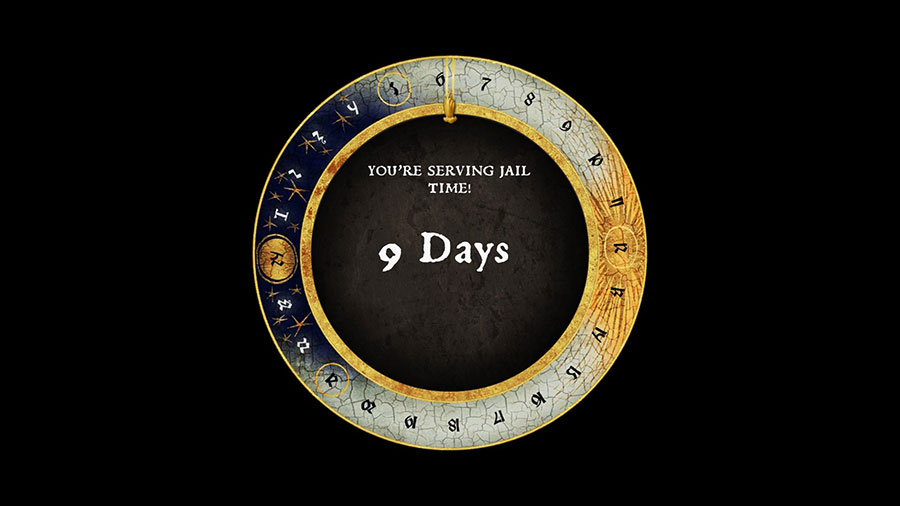
But, real talk, are you the type of player who is fine permanently failing quests you did not realize were timed? I’m not. Which means I had to do a lot of Googling on every upcoming quest to figure out when I was “allowed” to go explore the game and when I was locked on rails lest I run out the invisible clock. One of the biggest failings of the Witcher 3’s story (IMO) was a false sense of urgency with the primary quest, which made the overall impetus for action a joke. But Kingdom Come: Deliverance’s seemingly random adherence to the clock feels worse in practice.
Most RPGs do the false sense of urgency thing. But most RPGs don’t try to present themselves as some kind of immersive sim either. I don’t hold a Final Fantasy to the same sort of standard, even if the fate of the world is supposedly at stake.
At the end of all that, I still put in 50+ hours, so that’s saying something. I did not encounter TOO many bugs beyond some combat jank. I did lose probably around 4 total hours of progress to the asinine saving system, which involves you needing to manually drink some liqueur. There are mods to fix that (and other issues) but I could not be bothered to manually install them. Instead, I simply stole everything not bolted down from everyone I could to pay for my Quick Save addiction, which was still not good enough to prevent me from losing progress in dumb ways (e.g. peasant dog-piles).
If you’re looking for Skyrim 2.0, Kingdom Come: Deliverance is not it. But it’s also not the worst thing in the world. Just go into it knowing a lot of systems are obtuse on purpose, and not always because it’s good game design.
Nevertheless, sometimes the novelty of brazzeness counts for more than you think.
Crafting is Required
Divinity: Original Sin 2 (DOS2) has a terrible crafting system.
At first, I felt like this was okay. Crafting in the original game was often a bit overpowered, such that most of the time you were better off crafting upgrades than you were trying to loot them. This was a problem in Skyrim too, which I talked about back in 2012:
Short of the sandbox-esque nuclear option of destroying gear and/or permanent durability loss, I do not see a worthy payout for the costs of strong player crafting. I just completed a long questline to reconstruct a 1,000+ year old amulet whose power started a war and led to it being split into three parts and sealed away; the names of amulet keepers were to be forgotten under the pain of death. After finally reforging it, I held it in my hands and… oh, +30 to Health/Mana/Stamina? I created an amulet with +67 to Health and +40% extra Bow damage nearly 50 hours ago.
/vendor
I am not sure any game has gotten the craft vs loot tension correct. If the best items come from looting, players are incentivized to kill things for loot and ignore crafting. If the best items are crafted, players craft them and don’t care about killing stuff. Sometimes you can make hard enemies drop exclusive crafting material instead of loot, but that’s just loot with extra steps.
The problem is when game designers decide to have a weak crafting system, then seed their game with thousands of random pieces of debris. There is shit everywhere in DOS2: flowers, mushrooms, plates, cups, parchment, individual keys that exist forever for some reason, nails, hammers, and so on and so forth. Well over 90% of it is completely useless, despite it being integral to some crafting recipe or another. The existence of these items and your ability to interact with them is an invitation to their collection. Which, ultimately, just serves to pad game time and make inventory management a chore. It’s all a designer trap, outside maybe 2-3 arrow/scroll recipes.
So why not just get rid of crafting, if it’s going to be nigh-useless? Well… what are they going to do with all these cups and silverware so meticulously seeded on every table? Seems as though if you want interactable widgets, you need a crafting system of some kind to justify it. We’re well past the Metal Gear Solid 2 days when breaking single wine bottles or watching ice melt was an innovation.
Just because it’s an RPG doesn’t mean you have to be able to pick up all the things. But you damn well better have a useful reason to pick stuff up, if you allow it. Which makes crafting required.
Impressions: The Elder Scrolls Online
Over the past few days, I played around 10-15 hours of The Elder Scrolls Online (TESO) and the experience has been… odd. I say “odd” because while in general I found the experience pleasant, the more I played the game, the more I wanted to be playing something else entirely.
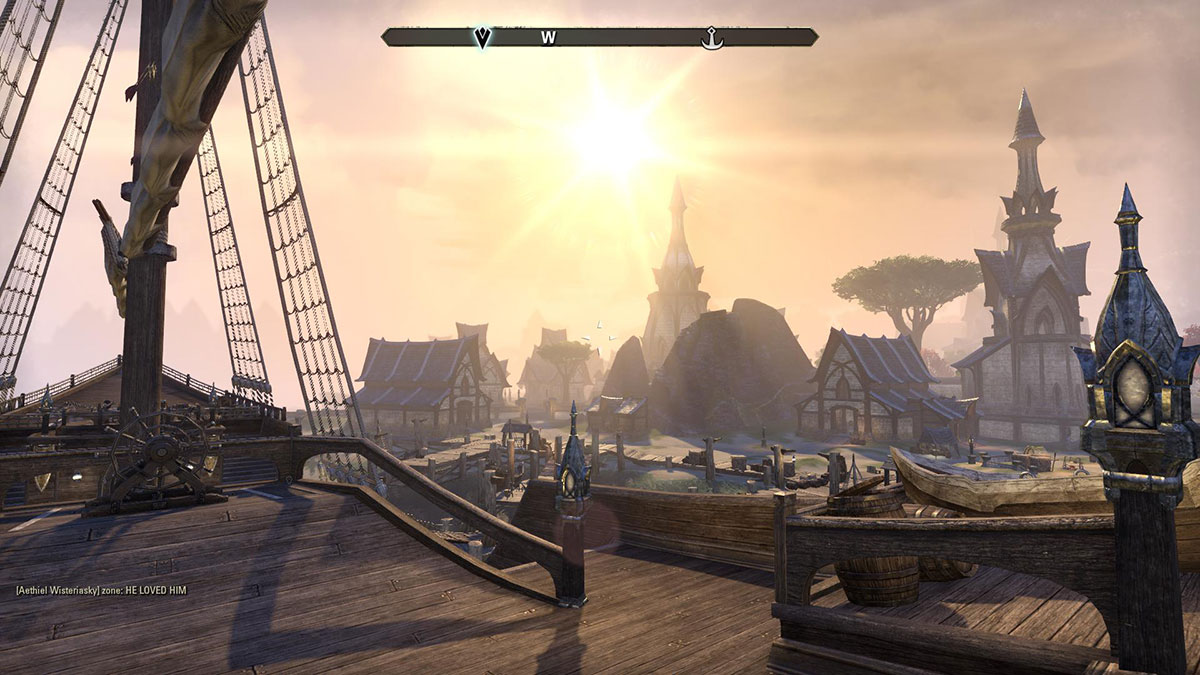
I’m pretty spoiled by my 970 card at this point.
There is a lot of interesting things going on in TESO. For example, while there is an option for a more traditional 3rd-person perspective, I stayed in first-person the entire time for its sheer novelty. I also appreciated the dedication to the traditional Elder Scrolls trappings, up to and including the ability to literally steal all the things. Want some Grand Soul Gems as a level 3 character? Just crouch behind the merchant’s cart and pocket (?) them. Finding a random armor rack with a full suit of wearable armor that you could just take and equip was rather delightful.
The progression/leveling system in TESO is interesting as well. There are four classes, each with three class specializations. Beyond that, every class has access to the same dozen or so general specialization lines: Light Armor, Two-handed Weapons, Destruction Staves, and so on. Most of these specialization lines have ~6 active abilities and a number of passives. Your character has a total of five hotbar buttons and one ultimate, and it is up to you to mix and match. Additionally, individual abilities level up with use in typical Elder Scrolls fashion, but once an active ability hits rank 4, it can be “morphed” into one of two mutually exclusive options, which typically adds bonus effects.
While all of the above systems felt satisfyingly crunchy, it reminded me heavily of Guild War 2’s system – limited ability slots, choosing abilities from a wide list, earning Skill Points from exploration (every three Skyshards found in TESO grants 1 Skill Point), and even “leveling up” skills in a sense. In fact, that was my exact problem: the more I played TESO, the more I felt like I’d be having more fun playing GW2. Especially when I started thinking about PvP and three-way battles.
Hell, I’m resisting the almost overpowering urge to redownload GW2 right now.
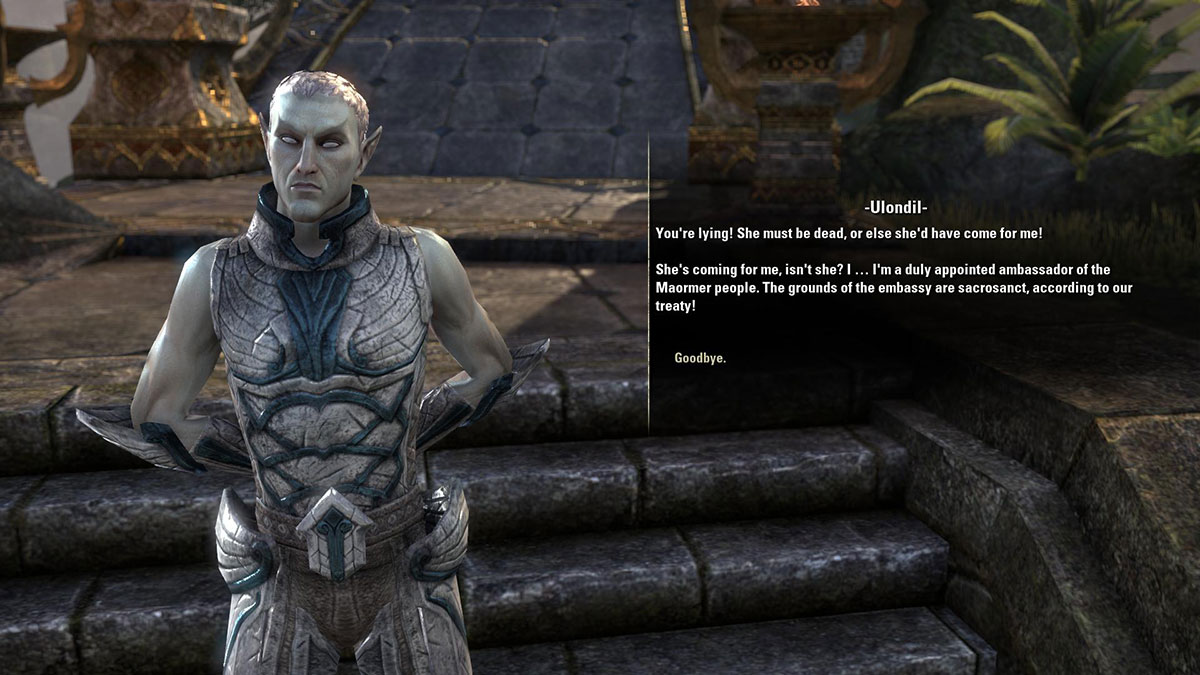
Not pictured: any combat.
Strictly viewing TESO as a sort of pseudo-Skyrim did not assist in keeping my interest level high enough to justify more play time. As tends to be the case, the existence of other players ruins the MMO experience. Apparently mobs drop individual loot so there isn’t any kill stealing, but objects in the world (chests, etc) absolutely disappear if someone loots them. I did not stick around a particular place long enough to see if they respawned, but the bottom line is that there was never a point in time that I was thankful to see another human playing “my” game.
It’s worth noting that I made it to level 10 without seeing even one “kill 10 whatever” quests. In fact, many of the (non-side) quests I encountered were fairly lengthy and involved. Not quite Secret World-level involved, but more than the industry standard. That being said, I found myself actually missing those kill quests, as the opportunity to kill anything was rather muted.
Sometimes I like pushing buttons, you know?
In any case, those are my impressions of TESO. I deleted the 44gb installation yesterday and don’t particularly see myself downloading it again. It wasn’t bad – at least the little slice of the beginning I played – but my New Years resolution is to not play “just OK” games to completion as if I don’t have a backlog of potentially amazing games to play through.
On Mods
As you may as heard, Valve’s grand experiment with paid Skyrim mods debuted and shut down in three business days. At one point the untouchable darlings reddit, both Gabe and Skyrim itself has taken a huge beating in the eyes of the horde; Skyrim went from a 98% positive feedback rating on Steam down to 86%. Gabe confirmed that the number of emails his staff received will cost them literally $1 million to comb through.¹
From my seat up in the peanut gallery, the entire issue of paid mods seemed to be a solution in search of a problem. Was there some crisis in the modding community preventing mods from being developed? Were popular mods being abandoned? What, exactly, was the issue with the status quo?
To be clear, I’m not against people getting paid for their work, in the same way I’m not against, say, religious liberty. At the same time, I don’t think the concept in of itself justifies every means of expressing it. The modding scene was already a healthy ecosystem built upon passion, collaboration, and natural curation. SynCaine points out there are some mods out there more elaborate and fun than the game they’re built upon. Just imagine how many more, better mods would be generated if said people were paid for their work?
Well… err, maybe eventually.
The Skyrim paid mod section was not active for long, but the future cesspit of theft and profiteering was clear to see. Who looked at Steam Greenlight or Early Access and thought, hey, let’s introduce that to the modding community? Under a paid mod paradigm, you literally can’t give your mod away for free, because someone else can and will turn around and try to sell it for cash.
During Gabe’s AMA on reddit, the creator of the Nexus website point-blank asked what Valve was planning on doing in terms of, you know, not single-handedly monopolizing the modding market. Gabe had no real answer. Which is a problem considering paid Steam mods would give even ambivalent modders every economic incentive to pull their mods from Nexus and any other site to exclusively use Steam Workshop. I mean, what, is Nexus and all the other sites supposed to suddenly create their own mod marketplaces?
With the paid mods plan on ice (for the moment), there has been some further crying about how “freeloaders” and “trolls” have won the day. Out of the entire fiasco, that sentiment bothers me the most. Erecting pay-walls around hitherto free content is an erosion of Consumer Surplus, full stop; it doesn’t matter whether modders “should” have been getting paid this entire time. Splintering the modding community into factions with negative incentive to cooperate is an erosion of Consumer Surplus. Maybe we get really well-done, professional mods out of the paid system eventually. But considering you are paying extra for that value, the Consumer Surplus gains may be a wash. In which case you are no better off than before, minus a thriving modding community.
Nevermind about all the bizarre arguments surrounding mods like DotA and Counter-Strike. Would those mods have achieved their meteoric status had they been priced “fairly” at the start? I don’t think anyone believes that that would be the case.
Do modders deserve to be paid for their work? Probably. Do I deserve to be paid for writing posts for the last four years? Feel free to Paypal me as much money you want. But as a consumer/reader, you are under no obligation, moral or ethical, to pay for something someone is giving away for free. And as a consumer/reader, you have every right to complain when your net Consumer Surplus is being reduced in any way. “Freeloaders” and “entitlement” are specious non-arguments, and especially absurd given how we’ll all talking about people who already bought a videogame.
If you want to pay modders, there is nothing stopping you. As in, right now. Go for it. I’m sure their contact information is listed somewhere on the mod page. Just don’t pretend this change was anything less than a fundamental redesign of the entire concept of modding. Or that this particular implementation was at all going to work, logistically or conceptually. In fact, I doubt that it ever does, even when Valve comes back to “iterate” the process later on. And by “work,” I mean generate more value in the aggregate for gamers and (free) modders alike.
¹ As opposed to Support tickets, which no human ever reads.
Falling Behind the Curve
As you may have noticed in the sidebar and/or prior post, I have picked up Dragon Age: Inquisition. I have not played it as much as I should have been however, because it is the first PC game in which I’ve ran into a hardware wall.
I am still strategically turning settings down, but I’m talking about Medium settings and getting maybe 40 FPS on a good day. Yesterday, my gaming session was cut short by the game randomly diving down to a literal 4 FPS level every 30 seconds. I “solved” that issue by spending a long time on Youtube weeding through arcane practices, many of which sounded suspiciously similar to “blow on the dice to make them roll high” from D&D players. One of the suggestions was to turn off FRAPS and other FPS counters; I was, of course, unable to ascertain whether it actually worked or if things ran better because I was unable to actually tell how bad it was running.
In any of these sort of situations, I come back to my experience with Skyrim. Basically, if your game doesn’t look as good as Skyrim on my machine, that’s your fault. Perhaps it’s not entirely fair to have that as a benchmark – I do notice a lot more NPCs milling about in Inquisition – but I still end up questioning whether my rig is truly outdated or if the designers got lazy with the PC optimization.
Regardless, my Inquisition FPS woes motivated me to start looking at weak points in my gaming rig:
- i5-2500K Processor (4x 3.30GHz/6MB L3 Cache)
- 8 GB [4 GB X2] DDR3-1600
- NVIDIA GeForce GTX 560 Ti – 1GB – EVGA Superclocked – Core: 900MHz
Now, I’ve heard a lot of people talk about getting GTX 970 cards recently, so I figured that my ole 560ti might finally have been gotten to its obsolescence phase. On the other hand, I am not about to spend $300+ on a new graphics card either. What I want slash need is a way of determining the price points of various GTX cards in terms that I can understand.
For example, while I like this chart, it doesn’t really tell me much:

Again with the numbers.
Actually, the chart did tell me quite a bit, as I was very seriously considering the GTX 750ti because bigger numbers equals better, right? I would have been quite pissed at that $100+ purchase for the tiniest of gains, let me tell you. But off-hand, I have no idea what 20,000 more… units translates into FPS terms. Eyeballing PCPartPicker.com shows that a 760 costs $170, the 770 is $260, and the 780 sits at $283. Which is a little weird considering the performance increase on the chart, and the fact that the rest of the 780s on the list are north of $400, above even the the 970s.
What ended up further confusing me is the fact that YouTube videos like this one exist. For the click averse, the title is “Battlefield Hardline ULTRA SETTINGS – NVIDIA GeForce GTX 560TI 1GB DDR5 @ AMD A-10 6800k 4.30Ghz.” And it looks like it runs okay, although there is no framerate counter in the corner. So… what gives? I’m pretty sure I wasn’t playing BF4 on Ultra on my rig. I think the person might have been playing at a lower resolution than 1920×1080, but would that make that big of a difference? I’m pretty used to 1080p at this point though, and am not sure I want to give it up even if it magically fixed all my problems.
From my research on the processor side of things, I have heard that the i5-2500K is still pretty pimp as far as things go. I did verify the speed at 3.3ghz, which means it has not been overclocked. I basically know nothing about overclocking other than what I have read on the internet, so I’m not sure whether that is an avenue worth exploring versus the risk of my machine bursting into flame. Then again, it is liquid cooled, so… yeah.
What this post boils down to is this: I’m open to any suggestions. It could be Inquisition settings, GTX card comparisons (I’m sticking with Nvidia), overclocking guides if that would actually help, and so on. As it stands, it’s still early enough in Inquisition that I likely won’t miss much by turning down settings before I get too invested in my characters actually looking good, but I’d prefer that they do. I mean, come on, Far Cry 3 and Tomb Raider and Titanfall looked fucking fantastic. Why can’t Inquisition? Bah.
[Fake Edit]: I did end up finding this site that compared Inquisition FPS on Ultra settings across multiple cards. The short version is that the 760 gets 30, 770 has 39, and the 780 hits 45. The 750ti is the closest equivalent to my own card, and it eked out 22 FPS. Which, let me tell you, is not indicative of in-game FPS at all at Ultra settings. Still, at least I have some sense of scale now. Will I spend hundreds of dollars on a new card to get 8 more frames per second? Well, I don’t actually need Ultra settings, so hopefully that 8 multiplies out a bit on, you know, High settings or whatever.
Revisiting Single-Player MMOs
Keen has a post up entitled “MMORPGs are not Single-player Games,” which laments the direction MMOs are heading as evidenced by The Elder Scrolls Online having a 100% solo “main story.” I am not particularly interested in talking about TESO, but rather this paragraph (emphasis mine):
If it’s so important to your game that the player be the hero in the story, why are you making a MMO? MMO’s suck at being single-player games. Did you skip SWTOR? What makes MMO’s any good at all are the multiplayer elements. Take those away and what are you left with? A game worse than the one you could have made if you actually made a single-player RPG.
Well… do MMOs suck at being single-player games?
It may be easy to answer in the affirmative, and in some respects I would agree. Undoubtedly there are concessions made in an MMO that are irrelevant in a single-player RPG. Daily quests, for example, exist as “content” to get people to log on at regular intervals and maintain social ties. The related notion of paced content (i.e. weekly resets) is also an MMO staple that makes no particular single-player sense. Even normal quests are likely more generic (and numerous) than they would have to be.
But in a very real sense I consider the average MMORPG these days as a much better single-player game than the average RPG. There are two main reasons why.
1) The gameplay is often more satisfying, for longer.
The example I used in Keen’s comment section was The Witcher. Here is a 3rd-person action-RPG game with hotbars and talents and exploration and quests and so on. Basically, a mini-MMO, if you will. As I detailed in my review, The Witcher’s combat system is terrible. Way worse than even Warhammer Online’s janky PvE gameplay. While I considered the storyline/setting to be somewhat of a redeeming factor, it could very well be that something like The Secret World or World of Darkness (assuming that is still a thing) or some other MMO eclipses it even within its own specific niche.
I would never agree with someone who would suggest that stories in RPGs are irrelevant, but let us be honest here: most of your RPG hours are spent in combat. RPGs don’t necessarily need gameplay deep enough to last 1000 hours because the story runs out in 40-100 hours, of course. But there is nothing worse than getting stranded 2/3rds of the way through an otherwise good story with gameplay that has ran out of steam. MMO combat systems, even the ones that feel “off,” convey a depth far beyond the average RPG. They have to.
Keen responded with “length isn’t related to quality,” which is true enough in a general sense. After a while though, one must admit that voluntarily playing the same game for 1000+ hours is perhaps indicative that fun is being had. I would not trade Xenogears’ 80 hours for WoW’s 7800 hours, or for the rest of my Top 10 RPGs for that matter. But for the Top #11-#120?
Absolutely.
2) Show & Tell enhances the single-player experience.
I truly believe that Show & Tell is the future of single-player gaming. If you are not familiar with the concept as I use it, this quote (from a year ago) sums it up:
In this light, I do not particularly think the trend of companion AI or whatever is necessarily bad. Having played Minecraft for a while now, I have reached that plateau where you want nothing more than to show off the cool biodome tower you built or the Pit of Doom you dug or the cross-Atlantic powered railroad to someone, anyone else capable of appreciating the amount of effort/vision it took to do so. Of course, the thought of trying to do what I have done on a multiplayer server where anyone could wreck my house and steal my materials at any time is mortifying. I want a Show & Tell, not a group assignment. I want a single-player MMO.
Repetition is required for communities – people are more asocial in LFD precisely because you aren’t going to see anyone again (unless you have a ranking system, of course). We can, however, condense the process via Show & Tell. What this means in a general sense is instead of blooming into a flower in front of others over time, you do hours and hours of blooming beforehand and invite others into your garden. […]
But that’s just it: players generally have a preternatural desire to express themselves any way they can. Player housing would not be about having somewhere to chill out waiting for a LFD queue, or even arranging your trophies and armor sets in aesthetically pleasing ways. It would be about designing and decorating a virtual space for others to look at. You already know the meaning behind that piece of gear that’s been sitting in your bank for the last four years. Other people don’t know, and deep down I believe it is a common human desire for said object or achievement to be recognized and acknowledged as something meaningful.
Show & Tell can be (and has been) implemented in bad ways. I am not a huge fan of arbitrary Achievements, for example, and I think focusing on the latest gear rewards is a bit crass. Transmog and costume options, on the other hand, are much better. Being able to invite you in to see my living room skull pit in Skyrim?
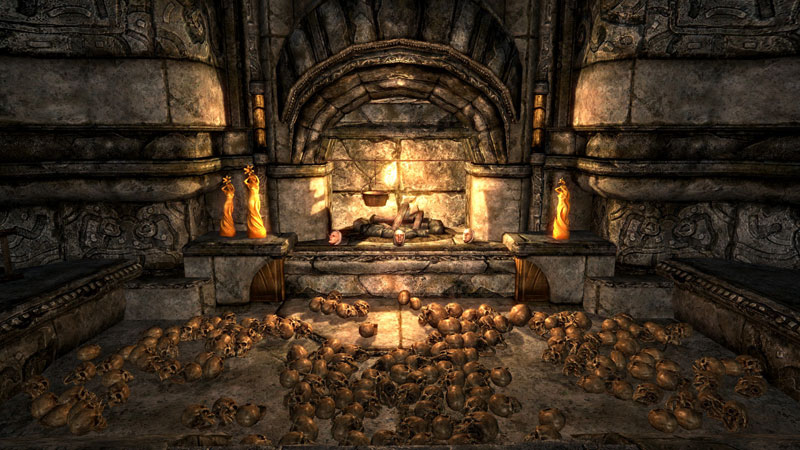
166 Human skulls. All legitimately obtained, I might add.
Would have been epic. The mere possibility of being able to eventually post the above screenshot, and having someone able to appreciate it on some level somewhere, generated dozens of hours of additional gameplay. In a single-player game. MMOs generate gameplay in this fashion all the time, of course, and I am here to confirm that it works for single-player games too. And, by extension, MMOs that are played as single-player games.
______
So getting back to the question at the top, I say: MMOs can (and often do) make excellent single-player games.
Keen openly wondered why this “mystery demographic” is getting catered to by MMO developers at the expense of “MMO identity.” I would say: where is the mystery? The vast majority of MMO players today are single-player MMO, erm, players. Less than 20% of WoW players raid; what are the other 80% doing? How many EVE players never make it out of high-sec space or never engage in consensual PvP? When you look at graphs like this:
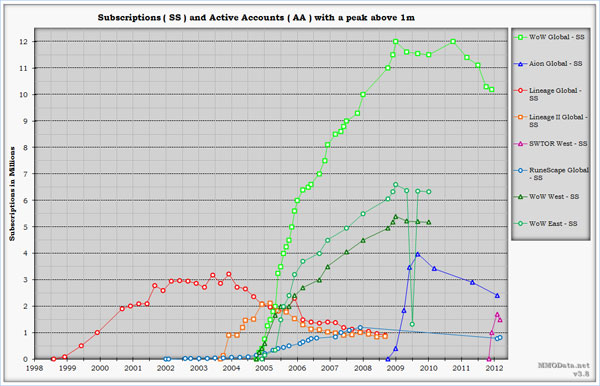
This technically qualifies as a Rorschach test in six states and the District of Columbia.
…what do you see? Did 5+ million social MMO players crawl out of the woodwork in a single year? I don’t think so. Rather, Blizzard tapped into the latent single-player market by letting said players solo at their own pace all the way to the level cap. That was Blizzard’s biggest innovation.
Are social players more valuable to the long-term success of MMOs? Absolutely. Can studios focus exclusively on such players, ala Darkfall etc? Of course. But in so doing they leave literally millions of dollars on the table. And so the reason we see a “dilution” in the MMO identity is precisely because developers are seeking out the most profitable piece of that Venn Diagram – the intersection of single-player and MMO – by trial and error writ large.
The age of single-player MMOs has arrived. And for the majority of gamers, this is good news.
The Problem With Romance
I normally play female characters in videogames despite being a guy in real life. Part of the reason is I find women more aesthetically pleasing. Part of the reason is cold pragmatism – if there is no strict game difference, why not choose the gender that typically gives you ability to seduce NPCs, receive gifts/attention from others (in MMOs), and otherwise get the door held open?
The biggest part though, is that I find female characters inherently more interesting. A man is always expected to prove himself, both in games and real life. A man is supposed to stand up for himself, supposed to be the embodiment of chivalry, supposed to fight and die for what he believes in. Simply put, a man is expected to “be a man.”
Generally speaking, women are not expected to do such things. Oh, they are expected to quite a number of other things, sure. But to fight and kill and die? When I see a female character putting herself on the front lines, I always subconsciously wonder what it was in her life that drove her to that point. A tragic past? Is she striving to be the son her father wanted? Righteous vengeance? Men fight dragons and bandits and each other because it’s required, expected. Women fight those things out of choice. And choice is what makes stories interesting.
The problem I am increasingly running into is not really feeling comfortable with RPG romances, playing as a female toon. For example, my machinations trying to get Alistair from Dragon Age: Origins in the sack as a female dwarf was perhaps the most embarrassing moment in videogaming for me. Partly because Christ, do I have to draw him a picture?, and partly because I expected Chris Hansen to walk out of the bushes in the middle of the cinematic.

"Why don't you have a seat right over there."
And, well, having to help him [highlight to reveal spoiler] marry one chick and get a second one pregnant [/spoiler] wasn’t exactly the most inspiring of endings. Guys can be such assholes.
Simply skipping the romances is not an option: as I established yesterday, missing content of any nature is difficult enough for me. But more than just that, this is a issue for me because I also genuinely enjoy this “optional” content – deep, philosophical ruminations and high school-esque relationship angst hold equal (if not more) appeal. I live a mostly vicarious life; no deeper psychoanalysis required.
So what ends up happening, even in games wherein lesbian romances are possible, I end up playing a dude. In fact, my first character in Skyrim was a level 4 female Redguard before starting over once I realized there was marriage options… even though the “romance” consisted of 3-4 lines of text and one event. Hence, Leonidas.
In any event, I am curious to know how other people handle game romances. Do you ever play the opposite gender and hit up those romance options? Is it totally not a problem? I am also curious as to whether men have more of an issue with this than women. My default assumption is yes, based both on cultural norms and simply the history of gaming wherein most main characters are male and rescuing princess love interests. I could be completely wrong.
Either way, let me know in the comments.
The Interview
I have perhaps the biggest interview of my life tomorrow – the kind of interview you spend $300 flying up to Chicago wearing a suit to attend – so it may be a few days before I get back to armchair game development. In commemoration of my finally “beating” Skyrim at 117 hours /played, please enjoy these Photoshops I threw together in the meantime.
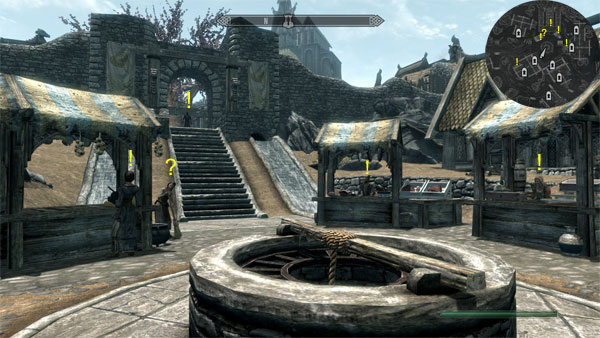
Just another round of dailies in Whiterun.
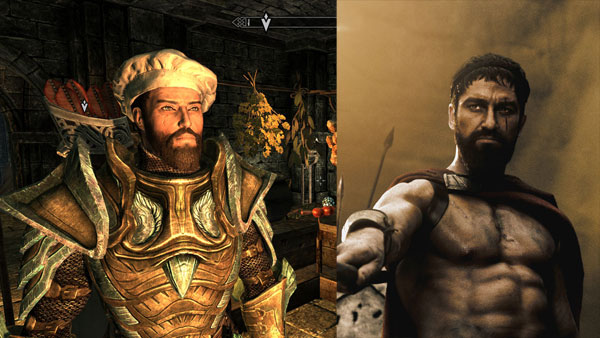
Introducing Gourmet Chef Leonidas.
I had intended to post Leonidas’ daily adventures when I first started, but that turned out to require spending time writing/’shoping when I could have been playing.
I still may put Leonidas to bed, so to speak, and there will be a formal review, of course. Beyond that though, I want need to wash my hands of Skyrim and move on with my life. Mass Effect 3 is coming, and I want to play ME2 before the spoilers get too ubiquitous.
 In An Age
Avowed – Veneer Off
Mar 3
Posted by Azuriel
I have added another 16 hours into Avowed (total: 32), clearing the entire second zone. And while some of what I reported earlier is still accurate – traversal is fun! – the game’s veneer is definitely rubbing off.
Combat, which hitherto has been fun, is now very rote. For the first half of the second zone, I respecced into a Ranger gun build and almost ended up abandoning the game entirely. There was… just no buttons to press. Sure, Ranger has a sort of vines CC ability, but aside from that, it was power attacks from pistols and nothing else to actively press. Technically I could have grabbed some more active buttons from Wizard as well, but Ranger is the only real splash-class, and trying to elevate your Intellect stat to the point where spells are relevant is a fool’s errand without just being a Wizard.
During the last half of the zone, I went into Fighter, first with a 2H weapon focus and then 1H with shield. Fighter had some more buttons to press – including a very satisfying Charge – and was a more dynamic experience overall with the Parry mechanic and blocking. The issue is that the DPS was just not really there. Avowed loves to throw groups of 5+ enemies at you, which is understandable considering Rangers/Wizards will nearly one-shot most of them from range in the opening salvo. As a Fighter, it’s not satisfying at all spending all your Stamina trying to block/dodge so many enemies. Although you do have two squad mates to help spread aggro around, the reality is that so do Rangers/Wizards, and those classes can actually eliminate enemies quickly. Which technically goes against the “gameplay” of Fighter, as if things die before you get into Parry chains or full attack combos, a lot of the Fighter-based weapons are useless. Which they are anyway, since they don’t kill quickly.
The other major issue that I glossed over previously was the world in general and interactivity in particular. Avowed is not Skyrim. Which is fine, most games aren’t. But as a first-person fantasy game that came out 14 years after Skyrim, Avowed is incredibly static. NPCs barely move (if ever), there is no world reactivity, there is no “stealing,” and every object out in the world is bolted onto the floor, aside from some breakable crates. To be fair, this is more an intellectual criticism, as I hardly noticed anything amiss in-game. But now that I have, I see signs of a Hollywood set everywhere. Which might have been fine, if this were not a fantasy RPG released in 2025 for $70 MSRP.
The final thing that is really dragging me down is the upgrade system and Unique weapons. I have been playing the game “as intended” when it comes to looting and experimenting, but have come to find out that the devs punish that playstyle. For one thing, all the respeccing I have done required me to upgrade several weapons that, oops, I am no longer using. Then I found out that all unique weapons in the world scale to the highest upgraded weapon you own at the time of pickup. What this means is that if the best weapon you have is Fine (blue quality), all the uniques you discover will be Fine. However, if you funnel all your upgrades into one particular weapon and get it to Exceptional (purple), those same uniques would have been Exceptional. And this works all the way into Superb (red) and Legendary.
Do you like exploring the map and picking up things organically, doing a few upgrades here and there? Punished! Because now if you decide to go with another weapon or playstyle, you will need to double (or more) the upgrade materials required to level them up. Which, let me remind you, is very necessary because weapons and armor get a debuff if they are more than a few “tiers” below the enemies you are facing. Also, remember that enemies and money is finite in this game, so it is very possible to just screw yourself and be locked into something that is no longer fun.
Which might just be the entire game itself for me, at the moment.
I don’t know, guys. Not everything I play needs to be Game of the Year material; lord knows I play plenty of trashy survival games for hundreds of hours. But, truly, Avowed feels like a game that would have been really great… in 2015. Or maybe 2010. Obsidian is not Bethesda, yes. But this also ain’t New Vegas. And between this and Outer Worlds, I’m thinking that Obsidian needs to stick to what they do best: iterating on the shoulders of better games, rather than trying to make their own.
Grounded was great though, so… ¯\_(ツ)_/¯
Posted in Commentary, Impressions
1 Comment
Tags: Avowed, Fallout: New Vegas, Game Design, Interactivity, Obsidian, Skyrim