Blog Archives
Republican Blues
You may or may not be following the sort of hand-wringing over the Black Market Auction House coming in Mists. Although I believe the sort of philosophical questions the BMAH raises are legitimate, I do not share Rohan’s (and others’) conclusions.
What I find amusing, though, is Zarhym’s rather tactless approach at community management:
No one should count on this even being close to a viable option for gearing up a character. If you can raise that kind of gold in the game, you’re going to have much better success paying your way into raids for gear than hoping the right items appear for you in the black market AH (which doesn’t include set pieces), hoping you can afford to outbid everyone else on your realm, and hoping you’re the last one to bid before the auction ends.
Sure, it’ll have some of the best rewards for sale. But that doesn’t mean it’ll be remotely reliable for one person to gear up quickly. It’s the black market, after all. :)
Ultimately the system is going to benefit the extremely wealthy and the extremely lucky. But in all likelihood the benefits won’t at all be consistent, even for those who can pony up the gold. (source)
Yes, because god only knows that what the extremely wealthy and extremely lucky need is more systematic benefits. And what a way to come right out and say “You can eat cake,” right? I can almost hear the argument on Fox News that goblins are the job-creators of Azeroth, giving millions of players the opportunity to pick tomatoes farm herbs and run dailies to afford their repair bills and marked-up enchants.
Kidding aside, I am not entirely sure why Blizzard does not simply come out and say “The BMAH is a gold sink. That is its sole purpose.” Prior gold sinks like the Mammoth and motorcycle and Vial of the Sands were fine, but pretty narrow in scope – they catered pretty exclusively to the Pimp My Ride crowd. The BMAH on the other hand hits everyone with a modular storefront filled with recycled content.
I anticipate the BMAH as being wildly, wildly successful at its unstated goal. As for whether the side-effects actually leave the realm of the hypothetical or not, we will presumably find out this Fall… or whenever the hell Mists goes Live.
Well, There is Always That
Remember that real-life interview I had back in February?
The selection process for the 2012 JET Program has now concluded. We regret to inform you that we are not able to offer you a position on the program this year. Please know that this decision is not a reflection on your personal qualifications, but on the nature of the JET Program selection process. As it is ever year, competition was stiff and the available positions were few, and unfortunately, many qualified applicants had to be turned down.
We hope you will reapply for the JET Program in the future and we wish you the best of luck.
So… yeah. Japan is a no-go.
I was a little ashamed that the realities of MMO gaming was a (small) thing I had thought about throughout the whole application process. People clearly play WoW from Australia and endure the cross-Pacific lag and whatnot, but it was a bit daunting to realize the likelihood that you would ever game with the same people again was effectively zero by the time differences alone.
Sure, there is always the chance that someone you hang out with in WoW or wherever can suddenly evaporate. There are dimensions to leaving the country though, that gave me some pause. Would Guild Wars 2 be playable over there? Could I even play Diablo 3’s single-player without lag? In a strange bit of coincidence, EVE was just localized in Japanese a week ago; perhaps it was would have been a sign?
Given those questions, I had not been thinking about upcoming MMO releases or even the current ones all that much. Would you even want to play a new MMO if you knew – for sure – you’d have to give it up in 2 months? Now that I know I will be sticking around, I suppose it is time to start looking towards a much more predictable future. A future that includes a lot more gaming than I necessarily expected.
And alcohol. Lots of alcohol.
Butchered
If you want to read a 4,079 word essay on the decline of WoW from the standpoint of two members of the sub-10% of raiders, you cannot go wrong with Failure, Challenge, and the Decline of WoW. If, instead, you were looking for a well-written, relevant essay on WoW’s “decline” exploring actual issues, don’t bother reading it at all. Stede in particular eviscerates the entire argument in a single comment.
What interested me about the essay is how so completely it falls into that utterly bizarre MMO difficulty trap – the sort of notion that MMOs should be social engineering experiments to create a generation of better gamers. The part that struck me the most was when they were talking about The Butcher from the original Diablo:
The best piece of low-level content ever created by Blizzard is found not in current WoW, nor even in old WoW, but 15 years ago in Diablo. The Butcher.
Every NPC in town warns you about The Butcher before your first trip into the dungeon. In case you didn’t bother talking to them, just outside the dungeon entrance you find the previous adventurer who tried to delve in, bloody and dying. Before killing your first mob, a villain is set up. The first half hour of dungeon crawling goes by uneventfully. But somewhere on the second level down, starting to get a little comfortable with your level 4 character, you come upon a small square room completely covered with blood. Maybe you remember the warning, maybe you didn’t, but in either case, it’s your first time playing and you want to know what’s in there, so you open the door. And you get Butchered.
This experience is hard to convey in text to people who’ve never played Diablo. Ask anyone who has if they remember their first time being killed by him. It’s sudden, surprising, and scary. It’s probably your first character death. He does a huge amount of damage, stuns you, and holds you in melee range. He has a loud yell the moment you open the door, an elaborate bloody apron, and a ridiculously-sized cleaver. You’re mostly likely dead before you take in everything that’s happening. And for some reason, it’s the one moment that makes everyone’s eyes briefly glass over in nostalgia.
Having played the original Diablo, I had the same experience of being mercilessly slaughtered by The Butcher. The essay goes on from this point to talk about Hogger, trying to tie both the experiences together while lamenting that Cataclysm and WoW in general has lost this dangerous feeling. The ironic part of these examples is that each were precisely designed to not be difficult. The Butcher was not supposed to be a difficult encounter, it was supposed to kill you. As the author(s) note, you probably had not died yet at this point in Diablo, so it behooves the game designers to set up unwinnable scenario to demonstrate what will happen when you overextend in the game proper. Same exact deal with Hogger: his purpose was demonstrate the difference between non-elite and Elite mobs. You were supposed to die. Neither were difficult in any meaningful sense of the term, and both simply encouraged you to grind mobs until you outleveled them as content.
The original Hogger.
Even Nils has recently demonstrated that the early game is designed to still kill you, Hogger or no Hogger. What gets confused by these challenge-seekers is that leveling was never designed to be challenging. The “kill you” moments or outdoor Elites that could be defeated through skillful actions were not designed to challenge your skill, they were to organically demonstrate how death and resurrection worked without resorting to instant-kill mechanics. And yet people lament the removal of the outdoor Elites near dungeons as if they were designed to spice up gameplay instead of marking territory out-of-bounds for solo players.
It is fine to desire content tailored to your skill level, as those authors so obviously want. But it always strikes me as bizarrely pompous to place said desire on a pedestal as if gamers becoming better at games is some kind of righteous calling, a form of high art compared to the Jersey Shore-ness of current WoW leveling. First, they were wrong about the purpose of early difficulty. But secondly, and more importantly, a high-difficulty paradigm actively destroys the social aspect of MMOs. If I want to experience hard raiding content but the friends that I made leveling up do not, I must abandon them. Read the comments from that article. For every “exclusive content through difficulty” proponent, there are at least two more people grateful that they can finally raid with their friends (until Firelands anyway).
In any event, the other half of the article talks about loot structures in MMOs, which is another post entirely. Suffice it to say, I disagree with them on that point as well.
Mobile AH Game Changer?
[Edit: I may or may not have been a bit premature. If the change below doesn’t auto-update the price as I assumed (in a sort of reverse-eBay bidder style), it merely matches the functionality of addons like Auctionator et tal. Apologies for the excitement, although if Blizzard continues down a road of making canceling/relisting easier, it could begin to cross over into premium competitive advantage.]
This is, by far, one of the most game changing features to the World of Warcraft AH I could ever imagine:
The iPhone World of Warcraft Mobile Armory has just been updated! Check out all the improvements we’ve included in the latest version:
- Automatic price undercutting: Set the default buyout price of your auctions to match or undercut the current lowest buyout price for an item.
- etc (source)
In one fell swoop, Blizzard has introduced a premium feature that simultaneously grants an unbeatable competitive advantage that destroys an entire economic methodology AND damn near makes AH botting obsolete. And possibly even entire addons. What am I talking about? I am talking about how AH barons can become immune to undercutting for $3/month. The simplicity and genius of it boggles my mind.
Just think about the glyph industry in WoW. The entirety of blog posts and guides devoted to becoming a captain of the glyph industry revolves around pushing other players out of the glyph market. Why? Because glyphs, by their very nature, are easy to create and have trivial listing fees. If I post a glyph for 200g and someone else lists the same glyph for 199g99s99c, I just lost that sale. In order to recapture it, I will have to cancel my undercut listing(s), collect the mail, and then go to AH and A) undercut the other guy by 1 copper, B) undercut deeply, or C) engage in economic/psychological PvP to drive this guy from the market.
Simply put, this changes everything. There are thousands of articles across the internet about setting up addons like Zero Auctions (etc) in creating Fallback prices and thresholds and so on, which this change completely invalidates. Toss your Glyph of X on the Mobile AH for 300g and set the threshold at 20g (or whatever). If someone pulls a 299g99s99c, they instantly get undercut by you. While they are spending time canceling, emptying the mailbox, and relisting, you are doing nothing. Relist goes up to 299g99s97c, automatically undercut again. There is no way to beat this. No longer will you be checking your glyphs 2-3 times a day, doing 12 hour posts, posting at 6 AM or other odd hours, emptying thousands of mails, etc. Assuming you set a sale threshold you are willing to accept, camping the AH as an economic strategy becomes obsolete. I am trying to come up with historical examples of strategies that have becomes this obsolete… and I am drawing a blank. Knights in full plate armor against the crossbow? Castles as defensive structures after gunpowder? Trench warfare after the invention of mustard gas?
One of the biggest reasons to NOT use the Mobile AH feature, aside from it costing $3/month, was how it was always more efficient and convenient to use your existing addons. While I do not think the Mobile AH is particularly well-suited for heavy AH usage interface-wise, the auto-undercut feature alone makes not using it impossible in an environment where anyone is. Forget glyphs for a second… what about gems or epics or other goods with non-insignificant deposit fees? I assume the auto-undercut feature will not charge you each time (that seems too large a trap for an unwary premium feature user), but if that is the case then you can literally bleed other stubborn goblins dry as they cancel and relist items with Xg deposits. Assuming the undercut logic is programmed well, you may not even need to care what the market price is for a good at all: just list everything starting at 300g and let it auto-adjust downwards for you.
The one negative implication – aside from people who forgo the app and to whom this entire announcement spells economic ruin – is when you get one or more persons with this app in the same market: without collusion, prices will automatically bottom out at the lowest threshold. Good news for the average player, of course, but bad news for anyone looking for margins that justify the crafting time. Then again, perhaps you could bait someone with this app into automatically bottoming out their prices, buying all the stock, and then relisting higher as they blithely go about enjoying their day in the knowledge that the app is doing their work for them. So perhaps some of the old strategies can still work…
In any case, this feels like a strange new economic world, my friends.
The Diminishing Returns of Fun
I was listening to an episode of The Instance (#242) today and was struck in a rather fundamental way by what they said in the Mailbag segment. So much so, that I went ahead and captured the 8 minute audio exchange and uploaded it to Youtube so it could be more easily accessed. The reader email question itself was rather asinine, but it elicited a (brief) discussion on how the playerbase of WoW has evolved over time. The evolution of the playerbase, or devolution as some say, has been a frequent whipping boy of forums posters and bloggers for ages – Blizzard dumbing down the game, catering to casuals, and so on.
The thing is, I firmly believe that the argument has always been backwards. Blizzard is not catering to casuals, they are desperately trying to retain that ever-sliding core of veterans. Blizzard is not shaping players, the players are shaping Blizzard. The rest is worth listening to, but I went ahead and transcribed the most important portion of that audio clip, spoken by Scott Johnson:
[Repeating content] is a distinct downside to MMOs in general, and it is why I really enjoy a cultivated experience like Diablo 3 – like the Elder Scrolls games, like I am expecting with Skyrim, like a lot of single-player RPGs – where the wonderment and the excitement and the newness is always present. Because, unless you are freak who plays games six times through for no reason, everything is new as you consume it. Whereas in World of Warcraft, and other MMOs like it, as much as Blizzard tries, and they do the best out there to make things SEEM as fresh as possible. After a while, like that Blood Beast fight… [snip]
But again, I’m kinda with him. This is why I don’t pug much. Because I find that so grindy and so not fun. What I want … if I’m going to do that stuff, I’ll do it with my friends because then THAT is the newness of the experience. Because we’re laughing, Manny said something funny, Pootinky made a fart noise, whatever. We’re having a ball in there. So THAT is fun for me. The actual pugging of the thing for the 5000th time is not fun for me at all in the least. It is just earning money, currency to go get something. And that’s fine, that’s working as a system. But I’m kinda with him that you lose that cultivated experience, you lose that wonderment of walking into a room for the first time, like walking into Ulduar and going “Holy crap! Look at where we have to go and how we have to get there.” And then after a while you are “Oh my gosh, Ulduar can suck it. I hate this fight.”
That is reason the “vanilla forever!” mindset never made sense to me, nor the appeal to nostalgia that was Cataclysm; as they say, you can never cross the same river twice. People like to imagine that if everything had stayed hard, they would not have gradually lost interest in the game. But think about your favorite games of all time. Are those games still fun for you today? Would they still be fun to you if you replayed them half a dozen times back-to-back? You can never recreate that original experience – the wonderment and newness is consumed in the act of experiencing it. And as much as I agree with Scott that Blizzard does a lot in trying to keep content fresh by constant iteration and new boss abilities (etc), at some point you understand on a fundamental level that the Ship of Theseus has sailed, so to speak.
The “catering” is not to casuals, but to the veterans who have reached the end of their original experience and who, through boredom or social ties, are looking for more things to do in-game to fill the time while they wait for schedules to align. But why would veterans actually want extremely fast leveling, faceroll dungeons, and so on? Some of that is actually trying to capture the 80-90% of players who never finish games, sure. But the things like Justice Points and LFD are firmly for the vets. Nils suggests that Blizzard uses “ease” as a weapon in the form of competitive advantage against other MMOs (or perhaps in response to others doing it). Or perhaps in reaction to player “entitlement.”¹ I would argue instead that fun in games has diminishing returns. Running across the entirety of Searing Gorge each time you wipe in BRD might have given you a healthy respect for safe pulling in your formative years, but I guarantee that you would be sick of it four or five years later if it was included everywhere. You learned that lesson, and reinforcing it constantly adds nothing of further value to your experience anymore than would repeating grade school as an adult.
Ultimately, I feel theme-park MMOs are their own worst enemy. Nils told me once that it was in my best interests for an MMO journey to last as long as possible. If I was purely fixated on the eradication of my free time, then sure. I played WoW for over 7000 hours as compared to Xenogears’ 80 hours. But I never once, for a single moment, felt that the magnitude of fun with the former came remotely close to matching the latter. In fact, as is the case with any novel or movie or TV series, the extreme danger is that efforts to elongate the experience instead poisons it². More becomes less. Instead of cultivating a complete experience with a beginning, middle, and end, the theme-park MMO model demands an open-endedness at odds with its progressive narrative.
Perhaps this is merely a sign that (theme-park) MMOs are not a genre meant for me. I do not think that is entirely true though. The genius of MMOs is that they appeal to and accommodate a huge variety of players with different interests – as vapid as questing seems to be to vets, it was actually an endearing experience the first (few) times. Instead, I think designers should embrace the end of their games, incorporating a more conclusive experience while leaving the door open for an encore. Or the after-party.
¹ Entitlement is a word so abused by bloggers and commenters that it has lost most of its meaning. Entitlement should not be synonymous with the expectation of a fair exchange of value. Nor should it denigrate legitimate instances of design criticism. It’s honestly getting to the point where you cannot say something is superfluous or inelegant without being accused of feeling “entitled” to, you know, better design.
² See: Lost, Rescue Me, every Terminator movie after T2, every Alien move after Alien 2, etc etc etc.
Paradox of Voice Acting
It’s fascinating to me reading this Kotaku article about how BioShock Infinite’s Actors Berated Each Other to the Point of Tears to Get the Scene. Although I would agree with some critics that Bioshock 1 was worlds better than Bioshock 2, I was already pretty excited about Bioshock Infinite from its first trailer (assuming I can actually play it on my PC). Seeing the lengths (depths?) the voice actors go through to paint a scene makes me want it more.
But then… how important is good voice acting to begin with?
Games have had voice acting for decades now, and I am not entirely sure I can even remember particularly good performances. Sure, bad voice acting tends to stand out, if only because it pulls us out of the narrative flow. But is that not the paradox of good or even amazing voice acting? The better the voice acting is, the less we remember it. This lies is stark contrast to amazing soundtracks which you tend to vividly recall.
Perhaps this is some sort of physiological thing insofar as in these games we are not concentrating on how well the actor sounds, but rather what sort of information they are conveying – we remember the words, the story, the way the narrative makes us feel, but we lose their voice in the process. And maybe that in itself, the ability of spoken words to immerse you in the narrative instead of jarring you out of it, is the mark of quality acting. That just seems… cosmically tragic, as opposed to how other forms of art usually work.
Honestly, I am trying to remember any of the voice acting in games I have played.
- “War… war never changes.” Fallout narrator.
- “James!” The wife of the protagonist of Silent Hill 2, but mainly for that one specific (but hidden) exclamation.
- Thrall and Aggra during the Call of the World-Shaman questline. The dialog is pretty bad (aside from Thrall’s Fire speech clips), but the emotion got through. In fact, Thrall’s voice acting and dialog during the Flame segment is the best I have heard in WoW and many other games.
- Well, I thought King Terenas’ acting was rather brilliant in WotLK’s intro and ending segments.
I am starting to wonder if I remember WoW’s actors more simply due to repetition than quality (although they have it too in the above examples); the Fallout narrator is the same from all the Fallouts, and each time he says that catchphrase. In any case do you typically remember quality voice acting in the games you play? Do you have favorites?
The F-Word
I was reading Stabs’ post about treasure hunting in Diablo 3, how the typical gold farmer strategies won’t work and so on, when I see Nils in the comments say:
While reading this something inside me cries out: “Why don’t you just try to have fun??”
You seem determined to optimize the fun out of it.
The first question that popped into my mind was “What if you find optimizing fun?” And Stabs replies:
@Nils Ah we’re getting back to the question, what is fun? All I can say is, for myself, I’m hyped that I’ll be able to play D3 for money, it was a game I’d have played heavily anyway, I’ve always loved theorycraft and numbercrunching, I have an encyclopedic knowledge of arcane D2 mechanics and I believe I’ll have an utter blast doing this.
I can’t really defend optimisation to someone who considers it not fun. I do suspect that you’re swimming against the tide.
If you listen to the PC Gamer podcast I linked you’ll hear them argue very persuasively that D3 is a game where everyone is a gold farmer but then go on to talk about how much fun it is to play. They’re not mutually exclusive.
I think the only fun I’ll intentionally sacrifice for optimisation is alting. I usually mess around with lots of different classes and builds when I get a new game. With this game I’ll be rushing to the end.
I have heard the phrase “optimize the fun out of it” from Nils and Tobold and others, and it was not until Stabs’ unapologetic response that I realized how asinine the phrase is to begin with. Optimization is fun. I am not going to hedge that with “can” or “to some people” because you have to fight stupid declarative statements with Objective (Self-) Truth. If you find optimization fun, then it is. Period. If you don’t like it tomorrow, then it is not fun, until such time that you change your mind again. If someone finds something different fun, they are wrong. Unless you agree with them. Is that not the implied premise in these fun discussions? Are we not justifying our favorite colors (red), flavors (peanut butter), or meals (taco salad)? I hate steak. Do I ask why people ruin their dinners with slabs of tough, bloody cow muscle? Of course not. And not just because I prefer taking a perfectly healthy salad and smothering it in greasy ground meat, nacho chips and sour cream.
I do not judge because I do not live in a solipsistic bizzaro-world where Fun is some objective Form straight out of the works of Plato. Have you read Gevlon at Greedy Goblin lately? He “refuses to nihilistically believe” that two people playing WoW can have different goals, motivations, desires. In a Battleground, he rages at the people fighting on the bridge instead of guarding a flag like he is; they are M&S (moron & slacker) for not winning in the most efficient manner. I was not aware winning was more important than having fun, but he covers that too by saying winning is the only way to have fun in the first place. I am not quite sure how he handles games like The Sims or Second Life – possibly you are M&S for not playing winnable games to begin with – but Nils, Gevlon, and Stabs all played WoW at some point in time so obviously someone was doing it wrong. Right?
The Dark Heart of the Matter
The underlying problem with “what is fun?” posts is not just because fun is a subjective thing. The underlying problem is that none of us can really be sure what fun even is to ourselves. That is, strictly speaking, an absurd statement. But the psychological fact of the matter is that human beings are damn near incapable of accurately predicting how they will feel in the future. Feel free to read along at home the article entitled The Futile Pursuit of Happiness. A choice excerpt:
Much of the work of Kahneman, Loewenstein, Gilbert and Wilson takes its cue from the concept of adaptation, a term psychologists have used since at least the 1950’s to refer to how we acclimate to changing circumstances. George Loewenstein sums up this human capacity as follows: ”Happiness is a signal that our brains use to motivate us to do certain things. And in the same way that our eye adapts to different levels of illumination, we’re designed to kind of go back to the happiness set point. Our brains are not trying to be happy. Our brains are trying to regulate us.” In this respect, the tendency toward adaptation suggests why the impact bias is so pervasive. As Tim Wilson says: ”We don’t realize how quickly we will adapt to a pleasurable event and make it the backdrop of our lives. When any event occurs to us, we make it ordinary. And through becoming ordinary, we lose our pleasure.”
It is easy to overlook something new and crucial in what Wilson is saying. Not that we invariably lose interest in bright and shiny things over time — this is a long-known trait — but that we’re generally unable to recognize that we adapt to new circumstances and therefore fail to incorporate this fact into our decisions. So, yes, we will adapt to the BMW and the plasma TV, since we adapt to virtually everything. But Wilson and Gilbert and others have shown that we seem unable to predict that we will adapt. Thus, when we find the pleasure derived from a thing diminishing, we move on to the next thing or event and almost certainly make another error of prediction, and then another, ad infinitum.
You can probably draw a line from that concept and connect it with Cognitive Dissonance, and especially the sub-set of that: Effort Justification. This is extremely relevant in MMO discussions about what is “fun” and what is not for what shall be readily apparent reasons:
Dissonance is aroused whenever individuals voluntarily engage in an unpleasant activity to achieve some desired goal. Dissonance can be reduced by exaggerating the desirability of the goal.
Oestrus from The Story of O and Nils from Nils’ MMO Blog both wrote about this dissonance in their (hopefully cynical) “What is fun?” articles. Both Nils and Oestreus argue (in effect) that fun is the resolving of the dissonance that is doing a long, arduous grind for an ultimately meaningless reward. After completion, you convince yourself that the journey was meaningful, and magically you retroactively have fun. Your brain does this because it refuses to believe that you could be so dumb to have spent all that time voluntarily being miserable, ergo the reward must have been worth it. And the sad thing is, this works. Nils even has a series of posts talking about how “great games enslave you,” not through riveting substance or fun activities (which is really salt that ruins the larger shit soup), but by pulling a Lucy and moving the football before you get to it, every goddamn time. I may be paraphrasing here.
In their defense, I do believe they are talking about great MMOs specifically, where “great” is defined as ones that keep you pressing levers for food pellets as long as humanly possible. It is the same definition of greatness, incidentally, that makes America’s Funniest Home Videos one of the greatest television shows of all time. Better than, you know, The Wire, The Sopranos, Dexter, etc etc.
On the Other Hand…
The good news is that your inevitable, happiness-based existential crisis may be unnecessary, and here is why: Think about your favorite games of all time. Now… were any of them MMOs? I am guessing no. For me, my favorite games are Xenogears, Final Fantasy 7, Final Fantasy Tactics, Chrono Trigger, Super Metroid, and so on. I quit playing WoW a few weeks ago after four years, and I have 7000+ hours logged; not only is that more time than I spent playing those listed games combined, it is probably more time than I played in the entire SNES era. And yet WoW will never occupy a place on my favorite game list. No doubt I had some memorial experiences, but the vast majority of those experiences were social ones that could have existed just as easily elsewhere, like in EQ, Rift, LotRO, Warhammer, etc etc. There was nothing specifically exclusive to WoW to merit associating the social triumphs with the quality of the game itself. Moreover, the very principals Nils attributes to “great” MMOs sours my memory of the WoW-specific moments of genius – Sunstrider Isle was an absolutely amazing starting experience, but it and other experiences are diluted by ~6920 hours of merely Okay gameplay. Just like a movie or book or blog post (like this one) can overstay its welcome via lack of editing and meandering structure, a game too can ruin itself by unnecessary extension.
It is for this reason that I believe the future of the MMO market is heading towards a more single-player Show & Tell experience. This was not possible when the payment model was pretty exclusively subscription-based, but now the stage is set through the legitimization of alternative payment models (F2P, but also Diablo 3 RMAH, etc) to allow developers to go back to crafting experiences with defined beginnings, middles, and ends. The end of the story is not always the end of gameplay, of course, which is where the Show & Tell comes into play. MMOs will be less about Lucy taking away the football at the last moment, and more about showing her how far it can fly.
900,001; Or How Tiny Tower Killed WoW
The frustrating thing about canceling your subscription is that you never end up doing it for the reasons you want to have done it for. All of us have those little wedge issues that crop up in the process of an evolving game design that we disagree with on fundamental levels. Cash shop antics with the Sparkle Pony/Disco Lion. Heroics being too easy or too hard. Justice point gear and the availability thereof. Premium subscriptions. Racials, class balance, paladins getting nerfed into the ground every patch/not getting nerfed enough.
I had a whole post titled “The Unapologetic Grind” ready to go, talking about how the malaise that seems to be spreading in the “community” has more to do with the transition of the badge system into an “empty bar filling” system that both encourages you to grind way past your normal limits (just… one… more… bar…) and injects feelings of inadequacy when you inevitably fail to fill them. Indeed, the first day that my guild failed to hit our maximum XP cap was the day I could point to as the beginning of the end.
But… when you get right down to it, the answer is always simple.
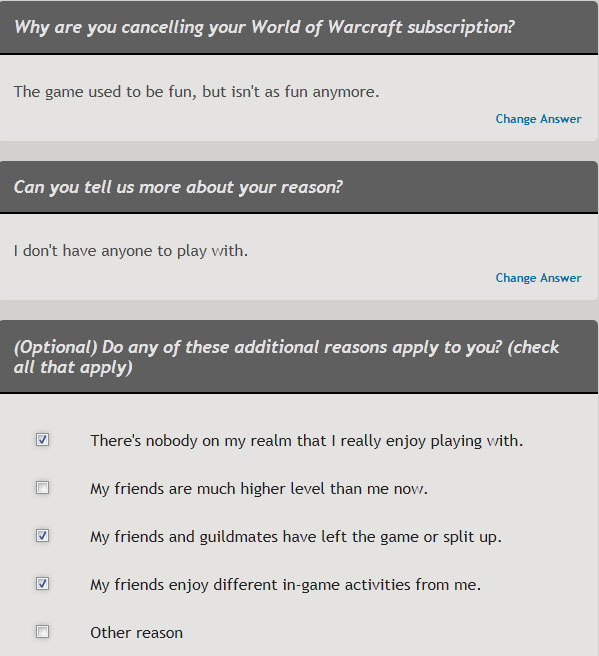
I first came across Tiny Tower a few weeks ago after hearing Scott Johnson and friends talk about it on The Instance and The Morning Stream, two rather hilarious podcasts I have listened to for months. If you have never heard of Tiny Tower, it is a “F2P” Apple app that is objectively a pointless waste of time. There is nothing skillful or strategic about any of the gameplay, and obviously there is no plot to speak of. It exists on my iPod only because it stimulates my nucleus accumbens in a completely vapid way: it tricks my physiological drive to multi-task into believing that the accumilated time spent playing has any meaning. And yet I have not deleted the app. It is still on there.
The philosophical question of whether anything we do has value or meaning aside, WoW engages in this same remote, psychological pleasure-center stimulation. And why wouldn’t it? It is an MMO with a monthly subscription. The difference between creating enough content to occupy people for a month versus creating content it takes a person a month to complete is the difference between bankruptcy and a sweet raise. Think about those Tol Barad trinkets you spent 30+ days “earning.” That they required 125 marks and Exalted reputation was entirely arbitrary. It was not about creating content, it was about creating a time wall that needed to be dismantled brick by brick by repetitive activity which creates an illusiary value to the end-product. Something you have worked towards accumilates value that simply getting it right away would lack.
In WoW’s defense, there is actually an end product there: a trinket that you might be using the rest of this expansion’s lifespan. Games like Tiny Tower have latched onto the notion that you do not even need the end-goal, do not need a pot of gold at the end of the rainbow. Worse than that though, these designers have realized that the individual actions do not have to be entertaining either. These are sandbox games without the sand; play replaced by going through the motions of play, yet triggering the same biochemicals as if you were having actual fun. And having thus deluded you into believing your participation has value, they tweak the “gameplay” to make even this seem reasonable*:
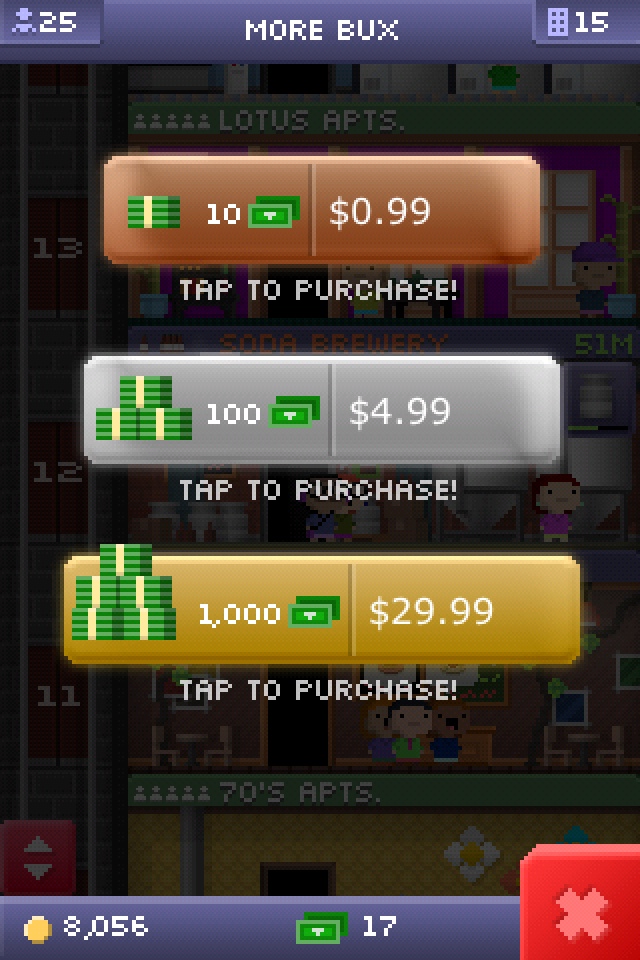
Seriously. I am waiting for a Steam deal on Limbo because $9.99 is a tad higher than I would prefer, and yet I was musing on how much could be accomplished with 1,000 Tower Bux… at the low, low price of $29.99. Philip Morris has nothing on these “F2P” assholes.
As my friends started logging into WoW less and less, the weakening social ties to the game gave me room to stand from my chair and really examine what I was doing. The taste of daily quests soured in my mouth. The AH was still fun… but it was the deals and strategy and the profit, not the tedium of listing, undercutting, emptying the mailbox. Sure, I could (further) automate those actions, but that is like automating chewing to speed tasteless digestion – it misses the point. The one activity I enjoyed for the sake of enjoyment was PvP. But when I became Honor capped on my warlock, BGs ceased to be amusing nearly instantly. “If I’m going lose 5 games for every 1 win during Twin Peaks holiday, I may as well do it on a toon that has use for Honor.” In other words, character advancement and fun had been so inexoriably linked in my mind that I questioned whether they could even exist independantly. Tiny Tower demonstrated that I would do something unfun for even the vaguest of rewards, and that was when I realized I was not actually having fun in those BGs. Or rather, it was no longer immediately clear that I was.
A lot of these sort of posts smack of “I quit WoW and so should you, for these reasons,” but that honestly is not my intention. I think there are some definite missteps that the designers made in Cataclysm, and I would be happy to debate those at length any day of the week regardless of whether subs are lost or gained. The fact of the matter though, is that if I was still having an engaging social experience in WoW I would probably still be paying $15/month. Without friends, WoW falls to the merits of its single-player experience. When that single-player experience is no longer fun, it falls finally onto its time soaking skills. And in the arena of time soaking, WoW cannot hold a candle to “games” like Tiny goddamn Tower.
God save us all.
*Obviously anyone who has played this “game” will go on about how they haven’t paid for anything. I haven’t paid for anything either. But any time you looked at that Bux screen and did not laugh at the designers’ overreach is a time you ceased to “beat the system” and became one with it. Nevermind all the stupid iTunes band previews or Youtube videos you watched because they gave you “free” Bux to do it.
The Problem With F2P and Microtransactions
Are you someone who almost never engages in microtransactions, has no real issue with people that do, but nevertheless feel like you are losing something whenever a game company starts to embrace them? Do you get the sensation that the purchasing power of your money is decreasing the longer a game goes on, seemingly for no real reason? Do you think cash shops are just plain wrong but have difficulty expressing it in words? The good news is I finally remembered the name of the economic concept behind the sensation: consumer surplus. The bad news is… so have game companies.
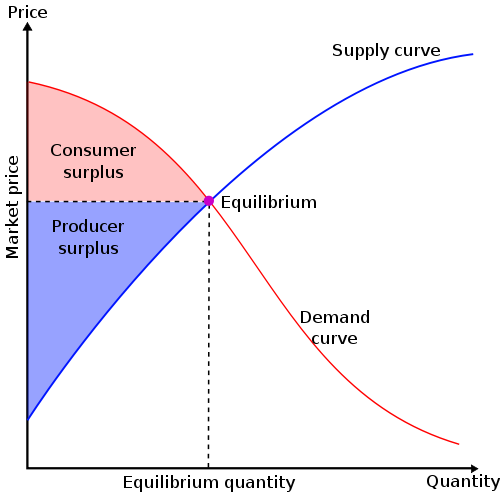
Consumer surplus is the difference between the maximum price a consumer is willing to pay and the actual price they do pay. If a consumer would be willing to pay more than the current asking price, then they are getting more benefit from the purchased product than they spent to buy it. An example of a good with generally high consumer surplus is drinking water. People would pay very high prices for drinking water, as they need it to survive. The difference in the price that they would pay, if they had to, and the amount that they pay now is their consumer surplus. Note that the utility of the first few liters of drinking water is very high (as it prevents death), so the first few liters would likely have more consumer surplus than subsequent liters.
The description is pretty self-explanatory, but I think the graph is a bit more useful.
And why not, here is a Greek college professor talking about it.
Do you want some videogame examples? Think back to multiplayer Diablo 2 and Warcraft 3. When I bought Diablo 2, it was because I wanted a quality dungeon-crawler experience similar to Diablo 1 – that there was an entire multiplayer experience attached was pure consumer surplus for me. Same with thing with Warcraft 3. Would I have paid an extra $5 for access to multiplayer? Probably. That $5 that I would have paid but did not have to amounted to Blizzard “leaving money on the table.”* Non-game examples includes Netflix Streaming, where you can access hundreds of movies at any time for $7.99. In spite of the “controversy” surrounding them raising prices of dual streaming/DVD plans, I think it is rather obvious that most Netflix customers would actually pay $10, $15, or even $20 a month for the service, especially since Movies On Demand-style services can cost upwards of $4.99 per movie.
The entire premise of microtransactions is dividing your content into smaller chunks to (re)capture and monetize every ounce of consumer surplus. While it is true that overall the game and it’s various monetized components are still worth buying – it falls within the bounds of the Demand Curve, which by definition means you value the game more than the money used to purchase it – it is equally true that literal value has been extracted from you. In other words, microtransactions remove value from games by reducing your consumer surplus.
Now, there may be the open question of whether the sort of microtransactions Blizzard is doing “counts” as consumer surplus mining. If Blizzard could/did not charge $25 for a mount, for example, would they have made the mounts at all? Would Blizzard have never made the Mobile Armory and/or the premium RealID grouping features if those did not tack on an extra subscription fee? I think they might not have developed those features and mounts, but that is more of an issue with the lack of credible competition** Blizzard faces than anything else. Indeed, competition generally engenders the greatest amount “value-added” consumer surplus since direct price wars are untenable. Then again, I might also bring up the Red Queen argument in that, much like raiding content, Blizzard has to continually be moving forward to maintain its present position. The artists that made and animated the Disco Lion would have been working on something either way, so if not adding that mount in as a PvE/PvP reward of some type, the effort might have been directed into a Titan or Diablo 3 model instead (increasing consumer surplus in those games).
In any case, I find the F2P and microtransaction model somewhat disturbing, yet inevitable. It obviously has the power to save games that would not exist otherwise (e.g. LotRO, APB, etc), and thereby opens the possibility of radical innovation in the types of games we play. Similarly, the rise of Steam and iTunes (and Facebook for that matter) as content delivery services makes indie games/music possible that could not exist in a typical retail box store. That said, the existence of that hitherto unexploited consumer surplus also leads to worse games, like Tiny Tower***. Meanwhile, instead of growing the industry, we have the major players pumping out sequals and squeezing the blood from what rocks are left instead of, well, mining for new rocks. This same phenominom is going on in the movie industry, with parallels like making movies 3D not because that adds value, but because A) they get to charge more, and B) it makes the movies nearly impossible to pirate.
The way I see it, the more game companies fall over themselves trying to monetize every corner of our consumer surplus, the less they fall over themselves giving us quality entertainment. Eventually, there will be some break-point beyond which lies an Era of Subsistence Gaming where we get exactly what we pay for and not one whit more. And those will be very bleak times indeed.
*Except Blizzard did not actually “leave any money on the table,” since that implies there was no value to Blizzard for giving consumer surplus. As we all know, it is the exact opposite: we as players give that value back to Blizzard in the form of brand loyalty and positive word-of-mouth recommendations. Part of that comes from the (historic) quality and polish of their games, but the feeling that we are getting more plays a non-zero part in the calculus.
**Blah, blah, Rift, LotRO, etc. Rift peaked at 600k subs and is now hovering around ~480k. LotRO peaked at 560k and is now at 360k. If you add both Rift and LotRO numbers at their peak, and then multiplied that by two, WoW would still have had more players than that in just North America… in 2008. Lost subs are lost subs, but I bet the Disco Lion made more money in the opening day it was released to cover a year’s worth of lost subs.
***Worse as in psychologically designed to exploit your nucleus accumbens, and essentially disprove the economic theory of rational consumers single-handedly.
 In An Age

2007 Called
Jul 9
Posted by Azuriel
…and it said attunements are still a bad idea.
I was not going to write on this subject, given how much of it is ancient history. Indeed, even now I am not going to spend a lot of words detailing how and why everyone is wrong. Only 7 words are really needed:
Attunements were unnecessary in accomplishing their goals.
In other words, every single thing attunements set out to accomplish can be achieved by doing something else. Epic quest lines? Those can still happen. Gating content? That is what the bosses themselves are supposed to do, but you can still go the Sunwell/ICC or gear check route if you like. Encouraging the spirit of cooperation (no seriously, Klep said this)? Since most attunements were for raids, this implies one is already in a raiding guild, presumably to raid, and thus cooperation is already secured. Alternative advancement at endgame? Achievements et tal, or the EQ2 method would be fine.
In the course of pontificating on this subject in the comment sections of three different blogs, the one attunement argument that I actually enjoyed was the “checking to see if you are ready to raid” one. You see, my primary umbrage towards attunements like the Karazhan key quest was how many components required a group. I tanked my way to attunement on my paladin main with the officer core no problem. And then, over the proceeding 37 weeks of raiding Karazhan, I had to make 15 additional Karazhan attunement runs for various people in the guild. People that had no problem being terrible raiders, or otherwise expecting the guild to provide them with endless dungeon runs so that they could guild-hop/get poached three days later. Who was getting attuned here? New DPS recruit #13? They aren’t being challenged by having Karazhan-geared raiders carry them through dungeon runs.
The one sort of attunement that I would consent to return would be personal attunements. The example I gave in a comment reply was:
I would 100% be behind that, not out of some kind of desire to demean casuals or new players, but out of an earnest desire to educate them. Where in WoW does it suggest to fill in sockets with gems, or that gear enchants exist? The Ready for Raiding achievement was amusing (less so for how few raiders probably have it), but imagine if it were a required attunement before zoning in to any raid content. Have it be some kind of solo instance tailored to spec/class and filled with fire that needs not be stood in, CC not to be broken, and a final mob that needs to be killed with some minimum level of DPS (that even a tank/healer could achieve). Hell, normalize the gear too.
Bam. I have just created an attunement with an actual, useful purpose related to the thing it is serving as an obstacle for. You know, unlike every other attunement in the history of the game.
Posted in Commentary
17 Comments
Tags: Attunement, Guild Hopping, Karazhan, Poaching, Ready for Raiding, Steamvault, WoW