Author Archives: Azuriel
Review: Bioshock Infinite
Game: Bioshock Infinite
Recommended price: $15
Metacritic Score: 96
Completion Time: ~14 hours
Buy If You Like: Stripped down, Art-Over-Substance FPS console ports
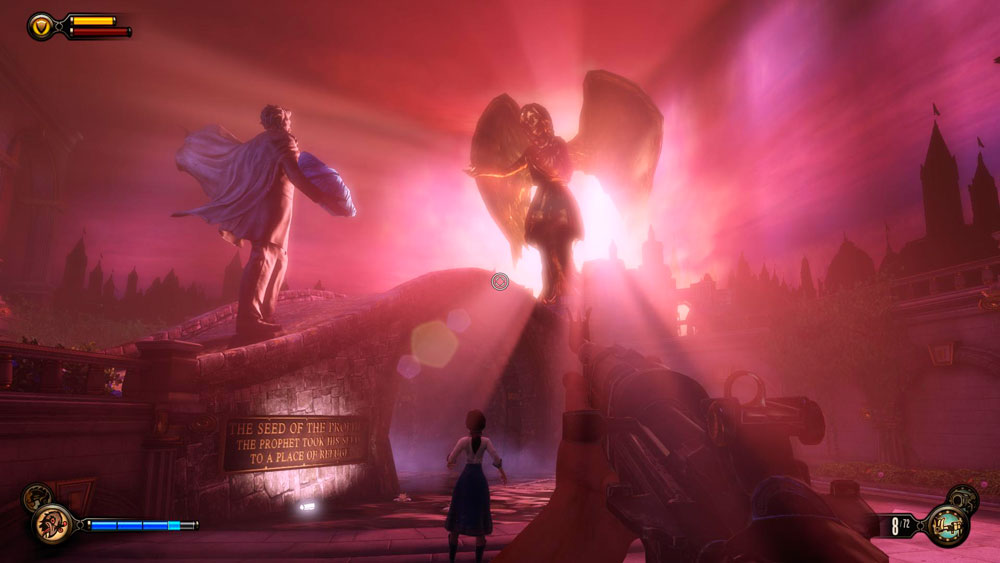
If only this level of polish extended to the gameplay.
Something that I struggle with when starting a videogame for the first time, is under which critique rubric I am to judge the experience. Sometimes the circumstances makes it easy: a $10 indie title ensures low-expectations, with potential high returns on either an entertainment-per-dollar basis (FTL, Binding of Isaac, SPAZ) or even an artistic one (LIMBO, Bastion). Indeed, in the years since the indie game revolution gained steam, I have found it increasingly difficult to justify $40-$60 Day 1 purchases of even AAA titles. What is the point, other than proactively (and expensively) avoiding spoilers? It was with this thought and a few other development team concerns that I initially decided to forgo Bioshock Infinite’s Day 1 purchase. That is, until I watched this fateful Adam Sessler video review. I mean, how could you not whip out your credit card right there?
Now, some 14 hours later and $45 poorer, I am wishing for an alternate reality in which I waited for the inevitable 75% off Steam sale to purchase the game.
Bioshock Infinite follows the story of Booker DeWitt, as he searches the floating streets of Columbia to bring back a girl to erase his debts. It is immediately clear at the beginning that Columbia is both visually stunning – seriously, where did these guys pull this fidelity out of the Unreal hat? – and an overt, artistic repudiation of Pax Americana fetishism. While rifling through picnic baskets and trashcans for every last silver dollar, you will run into signs of the blunt, religiously-justified racism and bigotry of the early 1900s. While I would be surprised if this is the first videogame rendition of this particular theme, Sessler is not wrong about game aspect of Bioshock Infinite functioning as a more effective prism to explore this theme, than had this been a book or movie and showing the same thing.
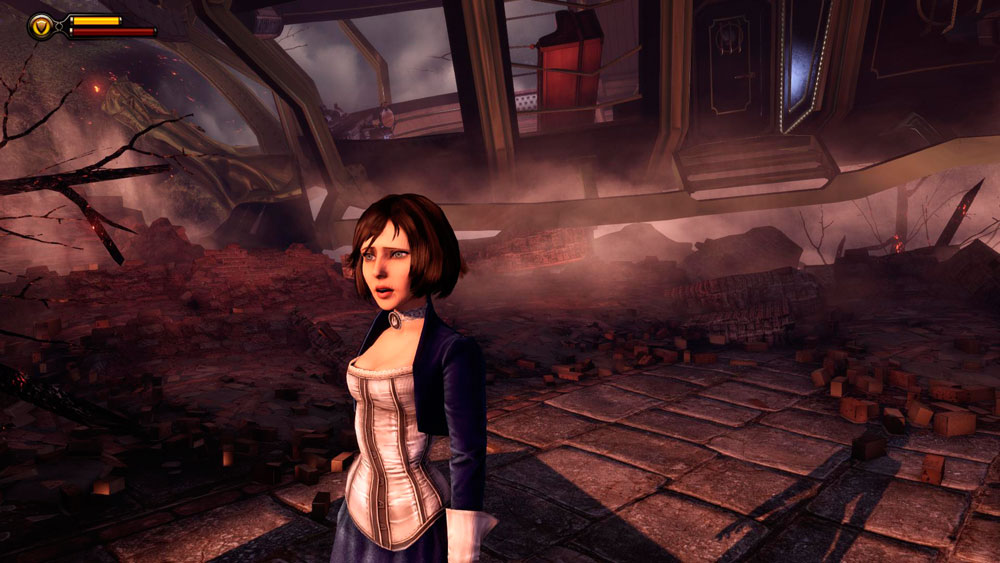
Elizabeth is the color in this Paint By Numbers.
Sessler and the other reviewers whom have catapulted Bioshock Infinite to a 96 (!!) Metacritic score are also not wrong about the brilliant elegance of Elizabeth. Rescued fairly early, Elizabeth initially serves both as a foil to the stoic/cynical Booker and as a player narrative stand-in. As the game progresses though, she provides a sort of… warmth that becomes noticeably lacking from the game proper whenever she is absent. Sometimes it is mesmerizing just watching her run around – the number of animations are incredible – or when she sits at a park bench as Booker stuffs his face with candy bars looted from the pockets of the slain. Immune to all damage, Elizabeth nevertheless avoids feeling like mere window-dressing (even in combat), while also avoiding the immersion-breaking pathing bugs we have come to expect from companion AI. She is simply… there. Present. And Bioshock Infinite is better for it.
I would also be remiss if I did not briefly mention the absolutely amazing soundtrack. While the omnipresent “angry violins” battle music gets old pretty fast, nearly everything single other ambient score is both haunting and melodic. Periodically there will even be barbershop-quartet-esque pieces that quite literally caused me to remove my hands from the keyboard and mouse to simply experience. Hearing songs like Will the Circle Be Unbroken and God Only Knows satisfies a need I never even knew existed. Any game that can fit in classical Mozart in a way both consistent with the fiction and powerful in execution gets mad props from me.
Unfortunately, where Sessler and all the other reviewers go off the rails is when they talk about (or conspicuously omit talking about) the actual game bits.
Simply put: Bioshock Infinite is not a very good FPS title, and absolutely not at all a good Bioshock title from a gameplay perspective. The skeleton is all there, with Vigors replacing the Plasmids, but there isn’t any meat. The gunplay is simplistic. Environmental damage combos are virtually non-existent. While the eight Vigors available seem to be a comparable number to the original Bioshock, the (usually) extremely open battle environments lends itself to one or two extremely OP strategies. For example, in an early combination with some equipment, using the secondary fire of Murder of Crows to create a single nest trap can disable dozens of enemies across the entire map; when one nest triggers, the crows chain from enemy to enemy, stunning and damaging them, and all enemies leave nest traps if they die while afflicted. Alternatively, once the Possession Vigor is upgraded, it essentially one-shots most enemies in addition occasionally scoring you kills if they actually get in some damage on friends.
For the record, I played beginning to end on Hard difficulty. So when I say things like the gunplay was simplistic, I do not mean that enemies fell over from one or two shots. Instead, firing the guns takes little skill, and there is little variety in the types of guns – there is no reason to have the Machine Gun, Burster, Repeater, and Crank Gun in the same game, for example, as they all occupy the same design space. While the skylines provided a useful gimmick to certain battlefields, their primary purpose seemed to be giving you the opportunity to one-shot weak enemies with a melee attack that would otherwise only remove 20% of their health.
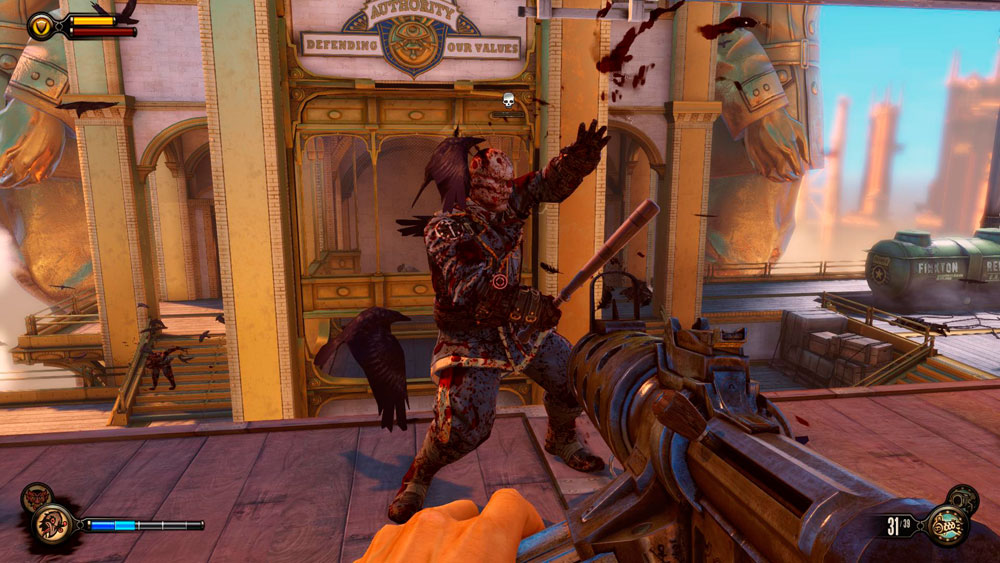
Da Birds, da Birds.
The fingerprints of Console-ification are also all over the place. Bioshock Infinite uses a completely oblique Checkpoint system, with no Save & Exit option. There are no Quicksaves. Booker has a regenerating shield, and can carry only two weapons at a time. There are no First Aid Kits or other inventory-esque items, although there is “clothing” that acts as swappable passive abilities. While changing clothes might have added some depth to the combat, the reality is that most of the items are hopelessly weak in comparison to the aforementioned OP combos.
While some of these things do not sound bad on their own, the problem arises when you then apply these simpler systems to an artistic game so focused on encouraging exploration inbetween the banal combat. Why barge into every non-locked house on the street – and see the thematically consistent bigotry – if there is quite literally no point to do so? Even if I accept that Checkpoints aren’t all that much different in practice than Quicksaves, the ever-present hunt to replenish my First Aid Kit supply drove me to explore every inch of Rapture, to my ultimate edification. Conversely, I explored Columbia out of a vague sense of propriety, like when an acquaintance takes you on a tour of his house even though you couldn’t care less about what the pantry looks like. Don’t get me wrong, I explored every masterfully crafted inch of Columbia that I could. But the whole time I sat there thinking “There is no reason for me to be here,” which I count as a deficiency in the game design, especially given how the original Bioshock played out.
Finally, in an effort to keep this review as spoiler-free as possible, I will not talk about the specific issues I had with Bioshock Infinite’s plot or overall narrative. Suffice it to say, I did not feel that the actual message the writers were trying to convey made a whole lot of sense given what was presented and foreshadowed. Indeed, the whole narrative felt disjointed, likely due to the first half of the game consisting almost entirely of exploring Columbia’s working class issues, rather than the more fantastical premises that dominate the later game.
Ultimately, Bioshock Infinite is clearly an ambitious game, but at the end, I felt like nearly every aspect of it did not live up to its inherent promise. While that is a shame, that doesn’t mean you should avoid the experience altogether. Bioshock Infinite is definitely a game worth playing, it is simply not worth playing for full MSRP, or even half that amount. If you can wait, you should. And as far as Sessler and the others predicting Bioshock Infinite’s long-term “lionization” and discussion “for years to come,” well… I think they will be waiting for that for quite some time. Perhaps until the heat death of the universe.
Happy Dead News Day
God, I hate April Fools. I hate it so much, in fact, I took the day off of work, so I would not be so bored out of my mind with the gaming site (and Reddit too, apparently) nonsense. The celebration of insipid deception is so pervasively perverse, I do not even bother believing any news for a full 24 hours. New PTR notes? A release date for X game? Nope, can’t hear you, lalalalalalala~.
Anyway, I beat Bioshock Infinite over the weekend. Were the 14 hours worth the $45? You will have to wait for the review; a review I most certainly will not write on April Fools, lest it not be believed.
Of course, if you have been around here for any length of time, you will probably believe it.
Bioshock Infinite Impressions: Day 1
I am hoping things get better than this.
Granted, I do not consider myself “in the game” quite yet; given how prominently Elizabeth displayed, I’m guessing everything up to her will still be considered tutorial. Of that tutorial though, some things are becoming more and more clear to me:
1) Fantastic visuals have the opposite effect on me.
The visuals, objectively, look awesome. The visuals are also immensely distracting. When I am trying to shoot a guy with a pistol, seeing a particularly well-done cumulus cloud in the background adds nothing positive to that gameplay experience. I had the same issue with Battlefield 3 in the beginning – it was difficult to “see” enemies amidst the Ultra-High settings – so this is something likely to get better over time, e.g. when I start tuning out the visuals.
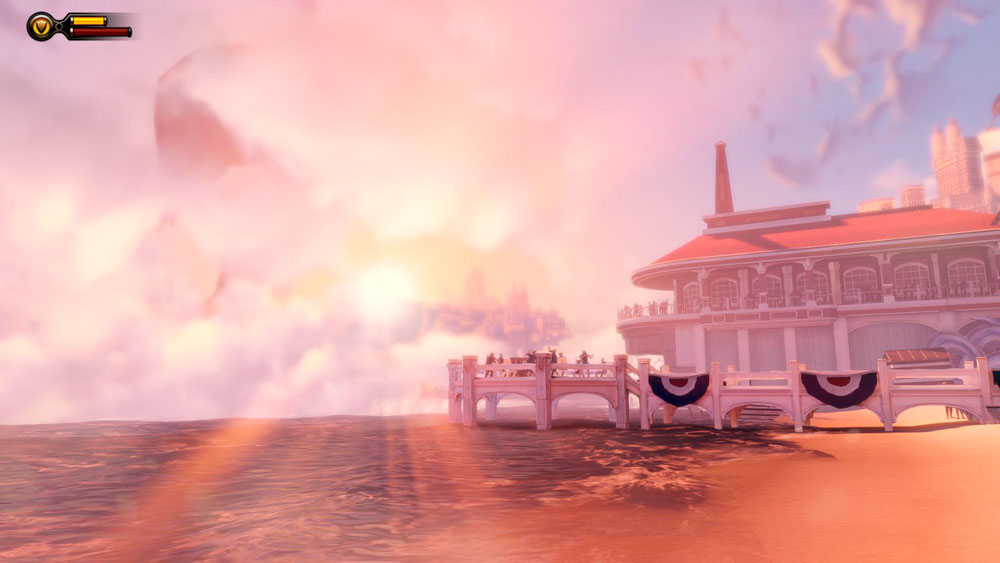
Just gotta ignore all of this.
Incidentally, I never had this problem with Borderlands 2, and I think that is because the moments of cel-shaded beauty are more spaced out, and act as breaks inbetween more functional battlefield back-drops. I don’t want ugly games, of course, just games where you are not overloaded with visuals at time when precision and quick reflexes are called for.
2) Thus far, the theme isn’t all that compelling.
In the original Bioshock, the theme was taking Libertarianism to its extreme conclusion – a gaming subject matter particular novel for its time. Bioshock 2 introduced the opposite, showcasing the nefarious side of Collectivism. While it is still early yet, Bioshock Infinite’s theme of religious extremism slash Isolationism slash historical fetishism is… somewhat rote in comparison.
Bigoted religious cults in videogames are right up there with zombies, Nazis, and demons when it comes to stereotypical bad guys. This might be the first time we have seen such (intentional) overt racist imagery in a game, but I feel like I can already plot the rest of the story from here. There is still plenty room for surprises… yet Bioshock Infinite is going to have to surprise me, lest its thematic message be no different than the one you have seen dozens of times in the 32-bit era, or watching Glenn Beck for more than ten minutes.
Also… aside from some nice clouds and sunsets, so far the underwater motif of the original Bioshocks feels worlds better than open sky of Infinite. There was implicit danger at all times in the ocean, along with a sort of fantastic plausibility; underwater buildings are more impractical/expensive versus impossible. Conversely, in Infinite, sometimes it is not especially noticeable that you are in the air at all. Just look at that screenshot up there again.
3) Console Port
The very first sign a game is a console port is when it is Checkpoint-based. My dismay at discovering there was no Quick-Save was both immediate and visceral. Technically Borderlands 2 is also Checkpoint-based, but the difference is that A) those Checkpoints are a known quantity (you know where they are), and B) you can still save at any time when you Exit the game.
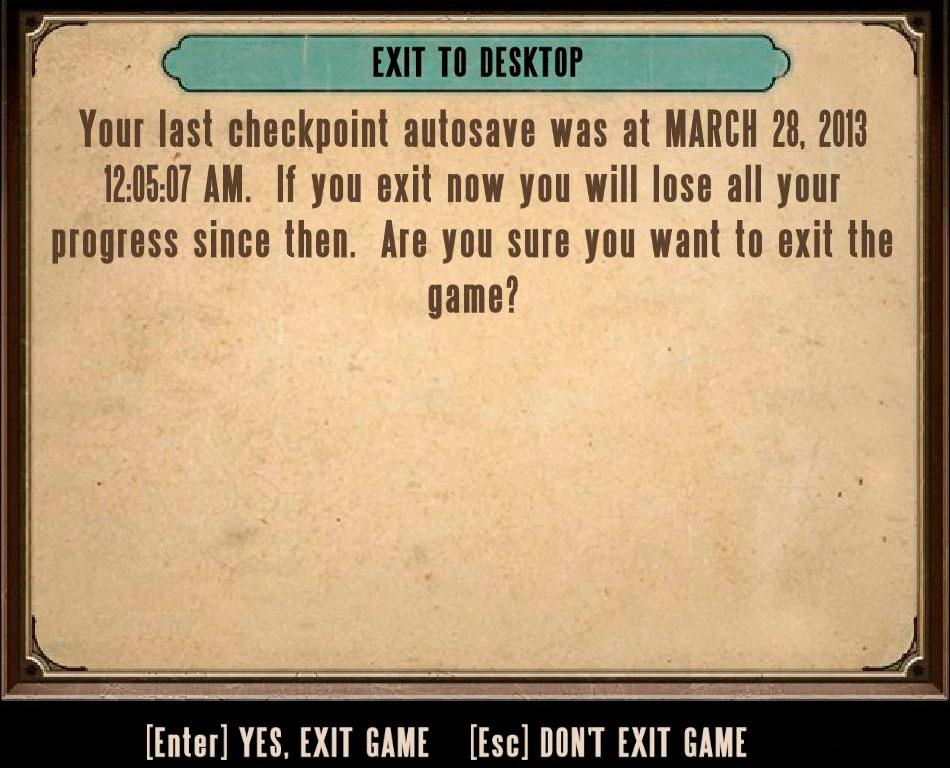
Ugh, really?
I am going to trooper on, of course, and perhaps it is a little unfair of me to expect brilliance from Minute 1. But given that I broke my Day 1 Embargo for Bioshock Infinite, I am a little bit weary of Buyer’s Remorse. I mean, I passed on Far Cry 3 for $30 for god’s sake!
Here is to hoping that I get blown away in the game proper, instead of musing as to whether I might have more fun playing Recettear like I was two days ago.
Bioshock Infinite
I was not going to purchase Bioshock Infinite on Day 1, for a variety of reasons. Between the delays, the abortive multiplayer aspirations, and the high profile resignations, the deck was stacked against an early purchase in my mind. Plus, I already have dozens and dozens of games I have yet to play/install, so why get a brand new one when I can instead wait for the price drop in 2-3 months? Also, First World Problem alert, I already owned all of the games being offered as bonuses for preordering.
And then… I watched this review by Adam Sessler:
I bought my “preorder” at 1am through Green Man Gaming, whose cash-back promotion technically means I got it for $45 (plus some Steam keys for games I already have).
By the way, “Infinite” might be referring to the amount of hard drive space required to run the game: 17 gigs. That is nearly 3 times the size of Skyrim, and almost as big as WoW by itself. I have some games still installed that I probably should clear out from lack of use, like Guild Wars 2 and Fallout: New Vegas, but it’s still a lot of hard drive real estate.
Lanced Boil
Faction-specific rocket launchers in PlanetSide 2 were released last Friday. As is often the case, what is complained about most on paper is the opposite of what occurred.
The launchers are the Striker, the Phoenix, and the Lancer. The Striker is sort of like a heat-seeking rocket-launching minigun. Well… sorta. Essentially, you lock onto a ground or air target, and then launch up to your full clip of five heat-seeking rockets. There was already a rocket-launcher that did exactly this minus the five rockets (the Annihilator), but this one does happen to deal more damage overall. The downside, as it is with the Annihilator, is that there is no dumb-fire mode, i.e. you can’t just shoot the rockets without locking on. Technically one flare from a jet or IR smoke from a tank will ruin all 5 of the shots, but considering most (good) pilots wait until they hear the rocket tone before dropping a flare, it might technically save you some ammo if you wait a second before releasing rockets 2-5.
The Phoenix is a camera-guided rocket launcher that was proclaimed the weakest on paper and yet is, unsurprisingly, is the most powerful. While the turning radius on the rocket is not especially good for the first 50m+ (to prevent steering rockets indoors), you can absolutely fire from behind a rock, fly through some trees, and then hit the back of a tank that was itself hiding behind another rock. Or, as this video amply demonstrates, simply steer it into any infantry, killing them instantly. Or fire it just to scout out the terrain. It even technically has a dumb-fire mode insofar as you can just fire it at close-range without needing to lock onto anything, or simply exit the missile “vehicle” and let it sail into a lined-up shot.
The last, most fearsome-on-paper launcher was the Lancer. In essence, the Lancer is a plasma railgun. Line up a target, hold down the fire button until it charges up to three levels, and fire… for slightly less damage than the default rocket launcher. And then leave a very pretty, very obvious 4-second contrail leading exactly to your precise location. The Lancer is so powerful, in fact, that it is… receiving buffs!
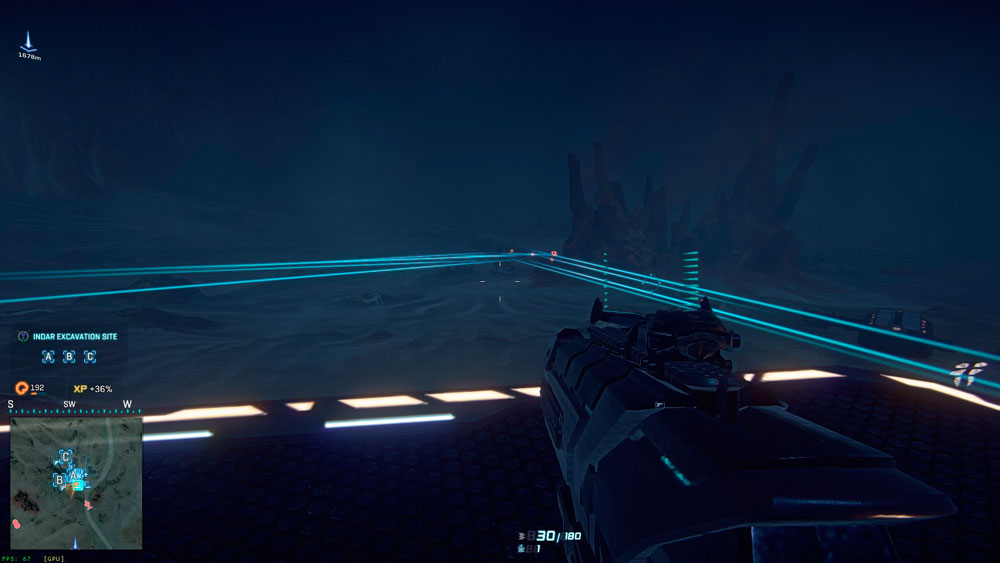
The Lancer is Super Effective… at putting on light shows.
On the SOE forums and Reddit, the thought was that a group of 6+ Heavy Assault classes equipped with Lancers would be able to one-shot any vehicle within a 500m range “without warning.” What never really made any sense about this argument was A) how it was unfair to die in a 1v6 scenario, B) how much warning a vehicle driver really has against a salvo of 6 normal rockets, C) how this is any different than 6 Engineers dropping 12 anti-tank mines all over the place, and D) what are the other 5 tanks doing? All of these questions were in addition to awfulness of the Lancer as released. Far from hit-scan accuracy, the Lancer was released with a random cone of fire with three projectiles, with any missing the target resulting in less damage (e.g. it wasn’t a graphical glitch).
It bears mentioning, in passing, that the Lancer does significantly reduced damage to player targets. There is also a dumb-fire mode of sorts, in firing off only a level-1 charge. If fired from the hip, this shot is about as inaccurate as a hip-fired sniper-rifle.
While it will be interesting to see if the Lancer is buffed into usefulness, at the moment (and likely even post-buff) the Lancer is not terribly useful for the solo player. Outside of alpha-strike coordination – something extremely difficult to pull off give that a max-charge shot is fired automatically/cannot be held – the average tank gets an extremely obvious warning in the form of ~20% damage and a convenient highlighted path by which to judge whether a nearby rock would provide sufficient cover. And this is besides the fact that the most common vehicle strategy, behind a rock peekaboo, defeats the “OP” Lancer just as hard (if not harder) than anything else.
Anything other than a camera-directed Phoenix, of course.
Sometimes the grass is actually greener on the other side. But I am far too deep in VS microtransactions to make a switch now. Sigh. The worst MAX, the worst launcher, the worst main tank, and the worst balancing mechanic (sacrificing bullet damage for bullet drop is irrelevant when combat occurs before bullets actually drop). The only actual advantage to VS are the Scythes, which would be a painful loss since NC has the worst possible jet.
I really do despise games with “unique” factions – more often than not, you just get punished for commitment.
5.3: That Was Fast
Patch 5.3 is up on the PTR. You can look at the notes here. Nothing too crazy… just the removal of Resilience from PvP gear, gear scaling in BGs and Arenas (!!!), and LFR off-spec rolls (plus increasing chance of bonus loot based on bad luck). You know, the usual.
Loot Specialization
- Players can now choose to receive loot for a specialization that’s different from their current class role. This feature could be accessed by right-clicking on the character portrait and selecting the option from the drop-down list. Loot specialization is available for bonus rolls, Raid Finder, and Pandarian quest rewards.
Bonus Roll
- Protection for bad luck streaks have been added to bonus rolls. Each bonus roll that does not provide loot has a progressively better chance to award loot to the player.
PvP
- Additional information and explanation for the reasoning behind PvP changes will be available very soon.
- All characters now have a base Resilience of 65%.
- Resilience has been removed from most PvP gear.
- Season 13 Tyrannical gear had their item levels increased to ilevel 496, up from ilevel 493.
- Season 13 Tyrannical Elite gear had their item levels decreased to ilevel 496, down from ilevel 512.
- Battlegrounds, Rated Battlegrounds, and Arenas now have an ilevel cap. All gear will be scaled down to ilevel 496.
Feels like the 5.2 PTR was just three weeks ago, doesn’t it? I suppose Blizzard wasn’t kidding around (finally) about accelerated release schedules.
Hearthstoned
Oh, my. I don’t think anyone saw this coming, but Blizzard is making a(nother?) Collectible Card Game.
Like I imagine many people in the non-apoplexy camp, I spent a large portion of my formative nerd years with Magic: the Gathering. My original shoebox of cards were from Ice Age, gifted from some obscure cousin of a family friend, but the first real entry into M:tG came with Tempest. Which then led into the Urza trilogy, with Urza’s Saga still remaining my favorite expansion of all time.

Not the most OP, but some of my favorite art/effects from Urza’s Saga.
My high school friends and I continued playing weekly up through, I believe, Ravnica. At that point, we were all scattered from life and interest waned. I dabbled with Magic: Online, still in the Ravnica era, and I was midway through busting out my credit card for another $17 tournament entry fee when I realized my objection to WoW and other MMOs with subscription fees was somewhat hypocritical.
I have little doubt that Hearthstone will be fun, at least for anyone who enjoys CCGs – it is difficult to screw up the innate simplicity and surprising depth to deck-building games. Any reservations I have is entirely based on the payment scheme.
Can we be frank for a second? Calling a Collectable Card Game “Free-to-Play” is such rank PR bullshit as to make even David Reid nauseous. Of course a CCG is free-to-play. You already bought the cards! Who is selling collectable cards and then charging a subscription for the privileged of keeping them? EA? This sort of nonsense is like calling Chess a F2P game. Maybe we are so mired in novel payment schemes that such a distinction (misleading as it is) is nevertheless necessary as signals to consumers.
And all of this obfuscates the underlying snare of all CCGs, Magic included: they are Pay-To-Win by design. I love M:tG, I really do. There are Pauper leagues (all common cards), Drafts, and some historical decks in which many of the key cards were no more than uncommon. But those things are only noteworthy insofar as they were the exceptions. If you look at standard tournament decks, they will cost between $250 to $650+ (!), stuffed as they are with Rare (or Mythic Rare, these days) cards. I used to read the WotC design articles, and at that time I almost swallowed their premise that these rares were justified in their rarity based on their complexities. “Commons are, well, common. You wouldn’t want the average player to crack open a pack of 12 complicated cards.”
Yeah, you’re right, we wouldn’t want that. It is just a huge coincidence that the more complex cards are the most objectively powerful and the most (artificially) rare, thereby forcing people to buy more booster packs in order to compete. I mean, we couldn’t possibly keep things proportional, like limiting rare cards to 1 specific card per deck instead of 4.
I mention all this because there is one indelible truth to CCGs: someone with more money to burn is going to ruin your day. Over and over and over again, until you can’t whip out your credit card fast enough. If you don’t think this is the first thing that will happen in Hearthstone, I don’t know what to tell you. Cynicism? Bitch, please. I am a Grade A recovering CCG addict and I know what’s coming for you and anyone else with less street-smarts to know that the first hit from the dealer is always free.
SimCity and Meta-Criticism
After a long period of reflection, I had originally decided to not join in on all the schadenfreude surrounding the SimCity debacle beyond my post two weeks ago. Not out of any moral sensibilities – heavens no! – but simply out of a lack of fucks given. That, and I certainly couldn’t keep up with the torrent of other blogger updates on the developing story, when it seemed some new embarrassment was revealed daily. Kotaku even had a SimCity Disaster Watch graphic created to handle all the articles.
At one point though, I was almost tempted to purchase SimCity myself out of a longing for gonzo journalism combined with the thought of a free EA game. Then I simply browsed EA’s catalog, realizing that unless they gave away Dead Space 3 (they did, dammit), I either had all the games or the value’s promotion was $20 max.
I do, however, want to commit to internet posterity my intense loathing regarding articles like this one from Time.com. These middle-road Apologist articles and their asinine, straw man arguments infuriate me to heights even EA cannot hope to surmount. Consider the following:
EA was never, ever obliged to make SimCity a single-player game, nor do these accusations (accurate or no) from modders that the existing code is just a few steps away from being a single-player game hold much water when it comes to EA’s obligations. So what if the game could have been a single-player game.
First, who said a single goddamned thing about obligation?
Look, I can follow the twisted derailment of thought that conjures forth the implied “obligation.” Someone stating that SimCity should have had a single-player mode is assuming a sort of game design high ground, harkening towards a moral edifice that does not strictly exist. Because the game should have been a certain way, Maxis/EA has an obligation to Comment out Line #22 in the code design a single-player mode. That’s where the implied obligation comes from, right?
If so, we live in a terribly nonsensical world, one immune to criticism or judgment of any kind. Did McDonald’s give you cold french fries? Too bad, because they aren’t obligated to give you hot ones. No complaining! Did you tell the waiter you wanted a medium-rare steak and they gave you well-done? The chef isn’t obligated to bend to your whims, knave! He or she is an artiste! Movie previews aren’t obligated to represent the actual feature film, and if you don’t like it, go back in time and don’t buy a ticket!
Of course, the author clearly is being pedantic here. The point most people are bringing up is that SimCity, both conceptually and literally, doesn’t need to be always-online. There is no requirement for it to be so, despite the rather flagrant falsehoods claimed by the development team and embarrassingly contradicted by the modding community and a Maxis insider. Maxis/EA has no obligation to accede to reason, of course, but they certainly invite the valid criticism that accompany such quests for profit at consumer expense.
Which segues nicely into this nonsense:
You can ask, you can even petition, but I’d like to think we’re not at the point where we’re now telling painters, musicians, writers and artists of whatever stripe — game designers included — what they have to do.
You can’t have it both ways. You can’t shake your fist indignantly and shout “but games are art!” then hold game designers to a different standard.
This is truly an despicable appeal to diversion. “Stop complaining about game design direction, or else games won’t be art anymore!” First of all, there is nothing sacrosanct about art. Authors have editors. Directors have focus groups. Fundamentally, all art is an exchange, and every artist considers his or her audience when making a piece for presentation (even if they imagine it is an audience of just themselves). And this is besides the fact that these game companies are businesses selling a product for profit. Games can be artistic products, but these companies are selling them to consumers, not putting (selling?) them in museums.
The pernicious worm at the core of this abhorrent article is the same one I have seen in similar, depressingly frequent articles: an implicit admonition of criticism itself. “Stop complaining,” these authors say, “you are lucky the artists deign to create anything for you filthy plebs.” No, I deny your thinly-veiled nihilism. Gamers have a right to reject anti-consumerist design. Gamers have the right to call out poor gameplay. The gamers who made the SimCity franchise successful in the first place have a right to protest design they feel is taking said franchise in the wrong direction. Is EA/Maxis or any game maker obligated to do anything? Of course not. Does that make levied criticism illegitimate? Hell no.
You are always entitled to your own opinion, and people can judge for themselves whether it an opinion worthy of consideration. And it is my opinion that Time’s article of meta-criticism – and all articles in the same vein – are specious nonsense, and nihilistic besides. Nothing is beyond reproach, else it demonstrates a perfection impossible to manifest in a universe of subjective minds.
I can only hope that the next EA CEO coming in can spare the 5 minutes of his or her time to understand why the company continues topping the worst company in the world charts. A quick memo to Maxis authorizing an offline mode would pull the teeth out of this endless negative PR; a gaming policy of not monetizing every single pixel with endless online passes could even get gamers to forgive Origin (or maybe just running some goddamn sales).
Bam, done. You’re welcome, EA.
P.S. While writing this article, a friend of mine pops up on Steam chat saying that the Mass Effect 3 servers were down, meaning he couldn’t play the single-player DLC he legitimately purchased through Origin weeks ago. This is the world we live in, folks.
Organized PvP
Everyone has heard the phrase “Less is More.” The converse is occasionally true as well.
A few weeks ago, several PlanetSide 2 servers were merged, and mine was amongst them. When it comes to player-generated content, you always need players to be in physical proximity for any of the magic to really occur. So, I should be all for this development, right?
Well…
In games like PlanetSide 2, organized PvP is too often boring PvP. When you look at this picture, what do you see?
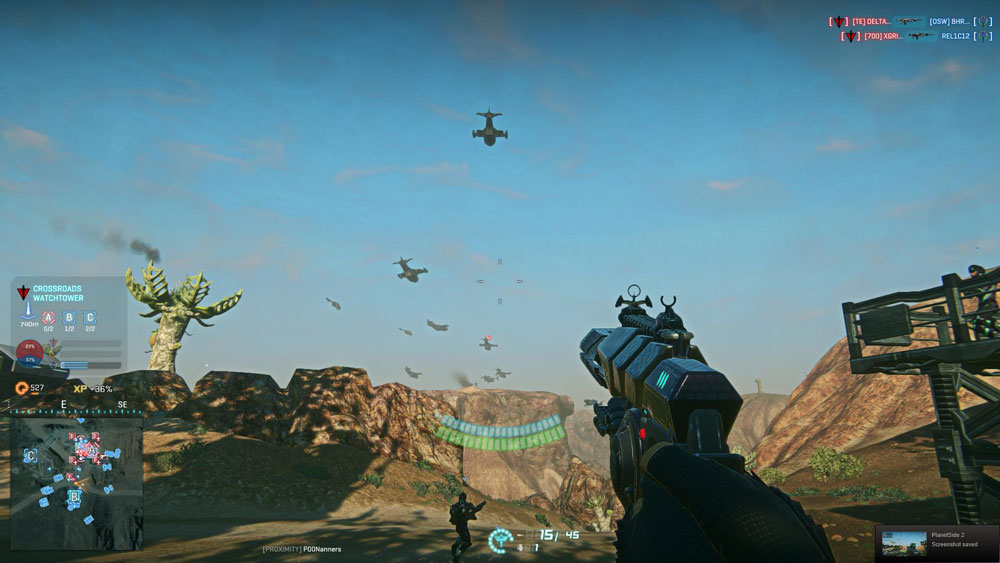
Whatever is over there is screwed.
If you said “a bunch of planes,” you would technically be correct. Each plane is a Galaxy, which is a 16-man troop transport. Dozens and dozens of fiercely-organized players could be spilling out of the sky, with no warning, deftly seizing territory almost behind enemy lines. Cool, right?
Not really. More likely, those dozens of troops will be landing on an empty base, sitting around shooting 1 bullet and reloading to give some free XP to the Engineers resupplying them ammo, until the base is capped and they move on to the next. Capturing anything less than a Bio Lab results in about the same XP as killing 3-5 people. And even if this Outfit lucks out and finds willing defenders, said defenders are likely to give up and respawn elsewhere than throw themselves beneath the tread of an organized zerg. Because… why would they?
When I log into PlanetSide 2, I do so out of a desire to shoot people. Fighting against an organized Outfit does not result in interesting gameplay for me, as I am necessarily foiled at every turn. Unorganized zerg clashes, on the other hand, are fun times – people flock from all around to any given Bio Lab fight – precisely because individual agency exists. It is your individual, focused skill against the seething mass of the average and distracted. Yes, the odds are low that you accomplish anything of consequence given any one of the dozens of enemies can undo your damage. But sometimes they don’t, because, you know, unorganized. And then you feel like the one-eyed man in the land of the blind.
Which brings me back to the Ps2 server merges. Simply put, since the change I have seen a large increase in organized Outfit activity. Which makes sense, of course, given that there are more people in a smaller space. The result is less interesting gameplay to me, however, as I either face an organized resistance or none at all – the unorganized defenders having been squashed or conscripted hours before. There simply isn’t room for a lone ESF pilot flying around, harassing the odd Sunderer. The landscape beneath my wings is either barren or blanketed with vicious Anti-Aircraft units, both scenarios a reaction to a prior sky full of organized terror.
One might imagine that the underlying design goal was for the two organized groups to meet upon the battlefield, fighting tooth and nail, performing novel tactics that can only emerge from such clashing of focused wills. One might also question what the designers were smoking to believe that such things ever occur naturally and spontaneously. Why struggle and possibly fail (!) when you can instead shepherd your Outfit into empty territory after territory, maximizing XP gains for all? Three kills give more XP than a base capture, but its doubtful everyone will have the opportunity to get three kills, assuming you even find that many defenders still sticking around when the dust of 17 tanks looms tall on the horizon.
No, PlanetSide 2’s organized warfare is the WoW random BG premade, seeking easy kills for the easy Honor. To get these Outfits to clash, SOE is going to have to fashion a similar solution: incentivize Outfit vs Outfit gameplay, ala Rated BGs or Arenas. Changing the hex system to a more linear one is no solution to anything. Scratch that, it’s a great boon to finding a fun, unorganized brawl. It is not, however, going to change how Outfits follow the natural inclination of organized warfare in the preference of soft targets to hard.
If anything, the meeting of strength to strength is the most unnatural result of all.
 In An Age
My Issues with the Bioshock Infinite Plot
Apr 4
Posted by Azuriel
As you might imagine, the following post contains many spoilers. Read at your own peril.
I did want to get two things out of the way first (and help create some extra spoiler insulation). The first is to reiterate, as I did in my review, that I very much enjoyed certain aspects of Bioshock Infinite. The characterizations were quite good; Elizabeth in particular was fantastic. I also enjoyed the art style and the music. The combat was particularly weak in my opinion (and others), but not terrible enough to preclude suggesting the game to other people, at least at a lower price-point.
The imagery alone is worth, like, nearly $10.
Secondly, there is almost nothing in this world more personally maddening than when people suggest a given narrative is good (or the best ever) simply because it appears complicated. Why is convoluted nonsense confused for depth? I had to turn off this Kotaku audio spoiler discussion because the hosts actually suggested that not thinking about (for example) time travel paradoxes makes time travel plots better. Well… yeah. That works because you are taking away the bullshit plot as it actually exists and then substituting your own, better version in its place. And odds are that your own version doesn’t make any more goddamn sense, cobbled together as it is with your vague, unexamined good feelings rather than the jumbled pieces presented by the original writers.
I am not asking for a happy ending. I am not asking for Saturday Morning cartoon simplicity. Hell, I am even completely fine with leaving things up for interpretation; Inception’s ending was perfect, for example. What I am not fine with is when vague nonsense is elevated to absurd heights. If Bioshock Infinite’s plot is actually any good, then surely it can stand up to some peanut gallery criticism. Right? Right.
And by all means, if I am talking out of my ass on any of the below points, or you want to provide a different perspective, call me out in the comments below.
.
.
.
.
Redefinition of what Alternate Universes mean.
First off, this may seem like a minor quibble, but I think a lot of the confusion and suggested paradoxes stem from the fact that Bioshock Infinite is inventing its own version of multiverse/time travel theory. Levine is basically saying “I’m going to take this hackneyed, impossible-to-do-right concept and solve it with three words: ‘Constants and variables.'” What about the Grandfather Paradox? “Constants and variables.” What about all the universes in which Comstock is a good guy, or those in which Booker doesn’t sell Anna? “Constants and variables.” Why couldn’t Elizabeth just stage an intervention to keep Booker from drinking and gambling? CONSTANTS AND VARIABLES.
I’m sorry, presenting a multiverse theory in which there are “millions and millions” of other Comstocks and yet certain outcomes are arbitrarily 100% set in stone is simply lazy storytelling. I mean, it is not even inconsistent for there to be universes in which Booker never sold Anna! It almost feels like Levine crafted the “constants” based entirely on being able to railroad the player in that one room with the baby. You can still have an impetus to stop Comstock in any of the universes in which he turns into a bad guy, even if it is not ALL universes. Or, hell, add some moral ambiguity to the story by suggesting eliminating the bad Comstocks is “worth” killing all the good ones too.
“Constants and Variables” might be a novel “solution” to the problems of alternative universe storytelling, but only because no other writer thought anyone would actually buy into it. This feels like deus ex machina ^ ∞.
“There are a million million other Comstocks”
Someone has some daddy issues.
This was my literal reaction to Elizabeth’s line about why the game wasn’t technically over after killing Comstock:
“So what?”
Seriously, so what if there are a million million other ones? There are a million million other bad things in alternate universes too – not to mention real life in 1912 – but we don’t seem to be solving those. Was what Comstock did in the Columbia period so bad that killing him at the point in the timeline which we did, was not good enough? Let’s drown him a million million times in that same fountain, as god only knows our conveniently omnipotent Elizabeth can time travel us there; there isn’t even the Constants and Variables bullshit to get in our way. Elizabeth and Booker quite literally have all the time in the world.
When did the drowning occur?
Speaking of drowning, when did Booker get drowned by the Elizabethes? Before or after the baptism? If before, why did that not kill off all Bookers/Annas/Elizabeths, e.g. make the after-credits scene impossible? If it occurred after the baptism, as the extra scene seems to convey, why is it so important for Booker to come to the “smothering” decision? Why is the player’s Booker smothered, instead of watching a new Comstock get smothered? Narrative convenience?
At first, I thought the answer was easy. In the game proper, it seems as though Booker shares the memories of any universe he has been in. For example, after bringing in the weapons, Booker has memories of being a hero of the Vox. In this way, by traveling to the past (time travel and alternate universes, this is so deep u guyz) and presumably merging with the post-Baptism-yet-pre-Comstock Booker, we can have a scenario in which a not-yet-Comstock Booker realizes what is going to happen and accept the need for his own drowning.
None, apparently.
Which is… a pretty shitty moral scenario, if you think about it. More on that in a moment.
Of course, if the above is actually the case, then how is it possible for Booker and Comstock to exist in the same universe in the first place? Why doesn’t Booker have Comstock’s memories the moment he wakes up in the row boat, or when getting into Columbia, or when physically drowning Comstock in the baptismal fountain (ooo, foreshadowing) in the game proper?
To be honest, I might have missed the explanation for why Booker wasn’t a drooling, nosebleeding basketcase like the other dead-now-alive soldiers. Or why those soldiers were having such a hard time when, at best, they were “remembering” alternate universes in which they were dead. If the dead soldiers were now alive due to us changing things in the past, what does that really mean for the great swaths of population we killed across Columbia even in a no-Comstock scenario?
Negating all events that were experienced
Right in the feels.
Let us pretend for a moment that the ending makes perfect sense, there are no plot holes, and everything is wrapped up with a neat little bow. Hell, let’s pretend the ending is even happy, despite the fact that Booker is still a murdering, gambling, union-busting alcoholic single father with enough debt to legitimately consider selling his own daughter to the first person who opens a checkbook. And let’s further assume that he retained the memories of all that he accomplished in the game, perhaps giving him an impetus to try and set everything right instead of dropping baby Anna off in a basket at the closest orphanage.
In this best case scenario, Bioshock Infinite is a game in which all your actions are voided. Everything you struggled to accomplish is erased. None of it happened. Every moral choice you made, every time you refrained from stealing from cash registers, every interracial kindness you demonstrated never matters because those people/scenarios never exist. It boils down to a “it was all a dream” scenario, which is the most pernicious storytelling mechanic in the history of narrative.
If I had no other problems with the story, this alone would be enough to throw my hands up in disgust. Do you really feel like a game in which you endeavor to negate everything that happens is deep and meaningful? You can accomplish all the game has set you out to accomplish by simply not playing. As prophesied by WOPR in 1983: “the only winning move is not to play [Bioshock Infinite].”
Moral of the story?
Creepy Level: The Shining
Finally, let me kind of wrap all these various ingredients up into one complete shit sandwich. What exactly is the message being conveyed here in Bioshock Infinite? What is the theme, the moral of the story?
At the beginning, I almost felt like Booker was trying to make up for his sins, to seek forgiveness and redemption, to put things right. But what is Booker’s actual crime that he is repenting? To stop a person he never turned out to be from entrapping the person he is into a crime a third version must now stop? Booker choosing to be drowned seems a noble sacrifice until you realize what exactly he is undoing: choices he never made. Or, even worse, stopping a man (Comstock) he had no choice into becoming. There is never any “good Comstock” because apparently being bad is a constant. Fate. Predestination.
What is the message here about personal responsibility, free will, and choice? You have none because Constants and Variables. And suddenly, infinite universes means you are implicitly responsible to consequences that you never chose and never happened in your own universe. Do you remember when you donated to charity instead of setting a baby on fire? Well, you should feel real bad anyway because the not-you baby-arsonist is running amok and it’s up to you to stop yourself like you already did by not setting the baby on fire in the first place. GUYZ, DEEPEST PLOT EVAR.
Even worse, apparently Booker is the one on the hook for what the Lutece twins are ultimately responsible for. Who invented the Tear machine? Who gave it to Comstock? Why isn’t this game about the Lutece twins stopping themselves from transdimensional kidnapping, extortion, and/or human trafficking?
Ah, right. “Constants and variables.” And when the Lutece twins invent the Tear machine anyway and give it to the next megalomaniac – a real shortage of those in the early 1900s, let me tell you – it will once again be somebody else’s alternate-reality problem.
_______
Fake Edit: After “playing” through the ending sequence again, I believe the drowning question can be put to bed. Elizabeth(es) specifically say:
Preacher Witting: Booker DeWitt, are you ready to be born again?
Booker: What is this? Why are we back here?
Elizabeth: This isn’t the same place, Booker.
Booker: Of course it is, I remember – wait. You’re not… you’re not… who are you?
Elizabeth: You chose to walk away. But in other oceans you didn’t. You took the baptism. And you were born again as a different man.
Booker: Comstock.
Elizabeth: It all has to end. To never have started. Not just in this world. But in all of ours.
Booker: Smother him in the crib.
Elizabeth Esemble: Smother… smother… smother..
Elizabeth: Before the choice is made. Before you are reborn.
Preacher Witting: And what name shall you take my son?
Elizabeth: He’s Zachary Comstock. He’s Booker DeWitt.
Booker: No… I’m both.
In other words, it was not Comstock that was smothered in the crib, it was Booker before he made the choice to be baptized or refuse. Meaning, both Booker and Comstock are dead. Meaning, the after-credits scene is either a vision of an afterlife, or a cheap plot hole to make you feel better while masquerading as deep storytelling.
Please, tell me I’m wrong about any of this. Tell me there is a legitimate reason people are praising this plot, as if it holds even the slightest of candles to the original Bioshock. Am I missing something? Perhaps, you know, the Tear into an alternate universe in which Bioshock Infinite’s plot is any good?
Posted in Commentary
24 Comments
Tags: Baptism, Bioshock Infinite, Constants and Variables, Fate, Moral of the Story, Multiple Universes, Predestination, Rant, Spoiler Alert, Time Travel