Category Archives: Philosophy
No Country for Old Blizzard
One of the more… persuasive talking points when it comes to World of Warcraft is that there is an Old Blizzard and a New Blizzard. The Old Blizzard are the people responsible for the most successful MMO ever created, and the New Blizzard is everyone that is sailing the ship into icebergs. The evidence for such a dichotomy seems almost, well, self-evident:
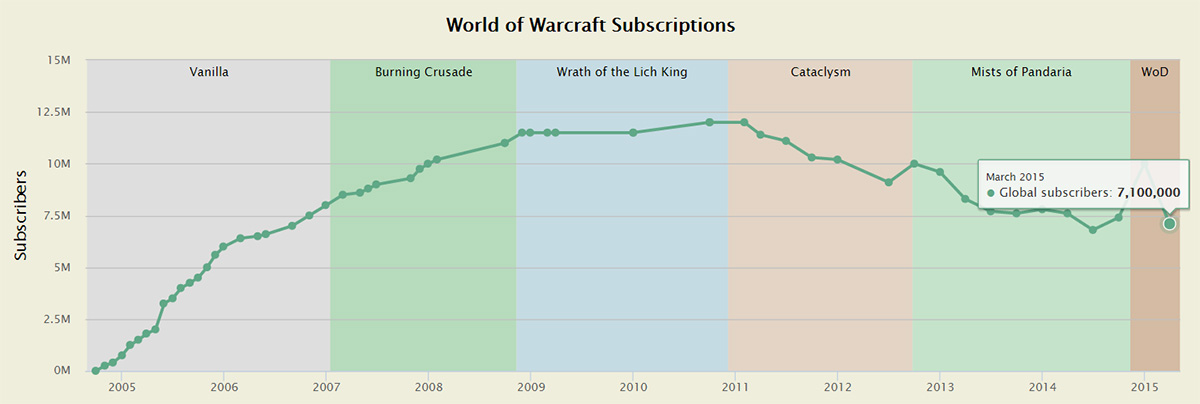
Whiplash.
Syncaine, who is much a fan of the two phrases, likes to point out that the breaking point between the Old and the New came in Wrath of the Lich King. From the graph, that is when WoW stopped growing. There are also a few philosophy changes that occurred during that expansion, such as the introduction of the fully automated LFD system, a full embrace of the Badge system, “bring the player, not the class,” and similar things.
Personally, I think Cataclysm marks a much more sensible breaking point, but nevermind.
As I said before, the Old Blizzard vs New Blizzard narrative is pretty persuasive. Which is rather unfortunate considering how it is factually incorrect: Old Blizzard never left. Below are the Credits screens from vanilla WoW and all the expansions, focusing on Lead Designers or Game Designers. I’m formatting it this way because it’s better than a table that won’t fit on the page:

Apologies for the formatting.
The source is the Credits screen accessed from within the WoW client (Character Select screen // Menu // Credits), which appears to be the only way to access the names. Luckily, you do not need a subscription to the game to access it. I typed it all by hand after taking screenshots, so feel free to check my work¹. Alternatively, just look at this Google Docs spreadsheet.
Notice anything? Like maybe all the duplicate names? In the spreadsheet, I highlighted anyone credited as a Designer in vanilla or TBC and who went on to be a Designer in any other expansion². Of particular note is the fact that of the 20 Designers of TBC, 15 of them went on to be Designers in Wrath. In other words, 68% of the design team of Wrath came from TBC. This includes Tom Chilton and Jeffrey Kaplan, both of whom were credited as Lead Designers in both expansions (and Designers of vanilla WoW besides).
Now, you may be thinking to yourself, “Rob Pardo is the missing link!” He was, after all, the Lead Designer of vanilla WoW and TBC before seemingly falling off the design map. Well, allow me the distinct pleasure of destroying your revisionist narrative dreams once and for all. See, Rob Pardo gave a rather sweeping interview back in 2009, almost at the midpoint of Wrath. The link points to the 1st page of that interview because it’s still that good, but money shots are on the 3rd page:
We had all these suppositions, and as the years went on and we had more and more experience living with WoW as a live game, we realized that they weren’t just truths. They might affect a hardcore minority, but the people we saw weren’t really as hardcore as we thought they were. If we reduced raids from 40 to 25, we saw, it makes it more fun. You might have some hardcore players who get upset, but keeping people out of content isn’t right for the game overall. We mellowed sometimes, and realized we were wrong.
The other piece is that the WoW playerbase is becoming more casual over time. People who were hardcore into MMOs, they joined us first, but the people we’re acquiring over the years are casual. They heard about the game from a friend of a friend, and maybe it’s their first MMO – maybe it’s their first game. The game has to evolve to match the current player.
And what did Rob Pardo think about the much maligned LFD system?
That segues in nicely to this question: Cross-server gameplay. It’s convenient, but do you think that it runs the risk of destroying server communities?
To be completely honest, [the Looking For Group tool] is a feature I wanted in the game when we launched the game. I was really unhappy when we didn’t have it when we first shipped, so it’s been 5 years coming. Maybe it wasn’t the number one thing I wanted in, but it’s definitely one of the top 5 things that I wanted in the game. It’s actually our third try at a proper LFG tool, and this one gets it right. With the Meeting Stones, we didn’t put enough attention into it, we just tried to jam it in, and people didn’t use it. The second tool, it ended up being compromised feature – we tried to cater to too many different audiences.
As for the community question, I used to … I think that 5 years ago, I would have answered this question differently than I would today. I was all about preserving the small realm communities, but already… Well, look at Battlegrounds, it’s a good case in point, because it doesn’t diminish social relationships that matter on a realm. Sure, everyone can bring up “that one guy” that they know, the ninja looter who stole his stuff. But I think your real community isn’t the whole realm, but it’s your guild and the friends you group with, and the cross-server LFG won’t undermine that at all. The Dungeon Finder – by the way, I think we just renamed it the Dungeon Finder last night – We designed it in such a way that it serves the need for guilds and groups and friends. You don’t have to always [join a Pick-Up Group]. If there are four guildies in a group who just need a fifth, they can do that. You can also use it if even you have a full five-person party.
Or, you can do it if you’re on your own and just want to run something, so I don’t think it diminishes it at all.
*mic drop*
…
*picks mic back up*
The argument I’m making is not necessarily that there hasn’t been a decline in quality WoW game design over the years. The argument I’m making is that there isn’t an Old Blizzard vs New Blizzard dichotomy. Tom Chilton has been at the head table every expansion. Jeff Kaplan was still Lead Designer for Wrath, and while he was absent after that, it was because he became the Game Director for Overwatch. Rob Pardo didn’t stick around for Wrath… as a designer. Instead, Rob Pardo became Executive Vice President of Game Design for Wrath and Cataclysm. And, don’t tell Syncaine, but Pardo is also Chief Creative Officer and Executive Producer of Hearthstone.
So who exactly is Old Blizzard again?
The alternative title I was going to use for this post was “the M. Night. Shyamalan Effect.” For those that might not know, he was the Director and Screenwriter to an enormously successful and critically acclaimed film called Sixth Sense – it is a cultural touchstone film still used in comparisons today. His follow-ups included Signs and Unbreakable… followed by 13 years of utter garbage. If you choose to believe in a narrative of WoW’s decline from quality, it is this comparison that fits. We would not say “Old Shyamalan vs New Shyamalan,” and we shouldn’t do the same with Blizzard.
¹ The one conspicuously missing name is Greg Street, aka Ghostcrawler. Greg Street is listed as Lead Systems Designer in Wrath, Cata, and Mists, and that role undoubtedly has something to do with design. However, the position doesn’t exist in vanilla, TBC, or Warlords, and there is another “Additional Designers” category I didn’t include either, simply because I can’t be sure what they do. In any case, they always say design is a collaborative process, so even if Greg Street is the cause of it all, that doesn’t get “Old Blizzard” off the hook.
² I have since color-coded all the designers who had carryover between expansions, and the results are interesting. For example, all but one of the designers from Wrath came over into Cataclysm, making up 91% of the final total. This is both baffling and makes perfect sense, assuming The Shyamalan Effect.
A Flight Too Far
I wasn’t going to write two posts about the lack of flying in Draenor, but the flurry of interviews and blue posts regarding it has taken me by surprise. After some thought though, I have decided to enumerate my feelings on the matter as dispassionately as possible, to hopefully serve as a more useful vehicle for feedback. I am mainly doing this for Russ Peterson:
“If I had asked people what they wanted, they would have said faster horses.” or similar is often attributed to Henry Ford.
And the point of that statement is that there are often solutions to a problem that are not always a direct continuation of what you expect
So when you think about flying/not flying today, try to think about what you like or miss in specifics rather than the blanket feature
Like: I miss flying because I enjoy looking at the world from a high vantage point, or I don’t miss flying because the world feels dangerous
It helps us when you can give feedback about the feelings and emotion you have or don’t have, and how that affects your behavior.
Yelling at us and telling us we’re dumb for making a decision doesn’t help.
For example, it could be argued that the command table is a stronger tether to keeping you in the garrison than lack of flight.
Try to dig past the initial feeling and reaction and tell us why you feel the way you do. That’s the feedback that makes the game better.
I’m heading out early for the holiday weekend. Keep sending feedback. I will always read it.
WHAT PROBLEM ARE YOU TRYING …ahem. Let’s begin.
1) Flying gives players agency.
When I am on a flying mount, I am in control of my character. I am interacting with the world on my own time, in my own manner, and at my own discretion. While I might not always be paying attention while flying around, the fact is something could attract my eye at any moment and change my plans. Maybe I see a rare spawn, maybe I see some resource nodes, maybe I see some players in need of assistance. Flying gives me power, and yes, convenience.
2) Flying exposes poor quest design, not create it.
In the interview with Ion Hazzikostas, he states the following:
Hazzikostas gives an example: Before flying was introduced to World of Warcraft, if you got a quest to rescue a prisoner from an enemy encampment, it would play out a certain way. Players would need to fight their way through the camp. After flying, players could just fly into the center of camp, land on top of the hut where the prisoner is, free him and fly out.
“It made the world feel in many ways much smaller,” he says.
In a world without flying, the quest Ion is using as an example is still bad. If all I have to do is click on the cage, that means there is no reason to interact with the rest of the enemy encampment. Which means I will go out of my way to not interact with it. Stealth past the mobs, run through on a ground mount and use one of the handful of combat-stopping items (Treessassin’s Guise, etc), and otherwise try not to have my time sunk fighting useless mobs that only drop vendor trash.
We can instead imagine an alternate quest in which you can only release the prisoner after killing X mobs. Perhaps one of the many guards is holding the key to the cage. Maybe the prisoner won’t be able to escape the encampment until you thin the enemy ranks. Or whatever. Adding just a single extra step completely obviates the concern about flying directly to the prisoner and flying away.
3) A world’s size is dictated by volume of content, not speed in which it’s traversed.
One of the points often raised in regards to flying is that it makes the world feel smaller. I could not possibly disagree more. There has not been a single location on Azeroth or beyond that I could fly across that felt small because I could traverse it quickly. In fact, the very argument implies that one can make a world bigger simply by reducing player speed by 50%. If it takes you twice as long to run across Goldshire, does that mean Goldshire is now twice as large? Of course not.
The size of any game world is a function of what you can do in it. Which is bigger: Dragonblight or Jade Forest? Take a moment and just feel your answer.
Now, look at this:

*Jeopardy music*
It could very well be that Jade Forest has more quests and square footage; I don’t know how big each is off-hand, although I’m tempted to say Dragonblight. But as I leveled my druid alt through Pandaria recently, I could not help but be struck by the feeling of enormity in Jade Forest despite having purchased the BoA flight book. After spending two hours questing and gathering, I realized that I was still in the bottom third of the map. That’s how you get a big world.
Empty space doesn’t make anything bigger. If you smash Silithus, Un’Goro Crater, and Tanaris together into one zone, you’ll have a big map, but still fall short of Jade Forest’s real size by 10 quests. Three entire zones.
4) Flight Paths, no matter how quick, break immersion.
I’m going to quote Ion again here:
“The world feels larger, feels more dangerous,” he says. “There’s more room for exploration, for secrets, for discovery and overall immersion in the world.
Two paragraphs later:
He also promises that Blizzard will continue working to improve its network of taxi flight paths in the game to prevent any major frustration from this change: “The goal is to maximize convenience in getting from point a to point [b] but retaining as much of the gameplay and depth as possible once you do get to that point.”
Faster, more numerous, and more direct Flight Paths seems to be the “compensation” for removing player flight, but it is a poor one. Do you know what I do the moment I click on a Flight Path? I Alt-Tab out of the game and go browse websites. Blizzard has to know how common a phenomenon this is, as they introduced a loading screen into WoW for players who Alt-Tab back into the game after their character finishes a taxi ride.
Immersion is about a consistent experience. For me, there isn’t anything that breaks me out of “the zone” more than a long, non-interactive loading screen from which I cannot escape. I mean, thank you for the Exit Taxi button, I guess, but there’s such a huge delay between seeing something interesting while on the FP and actually getting back there, that there’s no reason to bother. I will Alt-Tab out of even a 60-second flight because that is 60 seconds of me not actually getting to play the game.
I have no doubt there are players who get on their flying mounts and just auto-fly forward while AFK in the same way I do on Flight Paths. But again, immersion is about a consistent gaming experience. There is 100% immersion from me questing one moment, to flying back home the next. There is zero immersion while I browse CNN.com while the game arbitrarily dictates how quickly I get to my destination.
5) Exploration is discouraged with lack of mobility.
Ion and others mention how flying diminishes exploration, but it is the exact opposite in my experience.
“While there was certainly convenience in being able to completely explore the world in three dimensions, that also came at the expense of gameplay like targeted exploration, like trying to figure out what’s in that cave on top of a hill and how do I get up there.”
There is a threshold to how inconvenient an activity can be and still feel rewarding to pursue. An example of this is Archaeology: I have all but abandoned trying to obtain Zin’rokh (troll sword) and the Ultramarine Qiraji Battle Tank (Tol’vir mount). When I look at my Archaeology map and I see dig sites scattered across continents and focused on races I am not even pursuing, I feel like giving up on the entire profession. If it were even slightly less insane an undertaking however, I would continue happily farming away.
In the example of “what’s in that cave at the top of the hill,” I have to ask a few questions. How do I even know there is a cave at the top of the hill? Does a quest send me up there? Is there a rare spawn? Does it contain anything of any relevance to a level-capped player (as leveling characters never traditionally have flight anyway)? I ask these questions because the world is riddled with empty set pieces and half-finished content. If I navigate my way to the top of the hill and the bottom of the cave and there is nothing there, I will be hugely disappointed and far less likely to risk my time in the future.
In fact, the majority of the time you are punished for exploring. When we talk about navigating up that hill, or any hill, there is typically only one path that’s intended. I can’t count the number of times I saw what appeared to be a shortcut or “hidden path” in Shadowmoon Valley that ended up being a decorative piece of impassible terrain. So now I get to take falling damage and walk clear around the base of the hill to find where the designers wanted to “target” my “exploration.”
These days, if a quest asks me to go to the top of any hill or down inside any cave, I skip that quest and move on.
6) The world has never been less dangerous, even without flying.
I honestly do not get what people are talking about when they suggest lack of flying “makes the world more dangerous.” The danger of the world is completely independent of your method of travel (unless you are a druid). What is going to kill you? Pulling too many mobs? Having a patrol run into you while fighting something else? Guess what, you are already on the ground. Unless your health was so low that the 1-2 hits you might receive after you escape on your ground mount would kill you, the danger is identical.
I suppose there is an increased risk from falling damage, but many classes have means of negating it with simply class abilities. Or the Goblin Gliders. Nevermind just hearthing out.
There has been some talk about how removing flying mounts encourages more world PvP. If it does, I haven’t seen it. Sure, you are stuck on the ground, surrounded by impassible 5-foot slopes and such. But so is the other faction. If someone wants to go around hunting for trouble, they literally have to hunt – being stuck on the ground limits your sight horizons. So in many scenarios, I feel like there is less world PvP simply because those who want to be engaging in it can’t find targets who might just be over the next ridge or behind that tree.
7) Flight is a tremendous reward for reaching endgame.
Has there ever been a bigger carrot than unlocking flying again at the endgame? I haven’t seen one.
The only thing I got at the end of Draenor was a Level 3 Garrison which, considering how useless many of my professions became, did not actually help me much in terms of increased buildings. I suppose there are raids and heroics dungeons and such, but I get instantly teleported to those so… yeah. Compared to fundamentally changing how I interact with the expansion’s world (i.e. flying), there isn’t a whole lot to look forward to for that last ding.
8) Flying mounts look terrible on the ground.
Some of the most rare, most prestigious mounts in the game look absolutely terrible on the ground. While I do not normally advocate for past achievements dictating future design, I think it’s worth acknowledging that people spent hundreds of hours farming, say, the Pandarian dragons, and are now stuck watching them writhe on the ground like a wounded snake. I have the Ashes of A’lar, and I pretty much will never get to use that mount again, as it looks dumb hovering over the ground.
9) The Water Strider Problem.
Indeed, for all intents and purposes, I only have one mount this expansion: the Azure Water Strider. The ability to traverse rivers, lakes, and oceans makes all other mounts (aside from the Crimson Water Strider) functionally useless. Why would I use the Raven Lord – a mount I finally got after five years of farming – when it would limit my mobility and ability to navigate terrain? Even flying mounts apparently sink like stones.
If we really are going to be glued to the surface from now on, you are going to have to address the Water Strider problem for the nine classes that can’t just ignore it. I unlocked that mount back in Mists on a lark, and it turned out to be one of the best decisions I ever made for this, and potentially all future expansions.
10) Suspicious of the future.
This last point is kinda out there, but just stick with me for a second.
I think it is pretty clear that Draenor wasn’t intended to be a permanent no-fly zone. I say this not only because of the various statements from Ion and other Blizzard designers – who made it clear that no flying was an experiment that “could go either way” – but out of the basic design of the world itself. For example, the vast tracks of empty, quest-less terrain throughout Shadowmoon Valley recall the design of similar future-flight zones like Dragonblight. The biggest clue however, comes from the fact that we can fly a little bit here and there with items like Aviana’s Feather and the Goblin Gliders. We would not have had that ability if Blizzard didn’t fully generate 3D terrain throughout Draenor.
So here’s my theory: Blizzard is removing flying to cut future production costs.
In a world without flying, or restricting flying to specific areas, Blizzard is free to replace large swaths of the map with 2D sprites and skyboxes. This is the exact reason why you still cannot fly in Silvermoon City: the city outside the narrow roads simply doesn’t exist. Stormwind had the same issue prior to Cataclysm, if you’ll recall, but they did spend the manpower to construct a fully 3D space. They had to, because otherwise every character with a flying mount would immediately see the seams of the gameworld.
On one hand, there’s nothing necessarily “bad” about this sort decision in of itself. If you can’t physically get to somewhere, there is no reason why you should be upset that it was a clever skybox instead of fully functional rendered terrain.
On the other hand, if true, it would make Blizzard disingenuous to the extreme. And, you know, this particular explanation (e.g. cut costs) makes more sense than the ones we have been presented thus far. Flying has been spun as this big “problem” that there needs to be a “solution” for, but where is the actual problem? When did it start occurring? Did anyone honestly think Northrend was “too small” because of flying? Was there anything more impressive than Icecrown Citadel in terms of set pieces seen from a flying mount? If Northrend was a no-fly zone, I guarantee that 95% of ICC would have been sprites.
World of Warcraft is the most successful MMO ever made and has maintained that title for over ten years now. Despite that fact, and the sheer volume of cash flow, Blizzard has never been able to release expansions faster. How long was the last raid tier in Pandaria active again? So Blizzard has every incentive to cut as many corners as they can to push content out the door faster. We have seen that time and time again in Draenor, and I suspect we’ll see more of it in future no-flight expansions.
If this is the real reason, I wish Blizzard would just come out and say it. Because if it is the case, we already lost the debate, and nothing we say matters; we are no longer debating design philosophy, we are debating dollars. And that is one argument players are never going to win.
System Shock 2: That 90s Feeling
System Shock 2 (hereafter SS2) is a game I’ve heard about a lot, but up to this point didn’t have much of an interest to play. I mean, I immensely enjoyed Bioshock and all, but I have found by experience that “spiritual successors” tend to make their source material difficult to play. Which makes total sense, considering a game is a spiritual successor if it emulates and expands upon all the good things about the prior title while discarding the rest.
Plus, you know, 1999 was a long time ago. There is a whole swath of games that are more or less forever unplayable by me simply because I can’t get over the terrible (by today’s standards) graphics. Watching the intro to SS2 did not inspire much confidence:
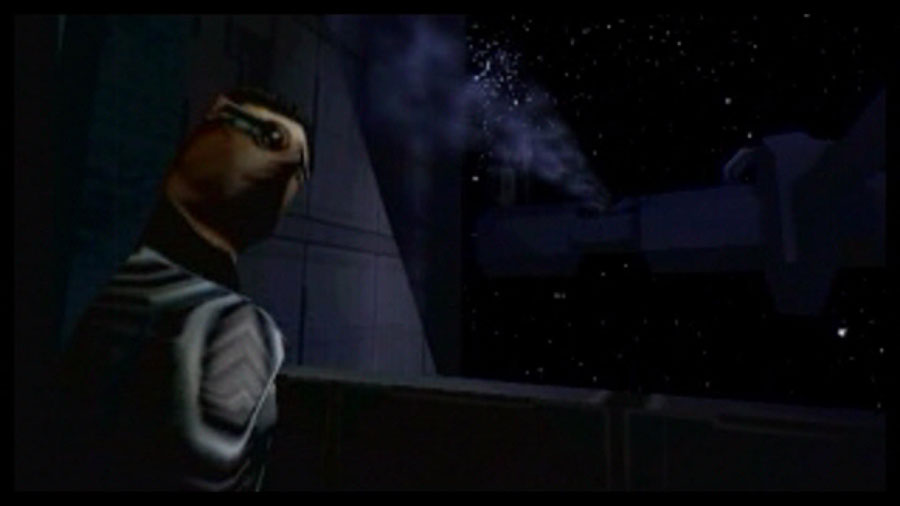
I’m trying to remember a time when this looked amazing.
Luckily for everyone, there is a wide selection of mods out there that more or less brings the game to at least 2004.
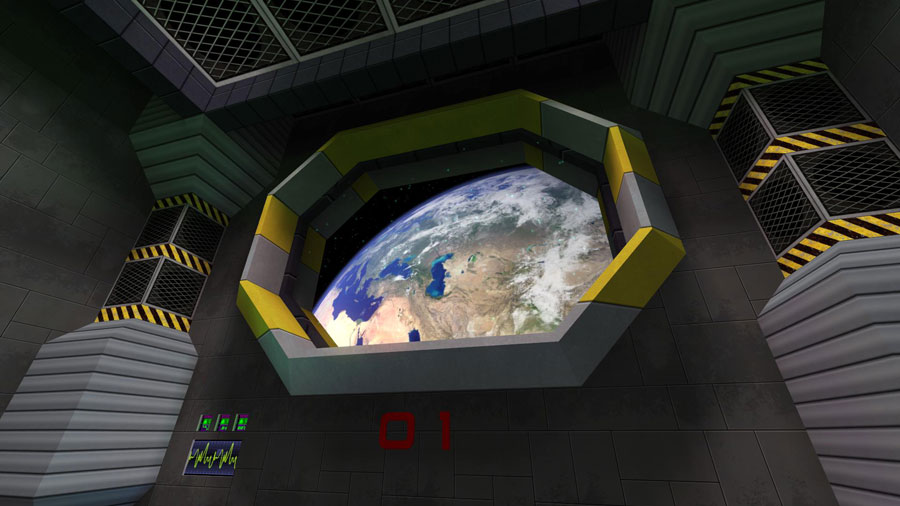
I was actually somewhat impressed.
At this point, I am roughly 10 or so hours into the game and I must admit that SS2 still has value to give. For example: it’s pretty damn scary, but not in the way you might be used to. FEAR has some great moments, Silent Hill definitely gets the horror angle correct, and Resident Evil does “crash through the window” better than most. None of those really capture the unique (as far as I know) dread that is hearing the “whisk” sound of a spaceship door opening behind you. In fact, I find myself developing somewhat of a complex with these doors, as evidenced by nearly jumping out of my chair from the sound of one door – that I had just activated – closing behind me.
Aside from the evil doors, I want to spend a moment and praise the overall sound design of the game in general. For the most part, you can hear nearly every enemy before you actually see them. Which, now that I think about it, is not as common a gaming trope as it should be. What this allows SS2 to do is make the various types of enemies resistant or vulnerable to specific weapons without the player feeling cheated. If you hear a robot walking around nearby and aren’t switching to your energy weapons in anticipation, it’s your own damn fault.
Another thing I can appreciate about SS2’s design is the overall upgrade mechanic. Your character has like four tabs worth of various stats and abilities you can upgrade/purchase with Cybernetic Modules. While you do receive some periodically as “quest” rewards, the vast majority of Cybernetic Modules are stuck in desks, on dead bodies, and sometimes hidden in plain sight on the floor. Combined with a traditional (the de facto back then) non-regenerating health system and the necessity to collect currency for ammo/hacking/etc purposes, Cybernetic Modules provide an immense incentive to explore every inch of the ship. Contrast this with, say, Bioshock Infinite which has painstakingly-designed nooks and crannies without any reason at all to search them.
As an aside, I can understand why some games might not go that route. If you hide a bunch of upgrade currency throughout your game, you are then faced with a dilemma: either that upgrade currency is necessary to realistically defeat the final boss, or it isn’t. If it is necessary, you are forcing everybody to comb your game for supplies, including the people who find that sort of thing tedious. If all the upgrades aren’t necessary, the people who enjoy looting all the things are “rewarded” with trivial encounters for the rest of the game. It is much easier to control your game’s pacing by directly tying upgrades to specific plot points, so no one is ahead or behind. That does make your game more boring and empty however. Hence, dilemma.
In any case, I am likely closing in on the System Shock 2 endgame and should be done in the next day or two. While I do not consider it to be as groundbreaking as something like the original Deus Ex, it is at least in the same parking lot as the ballpark. If you picked it up as part of one of any number of bundles in the last two years, go ahead and spend the 20 minutes or so it takes to set up all the mods and give it a whirl. Part Deus Ex, part Half-Life, and extremely atmospheric.
Winning for Losing
Way back before I got distracted with Crowfall news, Rohan had an interesting few posts exploring the challenges of structured PvP vs transient PvP. Namely, how do you solve the “3rd/4th faction” problem of people migrating to the winning side in structured PvP? The clear answer involves incentives to stay on the losing/outnumbered side, but the implementation is tricky.
Or is it?
I consider one of the gold standards of loss incentives to be Titanfall’s Extraction phase. At the end of each match – be it CTF, Death Match, etc – there is a no-respawn phase in which the losing team tries to make it to a waiting drop ship. If all losing members make it, the entire team receives a significant bonus (less than a win, but not by much). The winning team will of course try and kill the stragglers, but they can also destroy the drop ship and get bonus points. While it is still possible to queue into a complete blowout match in which the other team practically insta-kills the drop ship, most battles end with the drop ship taking off. Not only do the extra points for an Extraction soften the blow of losing perhaps a close match, the psychological reward for “escaping” is immense.
You lost, but you didn’t lose. And, yes, there is a difference.
This might seem weird to say, but I actually enjoy hopeless defenses in many games. Whenever I play used to play PlanetSide 2, for example, I looked for the bases under attack by near-overwhelming odds. From my perspective, such bases present A) easy opportunity for kills in the chaos, B) no expectation for success, C) small chance for epic comeback. Being spawn-camped by tank spam is miserable, but anything less can be great low-pressure fun.
The same sentiment existed even in WoW PvP for me. Being farmed at the Graveyard in WSG is enough to make one ragequit. Dial it back a few notches though, and I found it immensely entertaining simply being annoying, e.g. by tanking DPS as a healer, taking potshots and then forcing someone to chase me for two minutes, and so on. My team might lose, but I still won. Some of my favorite PvP memories was on my Rogue, when I ran around Sapping everyone into diminishing returns and watching their futile attempts at unstealthing me.
All of the above examples (except for PS2) are from transient PvP rather than structured PvP. Still, I think you can achieve a similar incentive structure using the same principals. For example, if a certain team is way behind or outnumbered, start giving them an alternative currency (call it Honor or whatever), or even a bonus to the normal PvP currency. In this way, winning becomes much less of a zero-sum game, and offers an “out” for those players who would, strictly speaking, be better off defecting to the winning side. Plus it would attract goofballs such as myself to hopeless defenses, thereby making the match more entertaining for everyone involved.
[Crowfall] Sweet Summer Child
In the comments yesterday, Scree disagreed with my prediction that Crowfall will have a major “3rd/4th/Nth Faction” problem, saying:
Further, players aren’t going to “give up” as the world draws to a close. In fact, your likely to see just the opposite based on Crowfalls Kickstarter Update #6 which indicates the materials you’ve gathered during the campaign… only a percentage of these transfer over to your Eternal Kingdom. That percentage is based on how you did during the campaign. You want to give up because 3 days are left? No problem, I’ll be happy to move up in the rankings and get more loot.
According to the Kickstarter, the most generous map type allows you to keep 30% of your scavenged goods upon a loss. In the next best world-type, there are 6-12 factions with (presumably) only one winner; the rest are stuck with 25% goods, maximum. It gets worse for the losers from there.
In fact, given how you need to physically haul your loot to the “Embargo area” to bank them – and the Devs even point out how nice of an ambush spot this is, implying either full or partial looting of your corpse – it might be that the winning side simply camps that area too and you are left with whatever you can squirrel away at 3am on a Tuesday. The kicker is that right now the Devs are saying that what loot gets saved at the end is actually random:
Do I have any control over which item(s) are kept and which item(s) are lost from my Embargo?
Maybe. Right now our design is simple: we will randomly select which item(s) and materials will be released and which item(s) and materials will be lost. We could certainly change this design later, to give preferential treatment to certain items based on rarity, size, value or player preference.
Spoiler alert: that’s a terrible idea and will be changed.
The “fix” Scree mentioned in the Kickstarter update is that these percentages are scaled based on your personal performance in the overall battle, including either time spent or when you entered the map (it’s not clear which). This does indeed prevent or at least discourage people from being able to hop into a winning map that is almost over and reap the higher rewards.
However, it does nothing at all in encouraging people to continue playing a losing match.
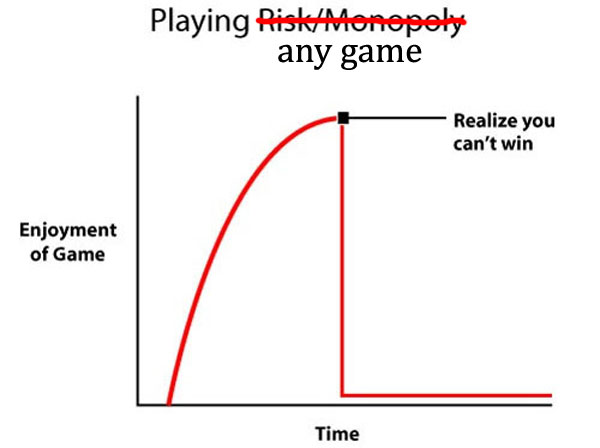
Basically all games.
The problem is simple: opportunity cost. Scree indicates he/she would be fine with me dropping out, as that would make his/her rank go up in the process. But who is really going to be fighting tooth-and-nail for the maximum value of the 25% pie? That would be crazy, especially if I could earn 35% by half-assing a winning map.
There are really no good solutions to this problem, and plenty of ways to make the problem worse. And Crowfall seems poised to do exactly that. For example:
1) Make it easy to hop in/out of maps.
The easier it is to exit a losing map, the more people will do so. As near as I can tell, Crowfall does lock you into a Campaign when you zone into one. I have been unable to quite tell what exactly that means though. Are you locked into that particular map type, but can go elsewhere? As in, can you go into a God’s Reach map and also a The Shadow map? Or are you locked totally down, such that your character ain’t going nowhere for the next three months? The latter might seem the most logical, but take a moment to really absorb what that potentially means to your day-to-day gameplay. You could be stuck in a shitty strategic situation and/or gametype for nearly a quarter of a year, grinding away for that 30% payout months from now. How excited are you for that?
Don’t worry too much though, because the concept of alts lets you easily bypass the restrictions and bail out of the failboat. Is your main doing poorly? Hop on to whichever of your two alts are doing better. Indeed, there is no rational reason to even have a main, considering:
2) Make loot Account-Bound.
This is actually the current Crowfall design. With the resources you gather in these maps being Account-Bound, it actively encourages you to cheese the system via alts as much as possible. It would be dumb to fight hard in a losing battle on your main if you could sail to an easy win on an alt – all loot goes into the same pile at the end, which means your main will benefit just the same.
I’m honestly shocked that Crowfall is heading down this route, especially given how prevalent the alt issue is in other games. I don’t normally believe conspiracy theories, but it’s hard to argue against the notion the Devs are doing this precisely to sell more subscriptions (for the multiple character passive skill gains) by making alt-hopping the best way to play. Put all three character slots into three different maps and play enough on each to get some middling reward, or extra hard on whichever map is a winner. If you have a subscription, you lose zero progress on any character by playing this way.
So what are some potential fixes? Well… there’s not many due to the nature of Crowfall’s design. Alt-hopping isn’t much of an issue in games like EVE and Darkfall precisely because the world is persistent and corps/guilds will likely vet your character to prevent spies. Then again, most EVE players have multiple accounts in the first place, so… maybe not the best example. People drop out of short-lived BGs in other MMOs all the time (and are punished by timers), but since the rewards are tied to the character, there’s not much of a point to switch to alts; switching factions for a win isn’t possible because you’ll never get back into that specific BG anyway.
Crowfall’s uniqueness is this regard presents a uniquely difficult problem.
What is realistically going to need to happen is for the losing (or even just disadvantaged) side to be rewarded with something else. Someone in EVE might fight for pride or survival, but Crowfall’s worlds are temporary. Someone in WoW might realize it’s faster to stick out a lopsided WSG match than the Deserter timer, but Crowfall’s fail states could last weeks. The people making a protracted, futile last stand in Crowfall need to be earning either bonus XP or skill points or perhaps another currency akin to Honor to make their time losing worthwhile.
Otherwise we might just see an emergent, Tol Barad win-trading situation all over again.
Dailies and Long-Term Engagement
In terms of creating an incentive to play, I believe that things like Daily Quests and other log-in rewards are extremely effective. That being said, I also believe it is an open question as to whether such incentives come at the expense of long-term engagement with the game. At least, those are my thoughts after reading the long thorough post by Torvald that is making the rounds.
Players are logging on, feel compelled to go through their Garrison chores, getting those rewards that are placed right in front of them… Even though that very content is not fun and drains their stamina for engaging in other content. It reduces their stamina for engaging in other activities that absolutely require large blocks of time to give a reasonable hope of success. And for activites that don’t absolutely require large blocks of time, so many of those lack structure that the player defaults to assigning them large blocks of time for what it would require to be “worth it” (i.e. very few players want to make a trip for an unstructured rep grind just to grind for 15 minutes).
In this situation, Torvald is talking about WoW players who say “there’s nothing to do” despite there arguably being more things to do than ever before. A player feels like they have to complete the Garrison stuff immediately, lest they forever lose the reward and fall behind. And that is a sentiment that I 100% can relate to in expansions past. Remember the Tournament dailies in Wrath of the Lich King? Or Jewelcrafting dailies? The end goal required X amount of days to reach with few (or no) catch-up mechanisms, so each day you skipped doing them added that much more time to completion.
There is absolutely no question that I logged onto WoW some days solely to do daily quests. Similarly, there is no question that on the days where I logged on just to do dailies that I sometimes ended up hanging out with friends. So, in essence, the daily quests worked in making social situations possible. After all, the death knell of any MMO starts ringing when you no longer feel compelled to log on.
But I can totally feel the other side of this too. When you think about MMO burnout, what is the image in your mind? Did it come from the activities you found fun in the moment? Or did it come from the sense of crushing obligation? If you are having fun every time you play, is burnout even possible?
I hesitate to say that dailies are not fun generally, as I personally find satisfaction in the completion of even mundane tasks. I also enjoy the sense of character progression and the working towards a long-term goal. That said, dailies do in fact take up a non-inconsequential amount of limited play time. If you spend “just” 30 minutes on chores, how much time do you have left for other activities? And how do you avoid the sense of loss (i.e. opportunity cost) that derives from not completing dailies and letting those easy rewards go?
I do not know if there is a solution. The one offered by Torvald is to essentially reduce the number of Garrison chores directly, and then make the remaining ones take longer than a day (e.g. Weekly quests). I did enjoy when WoW experimented with allowing you to complete a full week’s worth of dungeon dailies in a single session, as that allowed you the freedom to either work on other projects guilt-free or only to log on the weekends and still remain somewhat competitive. Then again, I’m not entirely sure how healthy plowing through that many dungeon dailies on Reset Day really was.
It might be cute to suggest “no dailies” but I’m not sure we can really go back. At a minimum, other games will have daily quests and I know people who log onto them to get those easy rewards before logging off and playing the game without dailies. That scenario “drains your stamina” just the same as if the daily-less game had them.
I’m not sure there is a solution here other than the one I’m currently employing: not playing MMOs. Of course, Dragon Age: Inquisition has War Table timer-based quests now too. You just can’t escape.
Time is Fair
Tobold has a series of posts now in which he simultaneously blames players for the failure of F2P games and then denigrates everyone who, you know, plays RPGs for supporting/enjoying “Grind2Win.” Apparently it is unfair for someone who has played an RPG for longer than you to have any advantage whatsoever. I can only imagine what he thinks about XP as a concept.
In short: Tobold is against any form of progression that you can’t buy your way past; merely playing the game more is asking too much.
Perhaps I am being less charitable here, but I consider the entire “debate” to be, quite frankly, insane. If you spend more time reading a book than me, you will be further along in the story than I. That is… logic, working as intended. Meanwhile, time and money are not analogous; the former is distributed equally to all persons and the latter is not. Perhaps you could argue that more money allows for more day-to-day freedom (i.e. time), but that extra freedom still requires one to spend the same hours playing a game as anyone else.
There is literally no more fair a payment than time. Unless you are dying by mid-evening, everyone has the same 24 hours in their day and every single one of those hours is valuable. Conversely, money has a marginal utility such that $10 to one person is a rounding error and to someone else it’s food for the week.
One of Tobold’s complaints is that Grind2Win lessens the importance of skill. Well, yes and no. If two players of equal skill are fighting, the one who spent more time playing the game will probably win. And that’s… a terrible outcome, I guess? A great moral failing of design? I mean, how dare someone who spent more time in an activity have an advantage over someone who has not! A truly Just World would… have exactly that design.
In clashes of unequal skill however, the outcome is usually less clear-cut than what is being assumed here. Outside of level differences in RPGs and time-management games like Clash of Clans, it’s hard to say how big an advantage grinding gets you. Gevlon did demonstrate it was possible to clear an entire WoW raiding tier in blue gear. Indeed, the surprisingly large delta between skill and gear becomes obvious in most MMOs – squeezing in an extra attack per rotation (skill) will almost always trump a blanket 5/10/15% better DPS stats (time). In MMO PvP, 10% more health isn’t going to save you from being dismantled by a Pro Player.
So what Tobold seems to be really upset about is that small band of conflict between a mediocre player who plays a game often and the slightly-less mediocre player who doesn’t. Sorry, I can’t quite get worked up about the “inequity” of that situation. Not only is one’s time-advantage frequently capped – in MMOs via raiding tiers – it is not much to ask a player to… play the game. Even the most skilled Chess player in the world has to, you know, play a lot of Chess matches to move up the ladder.
All of this really ignores the fact that “Grind2Win” doesn’t even exist as a monetization strategy on its own. Without a cash shop bypass, “grind” really means “pacing” – you can complain about the pacing being off or too slow, but that’s about it. You can’t even argue that MMOs like WoW have weekly raid lockouts to milk subscriptions because it makes no sense. The world-first competition is over within a few resets, long before anyone can “grind” anything. And then the entire tier lasts six months or more, leaving plenty of time for anyone else that cares to get all the gear they want/need. The only scenario that one needs to be suspicious of is when a task is made arduous while there is a cash-based workaround.
The bottom line here is that Pay2Win and Grind2Win are not “equally unfair” and its insulting to even suggest it. I know it sucks to lose to a “no-lifer” who is really a human being that has spent more time playing a game than you, but it’s not even in the same league as someone buying their way to the endgame. A hundred dollars to a F2P whale is not of equal value to a hundred dollars from someone living paycheck to paycheck. Hours spent, though? That’s a direct correlation with how valuable a given activity is to you. And if you are unwilling to spend the time on something, what are you even complaining about?
Detective Vision
About halfway through this already worrying Kotaku article regarding The Witcher 3 is a section on Geralt’s “Witcher Vision”:
Witcher Vision is pretty cool. At any given moment, you can hold down a button to put Geralt’s field of vision into a sort of detective mode. This lets him see footprints, clues, key items, and the like. In practice, sleuthing around various environments—be they houses, dilapidated beach huts, or seemingly inconspicuous forests—isn’t very challenging, but it adds a lot to the feeling of being a Witcher.
All I could do was release a heavy sign and massage my temples.
“Detective vision” and its equivalents has never been good game design in any game I have ever played, for one specific reason: there is hardly any incentive to ever turn it off. Games with detective vision usually have hidden treasures and/or secret doors that are only visible in detective mode. This makes sense in a twisted-logic way, as why have detective vision at all if you can only use it in certain prescribed areas? That is basically “Press B to solve puzzle.” Of course, you don’t want to give players an ability that’s completely useless outside of specific zones either, for the same reason you don’t craft an elaborate cave complex with no treasure chest at the end. That’s just frustrating.
But the end result is that designers hide invisible things throughout the game because they feel they have to, and then the players end up spending the entire game with detective vision active so as to not miss these invisible things. Which means not only is nothing of use being accomplished (the actions cancel each other out), the player ends up spending the entire game in a sepia-colored wasteland devoid of all detail or immersion.

The bad guys may as well not even have character models.
Case in point: Batman Arkham Asylum. Played and beat it a few months ago, but I couldn’t even really tell you how the game looked, because I was in X-Ray vision nearly the whole damn time. Case in point: Dishonored. The Dark Vision spell is an early upgrade that trivializes even the highest difficulty, no-kill runs. Beautiful game environments reduced to sepia-colored vomit for the whole rest of the game. Hell, I didn’t even like the scan mechanic all the way back in the first Metroid Prime game for these same reasons. I just ran around trying to scan every damn thing, just in case.
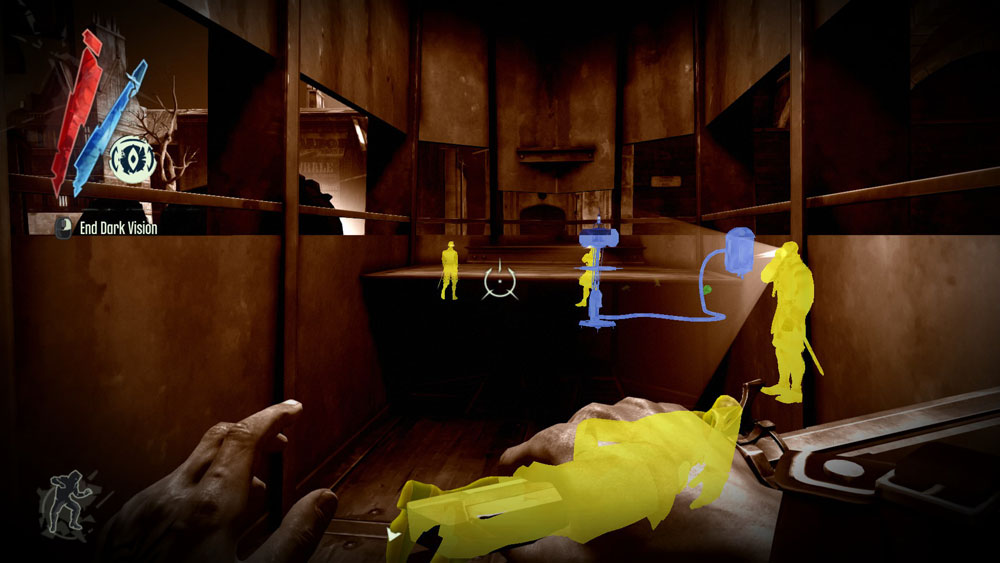
Around 90% of the time, your screen will look like this.
I honestly see no good solutions for this design issue. Even if you limit the player when they’re using detective vision (e.g. not letting them attack, or perhaps even move) that doesn’t stop players from feeling like they need to be utilizing it at every opportunity. Only allowing detective vision to be useable when there is something to detect is kinda asinine; why bother including it at all?
None of the solutions feel particularly good. One might think that the “search pulse” ability featured in Dragon Age: Inquisition, the original Witcher games, and many others might be better, but… I spend the whole damn game spamming those keys already. Same deal with the Battlefield series and PlanetSide 2, in spamming Q to spot enemies that I don’t actually see, but could be out there somewhere near my crosshairs. Sometimes it saves your life; there’s no reason not to.
This might well be one of those scenarios in which the “old school” solution of just making hidden things hard to find is best. At the same time, I don’t necessarily want to go back to the days of having to tab out and hit GameFAQs when I can’t find the pixels the designers wanted me to click on either. If I had to choose though, I would rather miss hidden treasure because I was too immersed in the game environment than miss it because I took a break from the otherwise permanent Instagram filters.
Tautology of Value
Keen has a post up on the nature of F2P that, at first blush, reads as a truism. Namely, that one should be suspicious of any F2P title – after all, if the developers thought it were a valuable product, they would be pricing it accordingly.
Why do we have to pretend games are free or better yet that they have to be free in order for people to want to play them? MMO gamers are capable of identifying whether a product is worth being paid for or not. A good product will sell. A poor one will not.
This prescriptive sentiment has always bugged me. In one of the comments someone else asserts:
A great product will sell itself.
These all read as tautologies to me. How do you know if a game is great? It sells itself. And games that sell themselves are great, by definition.
…except we all have examples of underrated masterpieces, and garbage that sells millions of copies every year. Unless we are ready to admit that Star Wars Galaxies was terrible and Candy Crush Saga is one of the best videogames of all time, we need to decouple a game’s quality from its sales performance. There is correlation on a good day, but just as often there is not.
Similarly, the trend towards F2P is not necessarily one of naked greed and cynicism. I will be the first to admit that I prefer the antiquated “buy the box” or subscription models, as I believe it properly aligns developer incentives (i.e. make better content vs more cash shop items). But in 2015, there is one reality every developer must face:
1) F2P competition exists.
If you are all set to release a subscription-based MOBA in an environment where League of Legends still exists, you are going to have a bad time. The same is true for subscription-based MMOs these days. It is easy to claim that Wildstar (etc) failed not because of the subscription model, but because it wasn’t good enough to justify a subscription model. But that still sounds tautological to me. “If the game was good, it would not have failed.” Or to shorten it: “If it were good, it would not be bad.”
In the present MMO environment, it isn’t enough to simply be good – one has to be as good or better than all the alternatives, many of which are F2P. This is especially salient in MMOs considering the social dynamics are pretty much the only reason why you would continue playing the game. We can imagine a scenario in which the perfect (to you) MMO is released… but it ends up as a ghost town, and subsequently loses most (or all) of its value.
Which makes this part of Keen’s post a little ridiculous:
Charging for a game is absolutely acceptable, and it won’t dissuade people from playing.
Of course charging a subscription or box price will dissuade people from playing, else lowering prices would not generate any increased sales. Obviously there are people out there willing to purchase $60 titles on Day 1; what is less obvious is whether there are enough. Unless you are willing to settle for Minecraft, most MMOs are released with $60+ million price-tags which need to be recouped by volume. Populations in the 100,000 range simply can’t cut it anymore, nevermind the negative social effects of low server concurrency. It is quite a pickle that you place MMO developers in when they either need to craft a more valuable product than WoW (etc) or go with an extremely low-budget project… which will still be called a failure anyway due to low sales volume. “A good product sells,” remember?
Overall, I do think the warning vis-a-vis F2P games is sound – there is no payment model better suited to erode consumer surplus than F2P. And there are certainly a million and one examples of very bad, very cynical F2P cash-grabs. But I do not agree that good games necessarily sell (or sell themselves), I do not agree that sales is necessarily an indicator of quality at all, and I would suggest that developers have many perfectly valid reasons to “give their product away” even if they could have charged for it. In fact, they very well may have to these days, just to get enough warm bodies in the door to achieve the social critical mass that MMOs require.


Dynamic vs Random
Feb 23
Posted by Azuriel
Keen has another post up lamenting the stagnant nature of modern MMO game design, while suggesting devs should instead be using ideas from games that came out 15+ years ago and nobody plays today. Uh… huh. This time the topic is mob AI and how things would be so much better if mobs behaved randomly dynamically!
The big problem with dynamic behavior in games is that it’s often indistinguishable from random behavior from the player’s perspective. One of the examples from Keen’s post is about having orcs with “hidden stats” like Bravery vs Intelligence that govern whether they fight against multiple players or call for backup. Why bother? Unless players have a Scan spell or something, there is no difference between carefully-structured AI behavior and rolling a d20 to determine whether an orc runs away. Nevermind how the triggers being visible (via Scan or visual cues) undermine all sense of dynamism. Big orc? Probably not running away. If the orc does run away, that’s just bad RNG.
There is no way past this paradox. If you know how they are going to react based on programming logic, the behavior is not unpredictable. If the behavior is unpredictable, even if it’s governed by hidden logic, it is indistinguishable from pure randomness. Besides, the two absolute worst mob behaviors in any game are A) when mobs run away at low health to chain into other mobs, and B) when there is no sense to their actions. Both of which are exactly what is being advocated for here.
I consider the topic of AI in games generally to be one of those subtle designer/player traps. It is trivially easy to create an opponent that a human player could never win against. Creating an opponent that taxes a player to their limit (and not beyond) is much more difficult, and the extent to which a player can be taxed varies by the player. From a defeated player’s perspective, there is no difference between an enemy they aren’t skilled enough to beat and an unbeatable enemy.
You have to ask yourself what you, as a hypothetical designer, are actually trying to accomplish. That answer should be “to have my intended audience have fun.” Unpredictable and tough mobs can be fun for someone somewhere, sure, but as Wildstar is demonstrating, perhaps that doesn’t actually include all that many people. Having to memorize 10+ minute raid dances is bad enough without tacking convoluted mob behavior outside of raids on top. Sometimes you just want to kill shit via a fun combat system.
Themepark MMO players enjoy simple, repetitive tasks – news at 11.
Posted in Commentary, Philosophy
9 Comments
Tags: AI, Dynamic, Game Design, RNG, Wildstar, WoW