Beta Impressions: Wildstar, Part 1
So I have been “in” the Wildstar beta for a while now. My motivation to play it has been pretty low though, for a few reasons. First, the strong NDA meant that really even hinting that I was playing it could revoke not only my own beta pass, but also that of the person who gifted a pass to me. Second, I find myself growing increasingly stubborn when it comes to overcoming (or even learning) game mechanics/designs that I find annoying.
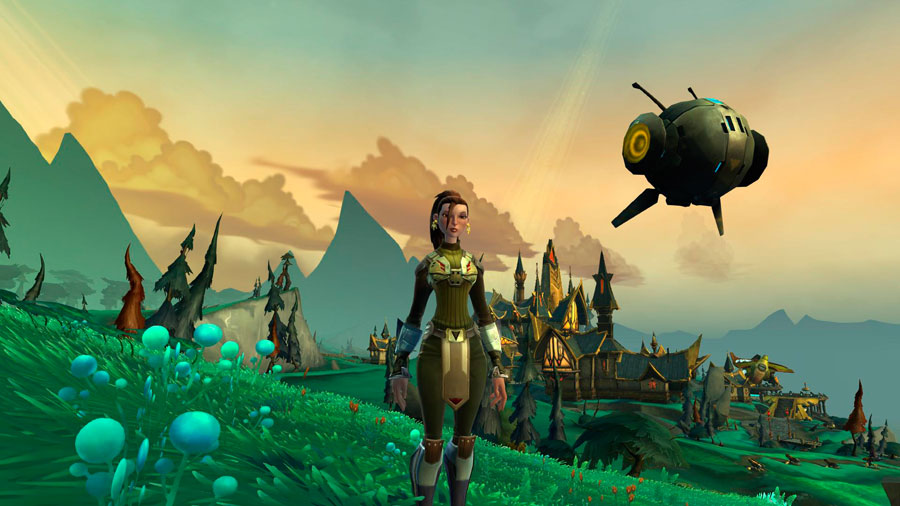
Almost like Wind Waker…
Before I get into that though, let me frame my experiences. On the whole, I fully expect Wildstar to be a great themepark MMO. The art style is bold and gamey, but also fun in a well-made way. Wildstar sort of doubled-down on the whole “floor AoE effects,” but it works on an intuitive level pretty quickly. Games like The Secret World and Guild Wars 2 had the same floor effects thing, but the relative rarity meant it always felt gimmicky rather than integrated. When you’re applying Expose Weakness from Stealth to every enemy in a long column and your other three attacks all have cone targeting however, you get into the positional mindset pretty quickly.
Speaking of stealth, I picked the Stalker, aka Rogue, as my first class because stealth mechanics are one of those things that can inadvertently break games or otherwise indicate how serious the designers take mechanics. I can’t say much about long-term viability since I never got past level 10, but I can tell you that Stealth lasts indefinitely and has no cooldown outside of combat. Compare that to the Thief in GW2 and draw your own conclusions.
Overall, combat is fun and visceral in that ineffable WoW-like way. Attacks have punch. The world is pretty populated with things to click on and interact with. I chose the Scientist “path,” which means I need to have a camera bot go scan stuff in the environment occasionally. Worlds look like worlds, with hills, mountains, and secret paths. The general game attitude is WoW meets Borderlands, especially when it comes to the Level Up prompt. You can double-jump. And so on.

Good job on further minimizing quest text, Carbine UI Dept.
It’s the little things though, you know? It’s one thing to have a Twitter-length quest text, but it’s another to have that and make it hard to read the dialog boxes. Who the shit thought it’d be a good idea to put most of them at the top of the screen? Then, you’ll get ambushed with Challenges out questing, which have universally been “kill X mobs in Y amount of time.” Every time it has happened, I stopped looking around at anything else and tunneled my way to the finish line, only to forget what I was doing afterwards. Which isn’t a big loss given the lack of quest text, I suppose, but I sorta felt like the content was on a conveyer belt and I had to act on consuming it immediately. The fact that you can click on your quest list and get a directional arrow plus rangefinder means you don’t really need to even understand where you are or what you’re doing anyway.
Then I leveled up, unlocked a slew of new Skills, and have since leveled up twice more without having encountered a Skill Trainer to actually unlock said Skills. “Ah. This is still a thing, then?” Hell, I don’t even know how I would go about looking for a Skill Trainer. My Stalker is currently logged off in what I assume to be a quest-hub city, and my cursory tour of the place has not revealed a Skill Trainer. Do I spend 30% of my meager wealth taking a taxi to the capital (last known location of a trainer)? Or do I continue leveling and hope that I’ll eventually run across a trainer in the next half-dozen levels? And who the hell thought this arbitrary bullshit was worth fishing out of the garbage can of bad MMO design?
Seriously, if your Trainers are glorified Skill vendors, it’s not worth implementing them. Maybe if each Skill required you to practice on a training dummy or otherwise integrated into your game’s fiction somehow, then it would be worth it.
I understand such complaints might seem pretty weak and hyper-specific, but that’s where my head is when it comes to MMOs these days. I have abandoned all pretenses that any specific MMO is ever going to be the MMO, or that I even want one to be, so it’s getting difficult to muster up enough cares to dance around their various idiosyncrasies. Given how the beta is getting turned off this week though, I’ll put some more time into it and see what develops.
Reviews: RAGE, Crysis, Sanctum 2
Game: RAGE
Recommended price: $0; bundle
Metacritic Score: 79
Completion Time: 13 hours
Buy If You Like: Racing games with FPS elements
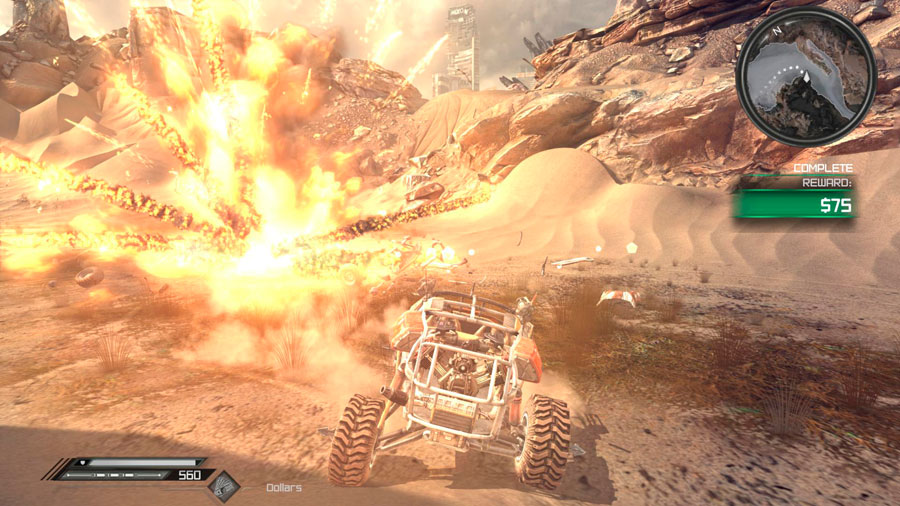
What you’ll be doing most of the time.
RAGE is a simplistic, 27gb racing game with some FPS bits tossed in.
Perhaps that is not entirely fair. If you include all the time you spend backtracking through the same exact environments, Halo-style, the game probably comes out to be 51% FPS or thereabouts.
In RAGE, you take control of a mute super-soldier who just woke up from cryo in the post-apocalypse future. After being rescued from some blood-thirsty raiders, you join the most generic-named faction in the world, the Resistance, to fight against the second-most generic-named faction, the Authority. Apparently the “Ark” containers (like the one you were on) were all supposed to be opened at the same time to usher in a new age of civilization. Turns out other Ark survivors somehow stopped that from happening, thus establishing themselves as rulers over the populace that apparently didn’t need space technology to survive the apocalypse.
Technically the above is a whole mess of spoilers, but considering there is literally no other plot, no character development, no competant writing, or really any redeeming factor for the game, it becomes necessary to work with what you got.

The set pieces can be kind of cool.
I take that back. There is precisely one thing RAGE got amazingly correct: melee enemies that are legitimately scary. The typical FPS that features melee enemies usually has to rely on them being bullet sponges or incredibly fast to compensate for their lack of cover-usage. In RAGE, melee enemies dodge back and forth, run up the walls, swing from ceiling fixtures, and otherwise make you reevaluate your damn-near-futile attempts at shooting them in the head. While I’m sure a lot of their acrobatics came down to heavy environmental scripting, it’s still something I’d like to see in games going forward.
What I would not like to see ever again is such a piss-poor implementation of damn near everything else. Little things start to grate on your nerves, like how pressing Esc brings up the main menu instead of canceling out of the Tab menu. Or like how you can hit Esc, choose Quit Game, and then it takes you to the Title screen where you have to hit Enter and then Quit Game again just to leave. Or how you have the ability to jump in the game, but not enough height to actually jump over anything 99% of the time.
I can appreciate the devs rebelling against the “only carry two weapons” FPS headwinds, but out of the nine weapons, eight of them have at least one extra type of special ammo. The crossbow carries normal arrows, explosive arrows, electric arrows, and mind-control arrows. Cool… except there is exactly one stage that allows electric arrows to do anything special (the stage they’re introduced in), and the vast majority of the enemies you fight after getting mind-control arrows are either immune to the effects or infeasible to use against.
In the end, RAGE doesn’t know what it wants to be or to do, and neither do I. Well, other than wishing I was playing something else. If you can grab it as part of a bundle, it’s worth checking out the legitimately scary melee enemies. But I wouldn’t necessarily give up a box of Girl Scout cookies for the privilege.
_____________
Game: Crysis
Recommended price: $0; bundle
Metacritic Score: 91
Completion Time: ~15 hours
Buy If You Like: Benchmarking your PC, Sandbox-ish FPS games
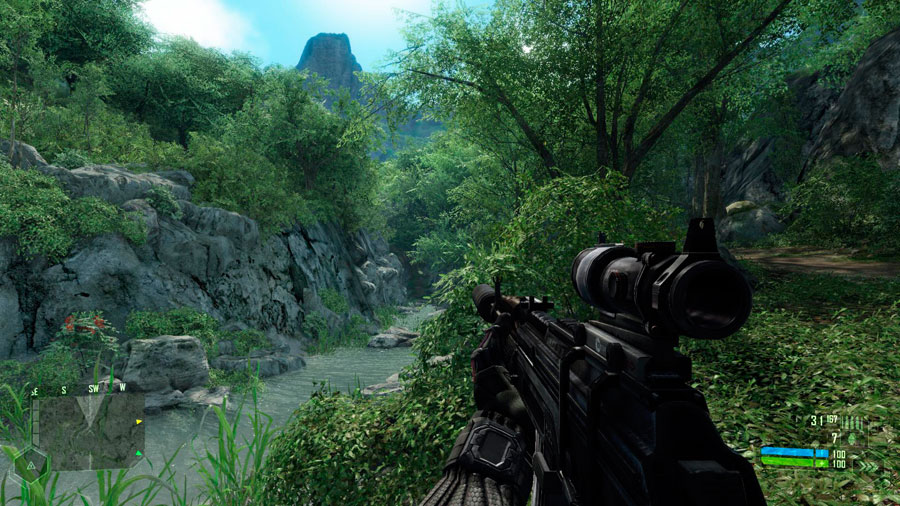
Seriously, 2007, folks.
Crysis came out in 2007, nearly seven years ago, and was the long-reigning benchmark of PC gaming everywhere. Not necessarily in terms of gameplay, but literal benchmarking – if your rig could play Crysis on High, you were hot shit back in the day. Crysis 3 was out for months before I acquired the original in some Steam sale or another, but I wanted to give the original its due, especially considering I finally had a computer (in 2012) that could run this beast.
Unfortunately, Crysis on Steam caused me considerable issues. I honestly cannot begin to recount exactly what steps were required, but I know some modding and 3rd-party downloads had to be done before the game would even boot up. Even when it deigned to boot, I experienced a C2D event roughly every hour or two on top of game-stopping bugs like missions not ending correctly.
Outside of those issues though? Damn, people weren’t kidding about the graphics thing. I mean, the game basically looks kinda like Skyrim, but Skyrim was released in 2013.
What I was really surprised by was the general gameplay though. Crysis is a FPS game where you control an elite soldier equipped with a nanosuit that has a handful of alternate abilities like cloaking, super-strength, super-speed, etc. Unlike perhaps every other game in existence though, you get all of those abilities right at the start. Indeed, most of the game consists of you getting a primary and secondary objective on a large map and being told to hop to it; the pseudo-nonlinearity really reminded me of the original Far Cry. This leads to the game feeling rather easy though, as for the most part you can abuse Cloaking and jungle-hiding to take out basically every enemy in the game, especially considering the suit provides regenerating health.
Overall, Crysis is FPS in which what you do in the first 30 minutes of gameplay is the same thing you’ll be doing in the last 30 minutes of gameplay. The graphics and environments are phenomenally well-done, but I’m not entirely convinced it would be worth the headache of installation unless you want revenge on its at-the-time insane PC requirements.
_____________
Game: Sanctum 2
Recommended price: $0
Metacritic Score: 77
Completion Time: 10 hours
Buy If You Like: Console ports of a dumbed-down sequel
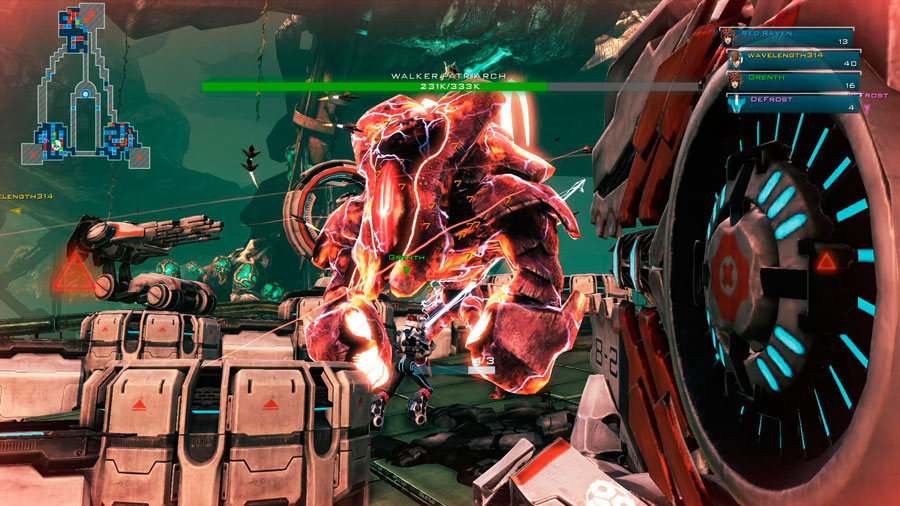
That 15-tower limit is fun in multiplayer, let me tell you.
The original Sanctum, along with Orcs Must Die that was released around the same time, really sparked my interest in Tower Defense as a genre. Prior to that, Tower Defense was just associated with those annoying missions in RTS games that always seemed too hard or too easy. But Sanctum? Here is Tower Defense where you can not only build the maze yourself, but actually get down and dirty with shooting the bad guys. And multiplayer! So fun.
It’s just rather unfortunate that Sanctum 2 ended up being the sequel.
I have not even bothered to investigate it, but Sanctum 2 <i>feels</i> like everything that goes wrong with console ports of otherwise great PC games. There are four characters to choose from, each with various innate abilities and a main weapon that cannot be swapped out. Want to use the Sniper Rifle and Missile Launcher? Nope, that’d be too complicated. Instead of getting a pile of resources and having to carefully consider their application – do I build an extra-long maze, or upgrade all my towers? – you specifically get X number of wall units and Y amount of resources to apply to 15 deployed towers maximum. Oh, and everything is a tower now; there aren’t any floor traps (unless you count landmines).
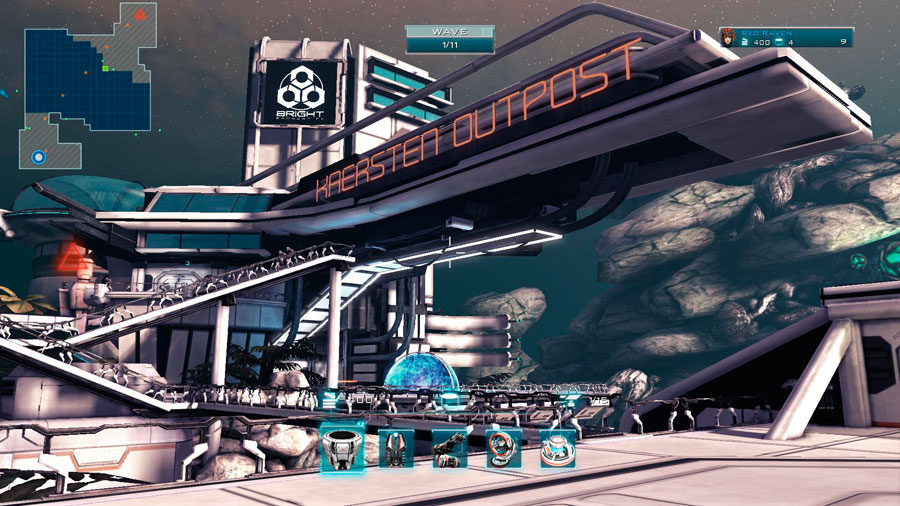
Four walls and 400 resources? Gee, thanks, I’ll get right on this maze.
I can understand the logic behind most of these changes, as it pretty much universally speeds up the matches. “You can build 8 walls and drop maybe 2 towers this round, good luck.” I can wrap my head around breaking characters into distinct classes, as perhaps a way to foster more teamwork. The designers even took the time to introduce a Perk system to allow a bit more customization with characters. And hell, the ability to voluntarily buff enemies (sorta like in Bastion) to gain more XP is a pretty clever difficulty switch.
But at the end of the day? The game still felt like a truncated console port. I found a rather ridiculous combo of perks and weapons early on and sailed through the game with the exception of a few maps that had surprise bosses in them (most of which can simply destroy your maze walls). The tension between adding more walls or more towers afforded a surprising amount of strategic depth to the original game, and it’s simply absent here. In short: a lot of the things that were fun in Sanctum are replaced with either not-fun things or simply missing altogether.
_____________
Hearthstone is Released, Weirdly Balanced
So the blues weren’t kidding about Hearthstone being released Soon™… because it came out today. Surprise!
Speaking of surprises, the patch notes were somewhat full of them. Or rather, not full of them, which itself is surprising. The most obvious changes were to two Legendary cards I talked about last month: Nat Pagle and Tinkmaster Overspark. Pagle’s nerf was brilliantly subtle, taking the form of moving the card-draw coin-flip from the end of your turn to the beginning. It almost doesn’t feel like a nerf at all, but the reality is that Pagle isn’t likely to be haunting the upper echelons of tournaments any longer; that one extra turn of being able to deal with Pagle before the draw engine full gets started is actually pretty huge.
In contrast, the Tinkmaster nerf has all the subtlety of Jay “And double it!” Wilson game design. Which may as well have been the case, since the card was “fixed” (in the veterinarian sense) by doubling the RNG.
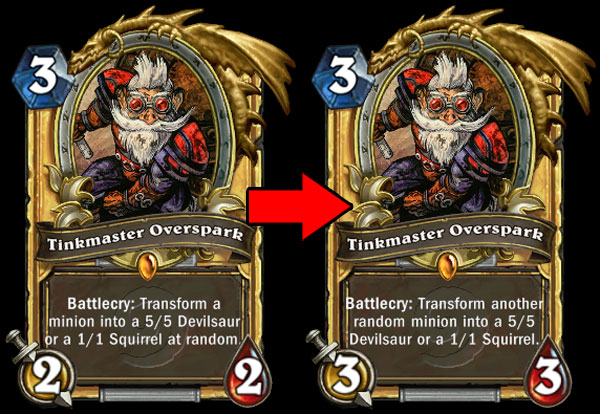
From hero to zero.
Where things get interesting is the peek into the Hearthstone card balance logic when the blues explained the Tink nerf:
Tinkmaster is a neutral card that silences and often shrinks big creatures. This reduces the amount of big, fun creatures in the environment. We think this change will increase the amount fun creatures in the environment, and bring him more in-line with his cost and overall power. Tinkmaster should still show up in certain types of decks, but will no longer be appearing in every high level deck.
While they did talk about cost and overall power at the end, the main concern was how Tink was “reducing the amount of big, fun creatures in the environment,” e.g. other Legendaries, presumably. Cards like Ragnaros and Ysera are win conditions in of themselves, and have pretty much gone unchanged since they were introduced; people who were holding out hope that perhaps these Legendaries would get the Pagle treatment seem out of luck. Hearthstone is not Magic: the Gathering, of course, but it appears this fact will need to be repeated a few more times before it fully sinks in.
And speak of the devil:
Secrets can now only activate on your opponent’s turn.
- Activating your own secrets feels a little strange, but mostly, the ability to do this was preventing us from creating new and powerful secrets that trigger off of events you can easily control (like a minion dying). They end up functioning just like spells, instead of trying to bait your opponent into a bad play. This change keeps secrets working like traps you lay for your opponent, instead of spells that you cast and use on your own turn.
I would characterize this Secret change as a huge Paladin nerf, but Paladins are pretty much nonexistent at high levels of play, and their Secrets are gimmicky at best. However, this change turns those gimmicks into Disenchant material. For example, Redemption is a Paladin Secret that says the next minion of yours that dies, gets brought back to life at 1 HP. Pair that with a value creature with Charge like Argent Commander, and you can suicide into a minion and come back to deal some extra damage. Or, of course, you could use Redemption with a Legendary for some serious card advantage.
Well, not anymore.
In any case, Hearthstone is out, it’s fun, and it’s F2P for US audiences… and merely Free-to-Download, In-App Purchases Optional (F2DIAPO) for those in the EU. Blizzard is offering a WoW mount for those willing to get rolled by beta veterans until three wins are grinded out, so there’s that too.
Hearthstone and other Game News
According to the Blues, Blizzard’s F2P “Free to download, optional in-game purchases” Hearthstone will be released for real in a matter of weeks:
How close to the end of the beta are we? Don’t need an exact date, because I know that would be horrendous, but is this a matter of days or weeks or months?
I can’t say exactly, but it is soon. Not months.
Although there are a number of annoying bugs still kicking around, I have largely considered the game to be ready for Prime Time since the closed beta. The level of polish when it comes to sound effects, the implied physicality of the game pieces, and everything else is pretty astounding considering the size of the development team. For a while there were rumors floating around that the game wouldn’t be released until the iPad version was up, but it seems like that might be referring to the planned single-player Adventure Mode.
Whatever the case, I am very much looking forward to the release and any potential card tweaks that might go along with it. To an extent, it’s easy to sit on the sidelines and call the release of new card sets/expansions as “greedy,” but goddamn does it get annoying after a while when you see the same dozen cards get played in game after game. The metagame is in a healthy state of flux, but the core staples of most every deck do not.
In news that I likely care about more than any possible reader, apparently there is a 4th (5th?) entry in the Deception series called Deception IV: Blood Ties and it’s being released this month. While it is obscure as hell, the Deception series was a set of rather groundbreaking PS1 games that were the precursor to games like Orcs Must Die. Essentially, you set up a number of nefarious traps in a mansion and then must lure trespassers to their doom by controlling an otherwise unarmed Gothic lady.
Here’s a video from Kagero: Deception 2, which is the sort of foundation of the series:
The graphics were pretty hideous even by the time the 3rd game was released, and the plot was Japanese nonsense, but the gameplay? Equal parts brilliant and hilarious. A large part of the game revolved around chaining trap combos, both because traps had cooldowns and because getting the bonus currency was required to unlock more traps/upgrade existing ones (and there was no farming). A fairly simple chain would go like this:
- Bear Trap at bottom of stairs.
- Giant Boulder crashes down stairs, knocks target into back wall.
- Push Wall knocks target back onto Bear Trap.
- Repeat.
Sounds quaint, right? Well, it should, considering Deception started doing it in 1996 and Kagero in 1998. Those were good years – FF7 was 1997, FFT was 1998 as was Xenogears.
…all of which happened almost 20 years ago. Sigh.
No Such Thing as F2P Anywhere…?
The comments to yesterday’s post about a EU regulatory body’s intention to crack down on the use of “free” in game descriptions were rather illuminating.
As you may or may not have known through prior posts, I vastly prefer the “B2P” model (e.g. the default) to F2P because the latter is associated with (IMO) compromised gameplay mechanics that serve no intention beyond the enforcement of the payment model. Plus, I cannot turn off the parsimonious part of my brain when it comes to purchasing things, thus frequently leading me to extreme and, frankly, insane behavior to save a literal handful of dollars that would have been eagerly frittered away en mass in other contexts.
That said, both eyebrows were fully cocked at what I was reading yesterday:
Saying you can play LoL for free is like saying Spaghetti Bolognese is a vegetable meal because you can just choose to not eat the meat part. I’m sure the EU doesn’t allow you to label Spaghetti Bolognese as a vegetable meal.
F2P has become a buzzword added to everything, completely useless in providing information as if you can really play for free, so it’s not that bad if they force producers into labeling their games into something more informative.
No for-profit product or service should ever be generically described as “Free”. It breaks the language.
“Where is the confusion”, you ask. Lawyers are very good at finding the confusion. Leaving the definition to be argued in court would be sure to burden games players and EU taxpayers with the very expensive costs of both sides of such a court case.
Regarding that last one, it is indeed true that Apple ended up settling their court case with the FTC for $32.5 million this year over in-app purchases (IAP). I suppose there is something to be said about “kids games” having IAP and potentially targeting children specifically, but I can’t help but wonder if companies other than Apple are being held accountable for the children of parents who hand them credit cards unsupervised. And to what degree court cases like this justifies the UK banning of porn. It just sorta seems like a concession that adults are incapable of being responsible parents by default; I mean, you’re either not monitoring their phone/game usage, or you’re not utilizing both Apple’s and Google’s ample parental controls before you hand over the small supercomputer to a seven year-old.
Let’s dial the politics back a bit though, as I want to focus on F2P. Or rather, how it apparently does not exist.
It was Bhagpuss that quipped that second to last quote, regarding how the term F2P “breaks the language” because it has free in the description when you can’t actually play for free. Or you can, but since the company is for-profit, it’s misleading. Just like those “free samples” in grocery stores. Or my anti-virus program. Or, I suppose anything at all from any for-profit company as we can assume they’re making money somewhere along the line. To be charitable, Bhagpuss suggests that the way games are labeled will be changed to accommodate the new rules, by making them say “Free to download, IAP optional.” Which they pretty much already do:

Just picking a game at random.
My question from the prior post still stands though: where are the EU-approved (no-IAP of any kind) free games? I poked around the Google Play store for a bit before running into an old stand-by that pretty much highlights the gaping holes in the EU commission’s logic: Where’s My Water?

It’s worth getting the full version.
Hey, look! No IAP at all! EU 1, Disney 0. Of course, scrolling down a bit, we see…

Sneaky, sneaky.
I’m actually pretty sure that I’ve seen these sort of “free trials” or demos for game apps long before IAP were ever implemented, so there’s a certain symmetry to companies circling back to what worked before. Because, let’s face it, if in-app advertisements are fine, advertisements for the full version of the game you’re playing (and others) are fine too.
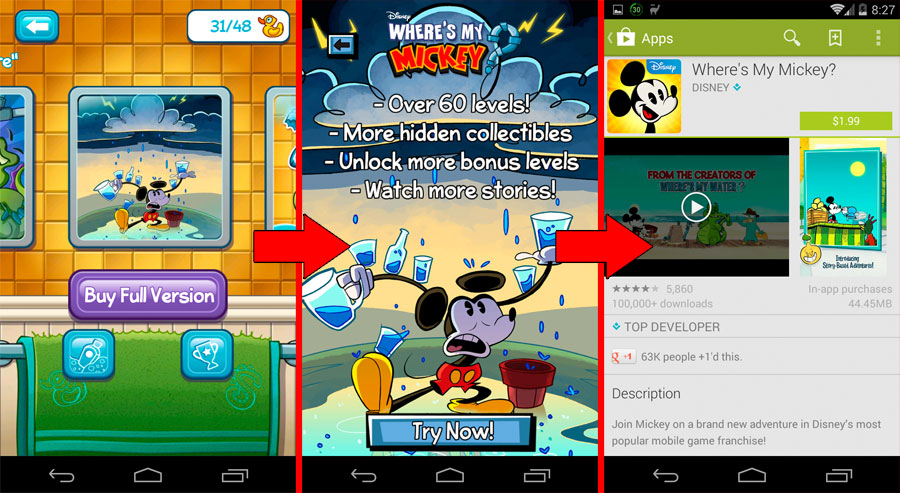
Feels almost like those old Shareware games.
As you might expect, the completely and totally free version of Where’s My Water? is a severely truncated mess that plays full-screen video advertisements every 2-3 stages you complete, followed by level selector that ends with a link to a paid app and the Where’s My Water? 2 sequel. At least they’re not selling gems though, right? Sure. But there’s no reason to suggest that they couldn’t advertise the full, “Try Now!” version that is also free to download with all its microtransactions intact. Considering that even a child will burn through these IAP-removed “free” games within 20 minutes, and they can still navigate to the app store via handy in-app advertisements to purchase the “full” IAP game within moments, I have to start wondering if the language is worth saving. Seriously, I was three clicks away from purchasing either a new game or the unlocked version of the one I was playing.
I mean, what, will the EU disable click-through advertisements next? If they did, that would actually be pretty amazing. They won’t though, because they can’t, and since this entire concern is predicated on children being able to circumvent their parent’s (likely nonexistent) IAP prevention measures, it won’t stop kids from buying the entire App store.
In which case we’ve come full circle, minus the word “Free,” while doubling the number of ad-riddled Shareware in App stores. So… success? Or maybe they could have simply mandated that IAP (and ad-supported) filters be more prominently displayed, so that reckless parents have one last chance at sanity before they download just anything and let it babysit their child for hours.
No Such Thing as F2P in EU
The European Commission is in the beginning stages of passing down a mandate on F2P games, with the following as perhaps one of the definitions:
“The use of the word ‘free’ (or similar unequivocal terms) as such, and without any appropriate qualifications, should only be allowed for games which are indeed free in their entirety, or in other words which contain no possibility of making in-app purchases, not even on an optional basis,” they wrote.
Now, I am about as pro-consumer as you can possibly get, but this… seems a bit off.
For one thing, where is the confusion? It’s called Free-to-Play and all these games – even the one with really manipulative, coercive business models – are literally free to play. It seems like kids being lured into purchasing in-game items is the thrust of the legislation, but I’m not entirely sure what about that gets solved by labeling these games as “Freemium” or whatever marketing term fills the gap. They will still be free to download, parents will still be dumb and leave their credit card info auto-filled in or account signed on, and kids will still be manipulated to do things.
In fact, I’m kinda curious as to what possible games truly fall under the “unequivocally free” category. In-app purchases will disqualify you, but the game designers are getting paid somehow, so… what? Rampant and misleading in-game advertisements are okay? Maybe affiliate links to Amazon pages with one-push purchasing of an Angry Birds plushie? Do donate buttons count as in-app purchases? I mean, little Johnny might get confused and push the Donate $20 button a few times in a fit of youthful exuberance.
While I do not like the implicit design channels that F2P inevitably inform (payslopes, time walls, extra grinding, etc), I’m completely fine with the term itself. And it seems somewhat dishonest to put League of Legends into the same category as Clash of Clan derivatives, just because the former happens to have cosmetic purchases. Have a special “IAP-supported” filter criteria if you must, although I’m not sure if those searches will turn up anything these days. I mean, the last time I saw any truly free freeware was either on 3.5″ floppy disks or a random CD in my Captain Crunch cereal.
Dry Watercooler
The latest Dev Watercooler is out concerning major changes in the upcoming WoW expansion, and yet it is one of the most content-free ones I have ever read. I’d say it was all bones and no meat, but you can usually suck some marrow out of bones. But this? This tells us nothing. And so we’re going to have to fill in the blanks with our own rampant speculation.
Stat Squish
There is but one new morsel concerning the Stat Squish (emphasis added):
It’s important to understand that this isn’t a nerf—in effect, you’ll still be just as powerful, but the numbers that you see will be easier to comprehend. This also won’t reduce your ability to solo old content. In fact, to provide some additional peace of mind, we’re implementing further scaling of your power against lower-level targets so that earlier content will be even more accessible than it is now.
That is just about the only possible concern there was with the Squish, so I’m glad it’s taken care of.
Racial Traits
To keep racials more in line with one another, we’ve decided to bring down the couple high outliers, then establish a fair baseline and bring everyone else up to that. We’re accomplishing this by improving old passives, replacing obsolete ones, and adding a few new ones where necessary. Ultimately, our goal is to achieve much better parity among races.
Know what would be really nice? What they consider a fair baseline.
I almost wonder though, if I am parsing that paragraph correctly: is anyone else getting the sense that perhaps activated racials are being left alone? Blizzard did mention Berserking (a Troll racial) as being “extremely powerful,” but I find it difficult to imagine how, say, Every Man for Himself could be redesigned to be equivalent. Unless maybe every race is getting some kind of PvP-ish active racial and then the passives will be the PvE knob. All I can say is that I’m happy this is getting looked at, as I have regretted rolling my paladin as a Draenei since pretty much the beginning – Gift of the Naaru has consistently been the most useless active racial in the game.
Ability Pruning
For Warlords of Draenor, we decided that we needed to pare down the number of abilities available to each class and spec in order to remove some of that unnecessary complexity. That means restricting some abilities to certain specs that really need them instead of being class-wide, and outright removing some other abilities. […]
One type of ability that we focused on removing is temporary power buffs (aka “cooldowns”). Removing these also helps achieve one of our other goals, which is to reduce the amount of cooldown stacking in the game. In cases where a class or spec has multiple cooldowns that typically end up getting used together (often in a single macro), we merged them, or removed some of them entirely.
Two interesting bits here. The first is a sort of roll-back of the “bring the class, not the spec” theme of the last two expansions. It’s possible that they’re not talking about the sort of active/passive raid buffs that made it easier to get a 10m raid together, but it’s a bit hard to imagine how else it would work in practice. I mean, are we talking about removing Heroic Strike? Slice N’ Dice? Only letting Frost DKs have Dark Simulacrum while Unholy DKs get Necrotic Strike? This is way too vague. But my point is that if these currently-class-wide abilities have any utility at all, only allowing one of the specs have them is going to create a demand for that specific spec. Which is fine in the abstract, I suppose, but it’s definitely a movement away from specs being more of a play-style decision than a mechanical one (outliers aside).
The second part about cooldowns is both welcome and terrifying simultaneously. Some cooldowns are simple macro-bait, but others… well. I hate to fall back on sacred cow terms like “iconic” and “class defining” but some actually are. I don’t think Blizzard would remove Avenging Wrath, for example, but that is almost always paired with Guardian of Ancient Kings. In fact, that’s pretty much the most classic (and visible) example of cooldown stacking I can think of. Perhaps both will stay in the game, but Ardent Defender/Divine Protection will be removed or rolled into Prot’s version of GoAK. What of the many Hand spells though? Lay on Hands? Could we see Devotion Aura go the way of the rest of the Aura spells? I could see Devotion Aura absorbing Divine Protection pretty easily…
At some point though, this is definitely something that can end up hurting.
Crowd Control and Diminishing Returns
The diminishing returns list up to this point has been a study in Rules Lawyering gone amok. “No, no, no. That’s not a Fear, that’s a Horror. And Controlled Stuns are nothing like Random Stuns.” All in all, there are 11 categories and 2 additional abilities that only DR with themselves. Which is not to say that the various categories didn’t serve an important function – making a wider variety of class/spec combinations viable in Arena – but the prospect of being locked in a CC chain almost indefinitely is a high price to pay.
Here is the shakedown according to the post:
- Removed Silence effects from interrupts. Silence effects still exist, but are never attached to an interrupt.
- Removed all Disarms.
- Reduced the number of Diminishing Returns (DR) categories.
- All Roots now share the same DR category.
- Exception: Roots on Charge-type abilities have no DR category, but have a very short duration instead.
- All Stuns now share the same DR category.
- All Incapacitate (sometimes called “mesmerize”) effects now share the same DR category and have been merged with the Horror DR category.
- Removed the ability to make cast-time CC spells instant with a cooldown.
- Removed many CC spells entirely, and increased the cooldowns and restrictions on others.
- Pet-cast CC is more limited, and in many cases has been removed.
- Cyclone can now be dispelled by immunities and Mass Dispel.
- PvP trinkets now grant immunity to reapplication of an effect from the same spell cast when they break abilities with persistent effects, like Solar Beam.
- Long fears are now shorter in PvP due to the added benefit of a fear changing the players position.
It’s difficult to get a read on how the DR merge will play out right now, especially considering we’ll supposedly see CC get cut altogether from certain classes/specs. At a glance, I can say that melee classes are likely getting the bigger end of the stick here with the removal of Disarm effects + ranged class CC nerfs. The Druid vs Paladin match-up won’t be so one-sided now that we can bubble out of Cyclone. Hunters are getting screwed with Scatter Shot + Freezing Trap being on the same DR. Warlocks are getting especially hosed with their panic-button instant-cast Horror effects diminishing the follow-up Fear, which is itself getting nerfed again anyway. What is that, 10 years of Fear nerfs in a row?
In any case, that’s about all the blood I could squeeze out of that Dev Watercooler stone. I appreciate birds-eye dev articles as much as the next guy (and probably a bit more), but I felt this one was really lacking in specifics. I suppose we’ll start connecting the dots once everything is data-mined on MMO Champ, although by then it’s likely everything will have changed again.
Edit:
Words cannot describe my disappointment.
Instant 90s, cont.
In a rather topical turn of events, Blizzard has confirmed both that the level-90 boost will be $60 for real, and that it’s priced that way for your own good.
“In terms of the pricing, honestly a big part of that is not wanting to devalue the accomplishment of leveling,” Hazzikostas said.
“If our goal here was to sell as many boosts as possible, we could halve the price or more than that – make it $10 or something. And then hardly anyone would ever level a character again.
“But leveling is something that takes dozens if not over 100 hours in many cases and people have put serious time and effort into that, and we don’t want to diminish that.”
He added: “I am not an economist, I’m not the one setting the dollar value myself, but it’s not the profit maximizing price. That was not our aim here.”
You know, because anything less than $60 devalues your leveling accomplishments from years ago. Aside from everyone getting a free 90 with the expansion. And aside from those free level 80s via the Scroll of Resurrection (RIP). And aside from getting triple XP for putting a character on /follow for $12.50. And aside from the people cajoling their friends for power-leveling AoE dungeon runs while wearing full heirlooms. And, of course, aside from the inevitable XP reduction that comes with each expansion.
What’s extra interesting to me now though (and with Wilhelm too), is what Blizzard is going to do when the price of the expansion inevitably drops. I ended up buying Mists of Pandaria for $20 over Christmas a few years ago. Will the $60 character boost go down in tandem with the box price? Or will their stomach for the “unwieldy” buy-extra-expansion-copies suddenly steel up?
_______________
My post yesterday came across to Tobold as an admonition of in-game purchases or whatever. While I do not expect people to maintain a full inventory of my opinions, I do hope that I am occasionally afforded the benefit of a doubt. Just so we’re clear though, here are my thoughts.
Way back in July 2011, I posted The Problem with F2P and Microtransactions. Over the years (!), I have come to concede the point that microtransactions are not going away. However, I have and will always continue to fight to slow the steady erosion of consumer surplus whenever I can. To me, there is no inconsistency with being okay with DLC in general, but not being okay with on-disc or Day 1 DLC. Similarly, there is good F2P and bad F2P, the latter of which can be summarized in Green Armadillo’s “To Vote Against Monetizing Nuisance” post. I’ve spent real dollars on PlanetSide 2 and Hearthstone, but would never spend anything on Dungeon Keeper or Candy Crush Saga, even though I have nothing against playing those latter games.
In fact, I talked about games like Dungeon Keeper just about two weeks ago. Their business models suck and they are emblematic of the wrong way to take game design, but if you treat their nuisance as an extra layer of challenge, you can re-extract the consumer surplus you inevitably lost somewhere else. Plus, paying in time management games is an extremely bad trade of value. Getting extra imps or builders or whatever usually results in maybe an extra minute or two of gameplay if you’re lucky – you will be able to take a few extra actions but will otherwise still be required to put the game down for an arbitrary period of time. Compare that with Don’t Starve or Terraria or whatever full-fledged indie game you could have bought with those same dollars.
In any case, circling back to Blizzard, I hope it’s clear that I’m not against all in-game purchases. I’ve used both the Scroll of Resurrection and dual-boxed a RAF account in the past (that’s the origin of my Priest named Freexp). My opposition to the $60 instant-90 is precisely the dollar amount, on top of the bullshit PR logic used to justify it. I have always had a problem with the $25 character transfer service too, which really came to a head when they dropped the price for a week. These services are priced so absurdly compared to what other pieces of entertainment you could be buying because, quote, it’s to discourage their use. Yeah, okay. Tell that to the thousands of people left duped and abandoned on no-pop “Recommended” servers that Blizzard left to rot for 6+ years. To those people, it was “pay $25 on top of the subscription to continue playing the game.”
Sixty Dollar Boosts
A lot of people have already weighed in on the $60 cost for instant-level 90 WoW characters, but let’s tackle this topic a week late and a dollar short. The funny thing is some people were actually surprised the price was so low. After all, the reasoning goes, it would cost more to buy another boxed set + expansion + character transfer to your main account.
Personally, the discussion regarding the “reasonableness” merely cements in my mind how completely unmoored from reality one can get in the midst of an infatuation. I mean, in the context of a game with $25 mounts and $25 to have your character transferred to different servers (in a completely automated fashion), sure, $60 sounds kind of like par for the course.
At the appropriate distance, on the other hand, it’s fucking absurd. That’s an entirely new AAA game. With the current Steam sale, that’s FFXIV plus four months of playtime. Hell, that’s four months of WoW game time. It’s the same sort of logic that considers it reasonable to suggest “investing” $20 into a F2P app like Dungeon Keeper.
Nevermind that Blizzard was giving away level 80 characters for free almost exactly two years ago. But hey, what a happy coincidence that the Scroll of Resurrection “ran out of charges” on the exact day of the $60 purchase leak.
The value of anything is subjective, true. Different people have different levels of disposable income, tastes, desires, and sees their gameplay time as more or less important. That being said, the fundamental constant in all this is opportunity cost. Sixty dollars here is sixty dollars not over there. Blizzard is banking (perhaps literally) on players not thinking their options through. I could give you a dozen game suggestions, any one of which could provide more entertainment per dollar than this exchange, even if you play WoW for 4+ hours a day.
Hell, the more you play WoW, the less sense $60 makes; heirlooms and guild mates could power-level you in a weekend. Recruit-a-Friend makes it so you could do it solo even faster, at a fraction of the cost (not to mention netting you three high-level characters). Seriously, do the math: the base warchest is $12.50 on Amazon and includes a free month, but the next month is also free since the veteran account gets it as well, just in case your casual dual-boxing takes a bit longer. So you get one level 85 and 42 bonus levels on whatever character for $12.50. Or you can purchase a second level 85 for an additional $25. Or take all of it over two months for $42.50.
Or, you know, $60 for one dude, I guess.
Trouble is that Blizzard put themselves in somewhat of an awkward scenario here. I would have suggested $25 as being an appropriate price for instant level 90 – the equivalent of a server transfer without destroying the original – but as with anything RMT, its mere existence instantly puts a price on everyone’s gameplay. Even now, there are people straining to control their incredulity regarding my suggestion that it cost $25. “Oh, $40 is the least it should cost!” “They’d be justified in pricing it at $100!” All of which is silly, because I just told you the price of a may-as-well-be-instant level 85 is $12.50 on Amazon.
Time will eventually tell whether the price of the character boost will be $60 or something else. Perhaps it will debut at that price to make the preorder of the next expansion seem like such a good deal, and then eventually get discounted. What isn’t particularly up for debate is that something was necessary. WoW has been hemorrhaging subscribers for years, and even though the flow has been staunched for now, the largest potential growth market continues to be ex-WoW players and not new ones.
I am not particularly convinced, however, luring ex-players into the Draenor expansion is going to make them consider $60 to boost their alts out of Cataclysm hell to be reasonable. After all, it is only after you unsubscribe that you realize the fragility of the “$15/month is cheaper than anything” argument. It may actually still be cheaper than many alternatives, but if you at any point deviate from that narrow path onto character transfer-land or RMT mounts, a single Humble Bundle or Steam sale can demolish you in dollar per fun. I played Terraria and Don’t Starve for 60 hours apiece. A subscription might get you 80 hours for the same price, but it’s the wrong comparison. How does 60 hours stack up against a name change? Or that shiny new mount?
 In An Age
Horizontal Verticals
Mar 10
Posted by Azuriel
I am beginning to question the conventional wisdom that horizontal progression in MMOs is less vertical than, well, vertical progression. Or that horizontal progression is particularly good for anything.
In terms of MMO game design, horizontal progression means two things to me. First, it means that you either quickly or immediately gain all the necessary abilities to succeed at all levels of in-game combat. If you have to have ability X to reasonably kill a raid boss, and that ability costs Y currency over the course of Z hours to purchase, then I consider the game to have vertical progression up until you unlock X. Same with PvP skills.
The second, related aspect to horizontal progression is that it allows you to experience a feeling of progression without necessarily experiencing power gain. This ostensibly takes the pressure off of skill choice by creating a lot of options/experimentation.
In my playing of The Secret World however, neither seems to actually be the case.
As you may know, TSW features an Ability Wheel with nine weapons that unlock a staggering amount of individual abilities and passives that you can mix and match to your heart’s content. The only problem is that if you screw up your selection, either by picking weak weapons with no synergy or simply realizing that a given play-style is not for you… well, you’re screwed. Ability Points come fast and loose in the beginning before tapering off at 40k XP apiece; Skill Points are gained at the rate of 1 per 3 Ability Points. While it is completely possible to unlock every Ability/Skill in the game eventually, the reality is that by the mid-game you are excessively punished for changing your mind.
See, your hit rating and such for attacks is based largely on your Skill Points in that weapon, while enemies are balanced in a zone upon given SP assumptions. SP requirements go up linearly (level 1 costs 1, level 2 costs 2, etc), so it is relatively easy to get the first few tiers in whatever. But about the time you start getting in the SP5 and SP6 range, a single rank up to match the enemies you’re facing costs as much as getting a new weapon to SP1-4.
This is my scenario: I’m tired of Shotguns. My whole thought process up to this point had been to unlock a certain Shotgun passive in the outer ring, and then enjoy all the synergies. As it turns out, an even better passive is in the outer ring of Chaos. But I kinda want to try Assault Rifle or Elemental. Except I can’t realistically do any of that because I already have SP6 in Swords and SP5 in Shotguns while my talismans have been languishing at SP4. So while I can certainly spend my Ability Points to unlock things I can’t even use on the way to Passives that I can, I can’t actually turn around and try those very skills I’ve unlocked because most of my attacks will glance/be dodged/blocked/etc.
So what have I been doing? Farming quests. Specifically, logging on and playing for 30 minutes and completing the first few quests in the starter zones (all quests are repeatable after a cooldown) that offer the quickest, easiest XP per effort. Sure, I would likely level faster just progressing normally. Then again, I would be progressing against tough mobs with a gimped setup that I begun to despise ten hours ago.
This is not solely a Secret World problem, although it is less pronounced in, say, Guild Wars 2. It can still be a tough pill to swallow though, when you dump a lot of points into an ability that looked fun on paper but ended up being useless in practice. Basically, all the negatives of vertical progression without the presumed benefit of being able to respec. And consider the best case scenario in which you picked 100% of the correct abilities the first time around: what then? The rest of your “progression” is really the equivalent of unlocking achievements.
Posted in Commentary
3 Comments
Tags: Ability Points, Gimp, Progression, Skill Points, The Secret World