Fallout: Survive
The big news is that Bethesda teased the next Fallout entry: Fallout 76.
People were understandably confused by the naming convention. “What happened to Fallouts 5-75?” The mirth turned to trepidation when Jason Schreier from Kotaku tweeted:
https://twitter.com/jasonschreier/status/1001832458164285442
Well, as of this afternoon, Jason tightened the thumbscrews further with this article:
When Bethesda announced Fallout 76 with a teaser trailer this morning, promising more information at E3, it was easy to assume that the new game would be a traditional single-player role-playing game. But Fallout 76 is in fact an online survival RPG that’s heavily inspired by games like DayZ and Rust, according to three people familiar with the project.
Jaw… dropped.
This could be a total disaster. An unmitigated, unrelenting disaster.
…or this could be the best thing of all time. Either/or.
No, but seriously, it’s difficult to assess the firestorm going on in my head right now. Am I disappointed that we’re not seeing a straight-up Fallout 5 right now? Sure. But take a moment and remember back to Fallout 4 and Fallout 3 (and New Vegas for that matter) and ask yourself: how important was the main story, really? Conversely, what were the best parts of this series for you?
For me, it was precisely the post-apocalyptic exploration bits that I love; the mini-vignettes in the form of skeletons or computer logs; the hoarding of thousands of pounds of tin cans and bottle caps; looking at my map, seeing the quest marker, and decidedly going in the opposite direction. While there were never many traditional survival elements to the Fallouts – baring the New Vegas option, which did not change much mechanically – the game setting just had a certain… je ne sais quoi which led me to ransacking every ramshackle shack in the wasteland, in spite of it being totally unnecessarily. Fallout 4’s base-building components were… well, also unnecessary, but at least gave those thousands of pieces of debris a purpose.
So, in short, my body is ready for this.
In fact, I have never been more ready. The only reason why I don’t own Metal Gear: Survive or Conan: Exiles is because they haven’t been bundled/deeply discounted yet. I only uninstalled ARK because it takes up 100+ GB on my limited SSD. I only stopped playing 7 Days to Die because I didn’t want to burn all of my interest until at least patch A17 is released (which is apparently in July). I don’t really advertise it, but my own personal dream game elevator pitch is “Fallout 3 meets Silent Hill – post-apoc psychological survival FPS.”
Now, it’s entirely possible that the devs won’t be able to thread all the needles:
Originally prototyped as a multiplayer version of Fallout 4 with the goal of envisioning what an online Fallout game might look like, Fallout 76 has evolved quite a bit over the past few years, those sources said. It will have quests and a story, like any other game from Bethesda Game Studios, a developer known for meaty RPGs like Skyrim. It will also feature base-building—just like 2015’s Fallout 4—and other survival-based and multiplayer mechanics, according to those sources. One source cautioned that the gameplay is rapidly changing, like it does in many online “service” games, but that’s the core outline.
How exactly does one have both survival multiplayer and quests? Is this going to be a stripped-down The Elder Scrolls Online? Jason mentioned in the comments that “Yeah I’ve also heard people who know the game make comparisons to Ark, fwiw,” so I could imagine it being… well, ARK with quests. But are they going to all be radiant quests ala Skyrim? Can people kill the quest-givers? Can you create your own private (single-player) servers? Will there be modding available?
Details will emerge in the next few weeks, for sure. In the meantime, I’m loving it. Even if Fallout 76 is a total disaster, it has solidified in me the understanding of something I wasn’t quite able to express. Namely, that I want a Fallout ARK. The RPG elements and VATS and such are traditional features that help define the narrative a bit, but I don’t view them as essential anymore. And maybe they never were. I just love that setting, and that gameplay loop of exploring the wasteland.
War never changes, but perhaps our appreciation of it can.
Current Addiction: Stellaris
It’s been a while since I was last gripped by a game for 5 hours straight. Over multiple days.
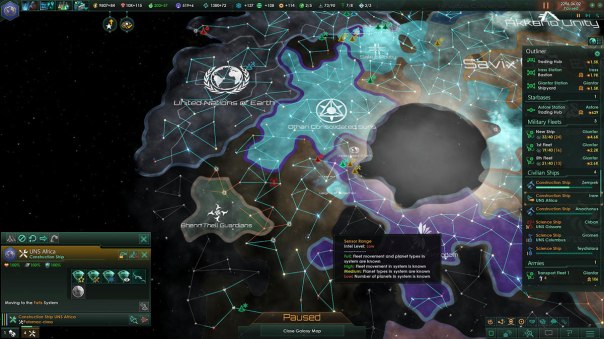
*rubs hands together*
Stellaris is a non-Paradox game developed by Paradox. This is important because of my history with this developer. Much like with EVE, I had heard a lot about Crusader Kings 2, all sorts of crazy stories, and bought it thinking that I’d like to play the game that generated them. Nope, I played about 3 hours before uninstalling it. So when a friend of mine recommended Stellaris recently, I was skeptical. So skeptical that I ended up installing Galactic Civilization 2 (free download) and Galactic Civilization 3 (don’t even know where this came from) in order to scratch the itch that Civ 6 had left. Then, finally, a recent 60% sale on Stellaris pushed me over the edge.
I have been falling ever since.
I’m about 30 hours into my sort of beginner tutorial playthrough and I’m trying to decide whether to start over or not. There have been some noob mistakes on my part, and some additional jankiness with the game that I am coming to terms with. I was in a recent war, for example, and was prevented from claiming total victory because… an ally was occupying the last planet instead of me. This enemy civilization had zero unoccupied planets and yet they “forced” me into a truce… that still resulted in me claiming all their shit. Except that last planet, with was taken over by my ally a few in-game months later. I don’t even know if it matters – the internet is awash in outdated information on the game – but it still bothered me.

Really? Really? C’MON!
Regardless, I am more excited about a game than I have been in quite some time. I’m still trying to figure out if it’s because Stellaris is a new puzzle for me to figure out, or if I’m excited about a new “survival-ish” experience of exploring and uncovering resources, or something else altogether.
Either way, I’m looking forward to figuring it out.
Destiny’s End
I beat Destiny 2’s single-player campaign a week or so ago. Haven’t touched it since.
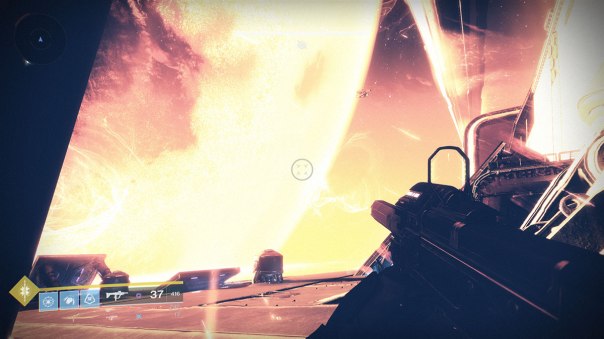
I know it’s kinda a gimmick level, but it was still really cool.
If you were wondering if you could trust all the assessments about how the campaign is pretty standard sci-fi FPS fair, the gunplay being amazing, and then a hard transition from story into a grinding endgame… well, consider this another data-point on the graph of player experiences.
I was actually more impressed by the overall campaign than most, even though it’s pretty ridiculous from a premise stand-point based on what you actually see. I mean, it’s cliche to point out how the story treats you as basically a minor god amongst mortals – in this case, kinda literally – but that sort of criticism never really landed with me in most other contexts. Never bothered me in WoW quests, for example. However, in Destiny 2, they went through great pains to express the fact that you were the only one to receive your powers back. And then you finish whatever story mission you were on, to go grind public quests with a whole bunch of other people with their powers back, until you got a high enough GearScore to start the next story mission.
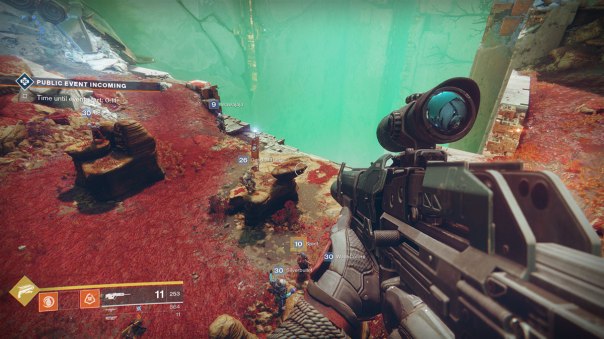
Pictured: totally not a whole bunch of other Guardians with their Light back.
In any case, as soon as I finished the final mission and the wrap-up quests, I started researching on the internet what would be the most efficient way to get better gear. Was it Patrols? Public quests? Should I be doing some kind of Daily? Then I realized: “Oh, right, there have been two DLCs since launch.” Much like in MMO expansions, I could be getting better green gear killing the equivalent of boars if I threw down the cash to catch up to everyone else.
But I’m not, so I won’t, so I’m done.
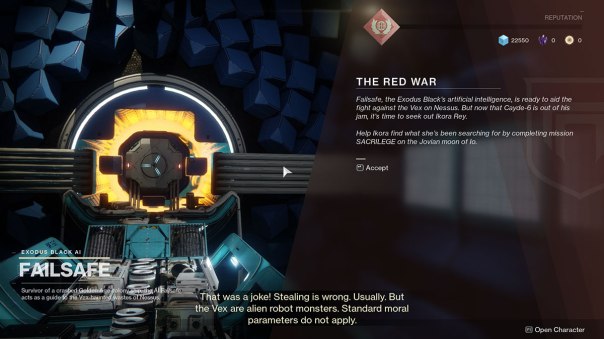
Indeed.
In the scheme of things, I think the Humble Monthly was worth it. I’m pretty miserly when it comes to games, so I probably would not have been happy with a $12 Destiny 2 purchase by itself – not quite sure about how many hours I played, but the spectacle was almost good enough. Almost. But the odds that I will enjoy something else from the full bundle is decent enough that I still consider the entire transaction worth my while.
Formulaic
I am basically done with Subterrain. There is plenty of “game” left, but my completion of it is a forgone conclusion made evident by the full accounting of its remaining systems. In other words, it has become formulaic, and that formula has been solved – there are no possible surprises left. Much like many Civilization endgames, it is simply a matter of going through the remaining motions.
And ain’t nobody got time for that.
The whole situation got me thinking about the design of formulaic systems in gaming, and why designers lean on them so heavily. The only explanations I can come up with is either laziness or fear. There is probably a more legit reason out there, but I can’t imagine it, because it almost always makes the underlying game weaker, and why would you do that intentionally?
Let’s use the most common formula as an example: the four elements of Fire, Water, Air, and Earth. I have no particular idea why these elements exist in 99% of RPGs (and even non-RPGs) when the designers ensure that elements bring nothing to the table. Yes, some monsters are stronger against some elements and weaker to others. Congratulations, you have just optimized combat against the entire game’s monster lineup after playing a Nintendo game 20+ years ago. In practice, those elements are really just different colored numbers – they have no gameplay impact beyond exploiting arbitrary weaknesses.
Compare that with the way, say, Divinity: Original Sin plays out. There are still elements, and still strengths/weaknesses based on them, but those elements actually have secondary consequences. Having fire spells create a Damage over Time effects and Lightning stun people is pretty cliche, but there was a tertiary concern with interactions between the elements themselves, e.g. poison clouds exploding with fire, electricity stunning everyone standing in water, etc.
That is good, interesting design.
As I said before, I can only imagine that designers are either lazy or scared when they lean so hard on formulas. “Scared” in this context means potentially introducing an unbalanced aspect to the combat system. For example, Ice damage slowing the target is pretty cliche, but many designers don’t even go to that level because it’s possible that players could cheese certain encounters by slowing and kiting the boss around the room. But imagine a designer who looks at that possibility and then crafts a boss in which that strategy is basically required in order to succeed. That would be great… until you realize that all the other players might not have learned that spell/chosen that class/etc.
I’m not trying to imply that game design is easy, but… c’mon devs. Surprise us once in a while. Maybe don’t have a Fire/Water/Air/Earth Temple unlock mechanisms. Make the spells be something more than different colored damage numbers. Embrace asymmetry when it makes sense. Switch up the formula… until switching it up itself become formulaic. Then do something, anything else.
Married
Hey, so… I’m getting married later today.
Don’t feel obligated to give me your well wishes, because honestly, I’m already pretty damn lucky. And I’m not just saying that because she occasionally reads these posts.
I started this blog back in December 2010. It had a different name and was hosted on a different provider, but the blog was me talking about what I was passionate about. At the time, that passion was making gold on the WoW AH. These days, my tastes have broadened a bit, but fundamentally the passion is the same. I have every expectation that that passion will continue on into the future.
That said… I am getting married. There may be posts next week, there may not be. Either way, you’re going to sit back and enjoy it – the posts, or the fact that I am too busy to write them.
Impressions: Subterrain
Subterrain is a poorly named, but surprisingly excellent indie-ish game that came as part of the April Humble Monthly bundle. It is essentially a top-down survival horror crafting game, minus any base-building. As someone with an interest in survival-type games, this one scratches the itch very well.
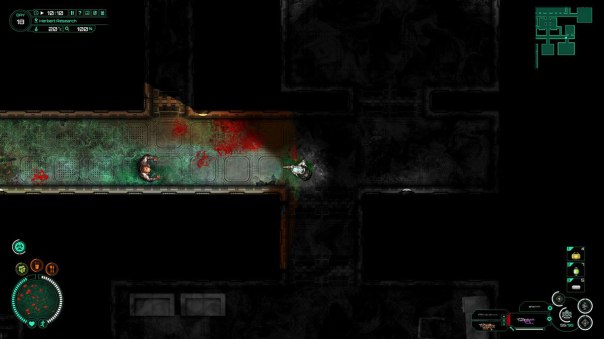
Limited field of vision can lead to nasty surprises.
The premise is that you are a researcher on a Martian base who gets thrown in jail, and then the power goes out. For a week. You eventually escape the prison and work your way to Central Command, and try to piece together what happened and why there are infected zombies and other creatures running about.
I’ve spoken about Economy of Design before, and there’s a compelling, intuitive call to action in this game. Specifically, the complex’s powerplant is slowly grinding down. There is already too much damage to sustain power to every single zone, so you have to choose which zones to send power to, with the others getting no Oxygen or Heat (assuming their Oxygen and Heat generators are even online). As it turns out, the infection plaguing the colony spreads faster in cold, non-oxygen environments. As each zone gets more infected, more powerful enemies appear, and at 50+% infection a bunch of zombies appear in Central Command and try to destroy the generator. So there is a race to find materials and blueprints to craft replacement power plant cores to power more zones and slow down the infection.
You have to balance the running around implied above, with more mundane concerns like food, water, sleeping, and even toilet activities. Each zone you enter typically needs to have Oxygen/Heat generators repaired too, so you have to bring along your own temporary supply of both lest you suffocate/freeze while exploring. There are enemies too, of course, so having a good supply of weapons and healing supplies are a must.
All the while, the clock is ticking and the infection is spreading…

No, really, I was super excited about finding forks.
To be honest, despite the above, it’s difficult for me to say how much fun the game actually is. I’m certainly enjoying it thus far, as it pressing a lot of my buttons in terms of survival and crafting and planning shit out. Fighting enemies is pretty easy, and exploring becomes quicker once you realize that 99% of everything is shit not worth sorting through. To an extent, I hate how formulaic it gets in the mid-game, where I’m at. I’ve unlocked everything in Tier 1, for example, and now to get the Shotgun v2 and Improved Nightstick (etc) I have to unlock Engineering Software v2 and Research Software v2, both of which were found in the 5th floor of X location.
In the meantime, I’m spending my time playing this instead of Destiny 2 because I like collecting all the things regardless of the pointlessness of the activity.
Humble Destiny
The latest Humble Monthly bundle has Destiny 2 as an early unlock. I’ve been subscribing month-to-month for a while now, and this was a no-brainer month to pay early.
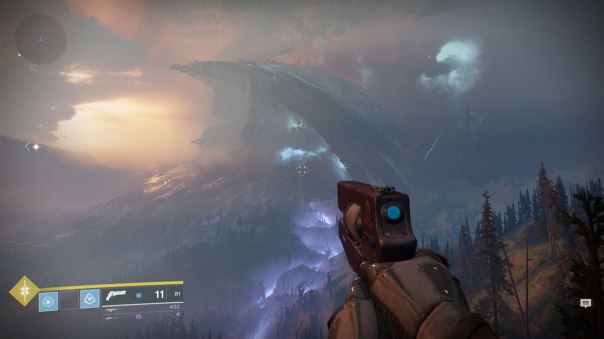
Graphics = good
Destiny 2 is the much maligned sequel to a game that should have been ported over to the PC the first time around. I am well aware that the endgame sucks, and that the (short?) campaign really just serves as a vehicle for expensive, disappointing DLC. Oh, and they actually removed content from the base game when the first DLC came out. Classic Activision Blizzard. Still, $12 is $12, and I wanted to see this train-wreck for myself.
You know, as a member of the Press©.
First impressions? It is a staggeringly beautiful game. Skyboxes are skyboxes, but D2’s are great. The gunplay thus far as been as good as they say as well.
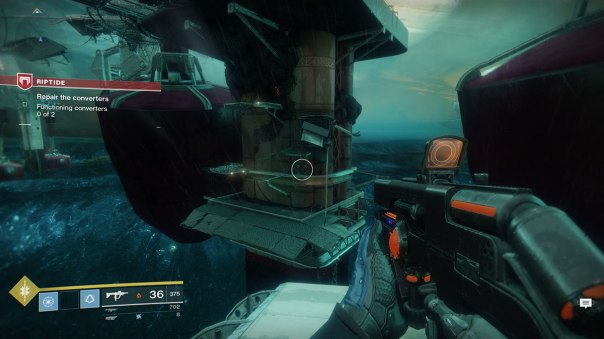
Actual jumping requirements? Interesting…
Once out of the immediate tutorial area, I found the sort of free-roam mechanics rather interesting. The first mission had a recommend gearscore Power level of 30, and I only had 20 at the time, so I stuck around and randomly killed enemies with other strangers until enough loot dropped to take me over the finish line. There were periodic public events, so things didn’t take too long, but it was interesting seeing this sort of MMO-ish Public Quest mechanic in a FPS. I’m sure things get significantly less interesting once you’re no longer getting upgrades, but until then… wheee!
Regardless, I am still super early in the experience – or maybe not… heard the story is like 5-6 hours? – having just unlocked the free-roam areas on Titan. Not sure that I like the rock-paper-scissor style of weapons though. Yeah, it’s fine have energy weapons be better at breaking shields than kinetic weapons. But having energy weapons deal less damage to normal mobs than basically any kinetic weapon? That means I basically only have the one weapon to use 90% of the time. Also disappointed that fun stuff like shotguns are limited to the “power weapon” slot that competes with grenade launchers and such.
Whatever.
I’m basically treating this like a non-cel-shaded Borderlands, so I’ll enjoy the ride until I don’t.
Economy of Design
It’s amusing what can change in three years.
I am currently playing through The Banner Saga 2, which in pretty much all respects is The Banner Saga 1. Still running from the Dredge, still having people die off in blind choices, still have the same combat system. Except, this time, I actually really appreciate the latter.

No secret systems, which is bold
For those that don’t know, the combat system has two components: Strength and Armor. Strength acts as both your attack power and your HP. The formula for damage is simply Your Strength – Their Armor = Their Strength Loss. When attacking, you are given the option of either attacking their Strength or their Armor, with the latter being a set amount of damage based on a separate Armor-Break stat, instead of Strength.
Now, this system can snowball very quickly. Imagine two characters with 8 Armor and 12 Strength. The first person to attack will bring the other down to 8 Strength, which means they will only be able to deal 1 Strength damage in return. Then the first attacker will deal another 3 Strength damage, making any further Strength attacks from the defender take a -10% deflect penalty for each point of Armor above their Strength. Now, the defender could possibly choose to attack the first guy’s Armor instead, but that will only help in future turns… which he won’t live to see.
In any case, the battles are not 1v1 affairs. Turns take place in a round-robin manner: one of your characters take their action, then the AI takes one character’s actions, then your next character gets to move, and so on. Killing an enemy does not remove the AI’s turn – it simply moves the remaining AI units up in initiative. This can lead to incredibly dangerous scenarios if you end up leaving a powerful enemy alive, who gets to act every other turn while you’re stuck moving out-of-range units around. Thus, the superior strategy is actually to maim enemies rather than killing them (e.g. leave them with 1-2 Strength) so that the AI is stuck with weak attacks while you concentrate on maiming more combatants until you can mop the rest up.
Like I said before, this combat system often leads to snowball situations in which one of your characters getting pummeled early makes the latter half of the battle incredibly dicey. Still… the economy in design is brilliant, IMO. You can equip your characters with a special relic that might improve stats a bit, but the whole Strength & Armor deal is incredibly straight-forward. The game will helpfully tell you exactly how much damage an attack will cause, but you can eyeball the field and work it out yourself since there are really only two components. MMORPGs have to have a pile of random-ass stats in order to have room for item level-creep, but most other games do not. Hell, this combat system is so simple that I could imagine them making a board game out of it.
Oh, and another thing? The only currency in the game is Renown. Leveling up characters, purchasing food for your journey, and buying special relics all consume this one common currency. I found this incredibly frustrating in the first game, but I have come to appreciate its elegance this time around. It reminds me of deck-building games wherein the cost of adding a new card to your deck is… adding a new card to your deck. Renown is a little less intuitive than Strength – why would merchants care how famous I was? – but the tension inherent in consuming that resource adds meaningful choice to an otherwise straight-forward decision. Plus, it’s a balancing mechanism preventing you from creating uber-leveled characters.
Like I said before, The Banner Saga 2 is precisely like the original game. If you didn’t have fun playing the first time around, then things are unlikely to have changed. Unless you are like me, apparently, because I’m having a lot of fun now.
That said, fuck Blind Choices. I have zero interest in choosing one of three options, only to find out that my choice results in the loss of 150 Clansmen and dozens of fighters because… arbitrary reasons. I look up the results before I make my “choices,” and feel zero guilt for doing so. I’m not sure if these exist as a sort of roguelike mechanism to encourage multiple playthroughs, but that’s not how I like playing my tactical RPGs.
Civ 6: Just Kidding
I have already uninstalled Civilization 6.
I have gone over this before, but my history with the Civ series is deeply rooted in the past. My first experience was with Civ 2, which I played for hundreds of hours on the Super Nintendo, of all places. The very next Civ game I played was Alpha Centauri, which blew my teenage mind and honestly affected my intellectual trajectory almost by itself. Remember the real-world quotes that pop up once you complete a Wonder or research a specific Technology? They were so cool that I started writing them down, which led to collecting cool quotes wherever I found them, which led to reading the books in which they were quoted, all in service of finding more cool quotes.
After Alpha Centauri though? Nothing. Well… nothing until Civ: Beyond Earth, but we don’t talk about that one. FPS games satisfied my itch for immediate stimulation, and MMOs gave me long-term goals to work towards. Spelled out that way, my prior criticism of Civ 5 makes sense:
I did a sort of beginner’s match in Civ 5 and just started a second game on normal difficulty/Civ spread. With things approaching 1000 AD, I am sort of wondering when the fun starts. The problem from my perspective is that I don’t seem to actually be making any decisions very often. I’m perfectly fine playing the “long game” in strategy titles, but I’m not particularly fine with spam-clicking Next Turn for 200 years. Moving a War Chariot around looking for Barbarians isn’t exactly cutting it.
There are a lot of subtle changes in Civ 6 that I enjoyed. The city districting system, for example, really grew on me. For one thing, it really made you think about where to place your cities strategically – you really cared about the terrain and what you’d be giving up for a district. For another, the fact that Wonders take up a tile all on their own means you can’t have just one uber-city with 37 Wonders piling up. There had never been a scenario in prior Civs where I unlocked access to a Wonder via Research and then was literally unable to build them. “Can’t build the Pyramids without access to a desert? I guess that makes sense. Wonder if there are any desert tiles around…”
Another feature I enjoyed was how Civics was on its own sort of research path, and the whole “policy card” thing. If you were gearing up for a war with your neighbors, you can make unit production faster, or focus on Trade Route bonuses, and so on. There was granularity there, with the design bonus of, again, preventing uber-cities that were good at everything.
Fundamentally though, a Civ game is a Civ game, and that’s where it lost me.
The whole “Just one more turn” byline exists because nothing ever happens in a turn. Or even over a couple. The most fun I have playing Civ games occurs immediately after world creation. You have reasons to move your scouts around, and the possibilities for city expansion are wide open. Things can still surprise you. There are barbarians at the gates, and hunting down their camps is a big deal.
Then, at some point, you hit the ADs and the game becomes clicking End Turn 10 times in a row. If you are shooting for a Science or Culture win condition, you literally have no reason to engage with other civilizations at all. Just sit around, wait for your cities to gain another population, wait for the Workshop to be completed so it can add X more Production to finish your Y project Z turns faster in the future.
Domination and Religious victories give you more things to do, of course. But that’s just the thing: the only way Civ becomes fun for me is with more moment-to-moment choices. In which case, why am I not playing a moment-to-moment game? Civ 6 is a terrible war game, compared with say, the Total War series. When you look at the Science and Culture victories though, again, it’s a whole lot of pressing End Turn and inevitably winning 300 turns later.
It’s entirely possible (and likely) that I’m missing the whole point with the Civ games. I mean, I did pound out something north of 33 hours in Civ 6 within a week, which is more than a part-time job. Obviously there are some components of the base game that I enjoy.
But that’s all there is for me: components. If you love the whole Civ package, that’s fantastic, I can see what all the fuss is about. I just… don’t. There is a gradient between instant gratification and the Zen-like abandonment of all earthly pleasures, and I find the spaces between payoffs in Civ games about 20 turns too far apart. There are options for shorter games, I think, but that’s not necessarily what I want either. Strategic density is more what I’m looking for.
And that’s something I’m going to have to find somewhere else.
 In An Age
Battlefield V
Jun 5
Posted by Azuriel
All my… what?
I am facepalming over here a little bit, but not necessarily for the reasons you might expect.
First, that trailer is just bad. Not in the “they got a British female amputee in my authentic WW2 sim!!1!” way, but in the very standard “this is an incoherent mishmash of themes” way. There’s a part halfway through when you see a squad of soldiers running away, and I was trying to figure out if they were on my (the viewer’s) team or not. And what the hell was with that “fire twice, then immediately reload” crap? Some people have complained about the Michael Bay-ness of the whole thing, but Battlefield has always had that element. If you don’t believe me, here is 21 minutes worth of Battlefield trailers.
Second, though… ugh, WW2? Why? What’s the point?
To be clear, I have zero issues with DICE introducing female soldiers, amputee soldiers, or any combination thereof. I have no issues with Braveheart-esque dudes in kilts, or people running around with katanas. BFV won’t be selling map packs anymore, so having a wide variety of wacky cosmetics is the trade-off we can expect. I don’t even have any issues with this laundry list of GamerGate-style criticisms. It’s completely fine, for example, that the developers wanted a more “authentic” experience with BF1 and have since changed their mind with BFV.
The one criticism in that thread that rings true, though?
I want that dieselpunk game now. And it makes me question why that wasn’t the direction they wanted to take BFV. I don’t feel that Battlefield should be beholden to “historical authenticity” at the expense of gameplay, but… why WW2 then? Why these specific fronts, with these specific armies, and aiming to tell the “untold stories” of WW2? Like seriously, I’m pretty sure the History Channel has told every damn WW2 story possible, else they would not have had to resort to broadcasting Ancient Aliens and Pawn Stars.
What also annoys me is how this trailer and the controversy it generates obscures all the cool shit they are implementing into the game. I have never been more excited to play a Medic/Support in a Battlefield game than I am right now. Towing around gun emplacements is whatever, digging foxholes in specified locations is kinda cool, and the hyper-focus on squad tactics fantastic. I can also see how all of it could be annoying nonsense, especially when the Medic starts dragging your body around and teabags you because you happened to have picked a female soldier.
Not looking forward to that.
In any case, my one hope for Battlefield V, regardless of anything else, is that it returns to the cool stories of BF2/3/4. The series is at it’s best when it generates videos like this one, with a dude ejecting out of a burning plane, sniping the enemy pilot, and then scrambling aboard the now-pilotless plane and continuing on. Battlefield 1 was a very pretty game, but it was also oppressive as shit in a very authentic WWI kind of way. I’m not looking for more of the that.
Posted in Commentary
1 Comment
Tags: #GamerGate, Battlefield 3, Battlefield V, Dieselpunk, FPS, WWII