Humble Destiny
The latest Humble Monthly bundle has Destiny 2 as an early unlock. I’ve been subscribing month-to-month for a while now, and this was a no-brainer month to pay early.
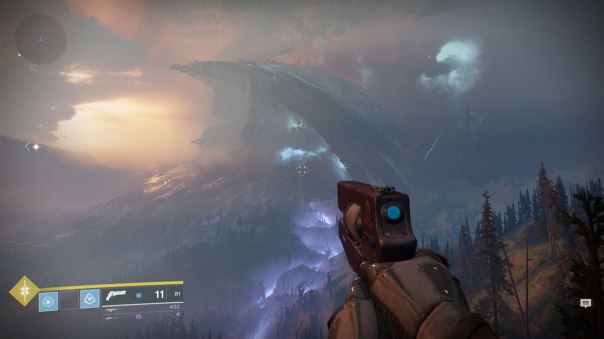
Graphics = good
Destiny 2 is the much maligned sequel to a game that should have been ported over to the PC the first time around. I am well aware that the endgame sucks, and that the (short?) campaign really just serves as a vehicle for expensive, disappointing DLC. Oh, and they actually removed content from the base game when the first DLC came out. Classic Activision Blizzard. Still, $12 is $12, and I wanted to see this train-wreck for myself.
You know, as a member of the Press©.
First impressions? It is a staggeringly beautiful game. Skyboxes are skyboxes, but D2’s are great. The gunplay thus far as been as good as they say as well.
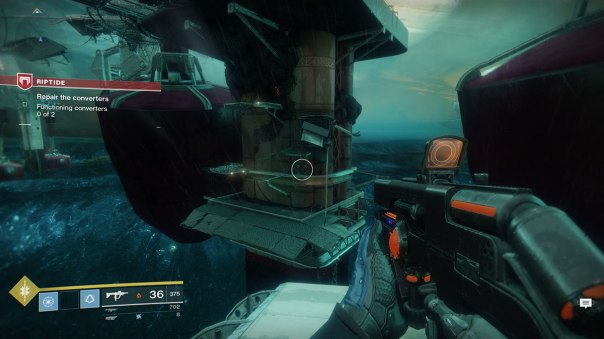
Actual jumping requirements? Interesting…
Once out of the immediate tutorial area, I found the sort of free-roam mechanics rather interesting. The first mission had a recommend gearscore Power level of 30, and I only had 20 at the time, so I stuck around and randomly killed enemies with other strangers until enough loot dropped to take me over the finish line. There were periodic public events, so things didn’t take too long, but it was interesting seeing this sort of MMO-ish Public Quest mechanic in a FPS. I’m sure things get significantly less interesting once you’re no longer getting upgrades, but until then… wheee!
Regardless, I am still super early in the experience – or maybe not… heard the story is like 5-6 hours? – having just unlocked the free-roam areas on Titan. Not sure that I like the rock-paper-scissor style of weapons though. Yeah, it’s fine have energy weapons be better at breaking shields than kinetic weapons. But having energy weapons deal less damage to normal mobs than basically any kinetic weapon? That means I basically only have the one weapon to use 90% of the time. Also disappointed that fun stuff like shotguns are limited to the “power weapon” slot that competes with grenade launchers and such.
Whatever.
I’m basically treating this like a non-cel-shaded Borderlands, so I’ll enjoy the ride until I don’t.
Civ 6: Just Kidding
I have already uninstalled Civilization 6.
I have gone over this before, but my history with the Civ series is deeply rooted in the past. My first experience was with Civ 2, which I played for hundreds of hours on the Super Nintendo, of all places. The very next Civ game I played was Alpha Centauri, which blew my teenage mind and honestly affected my intellectual trajectory almost by itself. Remember the real-world quotes that pop up once you complete a Wonder or research a specific Technology? They were so cool that I started writing them down, which led to collecting cool quotes wherever I found them, which led to reading the books in which they were quoted, all in service of finding more cool quotes.
After Alpha Centauri though? Nothing. Well… nothing until Civ: Beyond Earth, but we don’t talk about that one. FPS games satisfied my itch for immediate stimulation, and MMOs gave me long-term goals to work towards. Spelled out that way, my prior criticism of Civ 5 makes sense:
I did a sort of beginner’s match in Civ 5 and just started a second game on normal difficulty/Civ spread. With things approaching 1000 AD, I am sort of wondering when the fun starts. The problem from my perspective is that I don’t seem to actually be making any decisions very often. I’m perfectly fine playing the “long game” in strategy titles, but I’m not particularly fine with spam-clicking Next Turn for 200 years. Moving a War Chariot around looking for Barbarians isn’t exactly cutting it.
There are a lot of subtle changes in Civ 6 that I enjoyed. The city districting system, for example, really grew on me. For one thing, it really made you think about where to place your cities strategically – you really cared about the terrain and what you’d be giving up for a district. For another, the fact that Wonders take up a tile all on their own means you can’t have just one uber-city with 37 Wonders piling up. There had never been a scenario in prior Civs where I unlocked access to a Wonder via Research and then was literally unable to build them. “Can’t build the Pyramids without access to a desert? I guess that makes sense. Wonder if there are any desert tiles around…”
Another feature I enjoyed was how Civics was on its own sort of research path, and the whole “policy card” thing. If you were gearing up for a war with your neighbors, you can make unit production faster, or focus on Trade Route bonuses, and so on. There was granularity there, with the design bonus of, again, preventing uber-cities that were good at everything.
Fundamentally though, a Civ game is a Civ game, and that’s where it lost me.
The whole “Just one more turn” byline exists because nothing ever happens in a turn. Or even over a couple. The most fun I have playing Civ games occurs immediately after world creation. You have reasons to move your scouts around, and the possibilities for city expansion are wide open. Things can still surprise you. There are barbarians at the gates, and hunting down their camps is a big deal.
Then, at some point, you hit the ADs and the game becomes clicking End Turn 10 times in a row. If you are shooting for a Science or Culture win condition, you literally have no reason to engage with other civilizations at all. Just sit around, wait for your cities to gain another population, wait for the Workshop to be completed so it can add X more Production to finish your Y project Z turns faster in the future.
Domination and Religious victories give you more things to do, of course. But that’s just the thing: the only way Civ becomes fun for me is with more moment-to-moment choices. In which case, why am I not playing a moment-to-moment game? Civ 6 is a terrible war game, compared with say, the Total War series. When you look at the Science and Culture victories though, again, it’s a whole lot of pressing End Turn and inevitably winning 300 turns later.
It’s entirely possible (and likely) that I’m missing the whole point with the Civ games. I mean, I did pound out something north of 33 hours in Civ 6 within a week, which is more than a part-time job. Obviously there are some components of the base game that I enjoy.
But that’s all there is for me: components. If you love the whole Civ package, that’s fantastic, I can see what all the fuss is about. I just… don’t. There is a gradient between instant gratification and the Zen-like abandonment of all earthly pleasures, and I find the spaces between payoffs in Civ games about 20 turns too far apart. There are options for shorter games, I think, but that’s not necessarily what I want either. Strategic density is more what I’m looking for.
And that’s something I’m going to have to find somewhere else.
Thought Process
“I need to delete some games to free up space on my SSD. Let’s look at Steam.”
“Oh, here’s Civ 6. I tried it for about 10 minutes a few weeks ago, and it didn’t grip me. Why would I want to have to relearn everything from Civ 5? Besides, there are a lot of other, similar games I could be playing instead. This can go.”
“Whoops, I double-clicked on it instead.”
“Whoops, it’s 2am.”
“Whoops, it’s 2am every day this week.”
“I can’t wait for the weekend, so I catch up on my sleep.”
“Sweet, now I can play for 10 hours straight instead of just 5…”
[Fade to Black]
Tank One for the Team
I have been following Overwatch’s “one-trick pony” debacle off-and-on for a few months now. The official word is that no one gets banned for picking just 1-2 heroes and ignoring the team composition. The unofficial word is that you should be banned for not picking a character that best helps the team. Several Top 500 players seemingly get banned for one-tricking, and Gevlon sees a conspiracy to sell lootboxes.
Thing is, the overall system is such a shitshow that I almost agree with Gevlon that there has to be a conspiracy. The alternative is that the designers A) have never participated in a school project in their life, B) never played WoW, and/or C) never played their own damn game for 5 minutes.
See, the problem is this:
We built Overwatch around the concept of teamwork, and we believe the game is much more fun for everyone in a match when we’re picking heroes that contribute to the overall success of the team. At times, this means we’ll be playing our mains; other times, we should be trying to help the team by choosing heroes that round out the team’s composition. We won’t be actioning you if you only play your main, but we also don’t believe this is the ideal way to play Overwatch—especially in competitive settings.
Imagine the following: you are playing WoW and you hit the queue button for Looking For Dungeon. After a minute or so, you zone into the dungeon with five other people. As you stand there looking at one another, you have 40 or so seconds to figure out who is going to be the tank, who the healer, and who the DPS. Oh, and the dungeon itself has a time limit, and the bosses will change based on the classes and specs you choose. Good luck!
It’s an absurdity in a MMO-like setting, but the designers actually think it works in Overwatch. And it does for a bit, because there are X number of people who are willing to take one for the team and choose a character they don’t like to play in order to give the team composition a chance at success.
A team composition that was not chosen as a team, mind you, but rather by the whims of whoever insta-locked the DPS first. So in order to have a chance at winning, you have to reward the selfish behavior of others. And let me tell you, there is nothing more toxic than the feeling you experience when you take one for the team and the team loses.
Possible solutions are relatively straight-forward:
- Allow players to queue for roles (Tank, Healer, DPS, Flex)
- Create in-game Guild or Clan functionality, so players can organize themselves
- Only allow premades in Competitive modes
- Do nothing, while tacitly admitting your failure as a designer
Thus far, the Overwatch team is decidedly choosing the last option.
From Whence Fun?
The other day I was playing Words with Friends (aka Scrabble app) with my SO. She is not much of a gamer – although she did play WoW back in vanilla – but she enjoys board games, and word games the most. I play along with the word games mainly because it’s something we can do together, but… I don’t really enjoy it. Word games are not my forte, and it does not help that she is way better at words than I am. I have actually legit won on occasion, primarily on the back of a few critical plays when the tiles line up just right. For the most part though, she kicks my ass on the daily.
For those who don’t know, there are an abundance of Words with Friends “cheat” apps out there. What those will do is analyze your seven tiles and the board, and then list out the best possible scoring combinations via brute-force analysis. I have never played with any such apps, but I find the idea amusing simply because that is exactly what I try to do a lot in-game.
See, Words with Friends will only allow valid plays. So, if you don’t know whether something is a word, you can drop tiles and get instant feedback. I have gotten a lot of points before basically dropping random tiles in key locations and making a word I had never heard of.
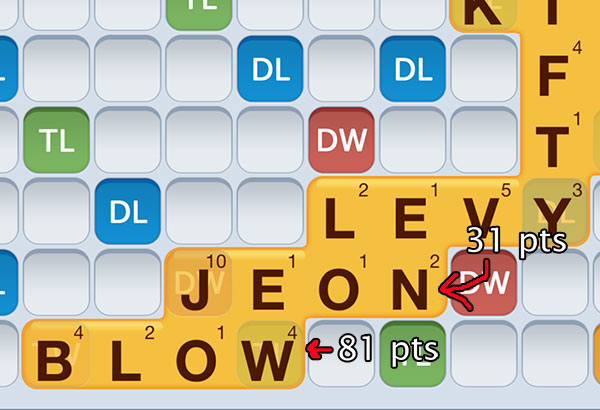
I don’t even know what “Jeon” is, but I regretted playing it immediately.
The difference between my method and using an app to do it for me is… something.
I suppose it becomes less of a contest between two players’ knowledge when automation is involved, cheapening the experience. On the other hand, my SO plays word games a lot – she runs several concurrent games at a time, in fact – so she has memorized all the different Q words that don’t need a U, and so on, which is a pretty big advantage. And like I mentioned, I can do everything the cheat apps would do, if I was patient enough to do it myself. So, at some point, her overwhelming knowledge versus my very basic brute-force tactics becomes analogous to one or both of us facing two different kinds of bots.
That thought led me to another: what if we both used cheat apps? At that point, the game would probably come down to the random nature of tile distribution, and perhaps a few scenarios in which we had to choose between two same-point plays. Regardless, it doesn’t sound particularly fun, right? If we have automated things that far, we may as well automate the selection of the answer, and just have two bots play against each other forever.
So… from whence did the fun originate?
I think it is safe to say that certainty reduces fun in games. While I do not necessarily mean that randomness needs to exist in order for fun to occur, I do mean that the outcome needs to be unknown, or at least in contention. If one person has the cheating app and the other does not, it’s not likely to be a fun game. Even if no cheating was involved, one player having an overwhelming advantage – either knowledge or skill – and the outcome is probably the same.
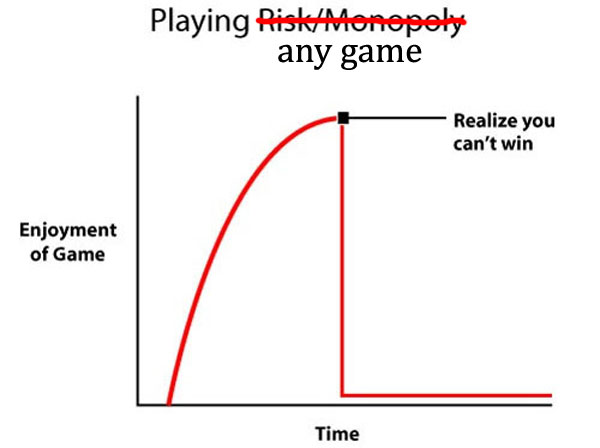
But what does that really say about our games, and the way we play them? The better we are at a game, the less fun we likely will have. Having a little advantage is nice, and the process by which we get better (experimenting, practice, etc) is a lot of fun too. At a certain level though, it tapers off. What’s fun after that? Direct competition? Maybe. Part of that fun is likely tied into the whole “unknown level of skill from opponent” thing though. Because if we knew he/she was using a cheat program, that fun would evaporate pretty quickly.
Now, there is a sort of exception here: it can be fun to totally dominate your opponent(s). Be it ganking in MMOs, or aimbots in FPS games, the reason a person would do such a thing is precisely to “collect tears” by specifically ruining other peoples’ experience. At that point though, the medium is kinda immaterial; the bully is just using whatever is convenient and less personally risky.
In any case, I went ahead and shared my thoughts above with my SO and her response was interesting. For her, the “game” within Words with Friends is actually just challenging herself in finding the highest-scoring move each turn – she does not necessarily care about the ultimate outcome of the game. Which, to me, sounds like she should be playing against bots, but nevermind. And I actually understand that sentiment: whenever I was playing BGs in WoW, my goal is not necessarily to win at all costs (e.g. sitting on a flag 100% of the time), but to amuse myself on a micro level, even if I was grinding Honor.
Still, I suspect my SO will eventually tire of the wordplay over time, once her skills plateau. Or… maybe she won’t. After all, I somehow find it infinitely interesting to collect resources in Survival games despite having achieved maximum efficiency usually by clicking the button once. Which leads me back to my original question: from whence fun?
Gaming Update
I’m probably done with RimWorld for now. After installing the mods I was talking about, I found some uranium on the map, made mining it a high priority, and completed the construction of a ship. By the time I had four cryopods – not nearly enough for my 12 colonists – I realized that a lot of it didn’t matter. I could continue fast-forwarding through time, or I could see the ending credits right now. So I did. And this was apparently enough to satisfy whatever itch compelled me to boot the game up every day.
I’ll definitely revisit RimWorld once 1.0 is released, but in the meantime, I’m playing other games.
Ironically, the other game that continues soaking up my free time is another Early Access title: Slay the Spire. I had stopped playing it a few weeks ago, having rather thoroughly and completely beat the game and unlocked everything. The Daily Challenges brought me back: they are normal runs with additional bonuses and/or restrictions. For example, some of them give everyone (including enemies) +3 Strength, or cause you to get three copies of a card when added to your deck, etc.
It is not lost on me that the Daily Challenge has some strong parallels with, say, Mythic+ dungeons in WoW. “Play the same content with additional restrictions/considerations.” The huge, fundamental difference though is that Slay the Spire is fun, and WoW dungeons are not. Well, that and the simple fact that the bonus/penalties in Slay the Spire can change the entire way you approach run, whereas in WoW it just makes the things you were going to do anyway (speedrun past enemies) more deadly.
I haven’t talked about it before, but I’m approaching the end of Rise of the Tomb Raider, e.g. the sequel to the first Tomb Raider reboot. The visuals are incredibly amazing, but for the most part I think I enjoyed the first game better. While this game plays better, I’m at a point where I feel more like Spiderman than Lara Croft. Or Ezio from Assassin’s Creed, for that matter. There’s always been platforming element overlap between the two series, I guess, but it feels more fantastical in Rise of the Tomb Raider than it ever did before.
Going forward, I have a lot more games queued up on my plate. We’ll see which ones actually get any attention though.
Fixing Problems*
After about 75 hours of RimWorld, I decided to download mods to “fix” the base game.
As mentioned a few times around here, RimWorld is still currently in an Early Access state. Version 1.0 is on the horizon, but we do not yet have a complete feature list or an itemized accounting of what is going to change. This was frustrating me quite a bit in my current playthrough, due to an outcome I cannot help but question whether it was intended.
The basic gist is this: a group of mechanical enemies attacked my base, and Wolle got shot and was bleeding out. I rescued him and patched him back up… but he would not leave the medical bed. Prognosis: shattered spine. Vanilla RimWorld actually has bionic arms, bionic legs, and bionic eyes as core features. You can’t craft them, but you can buy them from traders occasionally, and clearly have the medical technology to install them. Additionally, there are nanite serums in-game that can automatically boost your skills, which by the description function specifically by moving from the orbit of the eye, into the skull, and then transmuting into the necessary brain tissue.

The Days-Are-Numbered version
Plus, there is something called Luciferium, which are medical nanites that can fix permanent scarring – including in the brain – for the low, low cost of permanent addiction. If you miss a dose every 5-6 days, and you will go on a berserk rage until death. A “devil’s bargain” indeed.
Trouble is, nothing cures a shattered spine in the core game. Was this an oversight? If Luciferium can cure stab scars in the brain, surely it could repair a spine too? Well, it doesn’t. So that led me to question whether it was intentional. There is nothing that cures shattered ribs either, for example – they just permanently reduce the amount of torso damage a colonist can take before collapsing/dying.
So, perhaps the designers were wanting to force the player to confront a scenario in which they have a permanently disabled colonist. Do you maintain them as dead weight, perhaps even taking them with you somehow if/when you escape the planet? Do you simply euthanize them and turn them into a hat? I can see how the emergent moral dilemmas come about. On the other hand, it’s hard to draw a line at spines and ribs when nanite magic is already out of the bottle.
Despite this, it wasn’t until I wasted an in-game month unsuccessfully trying to find uranium to start building a ship that I broke down and modded the game. I added a mod that augments the ground-penetrating radar to actually tell me the resources that are located underneath. And then I added Expanded Prosthetics and Organ Engineering (EPOE).
With EPOP installed, I did the relevant research and built the required workstation and finally crafted a fresh new bionic spine for Wolle. After a successful surgery, I took a look at his Health page… and realized that he wasn’t just fixed, he was better. Specifically, something like 20% better. So now I’m in a scenario in which I could craft 11 more bionic spines and implant them into my colonists to maximize the amount and quality of their work. Then I could get to work on about a dozen other bionic implants too.

Now his spine is broken in a different direction.
Like I said before, bionic eyes, arms, and legs are already in the base game. In fact, I have some spares hanging around for emergencies, but bionics are better than standard-issue meat in every way already. While you cannot craft your own, you can generally pick up extras without too much trouble. So it’s not quite too far a bridge, right? Right?
Sigh.
Yeah, yeah, I know. I do think shattered spines are a hole in the vanilla game’s original design, hopefully to be filled in a more balanced way upon release. But then again, sometimes it is precisely the gaps in satisfaction that moves us out of our comfort zone.
Fungible
My gaming purchasing decisions go through two processing stages:
- Is the game discounted from MSRP?
- Do I anticipate more fun spending X on this game, than X on Y game(s)?
That second step really stops the vast majority of my purchases, especially since the advent of Humble sales and similar bundles. Ironically though, I often don’t end up purchasing those cheaper, great (indie) games because they get caught in the same filter, creating a sort of recursive loop that prevents all purchases.
You will note that my backlog of games shamefully has no impact on my purchasing decision.
Last night was the final day that I could preorder 70 packs of Hearthstone’s latest expansion, Witchwood. I sat looking at the purchase screen for a long, long time. I would not say that Hearthstone is necessarily a must-play game for me, but it is something I have been playing off-and-on for… how long? Jesus Christ, five years?! Wow. How is that even possible?
What was I talking about again?
The preorder for Witchwood was $49.99. For a game I have been playing for 5 (!!!) years, that doesn’t seem like a lot. But you know what else is $49.99, listed in the same Battle.net launcher? WoW’s next expansion, Battle for Azeroth. I’m not super excited for the next expansion, but I do have $70 in BlizzBucks on my account (from selling my Legion stockpile of gold) and a New Year’s resolution to fund my Blizzard gaming using it. Between the two, WoW is absolutely going to give me more bang for my BlizzBucks.
There is also the more salient point that $50 can get you a LOT of gaming these days. An absurd amount, honestly. The current Strategy Bundle at HB will net you Endless Legends and Endless Space 2 for $12. There is a complete edition for Civ 5 which is like $15. There is something to be said about fun depth probably being better than simply time spent (e.g. just because you spend 500 hours playing Civ, doesn’t mean it’s your favorite game ever), the fact remains that you can get a lot of value for your dollar these days and games are largely fungible.
Of course, what ends up happening far too often with me is that I get in the mood to play a particular type of game, and everything that isn’t that specific game becomes less fun to play. Which means I am generally better off buying games on sale, even when I have a ridiculous backlog, in the off-chance that my hankering is satisfied with something I already bought.
Or, sometimes, I just end up playing the same damn game over and over for a long-ass time, until my mood shifts again. Have I mentioned I have 70 hours in RimWorld now? The only thing that could bring me out of this Survival kick is an update to 7 Days to Die or me deleting enough games to make room for Ark again (100+ GB, ugh).
Or until the winds change again, I suppose.
Emergent Details
I am beginning to ponder whether “emergent gameplay” is dependent on what might otherwise be considered “extraneous details.”
In RimWorld, the details are the devil. Each and every creature that exists drops its own kind of meat when killed, along with its own type of leather. Forty-eight different kinds of leather, specifically. On the one hand, this can get annoying when your warehouse fills up with a dozens of different stacks of the same sort of resource (e.g. leather) that can’t be blended together to craft a piece of clothing. On the other hand, the specificity of leather allows for the now-infamous “Human Hat” situation.
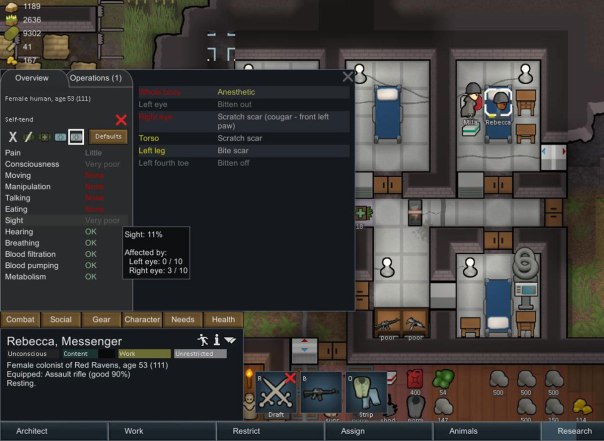
That would explain her poor shooting skills…
Another situation is wounds/scarring. When a colonist takes damage, they can be injured across their entire body in ultra-specific locations like… middle-finger of their left hand. Or their eyeball. I have one colonist with a shiv-scar in their brain. I did not find out about that old wound until two-dozen hours in, and finally made the connection as to why this particular person was slower than others at Researching (brain injuries basically reduce productivity by 50%).
This specificity occasionally leads to emergent gameplay. Another colonist (Redfields) was addicted to Smokeweed, developed a small tolerance, which led to a large tolerance, which led to Asthma in both lungs and a small carcinoma in the right lung. I was tempted to just kill Redfields and hope to recruit a different person – keeping someone alive and happy through withdrawal symptoms is a real pain in the ass – but I decided to give it the ole’ college try.
So after the next pirate raid, I captured one of the downed raiders, stabilized them, and then harvested their lungs. Which I then transplanted into Redfields.
Everything was fine up until Redfields developed a small carcinoma again in one lung. “Goddamnit, Redfields, those were brand new lungs! Well, to you, anyway.” Luckily, I realized that I could excise the tumor directly, which my doctor did successfully. Once Redfields made it past his withdrawal period, I went ahead and rewarded him by removing the eye that had a permanent LMG wound and replacing it with a bionic eye. Now, he’s one of the best sharpshooters in my colony.
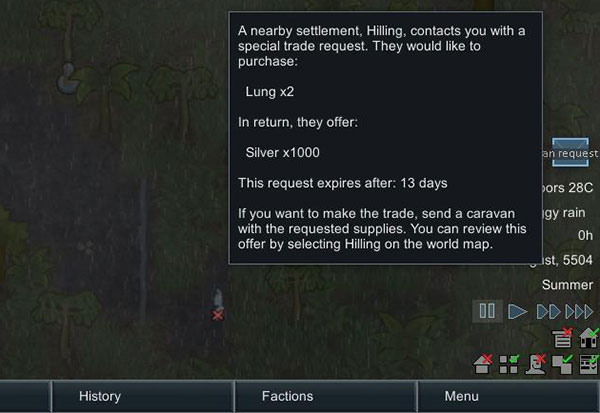
I feel the invisible hand of fate moving once again
He’s still missing a nose though. Not quite sure how he lost it, and I don’t there is cosmetic surgery in the vanilla game. Oh well.
The point is that emergent gameplay is kind of predicated on there being many, many different points of potential interaction. If damage was only registered to more generalized sites, or abstracted away entirely into HP, there is no Redfields story.
Then again, this can be done on the AI side instead, I suppose. There are not a whole lot of player-moving parts in GTA5, for example, but I think we have all seen some outlandish things occur in that game that come about because of random variance in civilian (or cop) behavior. Or in the Far Cry series. A “normal” shootout suddenly turns into a 5-car pileup, a wildfire erupts, and now there’s an angry bear or mountain lion or eagle joining the fray.
It makes me wonder about how emergent things might work in an MMO setting though. Project: Gorgon apparently has a whole lot of nonsense embedded in it – players turning into Cows and leveling Cow skills – but for the most part, I think most of us prefer less fiddly bits, rather than more. For one, it’s much harder to balance, and for another, it complicates social dynamics. If you aren’t optimal, you’re sub-optimal, which means you are holding the group back with your selfishness.
This pushes emergent features more into the AI side, which sounds like the direction Blizzard is heading. At the same time, would you even want an MMO where the mobs are intelligent and a real challenge? Like, all the time? In an open-world single-player game, absolutely. But elsewhere? I’m wondering if emergent social interactions is more than enough emergence for MMOs.
 In An Age
Economy of Design
May 8
Posted by Azuriel
It’s amusing what can change in three years.
I am currently playing through The Banner Saga 2, which in pretty much all respects is The Banner Saga 1. Still running from the Dredge, still having people die off in blind choices, still have the same combat system. Except, this time, I actually really appreciate the latter.
No secret systems, which is bold
For those that don’t know, the combat system has two components: Strength and Armor. Strength acts as both your attack power and your HP. The formula for damage is simply Your Strength – Their Armor = Their Strength Loss. When attacking, you are given the option of either attacking their Strength or their Armor, with the latter being a set amount of damage based on a separate Armor-Break stat, instead of Strength.
Now, this system can snowball very quickly. Imagine two characters with 8 Armor and 12 Strength. The first person to attack will bring the other down to 8 Strength, which means they will only be able to deal 1 Strength damage in return. Then the first attacker will deal another 3 Strength damage, making any further Strength attacks from the defender take a -10% deflect penalty for each point of Armor above their Strength. Now, the defender could possibly choose to attack the first guy’s Armor instead, but that will only help in future turns… which he won’t live to see.
In any case, the battles are not 1v1 affairs. Turns take place in a round-robin manner: one of your characters take their action, then the AI takes one character’s actions, then your next character gets to move, and so on. Killing an enemy does not remove the AI’s turn – it simply moves the remaining AI units up in initiative. This can lead to incredibly dangerous scenarios if you end up leaving a powerful enemy alive, who gets to act every other turn while you’re stuck moving out-of-range units around. Thus, the superior strategy is actually to maim enemies rather than killing them (e.g. leave them with 1-2 Strength) so that the AI is stuck with weak attacks while you concentrate on maiming more combatants until you can mop the rest up.
Like I said before, this combat system often leads to snowball situations in which one of your characters getting pummeled early makes the latter half of the battle incredibly dicey. Still… the economy in design is brilliant, IMO. You can equip your characters with a special relic that might improve stats a bit, but the whole Strength & Armor deal is incredibly straight-forward. The game will helpfully tell you exactly how much damage an attack will cause, but you can eyeball the field and work it out yourself since there are really only two components. MMORPGs have to have a pile of random-ass stats in order to have room for item level-creep, but most other games do not. Hell, this combat system is so simple that I could imagine them making a board game out of it.
Oh, and another thing? The only currency in the game is Renown. Leveling up characters, purchasing food for your journey, and buying special relics all consume this one common currency. I found this incredibly frustrating in the first game, but I have come to appreciate its elegance this time around. It reminds me of deck-building games wherein the cost of adding a new card to your deck is… adding a new card to your deck. Renown is a little less intuitive than Strength – why would merchants care how famous I was? – but the tension inherent in consuming that resource adds meaningful choice to an otherwise straight-forward decision. Plus, it’s a balancing mechanism preventing you from creating uber-leveled characters.
Like I said before, The Banner Saga 2 is precisely like the original game. If you didn’t have fun playing the first time around, then things are unlikely to have changed. Unless you are like me, apparently, because I’m having a lot of fun now.
That said, fuck Blind Choices. I have zero interest in choosing one of three options, only to find out that my choice results in the loss of 150 Clansmen and dozens of fighters because… arbitrary reasons. I look up the results before I make my “choices,” and feel zero guilt for doing so. I’m not sure if these exist as a sort of roguelike mechanism to encourage multiple playthroughs, but that’s not how I like playing my tactical RPGs.
Posted in Commentary
Comments Off on Economy of Design
Tags: Blind Choices, Economy of Design, Game Design, Intuitive, Tactics, The Banner Saga