Time and Place
One of the definitions of nihilism is “the belief that nothing can be known or communicated.” I was thinking about this the other day, when I was watching the anime Cross Game. See, I was watching Cross Game because someone had rated it very highly, 9 out of 10, and I am always on the lookout for such recommendations. As I talked about in my review of it though, I personally thought the show was okay… but not a 9 out of 10.
Which is fine, of course, as everyone has differing tastes in entertainment. For example, the acclaimed Breaking Bad series which I stopped watching around Season 2. I’m not sure whether it gets better or not, but I had a hard time getting over the initial premise (I didn’t buy into the main character’s reasoning) and I don’t much care for the whole “double-life tension mechanism” as a whole. I was able to put up with it in Dexter, but that’s about it.
So I then realized that for the people who were deeply moved by Cross Game or Breaking Bad or what have you, I will never be able to experience their same joy. I can certainly empathize with it, and of course I have my own personal joys as well. But in a sense, we’re alone.
And the problem isn’t just what we find meaningful, but also when we were exposed to it.
It should come to no surprise to anyone that one’s favorite games/movies/etc are generally correlated with what they watched first, typically when they are younger. It makes perfect sense after all – games and movies and so on are experiences too, occurring in a specific time and place in one’s life. There is a fundamental difference between playing FF7 back in 1997 when it was bringing the entire RPG genre into the mainstream… and playing it for the first time in 2015. Even putting the graphics aside, one would miss the zeitgeist, miss the novelty of a lot of its systems and character design, missing the power of one of the most recognizable spoilers in gaming history, and so on.
For me, FF7 ties with Xenogears for my favorite games of all time. The majority of that goodwill however is tied up in personal experiences unique to me. I can indicate to you that these two games are my favorites, and perhaps even attempt to explain why, but unless we shared similar experiences back then, the actual feelings would not be transmitted. You will not be able to feel what I felt; in that or any experience.
I am finding this realization incredibly tragic. Not just because my tastes in entertainment are clearly the best, but also because I could not even really begin to understand yours on a coherent level. Why was Cross Game a 9/10 for that person? What is it about EVE that is in any way appealing? Or Dark Age of Camelot? We can use words and arguments and perhaps even sales figures to convey as much as we can, but the words themselves aren’t experiences.
It seems the best we can do while stuck in the back of Plato’s cave, is to desperately use shadows to express to others the objects only we can see.
Game Collector
I think I just need to admit it: I no longer play games, I collect them.
There is no other explanation for what just transpired. Which was me buying the Humble Capcom Bundle, that included Resident Evil 4 & 5, Devil May Cry, and Remember Me. In my defense, it was the inclusion of Resident Evil 4 – which I have heard is one of the best in the series – and Remember Me that pushed me over the edge. In my prosecution, this was a few days after getting the Humble Weekly Bundle Valentine’s Day 2. For the pants. Or for Hatoful Boyfriend for $1. Your choice.
Indeed, the entire reason I am writing this post is as a distraction to not also pick up Grand Theft Auto 5 for ~$32. Granted, GTA 5 is on my 970 hit-list along with Far Cry 4, and this is an all-time low price. At the same time… I’m at 45 hours in Witcher 3 and I doubt even halfway done with the game. Then there’s Pillars of Eternity still languishing in my Steam account. And, you know, the literal library of other games that were purchased presumably for a reason. Don’t get me started on all those PS3 games on my shelf either.
This shit is the first-worldest of problems. And it has to get sorted out in the next three weeks because Fallout 4.
I don’t even know anymore.
Anime Review: My Little Monster, Your Lie in April, Plastic Memories
My Little Monster
Episodes: 1-13
Genre: High School, Romance, Comedy

My Little Monster is a charming and sometimes ridiculous romantic high school comedy focusing on the evolving relationship between Mizutani Shizuku, a girl who wants nothing more than to study and be alone, and Yoshida Haru, the namesake “monster” who ends up turning her peaceful life upside down. Both social outcasts, once Haru encounters Shizuku and immediately declares his love, Shizuku is left trying to salvage her grades and worldview from a boy who doesn’t even really seem to know what love is.
There isn’t much else I can say about this anime other than I enjoyed it. The show was entertaining to watch and still relatively satisfying even though it never really comes to a cathartic conclusion.
Your Lie in April
Episodes: 1-22
Genre: Drama, Romance, Junior High, Music

Your Lie in April is… well, as beautiful as it is devastating.
It follows the life of Arima Kousei, a Junior High school piano prodigy who has been living life in monotone. Following the death of his abusive, piano-instructing mother, Kousei can no longer hear the notes he plays, and thus has abandoned the craft for the past two years. Forcibly introduced to Miyazono Kaori one evening during a friend’s double-date, the boisterous and free-spirited Kaori begins to reignites his world with color.
Almost every single element of this anime is brilliant and well-executed. The art direction is amazing, including how the designers incorporated Kousei’s monotone worldview into the actual color-scheme, while gradually having Kaori’s vibrantness bleed through. Then there’s the music, which forms the basis around which the plot pivots. While I already liked some classical piano pieces, in the context of this show I began to appreciate them on a higher level. Then there is the devastating emotional payload, which reminds me of why I watch these sort of things in the first place: to feel something. And it succeeds in doing so.
In short, Your Lie in April has, to my own surprise even, become one of the best anime I have ever watched. It’s sad, it’s beautiful, it’s fantastic.
Plastic Memories
Episodes: 1-13
Genre: Sci-Fi, Drama, Devastating Emotional Payloads

Plastic Memories is a pseudo-Sci-Fi anime that follows the life of Tsukasa Mizugaki as he joins the Terminal Service Department of SAI Corp, and attempts to get along with his partner Isla. This particular department is responsible for the removal of the family androids who are approaching the end of their seven-year lifespans. What follows in this short, half-season anime is a series of devastating emotional payloads that, despite seeing them coming from a mile away, you nevertheless get destroyed by. Or maybe that was just me.
The closest analog to this anime would be Anohana: the Flower We Saw that Day, in the sense that the premise itself is sad, but you continue to get absorbed by the narrative and how exactly things will play out. You see the knife coming, but you still yearn to feel it twist. And in that regard, Plastic Memories does so with particular vigor. In spite of this, I came away from this catharsis with a greater appreciation of the relationships one can form, even if they prove to be temporary.
After all, that is exactly what everything is.
Anime Reviews: Mitsudome, Cross Game, SCHOOL-LIVE!
Mitsudomoe
Episodes: 1-13 (S1), 1-8 (S2)
Genre: Comedy, Slice of Life

Mitsudomoe is a risque comedy slice-of-life that ends up a combination of Azumanga Daioh and Kodomo no Jikan. It mostly follows the misadventures of the Marui triplets as they (intentionally or not) torment their 6th grade teacher and classmates with rampant misunderstandings, usually of a suggestive nature. For example, in an early episode they end up officially naming the class hamster… Nipples. Hilarity ensures.
In truth, how much of the humor actually gets a reaction out of you will depend on your willingness to let the show do what it does. I compared the show to Azumanga Daioh and Kodomo no Jikan, but both of those shows are far, far superior to Mitsudomoe as they have a sense of progression and deeper meaning underlying the jokes. Mitsudomoe? It’s basic, frivolous comedy. Don’t get me wrong, as I found the show quite funny. But if you aren’t looking for 24 minutes of 6th grade humor and panty jokes, you can keep on looking elsewhere.
For the record, there is a 2nd 8-episode season of this show, but it really felt like the entire second season consisted of jokes cut from season 1 for not being funny enough. Unless you are some kind of masochistic completionist (like I can sometimes be), feel free to skip it.
Cross Game
Episodes: 1-50
Genre: Sports, High School, Drama
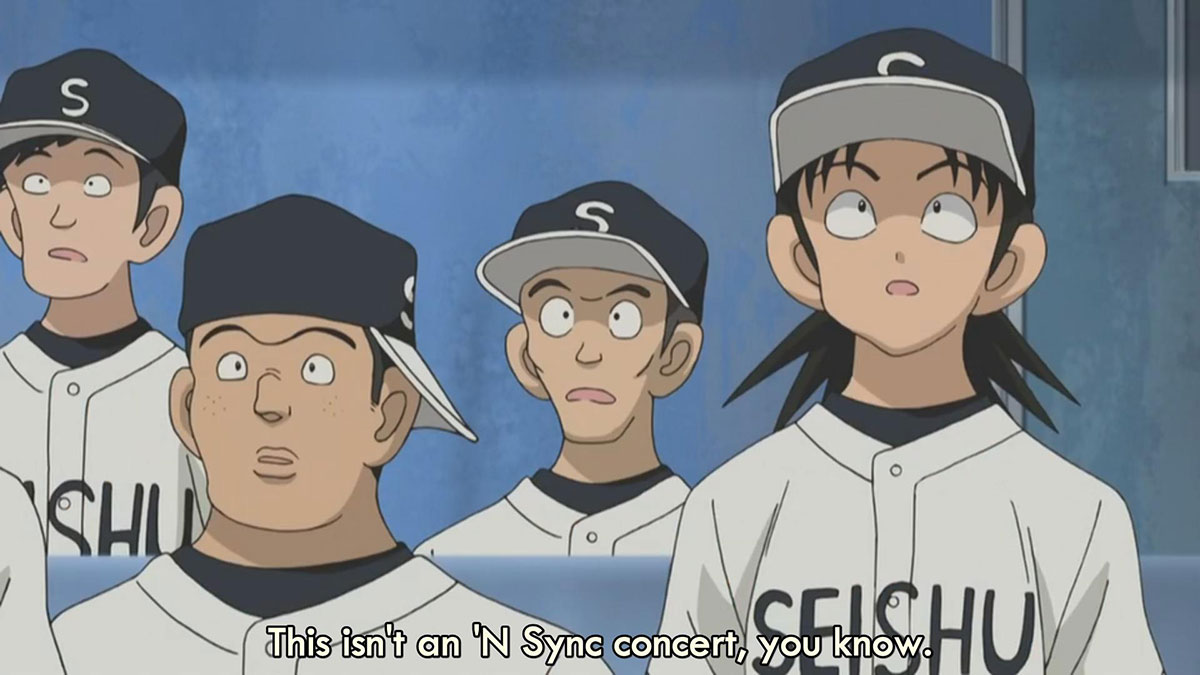
Cross Game is an old-school-looking, baseball-themed anime centered around Ko Kitamura, the Tsukishima sisters who live nearby, and the struggle of growing up with loss.
In truth, it is difficult for me to really summarize Cross Game, for one specific reason: the anime is 50 episodes long. This is not to suggest that the show was boring or had any particular amount of filler – indeed, I sat down and watched 20 episodes in a row one evening – but rather its ultimate theme takes form over such a distance as to make the thematic transition gradual. Which, in a way, is noteworthy on its own; this is an anime of small gestures, long silences, poignant looks, and accumulated experiences. The character progression feels completely natural, and there is ample time to grow acquainted with just about every character.
At the same time, I could not help but feel like the anime would have been more impactful had it been, say, 26 episodes. Or even less. Indeed, what I keep circling back on in my head is how shows like Your Lie in April or Plastic Memories or Anahona can in 13 episodes deliver an emotional payload on a greater scale than Cross Game does in 50. The relationships in Cross Game are “thicker” with the sheer volume of experiences, but… I dunno.
Ultimately, whether Cross Game is worth your time is going to need to be a call you make yourself. You do not need to be a baseball fan to watch the show (I’m not into sports), but you do need to be prepared to buckle down for the long haul. It will be a satisfying journey if you aren’t in a hurry.
SCHOOL-LIVE!
Episodes: 1-12
Genre: High School, Drama, [spoilers]
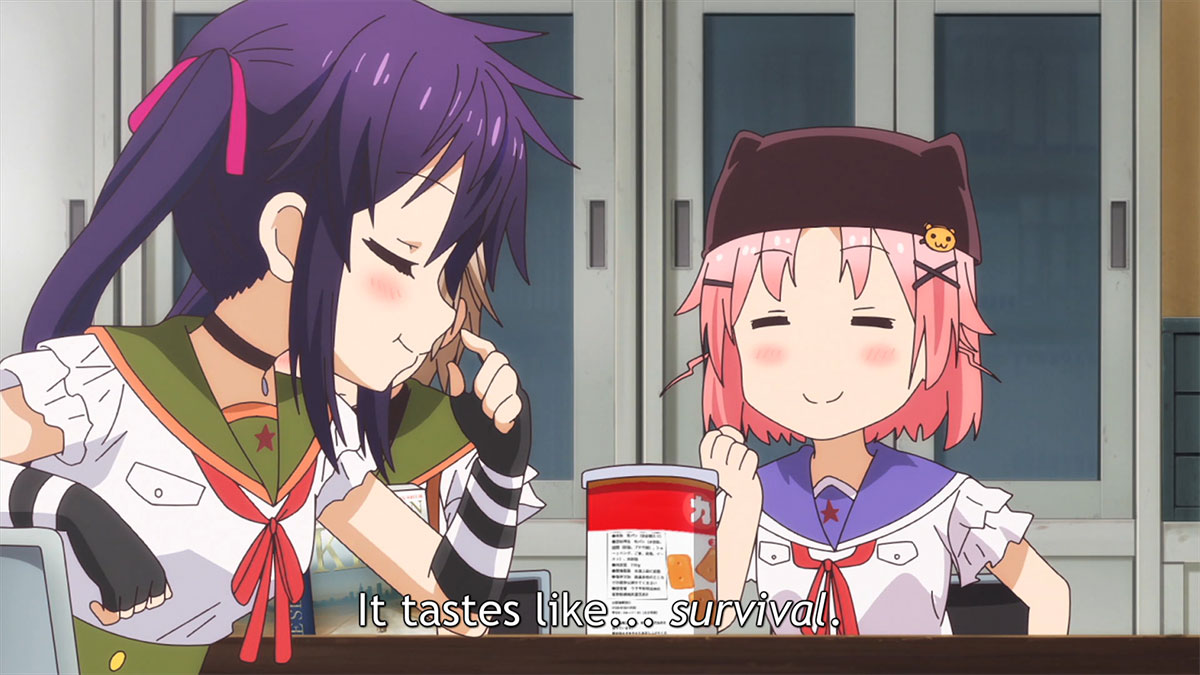
Holy shit, you guys.
I almost don’t want to write a review for this anime at all, as the best way to watch it is to go in completely blind, as I did. So this will be your first chance to stop reading and go watch it yourself without getting spoiled in any way.
…Continue?
The basic premise of School-Live is that a group of four high school girls have started a club with their teacher adviser called the School Life Club. In this club, the rules are that they are not allowed to leave the school building, and otherwise have to stay on school grounds. The anime follows their everyday life in this club, the various activities they get into, and the struggles they have with classmates, and adapting to living in the school building.
…
Last chance to stop.

…
The huge, mind-blowing juxtaposition this show presents is that all of this occurs after the zombie apocalypse. I literally almost turned the show off before the end of the first episode, as it seemed just another goofy high school comedy. As it turns out, the “narrator” of that first episode, Yuki Takeya, has completely blocked out the mental trauma of seeing everyone she liked die during the fall of the city, and thus sees everything as “normal.” So Yuki goes to class and sees a normal classroom, whereas in reality it is an empty room littered with blood, broken glass, and other debris.
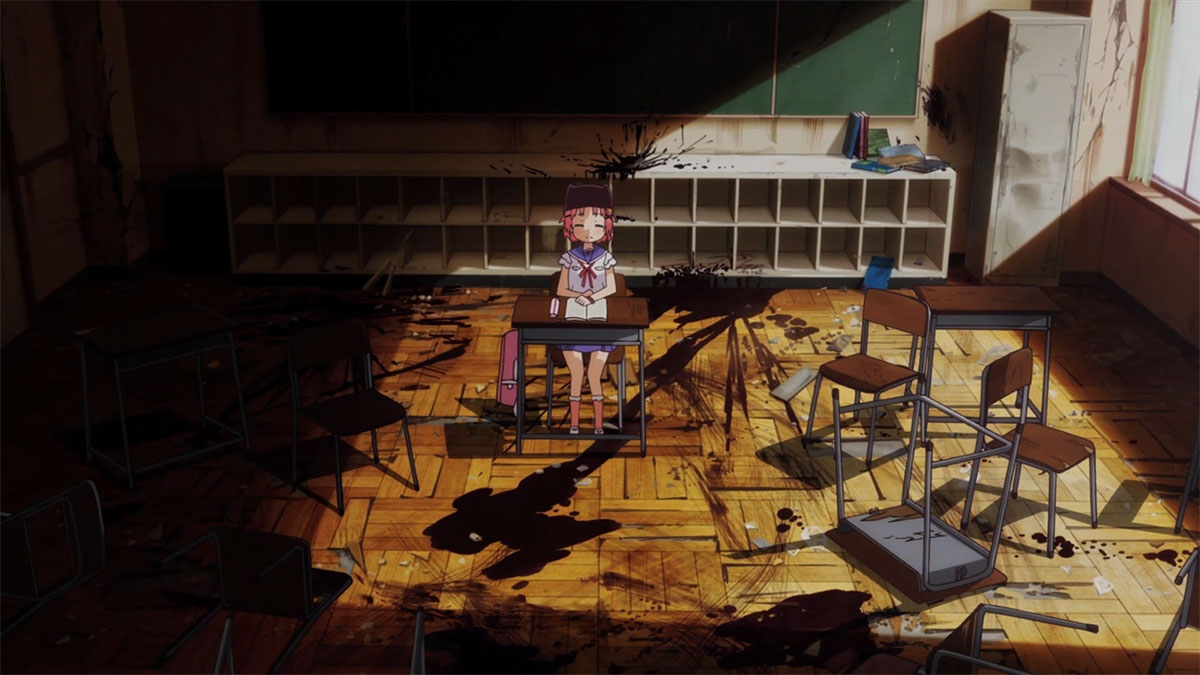
And the most amazing thing about School-Live! is how it plays all this straight. These are not girls with magical powers, unlimited ammo, or even particularly strong constitutions. The only real weapon they have is a shovel, and only one of them is strong enough to even use it. They are simply trying to survive on the upper floors of their school, while Yuki inadvertently keeps their spirits up by suggesting club activities as if everything was fine. And in so doing so… it somehow is.
As stated the juxtaposition is the best part of School-Live! After the first episode reveal, the title sequence changes to reflect reality (and continues to change as a foreshadowing mechanism), but the cute anime style stays the same. By “cute” I do not mean that School-Live! avoids sucker-punching you in the throat on occasion (especially towards the end), but rather the style remains consistent throughout. These characters could be air-dropped, personalities and all, into any other anime and perfectly fit in. But they still work beautifully and devastatingly here as well.
In short, this show is worth your time. It might not change your life, but it will make you feel something.
Nerf Forward
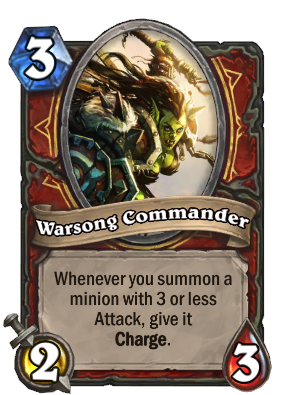
Blizzard did it. They really did it. Warsong Commander nerfed hardcore.
#NeverForgetToChargeForward
Specifically, the card was nerfed to simply say “Your charge minions have +1 Attack.”
There are a couple of things you have to say right off the bat. The first is “Thank Christ, Patron is dead.” I talked about the ridiculousness of Patron Warrior back in August, and it never really stopped being ridiculous. How long has it been a Tier 1, metagaming warping deck? Four months? Six?
Which is actually the second thing: err… why now? Oh wait, we’re heading into Blizzcon and the World Championship. This isn’t even the first time a high-profile card was nerfed specifically in weeks heading into said tournament. If I weren’t more cynical… ah, fuck it, I am exactly that cynical. As much as various commenters get their knickers in a wad over legitimately exciting randomness, nobody really wants to see 50+ damage delivered from an empty board.
Unless it’s double-combo Druid. Then it’s okay.
Then there’s the third thing, which is: “huh… this was the nerf they went with?” In the scheme of things, it is probably the best long-term one. As this Extra Credits mentions, you can’t just focus on making exciting cards today, you also have to give thought to what said exciting cards do to future design. The example in the video is Tuskarr Totemic, which is a Shaman 2-mana creature that summons ANY random totem. It’s a nice creature (assuming Shaman ever becomes playable again), but it’s mere existence means Blizzard can’t really create 8-mana totems or otherwise ones that would completely break the game by being summoned by a 2-mana card.
In a very similar way, an unnerfed Warsong Commander forces Blizzard to put every future 3-attack (or less) Warrior/Neutral creature under a microscope lest they repeat Grim Patron mistakes. Which is amusing in a way, considering I’m pretty sure Blizzard expressly considered the Grim Patron + Warsong Commander combo potential when they “fixed” Warsong Commander to also affect summoned (rather than simply played) minions.
The final thing I have to say is that I continue to be baffled by Blizzard’s balance philosophy here. How long does a clearly broken card or card interaction need to exist before it is addressed? The only real criteria seems to be “if it would embarrass us at Blizzcon.” Which is bonkers considering Hearthstone is perhaps the most perfect CCG to experience balance changes. There is no direct trading of cards in Hearthstone, no secondary market, so nerfing a card doesn’t actually destroy any value; every nerf is accompanied by getting full dust value of disenchanting the nerfed card, so you can spend that elsewhere. Compare that to Magic: the Gathering where a card getting banned in the Standard format can wipe out tens of thousands of dollars of value across the world.
In fact, do look at Magic. Back in January, Wizards of the Coast outright banned three cards and basically upended the Modern metagame thereby. Magic has a long history with errata as well, which is basically Wizards changing the text on printed, physical cards into something else. If you were just some high schoolers playing Magic on the weekends, you would just be left with some ridiculously powerful cards and no inkling that your combo wouldn’t actually work down at the comic shop or anywhere with an official judge. As far as I can tell, Wizards has really toned down the errata since the Urza’s expansions (which were the best), but the point is that they did it. And Blizzard doesn’t, when it would be incredibly easy to do so.
I know, I get it. If Blizzard changed things every time the metagame took an unhealthy turn, that in itself might make the metagame even worse. People might lose confidence in “investing” in Hearthstone, or may just throw their hands up and wait for nerfs to the best decks. Sometimes though, man, it makes it you think: if it’s unhealthy enough today to nerf, how long have we been unhealthy for what amounts to appearance’s sake?
That JAB vs Trump Hearthstone Game
The Hearthstone Americas Champion tournament aired this past weekend, and one particular game stood out: JAB vs Trump, Game 5. Or more specifically, this game-deciding bit of RNG at the final moments:
Now, the first thing I’m going to say is this: listen to that crowd. They’re loving it. I was watching the stream live and even I was going “OoooOOOoooh!” For all the derogatory “coin-flipping” and RNG flak Hearthstone gets, I think it’s pretty clear that watching these games can still be pretty exciting. Certainly more exciting than watching a perfectly mechanical, zero RNG game in which the outcome is known by turn four.
But as someone who watched the entire match-up, what gets me is how everyone always boils the RNG down to the final sequence… but seemingly ignore everything that lead up to it. This the final match in its entirety:
There is a ton of RNG at the beginning of the match, including a lot of amazing top-decks that changed the tone of the game. If Trump didn’t draw that Big Game Hunter to answer Dr. Boom, if the Shredder outcomes were different, if some other combination of cards were drawn… and so on. It reminds me of sports like football or baseball when mistakes are made with the final field goal or bottom-of-the-ninth plays. Everyone always remembers that last failure, and not all the other equally critical failures that lead up to it.
That thought then brought me to the Reddit thread in which someone wrote this:
You missed the whole pont, people say Hearthstone can’t be an esport because RNG isn’t affected by skill (mostly), so it’s more like playing bingo than a real sport in which there is 0% luck like soccer, or an esport like StarCraft 2.
There is no question that there is a lot of RNG in Hearthstone. But it is also beyond absurd to not recognize how much random bullshit occurs in meatspace sports as well. It is like suggesting all these soccer goals were 100% intentional, including the one where the guy tries to headbutt the ball, misses, and it bounces off his hip into the goal. Is the fact that a literal random number generator is not involve somehow make those “1cm to the right and it’d have bounced off the pole” scores less random?
Point being: randomness is involved in every asymmetric game, up to and especially including real-life sports. Are soccer games determined by coin-flips? Not ones we can see, anyway. But how else would you describe a penalty kick-off in soccer? That goalie has to arbitrarily decide to jump left or right, pretty much instinctually and before they see where the ball is heading. Or going back to card games like Poker – which a lot of people take very seriously – the most skillful aspect of the game is… bluffing. But what is that? If you read someone perfectly, all that really tells you is “they like/don’t their hand.” It doesn’t tell you what cards they have, or if yours could beat theirs.
I dunno. I don’t play Hearthstone as much as I used to, but I still enjoy watching it quite a bit. To suggest it can’t be an esport due to it having RNG moments though, is just ridiculously wrong. The randomness in other games is just more well-hidden. Perhaps we can say Hearthstone has too much of some arbitrary amount of RNG to be successful in an esports sense, but… is that really the criteria? Or is it “this is fun and exciting to watch?”
Open World, Closed Story
Having made it well into hour 30 of The Witcher 3, I am beginning to realize something about the plot. Namely, it is entirely incongruent with the actual gameplay.
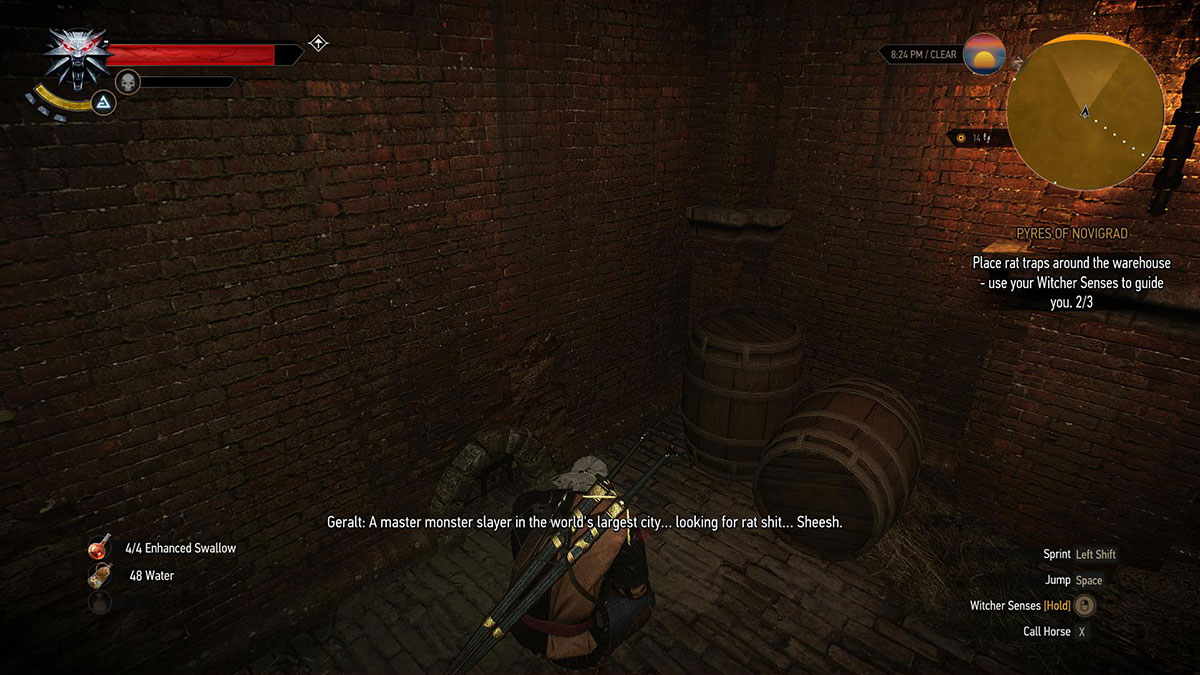
Take your time, the Wild Hunt is not going anywhere.
The basic premise of Witcher 3 is that Geralt is looking for his adopted daughter, Ciri, who is also being chased by The Wild Hunt. So already there is a trajectory here to the plot, which is “quickly follow the clues to find Ciri.” But every other single element of the game clashes with any sense of urgency that the premise should be bringing.
For example, during a beginning segment of the game, Geralt finds out the baron of the area has met with Ciri. However, the baron refuses to give Geralt any details until he finds the baron’s own missing wife and daughter. Before you can do that though, you will likely need to gain some levels completing other side quests in the area. So you complete quests, level up, go find the wife, then daughter, then head back to the baron to get the full story, 15+ gameplay hours later. The end result is, spoiler alert, Ciri is no longer in the area.
Which of course she isn’t. Literally nobody is the world expects to find Ciri in the very first area indicated by the quest objective. It would actually be incredibly novel for a videogame to feature a “quickly chase down this person” plot structure and actually allow the player to find them in the first area if they are quick enough. It would also make said game really short, and almost punish the player by removing gameplay, but very novel just the same.
The problem in Witcher 3 goes deeper than just using a false sense of urgency though. The problem is actually having any plot whatsoever in an otherwise open-world game. Every time I decide to strike out on my own and investigate every abandoned shack in the woods, inevitably I encounter the end-result of some quest I have yet to accept. For example, I spotted a shack, looted it, found out there was a cave system beneath it, explored and looted that, noticed all the red-highlighted spots (indicative of quest markers), then left the area. An hour or two later, I got a quest to investigate the same shack, “discover” a monster nest in the cave below, and then fight said monster. I ended up feeling punished for exploring on my own.
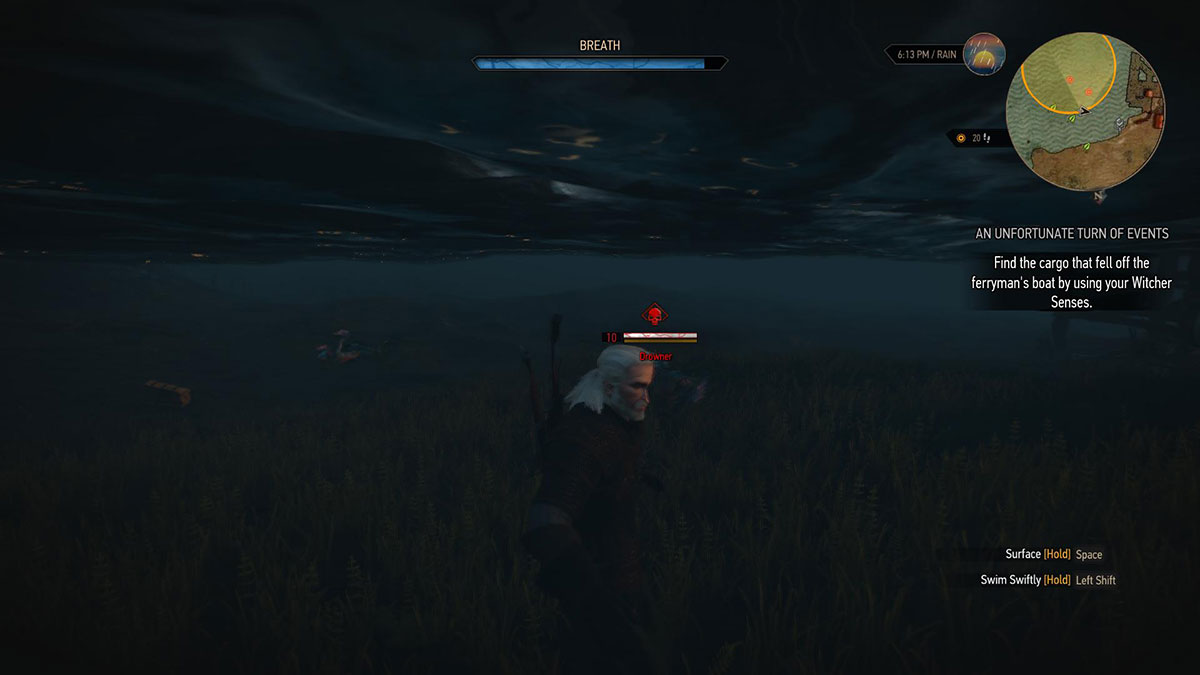
I didn’t want to complete that level 4 quest anyway.
The irony here is that Witcher 3 would have been screwed either way. It’s bad the way it is. It would almost be worse if there was some kind of plot lock on the cave system, because it would engender a feeling of false open world-ness. “Go anywhere you want! …except here. And there. And over there too.” It wouldn’t be much of an open world if you could only explore the empty bits.
The other thing that Witcher 3’s open world is demonstrating to me is how much I do, in fact, loathe fixed-level monsters in open-world settings. It is getting beyond frustrating to be exploring and exploring and all of sudden, skull-level monsters. I mean, it makes sense that there might be monsters out in the world that are super-deadly and Geralt would need to become more powerful to overcome. But quite often there is no delineation going on – you’ll be killing level 10 Drowned one moment, and then 50 ft away is a level 20+ monster. I suppose that it is more “organic” than just having all the monsters coincidentally more powerful near the edges of the map, but again, it feels bad to me as a player wished to engage with the “open” world. Especially considering all this really tells me is that the “right” way to play is to not explore anything until level 20+ so I don’t have to skip areas.
I don’t know. I suppose the conclusion I am coming to is that if a game offers an open-world setting, I almost want it to have little-to-no plot, or really level-based progression of any kind. Fallout 3 allowed me to explore every corner of the non-DC map by level 3 (and had scaling monsters), which is probably why I enjoyed that game so much. Minecraft of course lets you punch trees anywhere. I don’t remember being too put-off by Dragon Age 3 either. In the Witcher 3’s case however, I may as well go back to treating it as the hemmed-in, plot-centric game its two earlier iterations were.
Impression: the Witcher 3
The Witcher 3 is weird.
…
…what? You need more? Haven’t you played this game for 100+ hours already?
The weirdness comes from the juxtaposition of Witcher 3 (W3) getting some things outrageously, fantastically good, all while mired in mediocrity and out-right immersion-breaking shenanigans otherwise.
For example, the environment, the gritty, dirty, pustule side of medieval fantasy life is back with a vengeance and already a highlight of my Witcher experience yet again. When you walk around hearing peasants cough with genuine phlegm, it reminds you this isn’t Disneyland, this is real (fantasy) life. People lived in the muck, practically nobody has windows, of course they’d be walking around like diseased shit-bags. The entire Witcher series has always gotten this feeling down so well that every other medieval setting I have encountered since has felt like college freshmen at the Renaissance Festival in comparison.
Then you walk into an Inn and the barkeep is selling bottled water for 42g apiece:
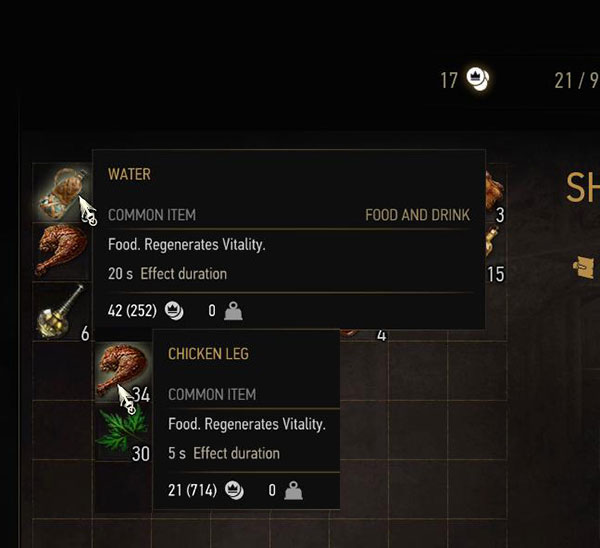
Brought to you by Nestle.
In the panoply of absurd gameisms out there – having access to world-ending magical powers but being unable to open locked doors, etc – it might seem disingenuous to pick on W3’s Nestle-style gouging as immersion-breaking. But it is precisely the confluence of W3’s fantasy realism and its absurd gamey bits that make little details like this so prominent.
Playing on the next step above Normal-mode difficulty means that Geralt no longer gets healed by Meditating. Whereas you might have just chain-chugged Swallow potions in prior titles to beef up your passive regeneration, W3 has opted for the Skyrim-esque “scarf fifteen pieces of raw meat in the middle of combat” HP management system. Different consumables heal X amounts in Y amounts of time, so you typically need the best to survive.
And one of the best? You guessed it: plain ole H2O.
I haven’t cared more about water in any game since Fallout: New Vegas hardcore mode. Every time I rummage through a peasant hovel, stealing everything not bolted down, I do a fist pump every time I see a bottle of water. “Silver candle stick. Old bear hide. Ruby dust. Water… score! Time to fuck up some demons!”
I’m only halfway kidding.
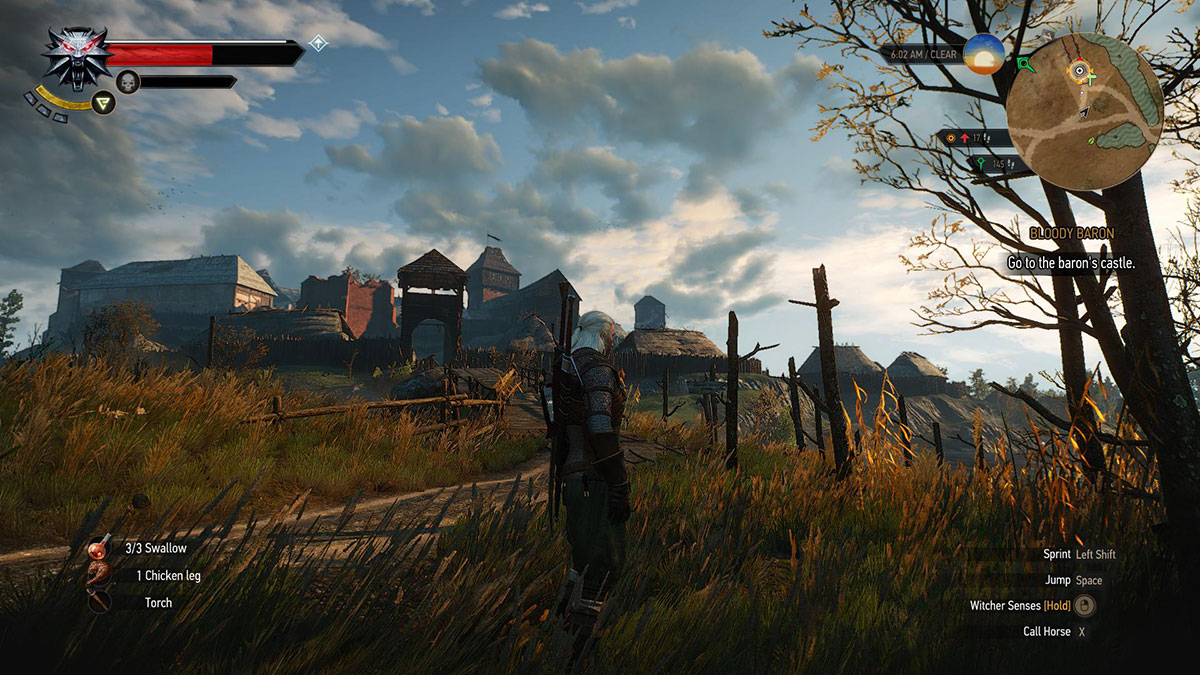
Please live up to this.
Truly though, W3’s combat system reminds me of Blizzard’s game design philosophy between expansions: instead of simply fixing what was broken, CD Projekt RED decided to veer completely in a different direction… again.
The combat itself is fine, for the most part. What is different (again) this time around is consumable use. Potions are no longer limited by toxicity (Witcher 1) or preparation (Witcher 2), but rather by what amounts to “per encounter charges.” Craft the Swallow potion one time and you get 3 charges of it, which are automatically replenished by strong alcohol whenever you meditate for at least 1 hour. Craft every potion once, use them all in five minutes, and they all come back after meditation. I’m not really even convinced that any alcohol is actually being consumed to replenish the stock of potions.
While toxicity still exists, it is largely window-dressing considering how a single Swallow potion’s toxicity drops to zero before the potion’s effects even have time to wear off. And while the toxicity meter limits your ability to stack potion effects I guess, the Quick Use menu is limited to two items anyway (presumably to not blow the minds of unwashed console peasants). Decoctions represent longer-term buffs that fully use up your toxicity meter, but I’m not entirely convinced this move towards the trivialization of preparation was worth it. Witcher 2 went way, way too far the other direction – forcing you to use potions before you even knew combat was coming – but why the crazy swing the other direction? Pretty sad how much better the original Witcher feels in comparison.
In fact, that’s precisely where I am mentally every time I boot up the game. It looks amazing, sounds amazing, and generally feels amazing when playing in the moment. If you slow down a bit at all however, and the high-speed blur turns into a mishmash slurry of disparate game mechanics. I’m hoarding herbs and potions out of Witcher 1 habit while throwing back Honeycombs and Wolf Livers by the pound. I’m looting every building and outhouse in sight for crafting materials so I can craft low-level items outclassed by bandit drops so I can kill skull-level monsters guarding swords five levels below me. Random loot is random, but there comes a time when the designers need to put in some goddamn sanity checks, yeah? Sitting on the recipe for Enhanced Beast Oil for 10 hours while Googling where the hell regular Beast Oil is supposed to spawn is not my idea of good game design. Especially when the answer is a shrug.
So. Like I said: weird. Good, but weird.
But hey, Gwent is pretty cool. It’d be cooler if they actually let me have enough cards to make more than one faction deck after 25 hours, but it’s still fun.
MyAnimeList
For those who might be interested, here you go:
http://myanimelist.net/animelist/InAnAge
That should link you to a nigh-exhaustive list of all the anime (and manga) I have watched and remembered to write down over the years. While I will continue to actually write reviews in the future, I feel like that list will be good enough for a lot of those shows, especially the older ones. In other words, if we have similar interests and you want some recommendations, just sort the list by Score and work your way down.
As far as the scoring system itself, I had an internal rubric going, but I’m realizing that it doesn’t make a whole lot of sense outside of my head. For example, is Serial Experiments Lain really a 9, above even Death Note? Well, Lain blew my mind back 2002 when I watched it, so that’s how I remember it. Chances are Lain would score lower if I rewatched it, or if I watched it for the first time after having seen Death Note. So just keep that in mind.
In light of that, it’s best to read my scores this way:
- 10-8: I really liked these shows, they made me feel something, go watch them.
- 7-6: These deserve a spot on your queue, even if you don’t watch them immediately.
- 5: It’s anime.
- 4-1: I wouldn’t bother.
So there you go. If you have a similar list you would like to share, or notice some glaring omissions in my anime resume, feel free to post them in the comments below. I prefer shows that are on CrunchyRoll, but I have access to FUNimation and even BakaMT.me for the older stuff.
 In An Age
Don’t Preorder Games
Oct 3
Posted by Azuriel
…unless it’s Fallout 4 for $42.14:
Life is kind of a grey area anyway.
While my parsimony is well-established, sometimes you just have to spend more money to spend less, you know? It’s Bethesda, I already know there will be crippling, horrible bugs on Day 1 and likely heading into Day 14. It is known.
…but I also know myself. Even if by some miracle I avoid spoilers (assuming there are story elements worth spoiling), I know that every other game I play during Fallout 4’s release to distract me from having not purchased it will necessarily be diminished. “I could be playing Fallout 4 right now.” “Am I having more fun than I would playing Fallout 4?” Thus, to me, in certain specific situations, not preordering will end up costing me more: either by breaking down and purchasing at full price, or by losing the value of fun from an already purchased game. So not taking them up on this deal is like robbing Peter to pay Paul.
Or maybe I just think ~$40 is a fair-enough price for this game and I don’t expect to be able to pay that amount two months after release.
…or maybe both. Yeah, probably both reasons.
Posted in Commentary
1 Comment
Tags: But the Flesh is Weak, Day 1 Embargo, Fallout 4, Parsimony, Preorder Prepurchase Prepay