Blog Archives
E33: How It’s Done
I am not particularly far in Claire Obscur: Expedition 33 (E33) – about 12 hours or so in – but I did want to briefly highlight one fantastic customization system that it has in comparison to, say, Avowed, The Outer Worlds 2, or frankly any game that professes to have player agency/customization at all. That system is of Pictos.
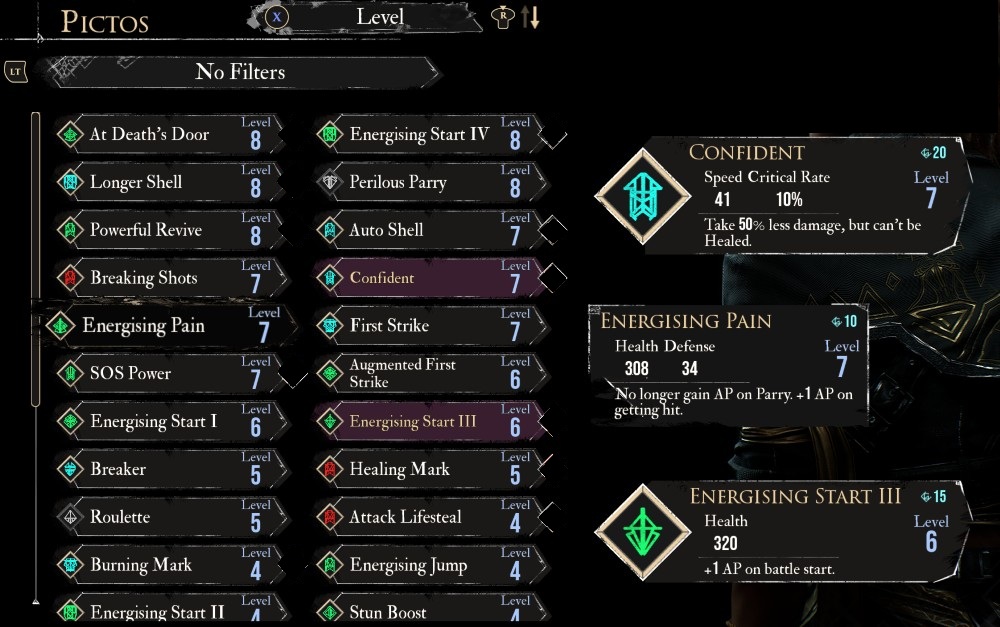
In many ways, Pictos feel like OG Final Fantasy 7 Materia: they are an item you equip that grants both stat bonuses plus a passive ability. Once you complete four combats with a given Pico equipped, the passive ability is permanently learned by everybody. Each character then has a pool of “Luma” they can use in a point-buy way to equip the passives. Some effects are cheap, like being able to gain +1 AP on a Perfect Dodge for 1 Luma; more powerful passives can cost 10, 15, or more. Oh, and of course you can freely move Pictos and Luma around at no penalty (there are respec items for base stats though)!
What gets the juices really flowing are the synergies and tradeoffs. Each character can equip three Pictos apiece, and while so equipped, the passive is granted without spending Luma. Thing is, there is usually an inverse relationship between how much Luma it would otherwise take to get the passive, and the raw bonus stats on the Picto itself. A given Picto might have +50 Speed and +15% Crit Chance, for example, but contains a passive that only saves you 3 Luma. Meanwhile, that 20 Luma passive is attached to like a +300 HP brick.
…which can be still be helpful if one of your characters is wielding a weapon that doubles as damage taken in exchange for another bonus. The downside of which you are mitigating with a passive that reduces damage taken by 50% but you cannot be healed by spells. No worries, just stack a bunch of +HP Picos and practice your sweet, sweet dance (dodge) moves.
Now, think about The Outer Worlds 2 in comparison. There is none!
Yeah, these are not the same type of games, so of course they are not set up in the same way. But there will be people who argue that you choosing Engineering and Medical on the character select screen in TOW2 is some deep gesture of customization when it is, in fact, an a priori straightjacket that railroads your entire playthrough. “I’m roleplaying though!” Roleplaying… what? Arbitrary Man?
Anyway. All I’m saying is that I am wherever I am in the game, and already have more than 40 Pictos to choose from. And unlike in TOW2, I am actually choosing builds and testing them out, because I am not expressly penalized for doing so. That’s some good, engaging game design.
Maybe Obsidian should take notes.
I Get No Respec
The Outer Worlds 2’s game director believes implementing 90+ perks with no respec option will lead to role-playing consequences.
“There’s a lot of times where you’ll see games where they allow infinite respec, and at that point I’m not really role-playing a character, because I’m jumping between — well my guy is a really great assassin that snipes from long range, and then oh, y’know, now I’m going to be a speech person, then respec again, and it’s like–” […]
“We want to respect people’s time and for me in a role-playing game this is respecting somebody’s time,” Adler argues. “Saying your choices matter, so take that seriously – and we’re going to respect that by making sure that we give you cool reactivity for those choices that you’re making. That’s respecting your time.
Nah, dawg, having an exit strategy for designer hubris and incompetence is respecting my time.
Imagine starting up Cyberpunk 2077 on launch day and wanting to role-play a knife-throwing guy… and then being stuck for 14 months (until patch 1.5) before the designers get around to fixing the problem of having included knife-throwing abilities with no way to retrieve the knives. As in, whatever you threw – which could have been a Legendary knife! – just evaporated into the ether. Or if you dedicated yourself to be a Tech-based weapon user only to find out the capstone ability that allows tech-based weapons to ignore enemy armor does nothing because enemies didn’t actually have an armor attribute. Or that crafting anything in general is an insane waste of time, assuming you didn’t want to just print infinite amounts of currency to purchase better-than-you-can-craft items.
Or how about in the original release Deus Ex: Human Revolution when you go down the hacking/sneaking route. Only… surprise! There are boss fights in which hacking/sneaking is useless. Very nice role-playing consequences there. Devs eventually fixed this two years later.
The Outer Worlds 2 will not be released in a balanced state; practically no game is, much less ones directed by apparent morons. Undoubtedly we will get the option for inane perks like +50% Explosive Damage without any information about how 99% of the endgame foes will have resistances to Explosive Damage or whatever. In the strictest (and dumbest) interpretation I suppose you could argue that “role-playing” an inept demolition man is still a meaningful choice. But is it really a meaningful choice when you have to trap players into making it? If players wanted a harder time, they could always increase the game difficulty or intentionally play poorly.
Which honestly gets to the heart of the matter: who are you doing this for? Not actual role-players, because guess what… they can (and should) just ignore the ability to respec even if it is available. Commitment is kind of their whole schtick, is it not? No, this reeks of old-school elitist game dev bullshit that was pulled from the garbage bin of history and proudly mounted over the fireplace.
But I’ll tell you, not every game is for every single person. Sometimes you have to pick a lane.”
And yet out of all the available options, you picked the dumbass lane.
It’s funny, because normally I am one to admire a game developer sticking to their strong vision for a particular game. You would never get a Dark Souls or Death Stranding designed by a committee. But by specifically presenting the arguments he did, it is clear to me that “no respecs” is not actually a vision, it’s an absurdist pet peeve. Obsidian is going to give us “cool reactivity” for the choices we make? You mean like… what? If I choose the Bullets Cause Bleed perk my character will say “I’ll make them bleed”? Or my party members will openly worry that I will blow everyone up when I pick the Explosion Damage+ perk? You can’t see it, but I’m pressing X to Doubt.
[Fake Edit]
I just came across developer interviews on Flaws and Character Building. Flaws are bonus/penalty choices you get presented with after a specific criteria is met during gameplay. One example was Sungazer, where you after looking at the sun too many times, you can choose permanent vision damage (bloom and/or lens flair all the time), +100% ranged damage spread, but you can passively heal to 50% HP when outside in the daytime. The other is Foot-In-Mouth where if the game notices you quickly breezing through dialog options, you can opt to get a permanent +15% XP gain in exchange for only having a 15-second timer to make dialog options, after which everything is picked randomly.
While those are probably supposed to be “fun” and goofy examples, this is exactly the sort of shit I was talking about. Sungazer is obviously not something a ranged character would ever select, but suppose I was already committing to a melee build. OK… how often will I be outside? Does the healing work even in combat? How expensive/rare are healing items going to be? Will the final dungeon be, well, a dungeon? I doubt potentially ruining the visuals for the entire rest of the game will ever be worth it – and we can’t know how bad that’s going to be until we experience it! – but even if that portion was removed, I would still need more information before I could call that a meaningful choice.
“Life is full of meaningful choices with imperfect information.” Yeah, no, there’s a difference between imperfect information because the information is unknowable and when the devs know exactly how they planned the rest of the game to go. Letting players specialize in poison damage and then making all bosses immune to poison is called a Noob Trap.
The second video touches more directly on respecs and choices, and… it’s pretty bad. They do their best and everything sounds fine up until the last thirty seconds or so.
Yes, you can experiment and play with it a bit. And you may find something… ‘I try this out and I don’t really like it too much’ you know… you might load a save. You might want to do something different, you might try a different playthrough.
This was right after the other guy was suggesting that if you discover you like using Gadgets (instead of whatever you were doing previously), your now-wasted skill points are “part of your story, part of your experience that no one else had.” Oh, you mean like part of my bad experience that can be avoided by seeing other players warning me that X Skill is useless in the endgame or that Y Skill doesn’t work like it says it does in-game?
Ultimately, none of this is going to matter much, of course. There will be a respec mod out there on Day 1 and the mEaNiNgFuL cHoIcEs crowd will get what they want, those who can mod will get what we want, and everyone else just kind of gets fucked by asinine developers who feel like they know better than the ones who made Baldur’s Gate 3, Cyberpunk 2077, Elden Ring, and Witcher 3.
Time and Place
Wildstar is one of those failed MMOs I have a bit of (perhaps misguided) nostalgia for. Granted, it’s a lot easier to remember only the good parts of something when the thing no longer exists to remind you of the bad. Wildstar’s terrible combat system, banal questing, radically tone-deaf developers pushing a hardcore experience for no one all seems to fade away with time. Meanwhile, the evocative art design, hoverboards, and astounding home building/decoration options springs right to mind.
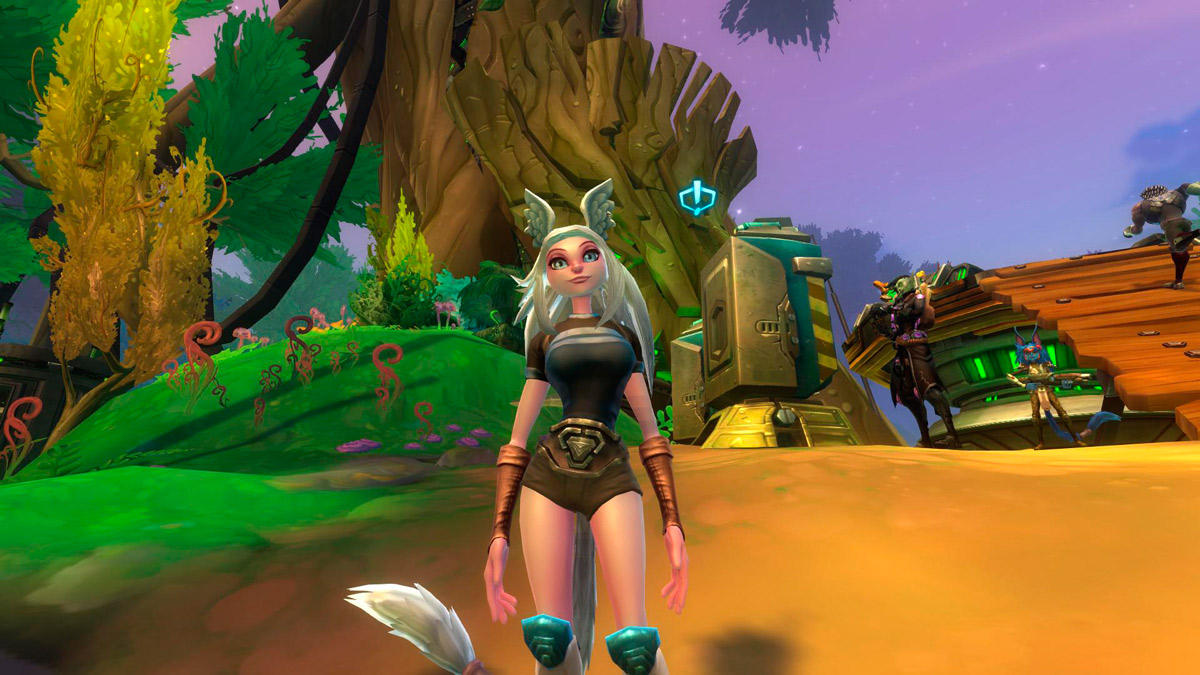
I bring this all up because of an interesting article I read the other day about Tim Cain spending 6 years working on Wildstar. And that wasn’t even all of it, as the game took another three years to release from there. Then the author drops this bomb:
To put it into perspective, when work began on WildStar, World of Warcraft was still in its vanilla era. When WildStar finally launched, we’d seen The Burning Crusade, Wrath of the Lich King, Cataclysm and Mists of Pandaria, and Warlords of Draenor was just around the corner.
No fucking wonder, dude. I had really never understood why the Wildstar devs believed the hardcore angle was a winning strategy in an MMO. Yeah, the original MMOs had that hardcore element to them and were successful. Were they successful because of the hardcore-ness? I would argue “clearly not.” But if the Wildstar devs were laying the groundwork for the game back in the age of vanilla WoW, their stubbornness nine years later makes perfect sense. That level of difficulty was what they were familiar with and wanted to “compete” against. Or perhaps even bring back.
Alas, the zeitgeist had since moved on.
Impressions: Enshrouded
I actually purchased Enshrouded on a sale prior to Nightengale and a few other games, but had been waiting until I finished those, lest I be too enraptured by what was going to be the better game. You know, eating your peas and mashed potatoes before the pudding.
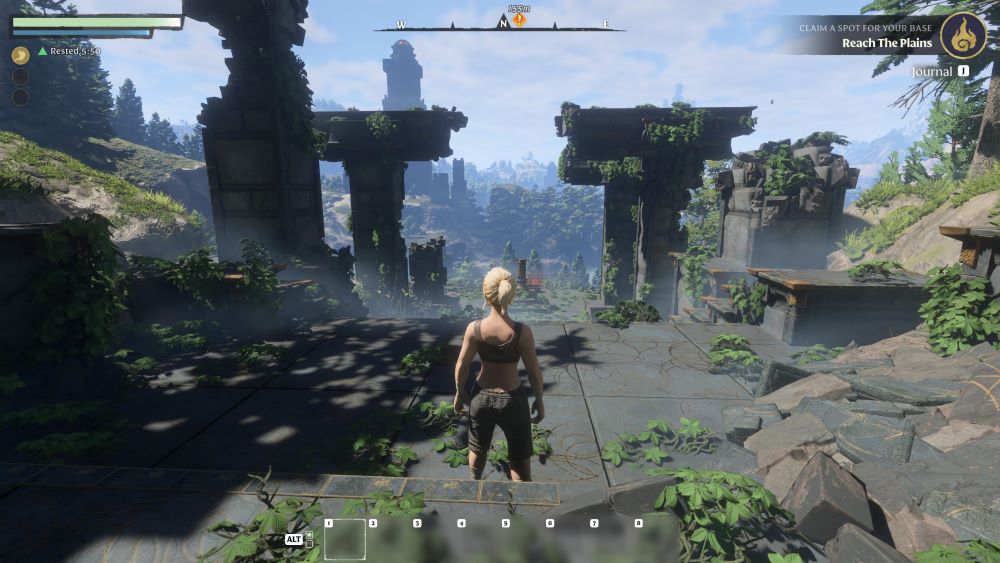
As it turns out, I needn’t have bothered: Enshrouded is not fun to play.
Believe me, I’m as surprised as anyone. Enshrouded has sold 3 million copies in Early Access, and is specifically called out by the Nightingale devs as one reason why they are reengineering their game.
Let’s get this big note out of the way: Enshrouded is not an open-world survival crafting game. I had to look at the Steam store page to double-check, but sure enough, it’s billed as a “co-op survival action RPG.” It’s an important distinction because the crafting, resource gathering, and survival elements are all perfunctory at best. Do you punch trees and collect fiber from bushes? Yes. Can you craft the cloth or metal scraps you need for practically everything? No. Those come from mob drops, or occasionally from destroying tents or other objects out in the world. After a while, you realize that you don’t really need much of anything from environment in comparison to mob drops, which is textbook Action RPG with “survival-lite” elements.
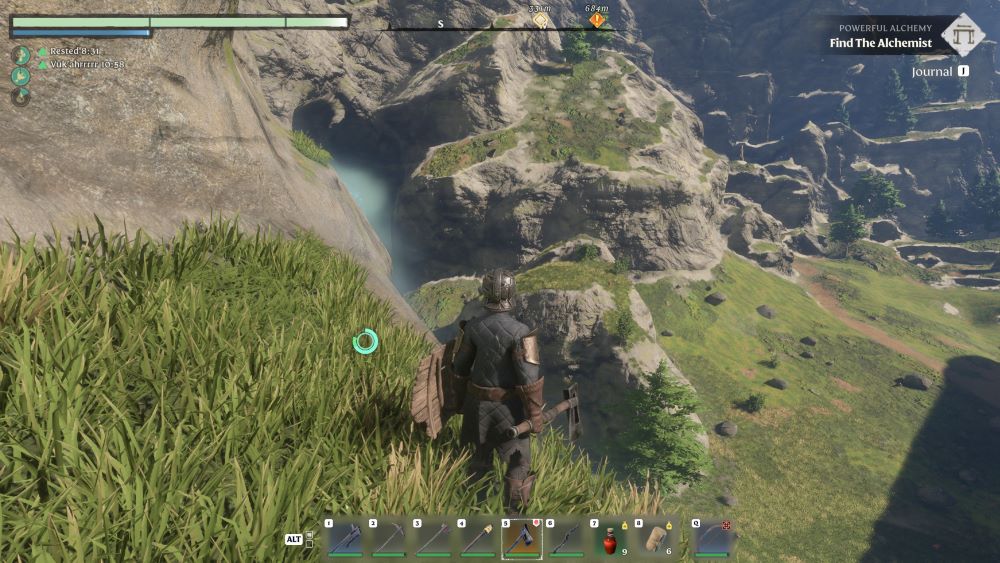
One thing Enshrouded is very good for is terrain deformation. Almost absurdly so. Nearly every inch of terrain can be dug into with a pick, and setting down base marker will allow rapid mining in almost any configuration. If you ever wanted a Hobbit-style house or Dwarven palace, this game is for you. Regular mansions are just fine as well. Build whatever you want! …provided it is within bounds of a Flame Altar.
This is important to know because general movement in Enshrouded is crap. Encounter a steep hill? Sometimes you can jump and land on individual pixels and sometimes not. If you aim your pick awkwardly upwards you can sometimes dig out a little ledge to help you climb. Double-Jump is a talent you can spec into as well. Things you can’t do? Build a box and stand on it. Or use the Grappling Hook – that’s exclusively designed to hook onto metal rings in specific places. Later on, you can unlock giant towers that you can fast travel to the top of and then jump off and use a “glider” to get around. But the glider handles more like a wingsuit weighed down with tungsten anchors than anything else.
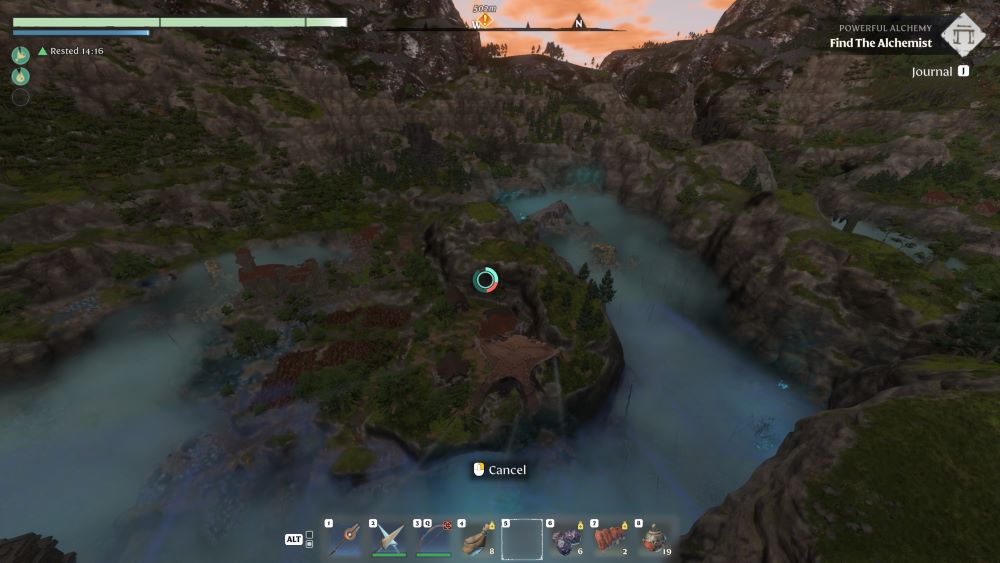
The sad part is that all of this poor mobility is likely bad by design. See, the central conceit of the game is that a Shroud has billowed out of the low places of the earth, killing those trapped inside. Venturing into these low-laying placed causes one to be “Enshrouded” and will result in death after a ~5 min timer expires. Meanwhile, poking your head outside of the Shroud will rapidly add time back onto the meter. Thus, if it were easy to grapple up hills and/or build structures anywhere one pleases, it would trivialize (to an extent) the threat posed by the Shroud. So… I get it. But I also get that Nightingale feels so immensely better being able to climb/grapple any surface and glide for ages via umbrella.
As for combat itself… meh. There are a few different types of melee weapons, but no real “moves” per se. There are block/parry and dodge-roll mechanics, along with bows and magic. I have heard the latter was nerfed recently, but I’m not sure if the abysmal magic system currently in the game is the result of that or if they made it that way on purpose. You can craft wands and staves early-on, with wands having infinite “uses” (that consume item durability) but extremely limited range. I’m talking practically melee range, for some reason. Staves, on the other hand, consume both MP and “ammo” scrolls or whatever, which can only be crafted once you rescue the Alchemist NPC. Why can you craft a staff before you have the resources to use it in any capacity?
So, yeah. Enshrouded. I have played for about ~7 hours thus far and every play experience goes the same way: sprint on a road for several minutes to some location, complete a micro-dungeon, fast-travel back to base. Repeat. Or in my case, Quit to Desktop because the play experience is exhausting. The world is gorgeous but devoid of anything interesting, combat is dull, magic is pointless, and going from place to place is skibidi Ohio no cap, as the kids say. Honestly, I should have expected something once I saw “Athleticism” as its own branch in the Path of Exile-style talent tree. Oh, and the devs are extremely miserly with the talent points and level-ups in the general.
Oh well. At least these are solvable problems that will hopefully be ironed out during Early Access.
Running Out of (Fae) Road
I am done with Nightingale, (presumably) for now.
I stand by all of my prior reporting, including the original Impressions post. There is a lot of potential with the game and its central realm-walking conceit, the ability for it to introduce fantastical creatures, an absurdly complex crafting system, and how great it feels to move around and exist in these magic(k)al worlds. Overall there is a lot to like here, and Steam tells me I spent 39 hours playing Nightingale. That’s pretty good for any game, let alone an Early Access title.
That said… there is still a long way for Nightingale to go.
The first problem is the consistently uneven difficulty spikes. Right after completing the tutorial island, you are shuttled off to Sylvan’s Cradle, a realm suffering from corruption. This corruption impacts you as well, with a realm-wide massive debuff to passive healing. You are then confronted almost immediately with a new type of Bound enemy that is insanely aggressive and hard-hitting, along with all mobs in general being at “level” 20. Your own gear progression is dependent on collecting higher-tier Essence and spending it to unlock new recipes and crafting tables. And therein lies the rub: you must suffer through being wildly underpowered until you grind enough T2 Essence to spend to craft gear to get back you on par.
And, spoilers, you will smash into the same wall again two realms later with T3 Essence.
By itself, uneven difficulty isn’t that big an issue, although the devs have gotten themselves in a bit of a pickle with the hard T1/T2/T3 Essence delineations. To me, the more relevant problem is a lack of consistent vision when it comes to crafting more generally. There are stats like Injury Resistance that sound important (damage reduction?!), but end up being worthless (prevent sprained ankle). Under Alchemy, they have things like a potion that fills your hunger meter. Literally, why? Food is everywhere and the importance of food buffs means you must be eating all the time. There are other potions to reduce being hot, which is also easily solved by equipping an umbrella, nevermind the fact that heatstroke or whatever simply limits your Stamina regeneration.
One aspect that is also utterly bizarre is the very thing Nightingale cannot afford to fuck up: realm-walking. Specifically, the absolutely nonsense direction they are heading with the Minor Realm cards. Shortly after completing Sylvan’s Cradle, you get the recipe to start building your own portals. Opening a portal means crafting and consuming a Major Realm card to one of the three available biomes (Forest, Swamp, Desert). Minor Realm cards can be used at a Realmic Transmuter within that realm to tweak “the rules” and usually the weather in the process. At first glance, there appears to be a lot of Minor Realm cards, but the more you look at them, the more questions you end up having.
The first group of Minor Realm cards are environmentally cosmetic, which is fine. Cleansing makes the realm turn back to default settings, Foresworn Skies makes it look like a black hole is overhead, Tempest makes it rain all the time, and so on. Then you have some pure upside cards like Feast/Tavern that boost food buffs, Angler makes fishing easier, Treasury lets you farm Essence. Then come the tradeoff ones like Dragon’s Hoard, that boost treasure chest contents but increases damage taken. Fine.
But then you see Blunderbuss that literally says:
Play this card to increase the damage you deal with shotguns, the yield when crafting shotgun ammunition as well as the damage you deal with magickal ammunition, while reducing the damage from other guns.
What? The devs included realm cards for pistols and rifles, by the way, so don’t feel left out. Additionally, there are realm cards that improve the yield of refined building materials, of wood, of ore, of crops, of meat/hide. All separate, of course, and occur only after the realm visibly shatters into a new form from the use of said card.
I’m honestly struggling to identify the design goal here. Is it intended for players to radically remake the realm in order to craft extra shotgun shells, and then revert it to another form to increase the yield on Wheat? Or should this encourage players to turn their primary residence into the City of Doors with portals to themed realms and otherwise endure the loading screens for marginal gains? Why are there output-related cards at all? Tempest makes it rain all the time, which means your crops will always be growing without needing to be manually watered. That sort of thing is what I consider good design – it’s subtle, intuitive (after a fashion), and atmospheric (literally). But then you have Greenhouse/Farm card which just straight-up increases plant growing speed and yield “for reasons.” Are these placeholders? Please tell me these are placeholders. Although placeholders for what I have no idea.
By the way, realms can only have one Minor Realm card at a time. Again, WTF mate? When I first heard about this portal system, I imagined being able to mix and match cards to craft bizarre realms like a very mountainous swamp or whatever. No Man’s Sky this ain’t. Instead, it’s just three procedurally-generated biomes with different skyboxes and min-max bonuses. Granted, there is a Trickster card that lowers gravity and shuffles up resources sources – chopping down trees give meat, skinning creatures gives ore, etc – but most everything else is rote. Safe. Sanitized. Much like with Starfield, you also end up seeing the same POIs and ruins over and over again.
Technically, there’s still time to right the ship before Nightingale runs out of road, to mix metaphors. Well, maybe. I doubt the realm generation code is flexible enough to accept blended biomes. Or maybe the original three will stay as-is and we’ll see others like Snow, Volcanic, and maybe some kind of Chaotic realm. Actually, I just found a quote:
“I think once we get a new biome out there, that will cement the last piece of the puzzle in terms of how we will create content going forward,” Flynn muses when asked about 0.6 and beyond. “There’s a volcano biome, there’s an Arctic and a jungle biome, all currently in discussion right now as to which one we’ll do first.”
Well, there you go. I do think that if they keep the bizarre Blunderbuss-esque Minor Realm cards around, they need to have it as an augmentation to an environmental-style Minor Realm card. That may lead to clearly-optimized combinations like Tempest + Farm, but they should either lean all the way into the nonsense or throw away half the cards immediately. When I think “Victorian gaslamp-fantasy adventure,” what does not come to mind is rewriting the rules of fae realms to make just my pistols better. Now, opening a realm to where all the Bound are wielding pistols and/or there are giant enchanted pistol enemies? That sort of thing is interesting.
Getting devs to gamble on “interesting” is not easy. Especially not when they’re already on their heels.
Cut the Concord
Statistically, you have never heard of it, but Sony is shutting down their new Overwatch-like hero shooter called Concord. After two whole weeks. On Steam, Concord apparently never broke 700 concurrent players at launch. The writing was probably on the wall from earlier when the open beta population was worse than closed beta – plus it launching as a $40 B2P in a sea of F2P competitors – but the sheer scale of the belly flop is shocking nonetheless. It is rumored to have cost $200 million, and for sure has been in development for eight (8!) years.
And now it’s gone.
You know, there are people out there that argue games should be more expensive. Not necessarily because of the traditional inflation reasons – although that factors in too – but because games costs more to make in general. Which really just translates into longer development times. And yet, as we can see with Concord along with many other examples, long development times do not necessarily translate back into better games. There is obviously some minimum, but longer isn’t better.
And yet, we have these industry leaders who suggest MSRP should be higher than the now-standard $70. To be “priced accordingly with its quality, breadth & depth,” as if any of that is really knowable from a consumer standpoint prior to purchase. We have reviews, sure, and Concord score a 70 from IGN. What does that tell you?
The overall way games are made is itself unsustainable, and an extra $10-$20 per copy isn’t going to fix anything. Indeed, there seems to be a blasé attitude in the industry that a rising MRSP will lift all the boats instead of, you know, causing the ones on the periphery to slide down the demand wave curve. Suppose GTA6 is released at $80. Is the argument that a consumer’s gaming budget will just indefinitely expand by an extra $10/year? Or will they, I dunno, just spend $10 less on other titles? Higher prices are certainly not going to expand the market, so… what?
As far as I can see it, the only reasonable knob to turn appears to be development time and nobody seems able to do it. I’m not trying to handwave away the effort and brute labor necessary to digitally animate mo-capped models in high fidelity. Or creating and debugging millions of lines of bespoke code. But I am asking how long it does take, how much of it is necessary, and how often these visually stunning games fall flat on their faces in the one function of their intended existence, e.g. being fun.
Throwing more money at the problem certainly doesn’t seem to be working.
Unsustainability
Senua Saga: Hellblade 2 recently came out to glowing reviews and… well, not so glowing concurrent player counts on Steam. Specifically, it peaked at about 4000 players, compared to 5600 for the original game back in 2017, and compared to ~6000 for Hi-Fi Rush and Redfall. The Reddit post where I found this information has the typical excuses, e.g. it’s all Game Pass’s fault (it was a Day 1 release):
They really don’t get that gamepass is unsustainable. It works for Netflix because movies and tv shows can be made in a year or less so they can keep pumping out content each year. Games take years to make and they can’t keep the same stream of new content releasing the same way streaming services do.
Gamepass subs are already stagnating, they would make more money if they held off putting new exclusives on gamepass like movies do with putting them in theatres first before putting them on streaming. (source)
Now, it’s worth pointing out that concurrent player counts is not precisely the best way to measure the relative success of a single-player game. Unless, I suppose, you are Baldur’s Gate 3. Also, Hellblade 2 is a story-based sequel to an artistic game that, as established, only hit a peak of 5600 concurrent players. According to Wikipedia, the original game sold about 1,000,000 copies by June 2018. Thus, one would likely presume that the sequel would sell roughly the same amount or less.
The thing that piqued my interest though, was the reply that came next:
Yeah, even “small” games like Hellblade and Hi-Fi Rush, which are both under 10h to complete, took 5/6 years to develop. It’s impossible to justify developing games like these with gigantic budgets if you’re going to have them on your subscription service.
I mean… sure. But there’s an unspoken assumption here that these small games with gigantic, 5-6 year budgets would be justified even without being on a subscription service. See hot take:
Hellblade 2 really is the ultimate example of the flaw of Xbox’s “hands off” approach to game dev.
How has a studio been able to take 5 years making a tiny game that is basically identical to the first?
How did Rare get away with farting out trailers for Everwild despite the game literlaly not existing?
Reddit may constantly slag off strict management and studio control, but sometimes it’s needed to reign studios in and actually create games…
Gaming’s “sustainability problem” has long been forecast, but it does feel like things have more recently come to a head. It is easy to villainize Microsoft for closing down, say, the Hi-Fi Rush devs a year after soaking up their accolades… but good reviews don’t always equate to profit. Did the game even make back its production costs? Would it be fiduciarily responsible to make the bet in 2024, that Hi-Fi Rush 2 would outperform the original in 2030?
To be clear, I’m not in favor of Microsoft shutting down the studio. Nor do I want fewer of these kind of games. Games are commercial products, but that is not all they can be. Things like Journey can be transformative experiences, and we would all be worse off for them not existing.
Last post, I mentioned that Square Enix is shifting priorities of their entire company based on poor numbers for their mainline Final Fantasy PS5 timed-exclusive releases. But the fundamental problem is a bit deeper. At Square Enix, we’ve heard for years about how one of their games will sell millions of copies but still be considered “underperforming.” For example, the original Tomb Raider reboot sold 3.4 million copies in the first month, but the execs thought that made it a failure. Well, there was a recent Reddit thread about an ex-Square Enix executive explaining the thought process. In short:
There’s a misunderstanding that has been repeated for nearly a decade and a half that Square Enix sets arbitrarily high sales requirements then gets upset when its arbitrarily high sales requirements fail to be met. […]
If a game costs $100m to make, and takes 5 years, then you have to beat, as an example, what the business could have returned investing $100m into the stock market over that period.
For the 5 years prior to Feb 2024, the stock market averaged a rate of return of 14.5%. Investing that $100m in the stock market would net you a return of $201m, so this is our ROI baseline. Can the game net a return higher than this after marketing, platform fees, and discounts are factored in?
That… makes sense. One might even say it’s basic economics.
However, that heuristic also seems outrageously unsustainable in of itself. Almost by definition, very few companies beat “the market.” Especially when the market is, by weight, Microsoft (7.16%), Apple (6.12%), Nvidia (5.79%), Amazon (3.74%), and Meta (2.31%). And 495 other companies, of course. As an investor, sure, why pick a videogame stock over SPY if the latter has the better return? But how exactly does one run a company this way?
Out of curiosity, I found a site to compare some game stocks vs SPY over the last 10 years:

I’ll be goddamned. They do usually beat the market. In case something happens to the picture:
- Square Enix – 75.89%
- EA – 276.53%
- Ubisoft – 30.56%
- Take Two – 595.14%
- S&P 500 – 170.51%
And it’s worth pointing out that Square Enix was beating the market in August 2023 before a big decline, followed by the even worse decline that we talked about recently. Indeed, every game company in this comparison was beating SPY, before Ubisoft started declining in 2022. Probably why they finally got around to “breaking the glass” when it comes to Assassin’s Creed: Japan.
Huh. This was not the direction I thought this post was going as I was writing it.
Fundamentally, I suppose the question remains as to how sustainable the videogame market is. The ex-Square Enix executive Reddit post I linked earlier has a lot more things to say on the topic, actually, and I absolutely recommend reading through it. One of the biggest takeaways is that major studios are struggling to adjust to the new reality that F2P juggernauts like Fortnite and Genshin Impact (etc) exist. Before, they could throw some more production value and/or marketing into their games and be relatively certain to achieve a certain amount of sales as long as a competitor wasn’t also releasing a major game the same month. Now, they have to worry about that and the fact that Fortnite and Genshin are still siphoning up both money and gamer time.
Which… feels kind of obvious when you write it out loud. There was never a time when I played fewer other games than when I was the in the throes of WoW (or MMOs in general). And while MMOs are niche, things like Fortnite no longer are. So not only do they have to beat out similar titles, they have to beat out a F2P title that gets huge updates every 6 weeks and has been refined to a razor edge over almost a decade. Sorta like how Rift or Warhammer or other MMOs had to debut into WoW’s shadow.
So, is gaming – or even AAA specifically – really unsustainable? Possibly.
What I think is unsustainable are production times. I have thought about this for a while, but it’s wild hearing about some of the sausage-making reporting on game development. My go-to example is always Mass Effect: Andromeda. The game spent five years in development, but it was pretty much stitched together in 18 months, and not just because of crunch. Perhaps it is unreasonable to assume the “spaghetti against the wall” phase of development can be shortened or removed, or I am not appreciating the iteration necessary to get gameplay just right. But the Production Time lever is the only one these companies can realistically pull – raising prices just makes the F2P juggernaut comparisons worse, gamer ire notwithstanding. And are any of these games even worth $80, $90, $100 in the first place?
Perversely, even if Square Enix and others were able to achieve shorter production times, that means they will be pumping out more games (assuming they don’t fire thousands of devs). Which means more competition, more overlap, and still facing down the Fortnite gun. Pivoting to live service games to more directly counter Fortnite doesn’t seem to be working either; none of us seem to want that.
I suppose we will have to see how this plays out over time. The game industry at large is clearly profitable and growing besides. We will also probably have the AAA spectacles of Call of Duty and the like that can easily justify the production values. Similarly, the indie scene will likely always be popping, as small team/solo devs shoot their shot in a crowded market, while keeping their day jobs to get by.
But the artistic AA games? Those may be in trouble. The only path for viability I see there is, ironically, something like Game Pass. Microsoft is closing (now internal) studios, yes, but it’s clearly supporting a lot of smaller titles from independent teams and giving them visibility they may not otherwise have achieved. And Game Pass needs these sort of games to pad out the catalog in-between major releases. There are conflicting stories about whether the Faustian Game Pass Bargain is worth it, but I imagine most of that is based on a post-hoc analysis of popularity. Curation and signal-boosting is only going to become increasingly required to succeed for medium-sized studios.
[Cyberpunk 2077] Terrible Design
Cyberpunk 2077 has undergone a ton of changes since its disastrous launch. I was not keeping track of everything they fixed and tweaked, but suffice it to say, there was a lot. Some of which was immediately indicative of… well, idiot designers. That may sound harsh but let me give you an example: there is an early talent (Dagger Dealer) that allows you to throw your equipped knives. What was missing from the launch of the game until literally February of this year was any way to retrieve your thrown knives. Some designer thought this talent up and some programmer put it into a game where there are legendary knives, and no one thought that maybe losing them forever was a bad idea? Again, this was fixed in version 1.5 which I am currently playing. But the fact that it was even a thing outside of alpha is mind-boggling.
What I am coming to understand is that Dagger Dealer is a symptom of deeper issues.
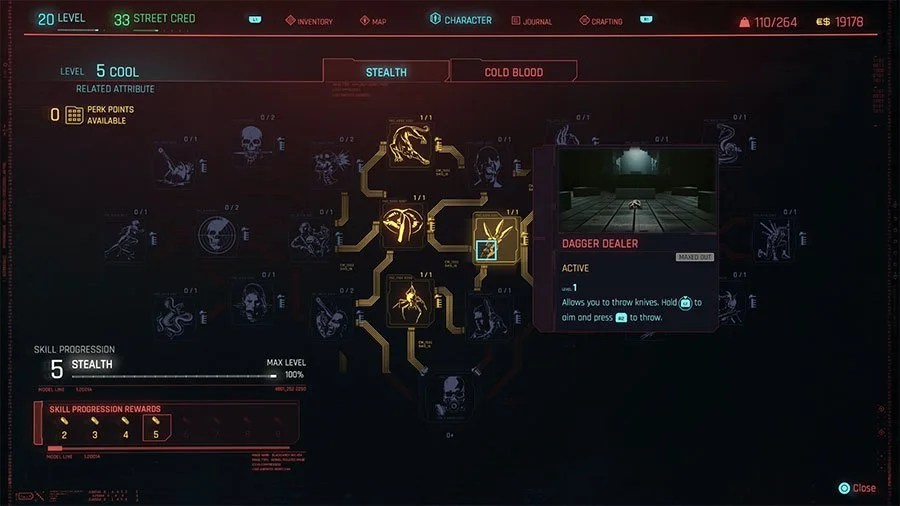
The overall leveling system is just a mess. You gain XP and gain character levels, which grant you Perk points and occasionally Attribute points. The latter are very important because they determine the maximum level of perk you can select within that Attribute. Additionally, each Attribute has multiple Skill Trees associated with it. So for example, the Reflexes Attribute contains the Assault, Blades, and Handguns trees, each of which contain 17-20 Perks that can have multiple tiers.
BUT WAIT, THERE’S MORE! Each Skill tree has its own XP meter that increases by utilizing that specific Skill in various ways. The more you use Handguns, the more Handgun XP you generate, and eventually you work your way down the reward track up to the limit of the Attribute. The rewards are usually little enhancements (Recoil reduction on Handguns, etc) but sometimes they are Perk points which you can actually assign anywhere. While that could lead to some interesting decisions wherein you start farming Blade XP to generate extra Perk points to put into Handguns or whatever, the emphasis should not deviate from the word “farm.” Because that is what it takes.
All of that may sound complicated, but none of it is particularly interesting.
I could live with all the overcomplicated shenanigans, but what I cannot stand is a Talent/Perk/Skill system with so few synergies. It is like the designers didn’t even try. I scoured the various trees and the closest thing to interesting that popped up was a Reflexes 8 Perk in the Blades tree called Stuck Pig that increases Bleed duration by 3/6/9 seconds. That is notable not because it’s actually any good, but because there is no “inflicted by a Blade” qualifier to it. Some things other than Blades inflict Bleed, so that would be an interesting choice and/or build to work towards if Bleeds were your thing. If instead you put any Perk points into Handguns, well, all of them turn off the moment you equip anything else.
And, Jesus Christ, don’t get me started on the crafting system. Because I’m going to anyway.
Crafting is governed by the Technical Ability Attribute and subsequent perks in the Crafting Skill tree. The most important ones are those Perks that unlock the crafting of Rare (5), Epic (12), and Legendary (18) items. In many games, there is always a tension between player crafting and found loot: A) if crafting is better, why search for loot, vs B) if loot is better, why engage with crafting at all. Cyberpunk kicks this up a notch with Iconic gear – these are weapons/armor with unique effects that you can continually upgrade… provided you dump a bunch of Attribute points into Technical Ability. If you don’t, those Iconic items might be good for a mission or two before trash drops start dealing more damage.

Aside from that, crafting largely sucks. You need to purchase weapon/armor “specs” from vendors to unlock the ability to craft that item in that specific tier. Just because you can craft a Rare sniper rifle does not mean you can craft the Epic version of the same sniper rifle, even if you unlocked Epic crafting via Perks. Also, the spec for that Sniper Rifle costs 75,000 credits which is just about what it costs to just purchase the Legendary version of that Sniper Rifle from the same vendor. At a certain point you can farm practically infinite amounts of credits via crafting anyway (purchase components, craft X gun, sell to vendor, cycle vendors), but the point is that the system as a whole makes no fucking sense. What was the harm with a more reasonable weapon spec cost? Woohoo, I get a “cheap” Epic Sniper Rifle by dumping Attribute and Perk Points into a tree that does not otherwise enhance my ability to deal damage with said Sniper Rifle. Christ, I bet that I would deal more damage with a trash-tier Sniper Rifle and those points spent in Reflexes instead.
By the way, Cyberpunk does feature a Respec button. The hilarious thing – in a comedy of errors sort of way – is that it only refunds Perk points, not Attribute points. Thus even though I am 40 hours deep into the game and realize how terrible Crafting has been for me, none of it matters because I can’t shuffle many of those points elsewhere because I’m limited based on Attributes, not Perks. I guess there is an argument that people would game the system by switching to a full Crafting build, upgrade all their shit, get infinite money, and then swap back to a weapon-specific build, but come on.
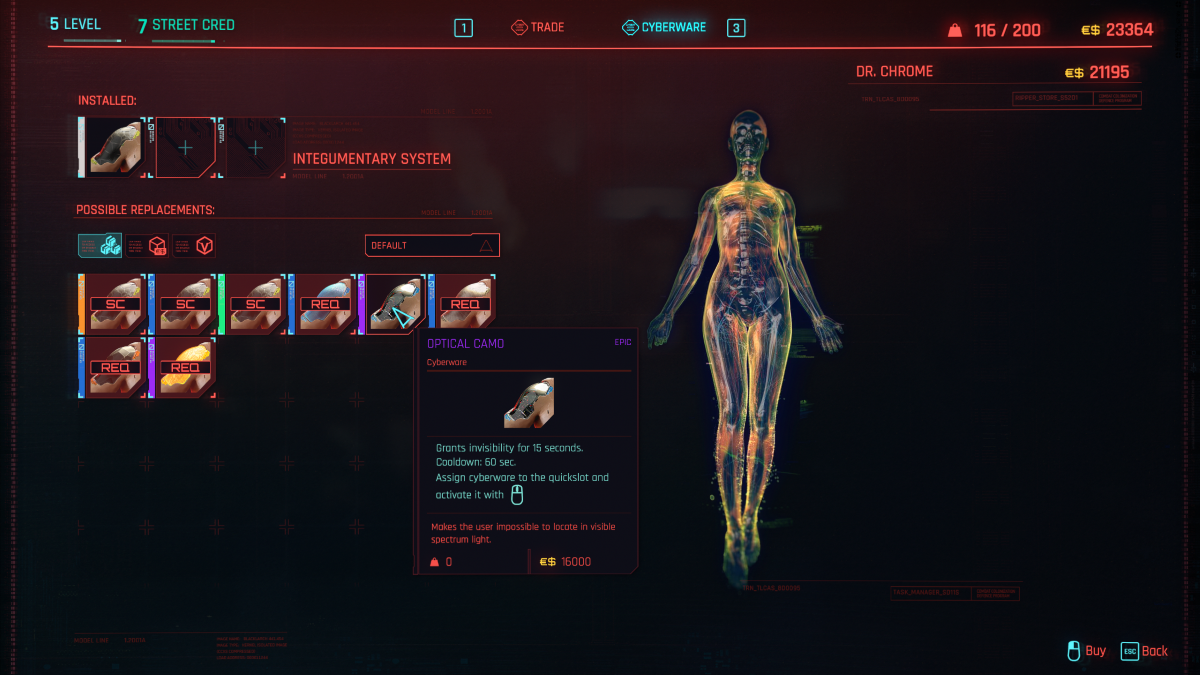
Know what else is disappointing? The cyberware parts of Cyberpunk. The game is predicated on body enhancements and everyone certainly looks the part. But the thing you find out after browsing a few Ripperdocs is that all the enhancements are… just random buffs locked behind Attribute gates. Sometimes you will find a common-tier upgrade not locked behind such a gate, but the vast majority are tied to your character’s Body or Reflexes Attribute, which means a Technical Ability/Intelligence character (cough) doesn’t have much to gain by cyberware. Which is really fucking bizarre, right? Compare that to how Deus Ex handles things – augments grant gameplay-changing abilities and are otherwise a big deal. In Cyberpunk, they are non-choices.
Ultimately, that is the biggest disappointment of all: everything in Cyberpunk (outside of dialog) feels like a non-choice. Can you “choose” to build your character around using Shotguns and Katanas for roleplaying purposes? Sure. Place your Attribute and Perk points in the corresponding slots. But none of that is interesting. And to me, there is no such thing as an uninteresting choice – there are choices and mere decisions. You decide to use Shotguns, and everything else follows. Notwithstanding the banality of having to decide on a specific weapon to use in the first place, there is no room for synergy choices within Skill trees or trying different strategies once Attribute points have been committed.
I am not certain this part of Cyberpunk 2077 is fixable. Being able to Respec Attribute points would help, or perhaps granting more Attribute points overall. Perks would have be radically reworked to introduce synergies though, and I’m not certain designers who had to wait a year and half to noodle on how to fix throwing knives is up to the task.
 In An Age
Priced In
Mar 30
Posted by Azuriel
If you haven’t heard the news, Sony announced that they are raising the prices of the PlayStation 5. Again. The disc-less version is now $600, and the Pro costs $900 MSRP. Nine hundred dollars. This comes on top of price increases of last year. As a reminder, the disc-less version launched in 2020 for $4001. Sony isn’t alone with price increases, of course, with Microsoft hiking the price of their lagging console several times in addition to Game Pass Ultimate. It seems inevitable that Nintendo will eventually follow suit with the Switch 2, despite trying to raise peripheral prices to compensate.
Meanwhile, game studios have been shedding workers at breakneck speeds. Just this past week, Epic Games laid off over a thousand people (with $500 million in additional cuts) amidst lower Fortnite engagement. Overall, the industry lost 45,000 jobs in the last four years. Some of this is attributed to a post-COVID correction, when apparently every studio hired anyone they could and greenlit even the dumbest of live-service games (Concord, Highguard, etc), ironically chasing (fewer) Fortnite dollars.
The other part of it is simple economics. If the average budget for a AAA game is $300 million, even with no storefront cuts and a price of $80, it would still require 3.75 million copies to be sold to break even. A more realistic figure would be 70% of a $70 game, putting it at 6.2 million sales. Again, just to get back to $0, let alone show any profit. GTA 5 sold 225 million copies worldwide, so yeah, it’s still possible to make bank on certain bets. I’m also guessing that GTA 6 will make back its $1 billion budget.
On the other hand, if people have to buy a $900 console just to play it… I dunno.
This very well may be the tipping point beyond which AAA no longer becomes economical viable. Think about the PlayStation 6, which is assumed to be coming out in late 2027 or 2028. Do you believe the base model will be coming out for less than $700? And if you’re willing to drop that amount of money for the next-gen system, will you be satisfied with games that do not require the level of graphical fidelity it would provide? At the same time, it’s going to be difficult for game developers to hit those break-even sales figures if the userbase is balking at the price of the console.
One thing that I think about is whether this whole trajectory is already “priced in,” so to speak. Game development cycles are 5-6 years long, so it makes sense how all these live-service games, started in the most irrational of COVID exuberances, are simultaneously returning to Earth at terminal velocity. Concord et tal failing is one thing though; Fortnite eating its own tail is quite another. Remember when everyone started releasing MMOs trying to chase that World of Warcraft subscription money? After that development cycle of failure – during which WoW declined all on its own – we did not see a renewed interest in full-priced subscription MMOs. The industry moved on to F2P and live-service.
Well, the tides are shifting again. But where is the next sandbar? Are there any left? And if there is, can anyone afford to build on it again?
I suppose we’ll find out around, uh *checks calendar*, 2031. Just in time for Fallout 5.
1 Inflation puts $400 in 2020 as being $750 today. Which… holy shit. Nevertheless, that isn’t how it normally works.
Posted in Commentary
1 Comment
Tags: Armchair Game Development, Epic Game Store, Price Hike, Priced In, Sony, State of the Industry