Blog Archives
Amazon Coins
As a further sign of these inflationary gilded age times, Amazon is altering the discounts associated with Amazon Coins, e.g. their virtual currency for apps sorta within the Amazon ecosystem.
We are writing to inform you of changes coming to Amazon Appstore Coin packs. On April 3, 2023 we will be consolidating the variety of packs offered and lowering the discounts associated with pack purchases. We will continue to offer the option on mobile to purchase a custom amount of Amazon Coins between 300 – 200,000 Coins (new discounts will apply).
The updated available packs and discounts are:
• 1,000 – $9.70 (3% discount)
• 2,500 – $23.75 (5% discount)
• 10,000 – $92.00 (8% discount)
• 50,000 – $450.00 (10% discount)These changes will contribute to supporting the costs of both operating and consistently improving our app store.
In case you were wondering, right now the discounts are:
- 1000 – $9.00 (10%)
- 2500 – $21.75 (13%)
- 5000 – $42.50 (15%)
- 10,000 – $82.00 (18%)
- 50,000 – $400 (20%)
It is a fair question to ask “who even uses these things?” The answer is: me. Specifically and exclusively to purchase things within Hearthstone. The whole thing is quite convoluted, but if you download the Hearthstone app on your phone from the Amazon store (and NOT through Google Play or iPhone equivalent), then you have the option of paying for expansions (etc) using Amazon Coins.

As a real example, there is a new expansion coming out for Hearthstone next month. Blizzard is selling a pre-release bundle that features 60 card packs and two random Legendary cards for $49.99. It’s not a bad deal if you are committed to playing the new expansion, as getting packs for less than $1 apiece is “good” (technically $1.50 each normally), with the Legendary cards being bonus on top.
But an even better deal is paying Amazon $42.50 for 5000 coins instead, and buying the expansion that way instead. Technically you need a smidge more Coins because of tax – that’s always how they get you – but the overall discount adds up. Plus, if you already have a Amazon credit card, you get 5% cash back on top of everything else. There were even better deals way back in the day, when Amazon would give you 30% coins back, which allowed for some extremely cheap Hearthstone’ing.
After April 3rd though, that same deal will save you… $2.50. Which will probably be a wash considering the need for miscellaneous coins for tax. Not sure who bothers with Amazon Coins after this.
Inflationproof
No matter what’s going on in the world today, I just gotta say: we picked a great hobby.
Inflation approaching (or hitting) double-digits? Gas prices through the roof? Games got your back. EVE raised subscription prices to $20 and a few developers are testing $70 price-points, but budget options abound in nearly every gaming genre. Supply chain slow-downs hit graphics cards and PS5 pretty hard, of course – I waited 1-2 more years than I had originally planned to upgrade my PC. It wasn’t like I was starving for options in the meantime though.
Just think about it. Prices in gaming go down over time. Outside of a few edge cases in live-service games, there is effectively an infinite supply of whatever you want to play. Between insane marketing giveaways and F2P options, there are scenarios in which your average monthly cost to engage with the hobby is between fifteen and zero dollars. You can’t even paint for that cheap. I have some friends that love to go to conventions and they are not having a fun time in this environment, let alone when COVID shut things down. Meanwhile: “Oh, I should be staying indoors? Way ahead of you, buddy.”
I was going to title this post “Futureproof” instead, as there’s nothing stopping gamers from using renewably energy to power our PC/consoles… but perhaps that’s whistling a bit too loudly past the graveyard. Some kind of collapse in the internet infrastructure would end the past-time for anyone not stockpiling emulators and ROMs. On the other hand, if there’s no internet, things have truly gone to shit and most everyone’s hobbies are probably over too. Unless you’re a gardener or psychopath, I suppose.
Hmm. Perhaps all these survival games will come in handy after all…
Inflation
Amidst all the gaming sales this holiday season was a surprise. A most unwelcome one.
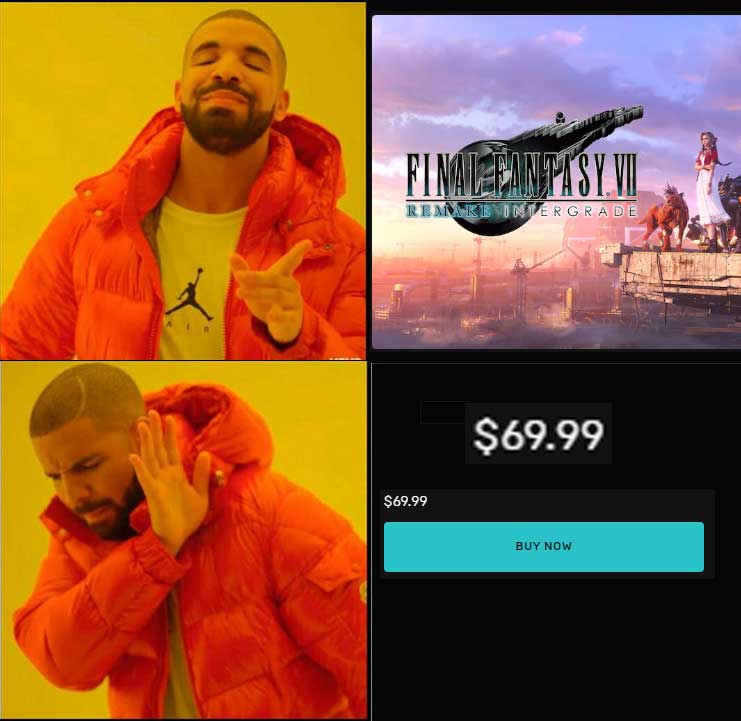
First was the surprise that the PC version of the Final Fantasy 7 Remake (FF7R) even came out. I was so giddy when the original news came out in 2015, but that giddiness has been tempered by years of self-restraint from not purchasing a PS4 to play just that game, and the constant endeavor to avoid spoilers. Somehow that avoidance must have led me to disregard news articles that the PC version was coming out. The fact that FF7R is an Epic exclusive also didn’t even register. But that’s because…
Secondly, seventy what-the-fuck dollars?!
I understand that FF7R is by no means the first to try to raise the hitherto $60 price ceiling of games. Many games of this new console generation are trying the same, including major franchises. It does seem a little weird that the PC port of a game that came out 1.5 years ago is trying to sell at a premium price though. Especially since one could purchase the PS5 version of the same PC bundle (main game + DLC) for $39.19 straight from the Playstation Store. That’s the winter sale price, of course, but there are cheaper options at GameStop and presumably other retailers.
I also understand that gaming companies have technically been raising prices this whole time via DLC and microtransactions and battle passes and deluxe editions and so on and so forth. Some have made the argument that it is because of the $60 price ceiling that game companies have employed black hat econ-psychologists to invent ever more pernicious means of eroding consumer surplus. That argument is, of course, ridiculous: they would simply do both, as they do today.
What I do not understand is gaming apologists suggesting inflation is the reason for $70 games.
Sometimes the apologists make the argument that games have not kept pace with inflation for years. One apt example is how Final Fantasy 6 (or 3 at the time) on the SNES retailed for $79.99 back in 1994. That is literally $150 in 2021 money. Thing is… gaming was NOT mainstream back in 1994; the market was tiny, and dominated by Japan. When you are comparable in size to model train enthusiasts, you pay model train enthusiast prices.
Gaming has been mainstream for decades now. Despite ever-increasing budgets and marketing costs, games remain a high-margin product. FF6 may have sold for $150 in today’s dollars, but FF7 sold three times as many copies for the equivalent of $100 by 2003*. So how does an “inflation” argument make sense there?
“The costs for making games have increased!” I mean… yes, but also no? Developers like to pretend that they need bleeding-edge graphics in order to sell games, but that is clearly not the case everywhere. For one thing, indie developers have been killing it with some of the best titles this decade with pixel graphics and small-group passion projects. Stardew Valley sold how many copies? Remember when Minecraft sold for $2 billion? Not everyone is a big winner, but the costs of game making has only increased in specific genres with specific designs. Do we really need individually articulated and dynamically moving ass-hair on our protagonists?
And that’s where the “iT’s iNfLaTiOn” folks really lose me: who gives a shit about these corporations? I wrote about this 8 years ago:
As a consumer, you are not responsible for a company’s business model. It is perfectly fine to want the developers to be paid for their work, or to wish the company continued success. But presuming some sort of moral imperative on the part of the consumer is not only impossible, it’s also intellectually dishonest. You and I have no control over how a game company is run, how much they pay their staff, what business terms they ink, or how they run their company. Nobody asked EA to spend $300+ million on SWTOR. Nobody told Curt Schilling to run 38 Studios into the ground. Literally nobody wanted THQ to make the tablet that bankrupted the studio.
Why should we take it as a given that PlayStation 5 games cost more to develop? A lot of things in the economy actually get cheaper over time, regardless of inflation. Things like… computers and software. Personnel costs may usually only trend upwards, but again, someone else made the decision to assign 300 people to a specific game instead of 250. Or to scrap everything and start over halfway through the project. And somehow these companies continue making money hand over fist without $70 default pricing. So I find it far more likely that the price increase is a literal cash grab in the same way the airline industry added billions in miscellaneous fees after their bailouts and “forgot” to remove them after they recovered. Basically, because they could. Some informal industry collusion helps.
In summation: fuck the move towards legitimizing $70 MSRP. That 14% price hike is not going to result in 14% better games with 14% deeper stories and 14% more fun. In fact, it’s probably the opposite in that you will just afford 14% fewer games. And unless you got a 6% raise in 2021, you are already eating a pay cut on top of that.
Oh well. Waited this long for FF7R, so I may as well wait some more.
Black Market AH

Yes, please.
So the lede here is that Blizzard may be introducing a “Black Market” AH into Mists that is capable of selling, say, the Ashes of Al’ar. We can have the discussion as to whether that devalues the 0.13% mount or not in a moment. What I am more interested right now is in the very notion that:
- These mounts (etc) potentially becoming BoE or otherwise Bind on Use.
- This being a brilliant money-sink into a rapidly inflationary economy.
- Blizzard getting into the business of selling in-game items with in-game currency.
That last point may seem odd (vendors have been around since Day 1), but what I mean is not necessarily the selling of the Ashes of Al’ar, but of any of the mounts/items that otherwise are only obtainable by grueling hours /played.
The initial reaction may be to say that this is counter-intuitive; by definition, what Blizzard is doing is making these items easier to obtain, which not only reduces their scarcity, but allows players to actually eat the carrot. In the long view, players actually accomplishing their goals is bad for business. As the classical argument goes, the Black Market AH should be the equivalent of cheat codes, which hollows out the enjoyment that comes from restrictions and limitations – an infinite life Super Mario Bros is a less fun Super Mario Bros.
However, I must ask this: is a Konami Code-less Contra a less fun Contra?
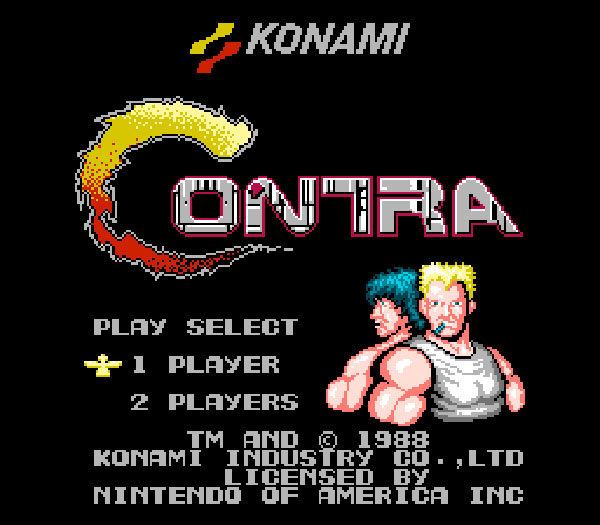
If you don’t know what I’m talking about, get off my lawn.
Nethaera on the Blizzard forums mentions:
It’s worth noting that since we’re in beta, we’re still looking into what our philosophies are for what should and what shouldn’t be on the Black Market. We’re also trying to discern the frequency/rarity of what shows up there as well.
So perhaps we will not ultimately see the Ashes of Al’ar on the Black Market after all.
But… why shouldn’t we? I brought up Contra because, as anyone who attempted to actually play the game without the Konami Code can attest, the game was stupidly difficult to beat within the default number of lives. So much so, that I imagine few would even try without the Konami Code. Thus, the Konami “cheat code” probably generated more enjoyment in the aggregate than was lost from “bypassing” the difficulty.
In other words, while the “legitimate” owners of Al’ar or the TCG items or whatever Blizzard ends up selling on the Black Market do “lose” something of value (scarcity), I believe the incremental gain by everyone else results in a net positive. Obviously, the average player doesn’t have the 200,000g+ that it will require to actually obtain these items, but they couldn’t get a group together to farm Kael’thas either. What the average player can do is farm herbs or run dailies and otherwise set X amount of gold as a goal to reach in the pursuit of Al’ar; something that was largely unobtainable before, but now has a “reasonable” path towards.
Will these undoubtedly obscene prices encourage gold-sellers? Maybe, maybe not. Just keep in mind that unlike the sale of BoE raiding epics – whose prices already can encourage gold selling – the final gold price of Black Market items are removed from the economy permanently, regardless of whether they can be resold or are BoP from the mailbox. Any reduction in inflation is a net positive for everyone.
So, I say: bring it on. And not just because I have oodles of gold with nothing else to buy.
P.S. The Daily Blink has the right idea:
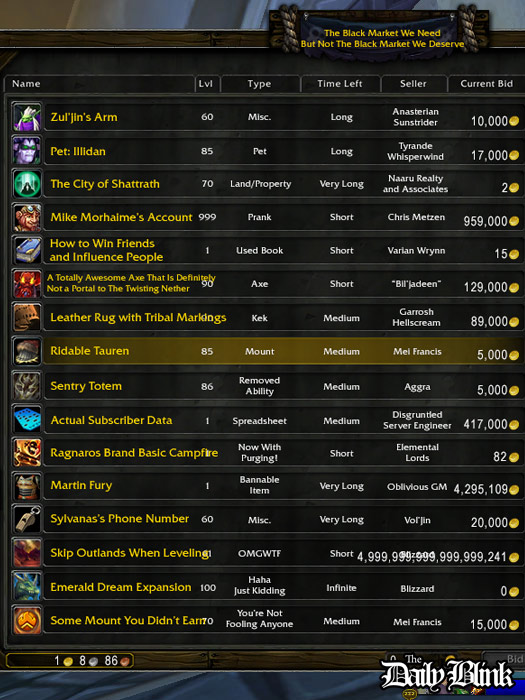
WTB that Actual Subscriber Data.
 In An Age
Dollar Per Hour of Entertainment
May 7
Posted by Azuriel
Today I want to talk about the classical “$1 Per Hour of Entertainment” measurement of value. This has been a staple of videogame value discussions for decades. There are multiple problems with the formula though, and I think we should collectively abandon its use even as general rule of thumb.
The first problem is foundational: what qualifies as “entertainment”? When people evoke the formula, they typically do so with the assumption that hours spent playing a game are hours spent entertained. But is that actually the case? There are dozens and dozens of examples of “grind” in games, where you must perform a repetitive, unfun task to achieve a desired result. If you actively hate the grinding part but still do it anyway because reward is worth it, does the entire process count as entertainment? Simply because you chose to engage with the game at all? That sounds like tautology to me. May as well add the time spent working a job to get the money used to buy the game in that case.
Which brings me to the second problem: the entertainment gradient. Regardless of where you landed with the previous paragraph, I believe we can all agree that some fun experiences are more fun than others. In which case, shouldn’t that higher tier of entertainment be more valuable than the other? If so, how does that translate into the formula? It doesn’t, basically. All of us have those examples of deeply personal, transformative gaming experiences that we still think about years (decades!) later. Are those experiences not more valuable than the routine sort of busywork we engage with, sometimes within the same game that held such highs? It is absolutely possible that a shorter, more intensely fun experience is “worth” more than a mundane, time-killing one that we do more out of habit.
Actually, this also brings up a third problem: the timekeeping. I would argue that a game’s entertainment value does not end when you stop playing. If you are still thinking about a game days/months/years after you stopped playing, why should that not also count towards its overall value? Xenogears is one of my favorite games of all time, and yet I played through it once for maybe 80 hours back in 1998. However, I’ve thought about the game many, many times over the intervening decades, constantly comparing sci-fi and/or anime RPGs to it, and otherwise keeping the flame of its transformative (to me) memory alive. Journey is another example wherein I played and completed it in a single ~3 hour session, and I still think about it on occasion all these years later. Indeed, can you even say that your favorite games are the same ones with the highest dollar per hour spent playing?
The fourth problem with the formula is that it breaks down entirely when it comes to free-to-play games. Although there are some interesting calculations you can do with cash shop purchases, the fact remains that there are dozens of high-quality games you can legitimately play for hundreds of hours at a cost of $0. By definition, these should be considered the pinnacle of entertainment value per dollar spent, and yet I doubt anyone would say Candy Crush is their favorite gaming experience of all time.
The final problem is a bit goofy, but… what about inflation? The metric has been $1 per hour of entertainment for at least 20 years, if not longer. If we look at 1997, $1 back then is as valuable as $2.01 today. Which… ouch. But suggesting that the metric should now be $2 per hour of entertainment just feels bad. And yet, $1 per two hours of entertainment also seems unreasonable. What games could hit that? This isn’t even bringing up the other aspect of the intervening decades: loss of free time. Regardless of which way inflation is taken into account, fundamentally I have less time for leisure activities than I did back in high school/college. Therefore the time I do have is more valuable to me.
At least, you’d think so. Lately I’ve been playing Hearthstone Battlegrounds (for free!) instead of any of the hundreds of quality, potentially transformative game experiences I have on tap. Oh well.
Now, I get it, nobody really uses the $1 per hour of entertainment metric to guide their gaming purchases – they would otherwise be too busy playing Fortnite. But, fundamentally, calculating the per hour rate is about the worst possible justification for a discretionary purchase, the very last salve to ease the burn of cognitive dissonance. “At least I played this otherwise unremarkable game for 60+ hours.” Naw, dawg, just put it down. Not every game is going to be a winner for us individually, and that’s OK. Just take the L and move on. Everything is about to start costing $80, and you sure as shit don’t have 20 more hours per game to pretend you didn’t get bamboozled at checkout.
But you know what? You do what you want. Which is hopefully doing what you want.
Posted in Commentary, Philosophy
3 Comments
Tags: Dollar Per Hour of Entertainment, Entertainment, F2P, Fun, Inflation