Blog Archives
Hearthstone’s Future
SynCaine brought up an interesting point about the future of Hearthstone:
“situation in Hearthstone only ever improves”
Until the the first expansion is released, and what do you think is going to be the revenue driver for the game?
At least with MtG:O, it was understood you were stepping into a P2W arena, where you could pay X to compete with Y. What level you wanted to compete at was up to you and your wallet.
Here, I feel as though Blizzard is trying to hide the P2W aspect (especially in beta), but ultimately that’s what the model demands. Without new cards you don’t keep people interested, and for those new cards to be interesting, they have to be worthwhile (aka; stronger/better).
I think the heavy class-based gameplay is also a balance nightmare as we are already seeing, and I expect it to get worse as the better players create more gimmick decks. Woe is the free player if the FOTM gimmick requires an epic or ten.
While the game isn’t even in Open Beta at this point, I think it is reasonable to start thinking about where Hearthstone goes from here. At the moment, I am sort of worried about the “depth” of the game, although it’s possible that it’s current shallowness accessibility is a feature, not a bug. Then again, I’m not entirely sure.
There are several things working against Hearthstone’s future. The biggest is it’s class system. In a card game like Magic: the Gathering, you can have a robust metagame arising from even the “generic” Core Set (which come out once a year and forms a “base” upon which the near-quarterly expansion sets build upon) because you can conceivably play any card you want; the five colors of Magic have their own class-like themes and mechanics, but you can mix and match to your heart’s desire. Thus, a Black/White deck can play totally different from an all-Black or all-White deck. With Hearthstone, a Paladin’s cards are exclusive to Paladins. You can’t choose to play, say, Avenging Wrath in your Mage deck, for example. Or Divine Favor in your Shaman deck.
A related long-term problem is expandability. I am not talking about running out of mechanics or creatures to reference from WoW or Warcraft lore (although that’s sort of a concern, honestly), I am talking about how many new cards can actually be coherently added. In short, Blizzard is going to have to either create a ton of new cards each expansion, or barely any. For example, an expansion that adds just one common, rare, and epic card to each class will require 30 new cards (9 classes + neutral). While that may or may not sound like a lot of cards, unless these new cards are above the curve or enable entirely new strategies, it’s possible that an expansion could be a total dud for you and the class you enjoy playing despite increasing the total card pool by 10% or more.
Third, as I have mentioned before, the class balance is on a razor’s edge even in a perfect scenario. It is pretty much a given that we will see a Death Knight and Monk class added in an expansion, and they will need to have at least 15 additional, class-exclusive cards and unique Hero Powers. While that can certainly shake up the overall balance structure, it’s not as though your specific metagame will likely change all that much. Because, again, your Mage deck is limited to Mage cards plus Neutral cards; there is no DK “splash” to provide additional depth.
Fourth, it is worth considering how many different mechanics Blizzard is A) willing to implement in this game, and B) can implement in this game. One of the most basic creature abilities in Magic is Flying: a creature with Flying cannot be blocked except by other creatures with Flying, although it can choose to block non-Flying creatures. In the context of Hearthstone, this ability doesn’t make a whole lot of sense, as you have complete control (barring Taunt) to choose whether your creatures attack your opponent or a specific creature. Now, Blizzard could certainly shoehorn it in there – perhaps making the flying creature untargetable by other creatures – but that’s when the devs start to go against their (presumed) mandate towards simplicity.
And that’s just with Flying.
Lastly, SynCaine’s cynicism regarding Blizzard making overpowered cards to sell future expansions is not without merit, even if I would argue that it’s largely unavoidable and not inherently malicious. Power creep happens. Even when “the rules” about costs are nailed down, some options are more powerful/relevant than others. In Magic, a First Strike 2/2 is better than a Trample 2/2 even if they both cost the same amount of mana. A Flying 2/2 is arguably better than either. I have pointed this out before:
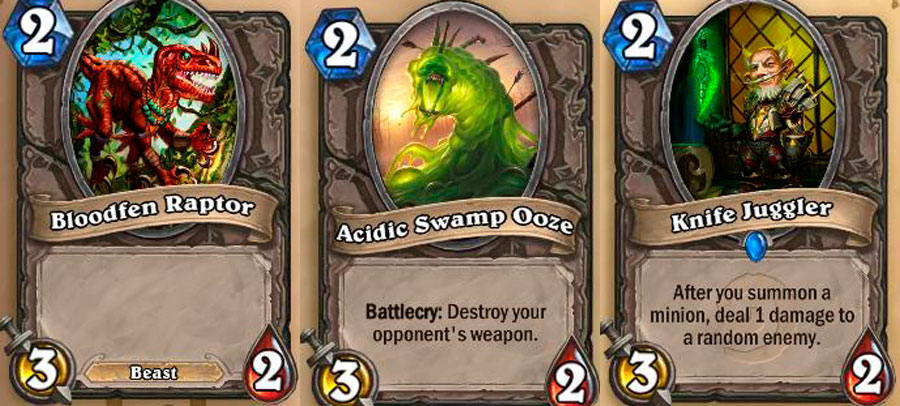
Balance!
Being a Beast is not as powerful as the other two cards, unless you are playing a Hunter Beast deck. But the more damning implication, IMO, is how the above cards sort of imply that a 1/4 for 2 would be balanced. Or a 2/4 for 2 mana, even. We already have 3/2s with an ability, 2/3s with an ability, 1/3s with a huge ability for 1 mana (Priests, seriously), so a 2/4 for 2 isn’t outlandish rules-wise. And yet it would be crazy OP, invalidating a huge swath of two-drops. The context of the environment is as important and possibly more so than the strict card power rules.
All that being the case, I don’t actually agree with SynCaine that the new player is screwed, as my prior declaration remains accurate: your situation in Hearthstone only ever improves. Six expansions later, assuming no structural changes, you will still be able to Disenchant the cards you don’t want to directly create the cards you do. That’s unbelievably huge in the CCG world. Even if you take the stance that your likelihood of opening one of the “ten or so required Epics” is necessarily diminished (assuming new cards are stuffed into the same virtual booster pack), your ability to guarantee a card is not – you will always get 40 Dust per pack, minimum. Ten packs is an Epic of your choice. You’ll get enough gold in two days of daily quests to buy a pack straight-up, or three if you want to go the Arena route. So, unless expansions are coming out every 1-2 months, you’ll have plenty of time to get whatever cards you need to be/stay competitive without spending a dime.
Spending dimes gets you there faster, of course. But in this context, I’m okay with it.
Hearthstone Beta Patch Notes
All Hearthstone progress was wiped last Wednesday, and we are now Live for all intents and purposes; no further wipes are planned between now and (eventual) release. In addition to that news, a number of careful changes have been made to cards across the game. Perhaps too careful.
The full patch notes can be read here. Some examples:
- Gold gained in Play mode has changed from 5 gold per 5 wins to 10 gold per 3 wins.
- Arena rewards now give less dust and more cards.
- More gold is guaranteed at 5 & 6 Arena wins.
- At 9 Arena wins, you are now guaranteed an extra pack or a Golden card.
- Pint-sized Summoner – The cost reduction has been reduced from 2 to 1.
- Wrath can no longer be cast on heroes.
- etc
There are a few surprising changes in there. Going from 5g for 5 wins to 10g for 3 wins is rather huge. As in, “literally a 33% increase in gold” huge. While I still doubt grinding out an entire Arena Pass in a single day is particularly viable (or sane), it will likely allow you to get a free Arena after every three days of dailies instead of four without too much extra grinding. We’re talking six extra games on average across three days instead of, you know, fifty. Plus, the Arena rewards are supposedly better, with less dust and more goodies.
The card-specific buffs/nerfs run the gamut of expected to boggling. Pint-Sized Summoner got nerfed down to (1)-crystal cost reduction from (2), Defias Ringleader is no longer inexplicably a 2/3 creature, and so on. Druid cards got an unexpected nerf, with many of their otherwise-too-versatile direct damage spells being unable to hit players any more. Rogues can no longer pump up weapon with their hero power, which probably has more long-reaching consequences than appears at first.
Then again, maybe not.
See, when I was browsing for more commentary on the patch changes, I ended up finding what lies at the bottom of the rabbit hole. Take a look at these Youtube “reviews” for some of the top Hearthstone decks, if you dare: Miracle Rogue, Divine Paladin, Pyro-Smith Warrior. Now, it’s possible that the Miracle Rogue deck was disrupted a bit by the patch, but the point is that that is what the game can be boiled down to. And that, quite frankly, scares me.
I have no illusions regarding my own competence level or willingness to compete on some higher level. Winning is great, but I would much rather win as a result of a deck I created than copy & paste a top-tier deck and harvest some tears. The feeling might be a holdover from my Magic: the Gathering days where I had an absolute advantage over my high school friends because I was willing to eBay cards; where was the fun in burying your opponents (who are also, you know, your friends) under piles of money? Skill in the form of tactical moves to snatch victory from the jaws of defeat or building decks that create esoteric, but functional combos is way more interesting to me.
These are the “Good Fights” that people like Gevlon despise, but at the end of the day, all you keep from your hours and hours spent playing videogames are memories. Will you remember winning those hundreds of games on Turn 5 against opponents who had no chance to survive make your time? Or will you remember the egde-of-your-seat victories and when you created an off-beat deck/strategy that actually worked in opposition to all logic and reason?
If you aren’t shooting the moon, you’re just killing time.
[Hearthstone] Remaining Concerns
My Press™ coverage of Hearthstone has been pretty glowing thus far, so I wanted to talk today about some lingering concerns about a few issues that cropped up in the last week. I do not believe these to be structural problems necessarily – I feel like they could be fixed within the Beta – but I also have no idea how Blizzard will address them, if at all.
1) Unbalanced Heroes
On paper, the nine Heroes you can pick between are balanced. Here is a rundown of their powers:
- Druid – Hero gains +1 Attack until end of turn, and +1 Armor
- Priest – Restore 2 health to target
- Warrior – Hero gains 2 Armor
- Paladin – Put a 1/1 creature into play
- Rogue – create a 1 attack/2 durability weapon, or +1 Attack to weapon this turn
- Warlock – Lose 2 Health and draw a card
- Hunter – Deal 2 damage to enemy Hero
- Shaman – Create a random totem (usually 0/2 creature w/ ability)
- Mage – Deal 1 damage to a target
By the way, all of the listed abilities cost the same amount of resources (2 crystals).
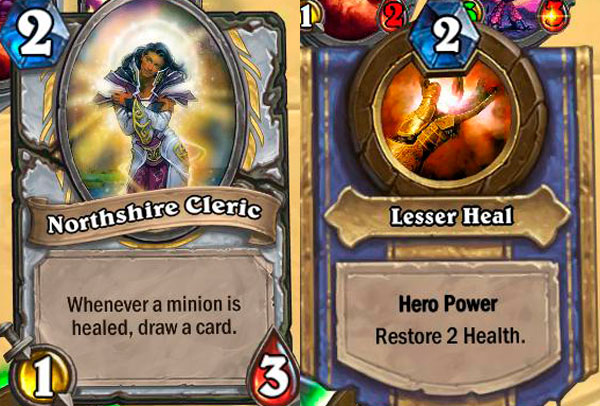
One of the more annoying classes to play against.
The problem in reality is two-fold. First, there is a huge difference in synergy between a Hero’s powers and the class-restricted cards. The Priest’s ability, for example, combos ridiculously well with one of the default Priest cards: Northshire Cleric, a 1/3 creature that let’s you draw a card when a creature is healed. In fact, entire mechanics revolve around and/or become enabled by the Priest’s ability. Enrage, for example, is an ability that triggers an effect when the creature is damaged. One of the most common cards that uses Enrage is the Gurubashi Berserker, a 2/5 creature that gets +3 Attack each time it’s damaged. Smashing into a 2/2 will beef the troll up to a 5/3, which is nice… but also puts it within range of a lot of counter-attacks. A simple heal from the Priest though, puts it back to 5/5, letting it snowball further. Then you have goofy cards like the Angry Chicken, which is a 1/1 with Enrage: +5 Attack. Obviously you need to combine that creature with some other effects to boost its Health, of which the Priest has many.
By means of comparison, nothing combos with the Hunter ability. In Magic: the Gathering, the devs eventually created the Bloodthirst mechanic that boosted a creature’s stats (or some bonus effect) if it was played the same turn as the opponent taking damage. No such thing exists in Hearthstone, at least for now. And while Rogue decks need no assistance, the Combo system on Rogue cards have nothing to do with the Rogue’s ability; at least the Druid, Warrior, and Warlock are thematically consistent with their class cards. Then again, perhaps we should look at the Priest as an outlier rather than the bar that other classes should reach.
The second problem is related to the first: what class cards are available by default radically changes the strength of your deck. Now, sure, technically everyone will be able to unlock all 20 basic class cards by simply playing against the computer (assuming they didn’t want to challenge players). But take my word for it: many of those early games suck. Hard.
Through either a combination of the first issue or the second, I can already tell that some Heroes are being left in the dust by the Beta population. I would say more than 95% of the Ranked games I have played have been against either the Mage, Rogue, or Priest. For a good reason: they’re strong.
There are a few clever things Blizzard is already doing to (presumably) combat this trend. One of the types of daily quests is to win 2 games as a specific class. When I logged on yesterday, for example, I had to win 2 games as a Druid and Warrior (two separate quests, as I had missed yesterday’s daily). Having played neither before, I created custom decks for both and then went for a spin against some human opponents. Those games played out very differently than my normal games, and were pretty fun to boot, although I doubt I will be spending much time with them until I luck into some of their non-basic class cards from booster packs.
The other clever move to improve class experimentation, if not promote diversity, is how Arena mode matches start by forcing you to pick between three random class Heroes before you start the actual Draft process. The other day, I had to pick between the Hunter, Druid, and Shaman, all of whom I had never played with before. While they let you mouse-over their Hero powers from that specific screen, the more critical aspect of the Heroes is ultimately their selection of class-specific cards. Spending some time in your collection looking at all of the class’ cards – which, by the way, Hearthstone allows you to do even if you don’t own them – is definitely recommended.
For the record, I chose the Hunter. And went 0-3.
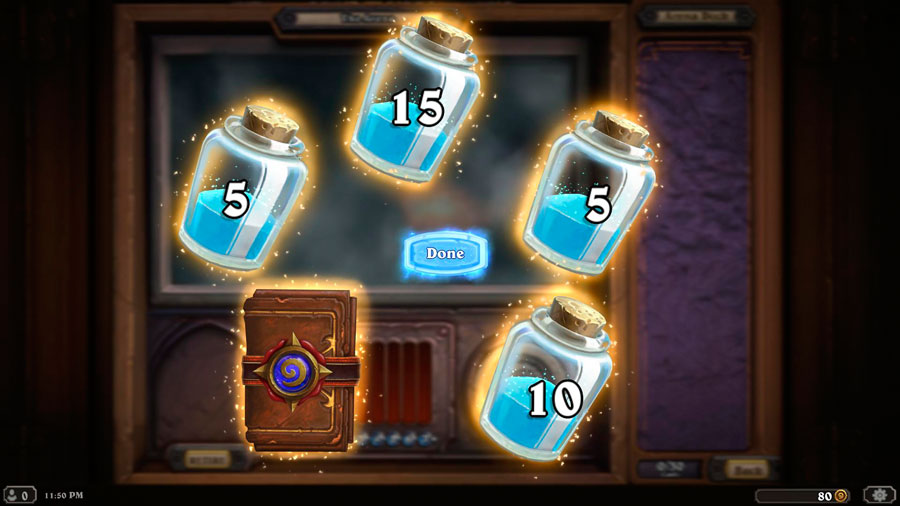
Worst possible Arena result, I think.
2) Unbalanced Cards
Beyond the Hero issue and the class-specific card issue, I have a problem with the card balance in a few locations. Basically, I don’t feel like strictly-better cards should exist in a CCG, especially not when it appears it’s being “balanced” around rareness. Take a look at the following:
Balance!
There is precisely one scenario in which you might choose the raptor over the gnome: if you were playing some kind of Beast deck (e.g. with the Hunter). And actually, you might put in the gnome even in your Beast deck; por que no los dos? At least with the Ooze, you can convince yourself that there are certain scenarios in which blowing up the opponent’s weapon is better than whittling down their blockers for free.
By the way, only the Paladin, Warrior, and Rogue are likely to ever have weapons equipped. That Ooze is pretty much a dead draw 90% of the time in my experience.
A few other cards are simply ridiculous. Pint-Sized Summoner, for example, pretty much single-handedly caused me to lose an Arena game (I had no targeted removal at the time). Bloodlust is probably balanced, but 100% of the games in which I lost to a Shaman have been due to that one card… and a bunch of suddenly bloodthirsty totems. And so on.
3) Over-reliance on Taunt
This section is going to be short, because the title sums it up: Taunt is both ubiquitous and pretty much the only means of combat shenanigans.
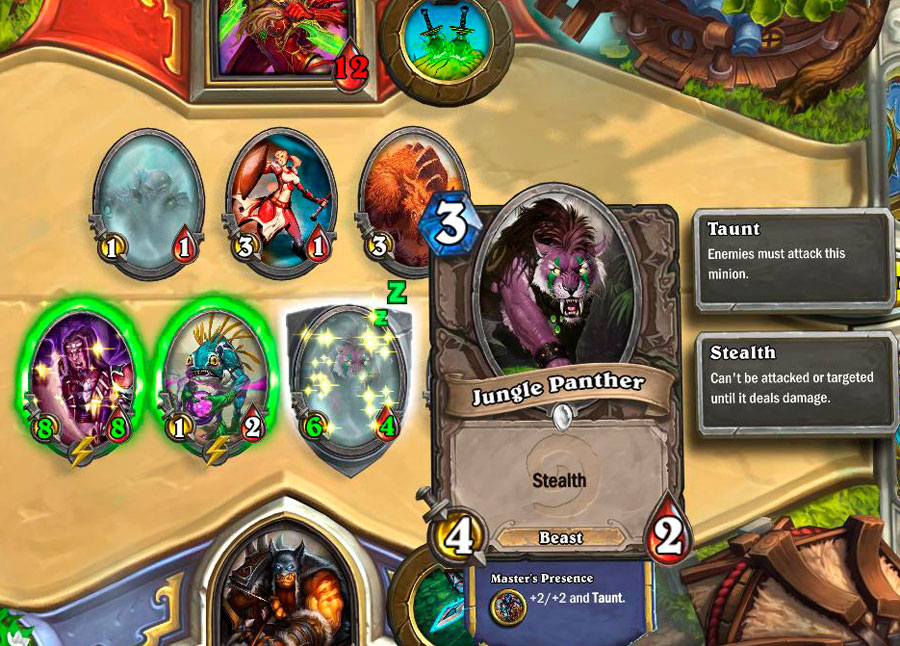
This should have been a combo, dammit!
In case you aren’t aware, Taunt is a creature ability that forces an opponent to only attack the creature with Taunt, as opposed to being able to attack any creature or just smash the opponent’s face in directly. Without Taunt, basically whoever drops creatures first is at a huge advantage since they can decide to attack any “special” creatures their opponents play with their own creature or ignore them. Pretty much the only rational strategy then becomes A) play special creature and then immediately drop a Taunt meatshield, or B) beef up a Taunt creature and control the board. An all-in-one package example of the latter is Ancient of War, which is an absolute bomb drop in Arena, by the way.
4) Playing first puts you at a huge disadvantage
Another shorty, but basically I never ever want to go first when playing Hearthstone.
Each player draws three cards before a game, and can choose to send any (or none) of the cards back and draw different ones. Whoever goes second draws a fourth card during this phase, and thus can fish for their deck combo cards or removal that much deeper. Plus, after the first player’s turn, they get a 0 crystal card called “The Coin” that will temporarily give you 1 crystal for a turn. So, basically, going second you can cast a 2 crystal card on your turn 1, or 3 crystal card on turn 2, and so on. What makes it even worse is that The Coin counts as playing a card/spell, which can trigger all sorts of nonsense, such as a Defias Ringleader suddenly giving the Rogue a 2/3 and 2/1 creature on turn 1.
Conclusion
Having said all that, I do feel like these are solvable problems. For the most part. Given the simplicity of the resource system and the mechanics in this first set, I am not quite sure how things will get balanced. The Knife-Juggler and Pint-Sized Summoner could be reduced to 2/1 and 1/1 respectively, and still be worth playing. But what about those Hero powers? The Hunter power can’t be reduced to 1 crystal or the damage increased to 3. Would they buff the Hunter class cards instead? What if a player doesn’t actually use those “balancing” cards?
Time will tell upon release exactly how broken some of these interactions are. Time will also tell how much we or Blizzard particular care. I probably have the most fun in Arenas (I went 8-3 and 9-2 this weekend, the latter of which resulted in 310g) where dropping game-changing cards is the norm, and Ranked matches sorta feel like 2v2 Arena in WoW somtimes. I would rather it be balanced of course, but this is also a CCG – there being only a few viable decks at the upper-end is pretty much par for the course. But if Blizzard wants to do some (more) groundbreaking things with their game design, they are going to have to fix the above four issues at a minimum.
Beta Impression: Hearthstone
Yes, I made it into the beta with that ridiculous email and Press™ credentials. It just goes to show you that with hard work and a can-do attitude Camus was right. Embrace the Absurd.
Anyway… Hearthstone!
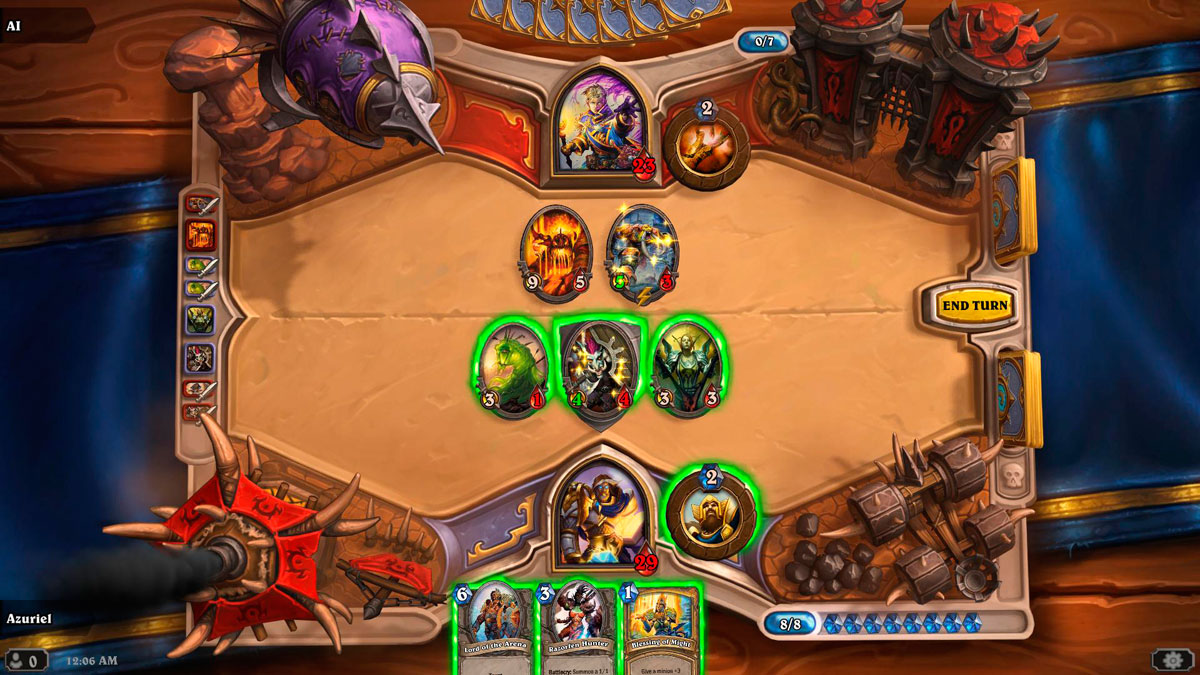
Momentum is extremely fluid.
For those not following along at home, Hearthstone is a free-to-play CCG made by a small team at Blizzard, all of whom likely had an awkward conversation with their bosses as to why they were apparently hiding their goddamn genius game development and UI skills under a bushel.
Indeed, that is exactly the first thing anyone should talk about when it comes to Hearthstone: it has perhaps the best UI in any game ever made. It is both visceral and whimsical, simultaneously. You know that feeling in a pillow fight, about ten seconds in, when you are just wailing on somebody and clearly winning before Jason knocks over the lamp and your mom comes upstairs and makes everyone go to bed? It is kinda exactly like that. Or close enough that I am going to continue using this ungainly metaphor for the rest of the post.
The basic premise of the pillow fight is that each player creates a 30-card deck, limited to 2 copies of an individual card, and then tries to reduce the opposing player from 30 life to zero in a turn-based manner. A few unique gameplay wrinkles show up immediately. First, players have to choose a Hero to represent them, corresponding to one of the original nine classes in World of Warcraft. Each class has their own unique set of cards that cannot be used by the others, although there is a large portion of “neutral” cards that can go into any class’s deck. In addition to the unique pool of class cards, each hero has a “hero power” which is an ability that costs two resources and can be used once each turn. The Paladin hero, for example, can create a 1/1 creature whereas the Warlock can pay 2 Health to draw a card (ala Life Tap).
The second gameplay wrinkle comes from the gameplay flow. Each turn, a player gains another resource point (aka Gems, Crystals, whatever), up to a maximum of 10, with them reseting at the start of each turn. While there are technically “Secret” cards with hidden triggers that can be played, there is otherwise no action possible during an opponent’s turn.
Finally, combat plays out a little differently than you might expect, coming from SolForge or Magic: the Gathering. Summoning Sickness and Haste (i.e. Charge) is all there, but there really is no concept of “blockers”; unless your opponent has a creature with Taunt, you are free to send your units to attack the player or his/her creatures at your leisure, in whatever sequence you choose. While the optimal move is sometimes obvious – sending your 1/1 into that 5/1 – the math becomes exceedingly fuzzy when you start having to compute whether it’s better to just send all the damage to their dome and hope you maintain enough initiative to win the damage race.
Here is an example of some strategery:
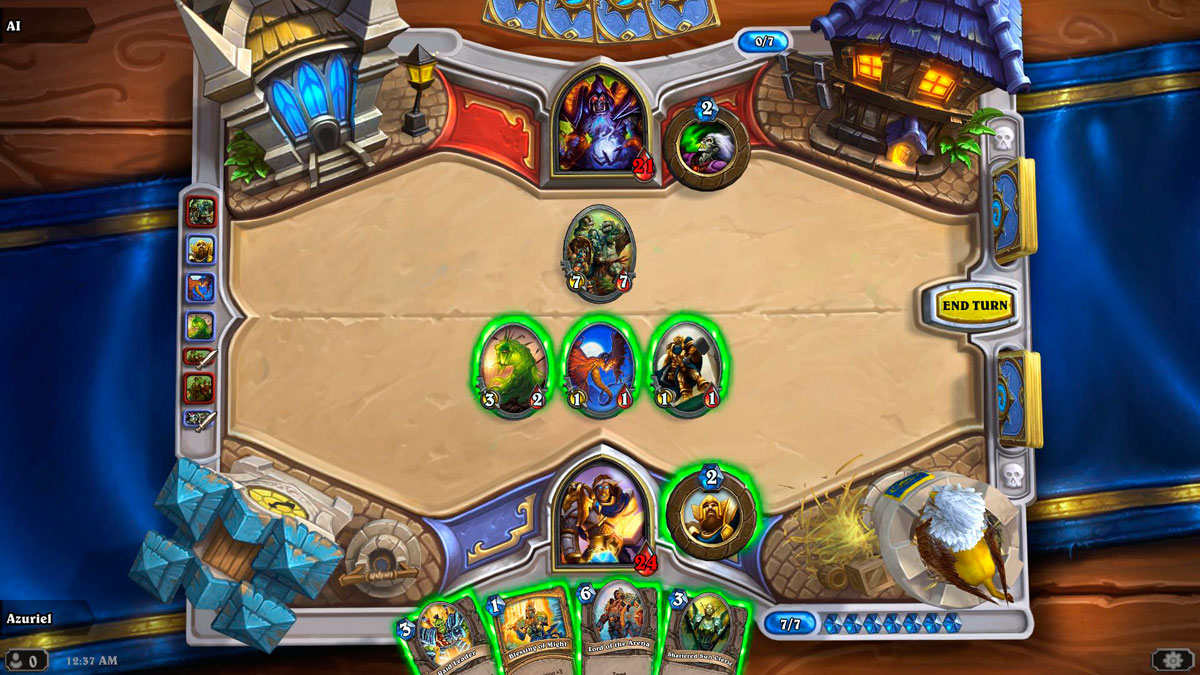
This Warlock is in for a bad time.
It’s turn 7, and the Warlock has a 7/7 mob. On my side, I have a 3/2, a 1/1, and a Young Dragonhawk (1/1 with Windfury, which lets it attack twice per turn). In my hand is Raid Leader (2/2, gives my other creatures +1 Attack), Blessing of Might (gives creature +3 Attack), Lord of the Arena (6/5 mob with Taunt), and Shattered Sun Cleric (3/3 that gives a creature +1/+1 when it comes into play). My moves? Blessing of Might on the Young Dragonhawk, Shattered Sun Cleric also targeting the Young Dragonhawk, and then playing the Raid Leader. Attack the Warlock directly with all my creatures, dealing 6 + 6 + 3 + 1 damage to the dome, bringing him to 8 life with more than lethal damage still on the board.
Why play this way? There are a few reasons I chose to, and a few more that argue for a more conservative approach. Warlocks have a lot of removal by default, including Hellfire that deals 3 damage to everything. As amazing as my 16 damage was the prior turn, a single Hellfire would have wiped my entire board and left the Warlock with a 7/4 creature wailing on me. I could have perhaps played the Lord of the Arena and then Blessing of Might on the Dragonhawk, dealing 12 damage and leaving a sort of Taunt barrier that would survive (and trade) a Hellfire. Or I could have done my big play like last time, and sent the 6/2 Dragonhawk into the 7/7 as its second attack and finishing it off with the 1/1, having dealt a total of 9 damage to the Warlock.
Having actually wrote all this out, it has become apparent that my original play was monstrously dumb. A single Hellfire would have wrecked me, to the point of not being able to recover. At the time, my thought process was that the Warlock had to remove my Dragonhawk or lose the next turn, so he’d send in his 7/7 targeting my 6/2, leaving it as easy picking on my next turn… which would be irrelevant because I’d have lethal damage available anyway. Shit, I was probably just too damn excited to contain myself. “Sixteen damage in one turn! Ka-Pow, right in the kisser!”
While there are moments of high excitement, there are also moments of extreme depression. Hearthstone, like many (most? all?) CCG games, forces one to become intimately acquainted with the Three Sisters: Tempo, Card Advantage, and RNG. Take a look at this screenshot which, days later, still causes me to groan:
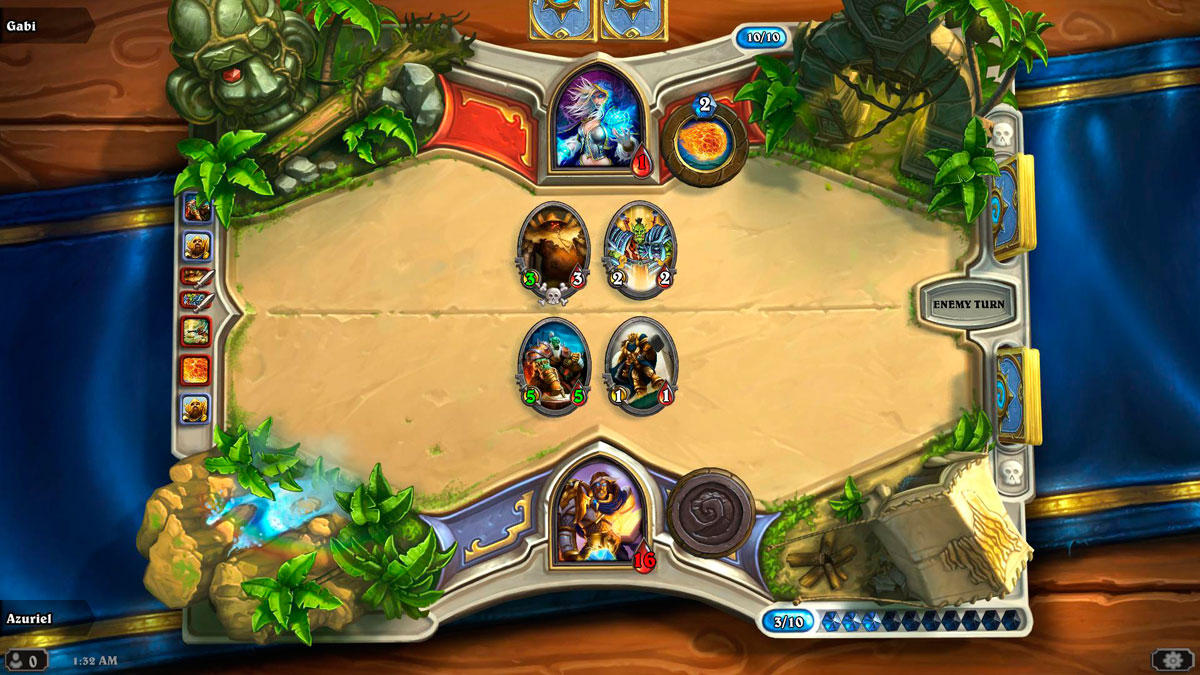
Seriously?! C’MON!
My opponent is at 1 HP, and it’s their turn. They send their 3/3 (which makes a 2/1 at death) at my 5/5, and then the 2/2, and then send a 1-damage fireball at my 1/1 creature. Approximately 247 days or five turns later, whichever is worse, the Mage wins. Wins. I never draw a creature with Haste Charge, or any “direct” damage (by Paladin standards), and nothing on my side of board lives long enough to attack. I created a 1/1 each turn only to have it pinged away.
You will have games like this, and it will suck. It is not quite on the same level as being Mana Screwed in Magic, but games possibly grinding to a halt is at least one problem that Scrolls solved beautifully – in Scrolls, you either turn a card into a resource or discard it to draw 2 new cards. With Hearthstone, some heroes like the Paladin have a severe problem with running out of steam. There are technically some Paladin-specific trickery to “solve” this issue – Divine Favor is a 2-cost spell that let’s you draw cards until you have as many as your opponent – but that is heavily dependent on actually having said cards in your collection, and drawing into them at the opportune moments.
Speaking of which…
The Business Side
So where are the Hearthstone F2P hooks? Well… it’s kinda weird. I mean, not really, but it sorta is. Here is how you spend money:
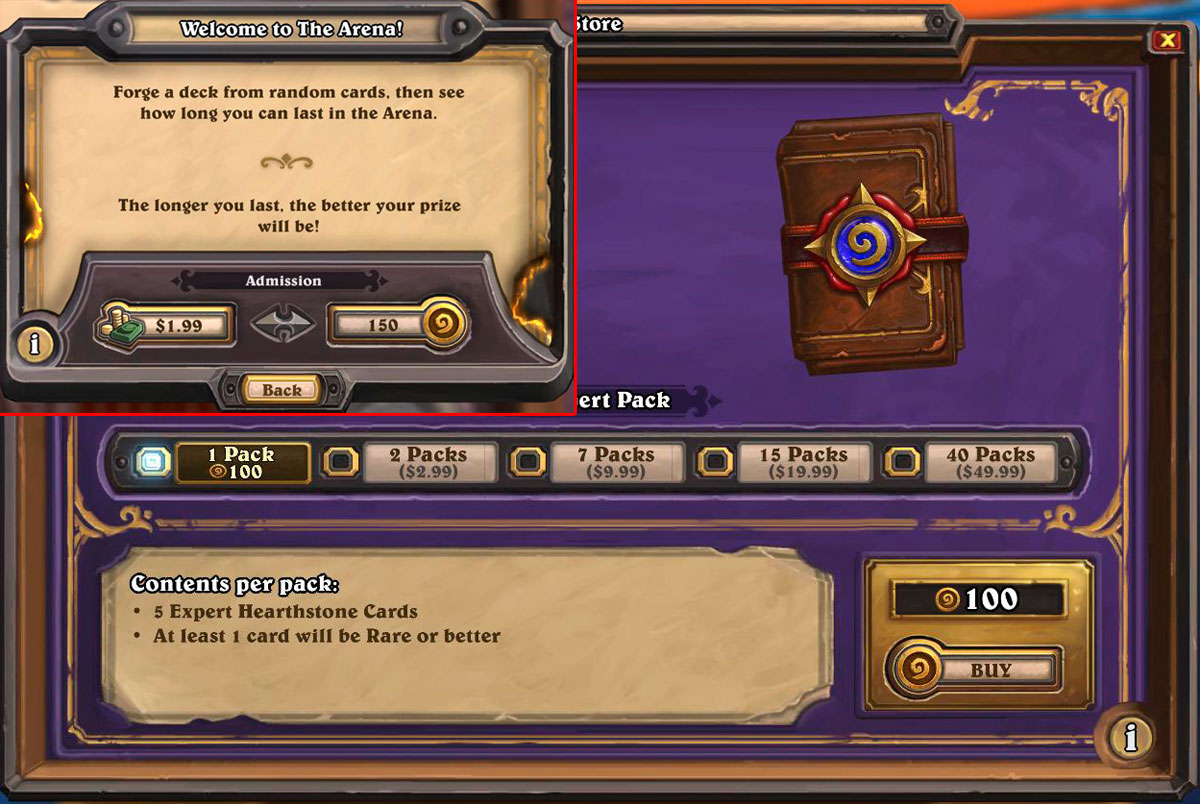
Almost… reasonable?!
You can buy 5-card booster packs for 100g or at an escalating discount; they come out to be $1.50, $1.43, $1.33, and $1.25 apiece in the various quantities. Entrance into the Arena (which used to be the Forge) is 150g or $1.99. Purchasing boosters for 100g is almost always a waste of precious gold, considering that even if you go 0-3 in the Arena, you will receive a booster pack at a minimum in addition to some other prizes. Supposedly, if you win 7 or more Arena matches, you will make enough gold to purchase another entry. I went 4-3 and came out with 45g and some dust (used to create cards) in addition to the booster, so I technically “paid” a 5g premium for a series of fun games and dust instead of simply having a booster.
What are sources of gold? There are basically two: daily quests and winning matches against people. The “daily quest” is really just a random quest that asks you to win 3 matches, kill 40 creatures, play some games as a specific class, and so on, with a reward of 40g. Winning matches gives you 5g after you win a total of 5, e.g. 1g apiece. I think there might also be a gold award when you level a class up to 20.
So you can sort of see the outline of the F2P hooks. You are not going to be playing in the Arena every day without forking over some serious cash. Being competitive in the Ranked games will require Legendaries and other power cards, which come from random packs. All pretty standard for a CCG, really.
But honestly? Blizzard is pretty much doing everything wrong if their goal was pure F2P exploitation. There are no special classes of booster packs (more expensive versions that have guaranteed rare cards) like in SolForge or the upcoming Hex. You can play the equivalent of Booster drafts using in-game currency. And the biggest jaw-dropper once you think about it? You can manually create any card in the game via the dust. Including Legendaries. Yeah, it takes like 1600 dust to craft a Legendary and your sole source of dust is going to be from activities that involve money (e.g. boosters or Arena), but again, you can substitute in-game currency for the costs. So, eventually, a person that spends $0 can have a full set of all the cards in the game.
Probably around the same time a new set comes out, but hey.
Bottom line: Hearthstone has some legs. In fact, it’s about to have a few more pairs after it chops the current (and upcoming) competition off at the knees. The game is fun, the UI is a feast for the senses, and the few issues I do have with the game can easily be addressed by the end of Beta. This Impression post is already absurdly long, but you can be certain that there will be more to say about Hearthstone in the weeks and months to come.
Beta Impression: SolForge
After becoming increasingly disenchanted with Scrolls while still craving a card-game experience, I found out that SolForge was in Open Beta as a F2P game. On Steam, no less. Score!

I have to consciously not read that as Solf Rge.
SolForge plays a lot differently than many other CCGs (there is no trading that I’m aware of): it has the most distilled, fast-paced card gameplay that I have ever seen, outside of maybe Dominion. The basic premise is that you build a 30-card deck with the goal of reducing your opponent from 100 HP to zero. There are four “factions” that roughly correspond with certain card themes, and your deck is limited to having cards from only two factions. Each player draws five cards, someone is selected to play first, and then you see this screen:

*rubs hands together*
The first big twist is that there are no resources to manage. On your turn, you can play two cards from your hand, be they creatures or spells. When you play any card, an upgraded version of that card is shuffled back into your deck. There is a combat step where all creatures attack, and you can trigger it at any point during your turn (before, in the middle of, or after you played your cards). At the end of your turn, any leftover cards in your hand are also shuffled back into your deck and you draw a new hand of five cards. Every four turns or so, your avatar “levels up” and then you are able to start actually drawing the upgraded versions of the cards you played previously (even if the original is still on the board).
A quick note about the leveled-up cards: it is way more strategic than you think. A lot of cards might have an especially weak Level 1 form, only to ramp up in power with Level 2 and Level 3. Others are strong Level 1 contenders, but feature a definite lack of scaling that almost make them dead-draws in the endgame. Still others sort of force you to use them early to keep them relevant at all. An example of the latter is Cull the Weak, a removal card which destroys a creature with 4 Attack or less, which ramps up to 7 or less and finally 14 or less at Level 3. Played early, Cull will serve you immensely well into the late stages of the game; drawing into a Level 1 Cull around Turn 15 though, and it may as well be a blank card.
Examples of the first two types of cards (late vs early game focus) can be seen here:

The Darkshaper is by far my favorite card in my collection.
Where things really get (further) mind-bending is combat. Creatures you play have Summoning Sickness are “On Defensive” until the start of your next turn, meaning they won’t initiate combat. Creatures will also stay in the lane you played them in (unless they have the Mobility trait), attacking anything directly across from them. Once creatures are “On the Offensive,” they will attack every turn. As in, creatures will attack on your turn, and then attack again on your opponent’s turn. Damage a creature takes is permanent, as are most boosts and the like. As you might imagine, creatures die pretty quick; conversely, this means that any creature that does stick around (especially if they have a nice ability) start becoming increasingly dangerous.
What I am failing to get across in words is this: the tempo is SolForge is insane. And addicting. Let’s say that I play a 5/5 creature and my opponent then plays a 7/7 across from it. If I do nothing, my 5/5 will automatically run to its death, and my opponent will begin dealing 7 damage a turn with the now 7/2 creature. Before the attack phase, I might cast a spell that gives one creature +3 attack and another creature -3 attack, making the match-up a 8/5 versus a 4/7. On my opponent’s turn, if he/she doesn’t kill the creature with a spell or throw another creature in front of my now 8/1, it will attack again on his/her turn.
Goddammit, words aren’t working. Here was board position of the closest fight I have ever seen:
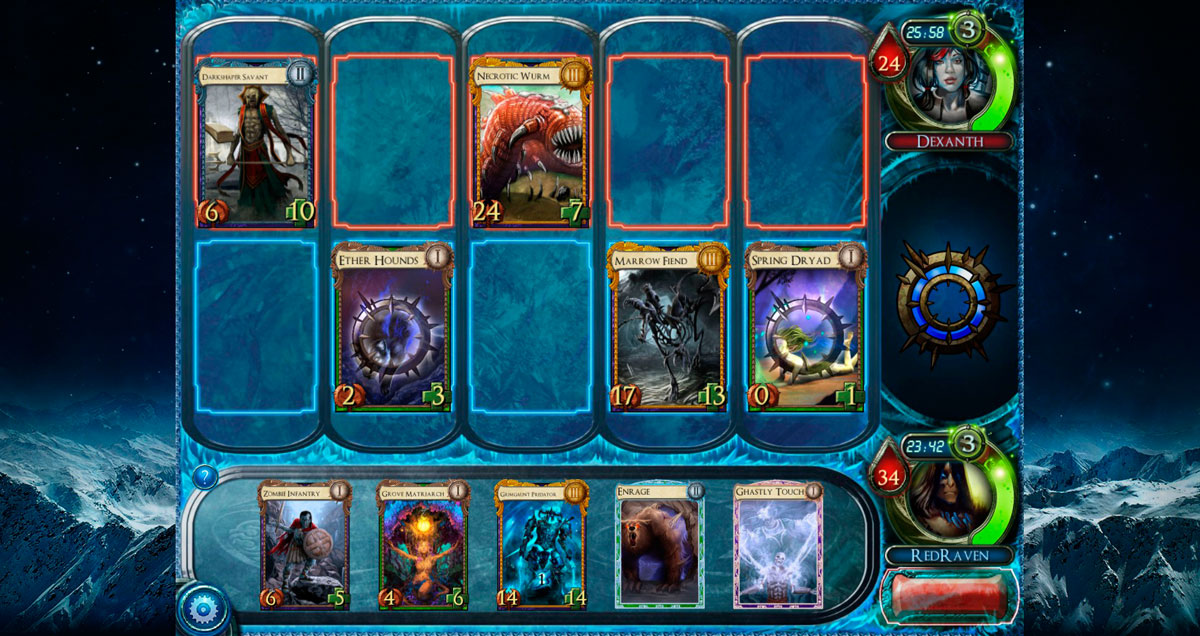
There has to be a way out…
It is my opponent’s turn, late in the endgame. His creatures are the 6/10 Savant that let’s him give a creature -3/-3 whenever he casts a Level 1 spell, and “just” a 24/7 wurm. Mine are all just vanilla creatures aside from the Dryad, which gets +1/+1 each time a creature comes into play on my side. He just cast the +3 Attack/-3 Attack spell I mentioned earlier, targeting his wurm and my dryad, taking out one of my 2/3 Ether Hounds with the -3/-3 trigger. He then plays his own Ether Hounds, providing blockers for my Dryad and Marrow Fiend, using the Savant’s trigger to kill my last Ether Hound. He attacks, creatures die, and we go down to 7 and 4 HP respectfully.
What are my options on my upcoming turn? Well… the 6/5 is just a vanilla creature; the 4/6 will spawn a 1/1 creature in its space after it dies; the 14/14 creature has Mobility and gets +6/+6 when a creature dies across from it; the card Enrage gives a creature +5/+5; and the last card gives a creature -3/-3. Hmm. After I make my moves, the board looks like this:
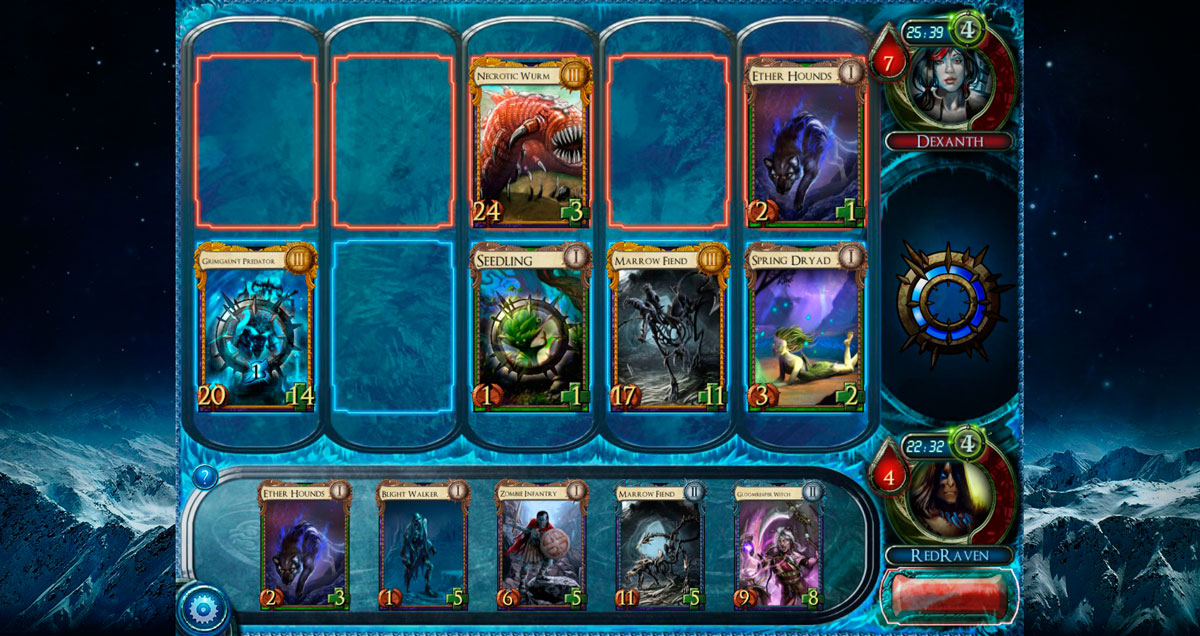
Not horse-shoes or hand grenades, unfortunately.
I had tossed my 14/14 in front of the Savant because the -3/-3 triggers were generating insane card advantage, and would basically negate my center lane gambit. Said gambit was tossing in the 4/6 creature in the path of the 24/7, and relying on the 1/1 that spawned after its death to give me the reprieve I needed to win. And, in fact, I would have won on his turn, but he managed to cast either another Savant or perhaps a Gloomreaper Witch (kills a 1-power creature when it comes into play) to remove my 1/1 and block my 20/14, and then some other throwaway creature to stand in front of my 17/11. The wurm, unopposed, kills me. GG.
Whether all of that sounds like gobbledygook or a smashing good time probably depends on how familiar you are with card games, or with Magic specifically. Oh, did I forget to mention that? Richard fucking Garfield had a hand in SolForge’s development, along with the guys who made Ascension, who were already pro Magic players. Now that I think about it, Richard fucking Garfield worked on Card Hunter too. Dude gets around. Considering how everything he touches seems to directly trigger my nucleus accumbens, I’m going to say that this is a Good Thing.
Less so for my wallet.
Beta Impressions: Scrolls
I tried out Scrolls the other day, mainly due to this video. My initial impression is… mixed. Which is not good for a game that requires $20 to buy-in into a beta state.
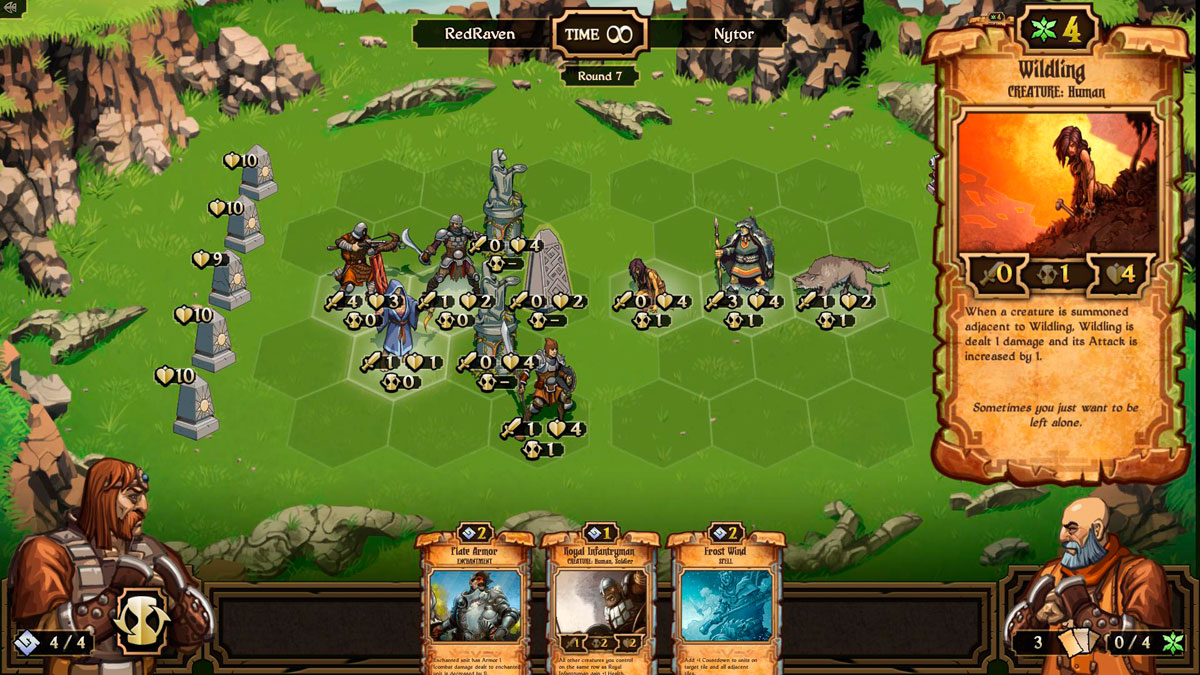
The flesh is willing, but the mind is weak.
For those who may have forgotten, Scrolls is the TCG follow-up project to Mojang’s genre-defining Minecraft. It is essentially Magic-lite with a few extra tactical considerations. Each player has five 10-HP totems at the end of five lanes, and take turns placing creatures or structures or casting spells/enchantments in an effort to reduce three of those five totems down to zero health. Creatures will attack down their lanes when their timer reaches zero, damage is persistent, and creatures can also be moved usually one “hex” each turn.
What I enjoy about Scrolls so far is its rather ingenious, nested card mechanics. At the start of the match, you draw five cards and thereafter draw one card per turn. Each turn, you have the opportunity to discard a card to increase your resources by 1 permanently (e.g. turning it into a MtG “land” essentially) or discarding a card to draw two new cards. As you can only have three copies of a given card in your deck, this immediately makes the early game exceedingly complex on a strategic level. Should you turn that high-cost card into resources now, or save it for later? Now that you’re at 5 resources, should you discard in order to draw two new cards or continue pumping up resources to allow you more options each turn? I doubt that Scrolls is the first card game to feature a system like this, but I am finding it extremely… delicious.
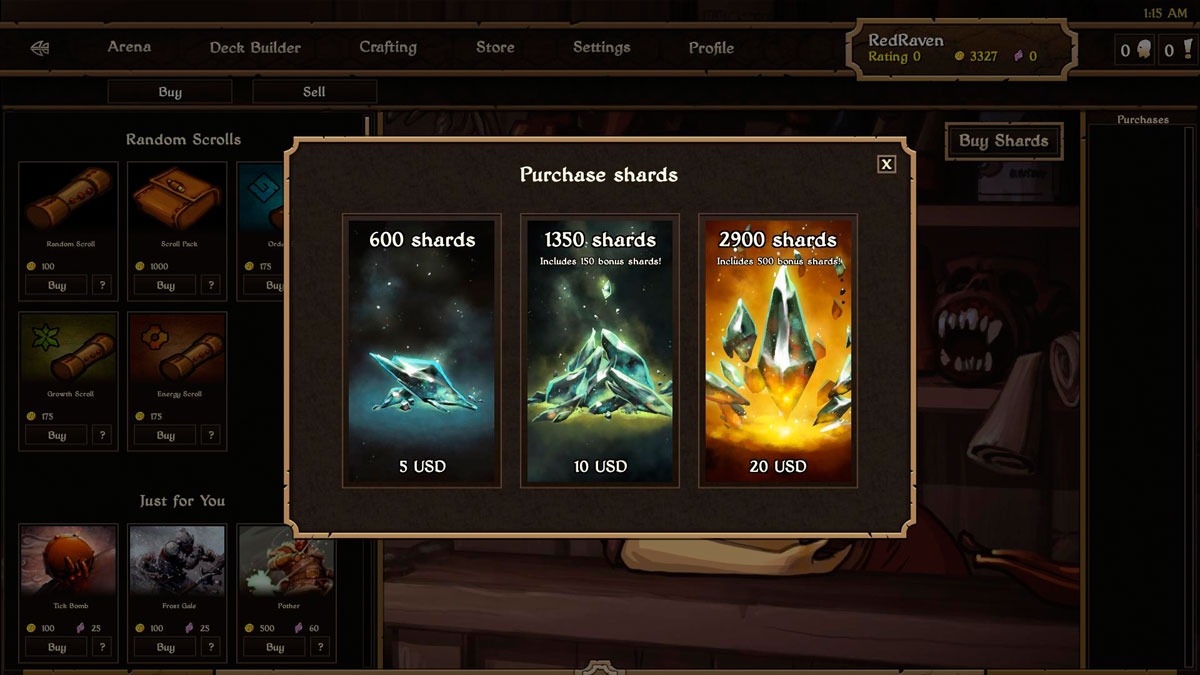
Really? That big pile of Minecraft money not good enough for you?
Now that I think about it, my mixed reaction basically comes down to the Store aspect. After you purchase the game, you unlock one of the three Starter decks to play with. Thereafter, you are stuck purchasing new cards in awkward increments using in-game gold earned from winning matches (either against AI or people). I made the unfortunate mistake of purchasing the Order deck and realizing that I don’t actually like its gameplay – a high emphasis on maneuverability and defense and so on. I am getting around ~300g for winning Trial matches (e.g. scenarios), but the other Starter decks are 6500g total. I started with 2000g, but foolishly purchased the 10-card booster packs at 1000g apiece.
So, essentially, I am stuck with a deck I don’t particularly enjoy playing while having to grind out dozens of games with no hope of actually seeing any new cards for that entire duration. Technically, I can also purchase things in the store for Shards, which is the RMT currency. However, the thought of spending more money on top of the $20 I already paid to play the game in the first place is repulsive. Scrolls is not a F2P game. Finding myself confronted with a payslope after the initial paywall is incredibly frustrating, especially with there being no way to undo the designer trap (having to choose a Starter deck with zero information) I fell into to begin with. This is a TCG, sure, but if your Starter deck isn’t fun to play, most rational people won’t be playing for long.
I am going to continue playing in the hopes that things improve, but at the moment I couldn’t really recommend Scrolls to anyone just yet.
Maybe not so indie after all…
One of the points I made yesterday regarding Card Hunter’s potential was:
1) Card Hunter is not being made by some large corporation (even if their F2P pricing is similar);
It occurred to me later though, that I never bothered to check on the actual game developers. Who are these guys and gals, and how were they able to create such a polished experience even in this Beta state? As it turns out… well, let’s just say that they have some experience in this regard:
- Jonathan Chey – co-founder of Irrational Games, director of Bioshock, producer of System Shock 2.
- Joe McDonagh – Production Director and Peggle Studio Franchise Director at PopCap Games.
- Dorian Hart – Veteran at Irrational Games; worked on System Shock I and II, Thief and BioShock.
- Tess Snider – from Trion Worlds, programmed Rift.
- Kevin Kulp – DM/game designer, worked at Wizards of the Coast, Green Ronin, and other places.
- Richard Garfield – Design consultant. Created Magic: The Gathering.
- Skaff Elias – Design consultant. Magic designer and founder of the Magic pro-tour.
So… yeah. Maybe this team isn’t so indie after all. I mean, when you have Richard fucking Garfield as a design consultant for your pseudo-TCG, that almost feels like cheating. Then again, I’m not particularly interested in having a hipster semantic war. Seven dudes with two consultants and no major publisher with suits to answer to? That passes the indie smell test for me.
P.S. For those just submitting their beta applications, it took me from May 11 to Jun 20 to get in.
First Impressions: Card Hunter (beta)
I got into the Card Hunter beta last Thursday.
It is rare anymore for me to spend a lengthy amount of time playing the same game. Game developers these days front-load their daily bonuses in such a way that the most “efficient” way to maximize your playtime is to switch between 3-4 titles. And yet I spent ten hours playing Card Hunter on Saturday, and another six on Sunday. So, spoiler alert: I really like this game.
Card Hunter grabbed me from the word Go. In essence, this F2P browser-based game is a tactical, turn-based RPG where your abilities come in the form of random cards. Instead of building an entire deck on your own, a character’s game deck is actually the sum total of the cards associated with that character’s equipped items. This might sound complicated, but it is the exact opposite – after about 5 minutes of looking at the screen, the system becomes immediately grokkable and engaging. For example, here is a character sheet:
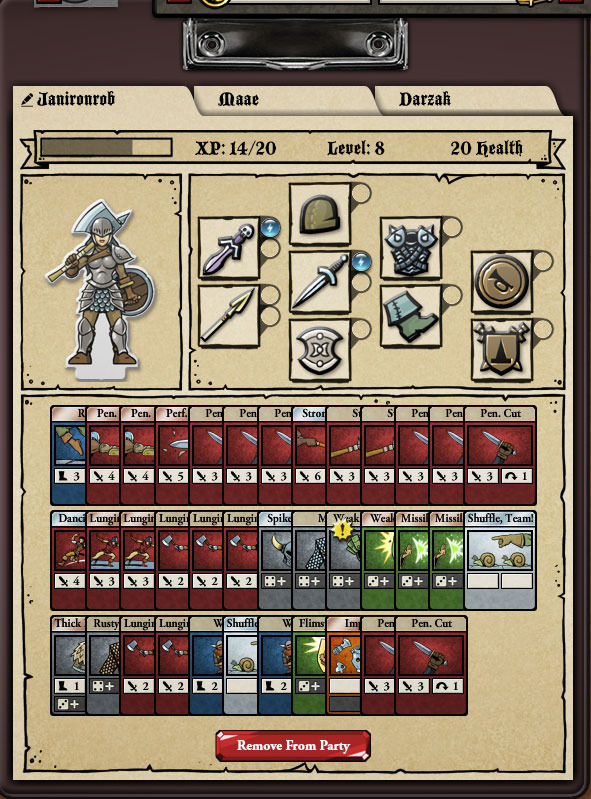
I have an immediate urge to go play right now.
All of the cards along the bottom are the sum total of the deck. When you look at a specific item…
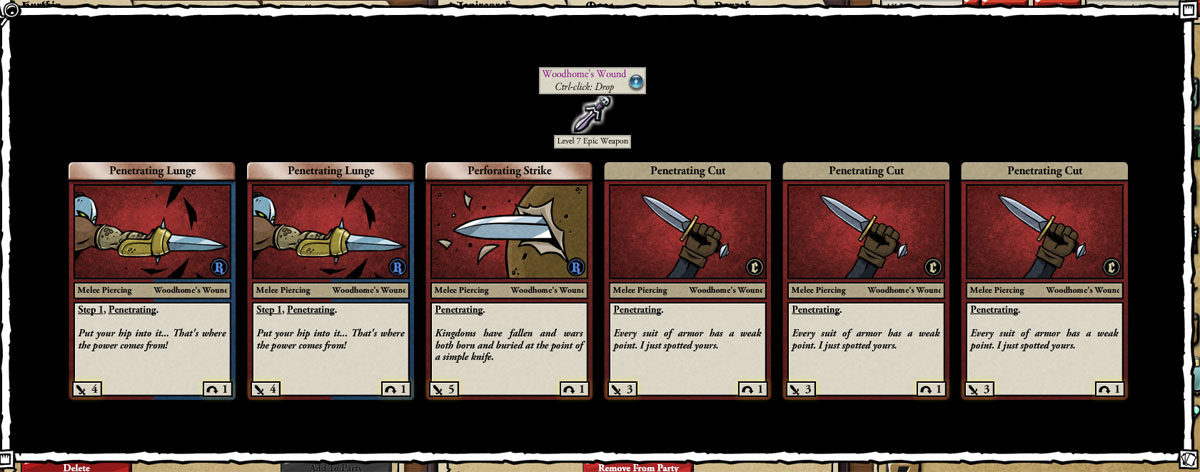
Kinda funny how it’s pretty much always going to be purple = epic from now on.
…you can see what cards it contributes to the overall deck. As you might imagine, weapons usually contribute attack cards, armor contributes armor cards, and so on. Occasionally though, you will have some items that contribute cards from outside their “theme.” Most items are limited to certain classes, of which there are three: fighter, cleric, and wizard. You can have either human, elf, or dwarf versions of any of those classes, with the differences being the typical D&D tropes; elves have low HP and fast movement, dwarves have the opposite, and humans are in the middle.
How does the game play? Fabulously.
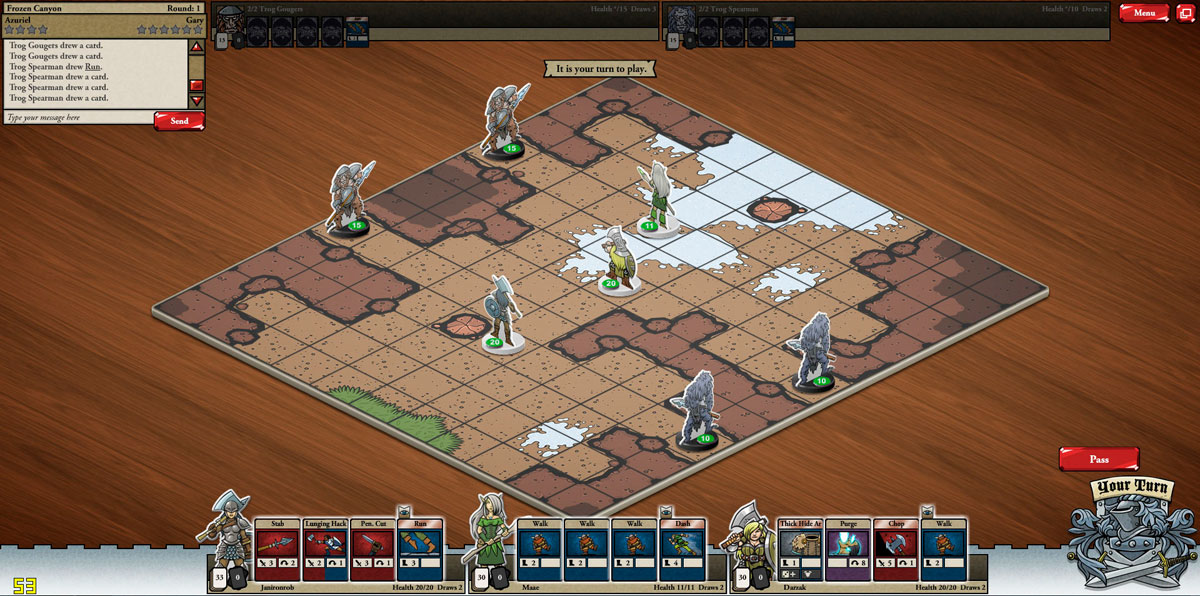
Yes. YES!
As you can see, the “setting/lore” of the game is retro-D&D, and it is adhered to from start to finish. All characters are represented with those figurines, and all the maps are exactly like this one (with different terrain and such, of course). The game’s F2P currency are slices of pizza, the battles are all prefaced with D&D-module write-ups, and there is clearly some tension going on inbetween the new DM Gary and his rules-lawyer brother Melvin in campaign mode – not to mention Gary’s awkward crush on the pizza delivery girl. Change some names around, add in two more teenagers, and Card Hunter could have described my high school D&D experience to a T.
As far as the game flow goes, it is pretty intuitive. You and your opponent take turns playing one card from any of your characters’ hands. You don’t have to alternate which character’s cards you play – if your warrior has 3 attack cards and someone within reach during each of his/her turns, you can wail on them 3 times. When you and your opponent pass turns in sequence, the Round ends, everyone discards down to two cards, three cards are drawn (one of which is always a movement card), and any Round triggers fire (e.g. players starting their turn in lava take 10 damage, etc).
The strategic brilliance of this combat system simply cannot be praised enough. Yes, the card-based nature of abilities can lead to immensely frustrating, if not outright impossible scenarios. In the screenshot above, for example, my elven mage has drawn all movement cards, severely crippling any initial attack I could muster. Defeat can (and will) be drawn from the jaws of victory even if you are careful. Here was a moment I exclaimed “You have got to be shitting me” out loud:
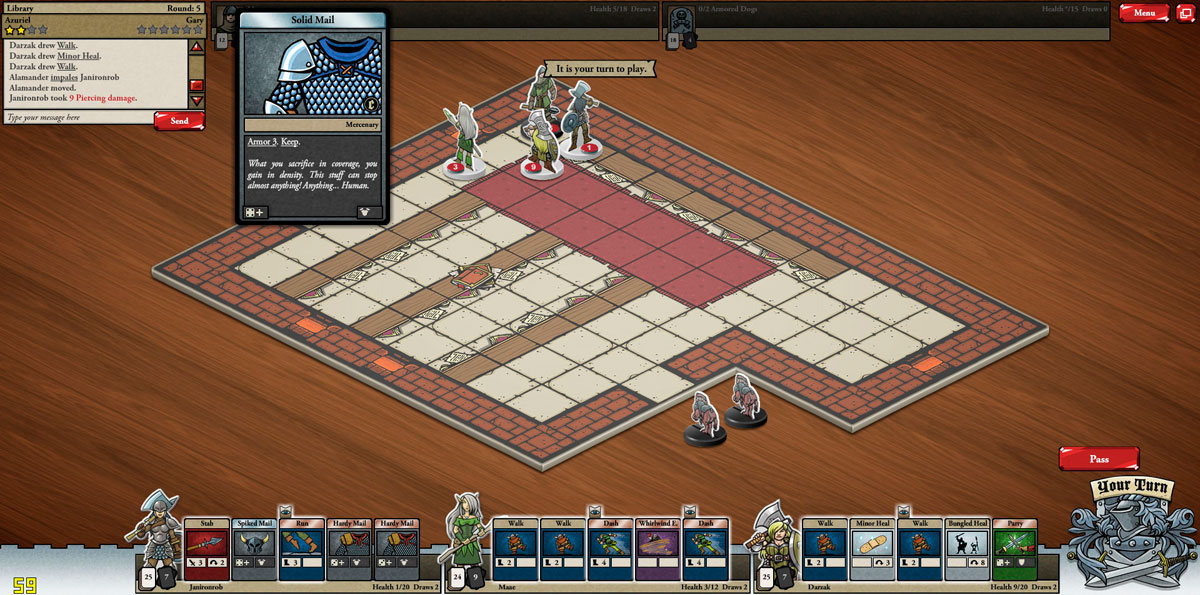
I mean, come on!
The above screenshot was taken from the dreaded Compass of Fucking Xorr level, right from where you might imagine is an insurmountable advantage. The armored dogs are dead, I have the last mercenary backed into a corner with 5 HP, and all my dudes are (barely) alive. It’s a new Round, my turn, and… look at the bottom. Don’t see many red cards, do you?
In fact, I drew exactly one attack card, and it only deals 3 damage. That larger card in the screenshot is a “seen” card that I know is in the merc’s hand, and it’s a doozy. Basically, any time you would deal damage to the merc, he rolls a d6: on a 4 or higher, the damage is reduced by 3. Like many Armor cards, it also has the Keep quality, which means it stays in his hand after triggering, ready for the next reduction in damage. And from fighting this guy, let me just tell you that his attack cards all deal 6+ damage from two squares away.
I did kill the merc on the turn after this one, as he just happened to draw a “drawback” card that caused him to discard all his armor cards. But it was a close one either way.
In any event, I am having a blast with Card Hunter thus far. That might sound strange after I just dedicated a few paragraphs to describing what could have been a terrible RNG-based wipe, but that kinda goes with the TCG territory. Who hasn’t been mana-screwed in Magic: the Gathering before? Part of tactical thinking should include the possibility of things going wrong – if games like Frozen Synapse taught me anything, it would be that. If nothing else, it keeps you on your toes.
I’ll go over the other elements of Card Hunter, including the ever-important F2P bits, next time.
Instant Gratification vs Fun Investment
All this talk about Magic: the Gathering makes me want to revisit a topic I briefly touched on last week, in the comments here and elsewhere. Namely, the sort of denigration of “instant gratification” and the elevation of investing in “long-term fun,” which is presumably shorthand for “doing a series of boring things for a reward later.”
The choice between instant gratification versus an investment in long-term fun is a false dichotomy. Gaming is an instance in which you can have your cake and eat it too.
One of the examples activities that was used to illustrate how “boring gameplay” can lead to bigger returns in fun was painting figurines in a tabletop game like Warhammer. Simply purchasing already-painted figurines would just not be the same despite having no direct gameplay relevance. I agree. I also agree with the notion that, say, using cheat codes to become immortal, having infinite money, and so on right at the start of the game likely diminishes the overall amount of fun you can derive from it.
But here’s the thing: someone who paints their Warhammer figures probably finds the act of painting them fun.
I used to play a lot of Magic: the Gathering back in high school. The games were nothing serious, just some 3-5 person chaos multiplayer amongst friends. However I would routinely spend about 10 hours crafting decks for every 1 hour a given deck would actually see play. In fact, if any of my decks began to routinely win, I stopped using them and built new ones.¹ And I had fun!
Deck-building was almost better than playing the actual game for me. There is something deeply satisfying in seeing a complicated scheme all fall into place, top-decking the one perfect counter that changes the game right when you need it to. But running all those scenarios through my head, pouring over all my available options, whittling down a pile of 250 cards I wanted to use into a perfectly-tuned 60-card machine was pure entertainment in of itself.
Another example: D&D. I ran a 4-year campaign throughout all of college, and a little beyond. As a DM, I let my players have ample freedom, but I made sure the world they inhabited was scaffolded in lore such that they had a place in it. In other words, I wanted to give them the ability to take the world as serious as they wanted to. Of course, most sessions started and ended with them starting a bar fight rather than the existential pondering I secretly wanted them to do. But it is not much of a stretch to say that I spent 20 hours per week in preparation of one 3-6 hour session. Never once did I consider those 20 hours a chore. I was excited to DM those games because it gave me the opportunity (and justification) to spend all that time world-building.
Now, clearly, what an individual finds fun is going to be subjective, and possibly something that changes over time and circumstance. But my point here is that the sort of activities necessary for long-term enjoyment – figure-painting, deck-building, world-creation – can be fun in of themselves. Not only can, but should. This extends to all in-game activities.
I do not buy the argument that something like Darkfall/EVE’s AFK resource-gathering systems is fun “because it gives you the time to do something else.” An activity doesn’t become fun by adding in a separate fun thing; an activity is either fun in of itself or it isn’t.² An unfun thing can become tolerable when mixed, but that is not a point in the base activity’s favor. Being punched in the face is alright if you give me $1,000, but I would rather just have the $1,000. Is desiring just the money considered “instant gratification,” or is that simply rational?
You can rightly question why I am not currently building Magic decks or constructing D&D campaigns if they are so fun in of themselves. The truth is that without the payout, without the destination at the end of the journey, these (investment) activities are not as fun to me. However, while they might not be as fun – that is, they are less fun than other things I could be doing instead – keep in mind that they still are fun. An actual destination acts as a force multiplier, if you will, to the entertainment of the journey. Contrast that with many of the in-game “investments” we are tasked to complete which make no sense to perform at all without reward, e.g. they are the punch to the face.
The distinction is important, because I feel it is far too easy to for us gamers to fall into the cognitive dissonance trap of “retroactive fun” and Sunk Cost fallacy. “I spent 5 hours farming herbs, it must have all been worth it!” Even if there is no real difference between actual fun and retroactive fun in practice (and isn’t that a depressing thought?), it does matter when comparing games mechanics in the moment.
All things considered, you should desire the mechanics that are both fun now and even more fun later. We simultaneously can and deserve to have both.
¹ A successful deck was a sort of “proof of concept” for me. Could my infinite damage combo reliably work in an actual hostile environment? Coming up with combos was a lot easier than constructing a deck capable of pulling them off, after all. Plus, my goal was never to craft a (P2W) deck that beat my friends 100% of the time; that sort of thing is never fun to play against anyway.
² It’s probably more accurate to say fun is a gradient rather than a binary distinction, one that can shift from one moment to the next. But I still believe that the unfun half of the scale hits zero right near the border.
 In An Age
Hex
May 13
Posted by Azuriel
In the event that you didn’t read last Friday’s Penny Arcade, they talked about the Cryptozoic Kickstarter for a “MMO-TCG” called Hex. Basically, Hex is Magic Online meets WoW TCG meets cards that can get socketed gems, equip gear, gain XP, earn achievements that expand artwork and upgrade cards to foil versions. Also, there will be PvE, apparently including dungeons and raids. And all of this is Free to Play.
Of course, just like with Hearthstone, calling a TCG “F2P” is criminally misleading.
I have some concerns with Hex. First, while I am frankly excited about the unique opportunities involved with an all-digital TCG – cards that buff your creatures do so for the rest of the match, you can put tokens on cards that get shuffled into your library, and all sorts of crazy nonsense that physical card games couldn’t pull off – this game skews so heavily towards Magic Online that I’m surprised Wizards of the Coast hasn’t issued a takedown notice.
Seriously, look at this video:
I’m not talking about Apple’s “rounded corners” copyright bullshit, I’m talking about Grand Theft Mechanics. Creatures have summoning sickness, there is First Strike, Haste, seven cards in the opening hand, 20 life per player, four copy limit on individual cards, 60 cards per deck, land cards, instants, discrete turn phases (Draw phase, main phase, declaring attackers/blockers/combat damage, end step), and even the goddamn Stack.
That’s not even really my concern here though. My concern is what occurs about 200 times in the bottom right corner of that video: spamming of the Pass Priority button.
This is alpha footage, things can change, etc etc etc… but not really. Magic is an incredibly nuanced card game with thousands of pages of technical rules that few follow to the letter in non-tournament settings; friends usually don’t ask each other if there is any response to their Draw Phase, unless one of them was packing a relevant card in their deck. My initial few weeks with Magic Online was a brilliant experience because the game reminded you of all the sort of routine Upkeep triggers and the like that can bog down/derail completely a physical game when you forget one. Trouble is, Magic Online is going to ask you every damn time because it has to. You can manually change your settings to ignore certain steps if you want, but again, Magic is an incredibly complex beast – if you aren’t careful about when you cast a spell or use an ability, you can snatch defeat from the jaws of victory in an (cough) instant.
So that’s concern number one: the Pass Priority button is going to simultaneously be annoying as hell and be the reason you lost a perfectly winnable match. It’s also incredibly high-brow for as much as Hex is being marketed as “easy to get into.” I was a tad disappointed at first when I watched the Hearthstone duels and realized that there would be no “in response I play X!” back and forth. But seeing Hex and being reminded about how cerebral Magic can get… I think the Blizzard folks are on the right track, at least for a casual audience.
Calling it now: this will sell for at least $60. Each.
Concern number two? You’re going to spend probably $100-$200 a month playing this F2P game.
Look at this paragraph from the official website regarding the above card Extinction:
Translation: everyone will be paying out of the ass for this “crucial staple” of a card.
Even if you don’t see yourself competing in the sort of obvious P2W Constructed deck format (or presumably high-end PvE raiding), you will still probably be spending many times the average monthly subscription if you are remotely interested in the game. It is all right there in the Kickstarter page:
In Magic Online, a Booster Draft = eight players buy three booster packs apiece. Open pack, take one card, pass remaining to the left, repeat. Build deck. Limited = buy six booster packs, open them, build deck. Booster packs in Hex will cost $2 for 15 random cards, which is half of what WotC charges. Magic Online rewards the winners of these mini-tournaments with extra booster packs, such that those coming in 1st and 2nd place can generally leave with a profit of a few packs; I assume Hex will reward similarly. Everyone keeps the cards they play with, so you don’t leave empty-handed if you lose, but… well. Suffice it to say, I finally overcame my game subscription aversion when I realized I spent $24 in the course of a one hour in Magic Online. Suddenly, a mere $15/month seemed like a total steal. Cue WoW purchase.
Frankly, Booster Drafts and Limited are the best Magic tournament formats to play in because there is no Pay 2 Win pressure – everyone starts with the same random chance to get good/bad cards, and skill plays an exceedingly strong role thereafter. But, again, in Hex you are looking at dropping $6-$12 to participate in “content” that evaporates after an hour, if you’re lucky. This is to say nothing about the fact that new sets will come out three times a year, which means most of your cards will be unplayable in Standard settings (which is the big set and its two smaller components in Magic). You can still play older cards in Magic, but only in Extended formats where most people are still packing the overpowered cards of 5 years ago, not the leftover garbage from your Limited games that just became old news.
My deck-building sense is tingling. Or that could be the withdrawal.
If you haven’t noticed, I am extrapolating a lot about Hex from how Magic Online worked, but Cryptozoic has already stolen so much shit I feel safe that they will keep the theme going here. Perhaps Hex will feel a little different since it will have a PvE aspect, where some of your “outdated” cards might find a long-term home. Perhaps you could even earn boosters from said PvE – that would at least make the F2P claim less of a bald-faced lie. But make no mistake here: Hex, like any TCG (digital or no), will contain the two worst components of consumer-gouging videogame design: Pay 2 Win and gamble boxes.
And goddamn it if I’m still reacting like an ex-junkie, credit card in shaking hand.
Posted in Commentary
8 Comments
Tags: Cryptozoic, Digital, F2P, Gamble Boxes, Hearthstone, Hex, Magic, Magic Online, MMOTCG, P2W, Penny Arcade, TCG