Blog Archives
The Turkey Haul
I had half a mind to forgo any videogame purchases this Black Cyber Fronday, because sometimes a 50+ game backlog just becomes ridiculous to consider adding to. (Un)Fortunately, the half of my mind that controlled the credit card was the other one. I picked up:
- Battlefield 4 Digital Deluxe version ($26)
- The Last of Us ($30)
- 12-month PlayStation Plus subscription ($30)
It could have been worse, of course. I did exercise restraint in not picking up Shadowrun Returns and State of Decay; not because they might not be worth it, but because I have no particular reason to have them right now. Perhaps after, I dunno, I get around to finishing The Witcher 2. And Crysis. And the half-dozen indie games I started but not finished. And…
Alpha Impression: Sir, You Are Being Hunted
I have been spoiled by other games’ betas. That is clear to me now.
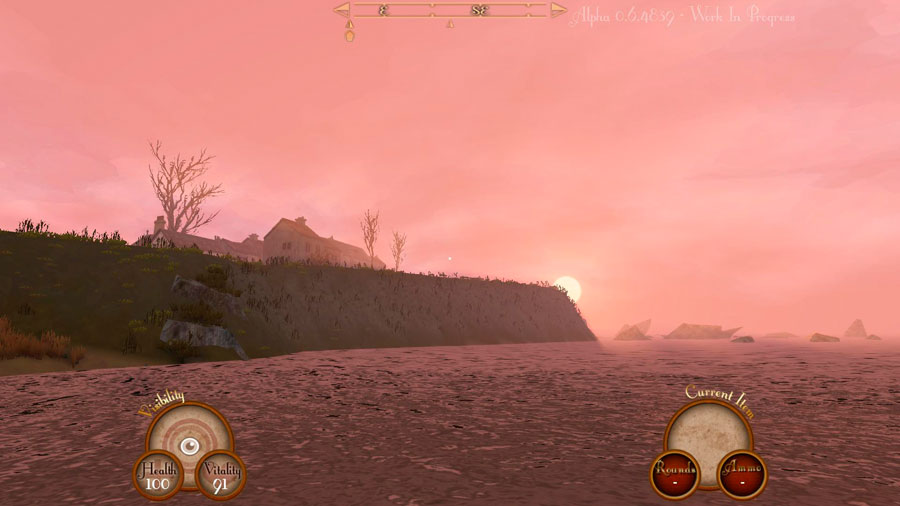
This part is okay.
Sir, You Are Being Hunted is a game I mentioned being excited about back in May, then promptly forgot about. Recently, it was up on Steam Early Access at a discounted rate, and I decided to take the plunge. A few hours of gameplay later, and I feel thoroughly soaked.
The problem I have with the game is that it is basically a sandbox without any sand. When you start playing, you are introduced to the core gameplay – find pieces of the Device, plug them into Standing Stone – given some binoculars and food, and sent on your way. As a veteran of Don’t Starve, this opening felt perfectly fine. What became readily apparent however, is that the game utterly lacks interactivity in its present state. Alpha is alpha is alpha, yes. But when I rummage through three entire villages and am armed with 3 alarm clocks, one bear trap, and two empty bottles against robots with shotgun sniper rifles, things feel lame.
Now, of course, the name of the game is to be, well, hunted. But the present AI behavior reminds me of the delicate, high-wire act that all stealth games must perform. If you have enemies patrol in a set pattern, it turns stealth gameplay into a sort puzzle game with logical, measured moves. It might feel less “realistic” to have the guard always look to the left for three seconds when he walks to the balcony, but as a game mechanic it is grokkable and feels “right.” Alternatively, you could have enemies who basically follow no pattern whatsoever, looking randomly in any direction at any time. More realistic? Sure. More frustrating? Absolutely.
Right now, Sir basically has the worst of all possible stealth worlds. The world is procedurally-generated and I’m not really certain one of the procedures is to place the Device pieces near cover. I basically spent the last 40 minutes trying, futilely, to grab a Device piece in the middle of a field where two robots were “patrolling.” And by “patrolling,” I mean they walked in random, jerking movements in a 3-meter radius around said Device. Tenchu, Dishonored, and Deus Ex this ain’t; the only possible solution is dropping an alarm clock, crab-walking as far away from it as possible, and grabbing the Device and running.
Of course, the robots run as fast as you do, are armed with shotgun sniper rifles as mentioned previously, and the only way to lose them is to be crouched in foliage. Which they immediately begin to search, because that’s the name of the game. But considering how you can’t really sneak through the foliage at any appreciable speed, they will find you immediately and GG.
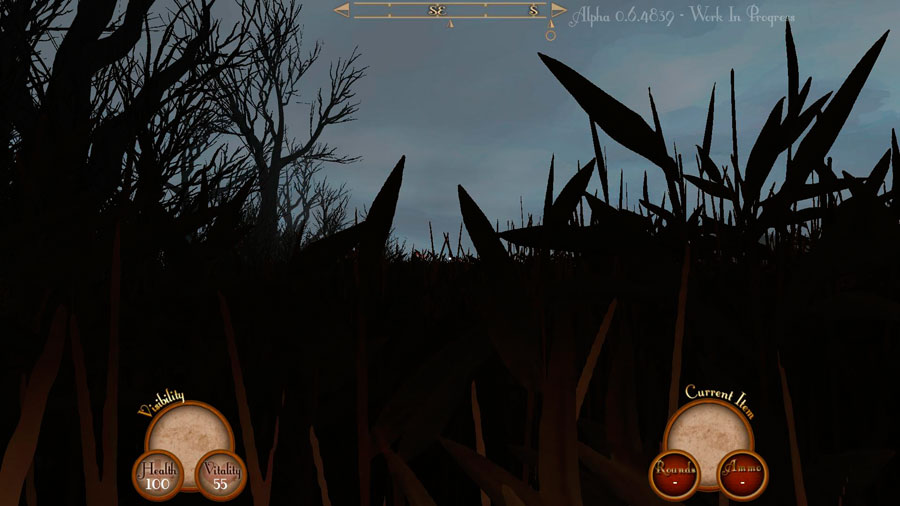
98% of your gameplay time is this.
Alpha is alpha is alpha. But right now, Sir You Are Being Hunted is basically a crouching simulator and not much else.
Steam Haul: Summer 2013
Someone asked me the other day what I picked up during the Summer Steam sale. So here’s the list:
- Antichamber
- Don’t Starve (of course)
- Far Cry 3 + Blood Dragon DLC
- Surgeon Simulator 2013
- Fez
- On the Rain-Slick Precipice of Darkness 4
- The Swapper
- Gunpoint
- Monaco
- Civ 5 (upgrade to Gold edition)
- Strike Suit Zero
- Dungeon of Dredmor (DLC)
- Rogue Legacy
- Closure
- Just Cause (hey, it was $0.27)
- Sanctum 2
Altogether, that came to around $133.24. Is that a lot? Probably. Then again, that’s about the same price as Far Cry 3 and Civ 5 bought on Day 1. At least, that’s what I keep telling myself.
That, and Press™. In fact, couldn’t these just be considered business expenses? Hmm…
WoW Finally Has Server/Faction Sale
In a move that I have been suggesting literally forever, Blizzard is slashing all character services by 50%… for one week.
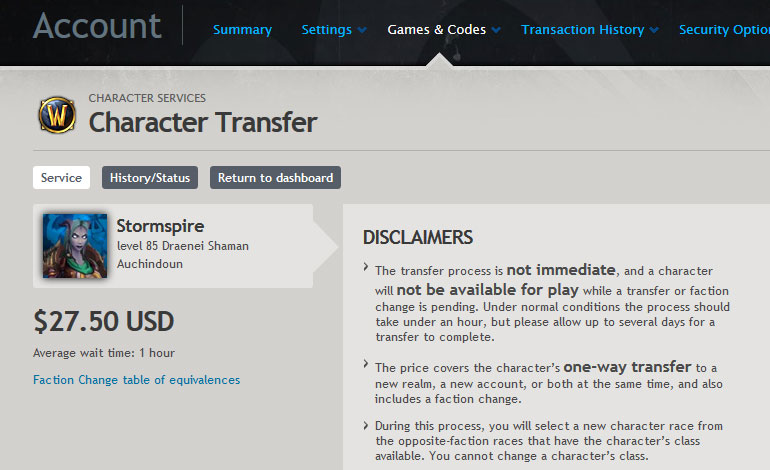
Still has a 50,000g transfer cap, unfortunately.
The prices break down as follows:
- Server Transfer = $12.50
- Faction Transfer = $15.00
- Server + Faction Transfer = $27.50
- Name/Appearance Change = $7.50
- Race Change = $12.50
If there is not a clearer sign that Blizzard believes WoW still exists as luxury entertainment on a level all to its own, I don’t know what it is. Well, you know, beyond the fact that as absurd as these prices appear to be, given the proper distance from the game, they are normally 50% higher.
I mean… Christ. Is this the same MMO that lost 1.3 million subscribers last quarter? That’s a rhetorical question because of course it is. Otherwise Blizzard would have no cause to not still charge people $25/$55 to move off dead realms Blizzard kills with extreme negligence.
In other news, I just bought EVE Online for $4.98 on Steam. You know, for a rainy day.
Hope Springs Eternal
(This is followup to my In Defense of Used Games post.)
I believe that eventually we will see the resell of game licenses. Given how our present trajectory is clearly in favor of restrictive limited licenses, games-as-services, and exclusive accounts everywhere, from whence does this optimism spring? Basically, it springs from what I imagine to be an inevitable reconciliation between what is legal and what consumers see as reasonable and/or how they play games in the real world.
I am going to divide this model into roughly two parts: the Practical and the Legal.
The Practical Disconnect
There is an incredible disconnect between what companies write in their ToS/EULAs and how people actually use the products in question. In fact, even the question of what amounts to game piracy is not as clear-cut as you might think. If you download the Tomb Raider reboot off of Pirate Bay, that is clearly piracy, sure. But suppose you let your little brother play the copy that you legally purchased. Is that piracy? Instead of it being a family member, suppose you let a friend come over and play it. Is that (still) piracy? What if you let a complete stranger play your copy of the game?
Now suppose this copy of Tomb Raider in question was purchased on Steam. Does that change anything at the family/friend/stranger level? It does:
“When you complete Steam’s registration process, you create a Steam account (“Account”). Your Account may also include billing information you provide to Valve for the purchase of Subscriptions. You are solely responsible for all activity on your Account and for the security of your computer system. You may not reveal, share or otherwise allow others to use your password or Account. You agree that you are personally responsible for the use of your password and Account and for all of the communication and activity on Steam that results from use of your login name and password. You may not sell or charge others for the right to use your Account, or otherwise transfer your Account, nor may you sell, charge others for the right to use, or transfer any Subscriptions other than if and as expressly permitted by this Agreement (including any Subscription Terms or Rules of Use).”
In our all-digital future, everything is tied to accounts. Ostensively, account-sharing is a bannable offense. In fact, if Valve suspects you shared or sold a given Steam account, it will ban all accounts in your possession, even if nothing untoward was happening in the others. And yet the problem with account-sharing is that it shouldn’t actually be any company’s business who is sitting in the chair, behind the keyboard/controller. I mean, it is technically their business – because they say it is – but it shouldn’t be.
I am not playing WoW right now, despite having multiple level-capped characters and a large sum of gold doing no good to anyone. If I resubscribed and started playing again, Blizzard would be happy. If I resubscribed and let a friend play my character, Blizzard would still be happy… up until the moment they realized what I was doing. But provided we did not alternate log-ins from multiple IP addresses or whatever, there is really no way for Blizzard to tell the difference between us. And yet that is “illegal.” Why? Because presumably the threat of account closure is supposed to induce the friend to purchase their own account/expansions/etc and work their way from scratch.
If letting friends and family members play your games does not count as piracy, neither should letting them log onto your account(s). Indeed, the only way the company would be able to ascertain a difference between users is with intrusive biometric privacy measures like… an always-on IR camera powerful enough to measure your heart rate via body heat to ensure only the True Owner ™ utilizes the account. Otherwise, these measures simply fail unless you attempt to log in from two places simultaneously. These companies are writing rules and contractual terms they have no means of enforcing outside the most heinous of nightmare scenarios. Or, I guess the Honor System.
Perhaps you do believe that your little brother playing your copy of Tomb Raider counts as piracy. In which case I have two questions: 1) why haven’t you turned yourself in, and 2) how far does that really go? Is it piracy for him to watch you play? Or is the crime committed only when he touches the controller? What if it is a strategy game in which he tells you what moves to make, and you simply act as his inputs? Still probably worth a $150,000 fine, wouldn’t you agree?
If companies could go this far, they would. That is the copyright endgame: the limitation of the experience to a single, paying mind. Thankfully, they lack the ability to dictate what happens in the privacy of our homes. Except, you know, for all the times that they can.
The Legal Aspect
In his rebuttal to me, Tobold linked an article in regards to US courts ruling against First Sale doctrine applying to digital goods. The article includes the following passage:
“Notably, the ReDigi case turned in large part on the same phrase at issue in Kirtsaeng—whether the copies at issue were “lawfully made” under [the Copyright Act]. In ReDigi, the court held they were not. “The first sale doctrine does not protect ReDigi’s distribution of Capitol’s copyrighted works,” Sullivan held, because the files at issue are “unlawful reproductions” and therefore not “lawfully made.” And, also like Kirtsaeng, the court said the proper venue to decide the core issue—whether buyers of digital products can resell them—is Congress.
“ReDigi effectively requests that the Court amend the [the Copyright Act] to achieve ReDigi’s broader policy goals—goals that happen to advance ReDigi’s economic interests,” Sullivan observed, adding that “amendment of the Copyright Act in line with ReDigi’s proposal is a legislative prerogative that courts are unauthorized and ill-suited to attempt.”
If you haven’t been following the ReDigi case, you really should take a look. Spoiler alert though: ReDigi lost back in April, but is appealing.
The hinge of the case was that even though ReDigi’s process involved removing the music file from the original computer, technically ReDigi was still “creating” a copy on their own servers by virtue of the transfer process. That was the entire hang-up, or more accurately, the technicality. Even Google tried to get involved in the case by coming to the defense of ReDigi, arguing a judgment against ReDigi “would put the entire cloud computing industry, worth an estimated 41 billion dollars, at risk.”
Incidentally, as pointed out in the concluding paragraphs of the same article:
To make his point, Sullivan stressed that the first sale doctrine does still protect the ability to resell digital music—you can still sell your “computer hard disk, iPod, or other memory device” onto which the file was originally downloaded, he wrote. While conceding that practice might prove to be “onerous,” he suggested there may also be reasons why such “physical limitations” are desirable. “It is left to Congress, and not this Court,” he concluded “to deem them outmoded.”
In other words, you can resell your digital music, as long as you originally downloaded them onto, I dunno, say a $6 MicroSD card. Or a $2-$5 USB stick (which are 1gb in size… Jesus, time flies). Preferably we could cut the bullshit and just print the CD/DVDs ourselves, but I imagine there is no direct-to-CD argument that can be made, else they would have made it.
The salient point here is that the current system is, at best, untenable. As more and more aspects of our lives migrate more fully into the digital realm, Congress will revisit this subject again. Honestly, they really should not have to – it would be better for everyone involved if companies came to this voluntarily. Hell, I have been shitting on the Xbox One pretty often, but Microsoft is apparently putting in a “used digital game” framework, in some murky form or another. It would be the height of irony if Microsoft ended up starting a revolution in the same way that Steam made digital games mainstream. Both Apple and Amazon have patented second-hand digital marketplaces, by the way, but have yet to actually do anything with them.
Some people get the impression that I am anti-IP, or that I am antagonistic to copyright. That is not really the case, although I do believe “life of author + 70 years” is absurd welfare for corporate rent-seekers rather than to the actual benefit of society, e.g. the entire original purpose of copyright. I mean, are there really artists out there that would look at something like Life + 5 years and go “fuck it, I’m not going to bother”? Give me a break.
Anyway, what I desire is for the designers to partner with consumers, for all of us to cooperate for the common good. I don’t like GameStop any more than game designers do – they really are just parasitic middleman – but only one of those two parties actually make efforts to improve consumer surplus, even if it’s just by accident. And if there was any enduring message that came out of the wild internet heyday, it is that you Can’t Stop the Signal. Revenue models are going to have to change, whether you like it or not. If game designers want a piece of the the new paradigm, they have every opportunity to get aboard the train.
In Defense of Used Games
I have talked about used games before. I am going to talk about them again, as a rebuttal against this video from Total Biscuit regarding how he justifies his belief that used games are bad.
Before I start, there is one fundamental truth that needs to be acknowledged: a used game sale is a new game sale at a lower price-point. No one is seeking out used games because they are used, they are sought because they are less expensive. Incidentally, this same principal applies if someone is able to re-sell a game they bought, as the ability to recoup part of the cost means the original purchase becomes less expensive.
Without further ado, let me examine each of TB’s arguments against used games:
1) Used Game Sales support shady/pushy retailers
Or, the GAME (in UK) and GameStop Are Bad argument.
It is absolutely true that retailers who specialize in used game sales push used games sales over new ones; the original sale is a recouping of an investment for the store, whereas each additional resell is nearly pure profit. I am not interested in defending the practices of GameStop (etc) though, primarily because it is irrelevant and red herring besides. No matter how much you swing the “games as licenses” argument, the fact remains that used game sales are legal in the United States and presumably elsewhere – GAME and GameStop would have been sued into the ground otherwise. The shadiness of any organization does not reflect on the product they provide. You can picket Wal-mart for all sorts of legitimate reasons, but that does not make cheap groceries immoral.
I have gone into a GameStop all of twice in my life, whereas I frequented a mom-and-pop used game shop next to the local theater for the better part of a decade. I went there because their used games were cheaper, and you received more store credit (or cash) than GameStop provided, all in a no-pressure sale environment. Ergo, any argument that uses the removal of used games as a vehicle to attack a retailer you don’t like is simply ridiculous. GameStop’s practices have nothing to do with the “question” of used games, as there are alternative stores which do not behave in similar fashion.
2) Used games do not depreciate
This honestly reminds me of the “you wouldn’t download a car” PSA. Even if we take this claim on face value… so what? Is the argument supposed to be that used game sales would have been fine if the AI started glitching out on its own five years from now?
To be charitable, I am going to assume instead that people are referring to how physical depreciation of goods naturally differentiates two otherwise identical products, potentially justifying the premium on the unused version. In which case, I’d argue that something similar already occurs even in purely digital products.
Videogames are not released in a vacuum – they are always a product of their times. While the actual data bits do not decay, the value and meaning of them in the mind of a player certainly can. There are whole classes of videogames that I literally cannot bring myself to play anymore, because the graphics are too primitive, or the resolution too low, and so on. Innovation in mechanics or design can render older titles feeling stilted or slow, even though nothing in the original game itself has changed. Some games hold up better than others, of course, and many older games are arguably better than new titles. But on a certain base level, videogames do depreciate, if not literally then culturally.
If you do not find this counter-argument particularly compelling, that’s fine, but allow me to make two final observations. First, no one expects a game to remain $59.99 two, three, four years after release. If games do not depreciate in value, why do you think we see the companies themselves reduce the price? Second, how much do you think your unopened City of Heroes or Battlefield 2 box will go for these days?
3) Music and Film industries are less harmed by secondary sales
TB’s point here is a roundabout justification for how videogames are a special case when it comes to secondary sales, despite music and movies also being digital goods without depreciation. Buying used movies is less harmful to studios, he argues, because a particular film can make the bulk of its money in the theater, followed by Pay-Per-View, DVD sales, rentals, and finally syndication on TV networks. Similarly, music artists get the bulk of their profits from concert tickets, in addition to (small) payments from streaming services and finally the default CD sales. In other words, music and movies have multiple revenue streams whereas videogames have just the one.
To which I must ask: whose fault is that?
As a consumer, you are not responsible for a company’s business model. It is perfectly fine to want the developers to be paid for their work, or to wish the company continued success. But presuming some sort of moral imperative on the part of the consumer is not only impossible, it’s also intellectually dishonest. You and I have no control over how a game company is run, how much they pay their staff, what business terms they ink, or how they run their company. Nobody asked EA to spend $300+ million on SWTOR. Nobody told Curt Schilling to run 38 Studios into the ground. Literally nobody wanted THQ to make the tablet that bankrupted the studio.
What is worse though is the implicit moral superiority that is derived for buying “legit.” If game companies and their designers deserve to be paid, and we have some moral obligation to do so, doesn’t that mean they deserve ALL the money? I cannot even begin to imagine the mental gymnastics Total Biscuit had to perform when he denigrated used games and celebrated Steam sales in the same breath. When you buy a game for 75% off, that is you robbing the game company of 75% of the money they deserve. Not even deserve, really, considering by many metrics they are entitled to much, much more than the purchase price given the total amount of enjoyment derived.
That sounds absurd, and it is, but that is my point; you cannot make the moral imperative argument and only go halfway. A company either deserves $59.99 or they don’t. Alternatively, you are not responsible for their business models at all, and are fully justified in maximizing your consumer surplus, e.g. by waiting for sales, buying used, etc. It is noble to wish these designers success, at least when such nobility is followed-up with busting out your checkbook. Otherwise, it is so many empty words.
4) Once used games are removed, games will be cheaper
No, seriously, Total Biscuit actually said this, presumably with a straight face.
Why in god’s name would anyone rationally assume that the removal of competition (in the form of secondary sales) would force or even encourage game prices to decrease? Everyone keeps pointing to Steam with its effects on PC gaming, as if Steam weren’t the exception that proved the rule. Everyone acknowledges that used games on the PC haven’t existed for quite some time, but no one seems to follow-up that thought with what should have been an obvious question to ask: were there big discounts on PC games back before Steam?
Good lord, no! You were at the complete mercy of retailers who almost never marked anything down from MSRP. And why would they? You literally could not buy these games anywhere else. If you found a good deal, it was likely because nobody was buying that game and the store wanted to liquidate their stock. Outside of fire sales, there was/is always going to be resistance from retailers over discounting a game’s price because there is a minimum cost involved with pressing a DVD, shipping it across the country, unloading it in the back, and paying people to sort and shelve it.
Incidentally, this is another reason why I don’t think future console games will be cheaper: there will still be hard copies sold. Do you think retailers would let Microsoft sell Halo 6 for $40 online and $59.99 in stores? Of course, there is a pseudo-analog that exists right now between PC vs digital download games, with things wildly alternating for no apparent reason. For example, it’s somehow $20 cheaper Amazon to ship me DVD of Bioshock Infinite than it is to download a copy of it. Or maybe that does make sense, insofar as what I explained earlier about retailers trying to liquidate stock.
If you legitimately believe Xbox One games are going to be cheaper, let me ask you two things. First, what kind of deals have you seen on XBLA titles? Similar in size, scope, and frequency to Steam sales? Microsoft has already dabbled in digital games for which no secondary sales exist, so their pricing behavior now may reflect any potential behavior in the future. Second, what kind of deals have you seen on Origin in the last, I dunno, two years? There have been a few recently, but very rarely more than 50%, and they are not nearly on a scale as Steam. That is a publisher who has as near a 100% profit margin on every digital sale as possible, and even they are not willing to compete on price with retailers who sell game codes on EA’s own platform!
The point here is that Steam is the exception that proves the rule. I bought Tomb Raider on the PC for $20 a mere three months – three months – after its $49.99 release. Granted, it was via Green Man Gaming, but it activated on Steam. Do you honestly believe that the only difference between our present console MSRP reality and a hypothetical all-digital future is the mere possibility of resell? That companies would be fine with a $30 markdown for a limited time a few months after release? Maybe. Maybe we don’t see similar sales because GameStop (etc) would buy a few pallets of discs at $20/each to sell at $40 after the sale is over. Then again, I could have done that exact same thing via GMG and just sold the activation codes. Actually… that’s not a bad idea…
Simply put, this argument requires a striking amount of faith in game publishers to work. Consumers are being asked to cede an enormous amount of implicit value, not just in resell value, but also in control over how they play these games (tied to accounts, phone home every 24 hours, no borrowing, etc). We are asked to cede these values all in the hopes that companies like Microsoft will not simply keep charging $59.99 out of… well, out of the goodness of their hearts. That is not enough for me. There is certainly every economic incentive to keep things running business-as-usual, after all.
5) Used games cost the companies money in terms of support/servers.
It is true that game companies “must” provide support to even non-paying (i.e. used game) customers in a way that movie and music companies do not. However, there are two things wrong with the argument TB is presenting. First, it sort of assumes that the game was not worth playing for very long in the first place. Total Biscuit’s example was how a company would need to provide support to a gamer for two months, and then a new player who bought the copy from the first guy for another two months, and a third person, and so on. The difference between that scenario and one guy who plays continuously for 6+ months is… what?
Total Biscuit’s second point about non-payers in multiplayer (presumably driving up bandwidth costs or whatever) caused me to facepalm IRL. Maybe he has never heard about why the Free-2-Play model works, or more importantly how it works? Someone playing the latest Call of Duty secondhand is providing content to “legitimate” players in a way that a no-longer-playing gamer by definition is not. I mean, that’s the premise of the argument, right? That the first dude sold his game, and is now an empty seat in a lobby somewhere. You do not even need to have the full F2P development plan set up to appreciate the fact that an extra body is making your multiplayer experience that much more worthwhile when it otherwise could/would have been nobody.
Summation
As I pointed out in the beginning, let me point out again: used game sales are new game sales at a lower price point. Nothing is stopping companies from lowering the prices for their games and otherwise being more competitive with used games. You might think that used game prices would simply adjust to compensate, and maybe they would, but that is an argument against selling at anything less than full MSRP, ever. Which is clearly ridiculous.
In any case, time marches on. Even though I see this forceful transition into all-digital games as a net-negative for gamers (and it is), I am obviously not against digital platforms themselves. I am just a bit miffed that the transition is being accelerated by Microsoft (etc) before the question on the transferability of licenses is fully settled, at least in US law. Believe me, the day will come when we shall be able to buy a Steam game (license) and then sell it to someone else after we are done.
At which point I’m sure the suits will pine for the days when it was at least possible for someone to lose their disc.
Edit: Removed incorrect “et tal” usage. Thanks, Tobold.
PlanetSided
PlanetSide 2 continues to be a part of my daily gaming routine. It’s a tough game to nail down though, balanced as precariously as it is between FPS and “MMO.” Battlefield 3 is probably the better shooter, and certainly can be paced better, but there are moments in the epic firefights of Ps2 that simply cannot be replicated in any other FPS that I have played.
Flying around in one of the “jets” is how I usually start any play session. Sometimes – more often than I like to admit – I die within a minute of taking off. Since my timer on the jet is 8 minutes long (I spent some Certs to bring it down from 15), I usually try and spawn at some sort of hotspot, hopefully in an already-filled platoon. Sometimes that is enough for the rest of the night. Other times we either win or are pushed back, and it becomes difficult to tell where to go afterwards. If I am more than 5 minutes away from any sort of action, I usually just log off.
I inadvertantly joined an Outfit (aka guild) a few weeks ago during the Double XP weekend. During that time, the coordination resulted in Certs raining from the sky and was pretty awesome. Other times… well. To be quite honest, actual coordinated “fights” in Ps2 are pretty boring. It is like running around in premades in WoW BGs: a lot of time spent rolling over a handful of randoms, while actively avoiding other premades. Capping empty, undefended bases is about the most boring thing you can imagine. At the end of the night, you have “claimed” territory that is fairly irrelevant to your gameplay the next day, barely getting the equivalent of 2-3 kills worth of XP per base. I caught myself thinking “I should have been doing daily quests in WoW instead” the other night.
That’s the macro view. On the micro view, I’m having tons of fun in the actual shooting.
For the longest time, I was stuck in a limbo zone of wanting to buy a new gun, but wanting it to go on sale first. About a week ago I finally buckled down and bought my Engineer (some guns can only be used by certain classes) the Solstice SF, which is basically a slightly-worse default gun… with the possibility of an under-barrel grenade launcher. It cost 700 Station Cash, i.e. $7, or technically $2.33 since all my Station Cash came from a Triple SC day.
I have an extremely hard time justifying purchasing anything in F2P games as I end up second-guessing everything. “Do I really need this gun?” “Remember that one time you threw down money on a F2P/DLC purchase and then quit the game two days later?” “Will I even be playing this game 2-3 weeks from now?” It is kind of a vicious cycle, or perhaps more of a self-filling prophecy – the longer I deny myself fun, the more likely it is that I quit playing. It is not as though I even need to be so miserly with my IRL money, I just derive zero pleasure from spending money on non-deals. It’s why I can have hundreds of dollars in Steam purchases for games I have never played, but waffle for weeks on a cash shop purchase for a game I’ve got 51 hours into and counting. My hesitation is actually even dumber than that, considering the SC was already bought and paid for months ago; why I cannot see the $30 as being a box purchase of Ps2 instead of dollars I can hoard instead is beyond me.
But, yeah. Otherwise, I am having inordinate amounts of fun in the jets, and now sitting on my own engineer’s ammo boxes shooting endless grenades at my foes. Now all SOE has to do is stop releasing patches that drop framerates.
Bugs
As you may have noted along the sidebar, I am “playing” the original Crysis on and off. The scare-quotes are there because the game itself is borderline unplayable with all the bugs and crashes I have been experiencing. For as much as I love Steam and try to get 100% of my PC gaming through it, I am finding it increasingly asinine how little support Steam offers for the very games it sells. Generally speaking, if the game is more than 5 years old, I don’t even bother trying to install it before checking out the forums first; luckily, most of the first page is usually filled with similar customers in dire need of tech support as all of us stumble in the dark together.
I give games like the original Borderlands a pass – despite needing to download a swath of mods to make it less of a brain-dead console port – because that was how the game was designed. With Crysis though? The goddamn game crashes 100% of the time when you try and change any of the settings. If I alt-tab out of the game, it automatically switches to windowed mode, with no way to go back to full-screen without crashing the game. And it’s buggy even inside the game too; I was stuck for over an hour before I realized that the Objectives not updating was a bug and not me missing some sort of programming trigger (which would still be stupid).
I get that computers are hard, what with all the potential variations in hardware and software. But, seriously, some of this shit needs to be bundled with the download of the game itself.
Post-Ownership
I am a big fan of digital games. In fact, I am having a difficult time remembering the last actually physical game I have purchased. The Greatest Hits version of Final Fantasy XII (still shrink-wrapped)? Or… yeah, probably Fallout 3 for PC – unless Wrath of the Lich King counts, anyway. As you can imagine, I skipped this entire console cycle and plan to continue holding out until I at least see if the Xbox 720 and PS4 are going to be backwards compatible.
At first, my purchasing habits were driven more by pragmatism than anything else. With the exclusion of a ridiculous find of Fallout 1 & 2 bundled for $15 and Planescape: Torment bundled similarly at a Media Play (anyone remember those?), computer games had always seemed stuck in the realm of permanent MSRP or mislabeled bargain bin treasure. Meanwhile, the local used game dealership offered a nice selection of $25 titles that you could eventually turn around sell back for $10 or so. Between the cheaper games and the likelihood of four-player split-screen shenanigans, there really was no contest.
Then… Steam happened. And cable internet. And WoW too.
Over time, I realized I no longer felt the need to “own” my games anymore. Keeping track of all the cartridges and discs started being a chore, and god help you if you misplaced the registration code for a PC game that you still actually had the disc(s) for. If legally all we are buying is a license instead of an actual good, then why could I not play Diablo 2 for a three-month period when I couldn’t find the case? Between that nonsense and how frequently I found myself downloading no-CD cracks for games I bought, it was really just a matter of time until I started eschewing gaming packaging altogether if I could help it.
What brought all this up to me again is that I am moving to a new apartment this week. While rummaging around in long-forgotten closets, I came across my NES and SNES collections; the wave of nostalgia nearly rendered me unconscious. While I did act on the daydream of plugging the consoles back up in college one time, these pieces of electronics haven’t otherwise seen the light of day for almost a decade. Was I really going to pack them up and move them to a closet in the new place? Would my theoretical future child have the slightest bit of interest in daddy’s ancient consoles in 2020’s era of (mobile) games? Hell, would these things still even work?
Holding onto the Chrono Trigger and Super Metroid and Secret of Mana cartridges impacted me more than I thought it would, even as I was cataloging their condition to sell to a website. It is pretty well understood how ownership of a physical good can influence your perception of its value, so that should not have been a surprise to me. However, I could not help but think: in a post-ownership world, is anyone going to feel this way again?
Maybe our kids still will. After all, I never held onto a Mass Effect disc, but still choked up a bit after uninstalling. A digital version isn’t the same as holding onto a piece of plastic that has been in your life for 20 years, but… well, it will likely be easier to play again than any of my N64 games which are permanently MIA.
P.S. The website I am using is DKOldies.com, whose prices seem pretty reasonable. If you know of a better place, by all means let me know – I simply don’t have the interest in playing the eBay game when I could ship everything to a single location
 In An Age
Xbox One Eighty
Jun 20
Posted by Azuriel
I take no credit for either the title nor the picture:
Sort of like SimCity’s “cloud computing.”
If you had not already felt the Earth’s sudden wobble from the magnitude of Microsoft’s about-face, allow me the pleasure of informing you: the Xbox One no longer has its ridiculous DRM. Namely:
One of the “casualties” of this Lance Armstrong-level backpedaling is that you can’t have that whole “10-person family sharing” plan or the ability to “take your games anywhere by logging in.” Often lost amongst the Apologist tears though was the simple fact that logging on from a friend’s Xbox One basically meant you would have had to wait for a 10+ GB download before playing anyway. And what were the odds that more than one member of the family could play the same game at the same time? In other words, you are not any worse off than the present system of just taking the disc with you.
Plus, you know, used games.
On a semi-related bit of interesting news, apparently Valve snuck some interesting code into the Steam software: shared libraries, e.g. lending digital games. Obviously nothing is formally implemented yet, but the premise seems to be that once you lend a game to a friend, they can play it until you log on to play it yourself (which then bumps them off). Which is… pretty remarkably clever if you think about it. Valve could just as easily went the other way, where you couldn’t play until your friend “gave it back,” which would probably discourage people from using the feature at all. Assuming there is no transaction fee or anything, I would feel comfortable giving one or two of my Steam buddies access to everything.
Regardless of which way the shared library plays out – if it plays out at all – today was a huge win for consumers everywhere. I am not quite ready to declare victory yet, but the future sure is looking considerably brighter than it was, oh, two weeks ago, eh?
Posted in Commentary
1 Comment
Tags: About-Face, Consumers, Digital Gaming, Microsoft, Rights, Steam, Used Games, Valve, Xbox One