Anime Update
It’s been a while, but the follow anime have micro-reviews up:
I usually don’t bother with screenshots while watching a show, but I made a few exceptions:
#goodanimeadvice
This shouldn’t have been as funny as it was.
Finally, here are two more from the moments when toothbrushes and staplers were changed forever:
I… I don’t even…

Holy shit!
If you want context, you’ll have to watch the show(s)!
Worst of All Worlds
A few days ago Tobold made what seemed to be a reasonable argument that F2P games are just like cell phone plans – some plans work better than others depending on how much you use the phone. That seems fine, until you realize that phone carriers typically give you a choice between subscriptions and buying minutes, even for the same phone model. But more than that, what I want to talk about is how/why I feel that F2P is always bad for me as a player.
I’m one of those people that derive pleasure from “optimizing the fun out of games.” Of course, I don’t actually see it as fun reduction at all; if anything, I get the most entertainment possible when I can lever the whole of my mind in opposition to the game designer. It is not that I want to discover the ultimate ability/gear combo to make the game trivial (most games have cheat codes, Save file hacks, etc), it is that I want the game to be difficult or deep enough to drive me to discover it using the tools the designer gave me. The optimization part is simply the nominal destination of a thoroughly engaging and fun journey getting there.
This brings me (back) to the topic of F2P. One of the common defenses of F2P is that it evens the playing field between the time-rich and the people with limited time. Frankly, I feel that is bullshit right off the bat. One of the hallmarks of a fair game is everyone playing by consistent rules – if I have to kill 1000 boars, everyone has to kill 1000 boars. If killing that many boars takes 15 hours, then yes, someone who can spent 15 hours a day playing the game will have an “advantage” over someone who can only play two hours.¹ Then again, a particularly skillful player might be able to figure out how to kill the required number of boars in only 10 hours, perhaps by optimizing his/her equipment, farming strategy, and/or ability rotation. The “time-rich” player might still have the “advantage,” but their brute-force approach is inefficient.
The typical F2P experience is thus the worst of all possible worlds for players like myself. I am both time and money “rich” (i.e. I have disposable income), which already presents uncomfortable gaming decisions on a daily basis. If you have no money or no time, the solution to any F2P problem is pretty obvious: grind it out or pay to skip the grind. Conversely, those of us who can do both are stuck rationalizing every possible decision all the time. “Do I grind for another 2 hours, or do I just spend the $5?” Maybe the default should be pay-to-skip in that scenario, but what about all the other games you could be purchasing with that same $5? Is “saving” two hours in one game worth purchasing a different game that could last you 20 hours by itself?
The real kicker though is the fact that F2P more or less invalidates any real sense of optimization. All of us already know that the most efficient move in a F2P game is to load up on XP potions, convert cash into in-game currency to clean out the AH, and open lockboxes all day until we have everything of any value. There is no possible way to beat that. “Just figure out the most efficient path without spending money.” Playing with an artificial handicap is simply not as engaging to me. You can technically increase the difficulty of a FPS by decreasing your mouse sensitivity, but that will never feel as satisfying as having more intelligent opponents.
Where I agree with Tobold is that F2P is here to stay. Outside of the CoDs and Battlefields and Counter-Strikes of the world, I’m not sure many multiplayer games could exist on their own in sustainable numbers. Astute readers will also know that I have been playing PlanetSide 2 for 230+ hours now and that’s a F2P game. Then again, I also spent over $100 in Ps2 thus far, including being “subscribed” for the last six consecutive months (efficiency, yo). Not to mention how I bought helmets and camo for my characters almost entirely because of the extremely slight advantage that they bring (arguably P2W).
I am not against F2P games on principal, it’s just that they quite literally cannot be as fun to me as they could be. I play these games to submerge myself in their fiction. Being constantly reminded that for the low, low price of $4.99 I could have X, Y, and Z not only breaks the immersion and puts a price tag on my hitherto priceless time, it also serves as a reminder that the solution to every problem is just a credit card away.
¹ Advantage is in scare-quotes because I don’t recognize an advantage as being “playing the same game more.”
Maybe not so indie after all…
One of the points I made yesterday regarding Card Hunter’s potential was:
1) Card Hunter is not being made by some large corporation (even if their F2P pricing is similar);
It occurred to me later though, that I never bothered to check on the actual game developers. Who are these guys and gals, and how were they able to create such a polished experience even in this Beta state? As it turns out… well, let’s just say that they have some experience in this regard:
- Jonathan Chey – co-founder of Irrational Games, director of Bioshock, producer of System Shock 2.
- Joe McDonagh – Production Director and Peggle Studio Franchise Director at PopCap Games.
- Dorian Hart – Veteran at Irrational Games; worked on System Shock I and II, Thief and BioShock.
- Tess Snider – from Trion Worlds, programmed Rift.
- Kevin Kulp – DM/game designer, worked at Wizards of the Coast, Green Ronin, and other places.
- Richard Garfield – Design consultant. Created Magic: The Gathering.
- Skaff Elias – Design consultant. Magic designer and founder of the Magic pro-tour.
So… yeah. Maybe this team isn’t so indie after all. I mean, when you have Richard fucking Garfield as a design consultant for your pseudo-TCG, that almost feels like cheating. Then again, I’m not particularly interested in having a hipster semantic war. Seven dudes with two consultants and no major publisher with suits to answer to? That passes the indie smell test for me.
P.S. For those just submitting their beta applications, it took me from May 11 to Jun 20 to get in.
Card Hunter’s F2P, Multiplayer, and Potential
Let’s get started.
Multiplayer
As strong as the campaign mode is right now, Card Hunter’s multiplayer is probably going to provide the “long-tail” revenue for the game. Because by “multiplayer,” what they really mean is PvP. The basic setup is pretty simple: your three characters against their three characters in 20-minute matches. Every map I have seen thus far includes Victory Squares (+1 Victory Point per turn that you control it) as well, so the games do not necessarily devolve into simple death-match.
There are some pretty big incentives to give multiplayer a try, even if you aren’t necessarily into that sort of direct competition. Winning your first multiplayer match of the day grants you a chest that has a guaranteed Rare drop, for instance – plus another Rare item if you have a subscription. The reward path after that extends outwards to special Rare chests at 3rd, 7th, 12th, and finally an Epic chest at #20.
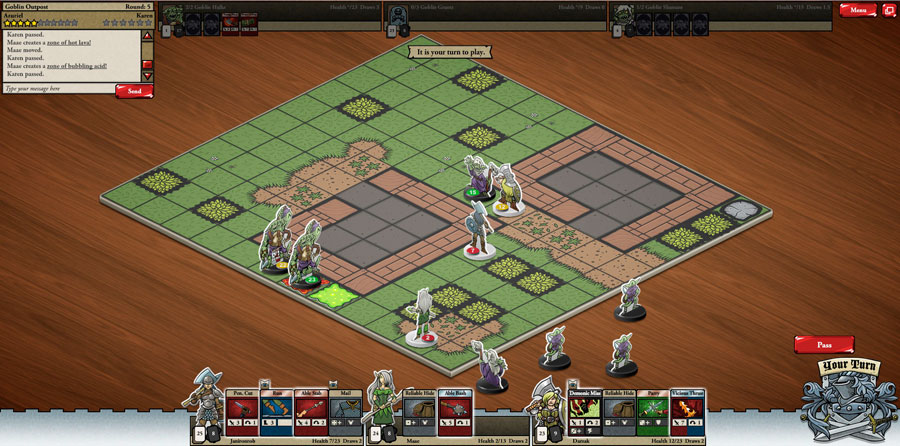
Pictured: Not Multiplayer, just a tactical genius at work.
A particularly clever move on the dev’s part – aside from the subtle push into subscriptions to double your guaranteed rewards – is the fact that if no one is available to play against (at your MMR), you will automatically get into a match against the computer. Which, trust me on this, just as brutal in MP as it is in the normal campaign. Which is awesome.
The downside to multiplayer is the downside to multiplayer everywhere: other people. I have only faced one human opponent thus far and he/she was a perfect gentleman/lady, but the beta forums are awash with concern over how to handle players who intentionally drag out games in attempts to win via boredom. Since the queue time for games visibly increases based on MMR, this is a particularly apt concern. The solution seems to be heading towards a progressively shorter turn timer (2 min, 1 min, 30 seconds) based on a player hitting certain limits, but I’m not entirely sure the full scope of player metagame malevolence is being appreciated here. Unless the triggers are invisible, why not wait until [Trigger – 1 second] to play your card? You know, other than to avoid being an asshole?
It is also worth mentioning that, given Card Hunter is a game about hunting for cards, you will also encounter other people with way better cards than you. The MMR should help with things a bit, but some of your matches are going to suck enormously when your mad tactical skillz are thwarted by a rich moron buoyed up to your MMR by the power of their cards. Speaking of which…
F2P
In talking about Card Hunter’s F2P scheme, there is really only two things to note.
First, my (beta) experience thus far as a non-paying customer has been fantastic. Based on what I have seen, I do not think there is really a paywall or some necessary purchase you cannot do without. Given the game’s incredible difficulty, you might feel tempted to purchase a few bonus chests or otherwise acquire more loot earlier in the game (when you are more restricted by random drops) though. While it is possible this could change as I enter the “endgame” (my party is level 11ish at the moment), it would very much surprise me.
The second thing is that just because you don’t have to spend money in a F2P to have fun, that doesn’t mean that you will get a good value for your money if you do spend. This is, unfortunately, the state I see Card Hunter’s cash shop in right now.
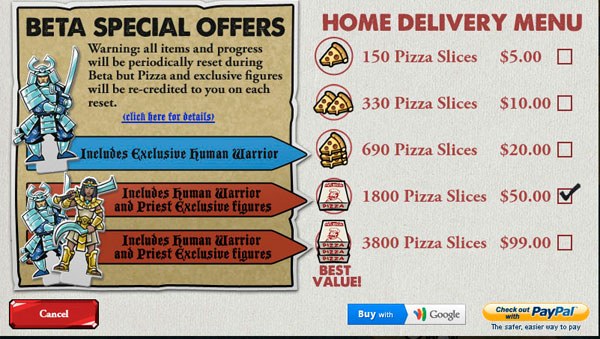
To illustrate the issue, let’s start with the cash shop currency page:
/sigh
I will ignore, with difficulty, the fact that there is a $99 option for the cash shop currency. I mean, I guess a 12-month subscription to an MMO would run $180 before discounts and such. But seeing the “best value” option set at $99 tells me that the devs are either A) incredibly optimistic, or B) setting up the game to make make one hundred dollar purchases of things attractive to players.
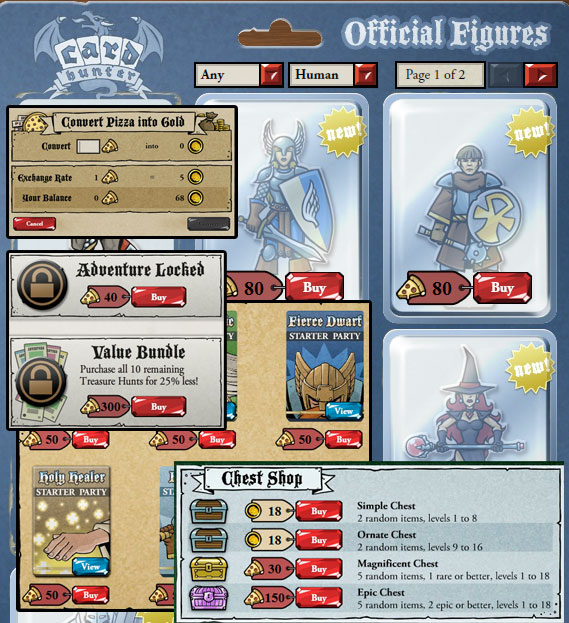
Gut reactions aside, a better metric of the F2P Evilness Scale is to look at the lower end of things. The minimum buy-in is $5, for example, which raises an eyebrow. What exactly can I purchase with $5? Well…
/double-sigh
So we have “cosmetic” options which are really just new figurines altogether. Do note though, that purchasing these new figures is the only way to access the other gender options for your race/class. You can purchase new Multiplayer Starter kits, which is the equivalent of a sort of theme deck in a TCG. While you can use your campaign characters in multiplayer – everyone is scaled to the same max level – the huge difference would be the quality of your starting items. There are “treasure hunt” maps which are dungeons that reward guaranteed epic items that you can purchase either individually or collectively with a discount. It wouldn’t be a F2P game without some ($5) lockboxes, of course. You can also straight-up convert leftover pizza into gold at a 5:1 ratio.
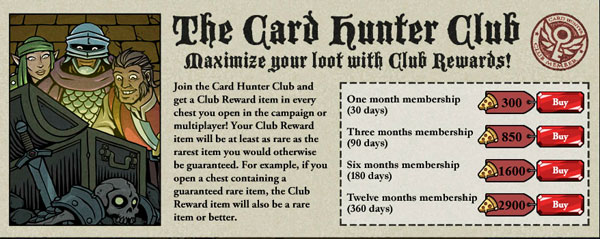
I saved the “best” for last, though. Card Hunter has a subscription option whose benefit is receiving one additional item any time you open a treasure chest. You will know about this functionality from the first map onward, because the game will show you exactly what bonus loot you are missing out on every single time. I… suppose that that is alright, in the scheme of things. It doesn’t necessary feel like cash-shop-in-your-face as some other games, even though it technically is.
*twitch*
How much do the subs costs? Basically it will be $10/month (with +30 pizza), or you can get the 3-month subscription for… err… hold on, let me break out the calculator. 850 pizza means $20 (690 pizza) + $5 (150 pizza), which leaves us 10 pizza short.
…excuse me for a second…
Are you fucking kidding me? Ten of your goddamn tokens? Don’t try and tell me that was an accident. This is some Microsoft Points level of intentionally asinine corporate bullshit. Jesus Christ, this is the sort of malicious “trick the customer” design that poisons the entire concept of F2P. If you want to charge me $23.62 for your 3-month subscription, fine, charge it. This ten-hotdogs-eight-buns nonsense has got to go.
Ahem. Where was I?
If you buy the $20 and $10 tiers, you can get the 3-month subscription with 170 pizza left over. That is enough overflow to then pick up one of the epic lockboxes (-150 pizza) and then you are left with 20 pizza… which is, of course, ten pizza away from purchasing the 30 pizza lockbox. About the only scenario that doesn’t leave you with leftover arcade tokens pizza is the $20 buy-in with the 1-month subscription + unlock of the Treasure maps + 3 of the Rare lockboxes. Which is probably alright.
Potential
With Card Hunter as it exists now, I believe most people will likely consume all that they wish to within a month, provided they play on an MMO time-scale. A month is not a bad amount of time at all, especially for how much entertainment value you get at the $0.00 price-point for a game that runs in your browser. Multiplayer might satisfy for a bit longer, but it’s tough imagining that it will provide months and months more content even for those that enjoy tactical games. After all, you will eventually get the strongest items in the game, and that will be that – it’s tough to transition from a state of eagerly anticipating a rare drop to simply having fun playing within the same game, in my experience.
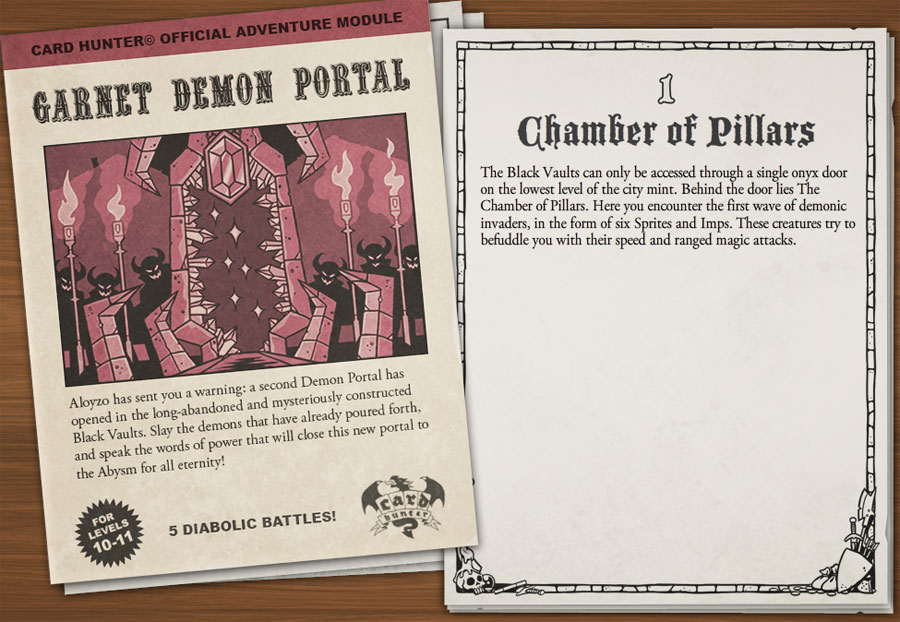
Where things could get potentially crazy is with the Custom game feature. You can, right at this moment in beta, create your own encounters for other players to try. This includes “drawing” your own map and placing monsters. I have not had a chance to dabble with it, but if anything, this is the feature that could spiral Card Hunter out (further) into a class of its own. Imagine creating your own 3-5 battle modules, complete with the sort of D&D sheet in front and pre/post-game writeups. Imagine being able to string several of those along in sequence.
*evil cackle*
Or how about going even crazier? Like instead of multiplayer being two people using their parties against each other, imagine one side controlling the monsters. Or allowing multiple players to control the same side, e.g. 3-person teams. All of a sudden, the game stops being a tactical mock-up of old-school D&D and starts being an online version of D&D.
If you are wondering why I see all this potential in Card Hunter and not in other games, the answer is pretty simple: it’s possible. Let me break it down:
- Card Hunter is not being made by some large corporation (even if their F2P pricing is similar);
- Multiplayer and custom games are already implemented;
- The graphical overhead is nil and no voice acting, making additions easy to implement;
- The game devs clearly like D&D enough to play such a great homage to it;
- Free content that players will likely pay for the privilege to make.
Make DM tools/campaign creation available with a subscription, allow user ratings to separate the wheat from the chaff, pay the successful module creators in Monopoly money pizza currency, and watch the real dollars roll in.
Bam! You’re welcome.
First Impressions: Card Hunter (beta)
I got into the Card Hunter beta last Thursday.
It is rare anymore for me to spend a lengthy amount of time playing the same game. Game developers these days front-load their daily bonuses in such a way that the most “efficient” way to maximize your playtime is to switch between 3-4 titles. And yet I spent ten hours playing Card Hunter on Saturday, and another six on Sunday. So, spoiler alert: I really like this game.
Card Hunter grabbed me from the word Go. In essence, this F2P browser-based game is a tactical, turn-based RPG where your abilities come in the form of random cards. Instead of building an entire deck on your own, a character’s game deck is actually the sum total of the cards associated with that character’s equipped items. This might sound complicated, but it is the exact opposite – after about 5 minutes of looking at the screen, the system becomes immediately grokkable and engaging. For example, here is a character sheet:
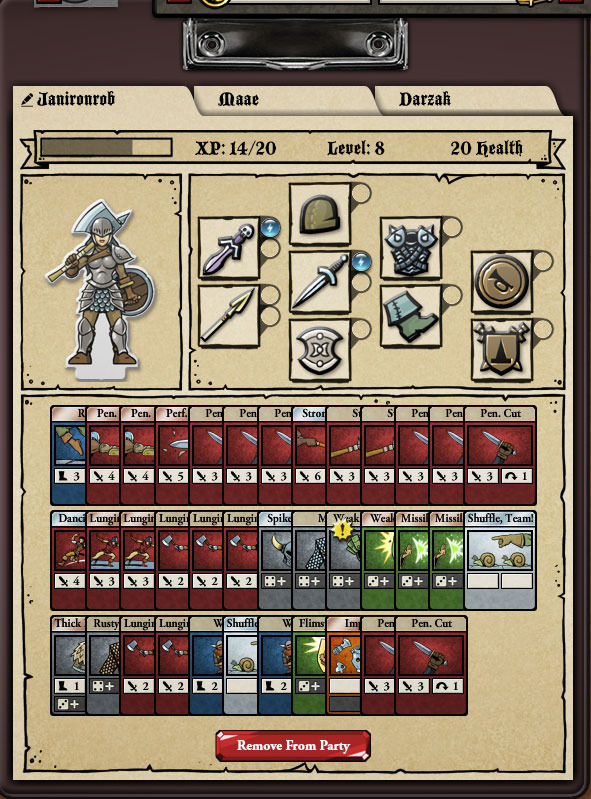
I have an immediate urge to go play right now.
All of the cards along the bottom are the sum total of the deck. When you look at a specific item…
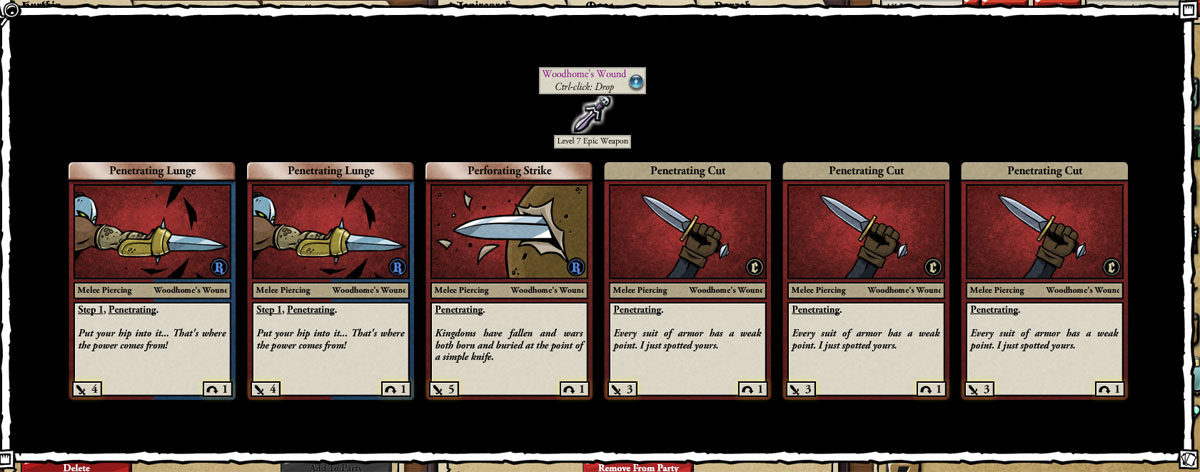
Kinda funny how it’s pretty much always going to be purple = epic from now on.
…you can see what cards it contributes to the overall deck. As you might imagine, weapons usually contribute attack cards, armor contributes armor cards, and so on. Occasionally though, you will have some items that contribute cards from outside their “theme.” Most items are limited to certain classes, of which there are three: fighter, cleric, and wizard. You can have either human, elf, or dwarf versions of any of those classes, with the differences being the typical D&D tropes; elves have low HP and fast movement, dwarves have the opposite, and humans are in the middle.
How does the game play? Fabulously.
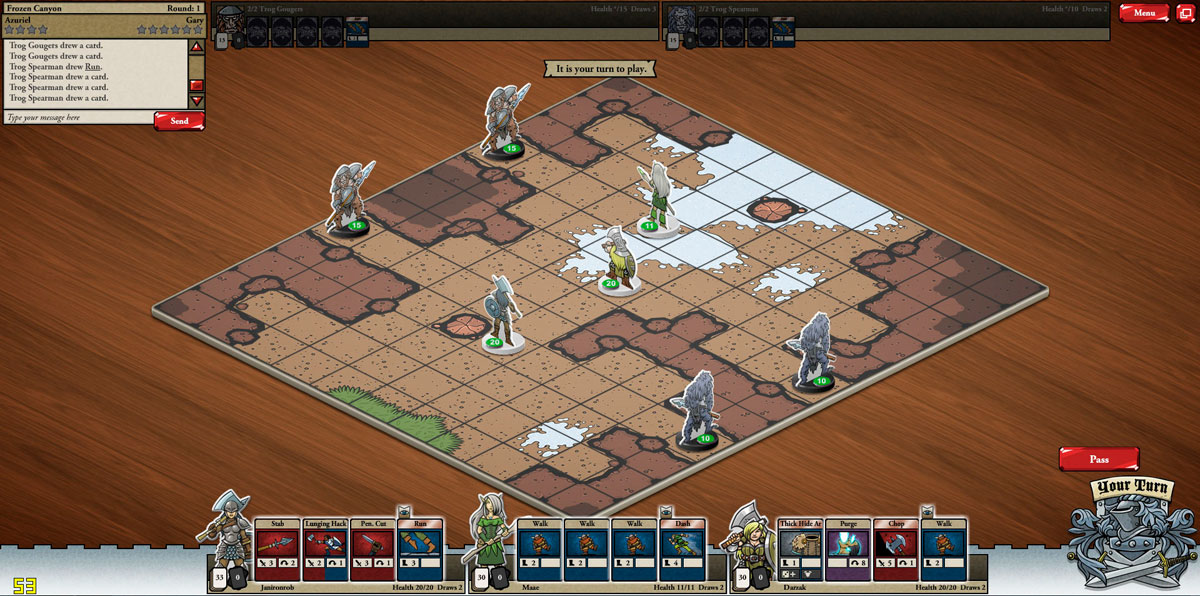
Yes. YES!
As you can see, the “setting/lore” of the game is retro-D&D, and it is adhered to from start to finish. All characters are represented with those figurines, and all the maps are exactly like this one (with different terrain and such, of course). The game’s F2P currency are slices of pizza, the battles are all prefaced with D&D-module write-ups, and there is clearly some tension going on inbetween the new DM Gary and his rules-lawyer brother Melvin in campaign mode – not to mention Gary’s awkward crush on the pizza delivery girl. Change some names around, add in two more teenagers, and Card Hunter could have described my high school D&D experience to a T.
As far as the game flow goes, it is pretty intuitive. You and your opponent take turns playing one card from any of your characters’ hands. You don’t have to alternate which character’s cards you play – if your warrior has 3 attack cards and someone within reach during each of his/her turns, you can wail on them 3 times. When you and your opponent pass turns in sequence, the Round ends, everyone discards down to two cards, three cards are drawn (one of which is always a movement card), and any Round triggers fire (e.g. players starting their turn in lava take 10 damage, etc).
The strategic brilliance of this combat system simply cannot be praised enough. Yes, the card-based nature of abilities can lead to immensely frustrating, if not outright impossible scenarios. In the screenshot above, for example, my elven mage has drawn all movement cards, severely crippling any initial attack I could muster. Defeat can (and will) be drawn from the jaws of victory even if you are careful. Here was a moment I exclaimed “You have got to be shitting me” out loud:
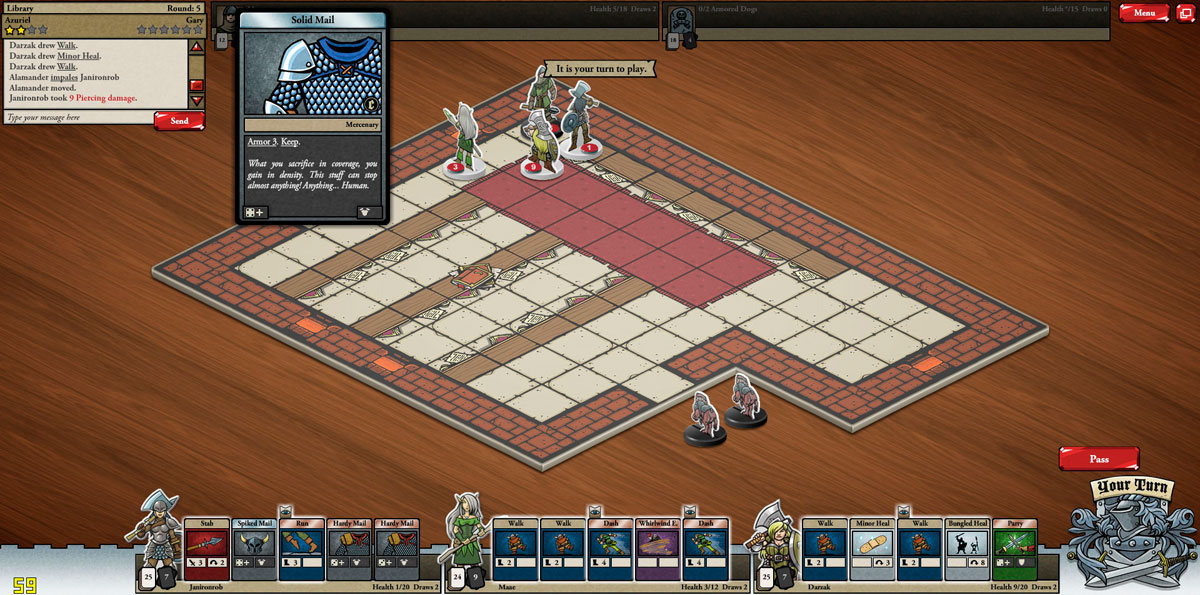
I mean, come on!
The above screenshot was taken from the dreaded Compass of Fucking Xorr level, right from where you might imagine is an insurmountable advantage. The armored dogs are dead, I have the last mercenary backed into a corner with 5 HP, and all my dudes are (barely) alive. It’s a new Round, my turn, and… look at the bottom. Don’t see many red cards, do you?
In fact, I drew exactly one attack card, and it only deals 3 damage. That larger card in the screenshot is a “seen” card that I know is in the merc’s hand, and it’s a doozy. Basically, any time you would deal damage to the merc, he rolls a d6: on a 4 or higher, the damage is reduced by 3. Like many Armor cards, it also has the Keep quality, which means it stays in his hand after triggering, ready for the next reduction in damage. And from fighting this guy, let me just tell you that his attack cards all deal 6+ damage from two squares away.
I did kill the merc on the turn after this one, as he just happened to draw a “drawback” card that caused him to discard all his armor cards. But it was a close one either way.
In any event, I am having a blast with Card Hunter thus far. That might sound strange after I just dedicated a few paragraphs to describing what could have been a terrible RNG-based wipe, but that kinda goes with the TCG territory. Who hasn’t been mana-screwed in Magic: the Gathering before? Part of tactical thinking should include the possibility of things going wrong – if games like Frozen Synapse taught me anything, it would be that. If nothing else, it keeps you on your toes.
I’ll go over the other elements of Card Hunter, including the ever-important F2P bits, next time.
The 4th Faction
One of the perennial hot topics on the PlanetSide 2 Reddit forums are concerns over the “4th Faction” and how to handle the issues that arise from it. So, let’s go ahead and talk about this issue.
Broadly defined, players of the 4th Faction in PlanetSide 2 are the people who have no particular loyalty to any one of the game’s three factions, and instead choose whichever side has the highest chance of winning. Some definitions of the 4th Faction term specifically reference the players who switch to an alt character in the final moments of an Alert, in order to get a higher Cert award. Other definitions include “spy” characters who will switch factions mid-battle to sabotage the efforts of their opponents via friendly fire. Still other definitions are so broad to encompass anyone who has an alt of another faction, even if that alt is on another server entirely.
So, already you can see that there is a serious problem with defining what a 4th Factioneer consists of, let alone how to tackle the issue (assuming one exists). And yet, by far, the most popular response is somewhat rudimentary: nuke it from orbit logging onto one Faction automatically locks your other Faction characters for 12 (or more) hours.
Apparently this was how the situation was handled in the original PlanetSide, and some feel it would work in this game too. Others are a bit more charitable and suggest the faction-lock should only trigger if you leave the warp gate. After all, SOE gives free daily Certs to each character you log onto, so a log-on trigger would prevent you from claiming these Certs. Others think a 3 minute timer would be sufficient. Still others believe you shouldn’t be able to roll different-faction alts altogether, or at least on the same server. Nevermind if SOE merged your server, or you are Australian and only have a single server on the correct side of the Pacific Ocean.
If I have not been overt enough with my tone, allow me to be explicit: the 4th Faction is a problem that cannot be solved. It can be mitigated somewhat with better incentives, but all of the proposals I have seen (including faction-locking) thus far have been terrible design.
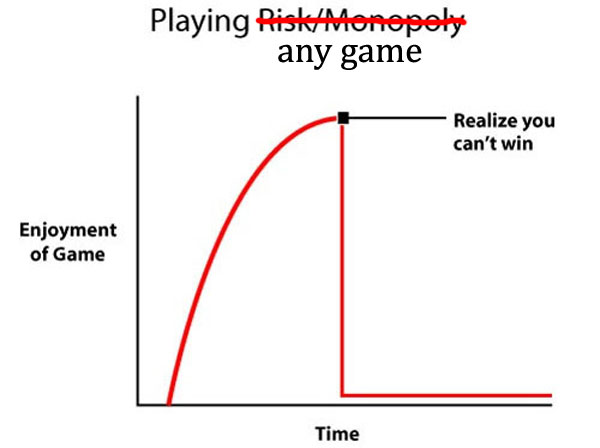
Let us all face reality here: nobody likes to lose. But the more salient point is that you cannot force someone to stick around to lose. At any moment a player can simply log off, hit Alt-F4, or unplug his/her computer from the wall. While games like EVE/Darfall can have your character remain attackable for X amount of time even after a ragequit, the point is that that player has already given up. Although I have not played League of Legends, I have heard about their anti-quitting penalties. Which, again, doesn’t really solve the problem of “motivating” a player to not have (mentally) conceded an obvious loss.
#FundamentalTruth
Many of the 4th Faction sob stories revolve around the curious population effect once an Alert starts winding down. Teams will be an even 33%/33%/33% for the first 1.5 hours, but in the final act the numbers start reading 50%/30%/20% or similar. “Those traitors are switching!” the forum warriors cry. Except… that’s not how it works. Each faction has a population cap per continent. You cannot go from, say, a 333 person split to 500/300/200, because 333 is the limit for your faction. While it is certainly possible for someone to switch to their winning-faction alt in the final moments, it’s only possible because there were empty seats.
And even if it were impossible to switch (via faction-locking), what difference does it make? The entire premise of the argument is that the person in question is on the losing side. The point at which they decided to switch characters is the point at which they gave up. They still would have given up if they could not switch. Switching characters at that point is indistinguishable from them simply logging off altogether or simply being AFK at the Warp Gate.
The fantasy that being “forced” to stay on your character will create the opportunity for a come-from-behind victory is exactly that: a fantasy. It might happen when the stars align and the angels sing, but it will never be due to random players banding together, but rather the concerted effort of Outfits – players who would not be switching to their alts anyway.
What are some solutions? Like I said before, we cannot “solve” the issue, but we can mitigate it. Here is an easy one: stop making Alerts grant 30, 40, 50 Certs for simply being online at the 00:01 second mark. Sometimes I will be online at 11pm and a 2-hour Alert will pop up, which means I can only really play part of it. While the Alert will grant a blanket 20% XP increase for everyone for the duration, why is it that I can play 99% of it and then lose the bonus Certs by having to go to sleep? The current design is dumb at both ends of the spectrum, and actually encourages people to switch characters (since they get the full reward whether they played 2 hours or 2 seconds).
Perhaps it would be too resource-intensive to track individual participation in an Alert. In which case, here is another solution: a steady trickle of rewards. Instead of 20% bonus XP throughout and 10,000 XP at the very end, how about 20% bonus XP and +50 XP every 5 minutes you are logged on? Or, hell, to reward the more “loyal” players, make the reward ramp up the longer you stay logged onto that character during the Alert. Something like +25 XP every 5 minutes, which doubles every half hour – if you stay for the entire Alert, towards the end you would be getting +200 XP every 5 minutes plus whatever you earn on the field. Change the final reward to something like 50% more XP/Resource generation for the next X hours, to incentivize winning (if necessary).
Will this solve server/faction imbalances? Sadly, no. If you are not VS on Matterson, you are probably getting farmed; other servers have similar scenarios with different faction names. You cannot force someone to pick the losing team. Not only that, but anyone who complains about the imbalance already implicitly gives voice to desire that sustains it. “It sucks being TR on Matterson.” Yes, I’m sure it does. Just like it sucks being outnumbered anywhere else. Stick with the miserable situation long enough, and it would be perfectly rational to quit or transfer… which is exactly what 4th Factioneers (proactively) do.
Am I 4th Factioning? By some definitions, yes. I created a character of each faction, on three different servers that I researched ahead of time to be the home of large Outfits. After server merges, my NC alt was moved to Matterson (home of my VS main). I basically stick with VS until I get the desire to use the Phoenix (camera-guided rocket launcher) or the desire to ruin people’s days with the Striker (OP and annoying lock-on rocket launcher). Indeed, for the longest time I started to think I would just give up on VS altogether, considering that the Lasher/Lancer was not nearly fun enough to justify the faction. Then, well, the ZOE happened. ¹
But here’s the thing. I find it completely ridiculous to buy into the whole “faction pride” angle when you are presented with fairly unique, faction-specific experiences. You are, in a sense, voluntarily avoiding the other two-thirds of the game. Granted, the empire-specifics weapons other than the rocket launchers are really just minor variations, so maybe not an entire two-thirds. My point still stands: the loyalty is largely arbitrary self-flagellation.
While even-fights and faction parity is a perfectly understandable, legitimate desire, so is the desire to not experience demoralizing losses or be stuck on dead-end servers/factions. And even in a perfectly balanced scenario, you are still going to lose two out of three games. Ergo, the best thing we can do is give consolation prizes to the losing side and hope there are a perfectly symmetrical amount of stubborn underdog-fans for, well, ever.
¹ And it’s getting nerfed, of course.
Review: Prime World: Defenders
Game: Prime World: Defenders
Recommended price: $5
Metacritic Score: Unrated (likely ~58)
Completion Time: 28 hours
Buy If You Like: Tower Defense, Grinding, TCG
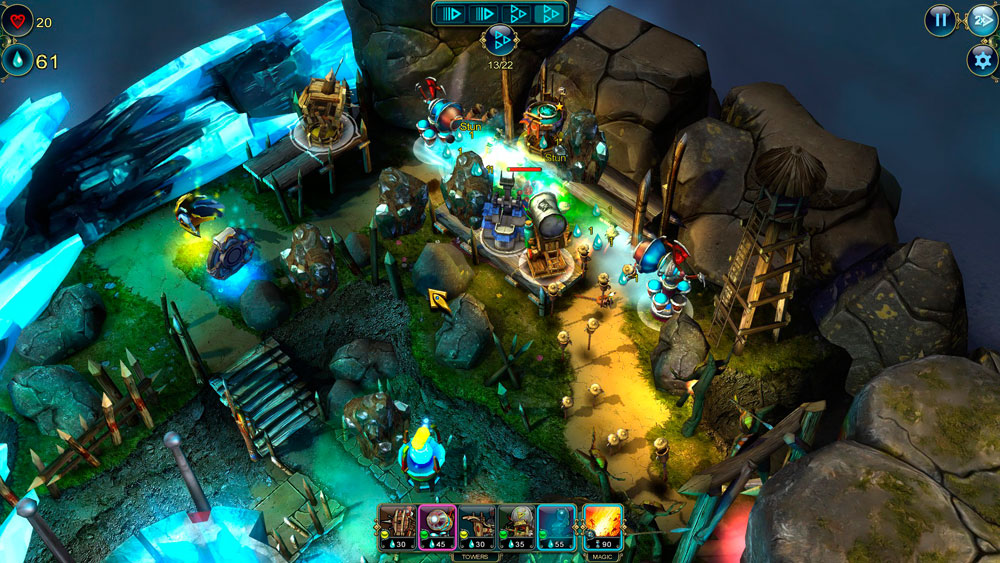
Like most things, it’s fun at first.
Prime World: Defenders is a Tower Defense game I bought in its Beta (what we used to call pre-purchasing) almost entirely based on a relatively glowing Penny Arcade review. I would not necessarily say I am a tower defense-er – I do not specifically seek the genre out – but I am pretty open to this gameplay in a general sense. Indeed, the only real problem I have with Tower Defense games is how binary things end up being: you are either murdering the enemy masses or you are overwhelmed. Well, there is that problem and the other intrinsically related problem in that there is always an optimal configuration of towers/abilities that usually renders entire levels moot.
But, hey, Prime World is Tower Defense plus TCG elements plus you can use magic spells; surely it could not fall into that same trap. As it turns out though, the things that make Prime World: Defender unique are the very things that make the game worse.
The central game conceit is that the player’s tower arsenal is represented by TCG-esque cards that can also individually level up to gain in power. The player also can gain levels, which only really affects the unlocking of tiers in the “talent tree” – something that ends up being more of an unlock menu since choices aren’t mutually exclusive. Winning battles will result in five cards being shown and then shuffled together, with the player choosing one effectively at random; up to two additional cards can be selected by paying in Silver. There is also an in-game “store” in which to purchase booster packs of cards, although it is entirely contained within the game – there is no RMT going on here.
As an aside, isn’t it sort of sad that we have to put in disclaimers like that?
Beyond the leveling mechanic, there are a few other interesting things going on. You can use Magic spells (which also level-up) during combat, for example. I also appreciated the ability to trigger the next wave early, which not only ramps up the difficulty but also gives you bonus resources, making it an interesting strategic decision. At first, anyway.
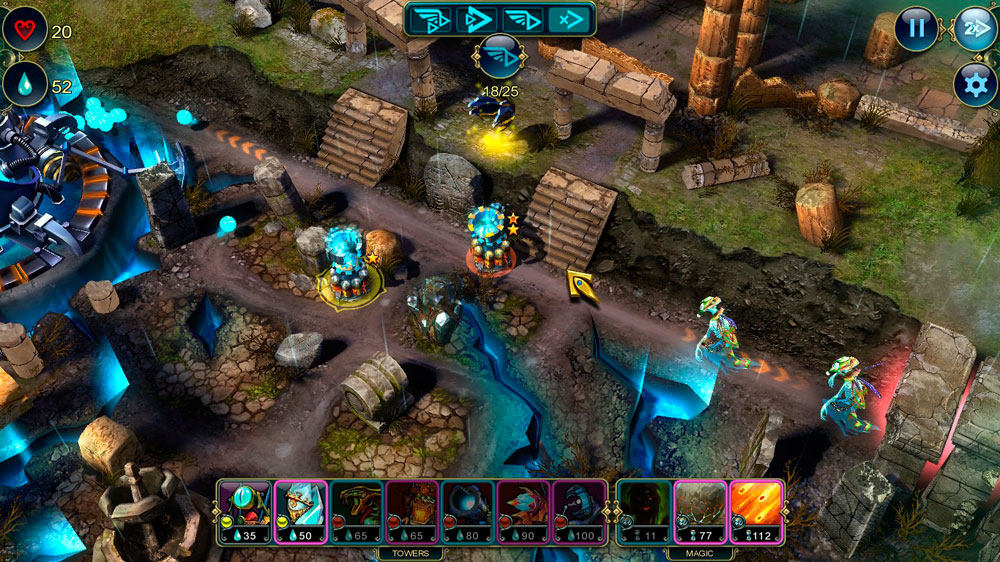
Yes, I got to Wave 18 with just two towers.
When it comes to Tower Defense games, I always use Sanctum as my high-water mark for the sub-genre (I count Orcs Must Die! in a different category). Under that sort of rubric, Prime World… is no Sanctum. For each story mission that you unlock, there are three satellite maps attached to it that correspond with Easy/Medium/Hard. These satellites are basically random battles in a typical RPG, allowing you to farm in-game currency and get additional cards/towers. The overall map structure in these random battles varies very little (there are less than 10 unique maps), but the empty squares available to place your towers might be filled in with rocks, enemy towers, or power-ups that boost the efficacy of any towers placed there. Enemy composition is variable as well, along standard genre lines such as mass of weaklings, tough tanks, flying enemies, and so on.
The overall effect of this random battle setup makes completing said random battles fun… at least for a while. The problem that arises, and my core complaint about the game, seems inevitable in retrospect: grinding/farming is required. The story missions increase in difficulty pretty linearly, although you will likely experience huge leaps every 4-5 missions. Sometimes the leaps will be in the form of Boss encounters, which feature an ultra-tough mob that standard towers are unlikely to defeat; other times mob HP just scales out of control.
Simply put, it does not matter how awesome your tower strategy ends up being when the game is balanced around you leveling-up your towers. And, indeed, if you dedicate enough of your time to power-leveling at the beginning, certain towers will basically allow you to coast to victory with no thought required. A level 1 tower costs the same the place on a map as a level 25 tower, despite the latter dealing +800 more damage and having a greater area of effect.

Tower costs the same, now deals +55 more damage.
I do not necessarily want to give the impression that the game is broken or anything. It’s just that, well, I was stuck on one of the story missions for the longest time, trying all sorts of different strategies and tower setups. I even looked up how other people were completing the mission. Nothing I did worked… until I dedicated 5 hours to farming random missions and got enough currency to upgrade my towers five or six levels apiece. The whole time I was farming, I was winning those missions using, literally, three of the same tower.
The whole game isn’t like that, but this particular story mission was a badly tuned break in the progression curve. And the sad fact is: this is technically a viable solution to every mission. Will you still feel clever replaying a tricky mission over and over knowing that you could technically just out-level it? And sometimes have to? Those questions are something you will have to answer for yourself.
If you are a fan of Tower Defense games, I would say that Prime World: Defenders is a solid entry in the sub-genre. If you care less about the sub-genre and more about compelling games themselves, well, you will probably still have fun for a while. As an on-and-off-again MMO player, I experienced considerable pull towards playing “just one more map” and farming money/XP fodder for my towers. As long as you know what you are getting yourself into, you will probably be fine with Prime World: Defenders. Just to be safe though, I would wait for a Steam/bundle deal.
Review: Journey [PS3]
Game: Journey [PS3]
Recommended price: $20
Metacritic Score: 92
Completion Time: 2-3 hours
Buy If You Like: World peace, Justice, Art, Sand simulators
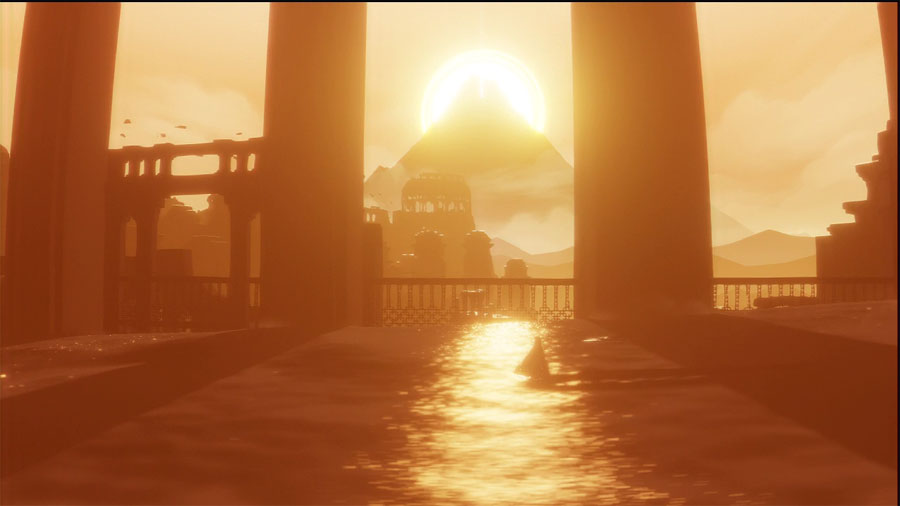
Seriously, play this game.
I do not even know where to begin with describing Journey. Perhaps the beginning? That always seems to work for most people.
Journey starts out as (and continues to be) the most impressive sand-simulator I have ever seen. Sliding down the first sand dune instantly transported me back into childhood, or at least as far as Super Mario 64. But Journey is not a platformer; it is an emotion, an experience. One that only gets more and more compelling as the minutes pass.
Describing your mechanical actions as you play the game almost feels like missing the point, but to not mention them would miss the point. Nearly every single thing about Journey is perfectly crafted. You move around with the left analog stick, and can pan the camera by either tilting the PS3 controller or using the right analog stick. In the opening desert-scape, you get some extra fabric added to your avatar’s scarf, which allows you to jump and glide for a few seconds. The only other button used is “O,” which lets out a little “energy chirp” or longer blast if held down.
That is it. There is no UI, no hearts, no power meter (aside from the scarf), nothing to distract you beyond the immensity and immediacy of the moment.
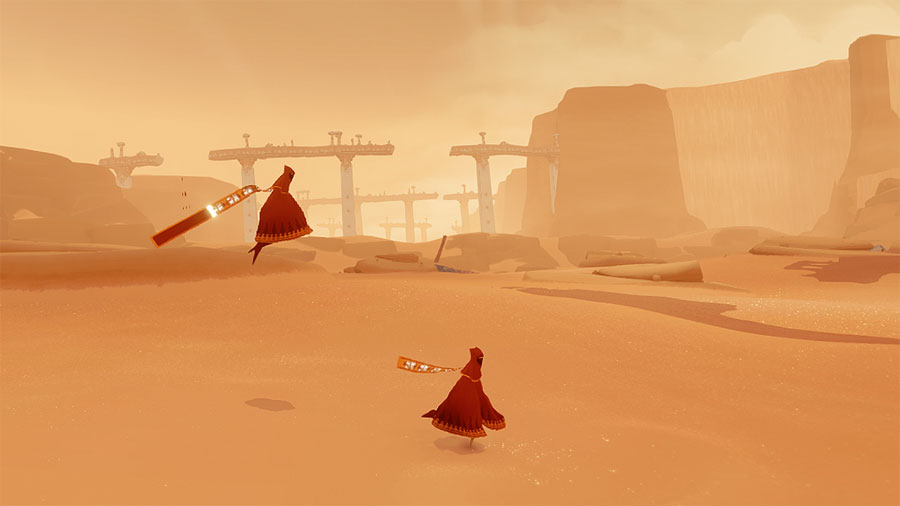
I felt more connected here than in most MMOs.
After the tutorial “level,” gamers connected to the internet will encounter perhaps the most sublimely executed feature in videogames: another human being. That sounds facetious, until you realize how often games treat other players as competitors, enemies, or judgmental peers desperately trying to foster virtual respect. Your fellow traveler in Journey is exactly that, no more, no less. Except… it is much, much more than that.
Remember when I mentioned the player’s scarf controlling the ability to jump? While there are items scattered around the landscape that add length to said scarf to further increase one’s hang-time, the ability to jump is always limited to how much of a “charge” the scarf has. One can only replenish this charge at certain locations along the map.
Unless, that is, there is another player around. Merely being in close proximity to a player with charge remaining on their scarf, will cause your scarf to recharge to full as they entwine. This is not a draining of power, but rather a creation, a resonance. Similarly, the sort of “energy chirp” players can do will also charge your partner’s scarf if they are in range.
I am spending so much time talking about this because the way Journey fits together as a whole led me to one of the most intimate experiences I have had in videogaming – all without voice, text, or even names. I felt connected to this stranger, as we slid down sand highways and soared above the dunes while alternating our energy chirps. I had a suspicion that my anonymous partner had played this game before, but he or she seemed tolerant of my exploratory inclinations. If they wanted to direct my attention towards something or indicate that we should give up on trying to get that tricky scarf-extension orb, a series of chirps was enough. Of course, as we traveled, I would occasionally chirp to keep up his/her power level, and after a while I think he/she realized what my seemingly random chirping accomplished (and then returned the favor).
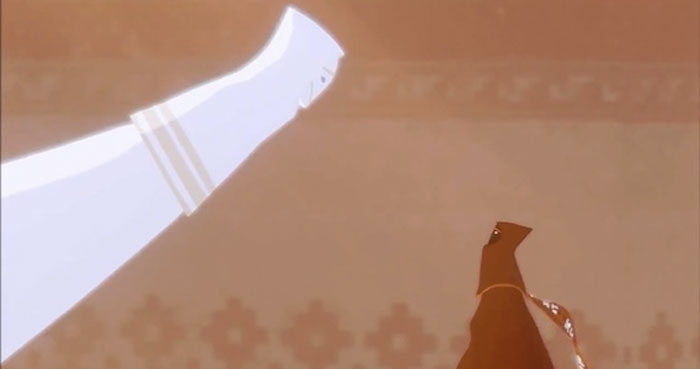
There’s more than just desert, but seriously, I don’t want to lessen the experience.
I am not going to talk any more about the rest of the game and the environments explored, both to avoid “spoilers” and because the game itself is only 2-3 hours long. But suffice it to say, it’s brilliant. Absolutely, devastatingly, goddamn brilliant. And I haven’t even talked about the music, which is universally praised and adored. And have I mentioned the visuals? I believe I have, but they too are striking and sublime – there were a few moments during Journey at which I seriously considered buying a $150 video capture device solely to take screenshots of this one game.
Sometimes I struggle with these shorter, more artistic games insofar as how much they are really worth. A game like LIMBO can be amazing (and it is), but spending $15 on something you finish in a single sitting? Perhaps I should have waited for a sale there. But with Journey I do feel it is enough of a novel experience to be worth skipping one night out at the movies to play. Not to mention it comes with two other games, although I have not yet played them. Possibly all combined they could make a full MSRP ($30) worth it. Even if it is just Journey though, anything more than a 25% sale means this bundle will be worth it on the strength of Journey alone.
…”Journey alone.” Whatever you do, don’t Journey alone. Christ, I want to play again.
Virtual Realms: Height of Cynicism
Alright, maybe Virtual Realms were the unannounced feature of 5.4. Or the tutorial zone, aka Proving Grounds. But, no, probably Virtual Realms:
New Feature: Virtual Realms
- Virtual Realms are sets of realms that are fused together, and will behave exactly as if they were one cohesive realm. Players on the same Virtual Realm will be able to join guilds, access a single Auction House, join arena teams and raids, as well run dungeons or group up to complete quests.
- Players belonging to the same Virtual Realm will have a (#) symbol next to their name.
I guess they finally solved that otherwise insurmountable naming problem, amirite?
Anyway, there are two (other) reasons this announcement is the height of cynicism:
1) Server Merges by any other name.
I get it, you get it, we all get it. Actually saying “server merges” is a sign of the apocalypse and bad PR besides. Grouping several low-pop servers together “virtually” is putting lipstick on the pig of 1.3+ million subscriber losses in the last quarter. At some point though, it’s just sad. You aren’t fooling anyone with that ridiculous comb-over. Just shave your head and get it over with.
2) Aren’t you glad you just spent $12.50+ server transferring?
I read the comments on my earlier post, regarding how things “usually go on sale before they are obsoleted.” For as jaded and dour as I can be under normal circumstances, I generally have some minimum level of faith in humanity. Obvious displays of naked greed are actions that can still genuinely surprise me, even if I distrust the “altruism” of corporations as a rule.
But, Jesus Christ, did Blizzard just take a huge shit on their playerbase.
There was a running joke in the PlanetSide 2 community regarding something similar: Item of the Day. Usually, the deals are 50% off the Station Cash (i.e. RMT) price of some garbage item or another, including items that are way cheaper to purchase with Certs. Every now and then though, some recently-released gun or something will pop up, prompting a lot of sales. People always joked that whenever something good snuck its way into the rotation, that meant it was getting nerfed by next week. And the shitty thing? It usually did.
The assumption got so pervasive and accurate that Higby, one of the PlanetSide 2 devs, actually stepped in and rolled back a planned nerf to one of the vehicle weapons that had just went on sale. He assured the community that these sales are planned out 30 days in advance, that the sale/nerf cycle was just coincidence, but who can you really believe when it comes to capitalistic incentives?
That question is not so rhetorical anymore. It was not an accident that Blizzard put server transfers on sale for the first time in their 8+ year history a mere week before announcing (free) server merges. Maybe they see some distinction insofar as players can choose where they go versus leaving it up to random chance. It’s still absolute bullshit though, because how many people would have bought a server transfer if the sale was this week, or next week? QED.
I mean, this is a new low that even EA hasn’t achieved, not for lack of trying.
 In An Age
Xbox One Eighty
Jun 20
Posted by Azuriel
I take no credit for either the title nor the picture:
Sort of like SimCity’s “cloud computing.”
If you had not already felt the Earth’s sudden wobble from the magnitude of Microsoft’s about-face, allow me the pleasure of informing you: the Xbox One no longer has its ridiculous DRM. Namely:
One of the “casualties” of this Lance Armstrong-level backpedaling is that you can’t have that whole “10-person family sharing” plan or the ability to “take your games anywhere by logging in.” Often lost amongst the Apologist tears though was the simple fact that logging on from a friend’s Xbox One basically meant you would have had to wait for a 10+ GB download before playing anyway. And what were the odds that more than one member of the family could play the same game at the same time? In other words, you are not any worse off than the present system of just taking the disc with you.
Plus, you know, used games.
On a semi-related bit of interesting news, apparently Valve snuck some interesting code into the Steam software: shared libraries, e.g. lending digital games. Obviously nothing is formally implemented yet, but the premise seems to be that once you lend a game to a friend, they can play it until you log on to play it yourself (which then bumps them off). Which is… pretty remarkably clever if you think about it. Valve could just as easily went the other way, where you couldn’t play until your friend “gave it back,” which would probably discourage people from using the feature at all. Assuming there is no transaction fee or anything, I would feel comfortable giving one or two of my Steam buddies access to everything.
Regardless of which way the shared library plays out – if it plays out at all – today was a huge win for consumers everywhere. I am not quite ready to declare victory yet, but the future sure is looking considerably brighter than it was, oh, two weeks ago, eh?
Posted in Commentary
1 Comment
Tags: About-Face, Consumers, Digital Gaming, Microsoft, Rights, Steam, Used Games, Valve, Xbox One