Ark Life
Ark can teach you a lot about life. Namely, man’s futile struggle against a hostile, uncaring universe.
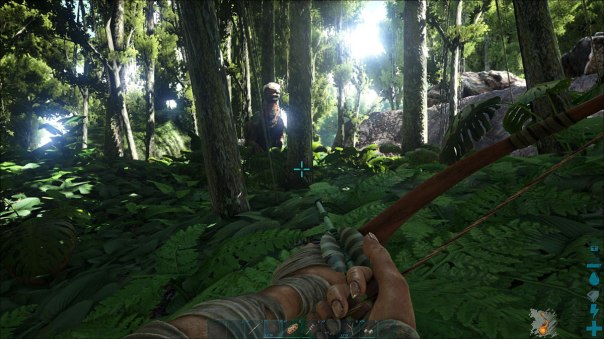
Don’t do it… it’s a trap!
It all started when I returned to my base with a handful of Obsidian from a scouting expedition. Emboldened by my success, and reading about the usefulness of the Sabertooths (Saberteeth?) I spotted on the mountain, I took flight again to snag a pair.
Life 1
I made it to the mountain in one piece, and scout around. I spot a pack of four Sabertooths, land on a nearby rock, and tranq two but the others had already wandered off. While taming, I am stuffing my face with Cooked Meat, because the temperature of the mountain is below zero. During this process, I realize that I’m out of Raw Meat, rapidly losing health due to the weather (no Fur clothing, because no Fur from these dinos), and while I have plenty of arrows, my crossbow itself is about to break. Shit. In a frantic bit of survivalship, I manage to kill some dinos for meat, tame the Sabertooths, and make my way to the warmer beach. Then I begin the journey back to my home base.
Along the way, I have to go through the Swamp biome. I stick to the edge, between the Swamp and the ocean, to avoid the more dangerous swamp creatures. What I did not avoid was the seemingly endless amount of piranhas. Despite doing only 15-20 damage per hit, one tiger dies. I hop off my bird to try and assist the remaining tiger. One minute later, the piranhas eat the remaining tiger and, somehow, my flying mount. I embrace the darkness.
Life 2
Take a backup bird to fly back and get my dropped items. This time, I load up on a fresh crossbow and extra meat. Spot my corpse, pick up my items. In the distance, I notice a low-level Sacro (e.g. giant crocodile). Thinking this might be a worthwhile tame to assist with the piranhas, I land on a rock and start shooting tranqs. With the Sacro down, I hop off the rock to start feeding it meat.
That’s when its mate shows up and starts feeding on me. Turning around to try and escape on my bird, I notice that the bird has simply dematerialized. No death record, it’s just glitched out of the game. Cool. I die.
Life 3
Fuck it, Imma build a boat.
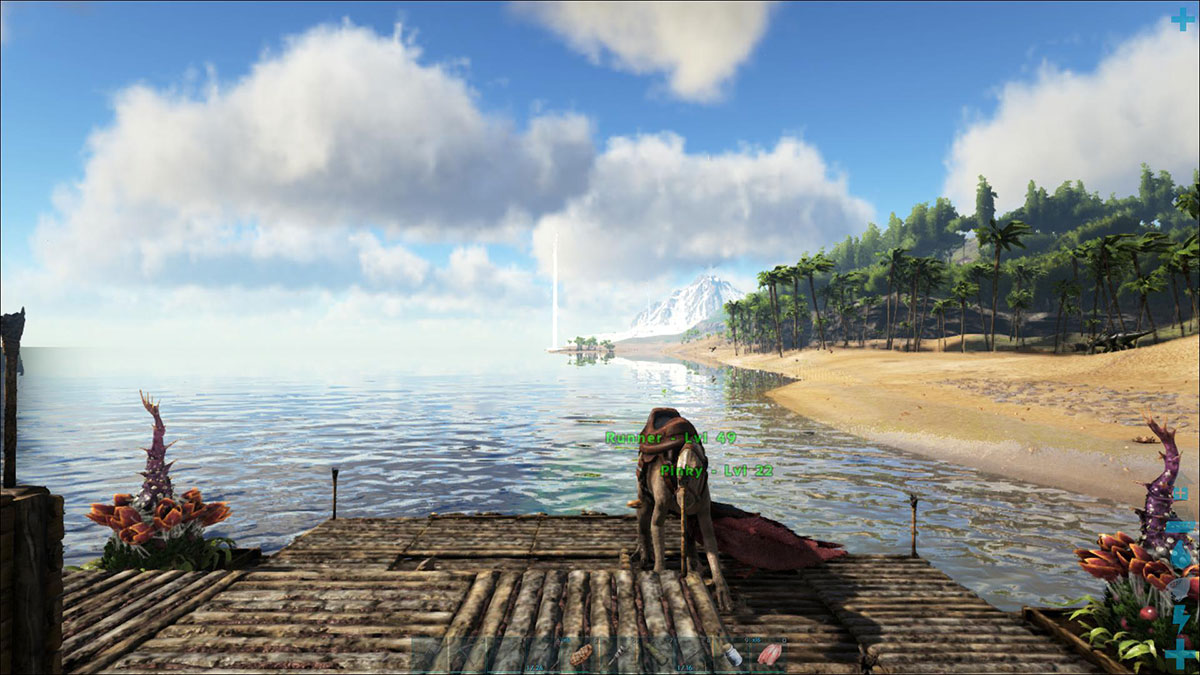
Tour length: 3 hours.
I spent the next few days collecting resources and constructing a boat and adding crafting stations and such to it. The goal was originally to boat up to the mountain, tame the Sabertooths, then boat them back. That’s when I realized that the snowy biome sounds more interesting, and hey, those penguins give you tons of Organic Polymer when you beat them with clubs. No, seriously, that’s how it works. Since I need a bunch of Polymer to craft advanced weaponry, let’s head North instead.
After a long time, I make it to the Snow biome. Club some seals, mine some frozen Oil, good times. Off in the distance, I see a Carno and some of hell boars. Huh, interesting. I craft some stuff for a bit, and then start to prepare to take my bird out to collect more resources. Except now there is a Carno and some hell boars, having aggro’d and swam out to greet me, clipping through the bottom of my boat killing my birds and my favorite mount. Fuck this.
Life 4
I ruthlessly murder every Carno and hell boar that I see. At one point, I got a little too zealous and fell off my rock perch, and the hell boars got their revenge.
Life 5
Let’s just avoid that area and get a little further North. What’s the worse thing that can happen?
This. This is the worst thing that can happen.
—–
It should be noted that I am actively save scumming in Ark, e.g. backing up files. Why they just don’t add a Quick Save functionality to Single-Player Mode, I don’t know. Perhaps it goes against the general principle of Ark, or might give people the wrong impression when/if they try and go to public servers and lose all their stuff for real.
In any case, I don’t even feel the least bit bad for what I’m doing. I cannot possibly imagine a scenario in which “cheating myself” out of that last loss will result in more game time than rewinding it. Maybe if this was more of a roguelike with a definite end, like Don’t Starve (Adventure mode), or even Binding of Isaac, I can see less replay value overall. With Ark though, losing an entire boat worth of stuff along with some of my best tames? I would be more liable to quit altogether than start over. Or perhaps never to have set sail in the first place, which is kinda the same thing.
I guess we’ll see. I managed to craft a modern pistol and assault rifle with my (rewinded) resources, while avoiding the anti-boat whale area. If the novelty of Ark wears off after gaining such weaponry, perhaps I did “cheat” myself out of time. Then again, I still have projects that I want to complete, caves I want to explore, and map to uncover. I’m thinking it’s better overall to trade future game time of uncertain value for non-frustrating gameplay right now.
Especially because of all the bullshit Ark throws at you out of nowhere.
Arked
Maybe there was some fanfare somewhere, but it came as a complete shock to me that Ark came out of Early Access this past week. As in, it’s fully released. It even has a Big Boy Pants price going on:

Glad I picked it up for $12 a year and a half ago.
Deleted my prior saved game and started fresh on a “Single Player” server. The results were… rough.
The early-game in Ark is essentially broken as shit. I spawned in the “Easy 3” section of the default Island, which puts me on a beach. The first few minutes is the traditional Minecraft experience of punching trees to create tools. As you gain levels, you can spend Engram Points to purchase schematics according to your level, which kinda allows you to differentiate yourself between a builder or scavenger or whatever. Which is fine, but particularly sucks in single-player considering that I’m level 10 but still can’t build a Thatch house (since I went for weapons).
The real problem though is the absurd difficulty spikes. The beach where I spawned has a cliff face blocking access to the interior of the Island, and the water is filled with massive sharks. No matter which direction you travel down the beach, there are extremely aggressive raptors essentially trapping you in a corridor of death. You can respawn after being eaten, but whatever items you were carrying will have been dropped, and the dinosaur responsible will still be by your corpse.

Carno corpse camp.
Oh, and your items despawn after 15 minutes.
In other words, in the early game, consider your former items to be permanently lost. Which wouldn’t be too bad if not for the fact that getting back to some baseline of combat readiness requires you to punch trees, craft a Pick, mine some stone, create a Hatchet, gather some wood, then make some Spears. Oh, and hold E down when near about two dozen bushes so you can craft some clothes. All so you can maybe engage some raptors that you cannot outrun and will likely kill you. So you can do the whole thing over again. And by the way, you can actually spawn into the game right next to a raptor or T-Rex and start getting eaten before you even have full control of your character.
If you make it past this early game though, you can craft a house and a bed that will let you respawn at a stationary location. And perhaps build some storage containers filled with surplus equipment, so that you aren’t starting from zero every time.
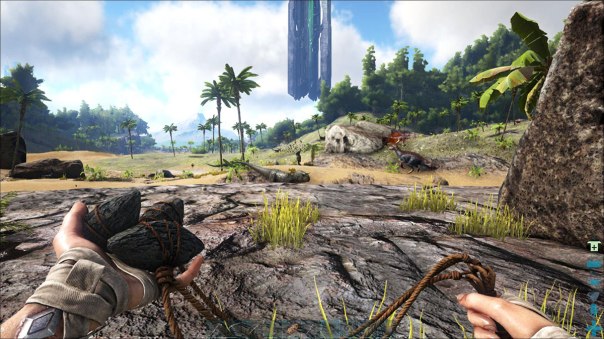
Carno, Alpha Raptor, Therizinosaurus? No thanks, I’m good.
This terrible beginning experience will not deter my Sisyphean struggle however. Part of the reason I stopped playing Ark 1.5 years ago was the terrible optimization that caused my PC to run it at 24 FPS max. With some settings tweaks, the game runs basically around 50 FPS at all times now. I’m hesitant to say everything is fixed on this front though, because I have a GTX 1060 now instead of a 970, so your frames might vary.
In any case, what I’m curious about is how the single player portion will play out. Supposedly there is an actual storyline involved, rather than this being a pure sandbox experience. [Fake Edit: Nope, no story] I routinely boot up 7D2D despite there not being any particular narrative, but the fundamental fact is… I like these sort of survival games. Ark scratches that “collect hundreds of Wood to build things” itch, in spite of being unbalanced as hell thus far. So, I will persevere. And should the boulder roll back down, I shall smile as I walk back down to push it up again.
At least, unless I spy a more interesting boulder somewhere else.
The Big F2P Correction
Big props to Eph for bringing my attention to a recent Gamasutra article entitled “How the Data Implosion will trigger the Great Game Dev Correction.” In it, the author put his “100% predictive accuracy” record on the line to portend the coming (Date: TBA) collapse of the F2P market.
If you want the short version of the 3100-word article, here it is: erosion of Consumer Surplus.
Really though, the author points to two primary trends that have entangled with one another in a negative feedback loop. The principle one is that the User Acquisition Cost, e.g. how much money spent on advertising/etc, continues to increase. One of the main drivers of that is the simple fact that there are thousands of competing titles on the market, with more arriving all the time. While we like to imagine that more options are better, the truth is that nobody really goes past the first two pages of Google results, much less browsing all 21,000 new games that came out in the last month. By “mathematical certainty,” costs go up trying to find new customers, revenue goes down as a result, and studios close their doors.
…but not before engaging in some Consumer Surplus shenanigans.
See, the second part of the feedback loop is how most F2P game companies are engaging in their data-driven quest to extract the maximum amount of Consumer Surplus from each user. Think lockboxes and timers and “special, one-time deals” that are psychologically honed to trick you into believing them to be worthwhile purchases. The very real problem though is that consumers have finite money. Shocking, I know. Since all of these F2P titles are trying to extract the same pool of dollars, all that happens is that each individual app only receives a smaller share of them.
And even worse than that is what we as gamers come to understand intuitively: these games just have less value as a result. In every sense of the term. Studios are spending more time and development dollars on ever more novel ways of tricking you to part with your cash, than they are with creating content worth purchasing in the first place. But even when those two points intersect, we’re left with little to no Consumer Surplus. At a certain point, you are better off watching Netflix than having to spend precisely the amount of money as enjoyment received from a game.
Now, the author is predicting a Correction at some point, with the Creative forces – as opposed to Big Data – rising up from the ashes of a devastated (F2P) game market and commanding a higher salary since we all suddenly realize we want better content again. I’m… not so sure.
For one thing, the F2P genie is out of the Cash Shop bottle. There is zero reason to believe that the surviving games of a post-Correction world will leave that extracted Consumer Surplus money on the table. Secondly, the game industry itself has proven rather resistant to the notion that content creators should be paid practically anything. Undoubtedly part of that is due to the fact that everyone wants to be a (armchair) game designer and thus there is no market pressure to improve working conditions/pay. Hell, I wanted that job so much that I spent two years of college studying programming and Japanese so I could try to break into the industry back in the early 2000s.
Finally, there’s Minecraft. You know, that little indie game that was sold to Microsoft for $2.5 billion three years ago? While an excellent case study in why Creatives are better than Big Data, the fact remains that this “simple” game won the lottery in a way that will inspire decades of copycats and dreamers, just as WoW convinced everyone that MMOs were the next big thing. The MMO fever has mostly died down, but that’s because it costs $60 million a pop to roll the dice. Meanwhile, there are hundreds of thousands of people creating apps in their basements for free, let alone the corporate code monkeys churning out thousands of Flappy Bird derivatives. The cost of each attempt is so low, and the payout is potentially so high, that there is no reason to believe investors wouldn’t keep some pocket change flowing into basically purchasing Powerball tickets each week.
So, while I do agree there will be a Correction of some sort in the game industry, it’s ultimately not going to fix the flooding of garbage games. What I expect to see is a return to Curation: a sifting through the river of shit for those few nuggets of value. People will find the voices that they trust, and those voices will end up picking the winners and the losers. At least, up until the Curators become corrupted by studios throwing money at them, and the great cycle repeats.
Destiny Window
Unfortunately, I have missed the Destiny 2 beta window. Technically, I could still have picked the game up midweek and tried to squeeze in a few hours, but the GreenManGaming sale price went from -18% off MSRP to -10% by the time I remembered to check. That’s technically only about a $5 difference, but… Consumer Surplus, people. Fight for it.
The other complication is that I could technically purchase the game outright via the money I earned via selling WoW Tokens. It’s funny money, but I’m still averse to paying full price for anything. I would still plan on purchasing the next WoW expansion and a month or two to play it, and that is unlikely to go on a similar deep sale ahead of time. We’ll see.
All that aside, I do plan on picking up Destiny 2 on or around release. I have never played any of the original game or expansions, primarily due to not having the requisite console. I couldn’t even really tell you anything in particular about the game that caught my eye either.
If Destiny 2 is anything similar to Borderlands 2 though – which I believe it to be – then I will be satisfied with a outlet in which to shoot things in the face and collect its loot. Overwatch was supposed to be that outlet, but… not anymore.
Surplus Deficit
Last week, Keen blogged about a tweet that should be filed under “Things that make you go Hmm… not really”:
In a world of $5 lattes a game with 50 hours of content is worth $1,000. Instead, many won’t touch a game until some stupid Steam Sale. (source)
Wilhelm has already penned an exceptionally good take-down of the latte vs game comparison. What struck a cord in me the most, though, was this follow-up tweet:
The unwillingness to pay what a game is actually worth is why we have on disc DLC, F2P, micros for single player games, season passes, etc. (source)
This, my friends, is the embodiment of everything I warned about six years ago.
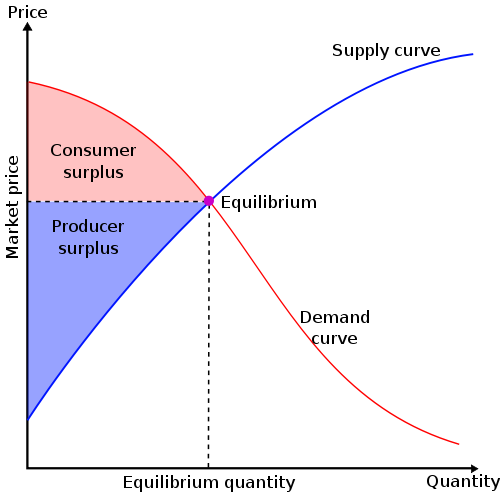
We as consumers have been beaten down so often and for so long that the argument almost makes sense. It seems “fair” that someone gets paid a proportional amount for the benefit received. But the funny thing is that reasoning only ever seems to go in one direction. Price exceeds the amount it costs to create? Capitalism, working as intended. Benefit exceeds the price? Suddenly there’s a whole lot of hand-wringing and articles about Millennials killing functionally useless industries.
Fight for your own Consumer Surplus! The difference between how much you paid for something and the amount of enjoyment it provided is yours. That’s your profit, not the game company’s. These corporations will try to erode your consumer surplus with ever more novel monetization schemes, and other people might try to guilt you into “supporting the devs” or admonish your “unwillingness” to throw your hard-earned money in a hole for literally no reason. But the fact remains that it’s the game company‘s responsibility to effectively manage their own resources, to figure out what payment models they should utilize, etc. Not yours. Their business is not your responsibility.
Don’t settle for the precise intersection between Supply and Demand. Don’t let anyone make you feel guilty for getting a deal. If you want to donate extra money to random devs in some idealistic hope they generate future value, go for it. But understand this: the only person looking out for you, is you.
Half Death: Episode 3
If you haven’t already heard the scuttlebutt… well, I’m sorry. The former lead writer for the Half Life series has released what is widely reported as a summary of the hitherto (and likely forevermore) unreleased Half Life 2: Episode 3. While it is being termed “fanfic” by the author himself, keep in mind that Marc Laidlaw left Valve in January of last year, and there are no other writers from the series remaining in Valve.
Read at your own risk unforeseen consequences.
Divorced from physics-based gameplay and otherworldly vistas, the plot ends pretty quick. And it certainly still leaves the door wide open to some kind of proper Half Life 3. But… this is closure enough for me. It feels right. While nothing can really assuage the ire I feel after the ending of Episode 2 almost ten years ago, this nevertheless meets me halfway. It lines up with pre-established lore, and completes the themes presented since the original game.
Which makes sense, coming from the person who wrote everything in the first place.
At the same time… goddammit. Valve hasn’t released a single-player game since Portal 2 in 2011. That’s more than five years ago, for those (not) playing at home. And really, they don’t need to anymore. Steam obviously more than pays for itself, as evidenced by the non-standards of Early Access and shovelware that make it to the front page. For all intents and purposes, Valve has taken the ball and gone home, having monetized every inch of the field. They built it, we came, they left.
Oh, well. At least there are all these other games I can play on Stea…
…goddammit, Gabe.
Main Story Sidequest
Against all odds, I remain playing FF14. Some days. For about an hour or two at a time.
Had I stuck with the Pugilist, I would have unsubscribed a month ago. Instead, I decided to try out the Archer and… I’m actually having fun. Usually. The mobility of instant-casts makes up for a lot of what I can only describe as the “jankiness” of FF14’s combat system. No attacks seem to have any weight to them – they are all high-pitched squeals and brightly flashing lights.
There is also an extremely noticeable delay in state-based attacks. For example, the Archer has a Kill Shot/Execute ability that’s off the global cooldown which triggers at 20% HP. Which is fine… except that it always lights up almost a full second after the target is below 20%. Combined with the default 2.5 second GCD, and enemy attack animations not being synced with their damage, the game feels like you’re playing with 250ms lag all the time.
I continue to slog through things though, because everyone talks about the fantastic story.
Know what I did on Monday? I /danced with some Sylphs to earn their trust. Then did some fetch quests for said Sylphs. Then helped out a bar owner, which involved talking to half a dozen people around the world to find out where a particular NPC went so I could return an earring. Then I helped the NPC make some liquor as a gift. Then went on a side quest to catch a traitor in the woods, ostensibly as something to do to pass the time. Finally, I found the the missing Sylph elder hiding (spoilers!) in another mandatory dungeon.
Best. Writing. Ever.
It really isn’t. I’m too committed to seeing this experiment to its conclusion, to see for myself if there is any redeeming value in playing FF14 for its story, to quit now. But I really, really want to. I have to imagine that SWTOR would be a better use of my time at this point.
Still, I shall overcome. With active, conscious effort.
Overwatch Accretion
About a year and half ago, I was excited about Overwatch in large part because it was new. I enjoy FPS games in general, and have spent countless hours over the years playing the Battlefield series. There were several titles though, such as Team Fortress 2, that I either tried and dropped or didn’t bother trying at all because of accretion:
ac·cre·tion
əˈkrēSH(ə)n
noun
the process of growth or increase, typically by the gradual accumulation of additional layers or matter.
That’s the dictionary definition, but I used it this way: “the older a game gets, the less space exists for the ‘skill middle class,’ and the less the developers seem to care about catering to said group.”
For example, getting into Counter-Strike or Team Fortress 2 these days, as a brand new player, would be an exercise in futility. Not only would you be useless to your team generally, your opponents are most likely extremely skilled veterans, and you are likely to die to mechanics/map secrets you don’t even understand yet. It is a frustrating situation for everyone involved, compounded twenty-fold considering the bile and vitriol that exists just below the thin skin of faceless internet gamers.
After this weekend in Overwatch, I can sadly report that the accretion is getting real there too.
The last time I talked about Overwatch was more than a year ago – ironically around the Summer Games, which are currently ongoing – and I stopped playing towards the end of the second competitive season. Competitive Mode was a necessary addition to the game overall, but I found it has actively made the Quick Play experience worse. First, naturally competitive players got their taste of what it’s like playing with people who actually want to win the objectives, which makes the Quick Play environment feel worse in comparison. Second, new players generally avoided Competitive Mode until they got more practice, lest they tank their ranking when it matters. And finally, the toxic tryhards that couldn’t try hard enough to be successful in Competitive Mode find themselves surrounded by other toxic tryhards and complete noobs in Quick Play all day long.
“Cream rises to the top.” Sure does. But once you remove that, everyone else is stuck drinking the creamless sediment that sunk to the bottom of the glass.
In short, the experience was awful. I stopped playing Overwatch before Ana was even released, so I’m four whole characters and countless patches behind the metagame curve. Team needs a tank? Okay, let me play… Orisa. That probably wasn’t the best pick for the team composition even if I had never played her before, but nobody else cared about team composition anyway (Hanzo and Windowmaker on a point control maps? Sure!), so why not?
Because it results in an embarrassing loss. I’m frustrated because I’m still trying to figure out the correct use of my abilities, but my team is also just bad players… unless they are just trying to figure out their characters… and oh my god just end it now. In another match, I decided to go back to my old standby, Zarya, to get a win. Things were good… until they weren’t, when I realized that the healer Ana spent more time sniping instead of healing. So here I was bringing my A-game with a hero I’m actually good at (but don’t want to play anymore) and everyone else is dicking around.
Wait a minute… now I’m the tryhard.
So, yeah, it sucks playing Overwatch now. If you never stopped playing, or exclusively play in Competitive Mode, perhaps it’s the same as its always been. Coming back from a break though, queuing solo in Quick Play? I’m not even sure I would ever recommend the game to anyone now. I would much rather be playing any iteration of the Battlefield series, where noobs can exist without constituting a full 16% of the team (6v6), or 100% of the teams chance for success should they occupy a critical role, e.g. tank or healer.
The accretion problem is real, my friends, and I’m not sure what the devs can do to counteract it. Overwatch does have Arcade Modes available, and something like “Mystery Heroes” where people get forced to play random classes can help. But these modes are not entirely satisfying on their own, and generally don’t help you develop the map awareness/strategies necessary to win “real” games.
 In An Age
Ark de Solo
Sep 13
Posted by Azuriel
In the comments for my last post, SynCaine questioned my decision to play Ark solo:
The “what then?” is the same answer as any survival game: play until you get bored.
Meet Pinky. He’s basically a jet ski that flies occasionally.
I’ve been playing Ark pretty much the exclusion of anything else since the beginning of September. This past weekend’s project was shepherding an Ankylo up a mountain and setting up a metal refinement base at the top. Big improvement over riding a train of dinos to a now-depleted smaller hill along the coast. It was not until just yesterday that I got my first node of Obsidian, which was up a completely different mountain, near a full day’s flight (on my slow bird) away.
My next project is to try and snag Dung Beetles from somewhere – possibly a cave – so I can have easier access to oil, as I want to avoid underwater shenanigans if possible. Then I was looking at taming one of those snails, which requires the vegetable cake, which requires Sap, which requires a high-cost collection piece most easily inserted on top of an extremely high-cost tree structure, then you can’t forget Giant Bee Honey… and so on and so forth.
Until yesterday, I hadn’t even left the SE corner of the map. I’ve seen the Redwood Forests, but haven’t actually been inside yet. Much less anything North or West of that. Steam says I’ve been playing for 60 hours.
Actually kind of impressive.
Sure, exploring and exploiting shit is only going to get faster from here. I’m way more confident in my ability to handle (or avoid) hostile dinos than before. But the game is still interesting to me, still dangerous, and I still have things I’d like to do. Maybe try out some of the caves, maybe see how far along the tech tree I can get before things get too annoying. I don’t know how much more novelty the game necessarily has – could be another 60 hours playing solo, maybe only 20. At my current rate, I’m leaning more towards the former.
If I do get bored, I can try a fresh character in a different starting zone, for a different experience. Or perhaps on a different map entirely, e.g. the Center, or Ragnarok. There is already one paid DLC map on top of that, with another on the way. There is even apparently a procedural generated map option, or custom maps.
What I don’t need is other people to make my gameplay meaningful. I’ve gotten 200 hours out of 7 Days to Die so far, and who knows how much time in Minecraft. All solo. If I want the experience of social obligation and responsibility again, there are plenty of MMOs to fill that non-existent void. Personally, I’m still enjoying the ability to close games without having to apologize for leaving, or doing exactly what I want to be doing in that moment without asking for permission.
Is Ark more fun with friends? Possibly. It is also completely, 100% fine by yourself too. There is enough sand in the box to make for a good time either way. At least alone, you avoid getting sand into your shorts and hair from other people mucking about. These days, I’m good, thanks.
Posted in Commentary, Philosophy
4 Comments
Tags: Ark, Show & Tell, Single Player MMO, Social, Solo, Survival