WoW Down 2.9 Million Subs
In news both kinda expected and yet still rather shocking, WoW is down 2.9 million subscriptions from last quarter.
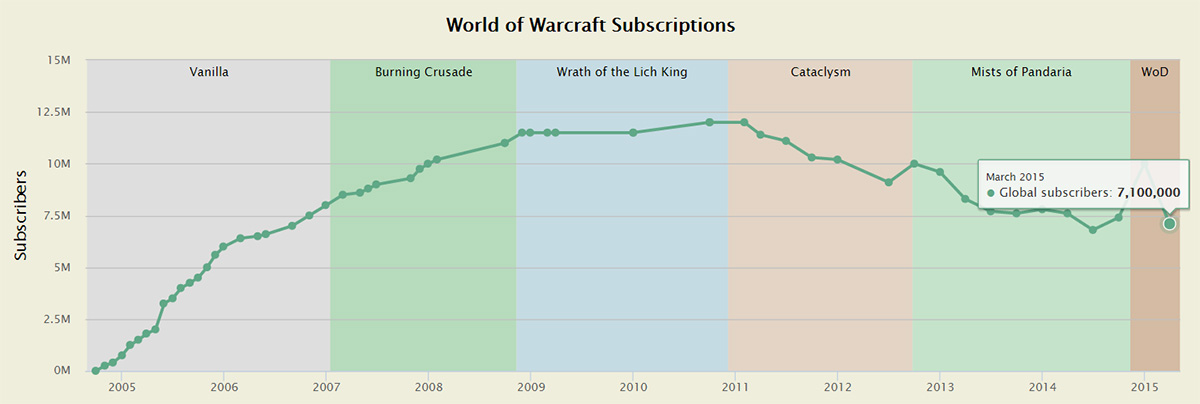
Whiplash.
At a certain point, the sheer magnitude of the change makes commentary moot. You don’t lose nearly three million people because of Garrisons. Or screwing up professions. Or having easy-mode raids. Or hard raids. Or whatever. And as I mentioned when we first heard about the 10 million sub surprise, the numbers are too big to ascribe to the expected MMO Tourism/Locust Effect either. I mean, yeah, the numbers jumped to 10 million and then back down, so people went somewhere. But unless we’re willing to state three times as many wished to tour Draenor than Pandaria, it had to be a confluence of all sorts of things.
Whatever those things are, it’s clear that it isn’t enough to last a full quarter.
There is no transcript of the call as I write this, but I went ahead and listened to the whole 42 minutes of PR bullshit anyway. No real juicy tidbits were found… unless you consider Guitar Hero on your phone to be juicy. The whole WoW Token thing was mentioned only in passing, which makes sense considering any of its effects won’t appear until Q2. Oh, and I suppose there was this bit about Hearthstone (PDF):

Two franchises that go together like peas and carrots.
Still doesn’t clear anything up in terms of the money part of Hearthstone’s success, but I suppose another data point is another data point.
Reckless Iteration
I was reading the 6.2 PTR patch notes for WoW the other day, and I was thinking to myself “hey, these are really good changes.” Like, really good. But after thinking about them for a little bit, I realized that they were so good because the mechanics they were changing were so bad. Like, really bad. Here are two of the items I’m talking about:
- Players can no longer queue for Ashran while in a raid and are now automatically placed into a raid after entering.
- Crafting the new upgrade items requires Felblight, a new reagent that can be obtained from Fishing, Herbalism, Mining, or Skinning in Tanaan Jungle.
I zoned into Ashran one day last week, and the experience was almost awful enough for me to stop playing altogether. Honestly, Ashran is just another failed iteration in pseudo-world PvP in a long list of them, but somehow the Blizzard devs made it worse.
Look at that first patch note. What happens right now when you zone into Ashran is: nothing. You grab some of the quests and then you storm out. But because you aren’t in a raid with everyone else, that means you get no buffs, no shared kill credit, no passive gains at all. While the LFG function can be used to find groups within Ashran, the only ones available when I zoned in were either farming specific races (for achievements, etc), or had some gear requirement, or were full. Which is fine on its own, go form your specialized groups, but we’ve had auto-raids for Wintergrasp and Tol Barad and it boggles my mind that this is just now being implemented.
On the other hand, I am not entirely sure how much this would actually help entice me back to Ashran. The “combat” is a one frame-per-second shitshow of lag and AoE spam where everyone charges up the middle lane. I guess there are events off the main lane sometimes? All I know is that if you aren’t a ranged class or a DK with Deathgrip, you are a waste of space and will die instantly the moment more than one person can tab-target you out of the crowd. Retribution paladin? GTFO. Compare that to Wintergrasp or Tol Barad, where even the worst-geared, worst-class player could make a difference in the battle’s outcome.
The second patch item listed above is what really drove things home though. For those that might not know, the hitherto endgame upgrade material was Savage Blood. For the crafted items in Warlords, there are four levels of upgrades, which can bring a level 91 2H Axe from already-beyond-heroic-dungeons power to current-raid power. The only realistic way to get Savage Blood? A level 3 Barn in your Garrison. It didn’t really matter what your professions were or where you farmed or anything at all to do with anything: you needed a Barn.
Which is precisely why the change highlights the absurdity of the current system. Blizzard all but killed every gathering profession this entire expansion. Every character has access to a Mine and Herb garden no matter what their professions were, and generally these resources were enough to fuel your required daily cooldowns. Which were largely the only reason you actually needed things like ore and such, since every profession was gated behind daily cooldown items. If I were to be optimal about things, I would have dropped at least one profession from every Warlords-level toon and made them Enchanters, strictly to sell their daily material (one of the few non-BoP versions).
Iteration is one of the cornerstones of game design, I know. But I can’t help but feel like Blizzard sometimes gets away with outrageous bullshit that would bankrupt any other MMO. Completely removing profession bonuses, followed up by rendering most professions functionally useless, on top of limiting how many pieces of crafted gear can be equipped? Then, a year later, saying “lol jk, I hope you didn’t drop Mining/Herbalism on every toon”? Just imagine something like that happening in Guild Wars 2 or WildStar or whatever.
I’m glad they are fixing terrible, broken game design. But who approved this shit in the first place? You already knew what worked three expansions ago!
Having read all these changes in the pipeline, I’m in a weird place now. Not just with the above, but there are also notes in there about how the mat cost of the crafted gear is being lowered, and the mat generation being increased. I have a bunch of alts that would be more than happy getting ilevel 640 gear the moment they ding 91. So… what? Do I go ahead and craft these items for them with the mats I have now, or wait until 6.2? Obviously if I’m going to keep playing WoW between now and then, it makes sense to craft them. On the other hand, I don’t have to keep playing. It’s not like I don’t got other shit to do. I feel like I’m in that Enthusiasm Tax trap of being better off if I enjoyed playing a game less.
Then again, that’s pretty much always been the case with WoW. And yet, here we are. Again.
How the fuck do they do it?
What WoW Economy?
It has been about 20 days since I’ve been mainlining WoW again, and I have yet to get a handle on economy. Not that I anticipated being some AH genius within a week or two, but I don’t even seen the contours of this beast. And I am beginning to doubt they exist.
Way back in the glory days of Wrath, there was the Saronite Shuffle. This was when you could take a stack of Saronite Ore and – through brilliant AH scheming and a stable full of max-profession alts – turn those 20 pieces of ore into damn near anything. The Shuffle was a cornerstone of my gold gains through Wrath, Cataclysm, and even when I came back to Mists.
In looking back at posts like this, I damn near had to wipe a tear for the nostalgia:
Right now, for example, I buy Ghost Iron Ore at 4g apiece (and below). This ore ends up being:
- Smelted into Ghost Iron Bars –> Transmuted into Trillium Bars –> Transmuted into Living Steel
- Prospected –> Rare gems cut for >60g minimum
- Prospected –> Uncommon gems turned into necks/rings –> Rare necks/rings procs sold for 300g, uncommon necks/rings Disenchanted for Dust
- Disenchanted Dust –> Enchanting scrolls and/or sold for mats
Near as I can tell, the Shuffle is dead in Warlords. At least, if it once existed, prices have warped so much since then as to make it unprofitable.
What’s worse, Blizzard made a number of changes in Warlords that, in retrospect, were probably rooted in heading off PR problems with the eventual WoW Token rollout. For example, players are limited to wearing three (3) crafted pieces of Warlords gear. You know, despite there being enough patterns to completely outfit someone. Why do that? So that someone couldn’t drop $400 in WoW Tokens and be decked out in ilevel 675+ gear at level 91. Unfortunately, that makes the likelihood of someone buying your crafted bracers or whatever pretty remote, unless said person already has better gear in other slots. The sanest path would be to upgrade the most impactful slots such as weapons and the like.
Compounding this issue is the way Blizzard is handling professions in general this expansion. Profession bonuses are gone, which is… understandable in a way. When raiders are willing to spend hours farming mats for a +20 stat boost, having professions grant many orders of magnitude better buffs forced people to make unfortunate decisions in which professions to pick. This also meant opening up profession-specific toys to the general public as well, a direct nerf to Engineering. Then the Stat Squish (and a desire to have raid drops be useful immediately) turned gem slots into extra-rare occurrences, a direct nerf to Jewelcrafting. I don’t even want to get into the problem with opening profession buildings up in Garrisons did to everything else.
The bottom line is I have no idea what’s going on in the WoW economy anymore. I was looking to see if there was a point in doing my Alchemy daily cooldown on Azuriel, and saw this today:
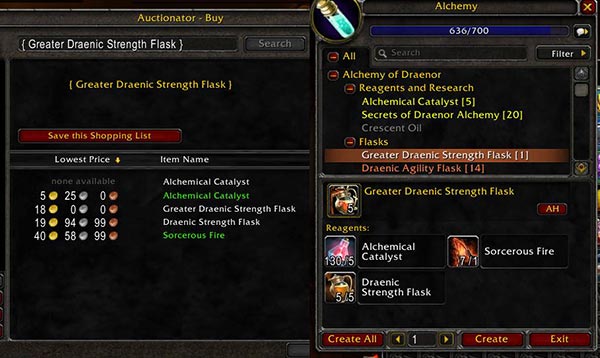
Does not compute.
Let me save you the math: the higher-level Strength flask sells not only less than the mats (18g vs 33g), it’s selling for less than the lower-level flask. I had already long-since dropped my Alchemy Shack for a Salvage Yard, but this is making me want to drop Alchemy altogether. Remember those Alchemy bonuses that have been in-game since Burning Crusade? Don’t work for Draenor goods. This is just a class-A market failure. Why is the Alchemy cooldown item tradable whereas nearly all the others are BoP? Because fuck you, that’s why.
Near as I can tell, we are living in the age of The Drop Economy. In other words, you don’t make gold from crafting or shuffling, you make gold from farming drops and selling that to people who don’t want to farm. I have little doubt there are some arbitrage opportunities – the Garrison AH robot parts seem to be going for insane prices considering you can just AH on an alt – but most gold seems generated from one’s Garrison. Which… isn’t unworkable, it’s just unfathomably less interesting to me.
The Shuffle was engaging. It rewarded outside game research, learning in-game mechanics, leveling multiple profession toons, and kept the gears of the economy moving. What we have now? Farming raids and vendoring all the things? I would almost rather farm ore. If, you know, there was actually any gold in doing that. And to an extent, the problem no longer exists under the WoW Token paradigm. Spending $20 on 23,000g is a bad deal IMO. At the same time, I’d prefer not spending hours soloing old raids each week.
I have made around 15,000g so far this expansion. Want to know how? Selling Living Steel and Arcanite Bars. I shit you not. And I will continue doing so until I run out of old-world supplies, grow bored with the current AH nonsense, and “unsubscribe.” I love what Blizzard has done with the Garrison generally, but everything outside of it? I’m missing goddamn Cataclysm over here.
If I have missed anything big out of the above picture, let me know. Otherwise this is just depressing.
Time Management
So… I may have more or less played WoW constantly this past weekend week.
While I’m sure that I will, like everyone else, grow bored with the feature eventually, I want it on the record (a year late) that what Blizzard did with the Garrison is just shy of amazing. For players like me, anyway.
See, I had every intention of abandoning my Paladin and making my (sigh) level 89 Rogue my new main. Before doing so though, I wanted to get my Garrison decently situated with a few level 2 buildings and Followers manning the profession stations. Which means I needed to do a few Outpost quest chains. And hey, may as well do the other Outpost quest chains so that I can save 750g-1000g on the blueprints. Oh look, I can get some more Followers pretty easily by just going here and doing one or two more quests.
Azuriel is now 25% into level 99.
Granted, all my characters are now in full heirloom gear that scales to level 100, minus the weapon because fuck that 5000g price tag. I even have the Dread Pirate Ring from back in the day, so the full percentage is +50% XP. In fact, I pretty much out-level a zone the minute I finish the Outpost quests. I could probably be a bit more concerned about that than I am, considering that as a non-raider, non-dungeon runner, questing is likely to be the only real content for me (outside BGs). But in a sense, Dragon Age: Inquisition broke the final thread tying filler quests with zero plot development and whatever fucks I had left to give. It’s not that I find killing X mobs tedious, I find killing X mobs for no reason tedious. I need some kind of narrative here.
Killing X mobs for a Follower, on the other hand…
My current plan of action is to go ahead and hit 100 on Azuriel, then get level 2 plans for my DK and Warrior (both of whom are 92) so that I get Inscription, Blacksmithing, and Enchanting professions going. As for my new Rogue “main” I’ll get around to her eventually. And by “eventually,” I mean those 5-10 minutes in-between Follower missions being completed across 3+ characters.
The irony is not lost on me that nearly four years ago I quit WoW the first time because of games like Tiny Tower, and now I’m back because it more closely resembles all those time management games. Time truly is a flat circle.
SSD Failure
Yeah, so, my main SSD up and died earlier tonight. You know, the one with Windows installed on it. And the one with the extra Windows partition, to make reinstalling easier. Just a quick BSOD followed by the BIOS no longer recognizing the drive. No other warning whatsoever.
While I did manage to make a frantic trip out to Best Buy to get another SSD in some insane fantasy that’d I’d be able to play videogames tonight, I was instead presented with the cruelest of ironies: you can reinstall Windows from the disk, but not the driver necessary to get on the Internet. I can’t even begin to imagine how that makes sense. Nor why it’s so goddamn difficult to have single, centralized place to download said driver (from another computer, if course). “Check your computer manufacturer.” Uh, it was custom-built; not like I can go to Dell or Apple’s website here. I did manage to figure it out, inexplicably, and shall henceforth seed my house with USB sticks with said drivers upon them.
The silver lining here is that the original SSD was only 64gb, mainly used for the OS, and thus my 500gb data drive remained intact. The new SSD is 480gb because why the fuck not, so once I preform the necessary blood rituals getting evening reinstalled, I might just migrate my Steam folder over.
In any case, here is your monthly reminder to back up your files. And your drivers.
That Old Pair of Shoes
Well, I bought Warlords of Draenor this weekend. And, as previously reported, I have 9 now 8 WoW Tokens. So I must conclude that I am playing WoW again.
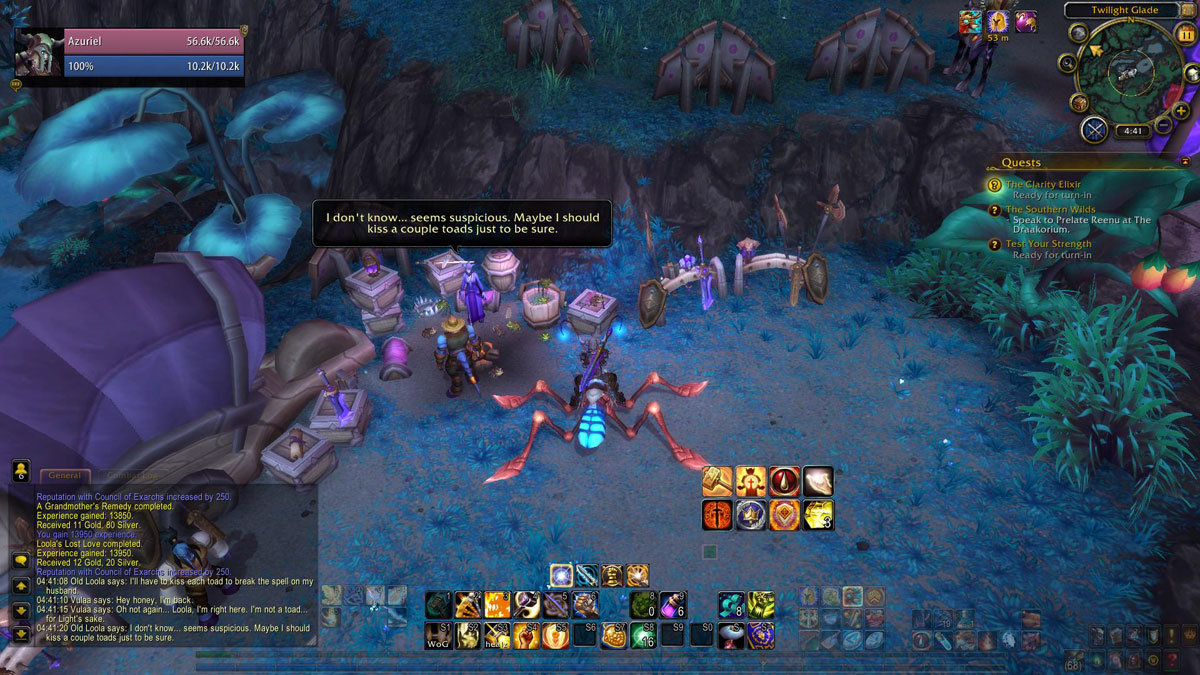
Surprised there hasn’t been a poop quest yet.
I was about to use “that old pair of jeans” phrase in the title, but the thing about old jeans is that they’re comfortable. WoW, right now, feels like an old pair of shoes instead: soles are a bit thin, rubber peeling off the sides, and they’re inexplicably damp. They still work, and are a better choice when it comes to doing chores like mowing your lawn, but they make everything feel ever so slightly off.
My namesake paladin just hit level 93 yesterday and I have little desire to play Azuriel again. The Retribution rotation doesn’t seem meaningfully different from what I remember, but the great ability pruning of 6.0 means that you have to especially enjoy your particular class because what you have is all you get. And what Retribution gets is Avenging Wrath and… a bunch of defensive cooldowns. Every time I was stymied by an entirely superfluous mountain and/or gentle slope in the no-fly zone that is Draenor, all I could think about was how my rogue could have Shadowstepped their way past the obstacle. Or warrior charged. Or DK Deathgrip the mob down the hill. Or anything.
All of which is fine, right? Just switch mains. Except my rogue is level 86. Which isn’t much of a problem with heirlooms – and what a wonderful goldsink that is, what with the upgrading them to scale to level 100 – but it’s still a speedbump. And there is just something ever-so-slightly distasteful about the fact that I need to switch mains at all. This is the “damp” part of the shoe metaphor.

Alright, Blizzard, take your point and enjoy it.
In terms of good things, there are a few. The Garrison has more or less supplanted my irrational desire to log into Clash of Clans every hour, in the time-management department. I just finished the Prophet Velen questline and felt immersed in the battle in a way I haven’t since… Wrathgate? Not as good as Wrathgate, but in the same parking lot of the ballpark. The music this expansion is extremely good too.
Before I pulled the trigger on the WoD purchase though, I was about this close to purchasing FF14 instead. In all likelihood I still will at some point, during the next $10 sale on the original box. If you are going to jump back into the MMO pool and relearn to swim, it may as well be a new pool, right? I only stuck with WoW because of the WoW Token shenanigans, which required me to use the 10-day free trial, which got me into Draenor and annoyed that I was capped at 1 XP less than level 92, and hey the 25% off sale was expiring that weekend, and… yeah.
Sometimes you just go without whatever is currently in your closet.
As the WoW Token Turns
You probably heard about the WoW Token already, and might even be aware it was finally implemented yesterday. What you might not know is that it does strange things to people.
Strange, terrible things.
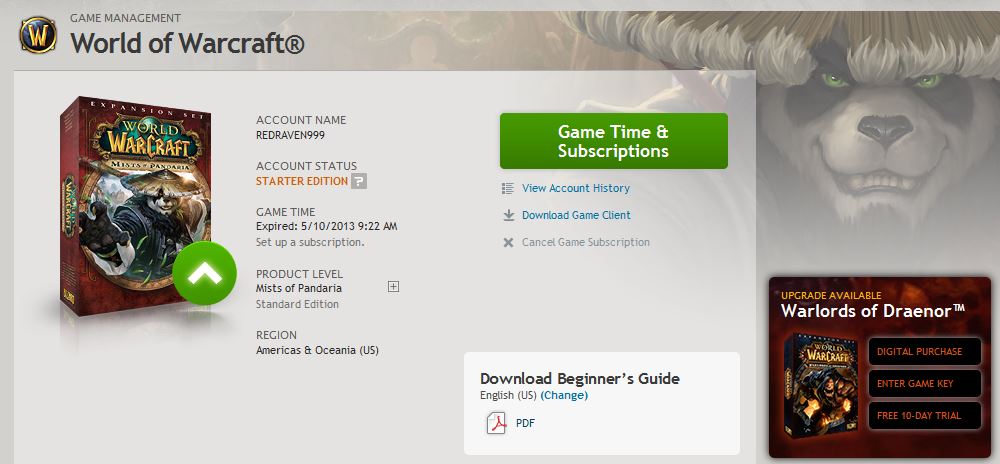
Damn, so close to 2 years.
What I knew going into this is that I wanted to jump on the opportunity the WoW Token represents, which is: a gold sink for the AH goblin that has (had) everything. Shit man, back in the day I was experimenting with selling stuff like Vial of the Sands, which was a crafted mount that required an extraordinary sunk gold cost right at the start. If it was not profitable, I would move on with the next bit of expensive AH R&D. It wasn’t millions of gold (Glyph spamming the AH was boring), but I was making gold just to make gold, you know? I couldn’t really bring myself to actually spend it on anything as I knew most things would be irrelevant by the next patch anyway; I wasn’t raiding, so who cares?
Queue my slight anxiety at the following error message:
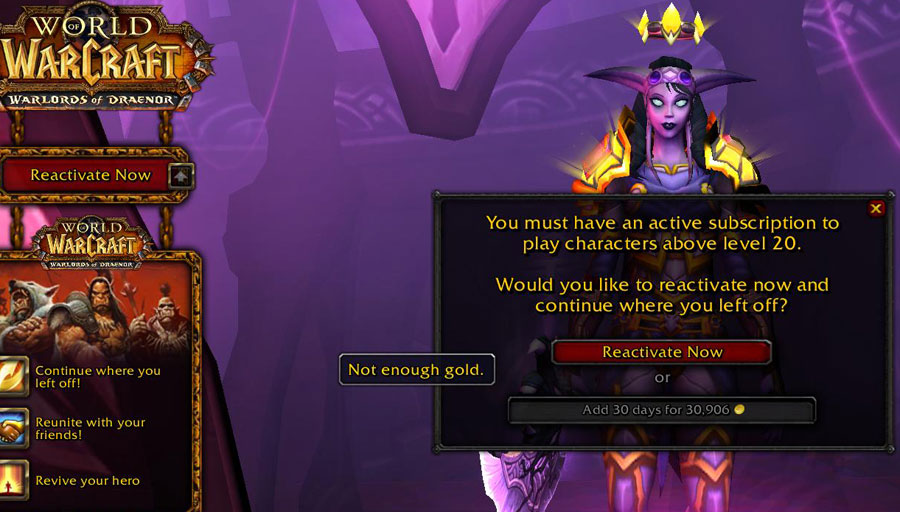
Been down this road before.
Was I hacked? Had my sizable stockpile been removed? I mean, I can clearly see my fully-dressed namesake there in the background, so I wasn’t stripped bare. Plus, the Authenticator was still humming along, not to mention my frequent bouts in Hearthstone, which I assume might have been in jeopardy had my characters in WoW been banned. Then again, maybe not. Whatever the case, I wasn’t able to purchase WoW Tokens from the character select screen.
And the story might have begun and ended there. Purchasing game time so I could log in and purchase more game time kinda defeats the purpose of WoW Tokens, yeah? If you’ll notice in the first screenshot though, I was still able to redeem my free 10-day trial of Warlords and take full stock of the situation.
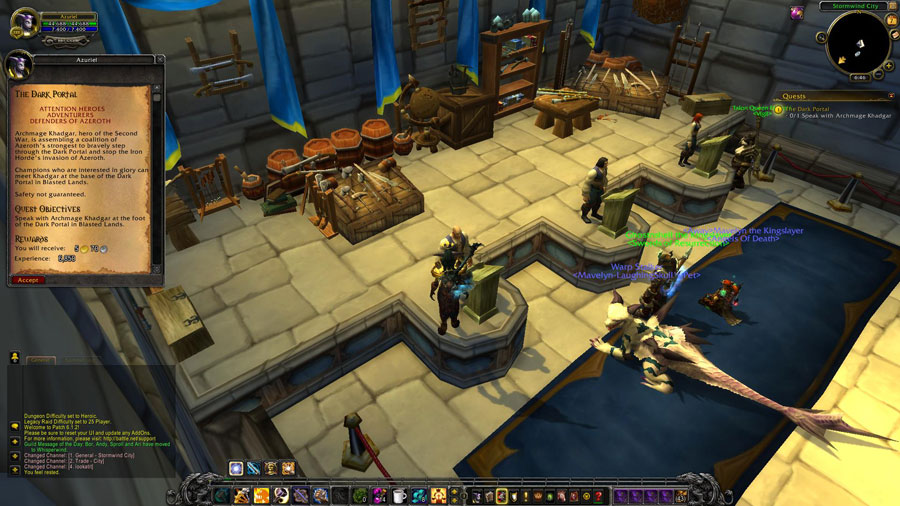
Where I logged off two years ago.
Observations:
- Damn, the default interface is still really terrible.
- I’m glad I set up the Curse Client all those years ago to manage my addons.
- Oh hey, the Curse Client updates addons but doesn’t save any of the settings.
- Recreating an interface I actually want to use is going to be an all-night project.
- I’d rather be playing Dead Island: Riptide.
- Oh, right, WoW Tokens.
I ended up purchasing four WoW Tokens at around 31,000g apiece. Before I logged off, I poked around the AH some to see the general prices of things. Even though I’ve only been back for a hot minute, my mind already sees the dollar signs creeping in:
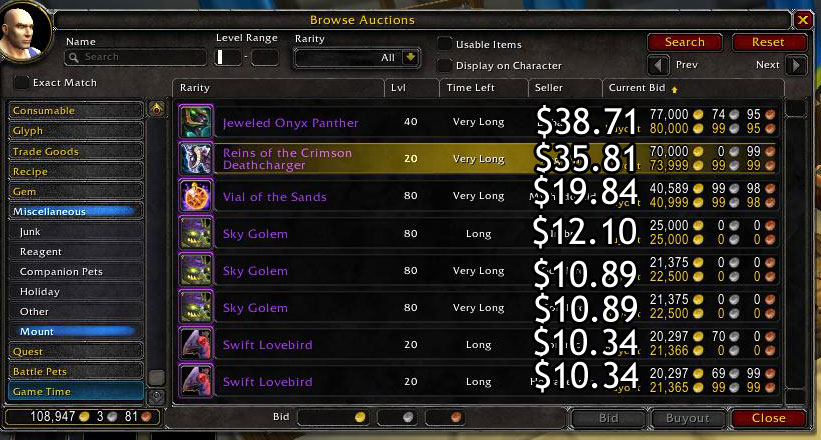
I can’t turn that part of my brain off.
It’s just a matter of time until someone writes a tiny add-on that projects these prices in-game.
But will it actually matter in the scheme of things? It’s hard to tell. I ended up buying nine (9!) WoW Tokens before calling it a night. The limit is supposedly ten tokens per month, and I might end up shuffling gold around to do just that. You know, to say that I did.
But then it hit me: I now have nine months of WoW subscription. Assuming I play the game at all, that means pretty much any gold I generate between now and the next expansion will be pure bonus. So while I can still see those dollar signs in a general sense, what they represent (i.e. additional game time) is not nearly as valuable as before I had nine tokens.
By the way, between the time I originally bought four tokens and the last five, the price had dropped to 26,000g.
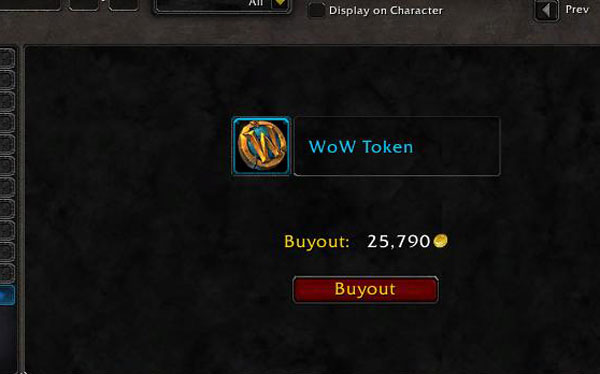
Now the fun (?) begins.
It shall be an interesting dynamic, yeah? On the one hand, I find it hard to believe that enough people have spent $20 on tokens to sell in the ~2 hours between the first batch I purchased and the second. On the other hand, Blizzard has so warped the playerbase over the years that $60 boosts and $25 character transfers have long ceased raising eyebrows. I personally know a few people who have transferred characters a half-dozen times (or more) following a migrating guild or chasing progression. In that sense, what’s another $20 here and there for gold?
The alternative theory is a bit more grim. Perhaps instead of there being too many extra sellers, maybe there aren’t enough buyers? If there is indeed an account-level limit of 10 tokens, there can’t be a mass-dumping of gold into the economy as even AH barons cap themselves out. We also know that the vast majority of MMO players are poor. So the actual market for these tokens will just be a narrow wedge of players who can make gold easily and don’t care about raiding, else they would be chasing the BoE epics that give them 5% better stats. And as I mentioned before, even these players will likely tap themselves out before too long – once you go past 3-4 months of paid time, what’s a fifth month really worth?
It will be an interesting year for WoW, that’s for sure. And if for some reason it isn’t… well, I’ll just let the account lapse and then revive it once it gets interesting again. For free. Forever.
Age of the MOBA
According to EEDAR, by the end of 2015 MOBAs will generate more revenue than (F2P) MMORPGs in the North American market:
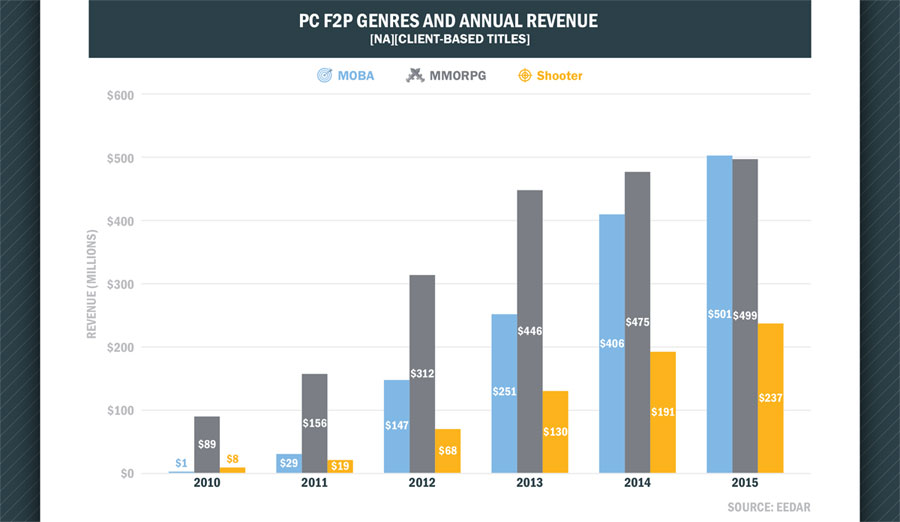
“Meteoric” pretty much covers it.
The difference is small – $501m vs $499m – but it’s impressive nonetheless for a genre that didn’t (formally) exist five years ago.
One thing is for certain though: MOBAs are the “new” hotness and are poised to overtake F2P MMOs either this year, or Soon™ in any case. Which is a fascinating turn of events for someone who really has less than zero interest in MOBAs specifically. Indeed, nearly every mechanic that make MOBAs “deep” are the same mechanics that make many MMOs terrible. For example, the whole Last Hit mechanic. Or having over a hundred different characters, many of whom are direct counters to others, requiring one to memorize a truly voluminous amount of minutia to succeed. You thought the whole Raid Dance memorization was dumb? Just wait until you spend time researching dozens of characters who don’t even get picked. Oh, and hey, I heard you like 40+ minute LFG fights were you (ideally) lose 50% of the time.
On the other hand, in the Venn Diagram for MOBA and MMO I wonder how much overlap there really is. Did some people leave WoW for League of Legends? What did they find on the one end that they did not on the other? Perhaps nothing, and the audiences are from two entirely different sources. Which really doesn’t answer the question of where the MOBA audience came from. Is this an entirely different generation of gamer coming to age during the rise of MOBAs? Or was this a deep pool of potential players who hitherto weren’t being serviced by existing products?
Maybe the answer is less complicated than I am making it out to be: MOBA players seemingly sprang from the earth because it’s all F2P. Easy to get into, easy to get hooked, and then easy to get monetized. As revenues approach half a billion dollars in NA alone though, this clearly is not a flash-in-the-pan phenomenon. Despite the MOBA saturation, revenue still increase almost 20% last year, according to the chart. You will undoubtedly have winners and losers in the market, but MOBAs are here to stay.
Which is… well, good for them. I’m going to play something else.


On Mods
Apr 30
Posted by Azuriel
As you may as heard, Valve’s grand experiment with paid Skyrim mods debuted and shut down in three business days. At one point the untouchable darlings reddit, both Gabe and Skyrim itself has taken a huge beating in the eyes of the horde; Skyrim went from a 98% positive feedback rating on Steam down to 86%. Gabe confirmed that the number of emails his staff received will cost them literally $1 million to comb through.¹
From my seat up in the peanut gallery, the entire issue of paid mods seemed to be a solution in search of a problem. Was there some crisis in the modding community preventing mods from being developed? Were popular mods being abandoned? What, exactly, was the issue with the status quo?
To be clear, I’m not against people getting paid for their work, in the same way I’m not against, say, religious liberty. At the same time, I don’t think the concept in of itself justifies every means of expressing it. The modding scene was already a healthy ecosystem built upon passion, collaboration, and natural curation. SynCaine points out there are some mods out there more elaborate and fun than the game they’re built upon. Just imagine how many more, better mods would be generated if said people were paid for their work?
Well… err, maybe eventually.
The Skyrim paid mod section was not active for long, but the future cesspit of theft and profiteering was clear to see. Who looked at Steam Greenlight or Early Access and thought, hey, let’s introduce that to the modding community? Under a paid mod paradigm, you literally can’t give your mod away for free, because someone else can and will turn around and try to sell it for cash.
During Gabe’s AMA on reddit, the creator of the Nexus website point-blank asked what Valve was planning on doing in terms of, you know, not single-handedly monopolizing the modding market. Gabe had no real answer. Which is a problem considering paid Steam mods would give even ambivalent modders every economic incentive to pull their mods from Nexus and any other site to exclusively use Steam Workshop. I mean, what, is Nexus and all the other sites supposed to suddenly create their own mod marketplaces?
With the paid mods plan on ice (for the moment), there has been some further crying about how “freeloaders” and “trolls” have won the day. Out of the entire fiasco, that sentiment bothers me the most. Erecting pay-walls around hitherto free content is an erosion of Consumer Surplus, full stop; it doesn’t matter whether modders “should” have been getting paid this entire time. Splintering the modding community into factions with negative incentive to cooperate is an erosion of Consumer Surplus. Maybe we get really well-done, professional mods out of the paid system eventually. But considering you are paying extra for that value, the Consumer Surplus gains may be a wash. In which case you are no better off than before, minus a thriving modding community.
Nevermind about all the bizarre arguments surrounding mods like DotA and Counter-Strike. Would those mods have achieved their meteoric status had they been priced “fairly” at the start? I don’t think anyone believes that that would be the case.
Do modders deserve to be paid for their work? Probably. Do I deserve to be paid for writing posts for the last four years? Feel free to Paypal me as much money you want. But as a consumer/reader, you are under no obligation, moral or ethical, to pay for something someone is giving away for free. And as a consumer/reader, you have every right to complain when your net Consumer Surplus is being reduced in any way. “Freeloaders” and “entitlement” are specious non-arguments, and especially absurd given how we’ll all talking about people who already bought a videogame.
If you want to pay modders, there is nothing stopping you. As in, right now. Go for it. I’m sure their contact information is listed somewhere on the mod page. Just don’t pretend this change was anything less than a fundamental redesign of the entire concept of modding. Or that this particular implementation was at all going to work, logistically or conceptually. In fact, I doubt that it ever does, even when Valve comes back to “iterate” the process later on. And by “work,” I mean generate more value in the aggregate for gamers and (free) modders alike.
¹ As opposed to Support tickets, which no human ever reads.
Posted in Commentary
9 Comments
Tags: Consumer Surplus, Gabe, Mods, Skyrim, Valve