Blog Archives
Impression: Firefall
When we last left Firefall, it was in the beta and I was labeling it “Firefail” in a moment of supreme cleverness. Basically, an early tutorial quest that required me to pick up a handgun wouldn’t complete, and a later re-attempt at playing the beta found me unable to download the final 0.04 MB of the file.
This time around, everything worked and I have spent ~13 hours across last week getting a feel for the game.
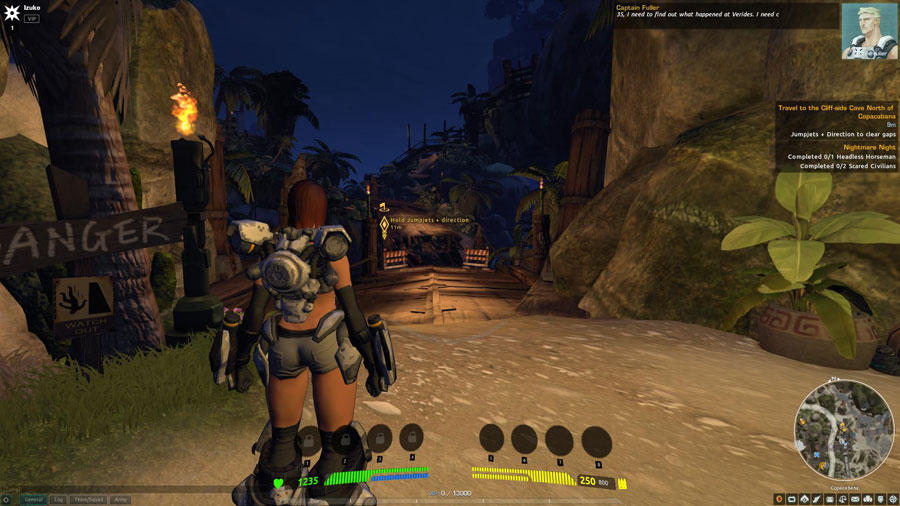
Booty Shorts are the future.
Firefall is a F2P 3rd-person shooter MMO, vaguely reminiscent of Mass Effect + Borderlands. You play as an ARES pilot, a sort of mercenary with the ability to swap in and out of battleframes, which are themselves the equivalent of classes. Different battleframes have different abilities and primary weapons, and each battleframe levels up independently of each other. At certain levels, you unlock Perks which can (usually) then be applied to your character no matter the battleframe you are wearing.
There are story quests of sorts you can follow in Firefall, although the main thrust of the game has more to do with random, open-world questing than normal MMOs. For example, a 15-minute story quest and a 2-minute quest to repair a generic Thumper generally give the same amount of XP.
The open-world part of questing is emphasized by the literal open-world: aside from needing to click on towers to push back the “Melding” – and the level-based mobs, a huge change from the early beta – you can generally run anywhere. And the world is absolutely HUGE in this game. Huge and vertical, even. Considering every battleframe has a jetpack (of differing quality), this lends itself quite nicely to exploring.

One of the better Glider jumps I’ve encountered.
As always, there are downsides. Although the world is huge, it also feels relatively empty. Part of this is literal emptiness, but part of this also comes from the vast distances between quests and the cash shop-based restrictions to moving around. For example, you can purchase a cash shop vehicle right away, or wait until level 25 to get one with a cooldown. Technically you can craft 1-time use transportation solutions (Gliders) too, but it’s generally easier to just turn on auto-run inbetween waypoints as you browse Reddit on your phone.
I like how you have one character that swaps battleframes rather than a stable of alts, but in practice everything ends up feeling more restrictive than less. If you’re playing Assault, I hope you enjoy your grenade launcher primary, because that’s the same weapon you’ll be using forever. If you swap to Engineer for a change of pace after 12 levels, suddenly you’re going to need to hoof it back to the starting zone and kill level 2 mobs again, assuming you even have low-level weapons to use. Since the story missions aren’t particularly rewarding, the end result is you repairing Thumpers 200 times just to get back to where you were in the first place.

CardioFall
The shooty bits are fun for fans of shooty bits, but… it’s hard to describe, but there’s some essential element missing. “Substance” is the best word I can use to describe it – you feel like you are shooting at ghosts all the time. There is technically collision, mind you, it’s just that the enemies never feel like they belong anywhere or behave particularly rationally. On some of the random missions you will walk into a room that is filled with 30+ enemies and get mowed down without understanding why the room had 30+ dudes in it. Was it intentional? A bug? Was it actually a hidden group quest? I actually survived that cave, but mainly by abusing the poor AI rather than any sort of fancy shooting on my part.
Overall, I don’t anticipate playing Firefall for much longer. The game is F2P and it does seem like you could get a lot of gameplay in legitimately without feeling too much like a 2nd-rate citizen. Hitting level 40 (the cap) supposedly gives you the ability to purchase one of the 10 cash shop classes, although you can technically get them off the AH for in-game currency as well. That said, it’s hard to imagine hitting the cap and playing the same routine missions again and again, this time with a different primary gun.
So… Firefall. Certainly not the worst F2P game I have ever played, but there are better options.
TitanSide PlanetFall
After gorging myself on Titanfall for the past few days, I just wanted to re-affirm my impressions from earlier.
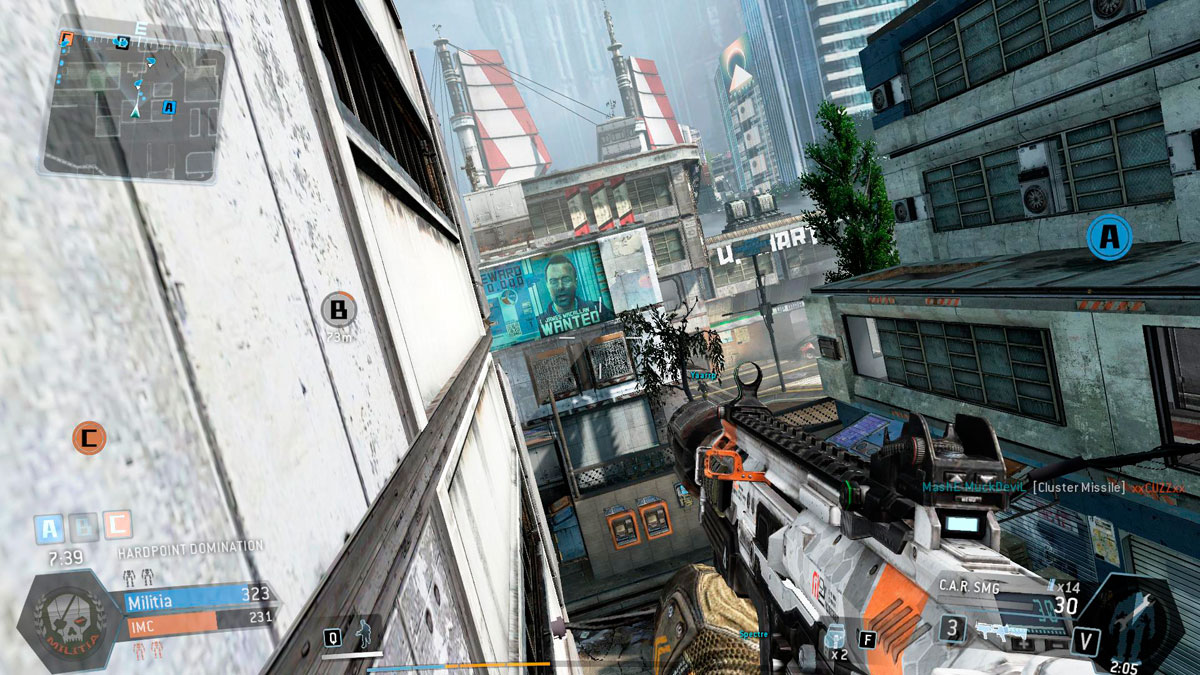
This = Very Fun
Essentially, Titanfall is the quintessential wirehead game: an absolute orgy of sensory experiences surrounding a hungry engine of time destruction. Respawns take less than five seconds. Time-to-Kill is better measured in mouse clicks. The game is so frantic and fast-paced that the 90 seconds inbetween matches feels like an eternity. This is the sort of game where nobody would have time to type “GOGOGO” if there were even a chat interface in-game, which there isn’t. There’s one in the lobby, but it’s sole function seems to be pre-game prognosticating (“Lame, they have two G6 players. GG”) and post-game trash talking/ragequits. There is also voice chat, but it too seems superfluous – what sort of coordination is possible or even necessary when your foes could be cloaked and across the map in 15 seconds or less?
I have never owned a Call of Duty or Medal of Honor game, so this could all be old news for some of you. I cut my teeth on Counter-Strike and Halo and Battlefield 2 which, at least back in the day, seemed to take a bit longer.

This = Less Fun
What is somewhat sad is my motivation for playing the game. Essentially, I’m playing it as a PlanetSide 2 substitute. They aren’t really comparable games at all, but sometimes you just want to shoot people in the face, sci-fi style. PlanetSide 2 was failing on the “people to shoot” front, and there is every indication that it’s eternal beta is catching up with it. Specifically, either it’s hemorrhaging players or hemorrhaging paying customers (or both). Anything less than a 24v24 hex is a waste of time, and even the few freebie kills from the spawn room of hopeless defenses is losing its luster.
And by the way, can I just reiterate how asinine faction-specific game experiences can be? I chose VS more than a year ago and have almost all of my unlocks and such spent on that character. There is not a single moment in which I have not regret that choice. I have infinite more fun on my TR and NC alts based solely on their faction-specific missile launchers. Infinite! About the only redeeming factor for VS is the Lasher (which is garbage 98% of the time) and the fact that the Scythe fighter jet thing doesn’t have bars across the cockpit windows. That’s it. A single TR or NC dude with a rocket launcher is a threat; a single VS dude with a missile launcher is a threat 10 minutes from now.
I brought up the Titanfall vs PlanetSide 2 comparison for another reason: I’m realizing the inherent imbalance of level-based unlocks. In Ps2, you are given a menu to select upgrades from. In Titanfall, you unlock things at certain levels, or occasionally based on achievements. I recently unlocked Satchel charges, for example, and it is better than grenades by a factor of a little over 9000. Most upgrades are technically sidegrades-with-downsides, but usually you’ll find that you can more than compensate for the trade-off. What you can’t really compensate for is that your guns or whatever can/will be weaker than those who played longer.
In any case, the one thing Titanfall absolutely must fix (and soon) is it’s utterly repulsive and/or non-existent matchmaking system. There is a “beta” version out there for Attrition and Hardpoint modes, but I cannot begin to imagine what that is supposed to mean in any context. Is it really that difficult to not have matches like this:
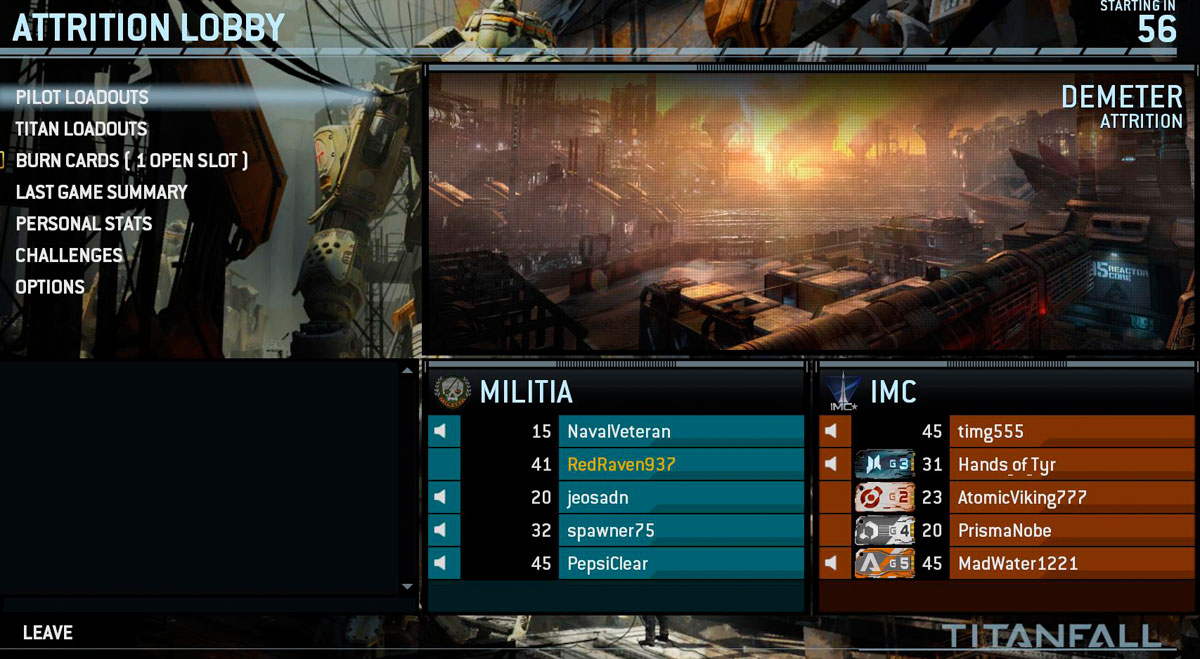
This = Rage Quit Worthy
Those special symbols are sorta like the Mass Effect 3 multiplayer tags, e.g. it denotes a player who hit level 50 and reset their progress to level 1. After “Generation 2” it also requires you to earn 4-5 special achievements in order to unlock the, ahem, next generation. It’s not fucking titan science to, you know, spread those guys around. Hell, I don’t even care if the G5 player is a skill-less noob somehow (pretty difficult to imagine), it’s just goddamn demoralizing heading into a 6v6 match of any kind looking down that sort of barrel. Give us the G5 and G2 and let them keep the G4 and G3. Bam! Balance! What’s worse is that you’re stuck in the same lobby of people from match to match unless you specifically leave, which tends to cement the winning teams harder and harder.
Anyway: Titanfall. Shooty-shooty, explosions, instant-kill jump kicks, wall-running. I spacebar through the 5-second kill cams so I can perma-sprint into the adrenalin high faster.
Beta Impressions: Hawken
In an effort to both delay poor decision-making and assuage the pain of not having purchased Titanfall for $48 via GMG, I decided to download and play Hawken this weekend. Apparently the game is still in open beta (since December 2012), even though I could have sworn it had been released already, but whatever.
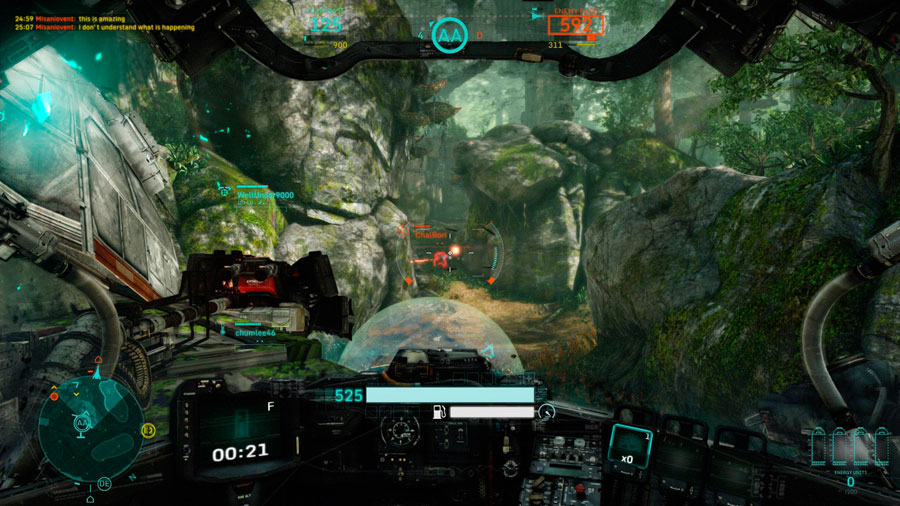
Graphics are pretty decent.
Hawken is a F2P F2Download FPS mech PvP game. Considering it too has a 6v6 player limit, there are a lot of amusing parallels to Titanfall, actually. The mech combat feels legitimately like you are inside a mech – it takes time to get momentum going when moving, your turning speed is slow, and so on. That being said, your maneuverability is actually pretty good with the assistance of thrusters, allowing you limited ability to fly through the air, do quick dodges, and do a 180-spin. Some mechs have larger (regenerating) fuel reserves than others, and there are lighter mechs that can perform all sorts of mid-air acrobatics.
The shooting feels pretty good and the TTK (Time To Kill) seems reasonable; you frequently have enough time to register you are taking damage and get to cover without dropping past 50%. All mechs can repair themselves, but it leaves you insanely vulnerable for up to 10+ seconds, the first few of which do not repair you at all. There are a few other ways to get some repair action going (defeated mechs drop health orb things), but I actually like how “sticky” damage ends up being; the prevalence of cover-based firing plus regenerating HP in FPS games has led to an over-reliance of ultra-short TTK, in my opinion. In other words, in Hawken you can dance around cover taking potshots at enemies, but eventually you’ll have to give them the opportunity to rush your position.

Pretty badass, actually.
Out of the very few games modes Hawken has, the most unique is probably Siege. Basically, each side attempts to gather power resources from either power stations or stealing it from downed mechs, and then deposit it back at their base. Once enough has been gathered, a capital ship appears and starts slowly flying towards the enemy base. At this point, the main goal is “capping” the AA turret in the middle of the map, as it will quickly destroy an opposing ship. If the ship gets within range of the enemy base, it will start damaging it, and your side wins when the base HP goes to zero. If both sides summon a capital ship, they will duke it out in the skies above.
Most interestingly though, your own mechs can fire at the capital ship and deal damage. There are exposed turrets that can be destroyed to significantly reduce the offensive power of a ship, and with enough time even a single mech can whittle the rest of the ship’s hull down with concentrated fire at the engines. All of which introduce neat little dilemmas throughout the battle: do you focus on gaining power, or slowing the enemy’s power gains? Do you bunker down on the AA and hope someone else on your team caps power? Do you assault the AA or do you spend time shooting the capital ships from the ground?
Having said all that, the main concern with these sorts of game are the progression/reward system. And it’s here that I feel Hawken flounders a bit.
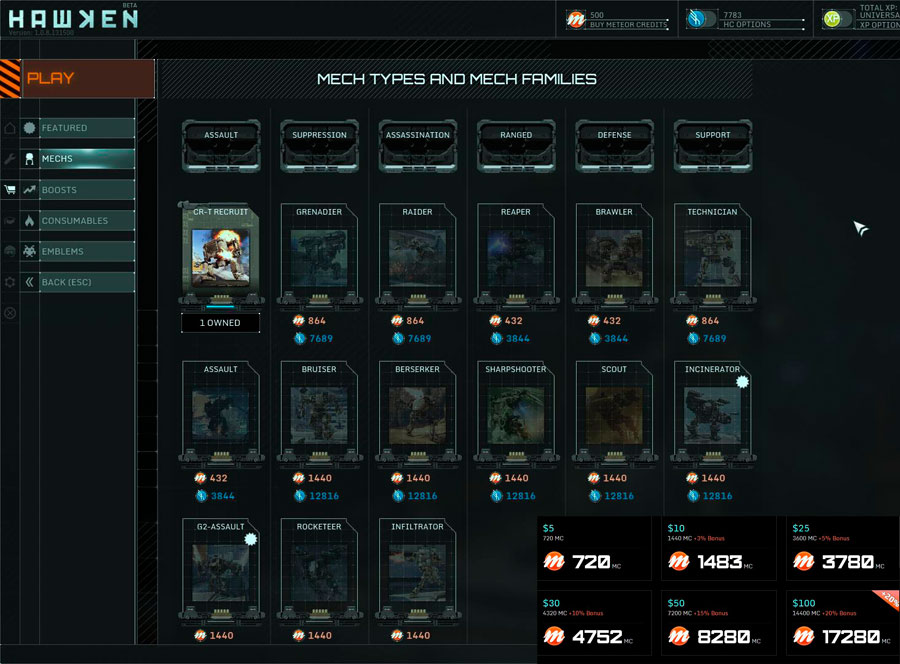
If you have a $100 option in your F2P game, please reevaluate your life choices.
Pretty much every single thing is an unlock you purchase with Hawken Credits (HC) or with the RMT Meteor Credits (MC). While you start off with a rather large sum of HC, each subsequent battle adds maybe +250 HC at the top end. Sometimes you get as little as 70 HC. Other mech chassis start at 3800 HC and go up to 12,000+ HC. While it is tempting to not spend any HC until you hit that first tier of new mechs, you forgo equipable items and passive abilities (costing anywhere from 300 to 3500 HC apiece) in the process, making you that much weaker for longer. And by the way, each equipment unlock is specific for that mech. Spend 3k MC on regenerating armor on one mech, and you’ll have to spend another 3k to unlock the same item elsewhere.
Is there any P2W? Strictly speaking: no. However, Hawken absolutely features strictly-better upgrades and arguably strictly-better mech types such that you can easily get creamed by more advanced players (who might have spent money to get there). At the most basic level, for example, items have one charge per respawn; their Mk III versions allows three charges per respawn. Thus, even though we might be able to say that grenades or EMP blasts or whatever is balanced, having access to them as essentially a spammable ability (cooldown aside) is not at all balanced in comparison to someone with just a single charge.
Overall, the game is decent enough for a 3.5gb F2Download title. There aren’t a whole lot of maps (7-8ish) or game modes (5) or even opponents (6v6), but the action nevertheless feels quick, responsive, and generally cool as a mech pilot blowing shit up. Hell, each mech’s ability to hover and dodge and boost forward almost made it feel like Titanfall for like a whole second there. Not the fairest of comparisons, of course, but there it is.
Reviews: RAGE, Crysis, Sanctum 2
Game: RAGE
Recommended price: $0; bundle
Metacritic Score: 79
Completion Time: 13 hours
Buy If You Like: Racing games with FPS elements
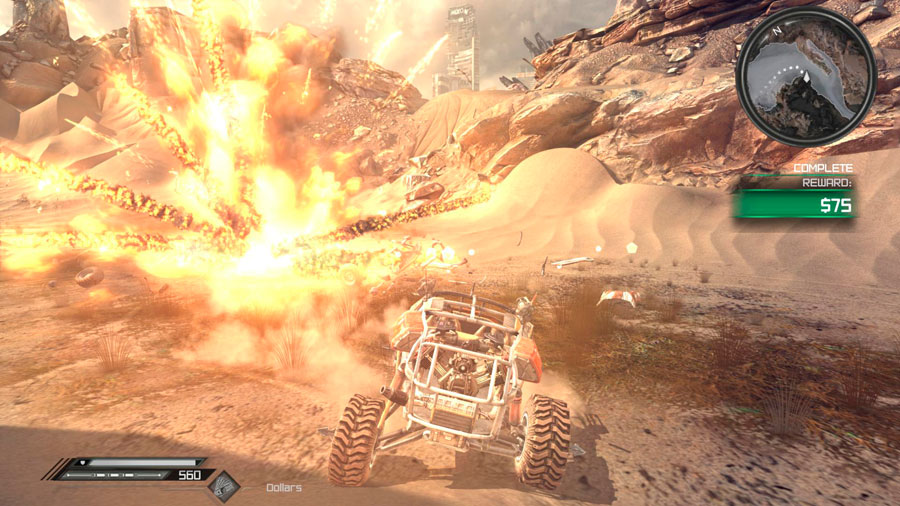
What you’ll be doing most of the time.
RAGE is a simplistic, 27gb racing game with some FPS bits tossed in.
Perhaps that is not entirely fair. If you include all the time you spend backtracking through the same exact environments, Halo-style, the game probably comes out to be 51% FPS or thereabouts.
In RAGE, you take control of a mute super-soldier who just woke up from cryo in the post-apocalypse future. After being rescued from some blood-thirsty raiders, you join the most generic-named faction in the world, the Resistance, to fight against the second-most generic-named faction, the Authority. Apparently the “Ark” containers (like the one you were on) were all supposed to be opened at the same time to usher in a new age of civilization. Turns out other Ark survivors somehow stopped that from happening, thus establishing themselves as rulers over the populace that apparently didn’t need space technology to survive the apocalypse.
Technically the above is a whole mess of spoilers, but considering there is literally no other plot, no character development, no competant writing, or really any redeeming factor for the game, it becomes necessary to work with what you got.

The set pieces can be kind of cool.
I take that back. There is precisely one thing RAGE got amazingly correct: melee enemies that are legitimately scary. The typical FPS that features melee enemies usually has to rely on them being bullet sponges or incredibly fast to compensate for their lack of cover-usage. In RAGE, melee enemies dodge back and forth, run up the walls, swing from ceiling fixtures, and otherwise make you reevaluate your damn-near-futile attempts at shooting them in the head. While I’m sure a lot of their acrobatics came down to heavy environmental scripting, it’s still something I’d like to see in games going forward.
What I would not like to see ever again is such a piss-poor implementation of damn near everything else. Little things start to grate on your nerves, like how pressing Esc brings up the main menu instead of canceling out of the Tab menu. Or like how you can hit Esc, choose Quit Game, and then it takes you to the Title screen where you have to hit Enter and then Quit Game again just to leave. Or how you have the ability to jump in the game, but not enough height to actually jump over anything 99% of the time.
I can appreciate the devs rebelling against the “only carry two weapons” FPS headwinds, but out of the nine weapons, eight of them have at least one extra type of special ammo. The crossbow carries normal arrows, explosive arrows, electric arrows, and mind-control arrows. Cool… except there is exactly one stage that allows electric arrows to do anything special (the stage they’re introduced in), and the vast majority of the enemies you fight after getting mind-control arrows are either immune to the effects or infeasible to use against.
In the end, RAGE doesn’t know what it wants to be or to do, and neither do I. Well, other than wishing I was playing something else. If you can grab it as part of a bundle, it’s worth checking out the legitimately scary melee enemies. But I wouldn’t necessarily give up a box of Girl Scout cookies for the privilege.
_____________
Game: Crysis
Recommended price: $0; bundle
Metacritic Score: 91
Completion Time: ~15 hours
Buy If You Like: Benchmarking your PC, Sandbox-ish FPS games
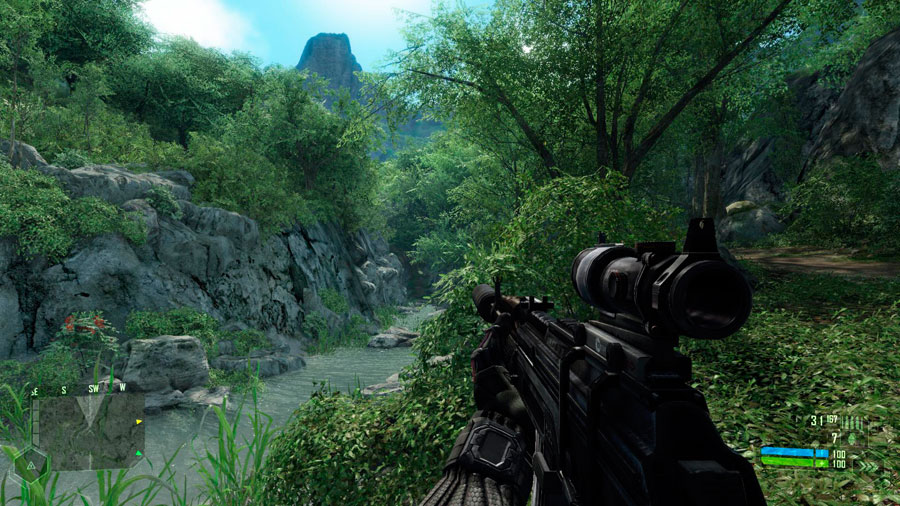
Seriously, 2007, folks.
Crysis came out in 2007, nearly seven years ago, and was the long-reigning benchmark of PC gaming everywhere. Not necessarily in terms of gameplay, but literal benchmarking – if your rig could play Crysis on High, you were hot shit back in the day. Crysis 3 was out for months before I acquired the original in some Steam sale or another, but I wanted to give the original its due, especially considering I finally had a computer (in 2012) that could run this beast.
Unfortunately, Crysis on Steam caused me considerable issues. I honestly cannot begin to recount exactly what steps were required, but I know some modding and 3rd-party downloads had to be done before the game would even boot up. Even when it deigned to boot, I experienced a C2D event roughly every hour or two on top of game-stopping bugs like missions not ending correctly.
Outside of those issues though? Damn, people weren’t kidding about the graphics thing. I mean, the game basically looks kinda like Skyrim, but Skyrim was released in 2013.
What I was really surprised by was the general gameplay though. Crysis is a FPS game where you control an elite soldier equipped with a nanosuit that has a handful of alternate abilities like cloaking, super-strength, super-speed, etc. Unlike perhaps every other game in existence though, you get all of those abilities right at the start. Indeed, most of the game consists of you getting a primary and secondary objective on a large map and being told to hop to it; the pseudo-nonlinearity really reminded me of the original Far Cry. This leads to the game feeling rather easy though, as for the most part you can abuse Cloaking and jungle-hiding to take out basically every enemy in the game, especially considering the suit provides regenerating health.
Overall, Crysis is FPS in which what you do in the first 30 minutes of gameplay is the same thing you’ll be doing in the last 30 minutes of gameplay. The graphics and environments are phenomenally well-done, but I’m not entirely convinced it would be worth the headache of installation unless you want revenge on its at-the-time insane PC requirements.
_____________
Game: Sanctum 2
Recommended price: $0
Metacritic Score: 77
Completion Time: 10 hours
Buy If You Like: Console ports of a dumbed-down sequel
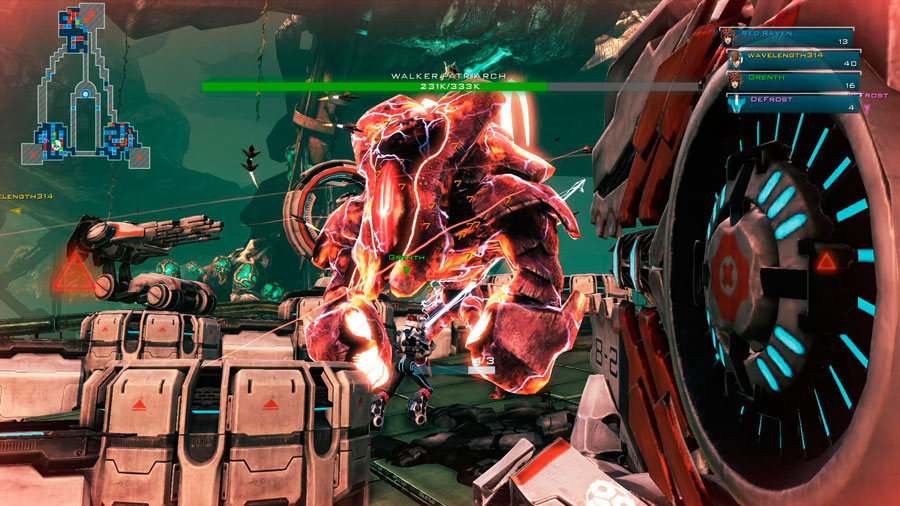
That 15-tower limit is fun in multiplayer, let me tell you.
The original Sanctum, along with Orcs Must Die that was released around the same time, really sparked my interest in Tower Defense as a genre. Prior to that, Tower Defense was just associated with those annoying missions in RTS games that always seemed too hard or too easy. But Sanctum? Here is Tower Defense where you can not only build the maze yourself, but actually get down and dirty with shooting the bad guys. And multiplayer! So fun.
It’s just rather unfortunate that Sanctum 2 ended up being the sequel.
I have not even bothered to investigate it, but Sanctum 2 <i>feels</i> like everything that goes wrong with console ports of otherwise great PC games. There are four characters to choose from, each with various innate abilities and a main weapon that cannot be swapped out. Want to use the Sniper Rifle and Missile Launcher? Nope, that’d be too complicated. Instead of getting a pile of resources and having to carefully consider their application – do I build an extra-long maze, or upgrade all my towers? – you specifically get X number of wall units and Y amount of resources to apply to 15 deployed towers maximum. Oh, and everything is a tower now; there aren’t any floor traps (unless you count landmines).
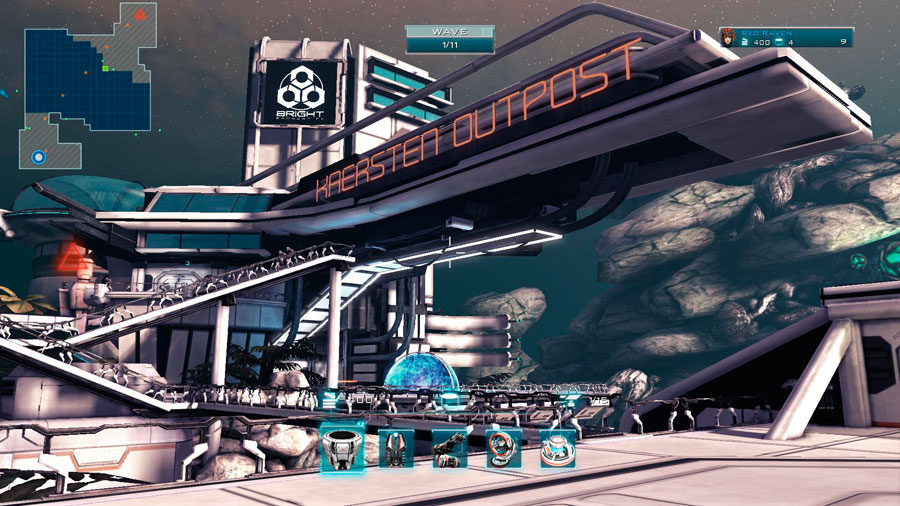
Four walls and 400 resources? Gee, thanks, I’ll get right on this maze.
I can understand the logic behind most of these changes, as it pretty much universally speeds up the matches. “You can build 8 walls and drop maybe 2 towers this round, good luck.” I can wrap my head around breaking characters into distinct classes, as perhaps a way to foster more teamwork. The designers even took the time to introduce a Perk system to allow a bit more customization with characters. And hell, the ability to voluntarily buff enemies (sorta like in Bastion) to gain more XP is a pretty clever difficulty switch.
But at the end of the day? The game still felt like a truncated console port. I found a rather ridiculous combo of perks and weapons early on and sailed through the game with the exception of a few maps that had surprise bosses in them (most of which can simply destroy your maze walls). The tension between adding more walls or more towers afforded a surprising amount of strategic depth to the original game, and it’s simply absent here. In short: a lot of the things that were fun in Sanctum are replaced with either not-fun things or simply missing altogether.
_____________
Beta Impression: Battlefield 4
I have been playing the Battlefield 4 beta these last few days, and I’m not quite sure what to think.
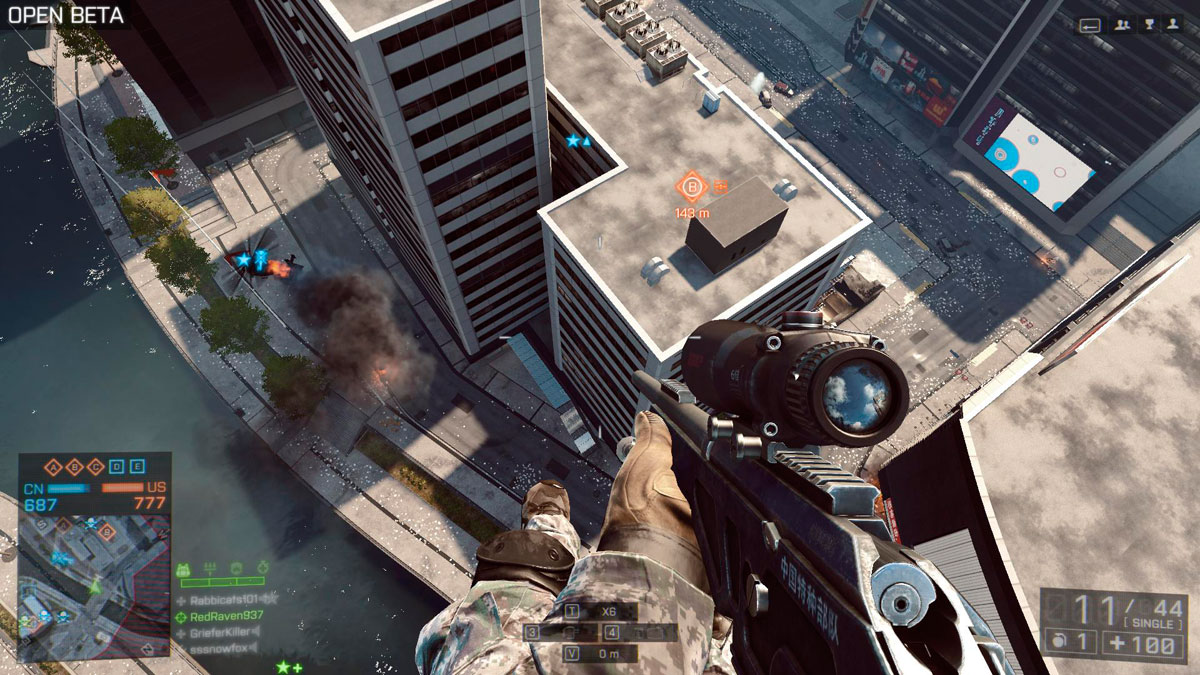
40 fps on High without latest video drivers.
It certainly isn’t the jump in quality from Battlefield 2 to 3, that’s for sure, although there are some interesting moves. For example, the default rocket launcher has a tracking mode that activates when the Recon class designates a target with their binoculars; this sort of solves the incredible power discrepancy between Engineers that had unlocked the, er, lock-on launcher versus newbie players.
Another interesting change was how they gave the Recon class (aka snipers) C4 charges. While this makes roof-top campers extremely annoying – they can drop C4 at the elevators and wait for the door opening sound for an auto-kill – it also creates an amazing tension in the class. Do you run out and C4 that tank while risking being caught in close-quarters with a sniper rifle, or do you hang back and try and snipe with a tank blowing you and your team up? Giving snipers claymore mines and assault classes C4 makes more thematic sense, but reversing those roles makes for more interesting gameplay decisions. Even better, the thermal Binoculars you get not only lets you lock on to vehicles for your teammates to kill (you get bonus XP when they do so), but it lets you more easily spot enemies running around that are too far to hit. Or, honestly, that you aren’t skilled enough to hit. Just spotting them is basically 1/4th a kill though, and it’s a useful service to do so.
Win-win.
However, some design changes have gone in the wrong direction. Technically, it was Battlefield 3 that “introduced” the concept of the medic class having to actually unlock their core ability, i.e. to revive people, but Battlefield 4 is taking that to ridiculous extremes. It takes 11,000 Assault-class XP to unlock the Defibrillator, which I hope to god is a placeholder value. Perhaps if smaller maps were available it might not be so bad, but actually getting that amount of XP on a class that otherwise brings nothing interesting to the table is a massive chore; not only do the other classes have easier ways of racking up easy XP, but remember that BF4 (and BF3) made the change to a regenerating HP model too. Between that and the near-zero Time To Kill numbers, the ability to throw a Med-Pack is only ever useful when you find yourself dueling someone from behind cover.
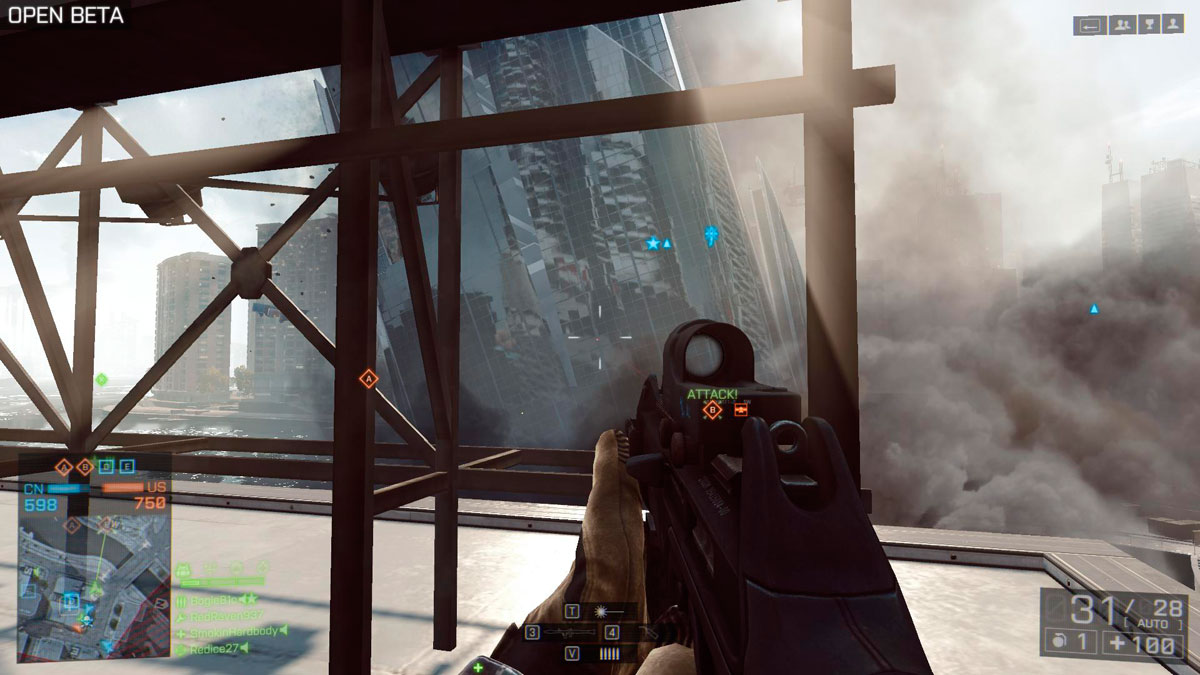
That tower is just bad news anyway.
The unlocking situation gets even more ridiculous when you look at the Support class, aka the ammo guy. While I suppose it was annoying/immersion-breaking when a single Support dude could drop an ammo box and spam infinite grenades over the wall, putting the ammo box behind a 52,000 (!) XP grind-wall is an extreme overreaction. The most obvious trickle-down effect is that it makes every class weaker by extension: what good is an Engineer without rockets? Given how you respawn with full ammo, the smart move is then to play both aggressively and carelessly by spamming everything you have and then effectively suicide yourself for Round N+1.
While there has also been some grumblings over the idea of “Battlepacks” – random lockboxes filled with camos, dog tags, XP bonuses, etc – as someone who played Mass Effect 3’s multiplayer for a while, I don’t see it as such a big deal. Yes, it is a cynical cash grab given how you can pay money to buy those things. However, as far as I can tell, you do not actually unlock more powerful weaponry from these boxes. Which automatically makes them less of an issue than ME3’s lockboxes where opening a rare Widow or Carnifex/Paladin was basically the start of your game.
Beta is beta though, and this one is more restrictive than most. Overall, I can’t say that I’m too impressed. It’s honestly been so long ago that I uninstalled BF3 that I forget if being able to spawn inside a vehicle from the Deploy screen is something new to BF4 or not. And, really, that’s kinda what it comes down to: why do we need Battlefield 4 again? Once all the maps are unlocked, then perhaps we’ll see where the differences lay. Plus, supposedly Commander Mode is back.
But right now I do not see any reason why I would be compelled to purchase Battlefield 4 on Day 1 as opposed to when they bundle the game + first Map Pack together. Or, really, when they bundle the game + Season Pass.
First Impressions: Dust 514
After talking about this F2P title on and off for the most of last year, I decided it was about time to put my conjecture where my mouth is. Err… hands? You know what I mean.
After quite literally dusting off my PlayStation 3, I started the process of downloading the 1.3gb game. To kill some time, I started playing Journey while downloading Dust 514 in the background. I didn’t make it more than five minutes before stopping Journey and doing some research as to how I could take screenshots on the PS3 because damn. An hour later, I stopped looking at $150 video capture cards and finished installing Dust 514. Ten minutes later, I begin updating the game. Forty-five minutes later, Dust 514 finishes downloading and installing a patch larger (!?) than the entire original download.
Now, if it has not already been clear from historical record, let it be noted that I am not much of a console gamer. This was not always the case. In fact, all the way up until the end of the PS2 era, I was a console purist. With the notable exception of Balder’s Gate and the original Deus Ex, I felt like PC RPGs were cheap imitations of the holy JRPG (i.e. Squaresoft), which could do no wrong. In my prior life as a freelance RPG reviewer, I have 60+ “published” RPG reviews attesting to that fact; I even gave Planescape: Torment a below-average score because the combat system was bad.
I’m bringing this up to illustrate the fact that this entire console generation has left me behind until now. Or, rather, I left it behind. Although I was in college during the Halo heyday and thus have experience playing its first three iterations many times in the fraternity house, I never personally owned an XBox. Ergo, my skill at thumbstick shooters is abysmal. Give me a mouse and keyboard and I will shoot your aim-assisted face off any day. Ask my thumbs to do more than spam the Spacebar though, and I’ll have some rehabilitation issues.
Enough preface, let’s dive in.
First Minutes
God damn this game is ugly. This seriously looks like I’m watching a 480p Youtube video of someone playing Turok: Dinosaur Hunter. Yes, the Nintendo 64 version. Don’t get me wrong, it looks better than Darkfall, but it also looks like it was drawn entirely in watercolors on a soggy canvas. Or I’m looking at it through goggles filled with river water. My first red flag should have been the 1.3gb download, I suppose, although Skyrim was Skyrim with just 5.8gb. Then again, that was on the PC…
I made Azuriel Inanage a Gallente something something race, a decision based entirely on the look of the face mask. In my defense, the entire race decision seemed somewhat pointless considering everyone is in armor all the time, mercenaries can fight for any race, and you can train every race’s gear. I sat through several tutorial screens which showed me around the basic lobby interface, with its amusing “Would you like to learn more?” Starship Trooper prompts. They start out giving you 500,000 Skill Points and 250,000 ISK and then… basically drops you off at the pool.
Now, I still struggle with the judgment as to whether a game developer deserves a pass for this sort of design. Is it the noble “sink or swim” attitude, or is it “crunch time, we’ll fix it in a patch later” lazyness? I’m personally willing to muddle my way through a considerable amount of bullshit in search for that one kernel of fun, but that’s mainly because I’m a masochist at a minimum it becomes easy blog content. And I am not even really saying that Dust 514’s Skill/etc system is hard. It’s just… opaque. 100% function, 0% form.
You basically cannot spend Skill Points until you pay ISK for a Skill book that unlocks that specific Skill. So to start, I needed to purchase Skill X for Y ISK and then spend Z SP to unlock Rank 1. Some of the skills are “empty,” in that their sole function seems to be to sink ISK/SP by forcing you to rank up just for the privilege to access other skills. Others are more functional, like increasing shields by 2% per rank. The system seems to promote unlocking as many Rank 1-2 skills as possible (these ranks only cost 18k-36k SP), but you are gated pretty hard by ISK, at least at first.
So let’s go get some ISK.
It is worth noting, before I get into the outcome of my first few matches, how this game works. You start out with a few different loadouts with basic gear that you can always equip no matter what. Every other thing in the game, from weapons to side-arms to grenades to the very dropsuit you wear is a consumable resource. Meaning, each time you die and respawn, you lose everything you were wearing. Did you just buy some uber-gun but get ambushed at the spawn point? It’s gone now.
I suppose this is designed to evoke a feeling of risk and gravity as a counter-point to the more standard suicidal FPS inclinations. I wouldn’t say that I am completely risk-adverse per se, but I absolutely hate the feeling that I would have been better off not playing at all. Losing WoW Arena games back when hitting 1800 represented a huge leap in combat effectiveness, for example, felt brutal; there was no worse feeling than starting at 1780 Rating and then losing six games in a row. Dust 514 evokes that same feeling, as not only can you lose a bunch of purchased gear right away, but that gear also represents ISK you could have spent buying Skill books instead.
As it turns out though, those ISK concerns may be moot.
My first match was pretty bad, entirely due to my aiming like… well, like I was holding a gun using just my thumbs. It was a “Skirmish” map, which breaks down as a pretty standard cap and control game. At the end of the match, it turns out I received ~150,000 ISK for losing. Based on my experience thus far, the payout seems to be mainly based on time spent; the difference between a win and a loss seems to be around 50k ISK. Also, you can end up receiving “salvage” in the form of guns/equipment. I am still technically in the “battle academy,” aka the kiddie pool, but I would be surprised if you end up earning less out in the game proper.
Given how much ISK you get either way, any consumable equipment concerns are severely diminished. Even a top-tier assault rifle only costs ~11,000 ISK. There was not a full match in which I died more than 8 times, so I would still have turned a profit despite losing all those guns. Plus, presumably a better weapon would mean dying less in the first place. The value of a whole suit loadout is probably more substantial, but quibbling over the 700 ISK mid-tier guns suddenly seems silly. If this is the paradigm though, why bother with all the ISK nonsense to begin with?
Ah, right. Free-to-play.
Instead of purchasing items individually, you can buy blueprints which give you an infinite supply of them. These blueprints, assuming they don’t drop as salvage, can only be bought via Aurum, the RMT currency. Now, Dust 514 is probably cheaper in the scheme of things compared to, I don’t know, Planetside 2. But in this particular case, the game mechanics themselves feel a bit more insidious. Granted, it could just be my bias showing through, especially given how Dust 514 lets you preview the weapons or effectively “buy them” for significantly less than the Planetside 2 equivalent.
Honestly, I just don’t like consumable anything, even if I have more than I would ever need. I’m the guy still hesitating to use the stockpile of Elixirs while fighting the final boss. It makes no rational sense, but there it is. Ergo, I’m leery of CCP having my number, so to speak, when it comes to these blueprints. I’m not actually going to buy any, but I will feel bad all the same.
Anyway, those are my Day 1 impressions of Dust 514. Like always, I will stick with the game for a bit longer just to ensure that I give it as fair a time as is possible under the circumstances.
Review: Borderlands 2
Game: Borderlands 2
Recommended price: $20 + $10 season pass
Metacritic Score: 89
Completion Time: 30+ hours
Buy If You Like: Funny and nonsensical cel-shaded FPS games
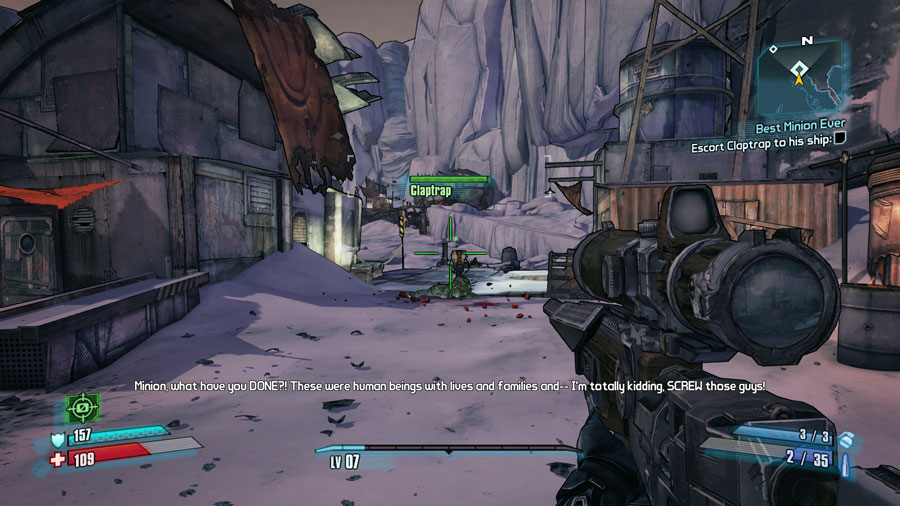
Some (most?) of the humor is a little juvenile, but some jokes had me rollin’ all the same.
Borderlands 2 is the cel-shaded, “why so serious?” smash-hit FPS pseudo-Diablo-clone follow-up to the original breakout Borderlands. Taking control of one of the four classes (or five with DLC), you set off on an adventure of mayhem and random looting across the now-much-more-varied landscape of Pandora, helping the heroes of the original game try and stop Handsome Jack from taking over the world.
To be honest, I am having a difficult time reviewing Borderlands 2 after having spent 130+ hours playing it. If you played the original, BL2 is better, longer, and more… Borderlandy than before. If you haven’t played Borderlands before, well, prepare to experience one of the frighteningly-few games out there with a distinct style. Said style might be nonsensical ultraviolence, but at least it is consistent and generally amusing.
The basic flow of the game will be familiar to anyone who has played a Diablo derivative: get quest, kill mobs, get random loot, repeat. There is a decent range and variance of mobs, but the AI controlling them is not especially robust; every encounter either involves mobs rushing to melee or shooting from range. In fact, since all the visible mobs aggro after the first shot and many mobs simply don’t exist until you get within range, an entire swath of the strategic playbook (Stealth, sniping) consists of blank pages. This is no different than what occurred in the original Borderlands, so if it was fine for you then, it will continue being fine now.
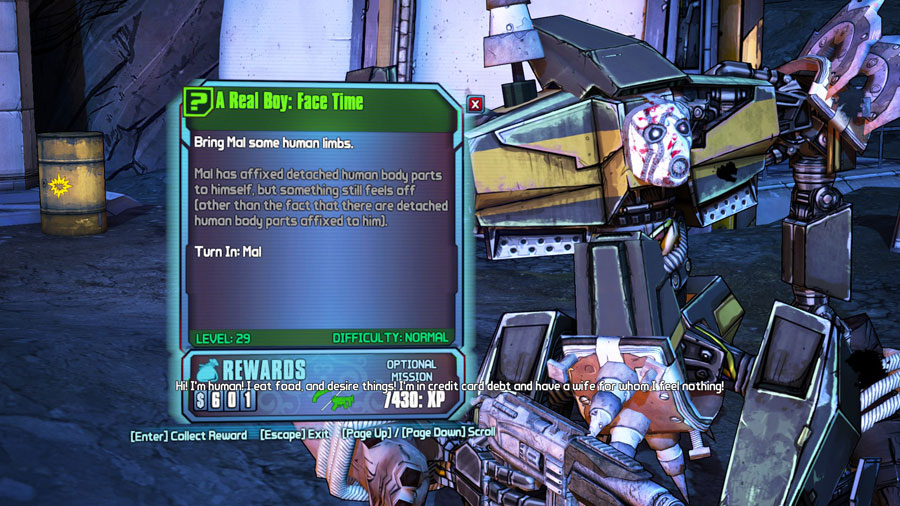
Not your standard quests. Well, they ARE, but still…
What saves BL2 can be summed up in three words: guns, guns, and guns. The trick that the Borderlands series pulls off is not merely emulating the loot-centric gameplay of Diablo, but how the loot itself can change how you approach the encounters. If a really kickass shotgun drops, for example, you might find yourself suddenly getting more up in psychos’ faces than you were just five minutes ago. While the character talent trees stamp down on this more freeform behavior by virtue of weapon-specific bonuses, respecing is only a trip to town away. And sometimes that minigun that shoots missiles is just too much fun to fire to care about trivialities like your +15% critical hits with sniper rifles.
Once you complete the game proper, you unlock “True Vault Hunter Mode” which allows you to redo the game from the beginning while keeping your level, cash, and gear. The enemies in this mode get new abilities, more health, and hit significantly harder as you plow your way to the level cap of 50. While this difficulty extends the life of the game quite a bit, it also leads into some counter-intuitive behavior. You see, sidequests typically reward you with unique items that are scaled to the level you were when you started them. Ergo, the “correct” way to play TVHM difficulty is to skip ALL of the sidequests until you reach level 50, and then go and complete them for the highest-level version of the unique items. Otherwise, the unique items may as well not exist, as they will inevitably be replaced by even the most generic level 50 drops.
As I mentioned before, I have clocked in over 130 hours into Borderlands 2, with around ~20 of those hours being from two of the DLCs. Although I chose to play solo the whole way through, I’m positive that the experience would have been even more entertaining with a group of friends. Hell, the DLCs even include the equivalent of 4-man raid bosses, if you are into that sort of thing. By the time you start to question why, exactly, you are chain-farming the last boss for legendary drops, Borderlands 2 will likely have generated twice as many hours of entertainment as your last non-Skyrim single-player games combined.
So get in there and start shooting some faces.
Review: Syndicate
Game: Syndicate
Recommended price: $5
Metacritic Score: 69
Completion Time: ~6 hours
Buy If You Like: Amoral cyberpunk FPS bastardizations
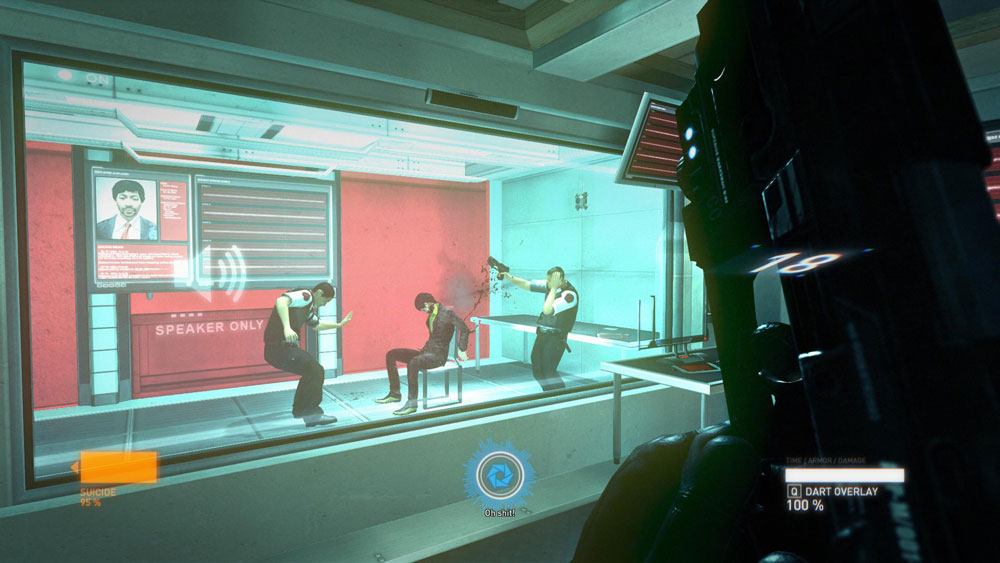
Style over substance ^ 100
Syndicate is a FPS reboot of the 90’s series of the same name. As someone who never played the original series, I became interested after watching the trailer and was drawn towards the dystopian cyberpunk setting as a means of getting through my Deus Ex withdraw. Indeed, at first glance Syndicate has a lot in common with Deus Ex on a thematic level, although Syndicate never really goes any farther than reestablishing the rather brilliant lore of prior games. There are no deeper ramifications to your actions, or introspection on the nature of humanity, or much beyond entertaining gunplay, so… not really like Deus Ex at all.
The premise of the game is that you are Kilo, an Agent of a syndicate named Eurocorp, who just developed a highly-advanced neural implant that grants access to various powers. In this future, industrial sabotage takes on an incredibly literal meaning, with Agents of rival syndicates tasked with infiltrating R&D departments and basically killing/stealing ALL the things. During a mission to do exactly that, a conspiracy is uncovered, reinforcements arrive, boom boom, explosions, lens flare, boss fights, the end.
That sounds facetious, but plot is not at all Syndicate’s strong point.
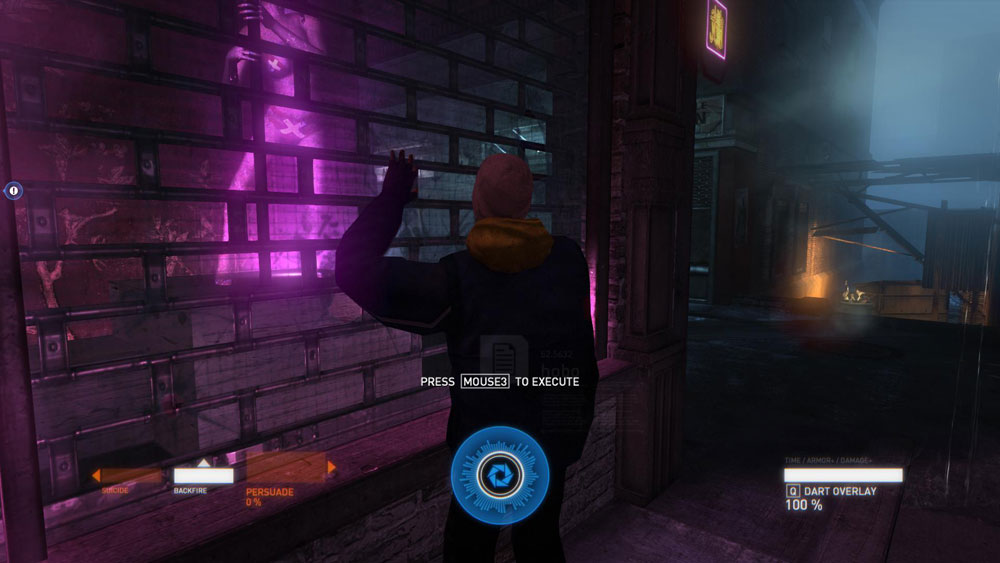
Not much room for deep thinking when you get an Execute prompt for hobos watching bad VR porn.
What is particular strong however, is the gunplay. Syndicate does a great job of making you feel like you are running and gunning in a Matrix-esque movie, including having access to overpowered abilities without making you feel immortal. As the plot develops, you eventually gain access to three main “Breaches”: Suicide, Backfire, and Persuade. Suicide makes the targeted enemy shoot themselves in the head or pop a grenade if they are near others. Backfire causes enemies to fall down (possibly out of cover) and take additional damage for X seconds. Persuade makes an enemy fight on your side for X seconds, before shooting themselves at the end of the timer. Each of these abilities recharge only when you kill enemies, ensuring that you don’t just hide in cover until your cooldown comes back up.
What does recharge is the sort of bullet-time mode that you can use in a more traditional Max Payne/FEAR sense to dispatch foes. In fact, this bullet-time is incredibly important because you frequently face massive waves of enemies who are more than capable of mowing you down in seconds. As you progress, the enemies get smarter, tougher, and many start becoming immune to your Breaches altogether. Along the way, you will face rival Agents as proper boss fights, including extra-long HP bar and various gimmicks. While such boss fights were really out of place in a game like Deus Ex, for some reason they felt alright in Syndicate.
In any case, if you are like me and care more about whether it’s worth $9.99 or whatever than about how much the reboot ruins the spirit of the original games, I would say it entirely depends on how much enjoy cyberpunk settings. Syndicate looks great, it has a solid five hours of mindless fun, and you can almost pretend that there is an in-depth existential plot you are just Spacebaring through the whole time. Indeed, Syndicate has a lot more in common with Hard Reset than Deus Ex in that regard. Times aren’t what they used to be though, and whereas I would recommend Hard Reset at $10, I have a tough time recommending Syndicate at any anything higher than $5… and even then, only if you really dig cyberpunk games.
Review: Far Cry 2
Game: Far Cry 2
Recommended price: $5-$10
Metacritic Score: 85
Completion Time: 19 hours
Buy If You Like: Novel, immersive FPS games with bad pacing and one-dimensional missions.
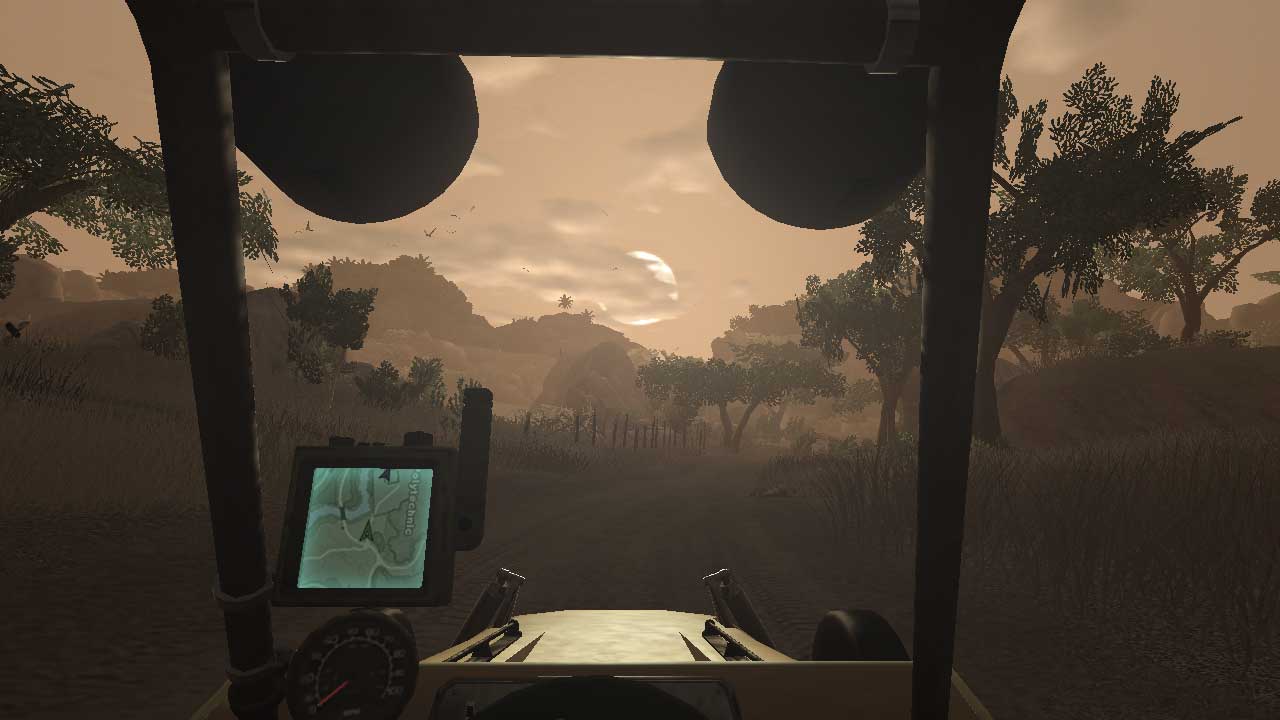
Get used to this. In a... bad way! Er...
Grand Theft Africa
The very first thing to understand about Far Cry 2 is that the designer intent is for you to be immersed in the story and setting. Unlike most games that also want this to occur, Far Cry 2 is unapologetic about its meta-story approach. Every single mission involves either killing a guy, or blowing something up and then killing a guy. These missions are not meant to be interesting, nor are the reasons you are given for doing them. Rather, the idea is for you to muse on what it means for you to be doing them, and why every mission is repetitive nonsense but you do it anyway.
Of course, the danger is always that too much is being read into what is objectively a beautiful, immersive if badly-paced game. I am giving the designers the benefit of the doubt though.
The premise of Far Cry 2 is that you are a bounty hunter or assassin or whatever, flying into a chaotic African nation to kill The Jackal, an arms dealer who sold weapons to both sides and arguably made the conflict possible. After an extended driving sequence reminiscent of Half-Life’s opening tram ride, you arrive at the hotel and collapse from malaria fevers. The Jackal shows up in your hotel room, taunts you a bit, and leaves just as a civil war erupts outside your window. You stumble around in your fever haze, before collapsing just outside of town. As far as intros go, it is refreshingly novel. I do wish the designers saw fit to show you being bitten by the mosquito in-game, but malaria’s quickest incubation period is 7-10 days, so I suppose that is a point in favor of Far Cry 2’s realism.
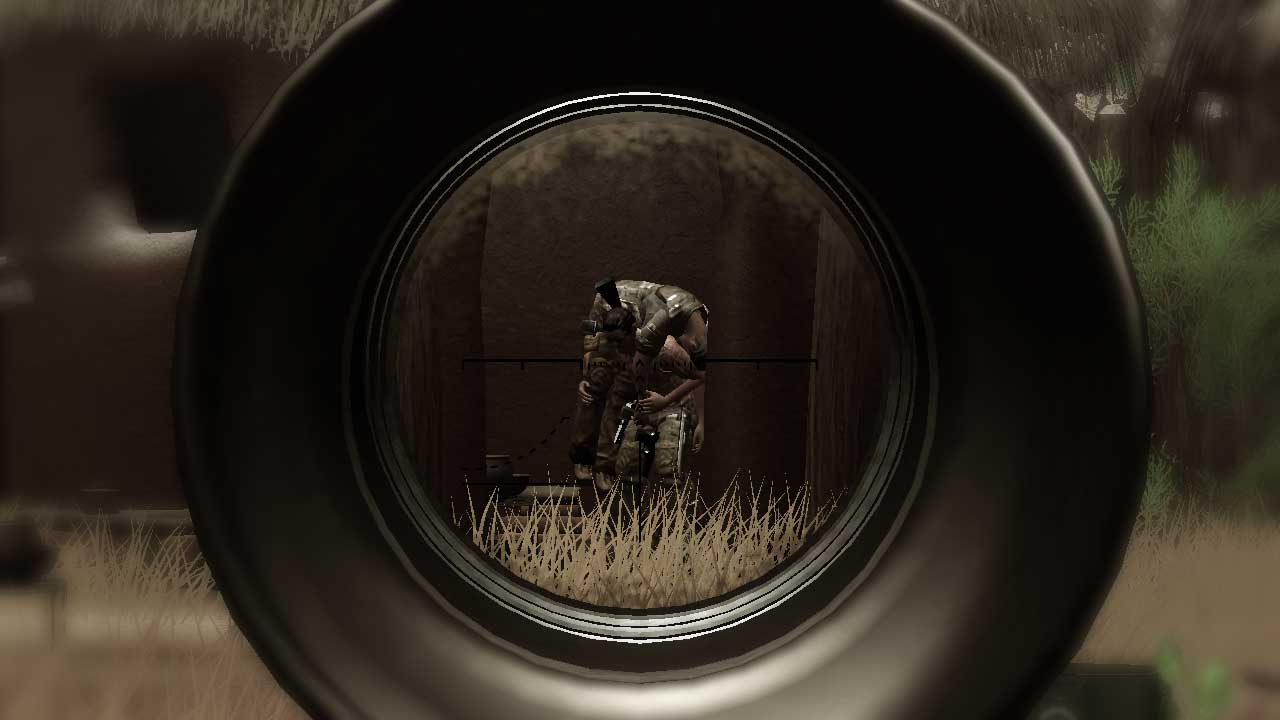
How convenient! I barely have to aim.
Once in the game proper, you are given a few “this is your ass, this is a hole in the ground” tutorial missions before suddenly Africa opens up as your gasoline-soaked, civil war-tincted oyster. To move the plot forward, you get episodic missions from both forces of this civil war, oscillating between the two factions with apparently zero regard for tact and subterfuge. Both sides see you as their “secret weapon,” and send you unsupported to deal damage to the other side, in the form of assassination and blowing things up. The problem is that “unsupported” means that the soldiers of whichever faction you are working for will shoot to kill, which is fine, but more troubling is that these faction leaders never once suggest that you should, you know, not shoot their own soldiers. At the height of Far Cry 2’s absurdity, one of the faction leaders straight up tells you that he knows you are doing missions for the other side… and then carries on like nothing happened. There is no identity between the two factions, no choice in doing missions for one over the other, no real choice in declining missions (at one point you have to blow up experimental malaria vaccines), and since everyone shoots at you, no real difference between anything whatsoever.
But again, given the meta-story that becomes more clear in the game’s final hours, it may be less bug and more feature.
Measured in raw game hours, Far Cry 2 is more of a driving game than a FPS. The game takes place in two Acts, each with their own 25 square kilometer game maps featuring realistically shitty African roads winding all over the place. There happens to be instant transportation in the form of Buses, but most of these are at the far corners of the map and generally shave off only ~20% of the driving distance at best. Given the nature of these maps, there are rarely opportunities to avoid the frequent guard checkpoints – which I suppose is a primary feature of good guard checkpoints, so another point for realism – which inevitably results in firefights every 3-4 minutes. While your enemies are decent shots out in the bush, their bullets transform into auto-tracking, Jeep Wrangler-seeking projectiles when you try to speed past them. It was originally satisfying creeping into these checkpoints, killing everyone, and being awarded (achievement-wise) for “scouting” the bases, but it has zero long-term impact on the game. No matter how many checkpoints you wipe out, it will always be fully staffed and stocked by the time you return.
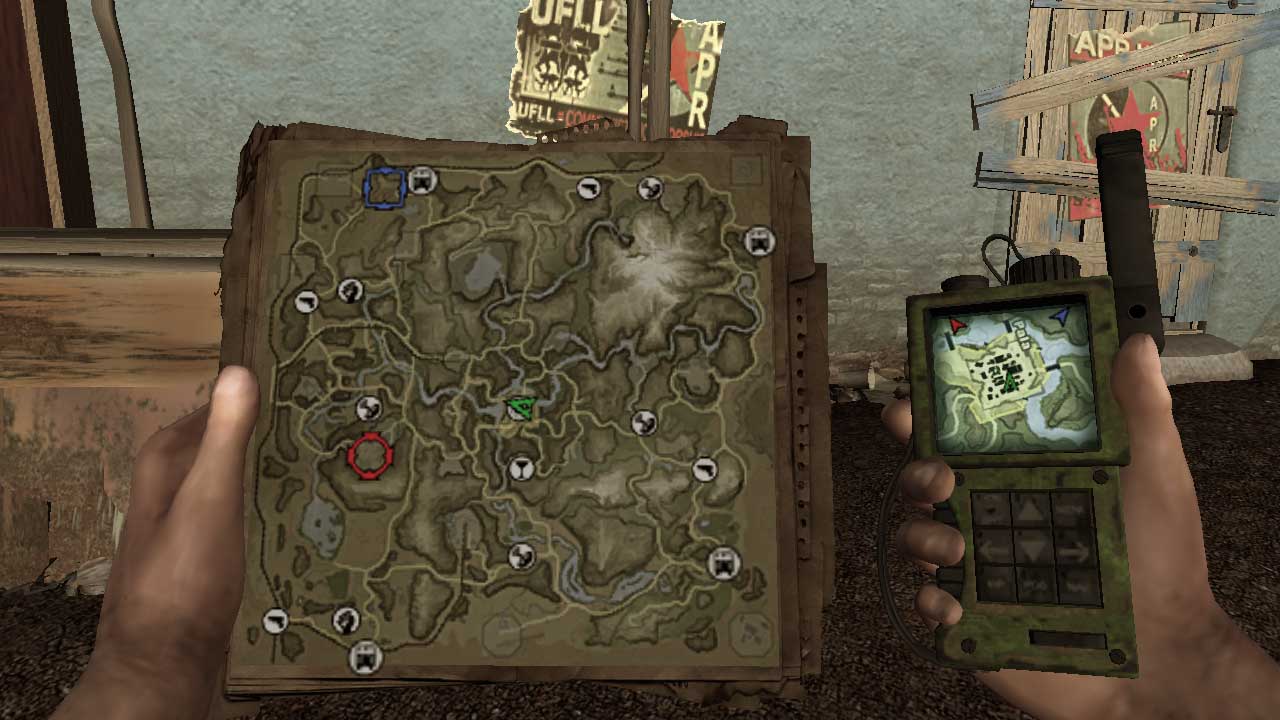
Optional blue objective is (thankfully) optional.
One of the more ballsy moves on the designers’ parts was having crosshairs disabled by default. In fact, generally speaking, there is no HUD at all until you reload or take damage. This definitely gives Far Cry 2 a more primal feel as opposed to arcade shooter, even though you look down iron sights most of the time. Reinforcing this primacy are little touches like how “health kits” are morphine ampules injected into your wrist veins. Indeed, if you are close to death, “healing” becomes pulling bullets out of your arm with needle-nose pliers, yanking your wrist/elbow/shoulder back into their sockets, cutting shrapnel out of your leg with a knife or extracting pieces of rebar out of your thigh. If you recruit a combat buddy, they can even swoop in when your health reaches zero to save you from a hard Game Over, in an extended sequence of dragging your semi-conscious form to cover before stabilizing you. All this happens wherever you are, not some stock footage, and that combat buddy will still be there helping shoot the enemies that (almost) took you out. If they go down, you have the option of returning the favor by stabilizing them, or putting them out of their misery with a coup de grace.
Ultimately, it is difficult to recommend Far Cry 2 as a game game when it plays out more like an interactive, philosophical art piece. The FPS elements are solid, but you only utilize them sporadically as you drive around. The sandbox feel of the maps and interface immerse you into the setting, but all roads lead to Rome. And the story… well, the story is disjointed and awful, but Far Cry 2 successfully transported me into the mind of the protagonist by the end. To me, that sort of experience is worth something… in the neighborhood of $5-$10.
 In An Age
Questionable Space Battles
Feb 27
Posted by Azuriel
Sometimes I find myself inexplicably drawn to building spaceships and watching them explode. With Steam having a 75% sale on the Gratuitous Space Battles DLC this past weekend, it seemed as good a time as any to try and get that fix.
The problem is that I am having a hard time convincing myself that the game isn’t complete bullshit.
You can read my original review here, but suffice it to say, GSB is essentially a game about building spaceships and nothing else. I think one of the DLCs or patches gave you the ability to change orders mid-battle at the cost of high score tracking or whatever, but under normal circumstances you design ships, give general orders, and let’em go. I mentioned in the review that I quickly came across a strategy that essentially wins 100% of the time – basically missile spam with occasional target painter that makes missile 100% accurate – but it seems clear to me now that it has been nerfed to oblivion. Anti-missile tech existed in the vanilla game already, e.g. guidance scramblers and Point Defense batteries, although it seems much, much stronger than it ever was so many months ago.
It is fine having counters to things, whatever. When I was looking at alternatives to missile spam though, I kept running into problems with the ship building aspects. As you might imagine in these sort of games, you have to juggle each component’s energy usage, crew requirements, weight, and so on. Except… all roads lead to the same max-level components and heavy mixing of weapons. It feels… banal. If I want an all-beam ship, let me build an all-beam ship without gimping on shields or armor. The weakness of specialization is supposed to be being vulnerable to counters, not it being nigh-impossible to actually specialize.
Or maybe I’m just all sour grapes because this happened:
Was totally wiped out, killing zero enemy ships. They all had ~20% HP or less.
I will continue plugging along with Gratuitous Space Battles for a while longer, but in the meantime, if you have any suggestions for spaceship designing/battle games, let me know in the comments below. I was obsessed with an ancient game called Stars! back in the day, and spent 40+ hours most recently on Space, Pirates and Zombies; dunno if FTL really counts, but I spent a lot of time with that one too. It can be a 4-X game, it can be FPS, it can be whatever it is, as long as it has a ship-designing component. And, preferably, no bullshit.
It just can’t be EVE. I have little interest in experimenting resulting in the destruction of weeks of game time.
Posted in Commentary
5 Comments
Tags: 4-X, Bullshit, EVE, FPS, FTL, Gratutious Space Battles, Missiles, Sci-Fi, Ship Building, SPAZ