Blog Archives
Switch On
I have been waffling on whether to get the Switch 2 or a regular Switch or nothing at all for quite some time. To a certain extent, the question itself was silly – if you weren’t going to get a console after seven years of its life, you clearly weren’t all that interested, yeah? Just let it go. And I was doing just that.
Then, my son was meeting some new friends and they asked if he played Minecraft.
*cue MGS guard exclamation mark sound*
To be clear, my son hasn’t actually played Minecraft… or any formal videogames at all. There’s been some “educational” apps and the Nex Playground sort of things, but nothing what I would consider serious. Indeed, I had actually been waiting since his conception for a time when he would be ready to ascend to the P2 position (or technically P3). So, sensing some weakness in my somewhat-crunchy wife’s protective shell, I decided to turn up the heat.*
The funny thing is, I didn’t know how my son would play Minecraft. I bought it ages ago on PC but there’s no way he’s going to play it there. Of course, Minecraft has been ported to literally everything, so we’re technically spoiled for choice. But how could we play it together? Sure, there are probably some workarounds like cross-play from a tablet to the PC or phone to tablet. Or, you know, a game console.
So, yeah, this past Prime Day I bought an OLED Switch.
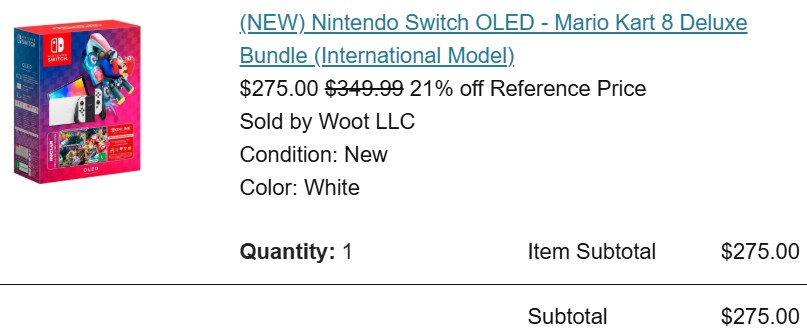
As pictured, it was a new OLED Switch with Mario Kart 8 Deluxe for $275 from Woot. I legitimately thought about trying to do some legwork and find a Switch 2 bundle someplace despite it costing double – you know, for future-proofing – but on the whole this “experiment” seemed safer anyway with a 6-year old. Besides, I had sorta regretted not getting a retro handheld with an analog stick and, well, here one is. Playing N64 games would require a subscription, but ehhhh it’s probably fine.
The funny/sad thing is that, at the same time as all the other frantic research being done before the end of the Woot sale, I actually got around to figuring out and executing on Switch emulation on my PC. So… maybe I didn’t need to be buying anything, really. Still, overall I feel like a legit Switch would be a good family-room style option to have. If it doesn’t work out in a couple of years, hey, Nintendo gear does appear to retain a lot of its value based on my eBay searching.
[Fake Edit] I’m going a little bit overboard, I think. Purchased the following:
- Legend of Zelda: Breath of the Wild [$45 via Costco voucher]
- Legend of Zelda: Tears of the Kingdom [$45 voucher trick above]
- Super Mario Bros Wonder [$38 eBay]
- Super Mario Party Jamboree [$45 Woot]
- Super Smash Bros Ultimate [$44 Woot]
- Super Mario Bros Odyssey [$40 Walmart]
That’s… a lot. Aside from the two Zelda games though, everything else are physical cartridges. I technically would have preferred digital games – who really cares for possibly losing cartridges around the house? – but the thought process is that physical games would retain some amount of resell value into the future. I’m positive that any of those Mario games would sell instantly on eBay for $30, for example. Will they continue to do so 5 years into the future or whatever? We shall see.
Something something, treat yo self.
…oh, and I’ll probably need Minecraft at some point too.
* I talked everything over with my wife beforehand, of course. Give me some credit.
Vintage Story – Modified
TL;DR: Mods help, fundamental issues remain.

While my Impression post went up on Monday, I actually wrote it few weeks ago. In that time since, I have downloaded the following mods for Vintage Story:
- Primative Survival
- Better Ruins
- A Culinary Artillery / Expanded Foods
- HUD Clock
- XSkills
- Carry On
- Animal Cages
- Prospect Together
As you may imagine from the titles, the mods add a lot of interesting elements to the game. Or at least would, if I was not still gated behind a Copper Saw. But let’s start at the beginning.
Once I had all the mods installed, I decided to go ahead and start a new game. I left most of the settings as the default, although I did increase the chances of surface copper, and also disabled class-specific recipe locks. Upon zone-in, I found a temporally-stable area, built a dirt house, found some clay, and basically got myself back where I was in my prior save within about 2 hours. While sifting some Bony Dirt, I actually got a Copper Hammer Head, which boosted me significantly into the Copper Age… sorta. I still needed to collect copper for a Pickaxe and then some for a Prospecting Pick, which you use as a method to determine what ore is nearby.
I then proceeded to spend literal hours of my limited gaming free time wandering around the map, prospecting stone to determine where copper might be. Now, you can find surface copper nuggets and then mark that area on your map due to the likelihood of there being copper deposits below there. However, that doesn’t necessarily mean you will find any before your Copper Pickaxe loses all its durability just smacking regular stone. No way of repairing tools, by the way.
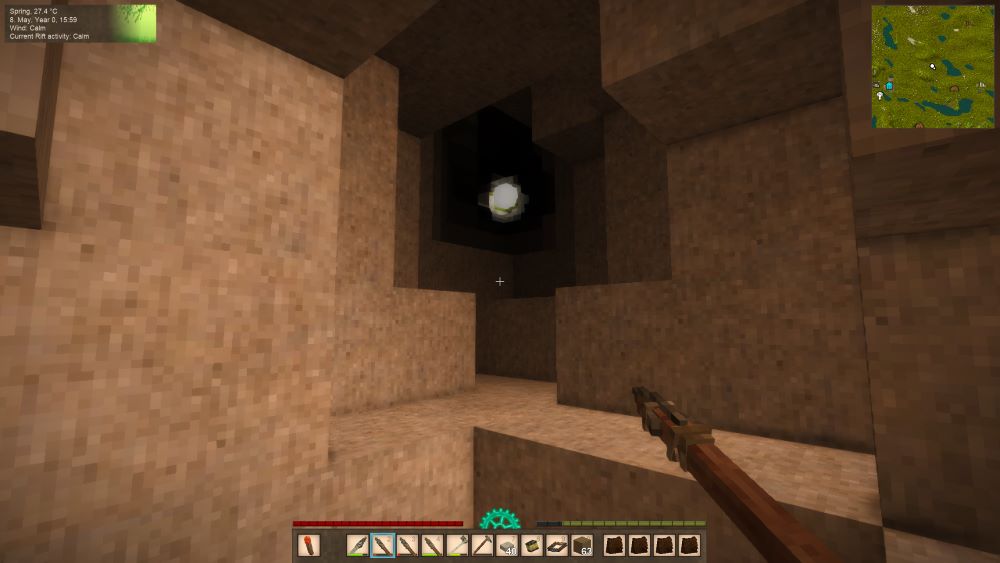
Fast-forward some more hours, and I actually found a cave that had real copper nodes clearly visible in the walls. Yay! I collected those went back to base and… just stopped playing. I had enough for a Copper Anvil, which is necessary to create the Copper Saw, but I realized (via Wiki) that you need a Bronze Anvil to craft Iron Tools, and that making Bronze is a better use of your copper than making an anvil. After a few attempts at getting some Tin to make Bronze, I gave up. Arguably, I should have just made the goddamn Copper Anvil and then Saw and then seen what was what.
Fundamentally though, I just wasn’t having fun.
What about the mods though? Well, Primitive Survival adds a lot of food options, including the ability to chop meat into jerky, which helps with preserving food in the early-game. There is also some enhanced fishing capabilities that doesn’t rely on literal fish mobs spawning. The extra food stuff from the other mods didn’t really come into play because I didn’t enter the Wood Board Age. Or maybe I was just too dumb to understand the trick behind easier recipes or whatever.
Out of all of them, XSkills had the most promise. Basically, the mod adds character progression to the game, which is absolutely something I feel Vintage Story lacks. The default XP rate is abysmal, but you can boost it via editing some files. One of the skills grants a chance of collecting Resin from chopping trees, which is essentially all I ever really wanted from the game. There seemed to be some neat stuff in there, amongst the more generic +5% X and similar, but I didn’t earn enough XP to reach anything of particular note. I definitely recommend it though.
Weirdly enough, I do sorta still have a vague desire to play Vintage Story. I’m not quite sure if its the equivalent to Stockholm Syndrome, wherein you spend so much time understanding the intricacies of a game that leaving it makes you yearn for it more, or what. It is fun exploring the map and potentially discovering something amazing right around the next bend. The problem is that everything circles back around to an incredibly dull, “realistic” mining simulation and arbitrary gatekeeping. Fighting feels bad, the lack of armor options feels bad, it feels bad when your map doesn’t spawn any goddamn Horsetail which is the only early-game source of healing items.
It is entirely possible the game is simply not built for someone like me. And I guess that is OK. I’m not even sure what changes they could make in future updates to make it more palatable. Maybe a more cohesive early-game where you can make leather without needing Wood Boards, or perhaps more armor options with just Hides? Maybe not needing to already have copper to mine copper?
We shall see.
Impressions: Vintage Story
Vintage Story is a ponderous, “realistic” survival crafting sandbox in the style of Minecraft. Pretty much the exact style of Minecraft, in fact, although it supposedly has a different codebase that allows it to do some interesting things. How interesting those things are will greatly depend on how slow and methodical you like your gaming.
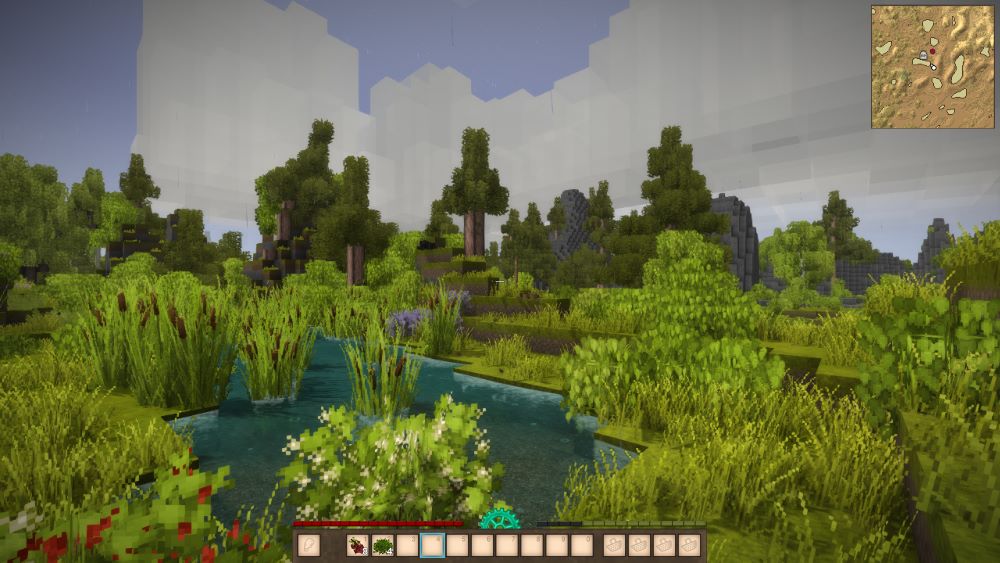
As with most survival games, you start out with just the clothes on your back. From there, you collect flint or some other hard rock to make tools. In Vintage Story though, you literally make the tools: you place the flint down on the ground, and use another piece of flint to “knapp” (e.g. chip) the other piece according to a voxel pattern. Combine the knife head (etc) with a stick in your Minecraft menu and voila, a flint knife. This will allow you to collect things like reeds to be turned into baskets or dry grass to help start a fire. You can’t just punch everything to get the proper resources here.
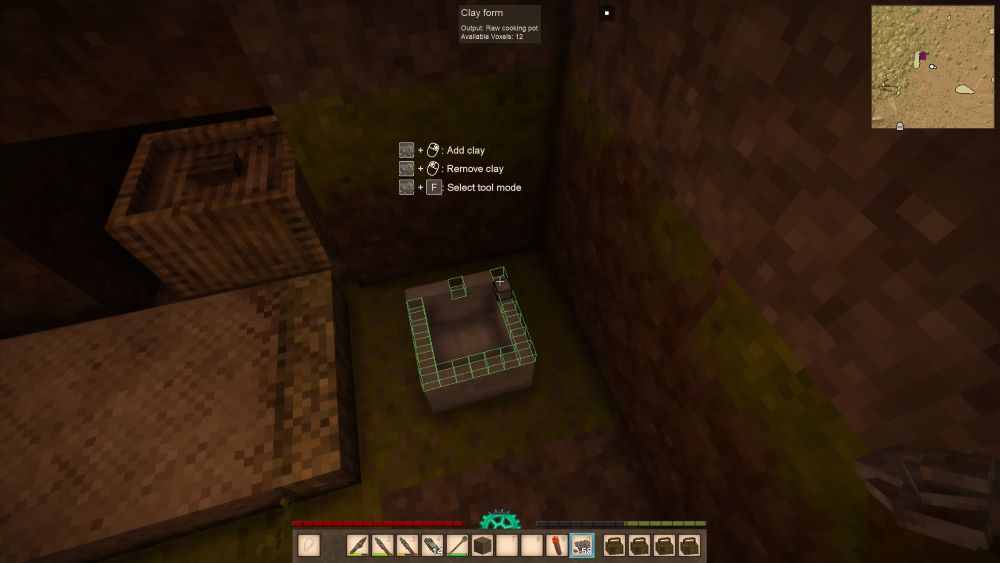
At this point, Vintage Story doubles-down on the intentionality. Flint tools are fine, but you really need clay to get to the next stage of development. Search far and wide for clay deposits, dig up a bunch, and then place some on the ground. You now have the option to create various clay vessels, like bowls, cooking pots, storage vessels, jugs, and so on. Crucially, you will also need tool molds, such as for a pickaxe and hammer. All of these things have to be sculpted, voxel-by-voxel, which is equal parts tedious and zen. Once completed, congratulations… you have still have raw, wet clay. Now you need to dig a hole, fill with dry grass, sticks, and firewood, light it on fire, and then wait 24ish hours for the pieces to harden. Oh, and make sure it’s covered from the rain and also away from flammable material.
Next comes copper. While traveling the overworld, you may come across a few pieces of copper nuggets on the surface. You can collect these – and mark your map since there is ore underground there – but will likely have to pan sand/gravel for additional nuggets. Once you have ~40 copper nuggets, you can begin the smelting process. Which requires charcoal, because firewood cannot hit the necessary temperature. Making charcoal involves digging holes, filling it to the brim with firewood, building a fire on top of that, lighting it, and then covering the whole thing up. A day later, you have charcoal. Go back and heat up the nuggets in a (fired) clay crucible, and using some wooden tongs – can’t have molten copper in your bare hands, of course – pour the copper into the (fired) clay tool molds… and wait. Once it cools, you have a copper pickaxe.
And now, finally, you can dig rocks!
I typed all that out because that is the type of game Vintage Story is. Mostly. Cooked food spoils at a reduced rate inside a clay Storage Vessel, and at an even further reduced rate in a cellar, and at an even more reduced rate if the food itself is stored in a clay Crock Pot sealed with animal fat. Neat. Meanwhile, you can construct your house and cellar by punching dirt blocks and placing them ala vanilla Minecraft. Making flint knives and other tools is a cool process, but the blade and handle are just magically connected somehow. I bring this up because the process of making a bow meanwhile requires twine, made of flax fiber, collected from flax (or looted from Drifters). Getting the first “tier” of armor above basically nothing requires Resin, which only comes from Pine trees at world creation, and only at an extremely limited chance. Like… why? We can hold molten copper in wooden tongs but can’t get some pine resin from pine trees?
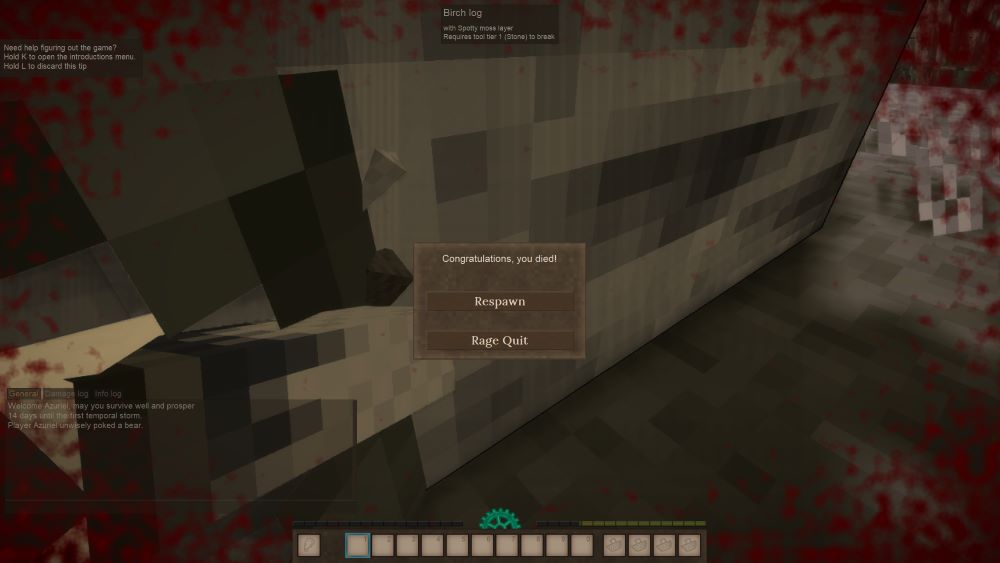
This sort of strained duality extends elsewhere. Wolves and bears are dangerous and will kill you in 1-2 hits. You can avoid them though by using a nerdpole, e.g. quickly placing blocks underneath yourself while jumping. Ore deposits are “realistic” in that they follow veins in specific sort of shapes. Getting to them can be sped up by either digging straight down and nerdpoling your way out, or creating an infinite waterfall via bucket and swimming straight up like in Minecraft. Crops take ages to grow – sometimes more than 1-2 in-game months – but animals generally spawn everywhere. Pemmican doesn’t exist, and not every animal has fat. And so on.
Those design choices are one thing, but the one that’s a bit more unforgivable (IMO) is the back-loading of content. The “real” game doesn’t really start until you can make wooden boards, which requires a copper saw, which requires a copper anvil, which requires enough copper nuggets gained from mining with the copper pickaxe. How do you get copper nuggets to make a copper pickaxe you ask? Panning sand, basically. Anyway, wood boards give you a ton of building and storage options, but the big ones are buckets and barrels, which then allow you to process things into leather, pickle food, and basically… everything. I understand that perhaps the intention was a sort of “congratulations on surviving until the Copper Age!” but that doesn’t mean the early game should be less interesting.
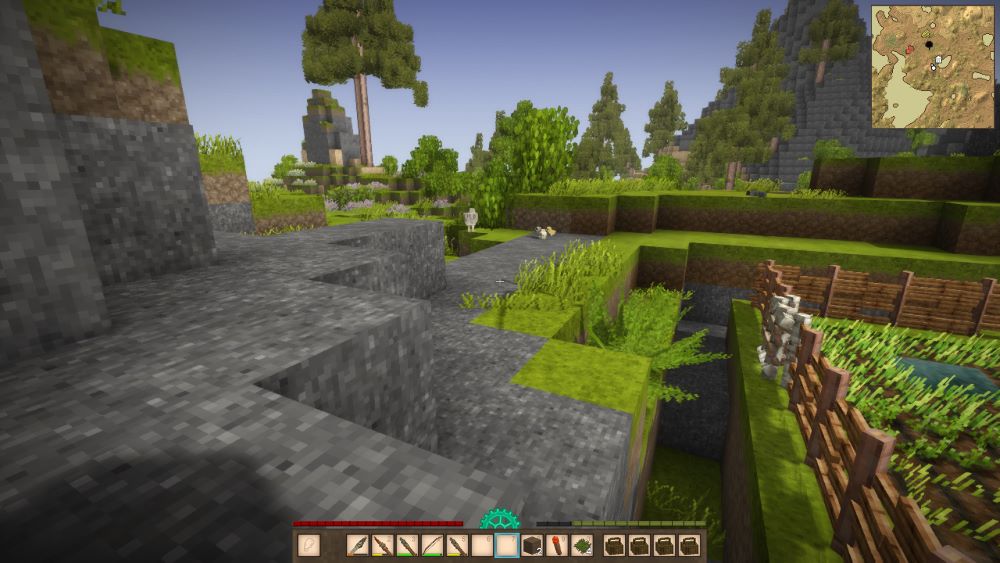
Vintage Story also suffers in the “now what” department. Surviving the first winter with limited resources is a massive struggle. After that? Farms will provide all your caloric needs rather easily. You can eventually craft some windmills and other mechanical tools to automate some tasks too. There are caves to explore and Drifters to fight and teleporter devices that can send you to far distance places. But… that’s it. I’m not saying other survival games do not have a similar endgame issue – there’s no “point” to 7 Days to Die or ARK – but the crucial difference is that playing these other games is, well, fun. They have good moment-to-moment gameplay, they have character progression mechanics that make you want to reach the next level, and so on.
That sort of thing is missing here. Once I finally got my Copper pickaxe and then realized how difficult it was going to be to find copper nodes, I was basically done. Plus, you know, if you lose your Copper Pickaxe somewhere (either by dying in a deep hole or via durability) you have to literally start all over.
Having said all that, Vintage Story is definitely a novel approach to the more traditional survival crafting genre. It is not in early access, still gets beefy updates, and was built from the ground up for mods. Indeed, there are supposedly a lot of mods out there that tackle many of the fundamental issues that I have brought up. I may end up rolling a new world with some of these mods installed and see if that smooths out the experience and make it more interesting.
Which, for the record, it was for a time. Just not enough. For now.
Impressions: No Man’s Sky
Before its release in August 2016, the hype train for No Man’s Sky was insane. Something like 17 trillion different planets in a vibrant galaxy full of procedurally-generated lifeforms. Do anything, go anywhere! Reality hit people hard, including me, even though I did not buy the game at release.
I did buy the game a week or so ago though, and I can say that after a year of actually substantive updates, No Man’s Sky is almost ready for its debut. Mostly.
The first hour or so of gameplay is not that great, and can be worse depending on the randomly generated planet you start on. The vast majority of planets have hostile weather that necessitates the constant recharging of suit protections, driving you to seek shelter in your ship or a cave or farming Zinc from plants. Your ship needs Plutonium to lift off the ground each time, and your Life Support systems can only be charged with Thamium9. And you have to juggle all of these competing element requirements with a micro-inventory that gets worse before it gets better.
That’s really the summary for the game: No Man’s Sky gets worse before it gets better. Mostly.
After getting a few upgrades here and there, especially getting a better ship, the game opens up tremendously. You still need all the survival elements, but you have the space and cash to stockpile a few stacks. Then there is the forward momentum that comes from the primary quests, assuming you did not choose to free-roam. Things progress quite nicely, especially after unlocking your base and assorted goodies like Exocraft, e.g. vehicles.
Here’s the thing though: the core gameplay loop is incredibly tiny. On each non-lifeless planet, there will always be the following: Life Pods, Habitable Buildings, Trade Posts, Crashed Ships, Monoliths. All of them will look the same, although there are a few different types. All of them will be randomly scattered around, but the scattering itself will be very uniform across the entire surface of the world. By all measures you can actually fully upgrade your Exosuit before leaving the original planet you spawned on (assuming you somehow got the cash).
Planets are literally the size of real planets, but everything you could really ever need on any individual one of them will exist within 10km of wherever you land. Each star system has a Space Station, and each Space Station is set up exactly the same way. You can accept “missions” from an NPC there, and these missions are essentially Radiant Quests ala Skyrim. Kill X number of Y, collect Z resource, kill some space pirates, deliver this item, etc. As you increase your reputation, more lucrative quests unlock, which feature harder to find Z resources, or tougher pirates.
Some of the gameplay elements remain half-baked. Early on, you will find many rocks that contain Deuterium, which you are unable to mine. After unlocking Exocraft, e.g. vehicles, you can finally mine them. I was pretty excited… up until the moment I realized Deuterium is only used for Exocraft upgrades. Once you install the ones you want, the element has no purpose anywhere else in the game. The same applies to another element that comes from “raiding” (read: blowing up) protected silos. Why would you ever mine Deuterium or raid the other element again? It not being used for anything other than the thing it was needed for seems comically short-sighted.
It’s not obvious at first, but No Man’s Sky is more of a game about economics than anything else. Each plant or creature you scan gives you Units. Some elements exist only to be mined and sold as vendor trash. Completing missions gives you Units, and unlock better missions that grant more Units. Some of the base-building requires specific elements, but for the most part its Iron which is everywhere. Pretty much the biggest reason to have a base at all is so your can start a Farm, which lets you “grow” special elements. That you then turn into unusable-but-very-sellable items. So you can eventually buy a Freighter for 186 million Units… to have more inventory space. For Units.
I’m at over 50 hours at this point, and I have no idea why I still find this fun, but I do.
The key, I think, is to temper your expectations. This is not Minecraft in space. This is not 3D Starbound/Terraria. I’m not even sure if it’s all that good for Explorers, given that procedurally-generated terrain/plants/creatures generally all look the same after a while. That said, I do find the Primary quests to be interesting, and I very much enjoy the ability to just fly around and do whatever. Want to stop what you’re doing and warp to a different star system? You can. Want to just make a bee-line to the center of the galaxy? Go do that. Want to make the perfect farm so you can mass-produce Circuit Boards and sell them for 1 million Units apiece? Yeah, I’m on it.
No Man’s Sky has gotten a lot of updates since release, and it seems as though more might still be on the way. I ended up buying my copy for $20, and at that price I feel like I got my money’s worth already. In a few months, it might even be cheaper with more content and better gameplay loops. We’ll have to see.
Cold Open
There have been two games I played recently that have started with a cold open, e.g. one with no tutorial that just sort of throws you into the game. The first was The Long Dark, and the second is a space-sim called Hellion; both are in Early Access and both are survival-based games. So, in a sense, it’s difficult to determine whether either one intentionally set out to have cold opens, or if this simply reflects their current, unfinished states.
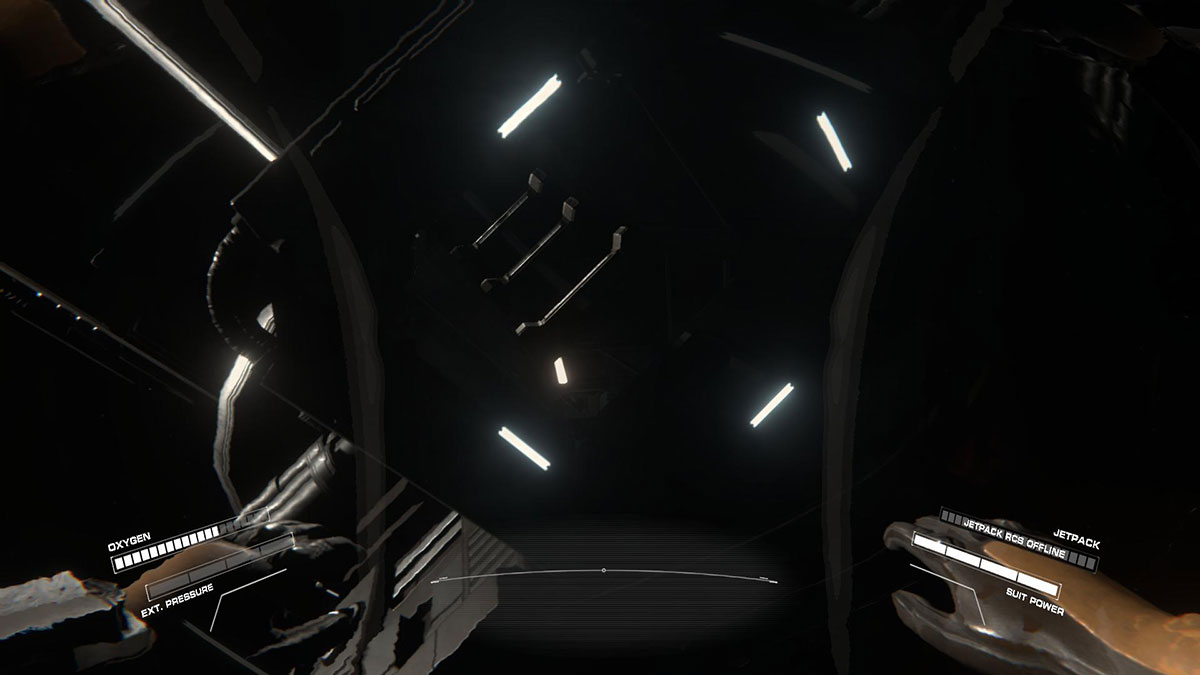
Pictured: falling out of the airlock into open space.
There is a lot to be said regarding the power of cold opens. In an age of 24/7 information coming from every angle, it is refreshing to be thrust into an unknown environment without any sort of hand-holding. It absolutely appeals to Explorer-types, and also those looking for more difficulty in their games. Plus, many times it makes thematic sense, say, if you just woke from cryo-sleep in an otherwise abandoned life pod.
Personally, I find cold opens to be exceptionally difficult to pull off well.
The fundamental issue I have is the dissonance between what the player expects and what the designers intend. What ends up happening is that players must essentially “metagame” how the designers actually intended the game to be played.
For example, in Hellion you awake from cryo-sleep inside a life pod without functioning Life Support. While there are a few tablets on the ground which give you a general idea of steps to take, that is basically all the guidance you are given. I searched the area and did not find enough items onboard to repair the Life Support. I found a jetpack without fuel, and supposedly a charging station for said jetpack, but could not determine a way to refuel.
So… what now? Did I miss an item in the search of the ship? Am I supposed to try and space walk without a jetpack? Is it a bug that there weren’t enough items to repair the Life Support? I have mentioned before that I am fine with tough puzzles, as long as I understand where the pieces are. What I absolutely despise is not knowing whether my failures are due to not performing correctly, or because I didn’t trip some programming flag from 10 minutes ago, or some other nonsense.
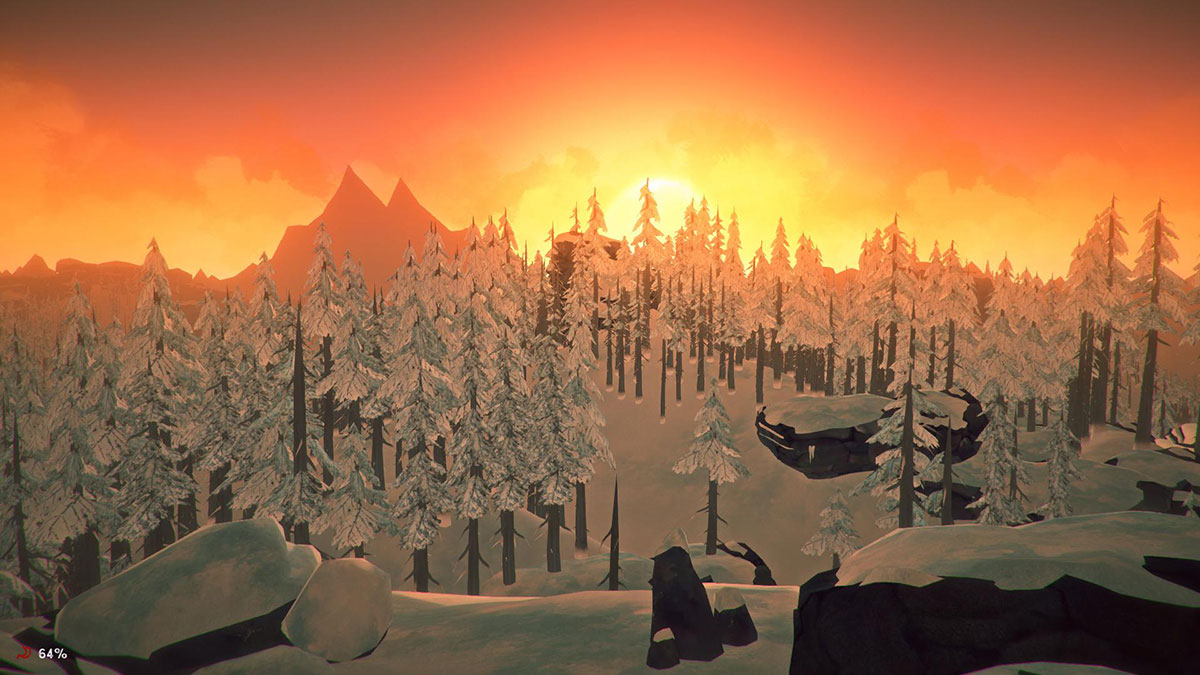
Somewhat more literal cold open.
I had a similar issue in The Long Dark, of which I played about an hour before turning off. It takes 30 game minutes to break a stick into pieces by hand? Okay, fine. But having found a shelter and tools, I saw no particular way to locate food, or reconcile my exhaustion meter with my temperature meter with the time of day, e.g. how was I to sleep and keep warm in the middle of the day and still survive the night? I understand that perhaps the intention is for the player to be constantly on edge in the quest for survival, but again, I’m not even sure how food really even works in this game yet. I have not seen any flora or fauna beyond sticks and snow.
Flailing around in the darkness is not my idea of quality game time.
I’m not saying game designers should go full Ocarina of Time and have Navi pester you for hours. Minecraft has (had?) a cold open that was relatively straightforward once you got over the intellectual hump of punching trees. Don’t Starve is a much better example of how to do a cold open – there isn’t much of an explanation of anything, but I still felt a sense of agency in being able to interact with things.
And maybe that’s just it: I might not be doing the right things, but being able to do something is important.
I dunno. I think the best compromise would be to have cold opens with a fairly robust PDA/AI Assistant/Crafting Menu. Those that want to wander around blindly can, but those who want to know what they can do… well, can.
28+ Days to Die
Okay, now I’m (probably) done with 7 Days to Die.
The one thing I really wanted to do was try and succeed at a randomly generated world. Which is kinda weird, since I’m not exactly a huge fan of procedural entertainment for its own sake. The issue in the absence of randomness is that… it’s not random – you know exactly where everything is. The specific loot might vary from seed to seed, but you’ll always know where the police station is, where there might be a gas station, ect.
Of course, random maps often end up like this nonsense:
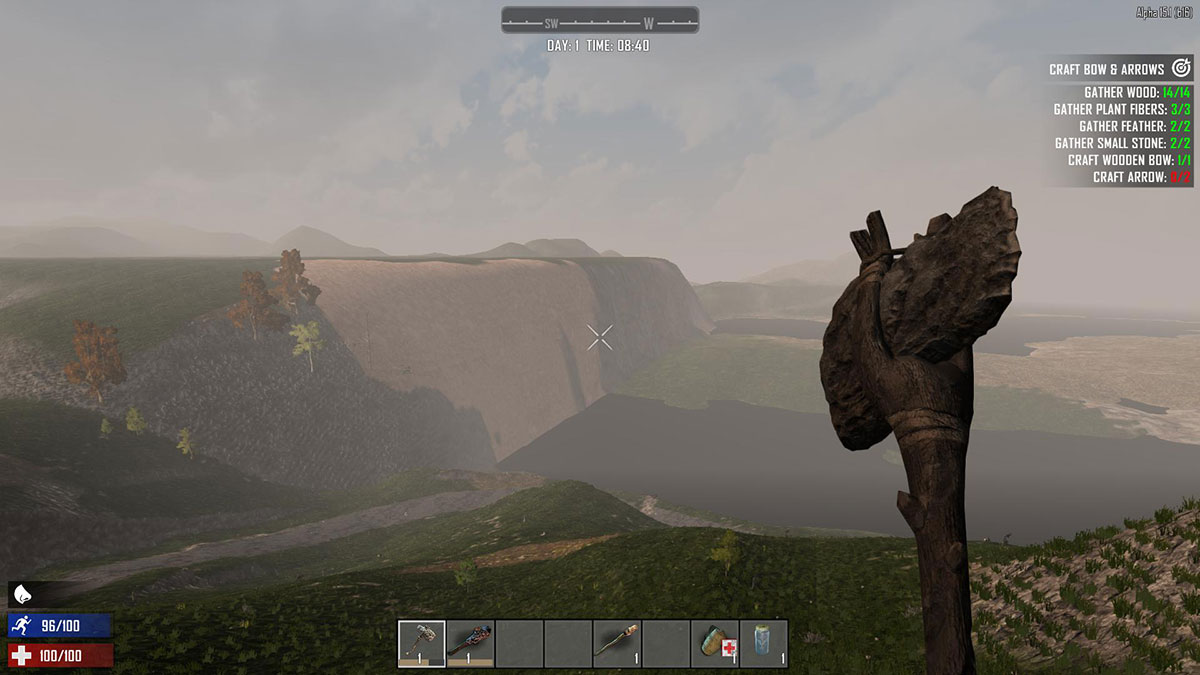
Seems legit.
I almost abandoned my attempt within the first 30 or so minutes, simply because of how annoying it is starting back over. In my prior save, I already had crossbows, iron sledgehammers, and nearly all gun recipes. The real meat of survival games happens in that inbetween time where you are desperately scavenging for supplies while establishing a base. So while it’s fun stepping foot into zombie town for the first time, loot possibilities endless, it’s also highly annoying trying to break down doors with a stone axe. Oh, a gun safe? I’ll just break the lock… ah, right, Stone Age.
I kept at it though, and before I knew it, I had an impenetrable zombie base. Actually, I knew exactly when I had such a base, because I recognized the weird structure that lays atop a “hidden” bunker, and also knew that zombies can’t dig anymore, so the game was effectively over. I mean, there was still the very real chance at death due to zombie dogs, which I encountered several times while venturing about. But as far as Horde Night goes? I could effectively just go AFK while browsing Reddit while it occurred in the background.
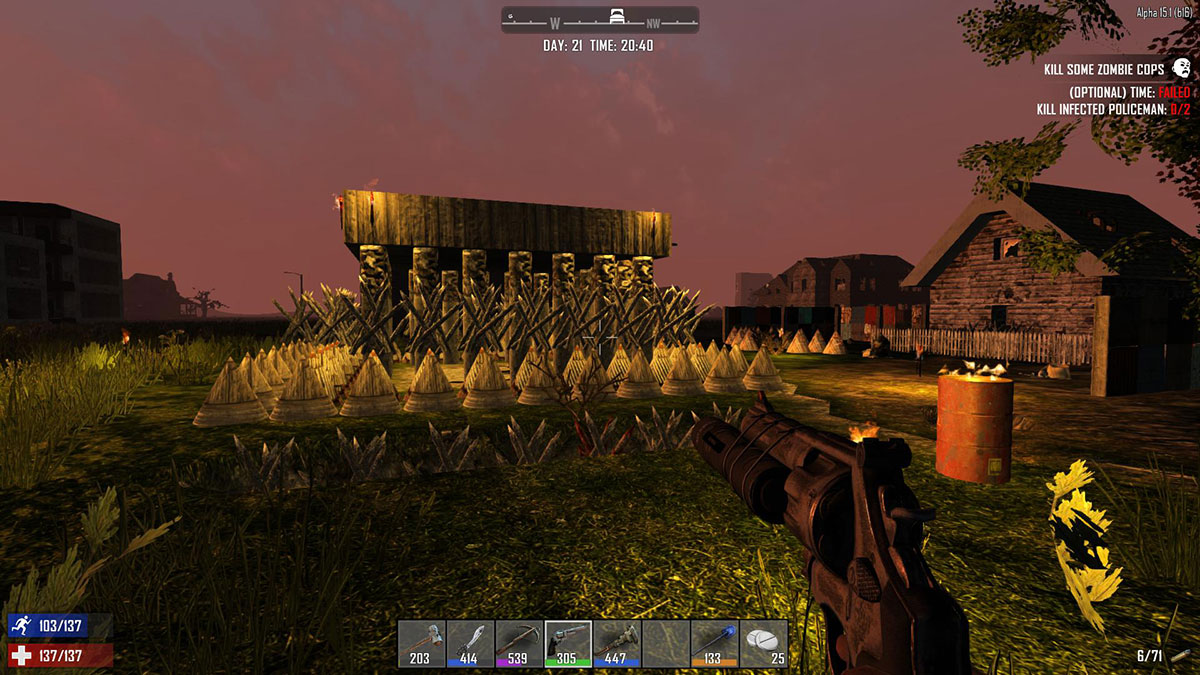
Welcome to Thunderdome.
Later, I created a zombie cage with bars and spikes such that I could shoot/stab through the bars and even loot while the zombies couldn’t do much. I have yet to encounter the Screamer or Cop Zombie types, so perhaps increasing the difficulty could engender some additional feeling of danger.
Alternatively, I might be effectively done. Which is fine, considering I have been obsessively playing it for the last two weeks and have racked up nearly 60 hours at this point. Not bad for a game in Alpha. Indeed, the next update is supposed to have a Behemoth zombie that will topple structures with ease. Unless they let zombies aim at the ground though, bunkers will still be an I-WIN button.
In any case, I highly recommend this game.
I might also recommend waiting until at least Beta to get the most enjoyment out of it. But hey, if you catch it at $5 or $10, it’s worth the money if you think you might like zombie Minecraft.
Survival Survival: 7 Days to Die
In short: zombie Minecraft.
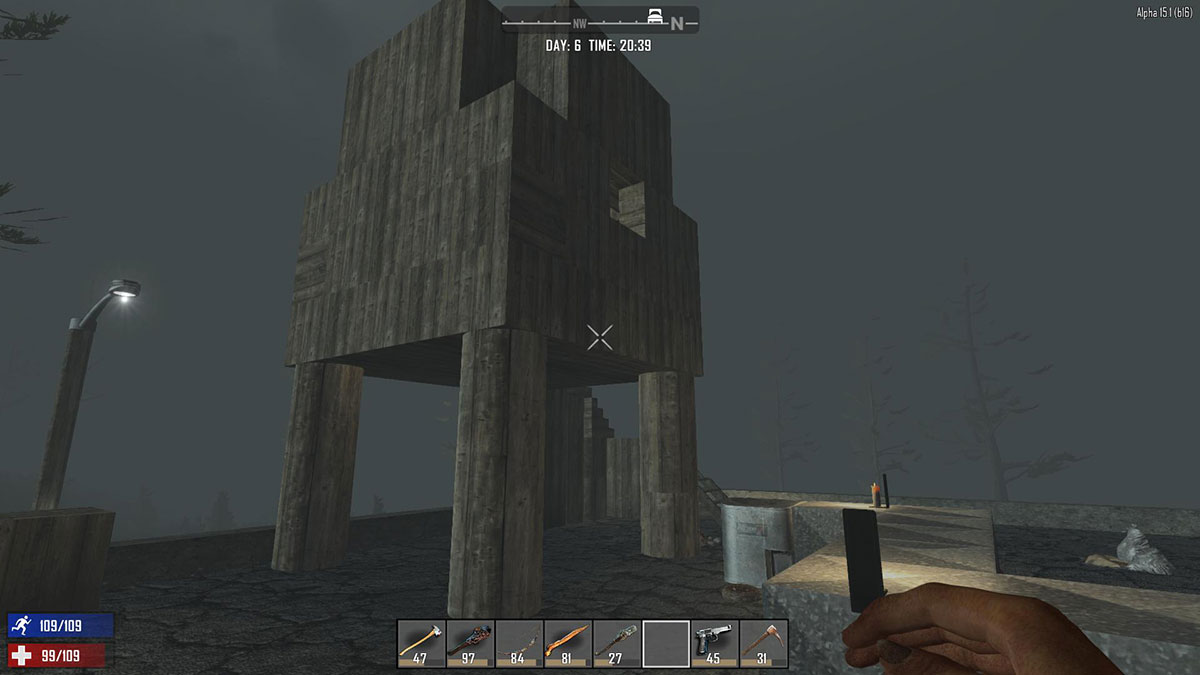
Fortress of Mostly Solitude.
7 Days to Die (7DTD) is a fairly robust post-apocalyptic survival sandbox game that features deformable terrain, zombies, and the titular over-the-top weekly attempt on your life. I played version 15.1, and the game itself has been in alpha since December 2013. I just purchased it in the recent Steam Winter Sale for $10.
As with most survival games, you start out mostly naked with limited supplies. Run around, punch some trees, craft a Stone Axe that will be your primary tool for most of the game. The nice thing is that just about every single thing in the game world is able to be manipulated or destroyed. Craft a Stone Shovel early on and you can pretty much dig to bedrock. Or just dig a large moat around your future fortress. Then fill it with wooden spikes.
The zombies in this game are fairly standard walkers and runners, at least as far as I have seen. There is supposedly a “heat” system in place that determines whether the zombies will be attracted to your location, and the zombies themselves apparently can hear you (including the noise you make opening your inventory). Oh, and smell you too, if you happen to be carrying any meat. In practice, there will basically be zombies around at night no matter what you do.
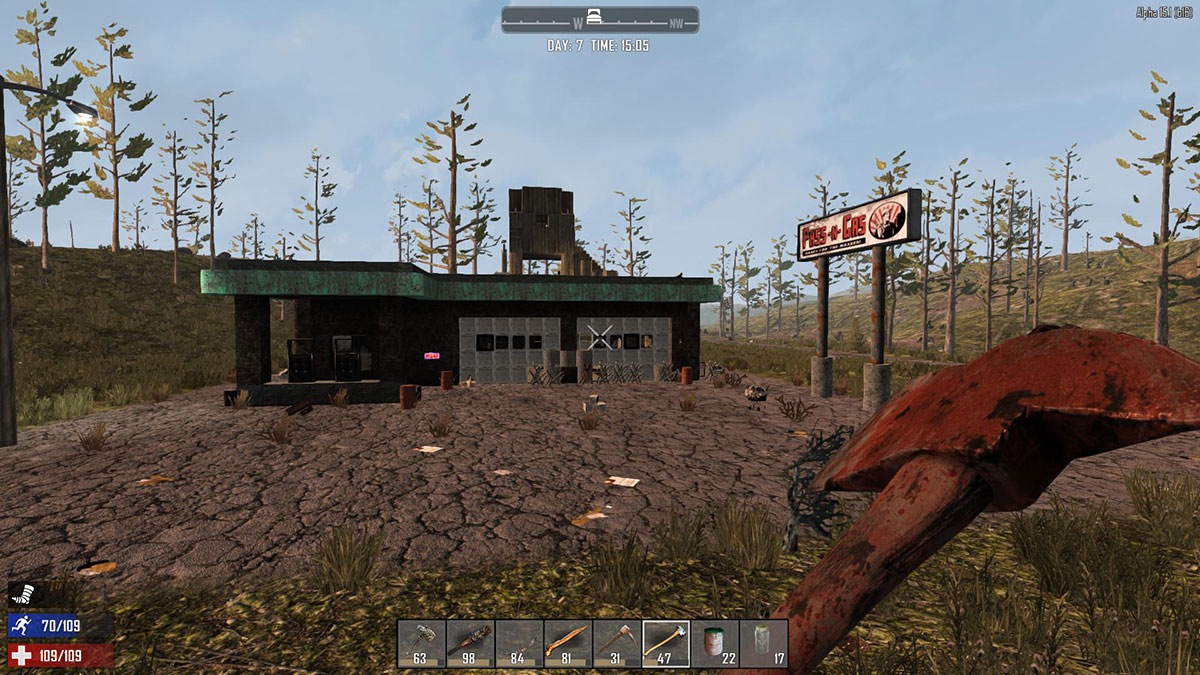
Further back shot of home.
Speaking of zombies, there is an interesting interaction with them and the game world. Everything is destructible, remember? That also means by zombies. While they can certainly try to break their way through windows and doors, there is nothing stopping them from literally banging their way through the walls either. Even elevated positions are not immune, as zombies with readily take their rage out at anything near your location, including any sort of support structures.
Oh, and have I mentioned that there are (rudimentary) physics in the game? Alpha is alpha, so there are some goofiness like floating candles and such, but buildings can absolutely come tumbling down if enough supports are destroyed. (Cue ominous foreshadowing.)
Mechanically, the game is… in an interesting place. The early game feels fantastic. Looting feels extremely rewarding, as you can get some rather extreme rewards from any random pile of garbage. Things get weird in the mid-game though, around the Iron stage of crafting. At that point you are going to need a standard, defensible base to craft a forge, and then start harvesting a ton of resources. If you haven’t looted some critical tools before the Forge though – such as a Cooking Pot – you almost might be better off resetting the game. You can craft such things, but it is so far along the “tech” tree that most of the benefit is moot.
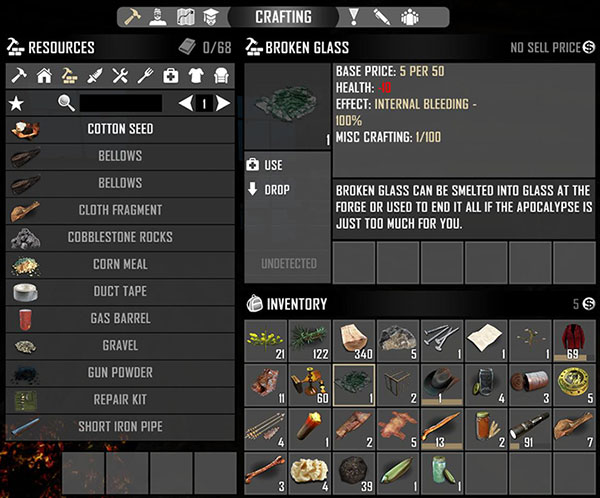
It’s always nice to have choices.
Speaking of tech trees, there is a rudimentary leveling system in the game, somewhat similar to Ark. Honestly, the implementation needs some considerable iteration, as it is not intuitive at all. There are some “big” skills that cost 10 points per rank, and grant you thinks like faster Stamina regeneration or bonus damage to blunt weapons. There are also skills that only cost 1 point each, such as Mining, which are naturally raised by performing the skill in-game, but can be purchased outright. Then there are other ones, such as Leather, which just straight-up grants you the ability to create leather. But there are also schematics in the game that are required before you can craft certain items.
Like I said, the Skill/Leveling system needs some work. It feels good seeing your crafting skills naturally improving, but you also run into the Oblivion problem of incentivizing, say, crafting a hundred wood clubs to power-level your way to the next unlock. It also irks me a bit that Iron and Steel take the same materials, with the latter just being kinda arbitrarily locked behind “Construction Tools X.” Some kind of progression system is good, but I’m not sure this one is the right one.
Overall though, I am both impressed and pleased with 7 Days to Die thus far. I put in around 10 hours in two days, and will probably be stopping here. On my second character, I built a sort of wood treehouse on the roof of a gas station, and survived the 7th Day horde attack with relative ease. As I started digging a moat around the perimeter in anticipation of the next one, it occurred to me that playing any further was likely to result in me extracting all of the fun out of the game before it is fully implemented/tweaked.
Reminder: Big numbers are big
Minecraft has sold over 100 million copies. In 2016, the average rate of new sales was 53,000 per day. That’s… pretty big. Here is part of the infographic Mojang posted:
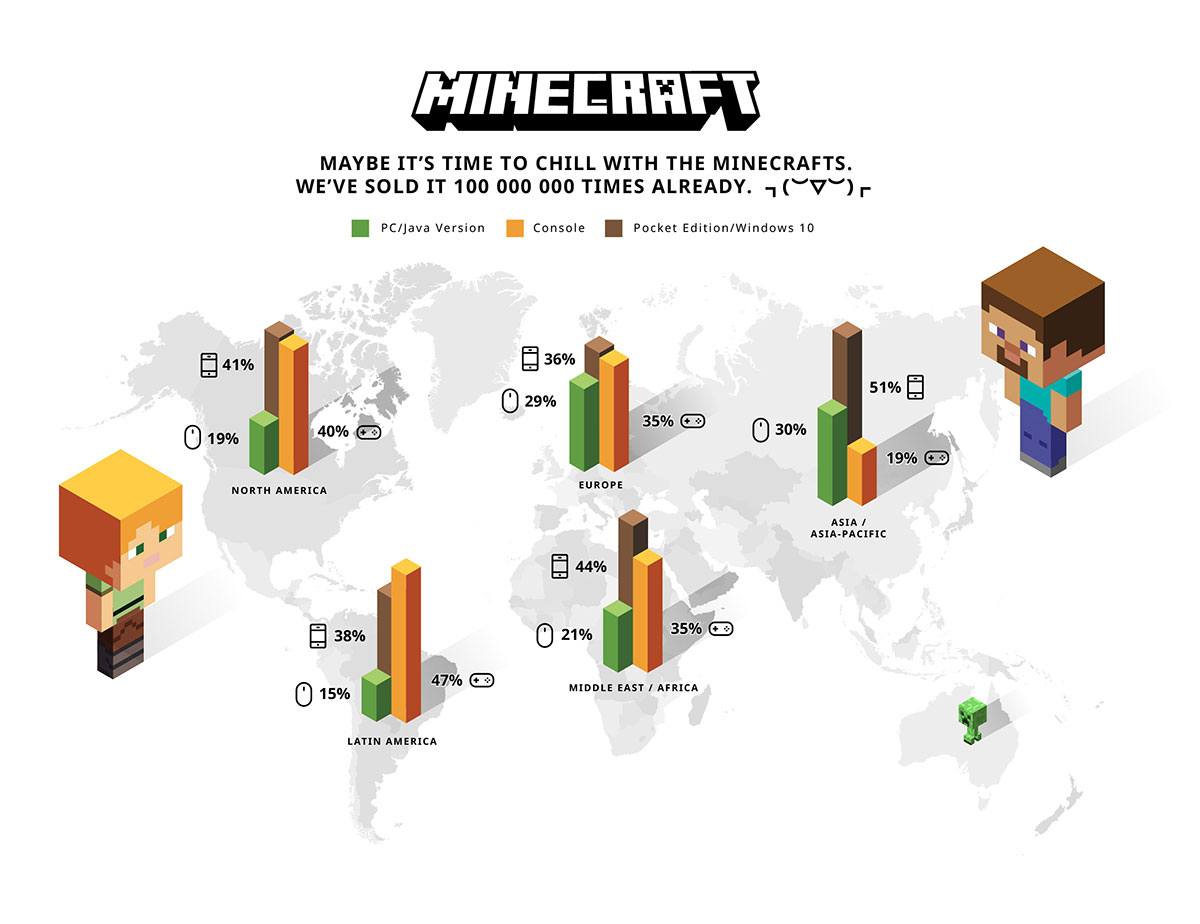
Holy mobile revolution, Batman!
The above infographic really surprised me though, for several reasons. As I pointed out in January of last year, the Minecraft stats we had circa June 2014 were the following:
- PC/Mac: 15 Million
- 360: 12 Million
- PS3: 3 Million
- iOS/Android (Pocket Edition): 16.5 Million
But look at the infographic again. Actual PC sales of Minecraft is just a small fraction of total sales, which was the trend we saw already happening in 2014. If you average the PC sales together, you only get about 23% of total. Which, if you math it out, means PC/MAC sales have been ~9,577,735 in the last two years (106,859,714 * 0.23 – 15,000,000). Or roughly 13,120 sales per day on PC.
The reason I bring this up is due to a recent post by SynCaine. His thesis is:
The bigger point here though, as it relates to MMOs, is that this is a very important date point related to the “Everyone who wanted to play WoW already has it” talking point and how it relates to the failures of the game from WotLK and beyond. Minecraft has a much larger user base than WoW, yet it’s still attracting a horde of new players daily, so why do some people think WoW is a special snowflake and had/has tapped out the market?
In other words, “how can market saturation exist if Minecraft is still doing so well?”
Wilhelm deconstructs the argument pretty thoroughly already, but I wanted to spend a moment, again, to remind people about big numbers. Specifically, the extremely likely chance that WoW is selling more copies per day than Minecraft is on PC. Yes, even now, in the nadir of Warlords.
The two questions you need to ask yourself are 1) what is WoW’s current population, and 2) what is its churn rate (i.e. percent of players that cycle out per month). Historically, the churn rate of WoW was 5%. Is it higher now? Probably. So, to throw out two numbers, let’s assume that WoW is holding steady at 5.5 million subs at a 10% churn rate. That means WoW needs to sell 18,333 new subscriptions a day, just to keep pace.
WoW is losing subscribers these days, of course. Since the numbers are no longer being reported, we may never know how many. But let’s do some sanity checks. The last reported sub number was 5.5 million in September 2015. As already noted, maintaining that number would require 18,333 new subs a day. But WoW probably isn’t maintaining anything – it’s losing customers. Rather than be arbitrary, let’s assume it’s “only” getting something like, oh, 13,120/day.
18,333 – 13,120 = 5,213 * 30 * 9 = 1,407,510
Do you believe WoW is currently at ~4.1 million subs or less? If not, hey, it’s still selling more boxes daily than Minecraft on PC.
In the comments to his post, SynCaine pointed out that since WoW is in decline, we can’t actually say that 100% of the churn are new players coming in. Er… okay. That’s not how churn (or reality) works, but let’s roll with that. What is the population at then? The same 4 million-some? Zero new players and 1.4 million vets burning out in the last 9 months? That’s an average of 156,390 per month, which equals a churn rate between 2.8-3.8%. Meaning this dead period of Warlords retains players better than vanilla or TBC ever did.
Granted, the reality is probably somewhere inbetween there. Still, big numbers are big.
Prisoner’s (Gaming) Dilemma
BINGO was postponed for a week, but I’m not even mad. Seeing the shit Blizzard is getting on the forums every time they introduce another flying mount is payment enough. For now.
Let us set that aside for a moment.
So I was presented with two hypothetical scenarios over the weekend which I found interesting for reasons. The first one was this: you’re going to jail for ten years, but it’s a minimum security prison that will allow you to take one offline game (any DLC included) with you. But that will be the only game you get for those ten years. Which game do you pick?
The second scenario is similar, but this time it’s life in prison. For some insane reason, the Warden will allow you to take any three games and allow an internet connection. The parameters did not specify whether future DLC or microtransactions will be free for you, but let’s assume you can make enough money stamping licence plates to cover, say, $30/month. Which games do you pick?
The answer to the first scenario was pretty much unanimous amongst my fellow hypothetical jail mates: Minecraft. There was a Skyrim holdout in there, but ten years is a long time and I don’t think mods could extend the attention of even the staunchest Skyrim fan that long.
The second scenario answer was more diverse, with my friend solidly in the Destiny camp (which is his current console mini-MMO game of choice). Mine was more blunt: World of Warcraft. Yes, even with bile I feel towards Flightgate, I have to admit that WoW is a game A) most likely to still be around and supported for decades to come, and B) one offering the most diverse playing experiences. In other words, you could spend a lot of time getting real good at raiding, master it, and then set off to roll the boulder up the PvP hill and feel a difference.
I found my own responses interesting primarily because I don’t particularly like playing either of them. The last time I seriously played Minecraft was before they introduced the Hunger meter; it may not have even been out of beta yet. I am still “playing” WoW currently, but it’s in the same way I play Clash of Clans: short bursts of activity to kill time, because apparently I’m going to live forever and have no standards. Or perhaps it’s because if I devoted the whole of my free time to one game, I’d probably clear three games a week, and the corresponding post-game depression phase three times. No thanks.
Still, what does that really say about me, and presumably us, that we aren’t simply playing these games full-time? That we could conceivably be playing them for 10+ years, but would rather not to? Obviously the intensity of a novel experience is higher with new games, so it makes sense that we enjoy playing the newer ones more (at least for a while). But here are these other games which clearly are mechanically superior in a replayability sense and we, or I, don’t seem to care. Until we’re in jail, anyway.
In any case, I’d be interested to hear other peoples’ choices in these two scenarios. For me, it’s Minecraft for the first, then Minecraft, WoW, and Counter-Strike for the second. I thought about swapping Magic Online with Minecraft in the second set, but the $30/month limit, while arbitrary, still wouldn’t cover hardly any reasonable amount of gametime.
 In An Age
Blowing Off Steam (Machine)
Nov 26
Posted by Azuriel
We have all the details about Valve’s new PConsole except the only thing that really matters: price.
What’s inHow much is the booooooooooox?There are a lot of reasons why Valve might be slow-rolling that particular detail. For one thing, the amount of free press being generated by endless videos and news articles (and blog posts, oops) is enormous. Ten thousand TF2 hats off to the Valve marketing department. Or perhaps it’s like a trial balloon to gauge consumer interest at various price-points. Or maybe the answer is dead-ass simple: because nobody knows what prices for components will look like more than two days in advance, let alone a few months from now. RAM prices have almost doubled in the last two months. It certainly wouldn’t be a good look for any company to raise the price of a console three times in a year.
The whole conversation about whether Valve is really trying to squeeze into the console market and compete with Sony and Microsoft is kinda immaterial, IMO. The given specs are not particularly competitive with a PS5, nor is it well positioned to even really play any of the AAA games that drive the majority of consumer spending in the console space. Right now, games like Fortnite, CoD, GTA Online, and similar won’t play at all due to (Linux) incompatibility with anti-cheat software.
What Valve is actually doing is pretty straight-forward: creating a PConsole that is equal to/an upgrade of what 70% of Steam users currently have. And technically 6x more powerful than the Steam Deck.
But they also have a chance to break into the coveted Azuriel market… if they stick the price landing.
See, I’ve talked about it before, but I have a very specific use-case that is not currently being addressed in the market: introducing my kiddo to Minecraft in the living room. We technically have a Switch, which technically can have Minecraft on it, but the reviews have said it sucks on a technical level. Sluggish, buggy, and local co-op is just about unplayable. Meanwhile, I have a perfect PC rig a few rooms down. Up to this point, I had been contemplating rearranging my computer room into a side-by-side setup and going from there, but there’s a lot to like about a potential all-in-one GabeCube solution. Not the least of which is how many hundreds of other games I could share with the little man.
…unless the Steam Machine costs like fucking $800 or something. That would be enormously dumb.
I have dabbled in the burgeoning handheld emulator space, and the ever-present elephant in the room was the Steam Deck. “Is this $250 handheld worth it… or should I just buy a Steam Deck for a few hundred more?” To be clear, there are a lot of reasons why you may not want a Steam Deck. For instance, it’s very large. If all you care about is N64 games, getting something that can (technically) run Cyberpunk 2077 is overkill. But what Valve (unintentionally?) did was create a universal, $400 anchor in the handheld space. And, yeah, the top-tier model retails for $650. However, imagine if the Steam Deck debuted at $650 for the lowest model. Would it have been as popular or been the reference point for this market? No.
So, we don’t know the price for the Steam Machine. We do know that it’s not going to be subsidized like consoles, and it’s going to be priced “like a PC” of similar specs. The reasoning is begrudgingly sound: it’s technically an open Linux PC. The PS3 was subsidized back in the day with the assumption Sony would make back the money in software sales, and yet the Air Force chained 1,760 of them together to build a supercomputer. Thus, outside of bulk discounts of materials, the Steam Machine is likely to cost roughly the same as off-the-shelf components. Which puts it high. Which puts it out of reach for my purposes.
The one positive that may result, regardless of price, is developer focus on their games being “Steam Machine compatible.” Which is somewhat silly to say, given that its already a PC. That said, we have seen an out-sized (compared with units sold) effort to make games playable on the Steam Deck. Part of that is pure marketing math – someone who already shelled out cash for a Steam Deck is likely focused on playing a bunch of games on it – and the other part is likely relief at having a discrete endpoint. A given PC owner could have any number of configurations, and nearly every permutation must be accounted for. Meanwhile, a Steam Machine is a Steam Machine. If it plays well on that, it probably plays well everywhere else. Although perhaps playing on a Steam Deck is good enough.
Which just might be the play, in my case, if the Steam Machine ends up double the price of the Deck.
Posted in Commentary
7 Comments
Tags: console, Minecraft, PConsole, Steam Deck, Steam Machine