Review: Dragon Age 2
Game: Dragon Age 2
Recommended price: $5
Metacritic Score: 82
Completion Time: 45 hours
Buy If You Like: More action-ish RPGs, Humorous party dialog, waves of trash mobs
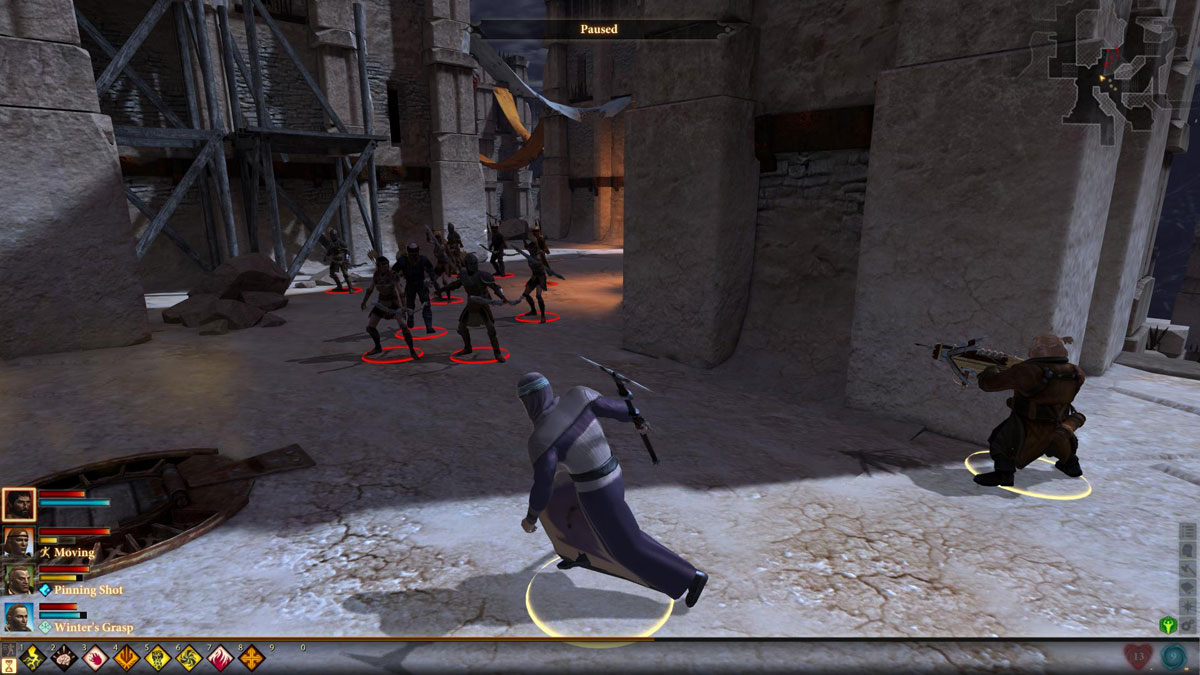
Another day, another 30-dude ambush.
In light of the impending release of Dragon Age 3, I decided to go ahead and play through the much-maligned Dragon Age 2. Would it be really as bad as everyone says? Well… maybe.
When Dragon Age: Origins came out, it was a love-letter to the Baldur’s Gate generation, featuring tactical and brutal combat, an epic and lore-rich storyline, and plenty of morally questionable scenarios. Dragon Age 2 follows mostly along similar lines, but there are enough breaks from the formula that you start wondering if the devs wanted to make a different game altogether.
Combat in Dragon Age 2 has a much more action game feel, even though it shares many things with the original. The Tactics system is still in place for configuring the AI, for example, and you can still pause the action at any time to issue orders or directly control different party members. Indeed, in the beginning, it felt largely the same as Origins, albeit “quicker.”
The major problem though is that the game throws waves and waves of weak enemies at you, even when it doesn’t make any sense. You could be walking around the slums when BAM! Thirty dudes try to take you out, ten at a time. While superficially more exciting, the challenge in these sort of fights is extremely low; the only times in which my party died were when an enemy spellcaster dropped an AoE spell, which typically will one-shot everyone nearby before you realize what’s going on.

There’s self-deprecating and then there’s sad truths.
Bioware went a different direction with the plot and overall story structure as well. Instead of fighting another Blight or dealing much with Darkspawn at all, the story follows your character as he/she… well, lives in a city. On one level, it felt pretty novel to experience a former refugee’s rise to prominence, especially given how reasonable the path ends up feeling. I especially liked how each game Act fasts forward time by 3 years – all too often it feels like the average RPG sort of assumes all this character development and world-saving occurs within a week.
On the other hand, the lack of any discernible threat puts a lot of pressure on the incidental stories being interesting… which they are largely not. The underlying plot of Dragon Age 2 is an exploration of the Circle and Templar tension within the Dragon Age setting. While I always thought that bit lore was cool, it isn’t enough to carry a 40+ hour campaign. At one point, the only quest left I could complete was the plot quest to find some Blood Mages who ran away, and all I could ask is: who cares? Those Blood Mages have nothing to do with anything, even in context.

At least the dialog was refreshing.
Another major issue I had with the game was the rather outrageously blatant copy & paste job with the environments. Going into a cave? Guess what, it’ll be the same cave you always go into, except maybe certain passages will be blocked off this time. Given how the game takes place in one main location, I can understand reusing assets to an extent. But when every warehouse, every cave, every secret base all have the exact same map even when they have no rational reason to be shaped similarly? Call it what it is: developer laziness and cutting corners.
Overall, the online criticisms of Dragon Age 2 largely hit the mark. It is very clear that DA2 was an experiment, and it is equally clear that even Bioware acknowledged that things did not pan out quite as they had hoped. Although some characters from Dragon Age: Origins make cameo appearances, there isn’t a real reason to encourage that fans of the original game to play this one. It isn’t awful, in isolation, but it’s not compelling enough to deserve the Dragon Age title.
Unfair Impressions: Dragon Nest, Neverwinter
My recent completion of Dragon Age 2 has freed up some mental space that I wanted to give towards something outside of my normal M.O. So, after encountering a random forum discussion somewhere, I found myself downloading Dragon Nest and Neverwinter. Why these two F2P games? Why not?
Dragon Nest
I had a pretty good idea what I was in for just based on the loading screen:
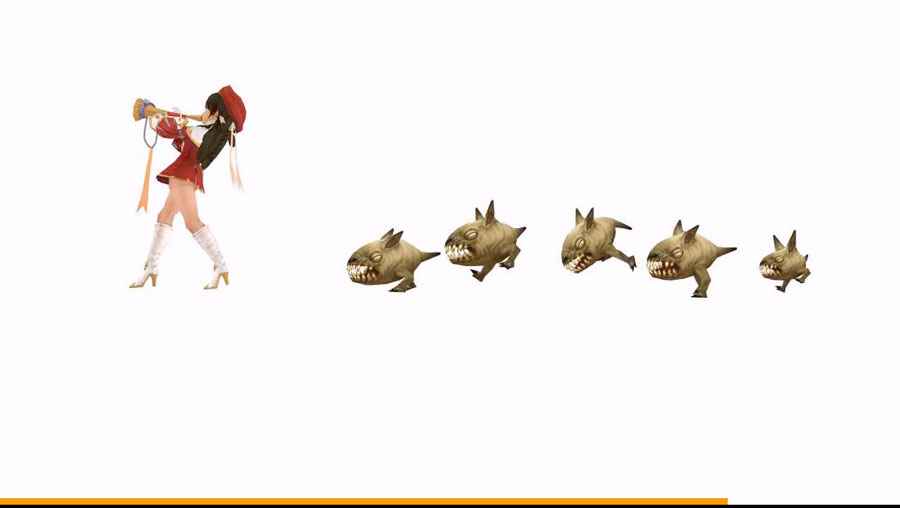
If I can see ass cheeks, it’s not a skirt.
Near as I can tell, Dragon Nest is a lobby-based, Action RPG with what amounts to MMO elements. In the random forum discussion that led me to download it, the game features a heavy, skill-based element to combat. Indeed, there is no tab-targeting; the mouse controls the targeting reticule, and spammable attacks are bound to left and right-click. Whenever I received a quest, I went through two loading screens until I arrived at a predefined area, killed all the mobs, and then zoned onto the next area in a sequence with a boss at the end. This picture sums that up:

Looks better than it plays.
This impression is labeled as Unfair because I basically stopped playing after about two hours. I was playing as the Kali, which is basically a melee warlock dancer, so perhaps that had something to do with my lack of fun. On the other hand, I just couldn’t shake the feeling that if the game was going for kinetic Devil May Cry or God of War-ish style, that they missed the mark. Movement wasn’t as fluid as I would have liked. And then there is the sort of goofy things like quest interface, inability to zoom out very far (which is a limitation of any crosshair-targeting game, I suppose), and general sense of 2nd-rate-ness.
Neverwinter
Much to my surprise, it turns out I had actually downloaded Neverwinter months and months ago, but had never bothered to boot it up for some reason. Unfortunately, I had about ~5gb worth of updates to download, so I might have been better off with a clean install.

Permanent drunk goggles.
In my handful of hours of play, Neverwinter just strikes me as a game that is missing, oh, maybe $25 million in development. Although I am on maximum settings, the world just feels… muddy, yet insubstantial. It is another crosshair-targeting game but I had a real hard time ascertaining that enemies really existed out in the world. And sometimes they were just really hard to see. It is sort of how I felt about Guild Wars 2, but worse.
There were a lot of little D&D touches that I liked. Your “daily” power meter is a d20 that fills up over time. There are “skill checks” of sorts when interacting with certain objects out in the world. For example, after killing an NPC in a cave complex, I noticed a sparkly skull over in a bookcase. After passing a Dungeoneering check (which basically happens automatically), the bookcase opens up to reveal a treasure chest on the other side. All of this managed to evoke both D&D and a sense of physicality, the latter of which is otherwise conspicuously missing from combat itself.

Neat.
The rest of my limited experience was spent seesawing between interest levels. I very much enjoyed how each class seems to have their own unique movement mechanism: warlocks float at a sprint whereas rogues do a dodge-roll. But movement in general just didn’t feel all that good. You know how in WoW and Wildstar and GW2 when you get a movement speed buff and you can kind of keep the momentum going after it wears off by jumping? You can’t quite do that in Neverwinter. And for some reason that feels bad. I can’t quite explain it better than that, but that feeling seeps into everything.
The other curious issue I ran into was how… health doesn’t regenerate. Maybe it does later? It just feels really weird in an MMO for it to not, as it sort of subconsciously delineates the world into checkpoint corridors. Which maybe is the point? There is health potions and such so maybe it is not all that big a deal. But it certainly felt like a big deal as I was playing.
I did not even try anything in The Foundry, which is likely the most remarkable thing Neverwinter brings to the table. Based on my current mood, it isn’t particularly likely that I will.
___________
So there are my completely Unfair Impressions for Dragon Nest and Neverwinter. If you are a player of either game, by all means let me know your own opinions on the matter. Do the games get better? Do I need to play them with a certain mindset? Which class would be the most fun? Things like that.
Voting with Your Wallet
Tomorrow is election day over here in the States, so I wanted to talk about a tangentially related topic:
“Stop complaining and just vote with your wallet.”
Sometimes I wonder whether people understand how voting works. Even if we assume that not voting (i.e. not buying a game) counts as a No vote in any meaningful sense, a single vote in isolation is functionally irrelevant. Beyond that, your No vote is indistinguishable from the same No vote from someone who simply can’t buy the game until the next payday. Or the person who never realized the game was coming out. In other words, your No is actually a Potential Yes. There is no “other person” you can vote for instead, no other means of actually expressing why you voted in the manner you did other than actually talking about it.
All of this is besides the extremely relevant fact that if I spend time on a soapbox complaining about something, and I convince other people to (also) not buy that something, the size of the wallet I am voting with has increased exponentially. Not voting is meaningless; conversely, removing Yes votes is priceless. Your opinions, positive or negative, have currency only when you voice them. So get out there and get dirty.
Anyone telling you to be quiet and simply vote with your wallet is actually getting you to vote with theirs.
Selling Laptops
In the approach of the 3-year anniversary of my buying a new computer, I decided to finally find a home for my world-traveling gaming laptop. Seriously, I bought an Asus G50v way back in the day expressly because I was studying abroad in Japan and I wanted something that could play Battlefield 2 when I got back. The laptop performed its intended function admirably, granting many, many years of mobile desktop gaming (shit weighed over 6 lbs) through some of the heaviest WoW raiding periods in my GMing career. The world moves ever onward however, and I felt terribly guilty for leaving it in a closet drawer for the last two years, especially when it was effectively and permanently obsoleted by my $179 tablet purchase this summer.
But… what exactly can you do with such technology? eBay? Craigslist? The laptop itself worked perfectly fine, at least in the era before sub-20 second SSD boot times and 1080p resolution standards (seriously, it had a 1440×900 screen). I almost could not consider selling it to a family member out of good conscience. But who knows what the actual market price would be.
Enter Cash4Laptops. Actually – spoilers! – don’t enter there. It is unlinked on purpose.
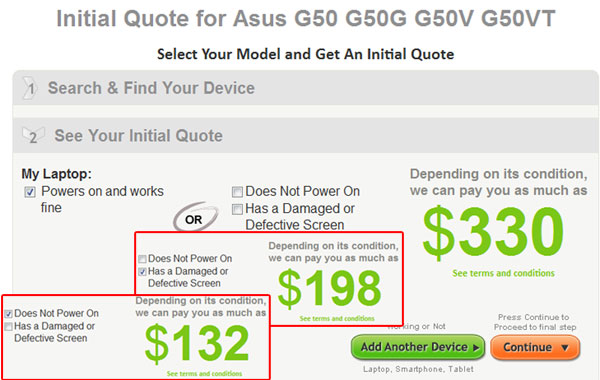
Total bullshit.
As you might imagine, I was rather excited to see the potential of “up to” $330 for my aging beast. So I submitted my order, got prepaid labels, shipped it off to the Nevada pasture, and awaited their inspection report. Then it arrived:
Hi XXXXXX,
Good news: your device arrived safely at our facility and just received a professional appraisal by our qualified device inspectors.
Nothing to do now but receive your cash!
After carefully inspecting your device by hand, seeing its condition, and following up-to-the-minute market conditions—you’re owed $52 for the device.
“Fifty-fucking-two dollars? What the literal shit?! Are they selling it on Pawn Stars?”
Now, on the one hand, obviously yeah “terms & conditions” blah blah. It’s a used laptop, no question. But my problem with the valuation isn’t even that it came in at 15% of the quoted price, but that it was less than half of what they would supposedly pay for a laptop that didn’t even turn on. You can’t even make up bullshit like that. How “used” does used have to be to be worth less than a laptop that doesn’t even power on? Did they open up the case and find a wasp nest inside? It still boggles my mind.
In any case, I asked for clarification on the valuation, was told to call in, did so, was transferred to the Purchasing department, left on hold for 40 minutes, and finally spoke to someone who admitted my laptop was inspected to be in “flawless” condition. The guy went on to say that the release of the Surface 3 has been a “slap in the face” to the old laptop market in general, and prices are in freefall. While I was forced to take the dude’s word on face value at the time, it appears to be reasonably accurate after all. Still, the terms & conditions mentioned they had to ship it back at no cost if I didn’t like the new value (within three days), and there were other, competing websites that were offering more than $52.
Before I could express that sentiment however, the guy said “Okay, how about I round it up to $100 and we’ll cover the Paypal fees?” Okay then. Deal.
The moral of the story, I suppose, is A) don’t be particularly surprised if you get a Pawn Stars-level lowball offer when using these sites, and B) dispute the valuation, especially if they have to send the thing back for free. Getting an extra $48 (and a blog post) for putting my smartphone on speaker while I browsed Reddit with a beer is pretty damn time efficient. Was the laptop worth even more than $100? Obviously yes, if they could so easily “round up” to the next hundred bucks. But I got more than I started with and no longer have to worry about it anymore, so I consider it a win.
Cardboard Throne
Much as with the base game before it, I believe I’m done with Beyond Earth for now.
This is not to suggest that I believe Beyond Earth to be a bad Civ game. There are quite a few issues – some imbalances, some questionable design philosophies, etc – as pointed out in various Reddit threads dedicated to the game. However, it absolutely captures that whole addictive “I pressed End Turn for six hours in a row” part of the Civ experience. Even now, I’m getting the urge to boot it back up.
What is stopping me is the realization that what I like about the game and what the game actually does are two separate things.

It’s all downhill from here.
My favorite part of a Civ match is the beginning, when your strategy is largely formless, reactive, as you cast your eyes about an unknown and hostile world. “Okay, let’s scout out that island.” “Ooo, a city here would capture three strategic resources!” This feeling lasts maybe the first 100 turns, beyond which everything becomes a formality, a known, an inevitability. Yes, perhaps disaster strikes, perhaps you lose a city, perhaps an enemy Civ suddenly wins with a surprise victory condition. Nevertheless, you still know what you have to or should be doing at that point – it all just becomes the mechanical action of carrying it out.
All for what? The personal satisfaction of grinding the patience of a machine to dust? If Firaxis changed the Retire button to a No Longer Delay the Inevitable button, I would win the same amount of times with at least some in-game acknowledgment of the hours poured into the equivalent of a roguelike. Do I really need to conquer those last two capitals before the game is officially over? The game was arguably decided hours ago when I stopped exploring and building cities.
This sort of reminds me of when I used to be really into RTS games like Command & Conquer and Starcraft, up until I understood the concept of Actions Per Minute. Suddenly, the game I was hitherto playing was no longer. I could not unlearn how horribly inefficient my “build six Protoss Carriers” strategies were, nor how much better I could have been playing. The three aspects of gameplay were (still) entertaining – building bases, ordering units around, micromanaging one unit’s abilities specifically – but I both understood that I was incapable of engaging in more than one of them at a time, and not particularly motivated to try to get better. If you had time to turtle up to spam endgame units, you probably had time to win much earlier. Which means I was doing… what, exactly?
There is nothing necessarily wrong with enjoying a game outside of its intended purpose, but if the box brings more joy to the cat than the toy it contained, maybe you should just have bought a box instead. Or go find a better toy.
Like I said though, if Civ and Beyond Earth is your type of game, more power to you. I used to think it was mine. But now that I see myself sitting upon a virtual throne of cardboard boxes, I am not quite sure what to think. Other than maybe I should go play something else.
Impression: Civilization: Beyond Earth
I think I am beginning to understand those old-school gamers who were miffed by EA’s Dungeon Keeper app. Because, you see, with Beyond Earth I thought I was buying Alpha Centauri and ended up with a full-price Civ 5 mod instead.
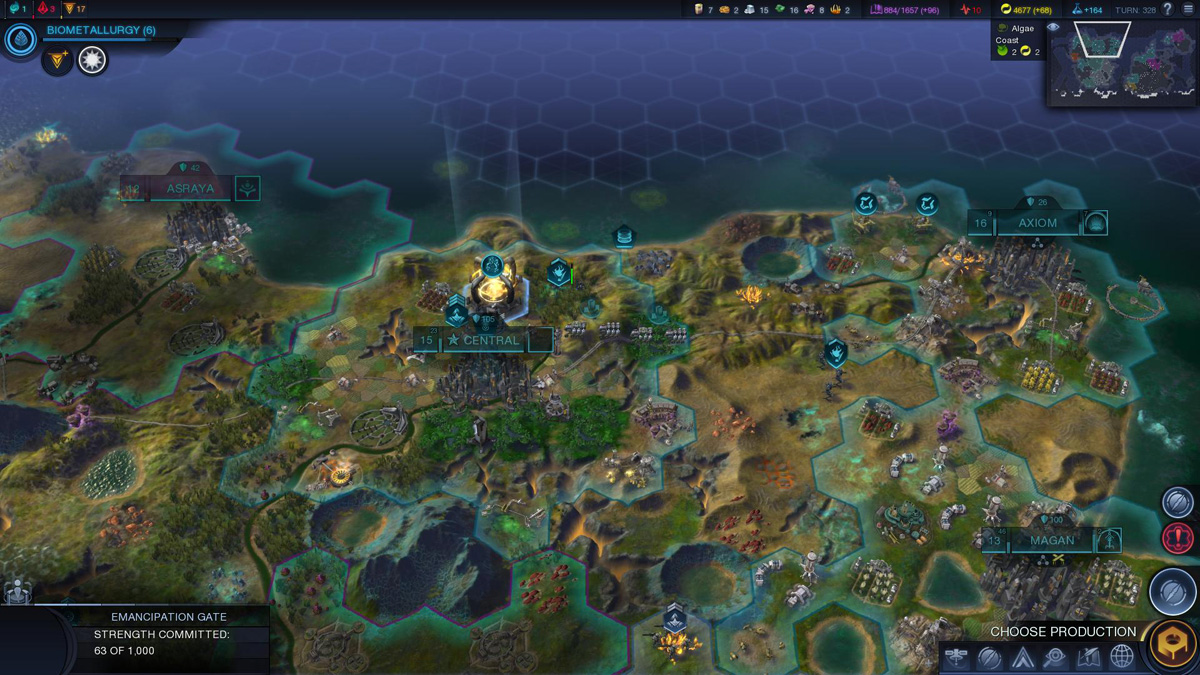
Look familiar?
That is not an entirely fair comparison, of course. I knew this wasn’t going to be Alpha Centauri. But… you know… I kinda wished it was. Alpha Centauri consumed a solid chunk of my adolescent mindspace, where it resides to this day. Like… like a mind worm. That will need to be nerve stapled to be removed. And don’t even get me started on those real-world quotations used when researching new tech – I walked into my college courses years later with the equivalent of AP credit from being inspired by Plato and Aristotle half a dozen years before they were required reading.
Anyway. Back to Civ 5 Beyond Earth.
You know, it’s actually extra unfair that I keep belaboring this Civ 5 point because I didn’t start playing Civ 5 until about two months ago. I have a total of 24 hours /played in Civ 5 actually. By contrast, I have 16 hours in Beyond Earth as of this morning. It came out three days ago. So there is that.
What I already like about the game are the barbarians aliens. There are multiple kinds roaming about, including ranged and flying units, and even some “endgame” aliens right from the start. While it feels a bit unfair to stumble across a Siege Worm with an Explorer on Turn 3, I enjoy that extra level of randomness insofar as it gives you some interesting decisions. Such as A) run screaming, B) decide you didn’t want to build a city over there anyway, and/or C) New Random World.
Another thing I like – thus far – is the tech web:
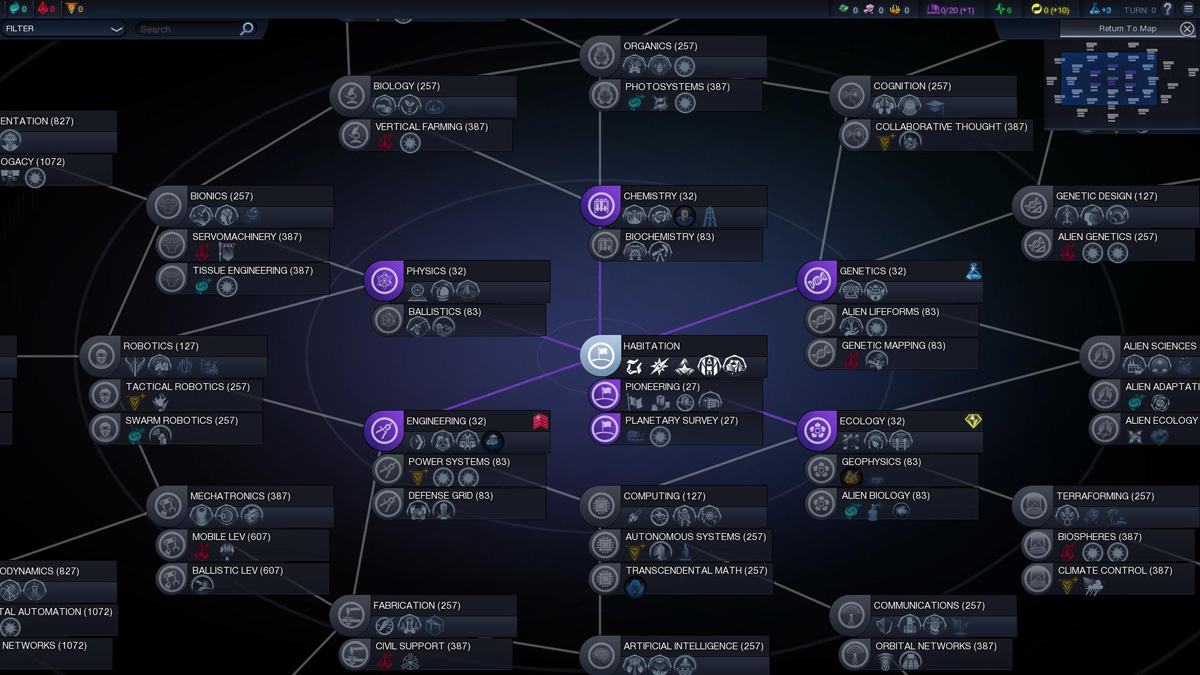
*Rubs chin*
The basic gist is that instead of needing to research lame things like Pottery and Horseback Riding on your road to thermonuclear weapons, you can make a beeline to wherever you want. Each tech “branch” has tech “leaves,” which I thought was a pretty clever way to keep the web itself relatively clean. Still, there is a lot of convoluted nonsense in there with some techs granting bonuses to buildings on the other side of the tree and the rather unfortunate necessity to research certain techs to “unlock” strategic resources. I know Civ 5 had something similar, but it’s extra important in Beyond Earth because your Affinity special units “reserve” a certain amount of said resource, and you never really know how much you’ll have until unlock the ability to see it. Combine that with Civ 5’s “we still don’t like you building cities” M.O. and you could be frustratingly locked into a different Affinity or just use standard units forever.
Speaking of forever, my Civ 5 experience in pressing End Turn about a thousand times before anything of consequence occurs has carried over into Beyond Earth. I have completed one game thus far, where I decided to go for the Supremacy victory instead of “just roll over the insane enemy Civs” victory. After grinding up Supremacy to the prerequisite level, I had to spend 30 turns building an Emancipation gate. Then I needed to… send 1,000 Attack worth of units through the gate. And you can only send one unit per turn. I get that this would probably be completely compelling in a multiplayer match or something, but Jesus.
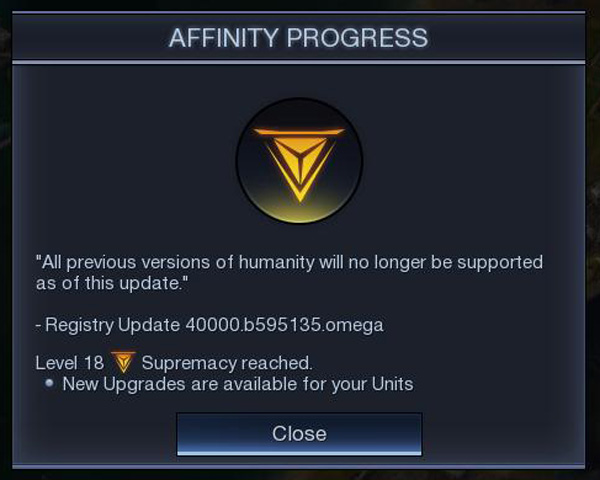
Worth it.
My second game was on a bigger map that ended up being an Archipelago-ish area. Which could be interesting… except, whoops, you need to spend ~17 turns researching the ability to Embark your land units. Remember when I told you that high-level aliens are everywhere right from the start? That also includes the seas. You can’t even escort a colony expansion until you research Gunboats in such a scenario, and one Gunboat can eat about two hits from the standard sea alien. It was literally turn 98 before my 2nd city came up to speed. I might have been able to push for a much earlier expansion but, again, Sid Meier apparently hates cities these days so I wanted the few he would deign to grant me to be near some strategic resource.
Want to know how that game ended? I came into it deciding to go Harmony and channel my inner Deirdre this time around. After unlocking the ability to see Xenomass, I check out the map and… huh. There is pretty much just one free node anywhere near me. Which makes sense, in a way, given that it spawns on land and this particular world is mostly water. Still, it was discouraging enough for me to just abandon the effort altogether. No doubt I could have switched strategies to something else – there were alternative avenues of (eventual) victory – but I wanted a Xeno Titan. Oh well.
There is more to say about Beyond Earth and it’s inevitable parade of expansions that will socket in more Civ 5 mechanics, but these are my impressions at 2am after playing 16 hours across three days. If you liked Civ 5, you’ll probably like this game. If you liked Alpha Centauri, you probably won’t. I am not quite sure what I ultimately feel like right now, but I do know that I would like to try it again.
Micro-Reviews: Suzuka, Orange Marmalade, GE – Good Ending
Suzuka
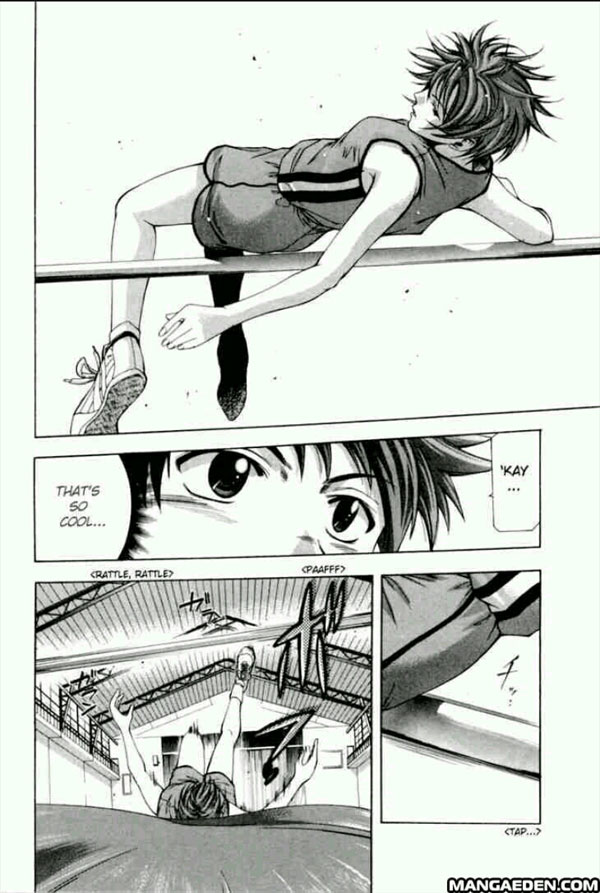
Suzuka starts off as a fairly cliche high school romance manga, right down to the main male character transferring to Tokyo and living in an all-girl dorm/spa. In fact, you might recognize pretty much that exact premise right out of Love Hina. The curious thing about the manga though is that I was never really able to get a sense of whether it started this way intentionally, or if the gradual evolution of the story into something more meaningful was a happy accident. In either case, the character progression becomes much more interesting as time goes on, the harem and fanservice drops away, and many satisfying (and occasionally frustrating) developments are had by the end.
Basically, if you are looking for a more “realistic” romance manga along the same vein as A Town Where You Live, Suzuka is a good front-runner.
____________________________________
Orange Marmalade

This is a Korean-style romance manga centering around high school girl Ma Ri, the “ice queen,” who actually happens to be a vampire in hiding. It has been 300 years since the last vampire has actually killed a human, but the discrimination and threat of exile is constant. In fact, her family has had to move around repeatedly any time people start to get suspicious, which has led to Ma Ri to make peace being alone forever. Despite her best efforts though, she is befriended by a group of girls and Jae Min, a boy who seemingly refuses to leave her alone once she accidentally nips his neck.
The pacing, art style, and overall quality of Orange Marmalade is extremely good. I enjoyed it so much, in fact, that I basically plowed through the entire series in a single day. It has angst, drama, and moments of extreme pathos, all without necessarily devolving into standard tropes. There are some vampiric shenanigans, but the story isn’t necessarily about vampires. In fact, beyond a few initial plot points, the vampire angle is more allegory than anything – and in that regard, it is extremely effective. I recommend it.
______________________________________
GE – Good Ending
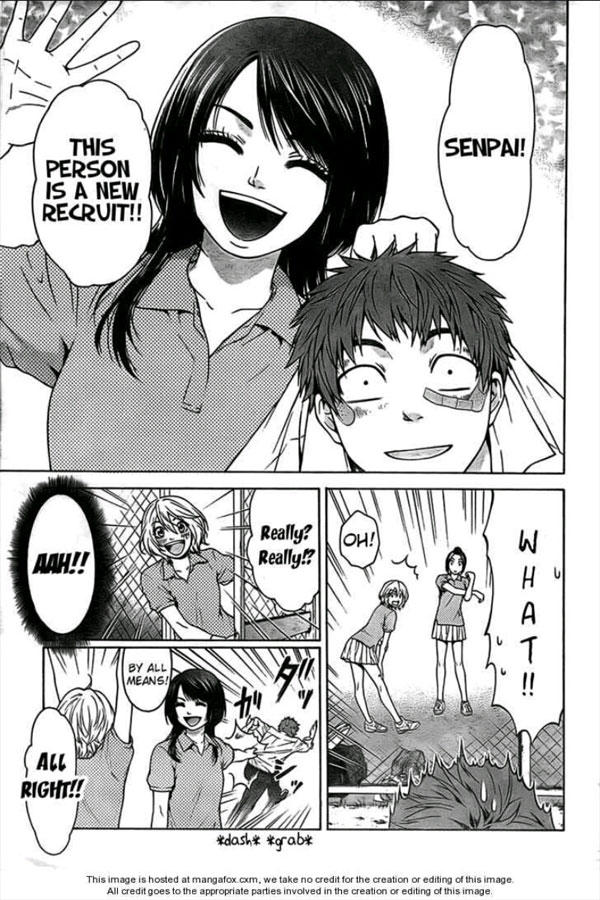
GE – Good Ending is, as you might expect from the title, a high school romance manga. The story centers around Seiji Utsumi, a boy who has a crush on the tennis club president. Too scared to make a move and too unathletic to join the tennis club himself, he remains content with admiring her from afar. That is, until another tennis club member, Yuki Kurokawa, catches him peeking in the bushes, and seemingly makes it her duty to put them together.
While this manga starts out with the stereotypical dumbass protagonist who is incapable of doing anything, the beauty of GE is the character progression and, indeed, evolution. Characters grow up, pasts are revealed, feelings change, misunderstandings are had, and basically real shit occurs. In other words, the beginning of the manga bears little resemblance to what it eventually becomes, which is a rather compelling narrative. If romance manga is your genre, GE will definitely earn a spot on your list.


On Clones
Nov 10
Posted by Azuriel
Let’s talk about Overwatch for a second.
A lot of the Overwatch reactions that I have been reading on blogs basically revolves around the “TF2 clone” observation. And it’s true: Overwatch does kinda sorta maybe look like TF2 when you squint at it. But I get the feeling from many of the posts that “being a clone” is somehow being considered a value judgment against the game.
Which is a little weird considering WoW was a clone of EQ, LoL was a clone of DotA, and so on. In other words, being a clone of something has very little to do with the merit of the final product. Unless the gameplay was directly cut and paste from the source material, it’s entirely possible for one or two (or more) key tweaks to change the overall feeling of a game. And if you don’t believe that, you haven’t been playing MMOs for very long.
As for myself, I remain mostly ambivalent towards Overwatch. I have played a grand total of about an hour of TF2, which was long enough for me to realize I have little interest in diving into seven years of accumulated competitive minutia; learning the maps, the weapons, the classes, and strategies of each while playing against hardened veterans isn’t exactly my idea of fun. Even if it were a total TF2 clone, Overwatch acts as a rather convenient “reset” of sorts that levels the playing field between vets and newbs, at least for a time. So in that sense, I am interested in playing it and seeing if it’s fun.
At the same time, my experience with Titanfall is giving me pause about the 6v6 format. I have long stated that Titanfall is an amazing game, but the smaller team size means a lot of pressure is put on the skill level of your best and worst players. In other words, a big fish on the enemy team can crowd out the pond. Which is the way things are “suppose to be,” but I’m not particularly inclined to play games in which I spend the majority of the time on the respawn screen. I much prefer larger games like Battlefield and PlanetSide in that gaming gods can rule some minor fiefdom (typically the air game) while everyone else is pounding the ground and having fun.
I don’t necessarily need to win to have fun playing something, but do 6v6 maps give the necessary space to have fun? Typically not, in my experience. We’ll see.
Posted in Commentary
5 Comments
Tags: Blizzard, Overwatch, PlanetSide 2, TF2, Titanfall