Second Impressions: FF7R
I didn’t think it was possible, but I like Final Fantasy 7 Remake even more.
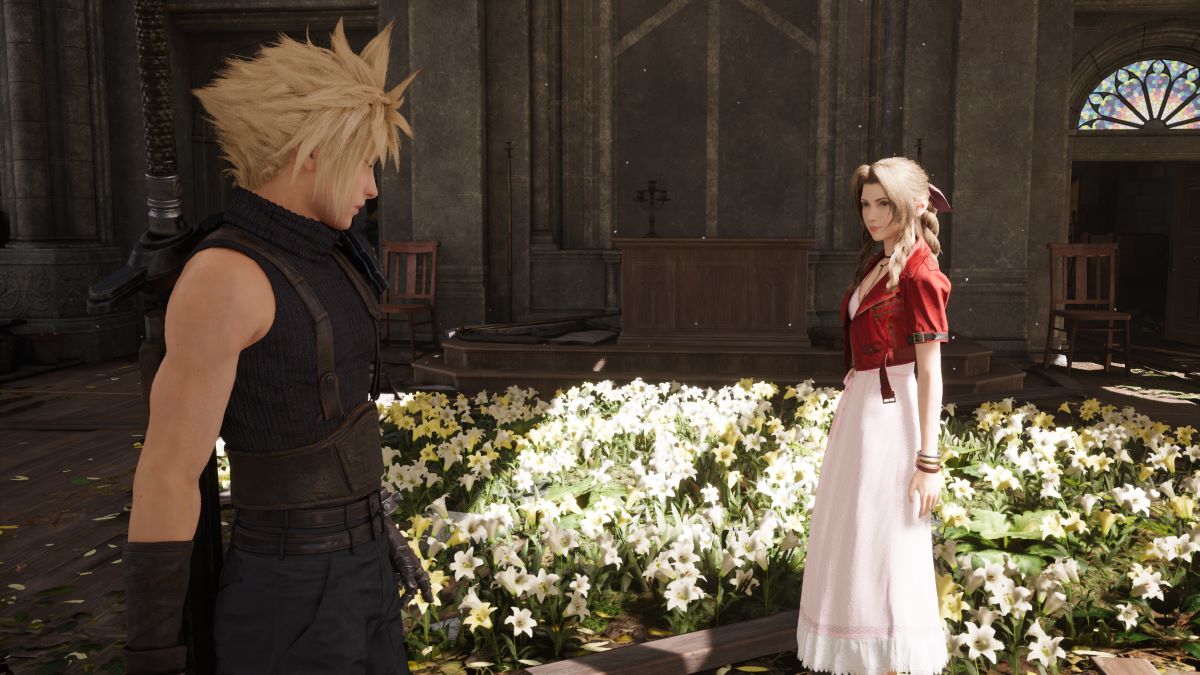
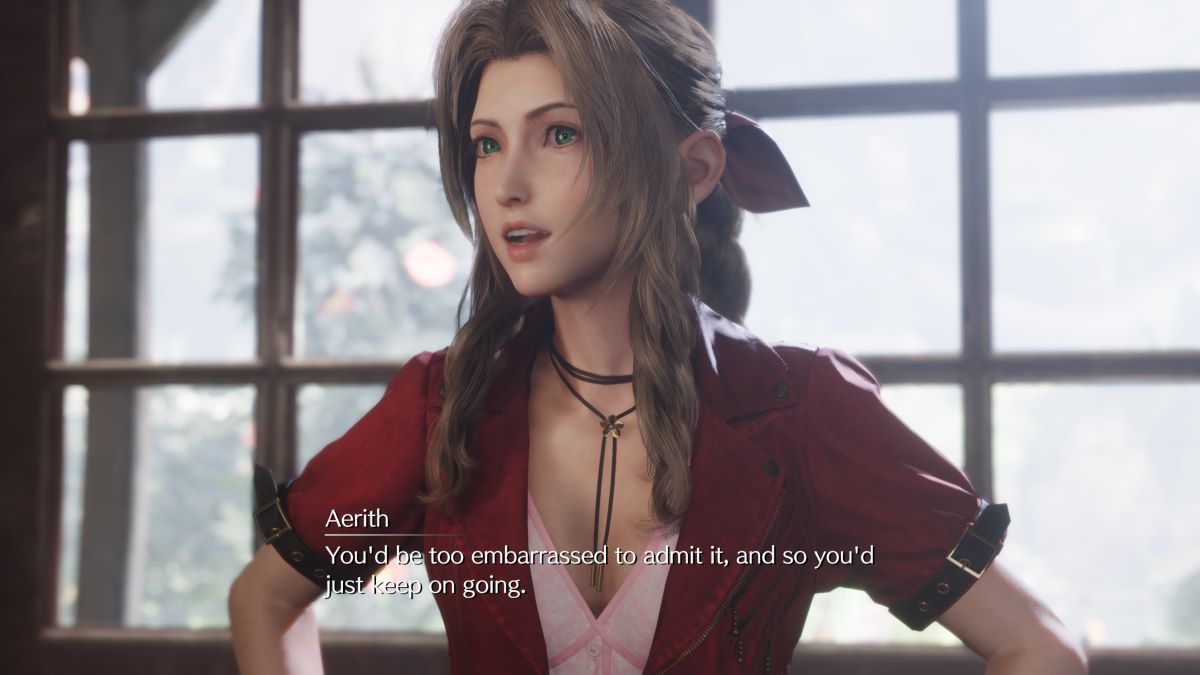
One aspect that I didn’t like initially has really grown on me: uninterrupted dialog. Basically, there are no RPG-esques pauses whenever someone is talking. Conversations just flow with zero button inputs. It was initially kind of frustrating, because some of the banter is hilarious and it goes by too quick for me to take a screenshot (I always have subtitles up in games precisely for screenshot purposes).
But do you know what it all reminds me of? Mass Effect.
Over ten (!?) years ago now, I was writing about how the winks in Mass Effect were blowing my mind. There is a lot more than winks going on in FF7R, but that’s not really the point. The point is that these are genuinely interesting characters with personalities and mannerisms. They wink, nod, pose, strut, and otherwise behave in consistent ways. Some of those mannerisms are very anime-ish, but hey, Japan. At least these land miles better than in FF14.
Anyway, I just got to the point where I party up with Aerith and I’ve been smiling the whole goddamn time. I’ve always historically been Team Tifa, even before Disc 1, but Aerith is the biggest dork in the Remake and I love it. Just the little things like Cloud saying “The wererats pray on the weak” and Aerith replying “Well, you better be careful then.” Typing this out seems so dumb but there’s just this whole vibe going on in the game, and I’m feeling it.
Oh, and there’s this moment when Cloud and Aerith reach a pipe and have to slide down to get to the next area. Aerith goes first… and says “Wheee!” with her hands raised in the air as she goes down.
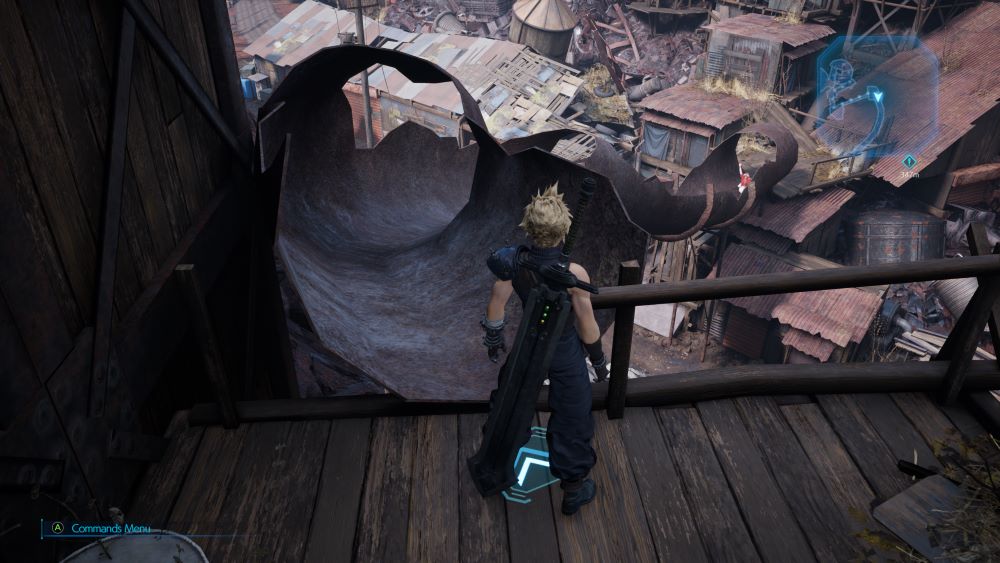
Guys. Guys. Again, feel super-dumb typing it out. But when was the last time you played a game where you were able to vicariously feel the joy and care of the designers through the screen? Whoever scripted that moment loved their job. It didn’t have to exist. It was over in literally two seconds – I couldn’t even hit the screenshot key fast enough – and it has no bearing on anything other than to flavor the experience and convey that which is Aerith.
It made me smile. When was the last time a game did that for you?
In closing, let me reiterate the disclaimer that the original Final Fantasy 7 has been in my top 5 game list for 25 (!?!) years. So FF7R is basically intravenous nostalgia from the word GO. Will you appreciate the “personalities and mannerisms” of these characters in the same way I do? Probably not. In a vacuum, they might just be cliché.
Nevertheless, these devs have taken a formative experience of my childhood and brought it to life in a way that has exceeded all my wildest expectations. A breath I never knew I was holding has been released as a cathartic sigh, blowing away my whole jaded gamer schtick. For the time being, at least.
So there it is. Hopefully the rest of the game holds up, but it doesn’t even matter. I’m happy right now.
First Impressions: FF7R
Oh, man. OH. MAN.
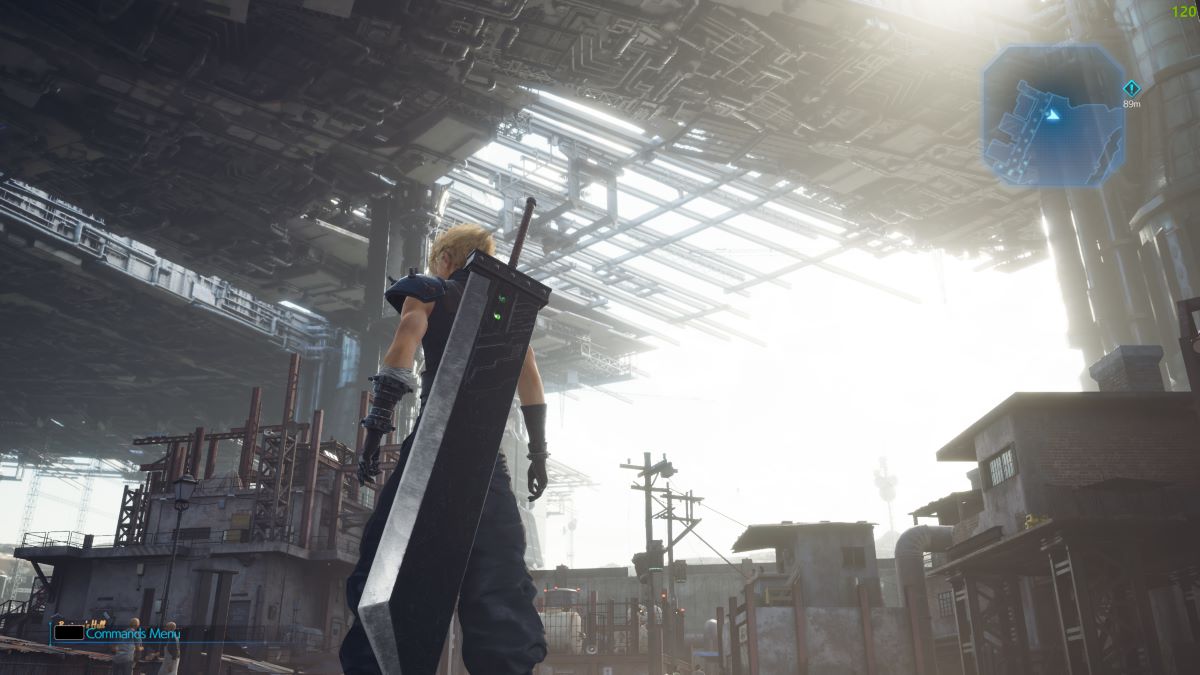
I know the game is a remake and the devs have had decades of modern game design experience to leverage… but, guys. I’m home. I haven’t been this giddy and excited since… I don’t even remember. Every single part of game so far is like finally finding someone who shares the same passion as you and catching up for hours. Walking around Sector 7 Slums and looking up (looking up!) just pulls the FF7 memories of my high school imagination straight out of my head and serves them right back in high definition.
And it really reinforces, to me, how groundbreaking FF7 originally was. For you see, FF7 was not my first Final Fantasy game – that was actually FF6. So this is not a “always remember your first love” situation. This instead is a recognition of how novel the pseudo-sci-fi setting was, the mind-blowing scale of Midgar, and that first time you leave the city and see it as just another town on the world map. Blew my fucking mind. That experience is right up there with first leaving the Vault in Fallout 3.
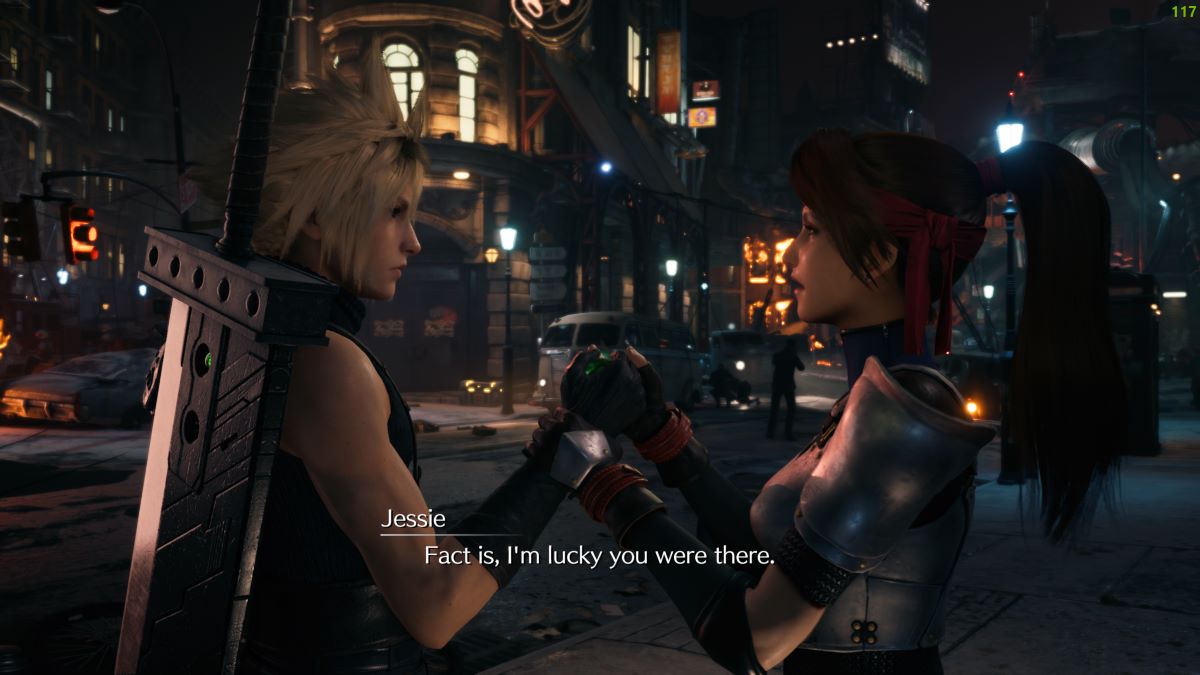
There are some other things I like. An extremely flirty Jessie. The random NPCs commenting on Cloud. The aftereffects of the reactor explosion. The extra cutscene on what really caused the reactor explosion. The well-stitched narrative in which I felt it difficult to stop playing. Not that I was going to stop playing until I reached Tifa for the first time. Tifa.
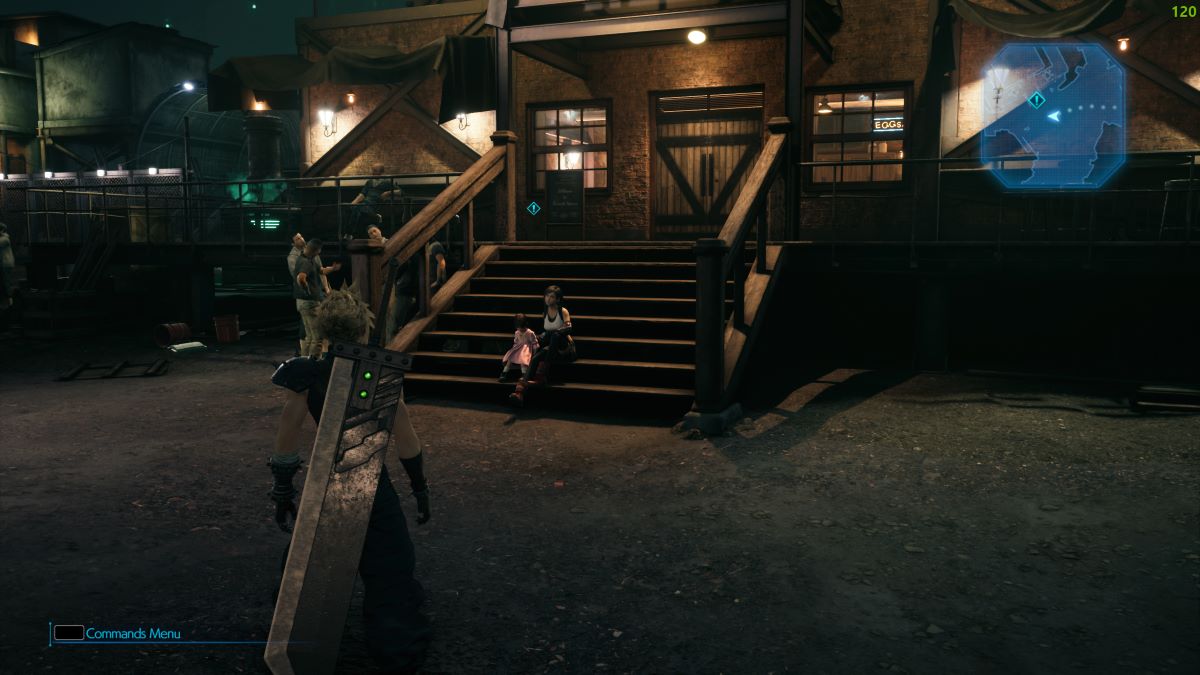
The one negative so far, and it’s kind of important: the combat system.
Basically I’m not quite sure what’s going on yet. Like obviously I’m reading the tutorial prompts and successfully navigating the fights. But it seems like I’m taking a lot of damage and I don’t know if that is expected, or if I’m supposed to not, or what. It’s “action gamey” but not in the same way as, say, Nier Automata. Controlling Barret feels even worse as none of his attacks feel particularly satisfying. Hold X to rapid-fire for some amount of time, or press Y to… speed up the charging of a special attack. But that attack can be stopped by random terrain if you aren’t careful.
Anyway, not going to let a little thing like a combat system interrupt my JRPG nostalgerbation. I am going to assume it gets better, or that I can change things around enough to make it so, or that it will not diminish the rest of the experience. Which would be quite the feat considering how much I am enjoying myself already just walking around.
The Wishlist, part Welp
I was expecting the Epic Sale to be weeks away still, but apparently it started today. Also, apparently inflation (or lawsuit fees?) come for us all:

Instead of getting a flat $10 off any game at $14.99 and above, you get 25% extra off.
This is technically a better deal when the baseline game you are buying is more than $40. Everything else is a worse deal. For example, Rogue Lords is on sale for $16.24. With the historical coupon scheme, it would be $6.24, but this new scheme means it is $12.18. The one extra nuance though is apparently the new scheme will allow you to get the 25% discount as long as your entire cart is above $14.99 rather than individual items. Risk of Rain 2 is discounted to $12.49, for example, which normally would not receive any extra discount. In the same cart as Rogue Lords, you save… $3.12.
Hey, I’ve done dumber shit for, well, not less but not much more than that.
In any case, it’s extremely disappointing that basically every game on my wishlist is $2.49 more expensive than it was six months ago during the Winter version of this sale. Two-fiddy many not seem like a lot, and perhaps it isn’t in the grand scheme of things, but in my head I turn those numbers into other games I could have bought.
Anyway, this is how my wishlist breaks down in this sale:
- [$37.26] Final Fantasy 7: Remake Intergrade
- [$22.49] Cyberpunk 2077
- [$22.49] Red Dead Redemption 2
- [$18.74] Horizon: Zero Dawn Complete
- [$15.74] Satisfactory
- [$9.37] Risk of Rain 2
- [$37.49*] God of War
- [$40.49*] Dying Light 2
- [$18.74*] Wildermyth
- [not listed] Sekiro: Shadows Die Twice
- [not listed] Elden Ring
- [not listed] NeiR: Replicant
The prices with an asterisk are games not on sale aside from the bonus 25% (Dying Light 2 is 10% off, I guess). I’m actually rather surprised about the bottom three games simply not existing on Epic. I’m not aware of any exclusivity agreements with Steam, and part of Epic’s whole deal was supposed to be a better dev cut of the action, so… what? How is something like Elden Ring not on here?
After some sticker shock at the “buy all the things” total, I pared it down to the four horsemen:
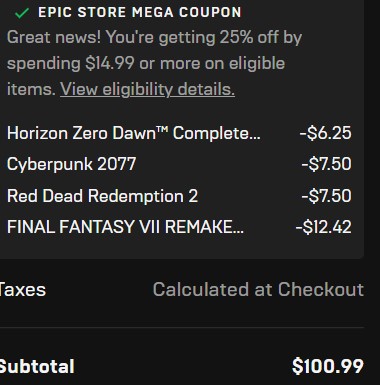
So, Final Fantasy 7 Remake, Cyberpunk 2077, Red Dead Redemption 2, and Horizon: Zero Dawn.
I had things like Risk of Rain 2 and Satisfactory in there and some other off-wishlist games like Days Gone and Far Cry 6, but I had to face reality a bit. Given those main four games (and nevermind my existing library), when would I have the time to be playing anything else? I suppose it’s possible that Epic’s next sale is an even worse deal than this one, but that is a risk I am just going to take. This way, I can see where things stand by the end of quad-AAA production experiences, not feel guilty for occasionally tooling around in random indie games, and see what ends up popping up in Game Pass.
And that’s it. See you in six months.
The Wishlist
With a monitor and the PC acquired, it is time for Phase 2: reasons to have upgraded my PC at all.
- Final Fantasy 7: Remake Intergrade
- Cyberpunk 2077
- Red Dead Redemption 2
- God of War
- Horizon: Zero Dawn Complete
- Sekiro: Shadows Die Twice
- Elden Ring
- Dying Light 2
- Satisfactory
- NeiR: Replicant
- Wildermyth
- Risk of Rain 2
The ones near the bottom did not need an RTX 3080, of course. Arguably, none of these do. But I have it now, so… Capitalism, Ho!
The plan here is to wait for the next Epic Store sale where they offer 50% off + $10 coupon, which could push many of these into the $15-$20 territory. Indeed, Cyberpunk and RDR2 were both $20 this past Winter, so I’m expecting the same thing this Summer. The big question mark will be FF7R with its MSRP of $70. I doubt it hits 50% off, but maybe something like 25%? With the coupon that would bring it “down” to $42ish which… ehh, maybe. There’s a part of me that wants to wait even more out of principle. At the same time, I have already waited so long for something I’ve wanted so much that it becomes a bit ridiculous. I could just, you know, not buy NeiR Replicant or whatever and use that cash.
Or just have bought a RTX 3070 prebuilt and all the games Nope, nah, I make GREAT decisions.
In other news, I’m looking forward to max settings on games where that matters.
Interlude
When it comes to music, I have a System.
Stage 1 is Acquisition. My ability to discover new music is very limited, as I did not have much of a commute even pre-pandemic for radio, and I typically listen to NPR besides. Therefore, I pretty much only hear snippets of songs from random Youtube clips, memes, or Indie-Rock playlists. Once I do hear something I like, I immediately try to locate the entire discography of the group “just in case” there are other songs I may enjoy. The amount of times this has worked out for me is small in the aggregate, but when it has worked out, I ended up finding some of my favorite songs of all time, so it’s worth it.
Stage 2 is Sifting. I have a dynamic playlist called Unrated that will display every song in my library that does not have a 1-5 Star rating. Once a rating is decided, it drops from the playlist and I continue down the list until my queue is empty. Roughly speaking, ratings mean:
- 1 Star – To be deleted
- 2 Star – Song is “useful” for some other purpose (e.g. memes, D&D, comedy clips)
- 3 Star – Baseline level of good, would enjoy this randomly being played
- 4 Star – Very good song, catchy, meaningful
- 5 Star – Devasting emotional payload
To give an idea about distribution, I have 3270 songs in the 3-Star category (80%), 721 in 4-Star (18%), and just 100 in 5-Star (2%).
Stage 3 is Assignment. Once everything has a Star rating, it goes into my Group Work dynamic playlist. It is here that I assign it a “Grouping” category. I base these off of colors that correspond to mood:
- Clear – no particular mood
- Blue – melancholy, pathos
- Green – mellow, unobtrusive
- Red – songs that make you drive faster on the freeway
- Yellow – Up-tempo, driving beats
- Rose – relationship songs
Once this last piece of metadata is complete, songs that have survived the gauntlet are automatically sorted into dynamic playlists. If I want to chill and do some work? Open the Green playlist and hit Random. Roadtrip? Load up Red and press Play. Want to just feel sad for a while? Blue. This has worked out much better for me than traditional playlists, as sometimes I forgot to add new songs to old playlists. Plus, some songs fit into multiple moods, which I can handle by giving them multiple Grouping labels (“Green, Blue”).
To be honest, I have no idea if this is convoluted or not. My default assumption is… Yes. But I haven’t really heard how other people tackle this sort of thing. Surely everyone has playlists of some kind, yeah? Do people just use Spotify these days? What is your System? Partially because I’m curious, and partially so I can determine what improvements (if any) can be assimilated into my own.
Addendum: Program-wise, I am using MusicBee as the player on PC, and Rocket Player on my phone. I used to use iTunes on PC and synced things easily with Rocket Player, but at some point that method failed and I could never figure out why. So these days I just bulk copy/replace files on the phone periodically.
Acquisition-wise, TPB used to be good enough, but these days I just rip from Youtube.
Misadventures
You didn’t think buying a premade PC would be easy did you?

Well, it was pretty easy, actually. What has not been easy is the business of migrating my life.
The thought process was that the prebuilt came with a 1TB NVMe SSD and then I would just move my two existing SSDs from my current machine over into the new one. Since they are already labeled as “Data” and “Games,” with corresponding contents, it would make for what I imagined to be an easy move. The first thing that tripped me up was the fact that my C:\ drive (a third SSD) had games installed on it too. So, I spent most of the afternoon copying over ~90 GB worth of files to the Data drive with the intention of moving them back to the C:\ drive of the new computer.
Once I cracked open the case of the new PC though, I became very confused.
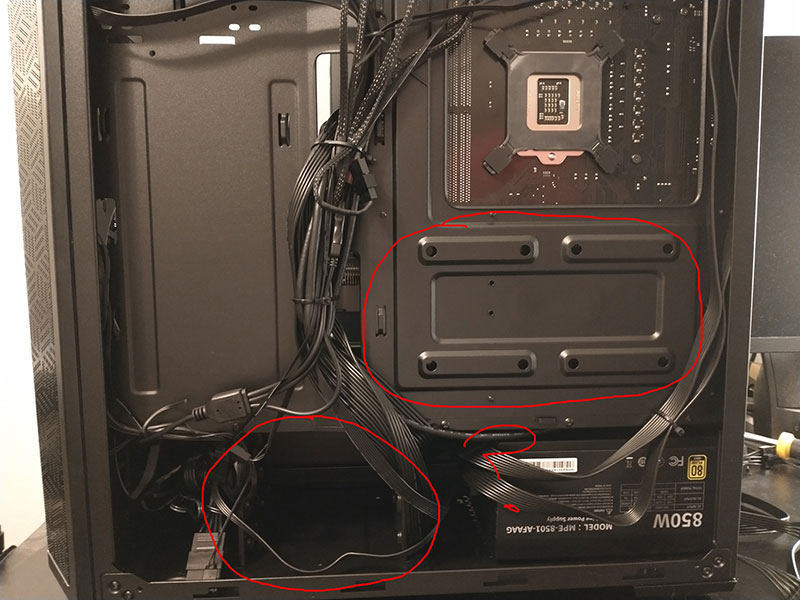
In short, there really didn’t seem to be any obvious bay drives or cages or whatever the fuck you call “place where you stick SSDs.” I mean, there were places where I could kinda sorta maybe see an SSD fitting, but not how it was supposed to fit. The internet was fairly useless in this regard, as was/is Cyberpower tech support who, as of the time of this writing, has still not responding to the ticket I submitted. All I wanted to know was A) where are SSDs supposed to go, B) what the shit these plastic things are supposed to be (presumably related to affixing SSDs), and C) is it true that there is only one SATA port on this motherboard?
That last apparent fact really threw my plans into disarray, as I wouldn’t be able to bring over two SSDs like I planned. The subsequent surprise that the Data drive was, in fact, an old-school HDD this whole time barely registered.
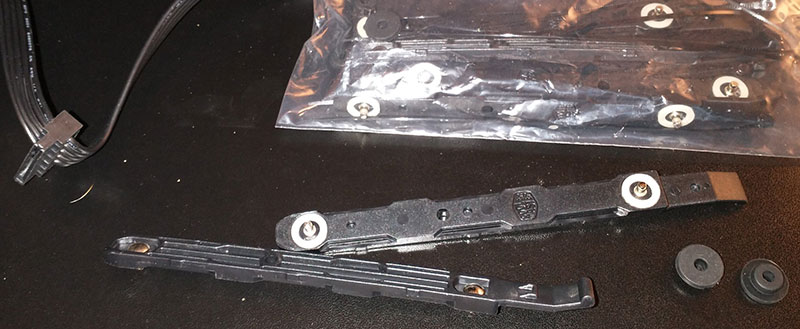
So, Lesson 1: it’s actually very important to pay attention to what the motherboard of your PC looks like, even if that seems like the least exciting piece of the machine.
Lesson 2: Likewise, pay attention to your case. Every damn one seems to have a window on the side these days, which means everything else is getting stuffed out of sight or miniaturized out of existence.
Incidentally, both are lessons I should have already learned from a prior misadventure a few years ago with buying a washer & dryer. Our old top-loading washer stopped working, and the issue was fried electronics that would have cost $200 to replace just in parts. Considering the dryer took 2-3 cycles to dry towels anyway, we opted for a new washer & dryer combo. We did our research, we compared prices, we shopped around, we got a good deal. The thing that we didn’t account for? Which ways the goddamn doors open. They are both front-loading machines and the doors open towards each other. Huge pain in the ass moving clothes around. Can’t really swap positions because of the drain pipes and the dryer vent, and the washer door is not reversible so… yeah. The little stuff matters.
In any case, I reexamined my available options for the PC. The motherboard technically has three NVMe slots, but one of them is behind the huge, honking RTX 3080. So, maximum, I could have one SATA SSD and one additional NVMe SSD. Decision? Throwing my hands (and cash) in the air and purchasing a 2TB NVMe SSD for about $200. Getting a 1TB version would have saved some money and put me on par with my current setup, but… well, my current setup is one without a lot of AAA games installed. And what this experience has taught me thus far is that I don’t really have a deep desire to be spending my precious free time fiddling around with computer components.
Seriously, how could I have not known I still had a HDD installed after all these years? That was where Guild Wars 2 was installed! I never questioned the loading times, but now it all makes sense.
As for the digital migration, that is still ongoing. Several years ago, I bought an external hard drive “docking station” thing in an effort to try and save my wife’s data when her laptop died. Basically, you can chuck any hard drive in the plastic cage, SSD or HDD, and then connect it to another computer via a USB 3.0 cable. It worked. So, that’s the play: install the NVMe SSD into the new computer, unplug the old computer, plug in the new computer, and then (temporarily) remove all the hard drives from the old one and transfer their contents via the docking station.
And because I like doing things the hard way, I am first making a fresh backup of my Data drive to an external SSD that I have around the house for exactly this purpose. Well, that, and because I am vaguely concerned about this 11+ year old surprise HDD dying mid-migration.
So that’s where I’m at. Hopefully the next update will be about how everything went perfectly, and that I was finally able to see a game, any game, at max settings and that it was all worth it.
Battlestation: PC Acquired
About 10 years ago, I bought my current PC. In that time, I pretty much only added a few extra SSDs and upgraded the graphics card from 560ti to 970 to 1060 (via warranty). I have had the same i5-2500K processor, the same 8GB of RAM, and the same motherboard the entire time.
Well, I just put in an order for a new prebuilt when a good deal presented itself:
- Intel i7-11700KF
- 32GB RAM
- RTX 3080 (10GB)
After tax, the total came to $1842. That’s more than the $1260 I spent on my rig back in 2011… although inflation means it really cost ~$1600 in today’s dollars.
The decision was tough. In fact, I have been mulling over the thought of canceling the order and getting a similarly beefy machine with a 3060ti instead for ~$400 cheaper. The idea would be to save that money and put it towards a replacement GPU in the Fall when the 4000 series cards come out and presumably obsolete the 3080.
But you know what? I kinda want to be done.
Assuming it arrives in working order, this PC will meet all the needs of every game that I had been putting off for the last few years. Cyberpunk 2077, Red Dead Redemption 2, Horizon Zero Dawn, FFVIIR. All of which I am planning on purchasing during the next Epic Summer Sale where they should be 50% off + $10 coupon. Having a 3060ti would make them playable at 1440p but otherwise put me in that awkward scenario in which I either play them with the hardware I have at the time, or sitting on them until I get the 4000-series card. Not that that is even guaranteed to be widely available! If I’m waiting until the Fall, I may as well wait for the Winter Sale instead… and so on and so forth.
If you think that’s exhausting to read, imagine being me.
So, yeah. It’s done. And that is certainly worth X dollars all by itself.
LFD? What LFD?
Not to belabor the topic of WoW Classic and LFD, but Rohan brings up an amazingly relevant point:
The real irony here is that Retail sees far less use of the Dungeon Finder than Classic would. Mythic and Mythic Keystone dungeons don’t use the Dungeon Finder and automatic group creation, they use the Premade Group Finder. So really, the only people using the Dungeon Finder are people levelling, people doing dungeons to finish quests, or people gearing up a little at the very start of an expansion. Otherwise everyone is doing dungeons the old-fashioned way, even having to travel to the instance entrance in the world.
I think it would be difficult for even the more ardent Classic purist to be upset over a Premade Group Finder compromise. It allows you to advertise a PUG to your local server community without needing to spam Trade chat. What would the counter-argument possibly be? Yeah, it didn’t exist during Wrath, but LFD did so… are you an originalist or no?
To be honest, I completely forgot about the Premade Group Finder because A) I’m not playing WoW and B) I had less than zero interest in Mythic dungeons when I was playing. I would still prefer an LFD system overall for less serious content though, especially for those on smaller servers. Sometimes you just want to press a button and get group content. If it’s good enough for PvP, why not PvE?
Borrowed Power, Borrowed Time
The Blizzard devs have been on a bit of a interview circuit since the reveal of the next WoW expansion. Some of the tidbits have been interesting, like this particular summary (emphasis mine):
- Borrowed Power
- The team reflected on the borrowed power systems of the past few expansions and admit that giving players power and then taking it away at the end didn’t feel good.
- As they thought of a way to move forward without borrowed power systems, they realized that the only talent system used to fill those gaps by giving you something new every expansion that would not be taken away at the end.
- The goal of the new talent system is to grow on it in further expansions with more layers and rows.
- They want the new talent system to be sustainable for at least a few expansions and what to do at that point is an issue to solve then.
In other words, Blizzard recognized the failings of the “borrowed power” system – after three expansions! – and decided to bring back talent trees as a replacement. All while acknowledging the reasons why talent trees failed in the first place… and simply saying the equivalent of “we’ll jump off that bridge when we come to it.”
You know, I’m actually going to transcript that part from Ion Hazzikostas for posterity:
And I think we’ve built this system… you know, I mean, could we sustain that for 20 years? Probably not. But we don’t realistically… we think of, you know, there’s a – there a horizon of sorts where you want to make sure this will work for two or three expansions and then beyond that it’s sort of a future us problem. Where so much will have changed between now and then we can’t… it’s not really responsible for us to like, you know, make plant firm stakes in the ground. And if we’re compromising the excitement of our designs because of we’re not sure how they’re going to scale eight years from now… we’re doing a disservice to players today and eight years from now won’t matter if we’re not making an amazing game for players today.
I don’t technically disagree. When you have a MMORPG with character progression and abilities that accumulate over time… at some point it becomes very unwieldy to maintain every system introduced. Not impossible, just unwieldy. It reminds me of when CCGs like Hearthstone or Magic: the Gathering start segmenting older card sets away from “Standard” and into “Legacy” sets. Want to play with the most broken cards from every set ever released? Sure, go have fun over there in that box. Everyone else can have fun with a smaller set of more (potentially) balanced cards over here.
Having said that… is it really an insurmountable design problem?
My first instinct was to look at Guild Wars 2, which recently released its third expansion. The game is a bit of an outlier from the get-go considering that there is no gear progression at the level cap – if you have Ascended/Legendary Berserker gear from 10+ years ago, it is still Best-in-Slot today (assuming your class/spec wasn’t nerfed). That horizontal progression philosophy bleeds over into character skills and talent-equivalents too: whatever spec you are playing, you are limited to 5 combat skills based on your weapon(s) and 5 utility skills picked from a list. You pick three talent trees, but those trees don’t “expand” or get additional nodes. The only power accumulation in GW2 is in the Mastery system… which is largely borrowed-power-esque, now that I think about it.
So GW2 is doing well in the ability/feature creep department. For now. Because that’s the rub: ArenaNet is on expansion #3. WoW is on expansion #9. Are we prepared for six more Elite Specs per class? Outside of it being a balance nightmare – which is hardly ever ArenaNet’s apparent concern – I could easily see more Elite Specs being slapped onto the UI and nothing else of note changing. So the problem is “solved” by never granting meaningfully new abilities to older specs.
And… that’s basically the extent of my knowledge of non-WoW MMOs. Surely EverQuest 1 & 2 have encountered this same issue, for example. What did they do? I think FF14 is accumulating character abilities but not yet hitting the limit of reasonableness. EVE is EVE. What else is out there that has been around long enough to run into this? Runescape?
Regardless, it’s an interesting conundrum whereby the choices appear to be A) not grant new abilities with each expansion, B) have Borrowed Power systems, or C) periodically “reset” and prune character abilities before reintroducing them.
 In An Age
Too Early to Access
Jun 1
Posted by Azuriel
Early Access games are such a double-edged sword, right?
Conceptually, they are pretty brilliant. Games are risky projects that typically only give you a chance at profits years after development. With Early Access, you can release whatever you have handy – “Minimum Viable Product” in the gaming parlance – and gain money while you finish building out the rest of the game. Plus, sometimes you might actually get a piece of actionable feedback from the customers that changes the direction of the game. Win-win for the developer.
For me personally, Early Access games are Lose-Win at best.
I do not typically replay games. Between Humble Bundles and Epic Store giveaways and being a periodic MMO player, I have accumulated a largely insurmountable stockpile of games that makes it difficult to “justify” playing even ones I like a second time. So when I do buckle down and play an Early Access title, whatever stage of development it is in is typically the only version I experience. Which can sometimes be fine – not every game makes it out of Early Access. But many times I recognize that things are not fine, as I end up experiencing a worse version of an incomplete game that would have been a lot more fun had I waited.
There are a few exceptions to the rule. Well, one and a half: roguelikes and survival titles. Roguelikes, by their very nature, are “replayed” many times. I started playing Slay the Spire back when there were just two characters, for example, and continue(d) to play it now that there are four. Oxygen Not Included, RimWorld, and 7 Days to Die are in similar boats… that encourage or at least don’t punish re-boating.
Some survival games land further away from the roguelike spectrum and otherwise do not necessarily lend themselves towards repeated play. I have zero desire to play Valheim again, for example, until it is much closer to final release. Is there much of a practical difference between Valheim and 7 Days to Die? It’s hard to articulate, but the latter is more viscerally entertaining and a more varied experience. Both have procedurally-generated maps and such, but how many different bases are you going to create in Valheim really?
I bring all this up because a really, really want to play My Time at Sandrock. Which, you guessed it, just hit Early Access last week. A sequel of sorts to the original My Time at Portia, it has everything I want: basically being a sequel to a game I already put 108 hours into. Everything except… not being done.
I can’t do it. Even if I imagined that I would pick one of the townsfolk to romance that had already been implemented, the “risk” is too great. “Risk” being uncharitably defined as making a choice that could result in a less satisfy gaming experience in the likely-only opportunity to play the game. Which is neurotic, I know, considering developers add choices to games to allow the opportunity for more people to enjoy themselves. But this brain meat is what I’m working with, so… yeah.
Incidentally, the other reason I’m bringing up this topic is because I was clued into a pre-Early Access game called Life Not Supported that’s basically Raft in space. As in, floating around and picking up space trash to build a space boat. Which reminded me that I spent 8 hours in Raft and enjoyed it and got the itch to play some more only to find that it is still in Early Access itself. And there’s a dev blog from January saying that Chapter 3 is delayed and they’ll be retooling the whole game once it comes out and I’d be better off not playing it until that occurs. At least, that’s the implication. Sigh.
Posted in Commentary
2 Comments
Tags: Early Access, Lose-Win, My Time at Portia, My Time at Sandrock, Roguelike, Valheim