Blog Archives
Prey in Conclusion
I completed Prey over the weekend, after about 35 hours.
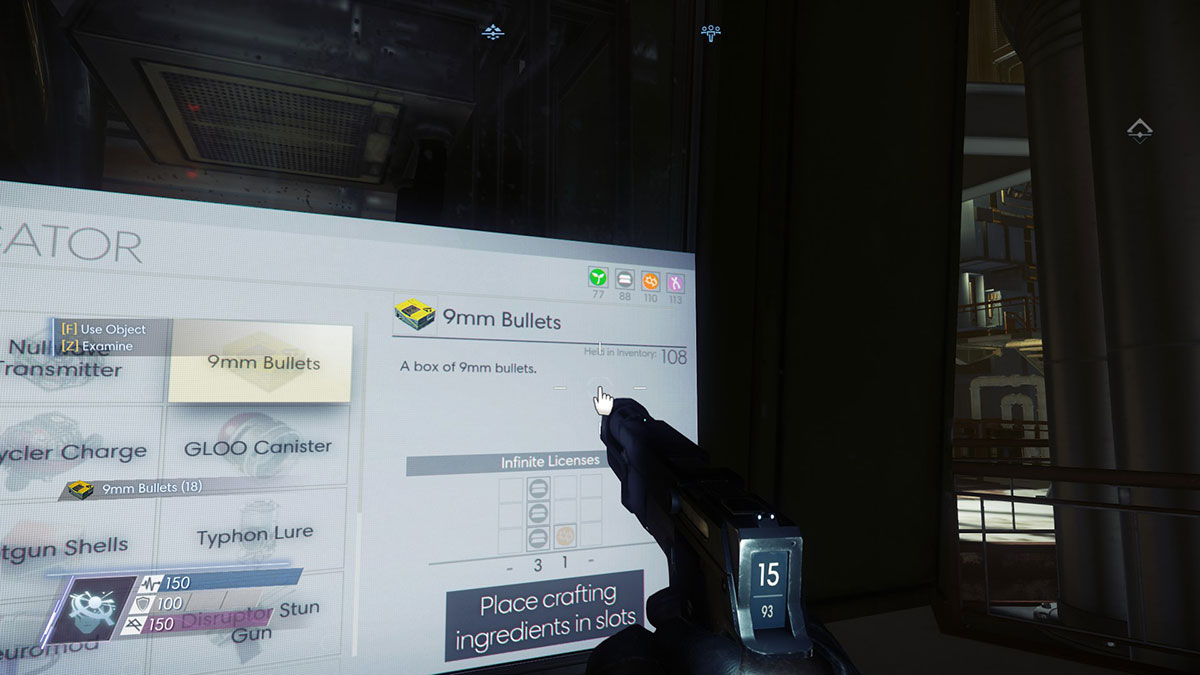
I could craft 870 rounds of ammo, if I wanted. Or if it mattered.
The majority of my concerns were comically overblown. Prey does tally up your behavior during play, but it only merits a single line of commentary at the end, and didn’t tip the scales in any case. I got the “best” ending doing the sort of things one would expect to merit a best ending, and that was that. Feel free to take all the special powers you want, unless you are specifically going for the achievement for not doing so.
How do I feel overall? Disappointed.
There are parts of Prey that are amazing. The GLOO Gun is an amazing tool that remains useful for 99% of the game. You can spend a lot of Neuromods to augment your jumping capabilities… or you can create your own path pretty much wherever, and whenever you want. At the same time, the GLOO Gun “platforms” are just tricky enough to utilize that you never think that it’s required to progress. In other words, it feels like the designers threw it into the game as a toy to play with, rather than a central mechanic (e.g. Gravity Gun in Half-Life 2), and thus you feel clever every time you use it to bypass obstacles.
The set pieces and overall level design are top-notch as well. The environment is cohesive and dense, making you feel as though you are exploring a real place. There is a ton of backtracking, which gets pretty annoying by the end of the game, but it also doesn’t necessarily feel artificial. Yes, if you want to track Volunteers, go to the Volunteer terminal. Yes, if you want to do something with Neuromods, go to the Neuromod area (again).
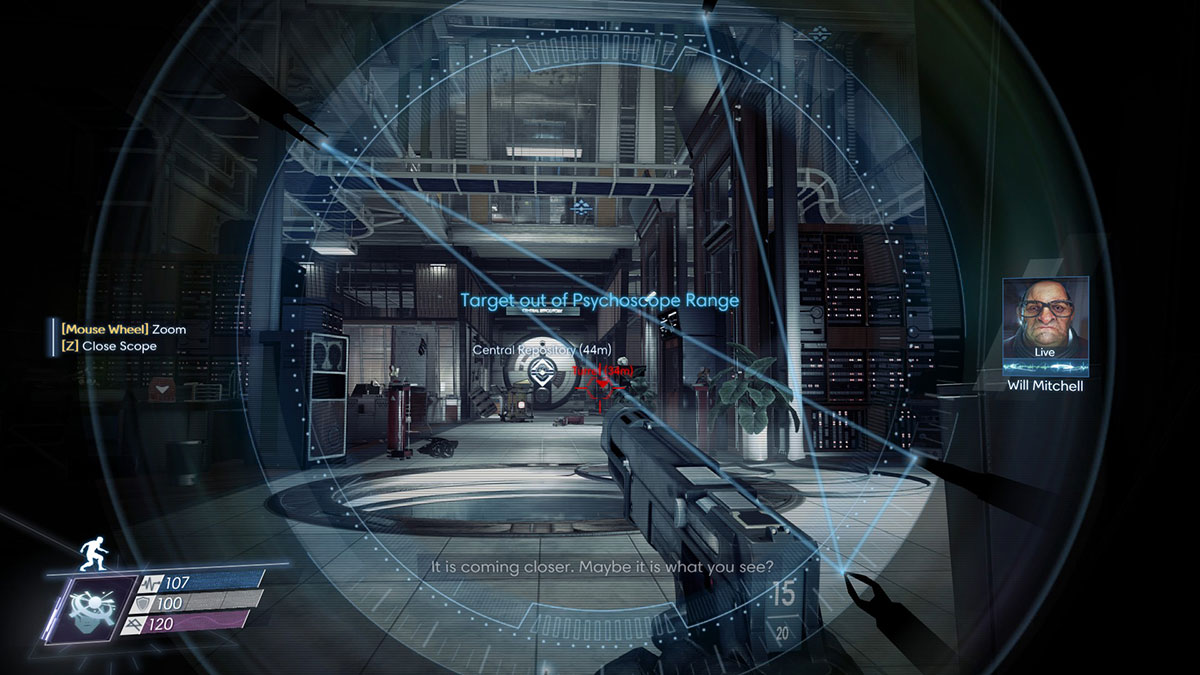
At least it’s not sepia-toned, but still… ugh.
Where the weakness starts creeping in is two-fold. First, the designers fell into the same design hole as Dishonored vis-a-vis “detective vision.” One of the marquee enemies you face in Prey are Mimics, which are capable of perfectly disguising themselves as chairs, coffee mugs, etc. After a few hours of exploring, you get a Psychoscope that will allow you to scan for Mimics. At this point, the rest of your gameplay experience will tunneled down a blurry circle, with buzzing in your ears.
Do you have to use the Psychoscope 24/7? No. It’s possible to pop it on to quickly glance through a room for Mimics, then turn it off. Hell, by the mid-game you likely have so many supplies and weapons that it won’t matter if you get ambushed by half a dozen at once. Nevertheless, you aren’t overtly punished for Psychoscoping the whole time… other than ruining the ambiance for yourself. Which, IMO, the is dev’s fault.
The other disappointing element is the ending.
Spoilers are below, but let me go ahead and create some more buffer.
…

…
Last chance… okay.
This is basically Bioshock Infinite all over again. Not specifically with Alternate Universes, but in the fact that the devs thought they could take another of the most reviled, cliche plot devices in history and polish that turd till it gleamed.
Nope. Even a polished turd is still a turd.
The ending actually failed on multiple levels for me. First, it was essentially spoiled in-game around halfway through by completing a quest. I expected a bad ending for trying to bail from the station via escape pod without even doing anything, but wanted to “get it out of the way” so I could continue the correct way. What I wasn’t expecting was Alex’s words after the fade-to-black. Whoops!
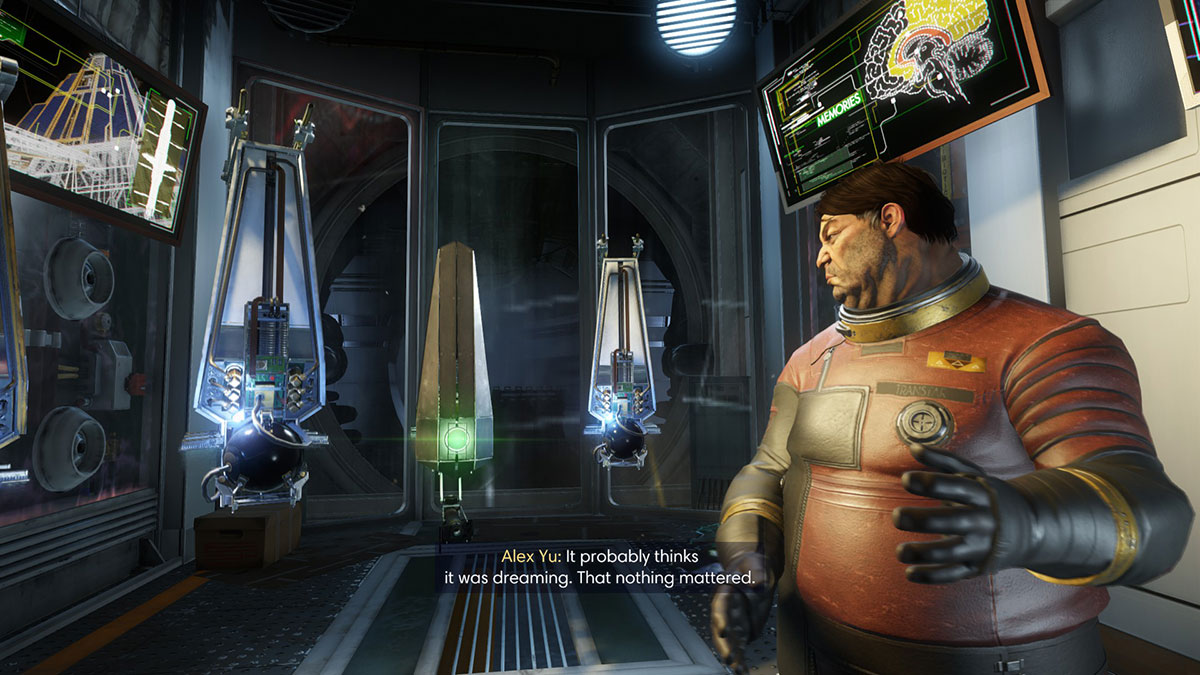
Yeah, actually, that’s exactly what I’m thinking.
The second level of failure was using the “it’s all a dream” cliche, period. I have read some arguments that state this implementation actually made your simulated in-game actions matter, given the extra-special reveal. Nope, still doesn’t work for me. Just because I’m being evaluated on my simulated actions, doesn’t mean I view simulated actions with any particular regard – none of it actually happened. Maybe it’s “based on a true story” when it comes to Morgan, but if all my actions can be rebooted with the flick of a switch, I’d rather them not have occurred in the first place.
Which… they didn’t.
Finally, the ending actually ruined a lot of the nuance I had hitherto been impressed with. For the majority of the game, your one directive was blowing up the space station. Given that, the still-living crew were effective dead already… so why bother helping them out? Was it not more cruel to give them hope before killing them all? At the same time, I felt better easing their more immediate suffering, so they could relax and eventually accept their fate when the time came.
Oh, but hey! Now we have a sudden third solution that magically makes everything better, revealed in the final act! Those dilemmas aren’t really dilemmas anymore. And they never were anything but contrived, simulated scenarios in the first place to judge your empathy. Congrats on playing through the trolley problem – not metaphorically, but literally. Woo!
I’m sure the ending worked for some people, just as there are people who feel Bioshock Infinite is a real deep narrative instead of the total bullshit cop-out it is. The special, second reveal at the end of Prey was indeed surprising, and I guess novel in the scheme of things. Nevertheless, I did not feel any better about how none of what occurred actually did, nor did it apparently matter to the people of Earth. Hell, we still don’t even know what happened, or if anything is real. It could be simulations all the way down.
And that’s why the plot device is such bullshit. A sequel, assuming one ever exists, would have to have a radically different tone or go through a lot of effort to convince the player they weren’t being duped again. But I guess we won’t be seeing a sequel so none of it really matters.
Sort of like any of your actions in the game.
Blizzard News Recap
So, hey, how about that. Leave the country for just two weeks and look what happens.
Blizzard Q2 2014 Investor Call
The big news, of course, is the fact that WoW has dropped 800k subs and is down to 6.8 million from Q1. MMO-Champion has a rather interesting interactive graph on the linked page, but let’s go ahead and take a screenshot for posterity:

Presumably there will be a soft landing at some point.
Honestly, it is hard to add anything to that; the graph really speaks for itself. I guess it is interesting to note that we are now well below the numbers of vanilla WoW at this point. It is also interesting to note that the number of subscribers WoW lost in the last few months is larger than the total reported subs for The Elder Scrolls Online. Or Wildstar + EVE. So anytime someone happens to discount WoW as a fluke and/or “not representative of the genre as a whole,” just remember that this is a fluke on scale with the supermassive black hole at the center of the galaxy.
There are bigger games, of course, like League of Legends. There still ain’t any bigger MMOs. And let’s face it: there isn’t likely to ever be any.
Back to that investor call, and the unintentionally hilarious corporate doublespeak:
Starting off with World of Warcraft. The franchise remains healthy with revenues up year-over-year. This is due in part to ongoing interest in Warlords of Draenor presales, which now exceed 1.5 million, and the character boost, which suggests strong support for the expansion by the community.
Yeah, sure, I can see it that way, Mike Morhaime. Someone who purchases a(n additional) character boost is likely a person preparing to use said boosted character in the next expansion. At the same time, is a boosted character not also a vote of no confidence of all the content that it was boosted past? Shit, the expansion is not out for another three months, and this is a report of player behavior from earlier in the year anyway. I’m not one of those guys who cry over planned obsolescence, but c’mon man, this is a sword with two edges. Be careful where you pick it up.
In looking over the rest of the call transcript, most of it had to do with Destiny and Call of Duty questions. Hearthstone was a surprise darling, but we sort of knew that already.
Warloads of Draenor
Release date of November 13th. And there’s a video!
I pretty much agree with the prevailing blogging opinion that the Warlords trailer is excellent on a technical level and somewhat of a horrible trainwreck on grokkable level. Are we supposed to know who these orcs are? It might be a little racist, but I can barely tell any of them apart. And then you get the confused sympathy going on, which results in you thinking the final boss of the expansion is actually a good guy. I mean, we just saw him kill a demon and everything! To the average person watching this thing, they aren’t going to know that the final scene is meant to imply the “good guys” will soon be invading an alternate timeline in which they don’t exist, only to be pushed back into their own world again and beaten silly by 10 or 25 kleptomaniacs in silly costumes.
And when I put it like that, I still almost feel bad for them.
Then I remember that alternate timelines and time travel in general is literally the worst narrative gimmick in literature (and all mediums, really), possibly tied with “it was all a dream.” It is always total bullshit because nobody ever treats it seriously, least of all the authors themselves. Bioshock Infinite, anyone? Warlords is all just another Metzen Horde masturbation fantasy that plumbs the shockingly shallow depths of the Warcraft RTS plot in search of remaining nuggets (or crumbs thereof) which can be squeezed and bled before the swan song of an Emerald Dream expansion.
In my attempt at researching the possibility that the Warlords narrative could be saved by Naaru somehow, I stumbled upon this blog post which does a good job at asserting the fact that we might be battling high lieutenants of the Burning Legion by the end. Up to and including Sargeras. I like the research supporting that position, but again, it all highlights for me the reason why time travel is stupid everywhere. Because now there is an infinite number Sargerases, and Titans, and McGuffins such that the likelihood of the “original” world existing at all is vanishingly small. Maybe the Bronze Dragonflight are supposed to keep all that shit on lockdown, but all it takes is a single “he/she went insane” and suddenly they are attacking every reality.
…which is sort of how the Burning Legion are described. Hmm.
Nah. The writers over there aren’t that clever.
I Come Bearing Time-Sensitive Gifts
First, the US Playstation Store is having a “flash” sale on PS1 classics. There are 28 total games going for $0.99, but here are the ones I picked up:
- Legend of Dragoon
- Harvest Moon: Back to Nature
- Wild ARMS
- Wild ARMS 2
Given my pirating travails, I decided on principal to put my dollar(s) where my mouth was and purchase the above legitimately. Plus, since those four activated on the PSP, I got to test out whether it was a memory card issue or what. Turns out it might have been a memory card issue because they became corrupt files too. However, the eBay’d PSP came with a 4gb card that successfully transferred my legally-acquired goods so… yeah.
As for the rest of the games not listed, you might find something worth something. I hope you do, actually, because apparently the Playstation Store has a $5 minimum buy-in, so you can’t just pay your dollar; the rest will sit around as store credit for the next sale. Which is kind of good to know that they are willing/capable of putting those older games on sale in the first place. Alternatively, Twisted Metal: Black is pretty good if you enjoy the series at all, but I already own the actual game.
Second, there is a Humble Bundle going on featuring 2K games. What’s amusing about it is that someone fucked up which games get hidden behind the beat-the-average and flat-amount paywalls. At least, that is what I imagine is going on. For example, they put XCOM and Bioshock Infinite behind a $20+ lock… despite the fact that XCOM was like $3 in May and Bioshock Infinite was about $7.50 in March. Meanwhile, a cool Washington (that’s $1 USD for you foreigners) gets you Bioshock, Darkness 2, and more importantly The Bureau: XCOM Declassified. The beat-the-average is filled with filler that has likely filled your Steam library from a dozen similar sales already.
Now, perhaps The Bureau is as bad as they say (66 on Metacritic), but seeing as how it’s the only item on that list that I haven’t seen already in a bundle, I would say that it is worth the risk. I’m not usually so cavalier with my dolla dolla bills y’all, but the first step is recognizing how utterly insane I come across most of the time, and thus take steps to remedy the affliction. Unless the affliction is in fact buying games I likely will never play, in which case fuck that.
Destiny, Bioshock Infinite, and FF6 on phones
Random news mishmash!
Bioshock Infinite
Ken Levine had an AMA on Reddit on Tuesday, in which he took some incredibly soft, er, softball questions about Bioshock Infinite and its upcoming DLC. I am not sure what exactly I expected – perhaps an apology? – but I left pretty disappointed. Actually, I sorta found myself feeling angry every time I read someone proclaiming that Infinite was their “favorite game ever.” I keep thinking: “No it’s not. The game taking place in your head bears no resemblance whatsoever to the actual game you are playing.” Yes, there is an ontological difference.
I generally have no problem with people having different favorite games than me. If you liked Zelda: Wind Waker more than anything else in the world, good for you. And, hey, now you can buy the High Definition cel-shading version with 300% more bloom! And with basically all the extremely annoying shit you had to do back in 2003 tossed right out: your sailboat can go 50% faster, you don’t have to bother with changing the wind while sailing (pretty sad how exciting that sounds in a game called Wind Waker), and there is significantly less trolling the ocean floor for maps that lead you to pieces of the pieces of the Tri-Force, i.e. what you do for 60% of the game.
See? No judgment here.
I suppose I should be more accommodating for peoples’ favorite games, given how my top-list basically came out in 1997-1998. But, seriously, if Bioshock Infinite registered anywhere higher than Top 50 for you, I’m going to need you to play some other games because damn. It looked pretty and the soundtrack was awesome, but the gunplay and story… you know, it’s not worth it anymore. I’ve said my piece.
Let’s just smother that baby and pretend these paragraphs didn’t happen. ¹
Destiny
Remember that not-Halo game Bungie was making? Me neither. Kotaku posted an article/video yesterday about how Bungie was coining the term “shared world shooter” for Destiny, and basically contrasting that with more traditional MMO player experiences. Which is actually a sort of interesting game design/philosophy argument when you think about it.
As the video points out, a game like Destiny or GTA: Online simply couldn’t work with 100s of players dicking around and causing mass mayhem. It got me thinking about how MMOs themselves manage to pull it off, and I realized that our extremely limited interaction capability is probably due to precisely this problem. The more people you put in one place, the less they are able to change or influence the environment, lest you spend your gaming hours traversing barren craters everywhere.
This is not a new subject by any means; I posted something similar way back in 2011 and the concept of TTP goes even further back (if not to cave paintings). The angle I had not considered was how ridiculous (and abusive) something like WoW would be if you could impact other players to degree you can in GTA: Online. Mount-jacking, being pushed off cliffs via collision-detection, and so on. Some sandboxes advertise these as features, of course, but I’m starting to wonder which one comes first. Like maybe you have to rely on player-driven content simply because players would just create a constant shitstorm in any sort of PvE content if they had to ability to directly grief interact with others.
Getting back to Destiny… well, I’d rather not. Once I realized that they are basically making a non-cel-shaded Borderlands, my interest level plummeted. Just watch that E3 video again. Dungeons? Check. Bosses? Check. Random loot drops? Check. Raids? Check. It can still be fun, no doubt, and maybe they will be able to do some things better than Borderlands did. But the game is “Bungie’s Borderlands” to me now, and I am very much burned out from Borderlands 2 right now.
FF6 Coming to iOS/Android
I don’t have much to add to what’s already out there. Well, other than how I think it’s amusing how much these old properties are being mined for residual income in an environment that (I assume) is dominated by ROMs. Actually, it’s probably pretty smart in that even a relatively tech-savvy person like me balks a little bit at the steps necessary to play SNES games on my phone. Hell, I’m not even sure I want to play these games on my phone in the first place; my commute is a short drive and my breaks/lunches get filled pretty quickly via Feedly and Reddit all on their own. And even if I did want to play these games, I sure as hell wouldn’t want to play them using a SNES controller overlay on the touch-screen.
Although I have perked up a few times hearing that I could play Xenogears on the PSP and Vita, I just can’t envision a scenario in which I would be playing it and not be near either my computer or television. If I’m not playing ROMs on the computer right now, why would I be doing so on a handheld? Help me out here, people: when would you be playing these classics on portable devices?
Plus, you know, Sony is still selling 32gb memory sticks for $72 like it’s goddamn 2005.
¹ That’s a Bioshock Infinite joke. If you don’t get it, be thankful.
Bioshock Infinite DLC Cometh
I am not entirely sure how I feel about the news that Bioshock Infinite will be getting three DLC packs in the near future. Actually, I do: a distinct lack of fucks given.
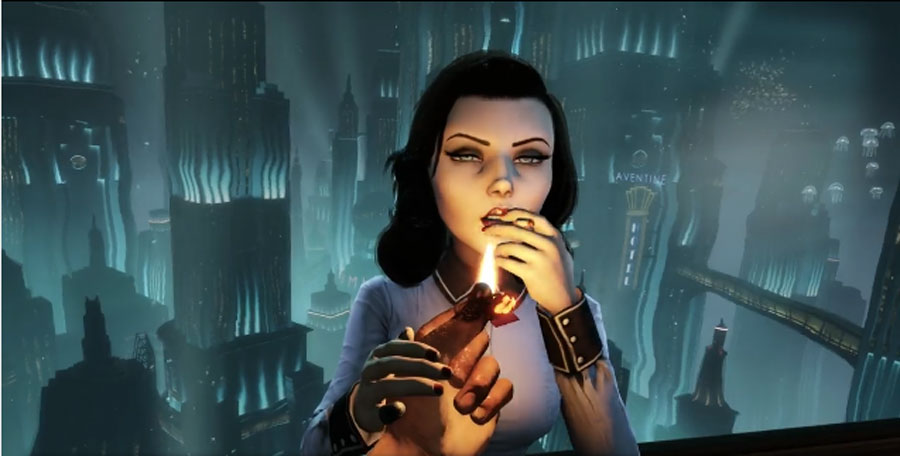
Can this be considered fan service?
The first DLC is a story-less horde mode that will subject you to more of the banal combat system. The second and third are portions of a presumably expanded narrative, although who can really tell what is going on in a time-traveling alternate-dimension throw-everything-at-the-wall plot? But, hey! We’re going to see a pre-destruction Rapture! You know, a throwback to the games that were actually good.
To be fair, Bioshock Infinite did do some things right. The visuals were gorgeous, Elizabeth made the game feel more human, Columbia had brilliant imagery, the music was fantastic, and so on. It is just that Kotaku’s recent interview with Ken Levine boiled my residual bile concerning the plot back up into white-hot incandescent rage. I was fine all the way up until the final paragraph:
“I walked away from BioShock Infinite actually very, very satisfied mostly because of the debate that people were having, not just about what happens in the game, but about what the meaning of it was. That we gave something for people to argue about. We trusted the gamers enough to say, ‘You know what? There’s some room here for you.’ If people walk away frustrated that we didn’t explain everything to them, it probably wasn’t a game for them.”
That noise you just heard is the sound of an aneurysm.
No, Levine, you do not get to fucking say that. As I pointed out months ago, the plot of Infinite is complete garbage. The “room” left for gamers is for them to refuse to apply critical reasoning to their experience, thereby passively constructing a better ending which doesn’t exist inside the actual game.
I can get behind a narrative that explores the descent of a man’s soul to the point that he believes unmaking his existence would be better for everyone involved. We can all probably emphasize with that, regretting having done things or failing to do so. That was not Bioshock Infinite’s plot. The real plot was this:
Finally, let me kind of wrap all these various ingredients up into one complete shit sandwich. What exactly is the message being conveyed here in Bioshock Infinite? What is the theme, the moral of the story?
At the beginning, I almost felt like Booker was trying to make up for his sins, to seek forgiveness and redemption, to put things right. But what is Booker’s actual crime that he is repenting? To stop a person he never turned out to be from entrapping the person he is into a crime a third version must now stop? Booker choosing to be drowned seems a noble sacrifice until you realize what exactly he is undoing: choices he never made. Or, even worse, stopping a man (Comstock) he had no choice into becoming. There is never any “good Comstock” because apparently being bad is a constant. Fate. Predestination.
What is the message here about personal responsibility, free will, and choice? You have none because Constants and Variables. And suddenly, infinite universes means you are implicitly responsible to consequences [of actions] that you never chose and never happened in your own universe. Do you remember when you donated to charity instead of setting a baby on fire? Well, you should feel real bad anyway because the not-you baby-arsonist is running amok and it’s up to you to stop yourself like you already did by not setting the baby on fire in the first place. GUYZ, DEEPEST PLOT EVAR.
There is no route from Infinite’s plot to a good story. None. The “grand redemption” is paying for mistakes you explicitly did not commit in this universe. Even in my most charitable reading of the game – that Booker acknowledges the potential darkness in his soul – leads to the same asinine moral conclusions. Because Booker can choose evil, and did so in an alternate universe, it’s better to kill all possible versions of himself before he can make that potential choice. O… kay? All of us have darkness inside; quite literally who we are is determined by how we manage that darkness. Simply choosing to have it never happen in the first place is an easy, childish fantasy.
And don’t get me started on how moral responsibility can possibly exist in a deterministic universe.
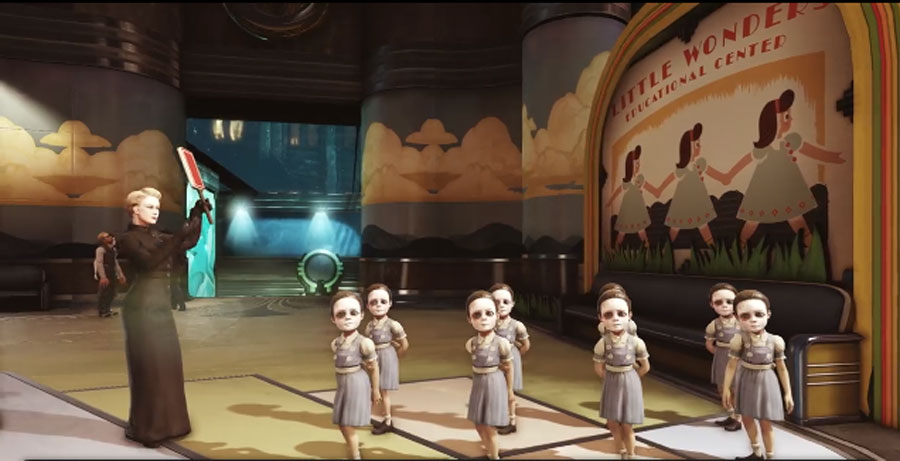
Remember to feel guilty for killing them in an alternate universe you weren’t a part of.
But you know what? This is not even about Infinite anymore. This is about the hubris of an artist to paint his/her deficiencies as strengths, thereby negating any difference between good or bad works. It is me telling you that if you do not find this argument convincing, it is your fault. “If you don’t like this thing I made, it must not have been for you, and thus you’re an idiot for having bought it.” That’s not how this shit works! And besides, Levine, you already told us everything relevant in the game proper: namely, that you’re the next M. Night Shamalanananon. A couple of great works, followed by a more crappy one, and all of a sudden (spoiler alert) the trees are killing everyone.
The tragedy in all this is that we already know who ultimately wins the historical narrative. It has been four months since the debacle started, and all the comment sections in the DLC posts are filled with those gushing over the “deep” ending. And why not? Those who were disgusted as I am have long since stopped caring, or are embarrassed to silence that they still do, leaving the uncouth Philistines to drown in their Confirmation Bias echo chambers. And that is how this whole thing will play out: a great game with a good plot that sold millions of copies. Just like 50 Shades of Grey, Diablo 3, and EA’s Sim City.
Constant and variables, amirite? Christ, how depressing.
My Issues with the Bioshock Infinite Plot
As you might imagine, the following post contains many spoilers. Read at your own peril.
I did want to get two things out of the way first (and help create some extra spoiler insulation). The first is to reiterate, as I did in my review, that I very much enjoyed certain aspects of Bioshock Infinite. The characterizations were quite good; Elizabeth in particular was fantastic. I also enjoyed the art style and the music. The combat was particularly weak in my opinion (and others), but not terrible enough to preclude suggesting the game to other people, at least at a lower price-point.
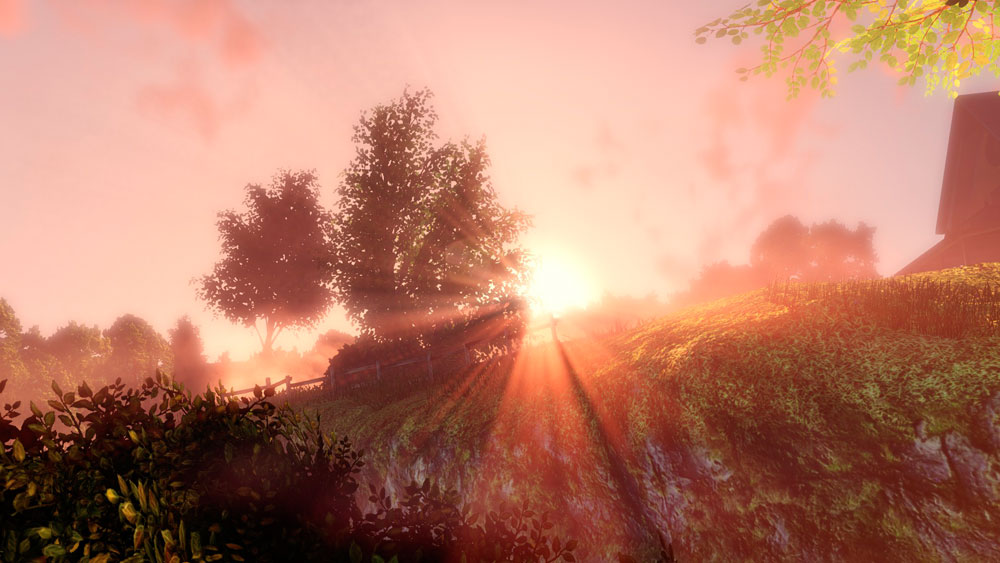
The imagery alone is worth, like, nearly $10.
Secondly, there is almost nothing in this world more personally maddening than when people suggest a given narrative is good (or the best ever) simply because it appears complicated. Why is convoluted nonsense confused for depth? I had to turn off this Kotaku audio spoiler discussion because the hosts actually suggested that not thinking about (for example) time travel paradoxes makes time travel plots better. Well… yeah. That works because you are taking away the bullshit plot as it actually exists and then substituting your own, better version in its place. And odds are that your own version doesn’t make any more goddamn sense, cobbled together as it is with your vague, unexamined good feelings rather than the jumbled pieces presented by the original writers.
I am not asking for a happy ending. I am not asking for Saturday Morning cartoon simplicity. Hell, I am even completely fine with leaving things up for interpretation; Inception’s ending was perfect, for example. What I am not fine with is when vague nonsense is elevated to absurd heights. If Bioshock Infinite’s plot is actually any good, then surely it can stand up to some peanut gallery criticism. Right? Right.
And by all means, if I am talking out of my ass on any of the below points, or you want to provide a different perspective, call me out in the comments below.
.
.
.
.
Redefinition of what Alternate Universes mean.
First off, this may seem like a minor quibble, but I think a lot of the confusion and suggested paradoxes stem from the fact that Bioshock Infinite is inventing its own version of multiverse/time travel theory. Levine is basically saying “I’m going to take this hackneyed, impossible-to-do-right concept and solve it with three words: ‘Constants and variables.'” What about the Grandfather Paradox? “Constants and variables.” What about all the universes in which Comstock is a good guy, or those in which Booker doesn’t sell Anna? “Constants and variables.” Why couldn’t Elizabeth just stage an intervention to keep Booker from drinking and gambling? CONSTANTS AND VARIABLES.
I’m sorry, presenting a multiverse theory in which there are “millions and millions” of other Comstocks and yet certain outcomes are arbitrarily 100% set in stone is simply lazy storytelling. I mean, it is not even inconsistent for there to be universes in which Booker never sold Anna! It almost feels like Levine crafted the “constants” based entirely on being able to railroad the player in that one room with the baby. You can still have an impetus to stop Comstock in any of the universes in which he turns into a bad guy, even if it is not ALL universes. Or, hell, add some moral ambiguity to the story by suggesting eliminating the bad Comstocks is “worth” killing all the good ones too.
“Constants and Variables” might be a novel “solution” to the problems of alternative universe storytelling, but only because no other writer thought anyone would actually buy into it. This feels like deus ex machina ^ ∞.
“There are a million million other Comstocks”

Someone has some daddy issues.
This was my literal reaction to Elizabeth’s line about why the game wasn’t technically over after killing Comstock:
“So what?”
Seriously, so what if there are a million million other ones? There are a million million other bad things in alternate universes too – not to mention real life in 1912 – but we don’t seem to be solving those. Was what Comstock did in the Columbia period so bad that killing him at the point in the timeline which we did, was not good enough? Let’s drown him a million million times in that same fountain, as god only knows our conveniently omnipotent Elizabeth can time travel us there; there isn’t even the Constants and Variables bullshit to get in our way. Elizabeth and Booker quite literally have all the time in the world.
When did the drowning occur?
Speaking of drowning, when did Booker get drowned by the Elizabethes? Before or after the baptism? If before, why did that not kill off all Bookers/Annas/Elizabeths, e.g. make the after-credits scene impossible? If it occurred after the baptism, as the extra scene seems to convey, why is it so important for Booker to come to the “smothering” decision? Why is the player’s Booker smothered, instead of watching a new Comstock get smothered? Narrative convenience?
At first, I thought the answer was easy. In the game proper, it seems as though Booker shares the memories of any universe he has been in. For example, after bringing in the weapons, Booker has memories of being a hero of the Vox. In this way, by traveling to the past (time travel and alternate universes, this is so deep u guyz) and presumably merging with the post-Baptism-yet-pre-Comstock Booker, we can have a scenario in which a not-yet-Comstock Booker realizes what is going to happen and accept the need for his own drowning.
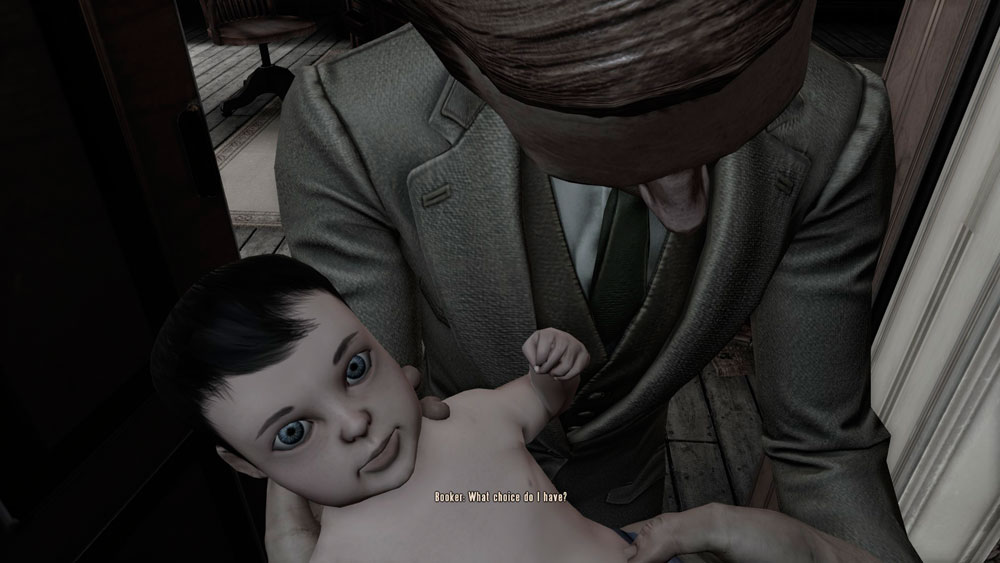
None, apparently.
Which is… a pretty shitty moral scenario, if you think about it. More on that in a moment.
Of course, if the above is actually the case, then how is it possible for Booker and Comstock to exist in the same universe in the first place? Why doesn’t Booker have Comstock’s memories the moment he wakes up in the row boat, or when getting into Columbia, or when physically drowning Comstock in the baptismal fountain (ooo, foreshadowing) in the game proper?
To be honest, I might have missed the explanation for why Booker wasn’t a drooling, nosebleeding basketcase like the other dead-now-alive soldiers. Or why those soldiers were having such a hard time when, at best, they were “remembering” alternate universes in which they were dead. If the dead soldiers were now alive due to us changing things in the past, what does that really mean for the great swaths of population we killed across Columbia even in a no-Comstock scenario?
Negating all events that were experienced

Right in the feels.
Let us pretend for a moment that the ending makes perfect sense, there are no plot holes, and everything is wrapped up with a neat little bow. Hell, let’s pretend the ending is even happy, despite the fact that Booker is still a murdering, gambling, union-busting alcoholic single father with enough debt to legitimately consider selling his own daughter to the first person who opens a checkbook. And let’s further assume that he retained the memories of all that he accomplished in the game, perhaps giving him an impetus to try and set everything right instead of dropping baby Anna off in a basket at the closest orphanage.
In this best case scenario, Bioshock Infinite is a game in which all your actions are voided. Everything you struggled to accomplish is erased. None of it happened. Every moral choice you made, every time you refrained from stealing from cash registers, every interracial kindness you demonstrated never matters because those people/scenarios never exist. It boils down to a “it was all a dream” scenario, which is the most pernicious storytelling mechanic in the history of narrative.
If I had no other problems with the story, this alone would be enough to throw my hands up in disgust. Do you really feel like a game in which you endeavor to negate everything that happens is deep and meaningful? You can accomplish all the game has set you out to accomplish by simply not playing. As prophesied by WOPR in 1983: “the only winning move is not to play [Bioshock Infinite].”
Moral of the story?
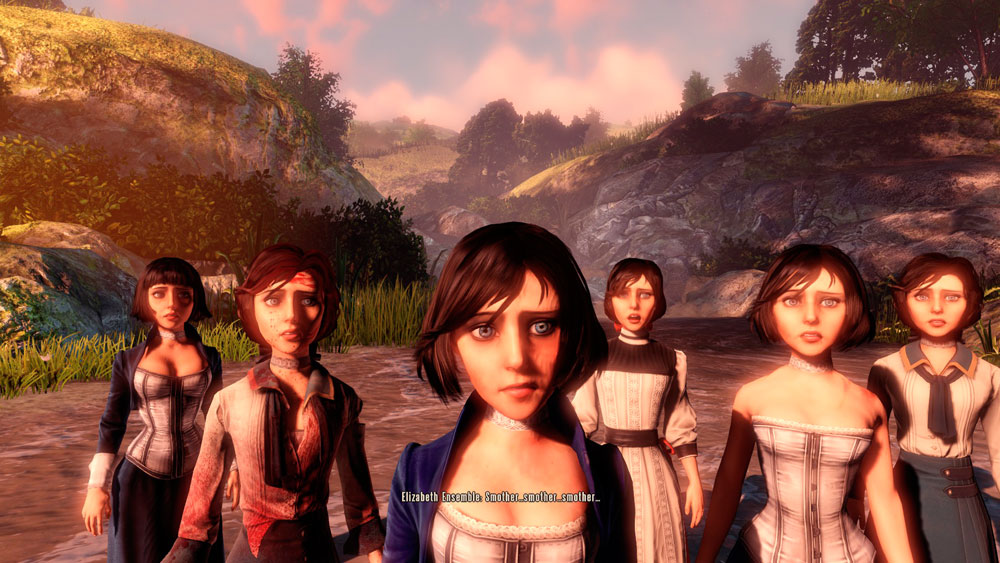
Creepy Level: The Shining
Finally, let me kind of wrap all these various ingredients up into one complete shit sandwich. What exactly is the message being conveyed here in Bioshock Infinite? What is the theme, the moral of the story?
At the beginning, I almost felt like Booker was trying to make up for his sins, to seek forgiveness and redemption, to put things right. But what is Booker’s actual crime that he is repenting? To stop a person he never turned out to be from entrapping the person he is into a crime a third version must now stop? Booker choosing to be drowned seems a noble sacrifice until you realize what exactly he is undoing: choices he never made. Or, even worse, stopping a man (Comstock) he had no choice into becoming. There is never any “good Comstock” because apparently being bad is a constant. Fate. Predestination.
What is the message here about personal responsibility, free will, and choice? You have none because Constants and Variables. And suddenly, infinite universes means you are implicitly responsible to consequences that you never chose and never happened in your own universe. Do you remember when you donated to charity instead of setting a baby on fire? Well, you should feel real bad anyway because the not-you baby-arsonist is running amok and it’s up to you to stop yourself like you already did by not setting the baby on fire in the first place. GUYZ, DEEPEST PLOT EVAR.
Even worse, apparently Booker is the one on the hook for what the Lutece twins are ultimately responsible for. Who invented the Tear machine? Who gave it to Comstock? Why isn’t this game about the Lutece twins stopping themselves from transdimensional kidnapping, extortion, and/or human trafficking?
Ah, right. “Constants and variables.” And when the Lutece twins invent the Tear machine anyway and give it to the next megalomaniac – a real shortage of those in the early 1900s, let me tell you – it will once again be somebody else’s alternate-reality problem.
_______
Fake Edit: After “playing” through the ending sequence again, I believe the drowning question can be put to bed. Elizabeth(es) specifically say:
Preacher Witting: Booker DeWitt, are you ready to be born again?
Booker: What is this? Why are we back here?
Elizabeth: This isn’t the same place, Booker.
Booker: Of course it is, I remember – wait. You’re not… you’re not… who are you?
Elizabeth: You chose to walk away. But in other oceans you didn’t. You took the baptism. And you were born again as a different man.
Booker: Comstock.
Elizabeth: It all has to end. To never have started. Not just in this world. But in all of ours.
Booker: Smother him in the crib.
Elizabeth Esemble: Smother… smother… smother..
Elizabeth: Before the choice is made. Before you are reborn.
Preacher Witting: And what name shall you take my son?
Elizabeth: He’s Zachary Comstock. He’s Booker DeWitt.
Booker: No… I’m both.
In other words, it was not Comstock that was smothered in the crib, it was Booker before he made the choice to be baptized or refuse. Meaning, both Booker and Comstock are dead. Meaning, the after-credits scene is either a vision of an afterlife, or a cheap plot hole to make you feel better while masquerading as deep storytelling.
Please, tell me I’m wrong about any of this. Tell me there is a legitimate reason people are praising this plot, as if it holds even the slightest of candles to the original Bioshock. Am I missing something? Perhaps, you know, the Tear into an alternate universe in which Bioshock Infinite’s plot is any good?
Review: Bioshock Infinite
Game: Bioshock Infinite
Recommended price: $15
Metacritic Score: 96
Completion Time: ~14 hours
Buy If You Like: Stripped down, Art-Over-Substance FPS console ports
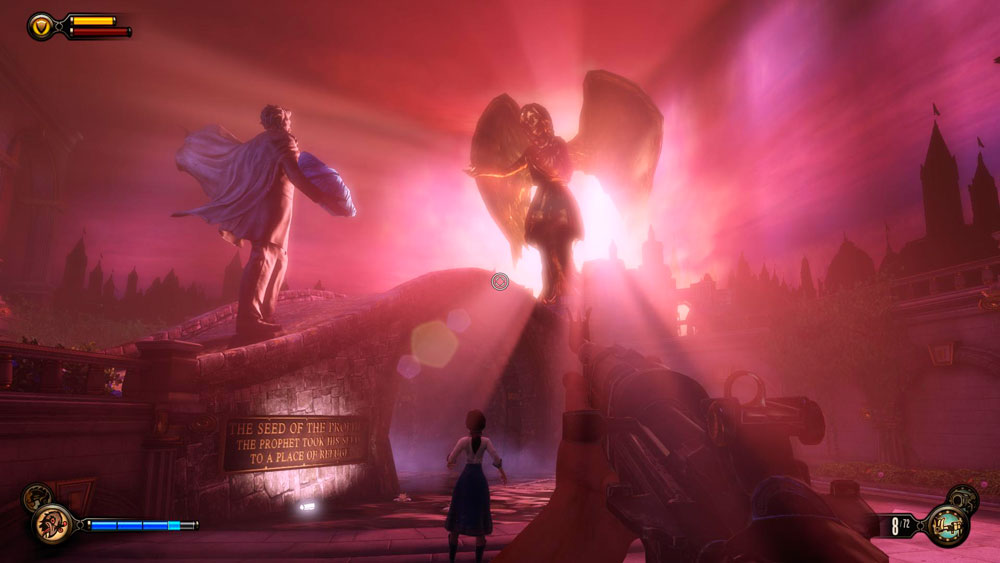
If only this level of polish extended to the gameplay.
Something that I struggle with when starting a videogame for the first time, is under which critique rubric I am to judge the experience. Sometimes the circumstances makes it easy: a $10 indie title ensures low-expectations, with potential high returns on either an entertainment-per-dollar basis (FTL, Binding of Isaac, SPAZ) or even an artistic one (LIMBO, Bastion). Indeed, in the years since the indie game revolution gained steam, I have found it increasingly difficult to justify $40-$60 Day 1 purchases of even AAA titles. What is the point, other than proactively (and expensively) avoiding spoilers? It was with this thought and a few other development team concerns that I initially decided to forgo Bioshock Infinite’s Day 1 purchase. That is, until I watched this fateful Adam Sessler video review. I mean, how could you not whip out your credit card right there?
Now, some 14 hours later and $45 poorer, I am wishing for an alternate reality in which I waited for the inevitable 75% off Steam sale to purchase the game.
Bioshock Infinite follows the story of Booker DeWitt, as he searches the floating streets of Columbia to bring back a girl to erase his debts. It is immediately clear at the beginning that Columbia is both visually stunning – seriously, where did these guys pull this fidelity out of the Unreal hat? – and an overt, artistic repudiation of Pax Americana fetishism. While rifling through picnic baskets and trashcans for every last silver dollar, you will run into signs of the blunt, religiously-justified racism and bigotry of the early 1900s. While I would be surprised if this is the first videogame rendition of this particular theme, Sessler is not wrong about game aspect of Bioshock Infinite functioning as a more effective prism to explore this theme, than had this been a book or movie and showing the same thing.
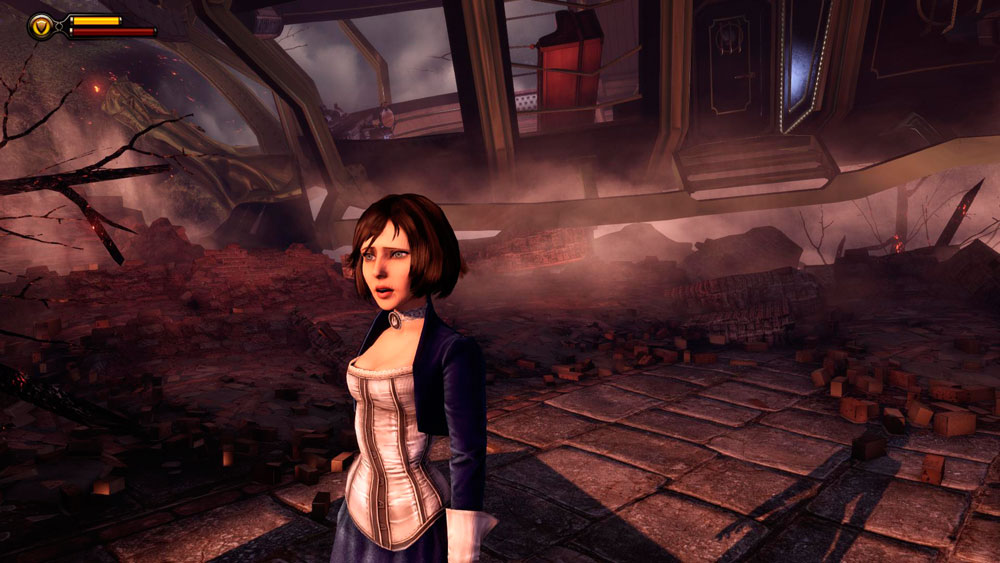
Elizabeth is the color in this Paint By Numbers.
Sessler and the other reviewers whom have catapulted Bioshock Infinite to a 96 (!!) Metacritic score are also not wrong about the brilliant elegance of Elizabeth. Rescued fairly early, Elizabeth initially serves both as a foil to the stoic/cynical Booker and as a player narrative stand-in. As the game progresses though, she provides a sort of… warmth that becomes noticeably lacking from the game proper whenever she is absent. Sometimes it is mesmerizing just watching her run around – the number of animations are incredible – or when she sits at a park bench as Booker stuffs his face with candy bars looted from the pockets of the slain. Immune to all damage, Elizabeth nevertheless avoids feeling like mere window-dressing (even in combat), while also avoiding the immersion-breaking pathing bugs we have come to expect from companion AI. She is simply… there. Present. And Bioshock Infinite is better for it.
I would also be remiss if I did not briefly mention the absolutely amazing soundtrack. While the omnipresent “angry violins” battle music gets old pretty fast, nearly everything single other ambient score is both haunting and melodic. Periodically there will even be barbershop-quartet-esque pieces that quite literally caused me to remove my hands from the keyboard and mouse to simply experience. Hearing songs like Will the Circle Be Unbroken and God Only Knows satisfies a need I never even knew existed. Any game that can fit in classical Mozart in a way both consistent with the fiction and powerful in execution gets mad props from me.
Unfortunately, where Sessler and all the other reviewers go off the rails is when they talk about (or conspicuously omit talking about) the actual game bits.
Simply put: Bioshock Infinite is not a very good FPS title, and absolutely not at all a good Bioshock title from a gameplay perspective. The skeleton is all there, with Vigors replacing the Plasmids, but there isn’t any meat. The gunplay is simplistic. Environmental damage combos are virtually non-existent. While the eight Vigors available seem to be a comparable number to the original Bioshock, the (usually) extremely open battle environments lends itself to one or two extremely OP strategies. For example, in an early combination with some equipment, using the secondary fire of Murder of Crows to create a single nest trap can disable dozens of enemies across the entire map; when one nest triggers, the crows chain from enemy to enemy, stunning and damaging them, and all enemies leave nest traps if they die while afflicted. Alternatively, once the Possession Vigor is upgraded, it essentially one-shots most enemies in addition occasionally scoring you kills if they actually get in some damage on friends.
For the record, I played beginning to end on Hard difficulty. So when I say things like the gunplay was simplistic, I do not mean that enemies fell over from one or two shots. Instead, firing the guns takes little skill, and there is little variety in the types of guns – there is no reason to have the Machine Gun, Burster, Repeater, and Crank Gun in the same game, for example, as they all occupy the same design space. While the skylines provided a useful gimmick to certain battlefields, their primary purpose seemed to be giving you the opportunity to one-shot weak enemies with a melee attack that would otherwise only remove 20% of their health.
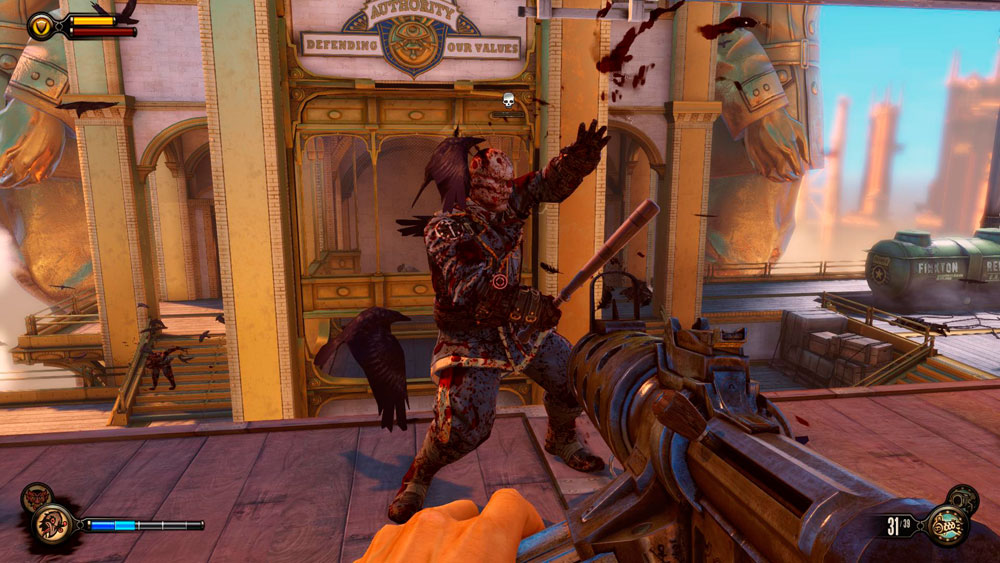
Da Birds, da Birds.
The fingerprints of Console-ification are also all over the place. Bioshock Infinite uses a completely oblique Checkpoint system, with no Save & Exit option. There are no Quicksaves. Booker has a regenerating shield, and can carry only two weapons at a time. There are no First Aid Kits or other inventory-esque items, although there is “clothing” that acts as swappable passive abilities. While changing clothes might have added some depth to the combat, the reality is that most of the items are hopelessly weak in comparison to the aforementioned OP combos.
While some of these things do not sound bad on their own, the problem arises when you then apply these simpler systems to an artistic game so focused on encouraging exploration inbetween the banal combat. Why barge into every non-locked house on the street – and see the thematically consistent bigotry – if there is quite literally no point to do so? Even if I accept that Checkpoints aren’t all that much different in practice than Quicksaves, the ever-present hunt to replenish my First Aid Kit supply drove me to explore every inch of Rapture, to my ultimate edification. Conversely, I explored Columbia out of a vague sense of propriety, like when an acquaintance takes you on a tour of his house even though you couldn’t care less about what the pantry looks like. Don’t get me wrong, I explored every masterfully crafted inch of Columbia that I could. But the whole time I sat there thinking “There is no reason for me to be here,” which I count as a deficiency in the game design, especially given how the original Bioshock played out.
Finally, in an effort to keep this review as spoiler-free as possible, I will not talk about the specific issues I had with Bioshock Infinite’s plot or overall narrative. Suffice it to say, I did not feel that the actual message the writers were trying to convey made a whole lot of sense given what was presented and foreshadowed. Indeed, the whole narrative felt disjointed, likely due to the first half of the game consisting almost entirely of exploring Columbia’s working class issues, rather than the more fantastical premises that dominate the later game.
Ultimately, Bioshock Infinite is clearly an ambitious game, but at the end, I felt like nearly every aspect of it did not live up to its inherent promise. While that is a shame, that doesn’t mean you should avoid the experience altogether. Bioshock Infinite is definitely a game worth playing, it is simply not worth playing for full MSRP, or even half that amount. If you can wait, you should. And as far as Sessler and the others predicting Bioshock Infinite’s long-term “lionization” and discussion “for years to come,” well… I think they will be waiting for that for quite some time. Perhaps until the heat death of the universe.
Happy Dead News Day
God, I hate April Fools. I hate it so much, in fact, I took the day off of work, so I would not be so bored out of my mind with the gaming site (and Reddit too, apparently) nonsense. The celebration of insipid deception is so pervasively perverse, I do not even bother believing any news for a full 24 hours. New PTR notes? A release date for X game? Nope, can’t hear you, lalalalalalala~.
Anyway, I beat Bioshock Infinite over the weekend. Were the 14 hours worth the $45? You will have to wait for the review; a review I most certainly will not write on April Fools, lest it not be believed.
Of course, if you have been around here for any length of time, you will probably believe it.
 In An Age
Avowed – What’s My Motivation?
Mar 18
Posted by Azuriel
I haven’t written much because I’m trying to work my way through Avowed. And it really is work at this point, because Avowed is not a good game. But I feel it is not good in a similar way that Bioshock Infinite was not good: the most frustratingly nuanced ways imaginable.
One example is with the combat system. I’ve talked about it all before, in that Ranger was strong but boring, Warrior was active but weak, and Wizard was both active and strong. About halfway through the 3rd zone though, none of it really mattered – even the Wizard became a chore. There are a lot of little reasons that quickly add up in the background until it hits you all at once.
Regarding the last point, Avowed has a really shitty talent/skill tree. It’s not something I’ve seen many other people talk about, but it’s one of the most uniquely uninspired one I’ve ever seen in a game. Seriously, look at this shit. Warrior has 6 buttons to press, Ranger gets 5, and Wizard… 21, technically. But look at the level 15 and level 20 bands, which is where one might assume you’re getting the biggest power boosts. Outside the active button, Fighter gets shit like… perfect (!!) blocks rebound arrows, and you deal 70% of the damage you received. Ranger gets increased crit chance (already 100% when you hit weak spots), and bonus damage on unaware enemies. Wizards get… increased elemental accumulation, but you have to spec into each element individually.
Oh, and on the ultimate level 20+ band? Fighters can… heal companions by 10% when you kill enemies! Rangers can… deal more stun accumulation with power attacks with ranged weapons! Wizards can… get fucking nothing, unless you want to learn Meteor Shower without a spellbook, which you never would because spellbooks give you like an 80% Essence discount on that otherwise meter-eating spell. Yes, Arcane Seal is something a Wizard can take at 20+ and effectively have infinite Essence regen. But at that point in the game, you effectively have infinite regen already from the hundreds of random vegetables you’ve collected throughout the game.
The other half of character progression is also shit. Getting Uniques out in the world has long ceased to be exciting. First time you replace a generic weapon with Unique? Fantastic. The second time? Frustrating, because you likely sunk a bunch of upgrade mats into the first one. Then you start to realize that none of the special abilities of Uniques matter all that much compared to the overall “tier” due to the asinine enemy “level” balance. If your stuff is blue and they are purple, you deal 35% less damage and take 35% more damage. Meanwhile, each time you upgrade a weapon or armor, you get silly shit like +9 damage or -4 damage received. Upgrading a Unique never boosts the special effects… why?
Finally, I want to talk about the story in general terms. I’ll throw a Yellow spoiler warning just in case, but the short version is: the game never answers the question of “what’s my motivation?”
The general premise of the game is that you are a godlike of an unknown god, working in the court of an Aedyran emperor. You are then tasked with solving the Dreamscourge plague problem in the Living Lands, an isle that the emperor is interested in taking over. You are sent over as an Envoy of the emperor himself, granting you leeway in resolving the Dreamscourge crisis in any manner you deem fit.
The problem is that all the Aedyran empire stuff just up and evaporates as soon as you step on the docks, unless you commit to being cartoonishly evil for the rest of the game. And if you do, all of your companions are from the Livings Lands, so they’ll be mad at you for everything you do. Having evil options in RPGs is a good thing even if players do not typically engage with it, but the problem is setting up your game to support it. None of your Avowed companions will leave you no matter what choices you make. There are no Aedyran or Steel Garrote companions, which would make such an evil playthrough more reasonable. And while I have not yet finished the game at the time of this writing, I haven’t really seen any good motivation to even care about the Aedyran side of things. Nobody is reminding you of your duty to the emperor, or even really questioning your loyalty.
This is not the first place Avowed leaned so far into “roleplay” that it fell directly into RPG mad libs. There are frequent dream sequences throughout the game where you are asked to choose how events in the past played out. Some of these choices lead to you getting one godlike ability versus another, but the majority of it is just… there. I understand that there are (presumably) people who like this sort of thing, but Avowed just sort of drops it on your porch and leaves. There’s no context, no sense of purpose. Again, what’s my motivation? Am I training somebody to be more forgiving or spiteful, depending on my dream answers? Or am I literally playing one-person mad libs?
I get that this may not sound all that different from all the normal RPG choices you encounter in the genre. In Baldur’s Gate 3, you can choose to free a gnome strapped to a windmill or send him flying by cranking up the speed. That choice doesn’t matter too much in the scheme of things, either way. Except, of course, to the gnome, and possibly some party members. But that at least has some immediate context and consequences and feels like a real choice. There are some quests vaguely similar to that in Avowed, but they all ring hollow. Perhaps in the abstract the quests are identical, and I’m just not invested in the world of Avowed in the same way as BG3 or Mass Effect or anything else. Or perhaps the devs simply were painting-by-numbers and forgot to include a soul in their creation.
And that brings me back to the Bioshock Infinite comparison from the top. There are some games in which I can understand people enjoying, even when I do not. League of Legends? That’s definitely of no interest to me, but I get it. Overwatch 2? Sure, I enjoyed the original for a time as well. Call of Duty? I prefer the Battlefield series, but a more arcade feel can be fun.
If someone says Bioshock Infinite is one of their favorite games though, my eyebrows go all the way up. Maybe the DLCs fixed the plot later, but Bioshock Infinite’s story was otherwise objectively terrible, like Mass Effect 3 original ending terrible. I feel the same way when I see people online say Avowed is a 9.5/10 or they are eager for another playthrough. I don’t even want to finish this first playthrough, let alone running around opening chest after chest of the same random crafting materials again. Some aspects of Avowed are fantastic genre improvements, like the feel of melee and the feel of exploration via jumping/traversal. Unfortunately, tragically, there is just no follow-through, no stuck landing.
The only way I can see Avowed being someone’s favorite RPG or deserving of a high score is if they simply haven’t played better games before. Which, given that many of my own favorite games came out 10-20 years ago, might be increasingly understandable. What a bummer.
I suppose there is still time in the 4th Act and resultant endings for Avowed to pull a miraculous redemption. Well, aside from the combat and itemization and character progression and world interactivity – those ships have already sailed. We’ll see if the plot payoff was worth the pain.
Posted in Commentary, Impressions
1 Comment
Tags: Avowed, Bioshock Infinite, Mad Libs, Obsidian, Plot, What's My Motivation?