Dear PR@Blizzard.com
Subject: Hearthstone Beta Press™ Request
Hello,
My name is nice try, NSA , aka Azuriel, and I run a gaming blog called In An Age (inanage.com) that has a focus on PC games. While the topic of my posts varies between what I’m playing, to game reviews, to MMO design critiques, I am especially passionate about my Beta Impression posts. I have wrote beta impressions about WoW expansions, Guild Wars 2, Darkfall, Card Hunter, and more. In fact, I just completed two more within the last week: Scrolls and SolForge.
I would be extremely honored if you allowed me to add Hearthstone to that list. By letting me in the Hearthstone beta. As a member of the Press™.
In return, I can promise you a minimum of one (1) brutally honest Beta Impression post, and possibly dozens more if the game is as amazing as it looks. In fact, since I would likely spend money in the store for the tournaments (as investigative journalism), you could almost say that I’m paying you for free advertising. Just think: a Hearthstone article by me could be seen by hundreds (!) of people! That’s a PR coup if I’ve ever seen one.
In any case, I want to thank you for your time, and stalwart support of the blogging community. Your willingness to give members of the Press™ (such as myself) beta keys is an inspiration to us all. Hopefully.
Shamefully yours,
– don’t doxx me, bro (aka Azuriel)
P.S. If you ever need to fill a slot on a Press™ tour of Blizzard HQ or on the WoW dev team, I am available.
When PopCap Jumped the Shark
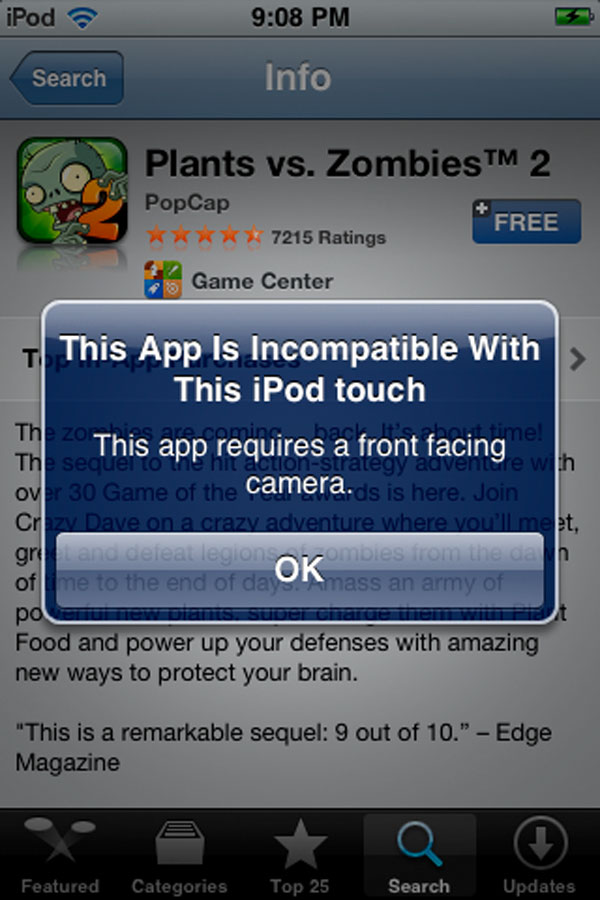
heavy sigh
Yeah, yeah, it’s a dev hack to get around the bizarre inability for iOS apps to figure out if the given device can run it. And the actual shark-jumping likely happened two years ago. But, still, it’s like… really? I’m not mad, just depressed about the first signs of the somewhat arbitrary obsolescence of my iPod touch. PvZ2 is not necessary by any means, but it’s still clear that winter is coming.
Beta Impression: SolForge
After becoming increasingly disenchanted with Scrolls while still craving a card-game experience, I found out that SolForge was in Open Beta as a F2P game. On Steam, no less. Score!

I have to consciously not read that as Solf Rge.
SolForge plays a lot differently than many other CCGs (there is no trading that I’m aware of): it has the most distilled, fast-paced card gameplay that I have ever seen, outside of maybe Dominion. The basic premise is that you build a 30-card deck with the goal of reducing your opponent from 100 HP to zero. There are four “factions” that roughly correspond with certain card themes, and your deck is limited to having cards from only two factions. Each player draws five cards, someone is selected to play first, and then you see this screen:

*rubs hands together*
The first big twist is that there are no resources to manage. On your turn, you can play two cards from your hand, be they creatures or spells. When you play any card, an upgraded version of that card is shuffled back into your deck. There is a combat step where all creatures attack, and you can trigger it at any point during your turn (before, in the middle of, or after you played your cards). At the end of your turn, any leftover cards in your hand are also shuffled back into your deck and you draw a new hand of five cards. Every four turns or so, your avatar “levels up” and then you are able to start actually drawing the upgraded versions of the cards you played previously (even if the original is still on the board).
A quick note about the leveled-up cards: it is way more strategic than you think. A lot of cards might have an especially weak Level 1 form, only to ramp up in power with Level 2 and Level 3. Others are strong Level 1 contenders, but feature a definite lack of scaling that almost make them dead-draws in the endgame. Still others sort of force you to use them early to keep them relevant at all. An example of the latter is Cull the Weak, a removal card which destroys a creature with 4 Attack or less, which ramps up to 7 or less and finally 14 or less at Level 3. Played early, Cull will serve you immensely well into the late stages of the game; drawing into a Level 1 Cull around Turn 15 though, and it may as well be a blank card.
Examples of the first two types of cards (late vs early game focus) can be seen here:

The Darkshaper is by far my favorite card in my collection.
Where things really get (further) mind-bending is combat. Creatures you play have Summoning Sickness are “On Defensive” until the start of your next turn, meaning they won’t initiate combat. Creatures will also stay in the lane you played them in (unless they have the Mobility trait), attacking anything directly across from them. Once creatures are “On the Offensive,” they will attack every turn. As in, creatures will attack on your turn, and then attack again on your opponent’s turn. Damage a creature takes is permanent, as are most boosts and the like. As you might imagine, creatures die pretty quick; conversely, this means that any creature that does stick around (especially if they have a nice ability) start becoming increasingly dangerous.
What I am failing to get across in words is this: the tempo is SolForge is insane. And addicting. Let’s say that I play a 5/5 creature and my opponent then plays a 7/7 across from it. If I do nothing, my 5/5 will automatically run to its death, and my opponent will begin dealing 7 damage a turn with the now 7/2 creature. Before the attack phase, I might cast a spell that gives one creature +3 attack and another creature -3 attack, making the match-up a 8/5 versus a 4/7. On my opponent’s turn, if he/she doesn’t kill the creature with a spell or throw another creature in front of my now 8/1, it will attack again on his/her turn.
Goddammit, words aren’t working. Here was board position of the closest fight I have ever seen:
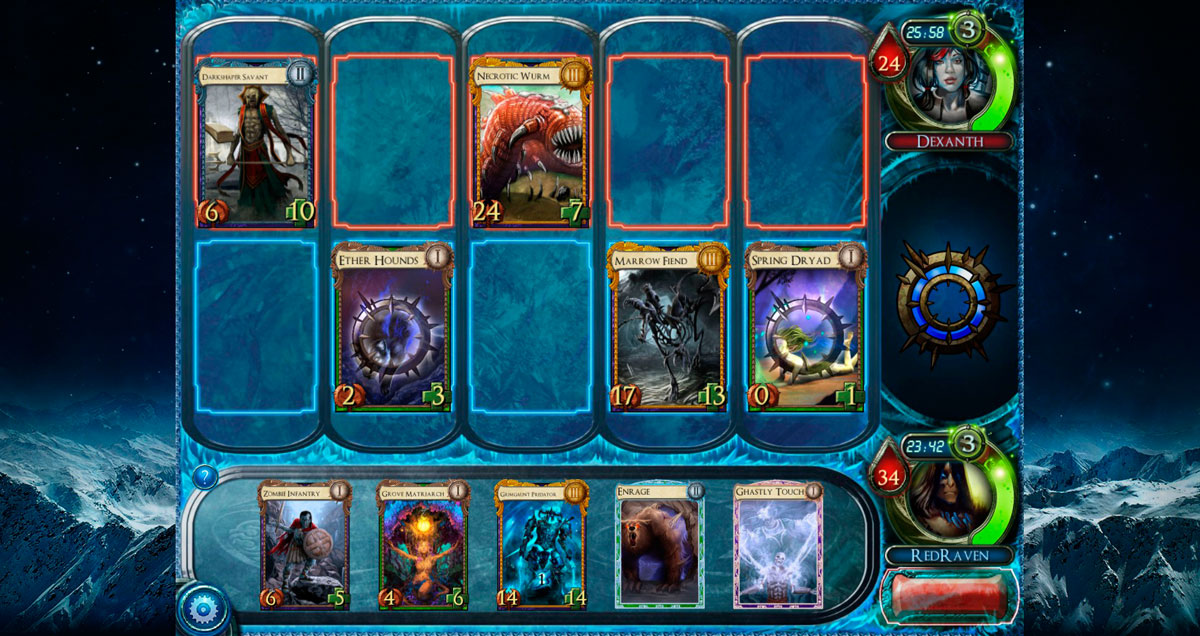
There has to be a way out…
It is my opponent’s turn, late in the endgame. His creatures are the 6/10 Savant that let’s him give a creature -3/-3 whenever he casts a Level 1 spell, and “just” a 24/7 wurm. Mine are all just vanilla creatures aside from the Dryad, which gets +1/+1 each time a creature comes into play on my side. He just cast the +3 Attack/-3 Attack spell I mentioned earlier, targeting his wurm and my dryad, taking out one of my 2/3 Ether Hounds with the -3/-3 trigger. He then plays his own Ether Hounds, providing blockers for my Dryad and Marrow Fiend, using the Savant’s trigger to kill my last Ether Hound. He attacks, creatures die, and we go down to 7 and 4 HP respectfully.
What are my options on my upcoming turn? Well… the 6/5 is just a vanilla creature; the 4/6 will spawn a 1/1 creature in its space after it dies; the 14/14 creature has Mobility and gets +6/+6 when a creature dies across from it; the card Enrage gives a creature +5/+5; and the last card gives a creature -3/-3. Hmm. After I make my moves, the board looks like this:
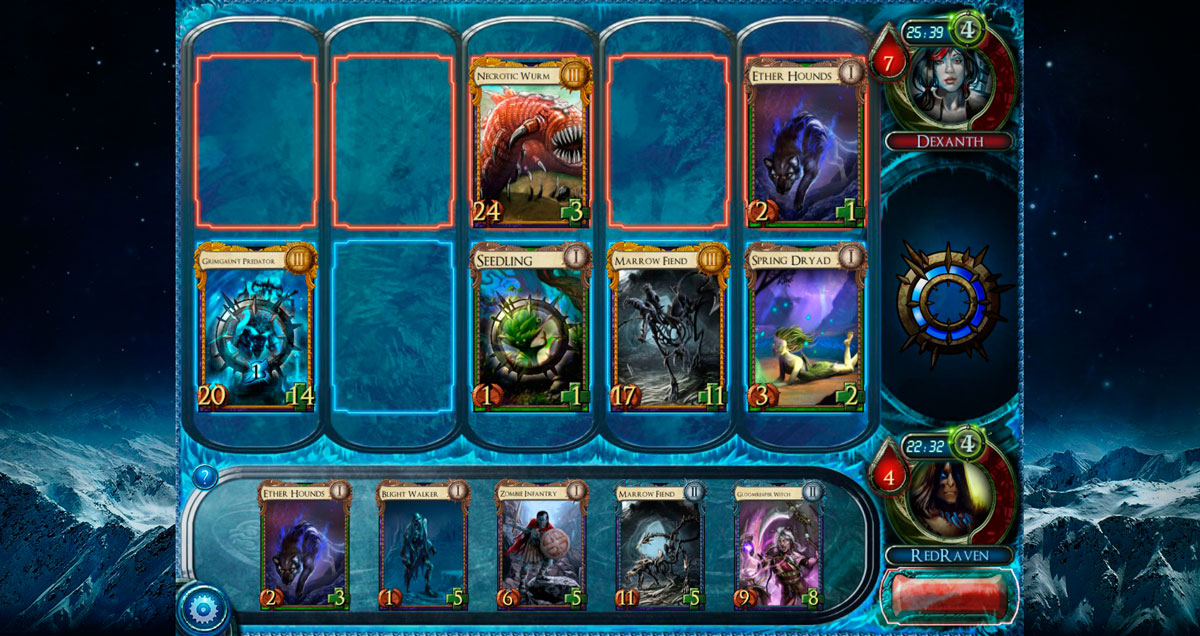
Not horse-shoes or hand grenades, unfortunately.
I had tossed my 14/14 in front of the Savant because the -3/-3 triggers were generating insane card advantage, and would basically negate my center lane gambit. Said gambit was tossing in the 4/6 creature in the path of the 24/7, and relying on the 1/1 that spawned after its death to give me the reprieve I needed to win. And, in fact, I would have won on his turn, but he managed to cast either another Savant or perhaps a Gloomreaper Witch (kills a 1-power creature when it comes into play) to remove my 1/1 and block my 20/14, and then some other throwaway creature to stand in front of my 17/11. The wurm, unopposed, kills me. GG.
Whether all of that sounds like gobbledygook or a smashing good time probably depends on how familiar you are with card games, or with Magic specifically. Oh, did I forget to mention that? Richard fucking Garfield had a hand in SolForge’s development, along with the guys who made Ascension, who were already pro Magic players. Now that I think about it, Richard fucking Garfield worked on Card Hunter too. Dude gets around. Considering how everything he touches seems to directly trigger my nucleus accumbens, I’m going to say that this is a Good Thing.
Less so for my wallet.
Guild Wars 2 is Fastest Selling Western MMO
During my futile hunt for Hearthstone Beta keys (c’mon Press™, don’t fail me now), I stumbled upon this GameBreaker.tv article about Guild Wars 2 sales:
With over 3 million units sold in the first nine months of availability, Guild Wars 2 is the fastest selling MMO ever in the western market.
That’s no small feat right there. Riding a wave of acclaim and accolades, Guild Wars 2 has set a high bar for quality, and it has earned them a spot in MMORPG history according to an official ArenaNet press release. 3 million units sold in the game’s first nine months of availability puts it at the top of the record books in Europe and North America according to DFC Intelligence, a strategic market research and consulting firm focused on interactive entertainment.
Technically, it may have been 3 million by January 2013. Either way, this news was mildly intriguing, considering how distant from GW2’s actual release it came.
Still, it got me curious about some other numbers and figures. For example, here is an article from VG247 parsing the latest financials that indicate GW2 box sales are down. Which… shouldn’t exactly be surprising given that that is exactly what happens with any box game, right? Then there is the admittedly anecdotal Digital Dozen feature that NoizyGamer puts out every Tuesday, measuring the Xfire hours logged. The latest pretty much show a 50% decline from December, but it’s still roughly half that of WoW today, hour-wise. So, it is probably safe to say that the game’s population is doing alright and ArenaNet deserves the accolades for its legitimate record-breaking, even if the timing is a bit PR-ish.
I was trying to find numbers on how WoW did by comparison back in the day, but it turns out Blizzard doesn’t like giving out those numbers. The best I could find was this old article from 2009, which stated Blizzard sold 8.9 million retail boxes to date in the US alone. As point of reference, MMOData.net (thank god they’re back) shows that halfway through 2009 the Western numbers were steady at ~5.25 million subscribers. There is no way to know the breakdown between US vs Europe, or even whether the numbers are even intelligible given how it counts both box and expansion sales, but there it is.
Just for giggles though: the 2010 census states there were 205,794,364 Americans aged 18-64. A Pew article says 62% of American adults aged 18+ owned a desktop circa mid-2009. If we do a bit of rounding (a couple ten thousand) and assume that every desktop computer could run WoW (no possible way that’s remotely accurate), we have a pool of 127.6 million potential MMOers of which WoW reached… 6.98% of. Back in 2009.
Take away the people whose computers couldn’t handle WoW and then further reduce by those who have no interest in RPGs (let alone online ones) and then the people with PCs but no broadband and… well, you can start to see why market saturation is/was a legitimate concern.
Reviews: Elven Legacy, QUBE
Game: Elven Legacy
Recommended price: bundle
Metacritic Score: 71
Completion Time: ~21 hours
Buy If You Like: Hex-based strategy games, old games
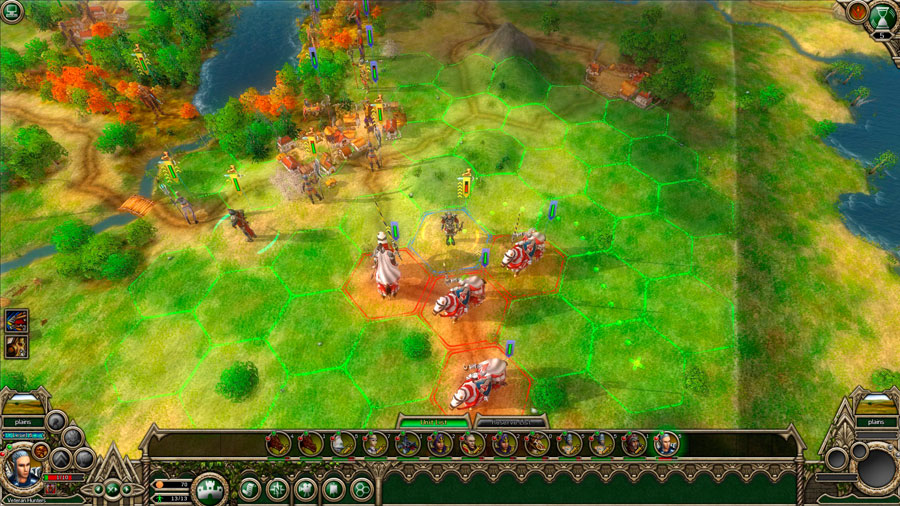
The strategy bits weren’t bad at all.
Elven Legacy is a somewhat more traditional hex-based strategy game featuring PS1 graphics, a somewhat abbreviated plot, and an incredibly brutal single-player campaign.
What I recognized early on was that I had not actually played many “strategy” games before, as opposed to more tactical affairs. The underlying mechanics were fairly simple: units can move and attack each turn, all units have 10 HP, sometimes there are special abilities or perks that can come into play, units gain XP and levels, and you can move your entire team each turn. When all the moving pieces come together however, you begin to realize how much the odds are against you on each and every map.
Allow me to present an example. During your turn, you move your spearman up to attack an enemy unit. Before committing to the attack, you see that you will deal 5 damage and take 2 damage in return. During the attack, the damage numbers were actually 4 and 3 – the projected numbers are simply the average range. The damage a unit takes is counted as either wounded or dead, with the spread being determined by perks and… well, I’m not actually sure how its counted. I noticed higher level units take more wounds than deaths, so I’m sure stats are somehow involved. Regardless, your now-7 HP unit will deal less damage than that same unit at full health. On your next turn, you can choose to order that unit to Camp, which will heal all wounded (not dead) units, at the cost losing both its attack and move phase.
Another wrinkle is morale. Units attacked below a certain baseline will Break, reducing their attack and defense scores by 4 until they Camp, while also retreating a hex away. Even units that do not Break will retreat a hex back when low on HP. This can wreck havoc with your plans should you attempt to attack with two units, only to have the first attack send the enemy out of range of your follow-up. This can lead to some odd behavior, like attacking with your weakest units first, probing for the breaking point, before sending in the big guns to hopefully annihilate the unit.
Then you have the hero/monster units, which can heal to full all the time. Then you have magic spells, which have unlimited ranges by only 1-2 charges per spell. Then you have terrain bonuses/penalties. Then you are picking one of three Perks for each level a unit gains. Then you are sending units around the map looking for artifacts that you can equip to give certain units more abilities/stats. Then you realize you often have a time limit to complete the map. And so on.
While the game was surprisingly strategic and all, literally everything else was forgettable. I have not dabbled much in the strategy game genre, but I know enough to know that there are likely better titles out there to buy. I purchased Elven Legacy at some ridiculous discount a year or so ago, and it is probably only worth that much (or less). It was fun while it lasted, but it really only succeeded in me wanting to look at other strategy games.
Note: I purchased the DLC along with the normal game, but was unable to get any of said DLC to actually work. The new campaigns showed up and were selectable, but none of the dialog or win conditions or any text was visible.
_____________
Game: QUBE
Recommended price: bundle
Metacritic Score: 69
Completion Time: ~3 hours
Buy If You Like: Portal-lite, FPS puzzle games
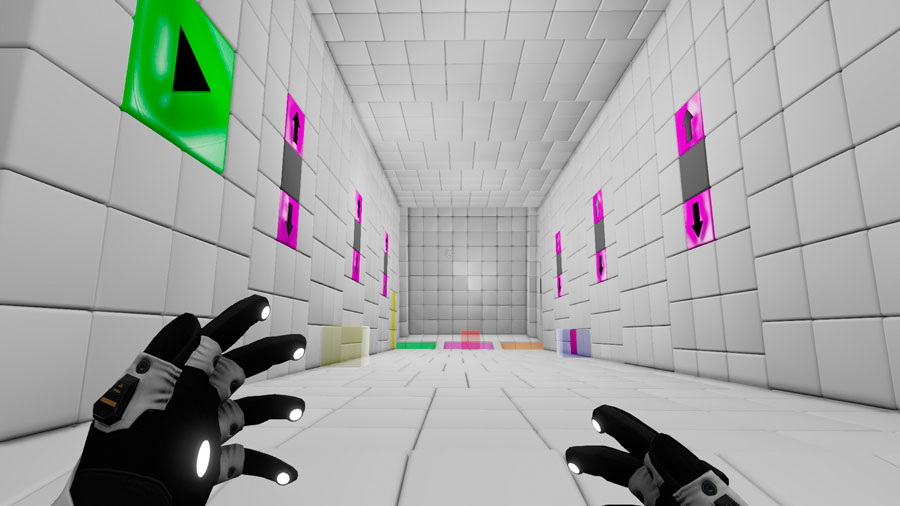
Aesthetically, it was quite nice.
QUBE is a first-person puzzle game in the Portal tradition. In fact, basically all you need to know is that QUBE is Portal-lite. Throughout the game you can manipulate the behavior of a series of colored cubes that have standard behavior: red ones extend out one square at a time to a three-square distance, yellow ones make a step-ladder patterns, blue squares act as spring-boards, etc. Actually, why stop describing them now? Purple cubes rotate a section of the wall/floor, and green create either a block or ball, depending on the puzzle. Oh, and there are magnet walls. There, that is 100% of the set pieces.
While all this sounds simple, QUBE veers into some ridiculously fiendish puzzles before the end of its ~4 hours of gameplay. At one point, you have to solve a puzzle in the dark, with only one element at time being lit up. Another requires the fine manipulation of otherwise inert cubes of differing sizes by using magnetic walls. Yet another requires the navigation of a sort of Wheatley-esque robot that only makes right turns through a maze.
Overall, QUBE provides a lot more depth than I originally thought it could, but it did not provide enough to overcome the otherwise deserved “Portal-lite” title. Just image Portal minus GLaDOS, minus the threat of death, minus the ability to move blocks manually, and minus the ability to put portals almost anywhere. Oh, and minus about ~10 extra hours of gameplay.
Grab QUBE as part of a bundle if you can.
Beta Impressions: Scrolls
I tried out Scrolls the other day, mainly due to this video. My initial impression is… mixed. Which is not good for a game that requires $20 to buy-in into a beta state.
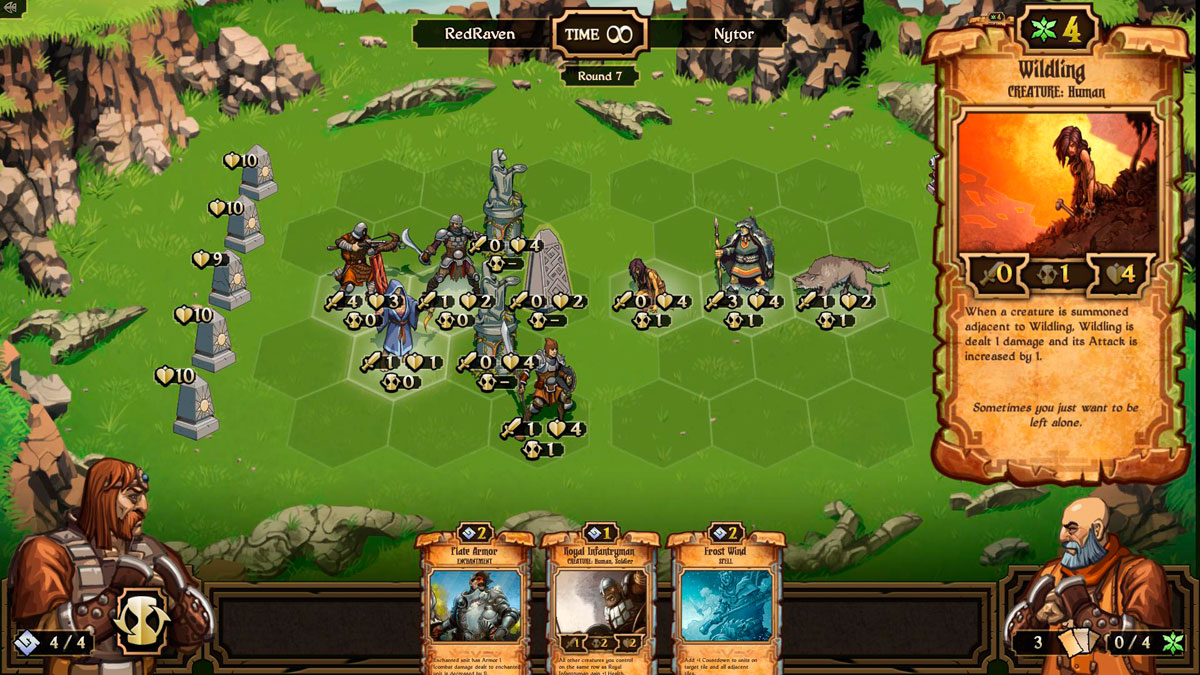
The flesh is willing, but the mind is weak.
For those who may have forgotten, Scrolls is the TCG follow-up project to Mojang’s genre-defining Minecraft. It is essentially Magic-lite with a few extra tactical considerations. Each player has five 10-HP totems at the end of five lanes, and take turns placing creatures or structures or casting spells/enchantments in an effort to reduce three of those five totems down to zero health. Creatures will attack down their lanes when their timer reaches zero, damage is persistent, and creatures can also be moved usually one “hex” each turn.
What I enjoy about Scrolls so far is its rather ingenious, nested card mechanics. At the start of the match, you draw five cards and thereafter draw one card per turn. Each turn, you have the opportunity to discard a card to increase your resources by 1 permanently (e.g. turning it into a MtG “land” essentially) or discarding a card to draw two new cards. As you can only have three copies of a given card in your deck, this immediately makes the early game exceedingly complex on a strategic level. Should you turn that high-cost card into resources now, or save it for later? Now that you’re at 5 resources, should you discard in order to draw two new cards or continue pumping up resources to allow you more options each turn? I doubt that Scrolls is the first card game to feature a system like this, but I am finding it extremely… delicious.
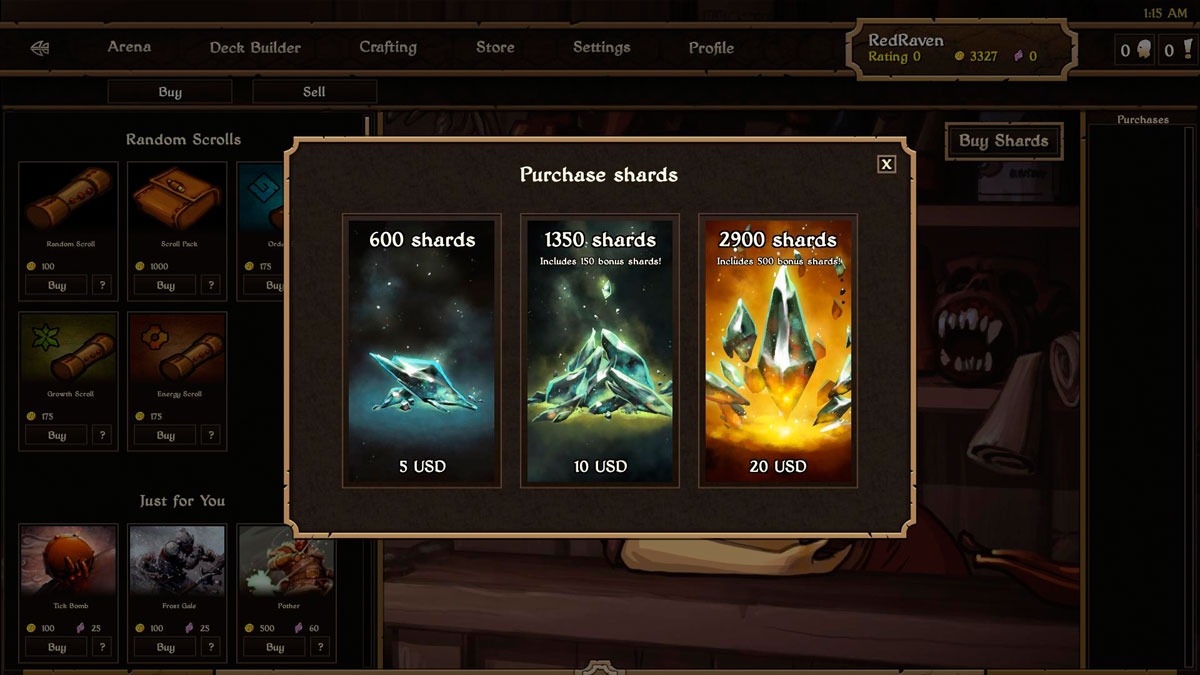
Really? That big pile of Minecraft money not good enough for you?
Now that I think about it, my mixed reaction basically comes down to the Store aspect. After you purchase the game, you unlock one of the three Starter decks to play with. Thereafter, you are stuck purchasing new cards in awkward increments using in-game gold earned from winning matches (either against AI or people). I made the unfortunate mistake of purchasing the Order deck and realizing that I don’t actually like its gameplay – a high emphasis on maneuverability and defense and so on. I am getting around ~300g for winning Trial matches (e.g. scenarios), but the other Starter decks are 6500g total. I started with 2000g, but foolishly purchased the 10-card booster packs at 1000g apiece.
So, essentially, I am stuck with a deck I don’t particularly enjoy playing while having to grind out dozens of games with no hope of actually seeing any new cards for that entire duration. Technically, I can also purchase things in the store for Shards, which is the RMT currency. However, the thought of spending more money on top of the $20 I already paid to play the game in the first place is repulsive. Scrolls is not a F2P game. Finding myself confronted with a payslope after the initial paywall is incredibly frustrating, especially with there being no way to undo the designer trap (having to choose a Starter deck with zero information) I fell into to begin with. This is a TCG, sure, but if your Starter deck isn’t fun to play, most rational people won’t be playing for long.
I am going to continue playing in the hopes that things improve, but at the moment I couldn’t really recommend Scrolls to anyone just yet.
Good Guy EA?
What. What.
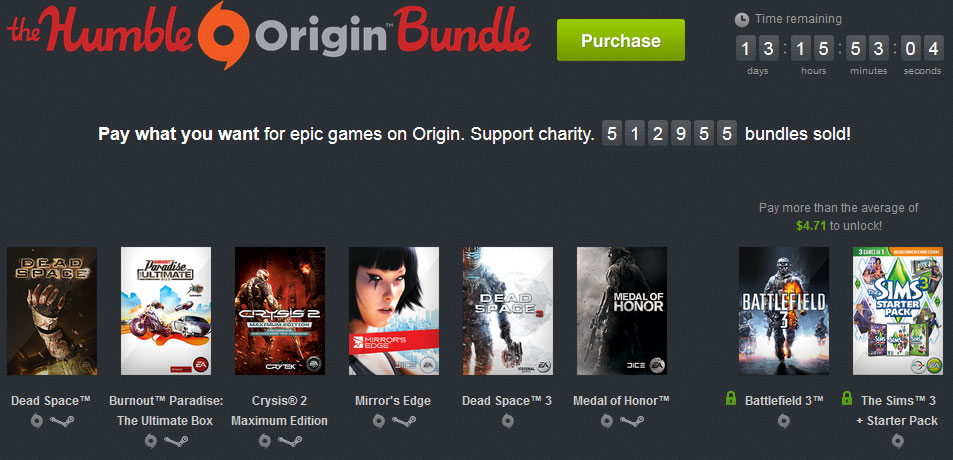
That’s like… totally worth a dollar.
Is EA about to discontinue Origin or something? Dead Space 3 for one dollar. You would be hard-pressed to find Mirror’s Edge on sale for $1, let alone a AAA (or at least BBB) game that just came out 6 months ago. And there are like six more games! Getting BF3 or Sims 3 for ~$5 is sort of a trap, considering how much important DLC is available, but good lord.
Yeah, yeah, I know EA is handing out the first hit for practically free just to rope more people into the Origin client. But then again, A) EA is giving their share of the money to charity (they aren’t even listed as an option, actually), and B) most of the games have Steam codes in addition to the Origin codes. So you could technically sell your extra codes to other people, if they couldn’t afford to purchase the bundle themselves for one dollar.
If this is somehow the new face of EA evil… well, we’re doing pretty good for ourselves.
Facepalm of the Day
I mean… is it really so crazy to imagine that after 2000+ hours playing the same class/spec that a person might just possibly want to try something different? And, you know, not have to spend the exact same (or similar) amount of hours getting that different experience to the same content you wanted to spice up in the first place? I wanted to experience a different endgame when I rolled my alts, not a different leveling/gearing experience.
Does he really think Blizzard wouldn’t bank $1 million overnight by offering paid class changes?
It just boggles my mind. One of your stated goals is to make each class and spec feel unique, and then you become baffled that people want to play more than one. I don’t get it. Is this a joke?
Review: Don’t Starve
Game: Don’t Starve
Recommended price: $10
Metacritic Score: 79
Completion Time: 20-60 hours (variable)
Buy If You Like: Roguelikes that don’t kid around, amazing indie games
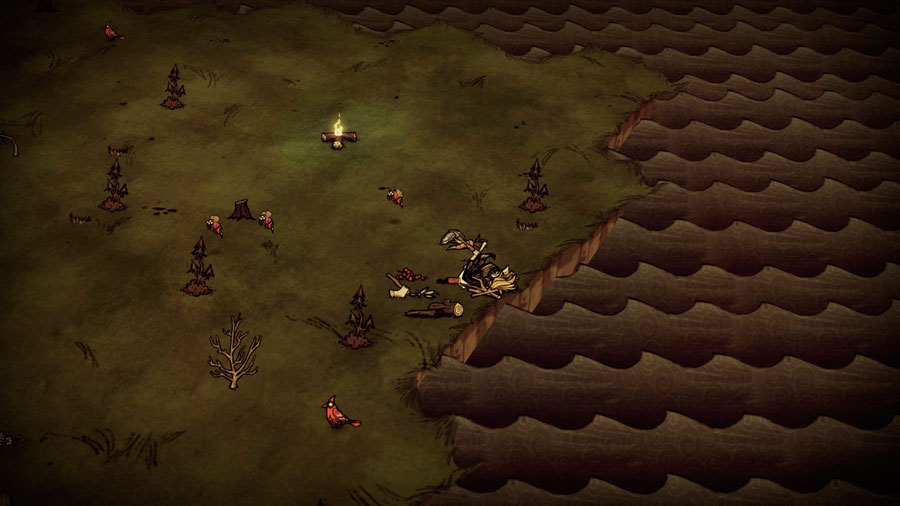
Pro tip: bees will STAB you TO DEATH
Don’t Starve is a harsh, survival indie roguelike with dark humor, a fairly unique visual style, and a pointed lack of hand-holding. You control a man named Wilson who suddenly wakes up in the wilderness, is told that finding some food before dark would be a good idea, and then… you are on your own. From there, the basic idea is to scrounge for some carrots/berries while using available materials to craft torches, tools, traps, and other basic gear as you do your best to survive in a world that wants you dead.
Moving around and interacting with the world is surprisingly easy and intuitive. You can move around via left-clicking the ground/objects or by using WASD. Interacting with objects is done either with left-click or right-click. Pressing the Spacebar will cause your character to perform some context-sensitive activity, like start chopping a tree if equiped with an axe, pick up something if it is nearby, or attack an enemy. Combat is not particularly deep, but the “shallowness” combined with the roguelike nature of the game lends a tremendous amount of gravitas to battles. It reminds me of survival horror games that have clunky combat on purpose, to ratchet up the implicit difficulty.
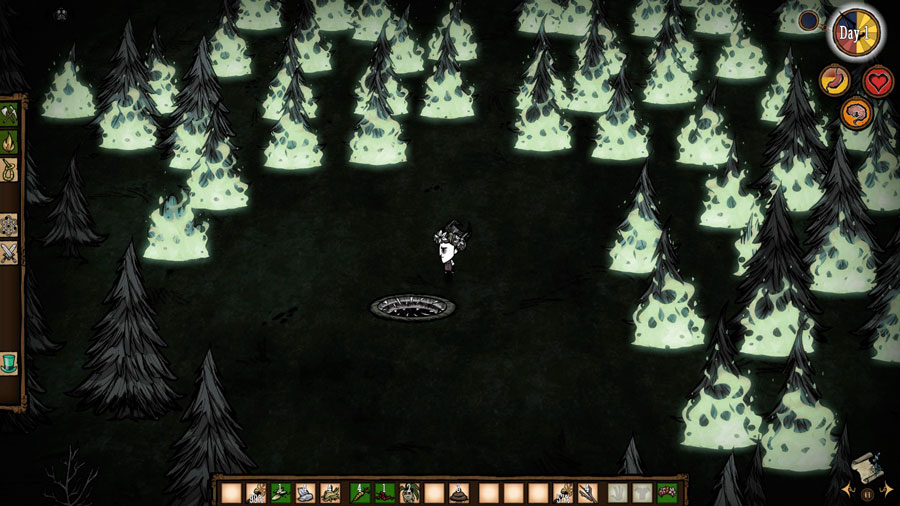
Don’t worry, I got this under control.
The default game starts you in Survival Mode, which is really more of a Sandbox mode. While there is not really an “endgame” in this mode, the game’s structure naturally (and ingeniously) lends itself to a sense of progression and escalating danger. Establishing a base camp is pretty typical and allows you to stockpile materials and research structures, making the maintenance of your Hunger, Health, and Sanity easier. On the other hand, resources generally do not regenerate very quickly, which forces you to forage farther and farther from your base camp with each passing day. And ultimately, the arrival of Winter will stretch your capacity to survive to the very limit, given how traditionally easy sources of food dry up (plants don’t grow, ponds freeze over). This is on top of an escalation of random hostile encounters by the Hounds, or other boss-level mobs.
Those in search of a more structured endgame can seek out Maxwell’s Door, a set piece randomly located somewhere on the map. Once entered, you are in Adventure Mode, tasked with surviving five randomly-determined theme worlds while collecting four Things in order to open the gate to the next world. Even if Don’t Starve consisted entirely of Adventure Mode, it would be enough to cover at least 20+ hours of gameplay. Especially given how the brutality of Survival Mode holds nothing to Adventure Mode worlds in which you are trapped in an endless Winter, or constant rain, or even a world with zero sunlight.
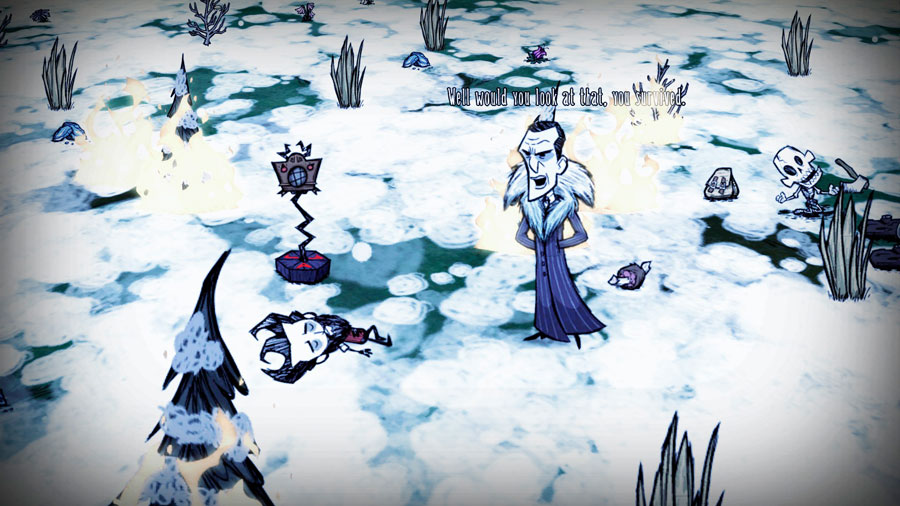
I’m pretty surprised myself, actually.
While I have been infatuated with Don’t Starve for quite some time, the game isn’t for everyone. Don’t Starve is extremely unforgiving, even in roguelike terms, where death is both easy to stumble into and results in a deletion of your save file. That said, while death is easy, it is almost always going to be due to mistakes you have made, rather than randomized deathtraps. Even if you get one-shot by a particular mob, that is only because you chose not to wear armor at the time, or because you were being reckless in not running away. Compare that to a game like The Binding of Isaac, where a white pill might randomly give a buff in one game and permanently reduce health in another.
If you are someone willing to play and lose dozens of hours of progress in a roguelike though (or cheese the system via console commands or making backup save copies), I cannot recommend Don’t Starve enough. It has style, it has substance, and it is receiving developer updates every 3 weeks (at the moment). It is simple to get into, impressively complex when you start planning ahead, and always engaging while you struggle to survive.
 In An Age
The Limits of Procedure
Aug 12
Posted by Azuriel
In a recent post, Tobold says:
Two paragraphs later though, he sort of undermines his own argument a bit (emphasis mine):
Er… if players cannot possibly make the mobs extinct, what’s the point in having an “ecosystem” in the first place?
But, never mind that. What I really wanted to talk about is the Minecraft bit. Because sometimes I get the feeling that “procedurally-generated” as a concept is being elevated as some paragon virtue of game design – a silver-bullet to boredom – when it is really nothing of the sort.
A procedurally-generated game solves exactly one problem: metagaming. That is not quite the correct word I want to use though, as you can still technically metagame a procedurally-generated world in several ways. Namely, by knowing its procedures. For example, no matter what Minecraft world is created (mods aside), diamond only spawns in layer 19 and below. Indeed, there is a whole bunch of Minecraft constants to consider (accurate circa 2010 anyway). All the Minecraft map being procedurally-generated does is prevent you from following a guide telling you to move North a hundred steps and then walk East to find a nice batch of Iron Ore near the surface. Avoiding those scenarios is certainly useful, and it’s always fun running into the truly bizarre and whimsical creations of the RNG gods.
The problem arises in treating the procedurally-generated whatever as “endless content,” when it is really not anything of the sort. As I talked about before, your knowledge of a game’s systems really only ever increases as you play; novelty has diminishing returns within the same game. Each Minecraft world generated may be completely different, but you are going to be doing the same sort of things each time: punch wood, make tools, make structure, dig for ore, etc. Different starting locations and details can spice up the gameplay for a time, but your “build order” is unlikely to change much no matter where you are.
Procedurally-generated content definitely has a place in gaming, usually in the context of roguelikes, but it will not solve any of EQN or any other MMO’s problems. Not that its application in MMOs made much sense in the first place – one of the defining characteristics of an MMO is a persistent world, which is incongruent with procedural generation. Even if it was just one world of infinite size (expanding at the edges), the amount of space surrounding objects of player interest would remain finite. And that’s assuming players would be willing to trudge out very far from their starting location in the first place.
No, just adding more space isn’t going to solve the issue. If anyone claims that an MMO’s world cannot be too big, simply point them at any given low-pop server of any game anywhere.
Posted in Commentary
10 Comments
Tags: Build Order, Diminishing Returns, EQN, Novelty, procedurally-generated, Tobold