A Good Problem to Have, I Suppose
Basically this:
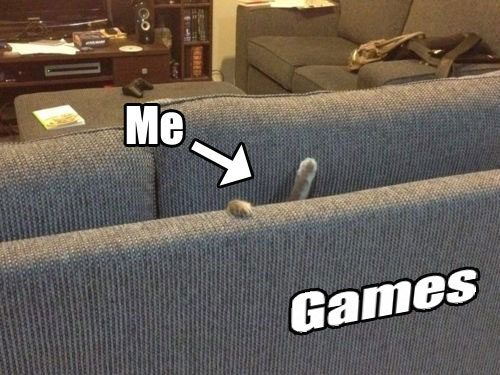
I have a problem.
The games on my plate at the moment:
- Tribes: Ascend
- Battlefield 3
- Diablo 3 (just purchased)
- Darksiders
- Greed Corp
- plus about 6-8 other Steam purchases
Since I had already spent D3’s launch date at the beach, I was toying with the idea of waiting for a Dealzon deal to pop up before throwing down. However, most of the old WoW crew are already into Nightmare and there gets to be a point beyond which we may as well be playing two different games. Sure, they could roll alts or bring their mains in to one-shot everything, but… yeah. It is just not the same.
As someone who prefers playing one game exclusively until completion and then washing my hands of it, my present situation is quite vexing. I keep thinking that this is a better problem than the opposite: ala my SNES childhood days in which I wrung Zelda: A Link to the Past dry with 30+ run-throughs because new games only existed on Christmas, Easter, and my birthday. Then again, given the trends I outlined in my last post, I have little doubt that enough gaming entertainment exists right now to last the rest of my lifetime.
And, oh hey, the Thief trilogy is on sale. Let me just compulsively buy that like the little digital hoarder I am. There, stacked up neatly next to the four untouched Splinter Cell games and seventeen copies of the morning edition of the 1971 New York Times newspaper.
One day at a time. One day at a time.
Revisiting Single-Player MMOs
Keen has a post up entitled “MMORPGs are not Single-player Games,” which laments the direction MMOs are heading as evidenced by The Elder Scrolls Online having a 100% solo “main story.” I am not particularly interested in talking about TESO, but rather this paragraph (emphasis mine):
If it’s so important to your game that the player be the hero in the story, why are you making a MMO? MMO’s suck at being single-player games. Did you skip SWTOR? What makes MMO’s any good at all are the multiplayer elements. Take those away and what are you left with? A game worse than the one you could have made if you actually made a single-player RPG.
Well… do MMOs suck at being single-player games?
It may be easy to answer in the affirmative, and in some respects I would agree. Undoubtedly there are concessions made in an MMO that are irrelevant in a single-player RPG. Daily quests, for example, exist as “content” to get people to log on at regular intervals and maintain social ties. The related notion of paced content (i.e. weekly resets) is also an MMO staple that makes no particular single-player sense. Even normal quests are likely more generic (and numerous) than they would have to be.
But in a very real sense I consider the average MMORPG these days as a much better single-player game than the average RPG. There are two main reasons why.
1) The gameplay is often more satisfying, for longer.
The example I used in Keen’s comment section was The Witcher. Here is a 3rd-person action-RPG game with hotbars and talents and exploration and quests and so on. Basically, a mini-MMO, if you will. As I detailed in my review, The Witcher’s combat system is terrible. Way worse than even Warhammer Online’s janky PvE gameplay. While I considered the storyline/setting to be somewhat of a redeeming factor, it could very well be that something like The Secret World or World of Darkness (assuming that is still a thing) or some other MMO eclipses it even within its own specific niche.
I would never agree with someone who would suggest that stories in RPGs are irrelevant, but let us be honest here: most of your RPG hours are spent in combat. RPGs don’t necessarily need gameplay deep enough to last 1000 hours because the story runs out in 40-100 hours, of course. But there is nothing worse than getting stranded 2/3rds of the way through an otherwise good story with gameplay that has ran out of steam. MMO combat systems, even the ones that feel “off,” convey a depth far beyond the average RPG. They have to.
Keen responded with “length isn’t related to quality,” which is true enough in a general sense. After a while though, one must admit that voluntarily playing the same game for 1000+ hours is perhaps indicative that fun is being had. I would not trade Xenogears’ 80 hours for WoW’s 7800 hours, or for the rest of my Top 10 RPGs for that matter. But for the Top #11-#120?
Absolutely.
2) Show & Tell enhances the single-player experience.
I truly believe that Show & Tell is the future of single-player gaming. If you are not familiar with the concept as I use it, this quote (from a year ago) sums it up:
In this light, I do not particularly think the trend of companion AI or whatever is necessarily bad. Having played Minecraft for a while now, I have reached that plateau where you want nothing more than to show off the cool biodome tower you built or the Pit of Doom you dug or the cross-Atlantic powered railroad to someone, anyone else capable of appreciating the amount of effort/vision it took to do so. Of course, the thought of trying to do what I have done on a multiplayer server where anyone could wreck my house and steal my materials at any time is mortifying. I want a Show & Tell, not a group assignment. I want a single-player MMO.
Repetition is required for communities – people are more asocial in LFD precisely because you aren’t going to see anyone again (unless you have a ranking system, of course). We can, however, condense the process via Show & Tell. What this means in a general sense is instead of blooming into a flower in front of others over time, you do hours and hours of blooming beforehand and invite others into your garden. […]
But that’s just it: players generally have a preternatural desire to express themselves any way they can. Player housing would not be about having somewhere to chill out waiting for a LFD queue, or even arranging your trophies and armor sets in aesthetically pleasing ways. It would be about designing and decorating a virtual space for others to look at. You already know the meaning behind that piece of gear that’s been sitting in your bank for the last four years. Other people don’t know, and deep down I believe it is a common human desire for said object or achievement to be recognized and acknowledged as something meaningful.
Show & Tell can be (and has been) implemented in bad ways. I am not a huge fan of arbitrary Achievements, for example, and I think focusing on the latest gear rewards is a bit crass. Transmog and costume options, on the other hand, are much better. Being able to invite you in to see my living room skull pit in Skyrim?
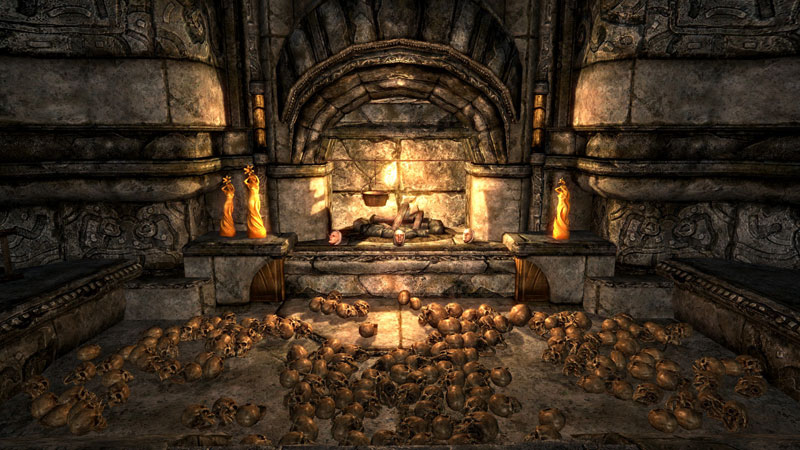
166 Human skulls. All legitimately obtained, I might add.
Would have been epic. The mere possibility of being able to eventually post the above screenshot, and having someone able to appreciate it on some level somewhere, generated dozens of hours of additional gameplay. In a single-player game. MMOs generate gameplay in this fashion all the time, of course, and I am here to confirm that it works for single-player games too. And, by extension, MMOs that are played as single-player games.
______
So getting back to the question at the top, I say: MMOs can (and often do) make excellent single-player games.
Keen openly wondered why this “mystery demographic” is getting catered to by MMO developers at the expense of “MMO identity.” I would say: where is the mystery? The vast majority of MMO players today are single-player MMO, erm, players. Less than 20% of WoW players raid; what are the other 80% doing? How many EVE players never make it out of high-sec space or never engage in consensual PvP? When you look at graphs like this:
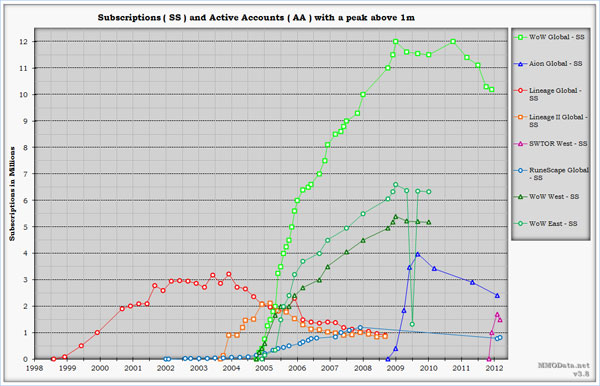
This technically qualifies as a Rorschach test in six states and the District of Columbia.
…what do you see? Did 5+ million social MMO players crawl out of the woodwork in a single year? I don’t think so. Rather, Blizzard tapped into the latent single-player market by letting said players solo at their own pace all the way to the level cap. That was Blizzard’s biggest innovation.
Are social players more valuable to the long-term success of MMOs? Absolutely. Can studios focus exclusively on such players, ala Darkfall etc? Of course. But in so doing they leave literally millions of dollars on the table. And so the reason we see a “dilution” in the MMO identity is precisely because developers are seeking out the most profitable piece of that Venn Diagram – the intersection of single-player and MMO – by trial and error writ large.
The age of single-player MMOs has arrived. And for the majority of gamers, this is good news.
Reviews: Sequence, DE:HR – Missing Link DLC, Dawn of War II – Retribution
Game: Sequence
Recommended price: $2.50
Metacritic Score: 70
Completion Time: ~11 hours
Buy If You Like: Playing DDR on your keyboard… with RPG elements
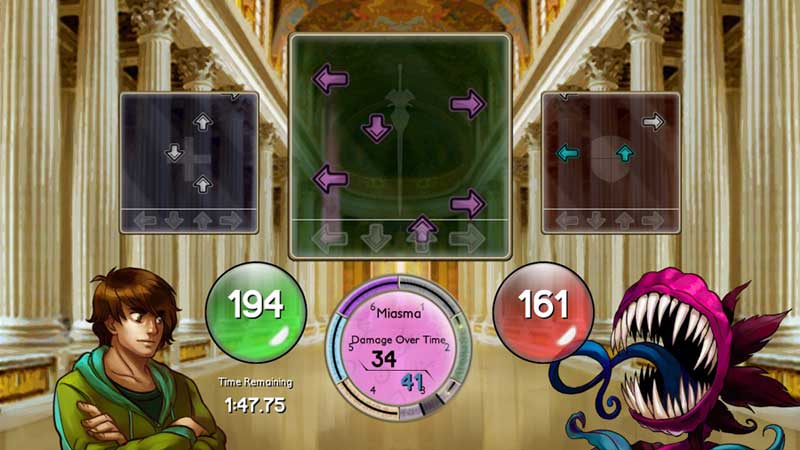
It’s actually a bit more fun than it looks.
Sequence is definitely one of those “out there” indie games in which the initial concept sounds unappealing, and yet the game is mostly redeemable fun. The premise is that the main character is abducted into the bottom level of a tower, and he must fight his way to the top by crafting keys from the dropped loot of monsters killed by three-panel DDR rhythm battles. The three panels correspond to Spells which you cast to heal/buff yourself, or damage/debuff the monster; a Mana panel which just constantly flows with arrows, with each successful arrow refunding 2 MP for use with Spells; and an Attack panel which represents arrows you need to match, or suffer damage. You lose the battle by either running out of HP before killing your opponent, or if you run out of time. Successful battles gives you XP and item drops, the latter of which can either be equipped right away or combined via “Synthing” into usable items, new spells, or the keys to unlock new floors.
I had a healthy level of skepticism coming in as to how a rhythm game would feel being played on a keyboard, but I can tell you now that Sequence handles itself rather well. I used WASD for the arrows, Q/E to rotate the three different panels, and 1-6 as the Spell buttons. Just like any good rhythm game, there is a decent variety of songs with differing tempos and general arrow densities. The RPG elements of the game also do a decent enough job at making sure you aren’t bored out of your mind in fighting the same enemies over and over again (only 3 different monster types per floor). There is definitely some possible frustration though, insofar as the item drops you need might have a 20% chance and then you end up grinding the same monster 11 times in a row. Also, learning some of the later Spells requires you to achieve a 95% accuracy in a 5 minute song or get 120-note combos (e.g. no mistakes), with failure resulting in losing a ton of XP (since you spend XP to get a chance to learn a new Spell).
Overall though, I had a decent enough time with a fairly unique indie game. I have heard some other reviewers complain about the irreverent storyline filled with pop-culture references, but I enjoyed it. And while my recommended price is $2.50 (which I bought it at during a sale), the default Steam price is just $5. Sequence isn’t necessarily a must-play game at $5, but it definitely will add value to whatever indie bundle it ends up getting attached to in the future.
_____________
Game: Deus Ex: Human Revolution – Missing Link (DLC)
Recommended price: <$5
Metacritic Score: 73
Completion Time: ~4 hours
Buy If You Like: Four extra hours of DE:HR
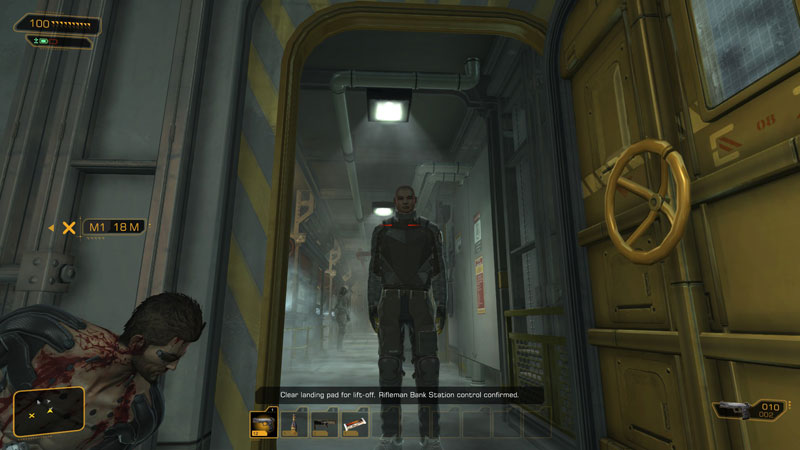
Oh, how I missed this.
To be honest, the Missing Link DLC to Deus Ex: Human Revolution was one of the first DLCs I have ever played which felt like a legitimate “deleted scene” from the main game. This is both a good and bad thing. Good in that it feels like a relatively seamless addition despite being on its own 2gb installer and featuring the vastly overused (gaming) trope of the hero losing all of his/her powers. Bad in that, well, most deleted scenes are deleted for a reason.
Taking place in the midst of a fade-to-black scene change in the middle of the original game, Missing Link does not add anything of plot value to the game proper aside from, well, around four more hours of gameplay. While you end up getting access to most of the weapons/augments from the main game, I definitely experienced a mental disconnect between the choices I was making, knowing that none of it mattered since no data was going to be transferred. Want to explore every nook and cranny? Okay… but why? No data, no XP, no weapons, no credits, nothing will endure past the final encounter.
Which, incidentally, takes the form of how all the boss battles in Human Revolution should have played out. I was actually kind of surprised when I discovered that I had inadvertently killed the last boss, thinking it was just another dude shooting at me.
Aside from that, and a frustrating amount of pointless backtracking past a 20-30 second in-game “loading screen,” Missing Link is a good enough dessert to the main course that was the original game. Provided, of course, you can snag it for less than the outrageous $15 retail price. Less than $5 or included in a Game of the Year edition would be ideal.
_____________
Game: Warhammer 40k: Dawn of War II – Retribution
Recommended price: $0/bundle
Metacritic Score: 80
Completion Time: ~11 hours+
Buy If You Like: Dawn of War II, RTS games minus the resources/base management
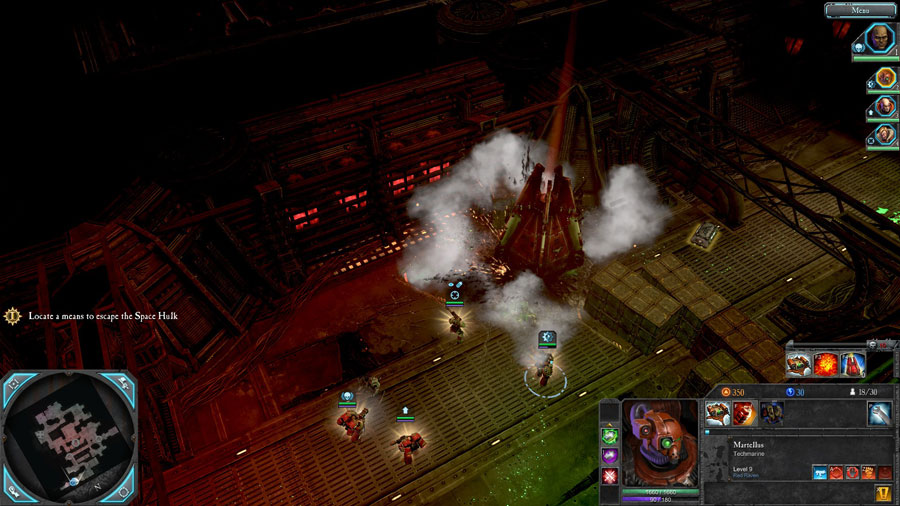
Drop pods while inside another ship probably makes more sense than the rest of the game.
In the interest of fairness, I absolutely despise the direction the Dawn of War series took when it dropped the base-building and resource management arms of the RTS genre into Dawn of War II. The original Dawn of War was a groundbreaking work of beauty – to this day, almost all other RTS games feature infantry units as little squads, so they can be shown to be killed individually by vehicle units. I played DoW: Dark Crusade for something ridiculous like 200+ hours. Dawn of War II was fine on its own, and DoWII: Chaos Rising was alright. But as I headed into this particular installment, I began to tire of the 4-5 squad “tactical” gameplay that ends up feeling like a WoWVille iPhone app.
As I understand it, there are six “campaigns” in Retribution, but after completing the Space Marines, it appeared as though every other race uses the exact same scripted maps in the same exact order with perhaps a slight difference in the faction you are fighting. For example, at the end of the first map as Imperial Guard you fight a Tyranid hero; at the end of the map as Tyranid, you fight an Imperial Guard hero. While each race has access to different units and general fighting styles, the heavy emphasis on terrain “tricks” (shoot these barrels, take cover here, approach the turrets from behind, etc) means each map plays out identically no matter what you play as. Technically the same could be said about, say, Dark Crusade, but the difference is that a resource/base-focused RTS at least can play out much differently each time.
While many people dismiss the importance of story in Warhammer 40k’s grimdark setting, I genuinely enjoy that sort of thing. And here again, unfortunately, Retribution fails to deliver. While it wraps up the Blood Raven arc (hopefully for good), it lacks any of the subtlety of even Chaos Rising, let alone Dawn of War II. I can only imagine it was so truncated specifically because they felt it necessary to shoehorn all six races into the same story on the same maps in the same order. Even if there are redeeming plot points in the final chapters of the other races’ stories (which I doubt), I am thoroughly unable to bring myself to slog through the game again to reach them.
I just hope against hope that Dawn of War 3 is more like 1 and not 2.
Photo Limbo: Japan Jobs
While my attempt at gainful employment in Japan via the JET Program didn’t pan out, I did spend some time browsing some other openings. One of the practically universal requirements is for you to already live in Japan, which requires a work visa, which requires you to already have a job before coming over, which is a Catch-22 so perfect that Joseph Heller filed a posthumous injunction.
That did not stop me from dreaming though:

I sometimes forget that Mongolia is still a real place.

I obviously picked the wrong career path. And, presumably, gender.
Finally, I was legitimately saddened by this last one:

I’d still do it.
See you Monday.
Black Market AH

Yes, please.
So the lede here is that Blizzard may be introducing a “Black Market” AH into Mists that is capable of selling, say, the Ashes of Al’ar. We can have the discussion as to whether that devalues the 0.13% mount or not in a moment. What I am more interested right now is in the very notion that:
- These mounts (etc) potentially becoming BoE or otherwise Bind on Use.
- This being a brilliant money-sink into a rapidly inflationary economy.
- Blizzard getting into the business of selling in-game items with in-game currency.
That last point may seem odd (vendors have been around since Day 1), but what I mean is not necessarily the selling of the Ashes of Al’ar, but of any of the mounts/items that otherwise are only obtainable by grueling hours /played.
The initial reaction may be to say that this is counter-intuitive; by definition, what Blizzard is doing is making these items easier to obtain, which not only reduces their scarcity, but allows players to actually eat the carrot. In the long view, players actually accomplishing their goals is bad for business. As the classical argument goes, the Black Market AH should be the equivalent of cheat codes, which hollows out the enjoyment that comes from restrictions and limitations – an infinite life Super Mario Bros is a less fun Super Mario Bros.
However, I must ask this: is a Konami Code-less Contra a less fun Contra?
If you don’t know what I’m talking about, get off my lawn.
Nethaera on the Blizzard forums mentions:
It’s worth noting that since we’re in beta, we’re still looking into what our philosophies are for what should and what shouldn’t be on the Black Market. We’re also trying to discern the frequency/rarity of what shows up there as well.
So perhaps we will not ultimately see the Ashes of Al’ar on the Black Market after all.
But… why shouldn’t we? I brought up Contra because, as anyone who attempted to actually play the game without the Konami Code can attest, the game was stupidly difficult to beat within the default number of lives. So much so, that I imagine few would even try without the Konami Code. Thus, the Konami “cheat code” probably generated more enjoyment in the aggregate than was lost from “bypassing” the difficulty.
In other words, while the “legitimate” owners of Al’ar or the TCG items or whatever Blizzard ends up selling on the Black Market do “lose” something of value (scarcity), I believe the incremental gain by everyone else results in a net positive. Obviously, the average player doesn’t have the 200,000g+ that it will require to actually obtain these items, but they couldn’t get a group together to farm Kael’thas either. What the average player can do is farm herbs or run dailies and otherwise set X amount of gold as a goal to reach in the pursuit of Al’ar; something that was largely unobtainable before, but now has a “reasonable” path towards.
Will these undoubtedly obscene prices encourage gold-sellers? Maybe, maybe not. Just keep in mind that unlike the sale of BoE raiding epics – whose prices already can encourage gold selling – the final gold price of Black Market items are removed from the economy permanently, regardless of whether they can be resold or are BoP from the mailbox. Any reduction in inflation is a net positive for everyone.
So, I say: bring it on. And not just because I have oodles of gold with nothing else to buy.
P.S. The Daily Blink has the right idea:
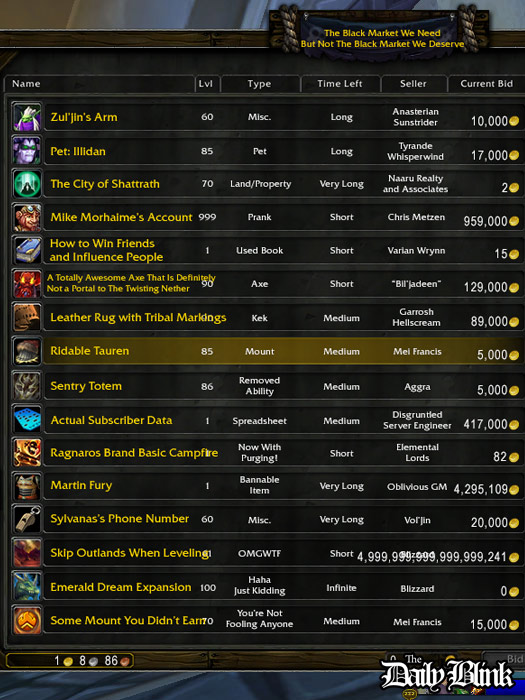
WTB that Actual Subscriber Data.
D3-Day
As you slaughter more skeletons and zombies than should technically exist based on historical human population levels, remember this:
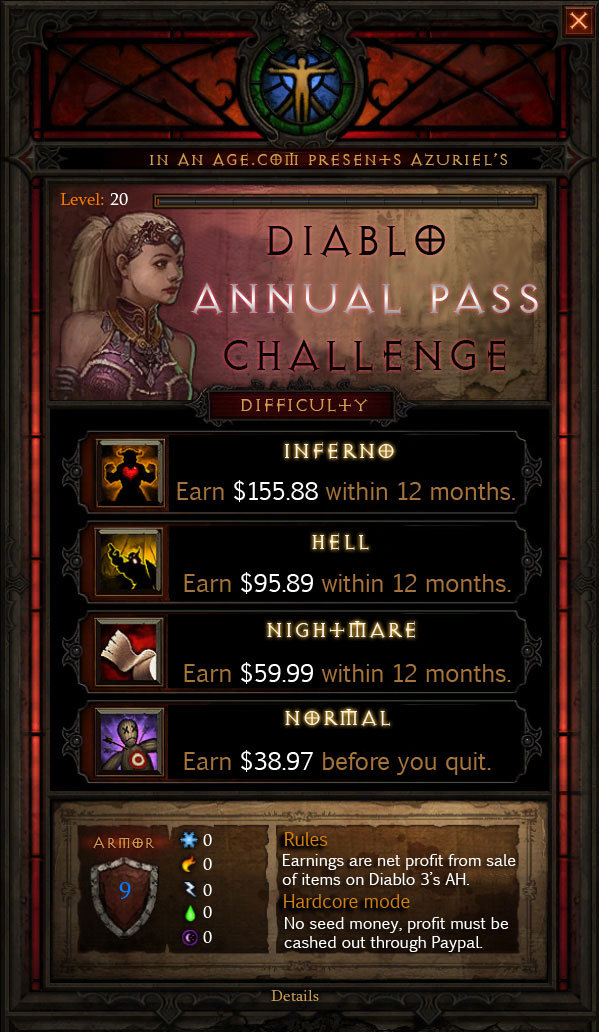
Bam!
I never ended up pulling the trigger on the Annual Pass, and the RMAH fees Blizzard settled on are completely ridiculous, but hey. Give it the old college try, and let’s see what happens.
Photo Limbo: GW2
I take a lot of screenshots when playing games, and most are deleted. Of the ones that survive, a few end up being Photoshopped and added into posts. The remainder? Consigned to Photo Limbo. Until now that I need some filler while on vacation…
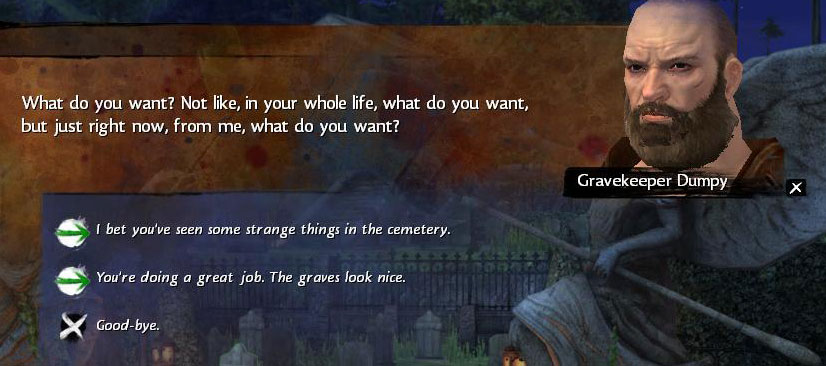
Oh Gravekeeper Dumpy, never change.

Start’em young.

Better reserve XxArthasDKlolxX while you can.
Speaking of names, “Azuriel” and about 15 semi-random variations were taken when I was playing the beta. As you can see here, the secret is that GW2 allows spaces. While other games have done this before (including GW1, I believe), let me reiterate how awesome that is. Clearly it can be abused, but it’s nice to be able to actually take the name you want by simply adding a last name to your character.
And finally:

Is it hot in here, or is it just me?
This is why I don’t make male characters.
Quick & Dirty Guide to ME3 Multiplayer
There are a couple of things going on.
First, I removed the Currently page and turned it into a sidebar item instead. Time will tell if I actually update it with any more regularity than I did with the original page, but I’ll jump off that bridge when I come to it. In the meantime, it is accurate.
Second, I have a new menu page entitled Design. The only item in there currently is my Quick & Dirty Guide to Mass Effect 3 Multiplayer. I thought about posting it in its entirety here, but the idea is that the guide itself is going to be a permanent resource that can and will be updated occasionally. Indeed, when I started writing it in the weeks after ME3’s release, the goal was to send it off to GameFAQs as there were no similar resources at the time. Unfortunately, someone beat me to the punch, so who knows whether it will be accepted there now. The goal for the guide itself is to be something I wish I had available when I first started playing the game. If that interests you, check it out.
In any event, the Design page will eventually be home to other projects I have been working on that I want to be able to upload in a semi-permanent location. Most will be game-related, but some may not be. Unlike these blog posts, I will not be vouching for their peerless quality and relevancy to your daily lives.
Finally, I am going on vacation for a week, starting tomorrow. It is unfortunate that I shall miss the launch day of Diablo 3 in the process, but I will try and trooper on from the condo’s 2nd-floor beachfront balcony. I may schedule some posts ahead of time for you to read, or you may have to waste away the hours of my absence by forlornly browsing the archives. Either way, it shall be full steam ahead starting back on the 21st.
SWTOR Drops an EVE in Size
In other words, SWTOR lost 400,000 subscriptions in the last three months:
Star Wars: The Old Republichas dropped from 1.7 million active subscribers to 1.3 million, publisher Electronic Arts said today in an earnings statement.
That’s a loss of nearly 25% for the massively multiplayer online role-playing game, or 400,000 subscribers. […]
Update: In a conference call this afternoon, EA said the decrease was indeed due to “casual and trial players” cycling out of the game.
It is worth noting, of course, that the 1.3 million current subscribers is circa March 31st; things may have stabilized or gotten worse sense then.
Remember the whole brouhaha concerning the free month of game time given to Bioware’s “most valued players?” That took place two weeks into April. So while that may still have been a cynical move to prop up subscription numbers, we can be reasonably certain that the 1.3 million figure is not being finessed by anything (the 1.7 million figure at the beginning of the year had some vague language).
I’m not sure I’m going to follow SWTOR with the same level of attention I give to WoW’s subscription/raiding numbers, but for some future reference, here is an Xfire screenshot:
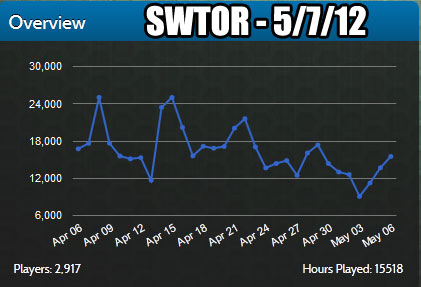
I… guess that’s a downward trend?
I personally don’t like using Xfire as a metric – the sample of players here are playing SWTOR for 5.3 hours at a time if I’m reading that right, and I’d assume even happily subbed players play less over time – but there you go. Damning evidence of EAware’s hubris and impending downfall, or signs of a much healthier MMO than most releases have achieved in the last few years. Obviously 400k is nothing to sneeze at, but 1.3 million is much better than analyst predictions of 800k.
Spin that narrative however you please.
Out of Game
You may or may not have been following the Gevlon + Rohan argument about whether PLEX-selling – that is purchasing a RMT item that confers 30 days of game time in exchange for in-game currency – constitutes cheating in EVE, or is “unfair,” or skipping content, or is ruining the simulation, etc. It has been a fascinating series of posts precisely because I find it almost impossible to relate to their worldview at all. Parts of the argument have the contours of unassailable logic; see Rohan’s near prose when it comes to inconveniences. And yet some part of my mind reels backwards each time I get too close to accepting their premises.
So, let us back up a bit: what constitutes out-of-game resources/thinking?
I still think PLEX is unfair. All the arguments for PLEX have sidestepped the basic unfairness issue, and pointed to the good effects that PLEX has. But at it’s heart, Eve permits one faction of players to skip content for real money, but does not do the same for other players. It weakens the fidelity of the economic simulation that is Eve Online. […]
PLEX is like the designated hitter rule in baseball, or shootouts in hockey. It’s legal, it’s in the rule book. It’s popular, the crowds enjoy it. It might even be necessary for the continued health of the game. But baseball without the designated hitter is a purer form of baseball, as is hockey sans shootouts.
See what I mean about contours of unassailable logic? PLEX can exist within the game, in your cargo hold or on the AH, but it is not of the game, so to speak. You cannot be mining an asteroid and a PLEX fall out; you cannot assemble a PLEX from a blueprint. Every PLEX that exists came into being from a cash transaction outside of the game. In a very real way, it is a breaking of the 4th wall. Rohan is essentially correct.
…and yet, I cannot shake the nagging feeling of the arbitrary.
Across the main post and comments, Gevlon says:
You can only skip grind. If you skip competitive elements, you are cheating. Skipping any competitive element is cheating. Otherwise you are on the slippery slope of “I just skip one more element” until the point of you skip it all and buy a pilot with top killboard stats and peacock around without actually killing anyting yourself. That’s not against the ToS either. […]
@Ephemeron: true that for most people getting E15 is probably just as long as solo mining 500M ISK but it’s an out-of-game skill. Again, if we accept this, the conclusion is “the best way of winning EVE is being good in RL money making”
@Azuriel: you are an inch from being banned from here for being an idiot.
The second account ship obeys the same rules as the first. With 2 hulks you can mine twice as fast, true. But can lose two times more ISK to a ganker.
Real life money is real life money. Buying things in real life with it is normal. Having lot of money is winning RL. But a game is separated from RL for a reason. Buying an EVE-ship by having RL money is just as bizzare as buying a car from ISK.
Putting aside the unfounded belief in the objectiveness of sandbox competition, I see the contours in this argument as well. The ISK from the sale of the PLEX cannot be affected by anything Gevlon does; the credit card which creates the PLEX cannot be ganked, unlike the ship earning 500m ISK mining Veldspar.
But let us go back to our question: what constitutes out-of-game resources/thinking?
Where things break down for me, in both arguments, is when it comes to the arbitrary natures of the distinctions being made. Gevlon, for example, is perfectly fine with multi-boxing. He himself has three accounts running so as to have three separate characters gaining skill points… in an apparently competitive game. But at what point did a second and third account not count as buying advantage using real-life money? Those additional accounts are supporting the primary one: his original “competitive goal” of buying and piloting a Titan is only becoming a quicker reality due to the additional skill point paths he is paying a premium for. Using just one account, his goal would be months (if not years) farther off, as he cannot train Trading and Combat skills at the same time.
I find Rohan’s argument similarly arbitrary. What makes PLEX so especially odious and disrupting? The nakedness of purchasing it from CCP? Consider for a moment other out-of-game transactions. Does multiboxing reduce the fidelity of the economic simulation? Although both of your spaceships exist in the “pure” game world, the reality is that you are paying for an advantage over those with one account. A normal player cannot be in two places simultaneously, nor specializing in two separate skills, nor being able to jump around and trade on six different stations. And let us not pretend opening a 2nd account is any less naked than PLEX.
For the moment though, let us assume that multiboxing is fine.
Is it fine to accept ISK from a friend whom also plays the game? Is the competitiveness of the game intact, should he simply pay for all of your ship fittings and cover all of your losses? Does that constitute out-of-game? Let us even assume he received all of his ISK “legitimately.”
Suppose that instead of simply gifting you the ISK, your friend grants it as payment for letting him copy your homework. Or for driving him to the airport. Out-of-game? What if you offered to pay his EVE subscription for a month, in return for 500m ISK? Your friend still risked his ship getting ganked, still had to undercut Gevlon’s Veldspar by .01 ISK on the AH, and so on.
Rohan and Gevlon’s arguments have such shapely contours because they imitate the elegance of Plato’s Forms: the “pure” EVE is such, and self-contained. But it’s not. Other people exist, and the relationships can cross over between in-game and out-of-game. Ever play Monopoly? You may not have been able to buy Boardwalk by slipping the Banker a real $20 bill, but in the last game I played every single one of us brought in out-of-game resources in the form of favors, grudges, and so on. I gave my friend Andreas a railroad essentially out of spite; he had done nothing in-game to warrant such a one-sided transaction, but I was tired of Aaron winning all the time.
Point being, I can understand how PLEX appears as an “obvious” case of Pay-To-Win (assuming you subscribe to the notion of ISK = winning)… but I see no rational reason to draw such otherwise arbitrary distinctions. Using a Vent or Mumble server to coordinate attacks is an out-of-game maneuver. So is helping a friend with ISK, either freely or for services rendered. I would even argue that reading gaming blogs and Wikis and other 3rd party websites are absolutely out-of-game resources regardless of whether you can open up a browser in-game or not.
Where is the clearly delineated line? Does it start at the cash shop, or at the relationships you bring to the game? Is there one at all?
 In An Age